Mann, Mitsui, Bcswick, and Harmoni (1994) reported a study in which Australian and Japanese children's perceptions of interpersonal rules were compared. In this article, a secondary analysis of Mann et al.'s data was conducted with three-mode principal component analysis to examine both common and culture-specific patterns of interper-sonal rules, which were only touched on in the earlier study. A large cultural similarity across samples was found with social status and social distance as the major dimensions that structure children's social world. The sizable cross-cultural differences could be understood as deviations from the common structure Some of these deviations arc explicable in terms of the general variables of individualism and collectivism.
RULES IN CONTEXT
A Three-Mode Principal Component Analysis
of Mann et al.'s Data on Cross-Cultural
Differences in Respect for Others
PIETER M. KROONENBERG
Leiden University. The Netherlands
YOSHIHISA KASHIMA
La Trobe University, Melbourne, Australia
Mann, Mitsui, Beswick, and Harmoni (1994) recently reported a well-conducted study in which Australian and Japanese children's perceptions of interpersonal rules were compared. They have uncovered a result that count-ers the well-established stereotype about Japanese children being respectful to people. In fact, relative to their Australian counterparts, the Japanese children in their study showed less respect to various target people ranging from father and mother (in-group) to adults and children in neighborhood (out-group).
Intriguing as the results may be, we contend that Mann et al.'s data can be explored in more detail to reveal both common and culture-specific patterns of interpersonal rules. Specifically, we believe interpersonal rules can be
AUTHORS'NOT!;: Send requests for reprints lo P M Krooncnherg, Deparlmenl of Education, Leiden University. Wasscnaarseweg 52. 2.133 AK Leiden. The Netherlands. The authorship of this article was equally shared by both authors The first author was partially supported by a grant from the Netherlands Organization for Scientific Research.
JOURNAL OF CROSS-CULTURAL PSYCHOLOGY, Vol. 28 No. 4. July 1997 463-480 O 1997 Western Washington University
examined explicitly as the conjunction of an act (e.g., offer to help if you see someone carrying a heavy box) and a context, which is typically defined by the target person to whom the act is directed. In agreement with Poortinga (1992), we believe we may gain more insight into culture by conducting a more contextualized analysis of human action. This is because it is in the pattern of acts performed in different contexts that gives a signature of a culture. Take bowing as an example. The act of bowing exists in both England and Japan. However, in Japan, this act may be performed in many contexts (e.g., to a guest, a neighbor), whereas in England, this may be appropriate only in the presence of the Crown.
Mann et al. clearly embraced this idea in their design of the study: They factorially combined six specific target persons and seven specific acts. Therefore, in the Act x Target matrix, there were 42 rules in context. Yet, due to a lack of methodological technology, the information contained in this Act x Target matrix was not fully addressed in Mann et al.'s analysis. We report in this article a secondary analysis of Mann et al.'s data that does justice to their original design. The structure contained in the Target x Act matrix will be examined using two-mode and three-mode principal component analysis (PCA) (e.g., Kroonenberg, 1983b).
MANN et al.'S (1994) STUDY
Krooncnhcrg. Kashima / RULES IN CONTEXT 465
Target were within-subjects factors. The questionnaires were administered in a counterbalanced way.
Mann et al. then summed the subjects' responses across different acts, and computed the composite score of respect shown to each target. Their report primarily focuses on the result of a mixed-design analysis of variance (Culture x Format x Target), treating the composite respect score as the dependent variable. They reported two main classes of findings. First, there was a main effect of Culture: The Japanese children showed less respect to others than the Australian children. In addition, a Culture x Target interaction effect showed that the difference between the amount of respect shown to parents and teachers relative to friends and peers was more pronounced in the Japanese than in the Australian children. Second, although both Australian and Japanese children said they do show less respect than they should, the discrepancy between prescription and self-description was greater for the Australian than for the Japanese children. Although the authors reported the effects of Act, by summing the scores across the targets, they did not systematically examine interaction effects due to Target and Act. It is espe-cially these interactions between Acts and Targets that are the focus of our article.
Mann et al.'s analytical strategy is sensible, given the complexity of the data structure. It may even be a common procedure to collapse across the levels of one factor to render the results interprétable. However, by collapsing across Act or Target, Mann et al. forwent the opportunity to examine Target x Act interaction effects, which lie at the heart of rules in context. Our main aim is to examine the structure embedded in this Act x Target matrix. Three major questions will be addressed.
1. What is the structure of rules in context (i.e.. Act x Target matrix) that is common to Australia and Japan?
2. Which aspects of the structure arc culturally specific to Australia and Japan? 3. Is the structure of what children say they do similar to the structure of what
they say they should? If not, how are they different?
METHOD
element in the matrix can be read from the two-dimensional representation. The data were obtained from Mann et al.'s Tables 1 and2(1994,pp. 138-139). Note that these tables contain the mean scores averaged over individuals. In our analyses, the original four-factorial design of Culture x Format x Act x Target will be treated as a Condition (Culture x Format is combined into four levels) x Act x Target design. Thus, our database consists of a three-way data set with a three-factorial design with one observation (i.e., the mean respect score) per cell.
Two types of analysis will be reported. In the separate analysis, to examine the structure of rules in context, we will construct a biplot of the acts and targets via (two-mode) PCA of one Act x Target matrix at a time for each of the four conditions separately. Then we will examine via an external analysis using again two-mode PCA how well the structures of the acts and targets obtained from one condition can explain the data of another condition. This analysis will provide some insights into the similarity in structure of rules in context between conditions, as opposed to the similarity in magnitude as reported by Mann et al.
In the joint analysis, three-mode PCA (see Kroonenberg & De Leeuw, 1980) will be used to examine the structure of Act x Target matrices of the four conditions simultaneously using the TUCKALS3 program (Kroonenberg, 1994, 1996). Three-mode analysis originated in psychology (Tucker, 1966), and Kroonenberg (1983a) is a bibliography on techniques and applications. Some applied articles in social psychology are Imada & London ( 1979; social perception), Hirschberg (1980; social judgments), and Triandis (1972; sub-jective culture).
Three-mode PCA derives principal components for each of the three ways so that we can investigate the structures of the Act, Target, and Condition modes both separately and jointly. Joint (bi)plots can be constructed that allow for an examination of the similarities and differences of the three ways (see Kroonenberg, 1983b, pp. 164-165).
Kroonenberg, Kashima / RULES IN CONTEXT 467
TABLE 1
Fits of Solutions for the Separate Rules x Target Persons Matrices for Unrestricted Analyses and for Analyses Restricted
by Configurations of Other Conditions (External Analyses)
Australia Culture Australia Japan Format Should Do Should Do Should (.91) .70 .47 — Do — (.94) — .32 Japan Should .40 — (.96) .78 Do — .20 — (.91)
NOTE: Figures in parentheses indicate unrestricted fit to the data. Other figures indicate the fit of row data to the column configurations. — signifies that no fit was computed due to lack of a relevant hypothesis.
carry the information about the conjunction of Act and Target, which is the rules in context. We believe the proposed procedure enables us to examine the structure of rules in context more clearly.
RKSULTS
SKPARATK ANALYSIS
«••pactt xu.tr.li.n «upl« - «houla
2.00
1.30
1.00
.SO
•1.00
-l.SO
-2.00
Father« Mother*
Truth*
TMChar*
rriand
•VdultH
-a.o -i.s -i.o -.5 .o i.o i.s a.o
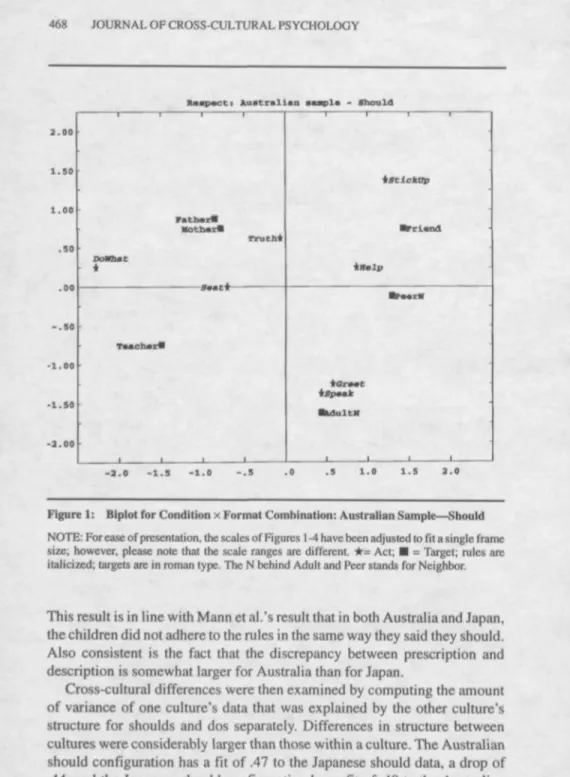
Figure 1 : Biplot for Condition x Format Combination: Australian Sample—Should
NOTE: For ease of presentation, the scales of Figures I -4 have been adjusted to fit a single frame size; however, please note that the scale ranges are different. *= Act; • = Target; rules are italicized; targets are in roman type. The N behind Adult and Peer stands for Neighbor.
This result is in line with Mann et al.'s result that in both Australia and Japan, the children did not adhere to the rules in the same way they said they should. Also consistent is the fact that the discrepancy between prescription and description is somewhat larger for Australia than for Japan.
Kroonenberg. Kashima / RULES IN CONTEXT 469
«••p*cti X o « t r > l l » n
1 . 0 0 0
.750
.500
.250
.000
- . 2 5 0
-.500
1.000
Father*
•other*
It* *rruth
»Or-»«t
•Jkdultn
«P-«*
- 1 . 0 0 - . 7 5 - . 5 0 - . 2 5 . 0 0 . 2 5 .50 . 7 5 1 . 0 0
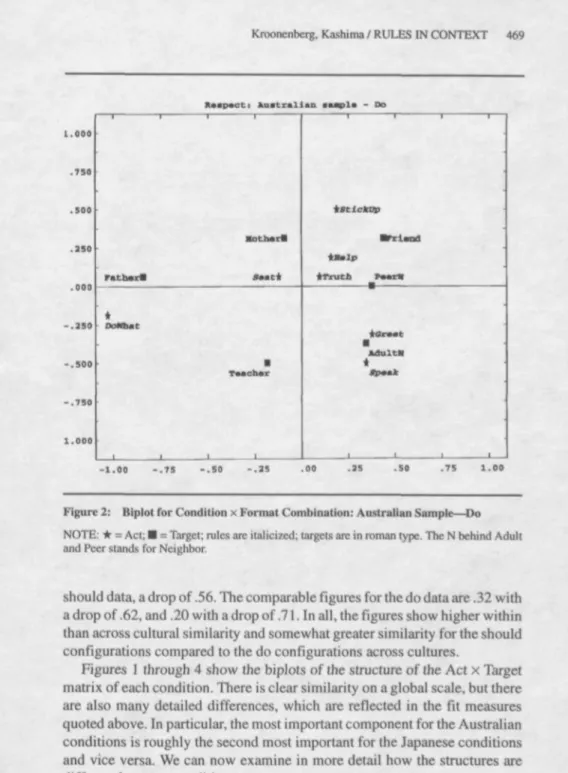
Figure 2: Biplol for Condition x Format Combination: Australian Sample—Do
NOTE: * = Act; • = Target; rules are italicized; targets arc in roman type. The N behind Adult and Peer stands for Neighbor.
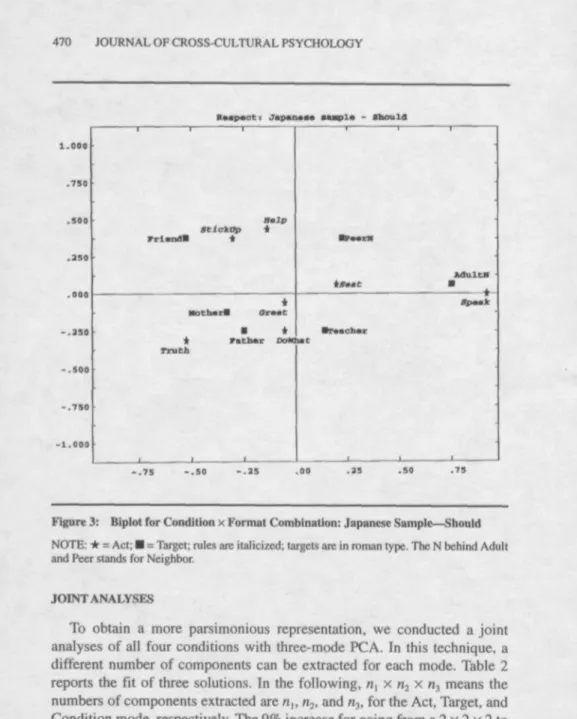
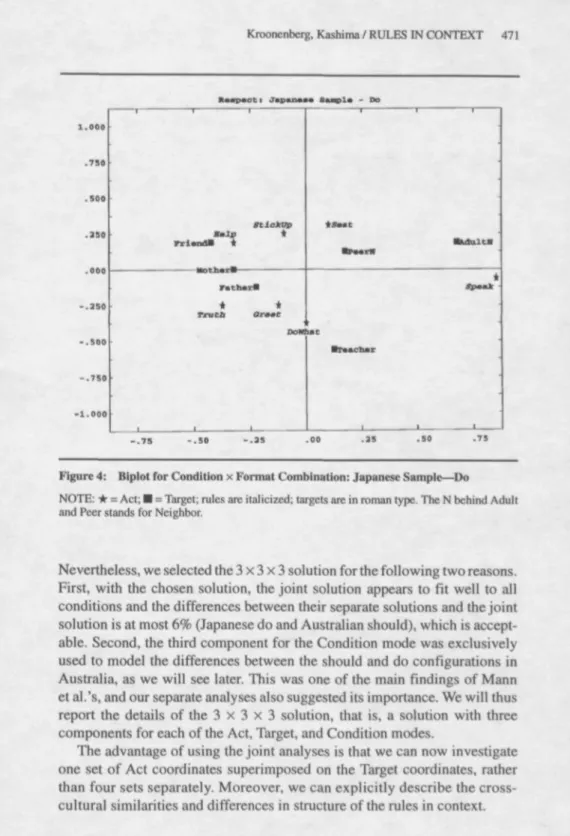
should data, a drop of .56. The comparable figures for the do data are .32 with a drop of .62, and .20 with a drop of .71. In all, the figures show higher within than across cultural similarity and somewhat greater similarity for the should configurations compared to the do configurations across cultures.
•••pact i JapMMM supl* - should
1.000
-7SO
.230
- . 2 5 0
- . 5 0 0
-.750
ttlclcOp *
*
•other*
*
Truth rather DoHtimt
«p*.»
-.75 - . S O -.25 .00 .95 .50 .75
Figure 3: Biplot for Condition x Format Combination: Japanese Sample—Should
NOTE: * = Act; • = Target; rules are italicized; targets are in roman type. The N behind Adult and Peer stands for Neighbor.
JOINT ANALYSES
To obtain a more parsimonious representation, we conducted a joint analyses of all four conditions with three-mode PCA. In this technique, a different number of components can be extracted for each mode. Table 2 reports the fit of three solutions. In the following, n, x n2 x n, means the
numbers of components extracted are n,, «2, and n}, for the Act, Target, and
Condition mode, respectively. The 9% increase for going from a 2 x 2 x 2 to a 3 x 3 x 2 solution seemed sufficiently large to warrant the third components for the Act and Target mode. Given the differences between the conditions, it is not surprising that a joint analysis requires more components for these modes than the separate analyses.
Krooncnberg. Kashima / RULES IN CONTEXT 471
.750
- S C O
-.250
-.7SO
-1.000
rri.ndB *
• • •
rticum
*
*
Truth
+JMC
- . 5 » - . î ï .00
Figure 4: Biplot for Condition x Format Combination: Japanese Sample—Do
NOTE: * = Act; • = Target; rules are italicized; targets are in roman type. The N behind Adult and Peer stands for Neighbor.
Nevertheless, we selected the 3 x 3 x 3 solution for the following two reasons. First, with the chosen solution, the joint solution appears to fit well to all conditions and the differences between their separate solutions and the joint solution is at most 6% (Japanese do and Australian should), which is accept-able. Second, the third component for the Condition mode was exclusively used to model the differences between the should and do configurations in Australia, as we will see later. This was one of the main findings of Mann et al.'s, and our separate analyses also suggested its importance. We will thus report the details of the 3 x 3 x 3 solution, that is, a solution with three components for each of the Act, Target, and Condition modes.
TABLE 2
Fits of Solutions for the Rules x Target-Persons Matrices for the Separate Two-Mode Analyses and Several
Three-Mode Analyses
Three-Mode Analyses
Culture
Australia
Japan
Fit three-way model
Formal Should Do Should Do Two-Mode Analyses .91 .94 .96 .91
2 x 2 x 2
.65 .84 .86 .73 .79 3x3x2 .77 .92 .94 .85 .89 3x3x3 .85 .93 .94 .85 .90
NOTE: An n\ x m x nj three-mode analysis indicates that the three-mode solution had m components for the first mode (Acts), m components for the second mode (Targets), and nj for the third mode (Conditions).
Conditions
The three components for the Condition mode are presented in Table 3. (Note that the components have been scaled to have equal lengths in contrast with the standard practice in two-mode PCA where they are scaled with the eigenvalues.) The first component indicates what the four conditions have in common: All conditions have roughly equal weights on the first component. The second one shows a clear cultural contrast: The Japanese conditions have positive weights, whereas the Australian conditions have negative weights. The third component provides the should-do contrast for the Australian children: The Australian should condition has a large negative weight and the Australian do condition has a sizable positive weight, whereas the Japanese conditions have weights close to zero.
Kroonenberg. Kashima / RULES IN CONTEXT 473
TABLE 3
Components for the Culture-Format Combinations ( 3 x 3 x 3 Solution)
Culture Australia Japan Explained variability Formai Should Do Should Do / .41 .62 .54 .40 .66 Components 2 -.27 -.62 .57 .47 .22 .? -.87 .48 .10 .01 .02
NOTE: All components have unit lengths.
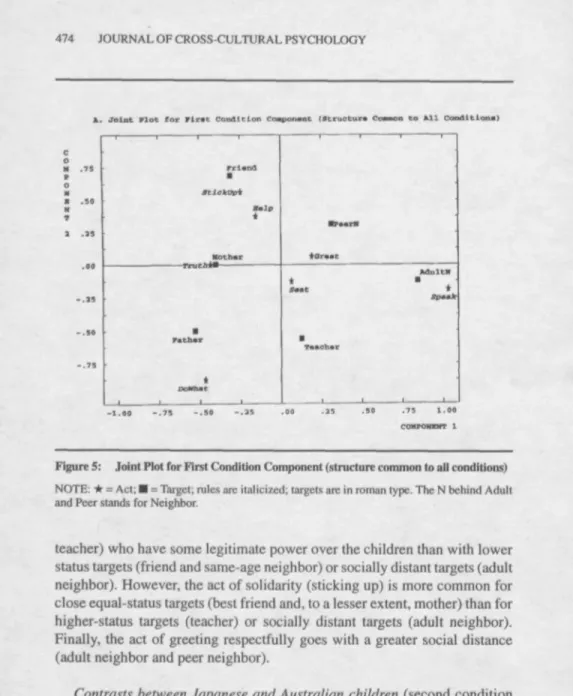
Common structure (first condition component: 66%). Figure 5 shows the first dimensions of the structure of specific acts directed to target persons, which is common to all conditions (the third dimension. 2.5%, is not shown). The major patterns can be examined by the following procedure. First, draw the vector connecting the zero point of the coordinates and the point that represent an act. Second, project the point that represents a target onto the vector for a given act. Projections on the positive side indicate a higher than average endorsement of the act with respect to those targets, and projections on the negative side a lower than average endorsement of the act for those targets. Conversely, one can also draw vectors for targets, and project acts onto them. The plot does not contain the overall level of endorsement, because that is contained in the means that have been removed before the analysis. The figures portray the interaction rather than the main effects. Of course, the conclusions from a plot like this are only as good as the approxi-mation, which is quite good in the present analysis.
Jk. Jetât riot for rirat Condition Component (Itruotur* Common to All Condition«)
-.19
rrlend
• Klckapt
Mother Truti*«
.00 .« .50 .75 1.00
COMPOmNT 1
Figure 5: Joint Plot for First Condition Component (structure common to all conditions) NOTE: * = Act; • = Target; rules are italicized; targets are in roman type. The N behind Adult and Peer stands for Neighbor.
teacher) who have some legitimate power over the children than with lower status targets (friend and same-age neighbor) or socially distant targets (adult neighbor). However, the act of solidarity (sticking up) is more common for close equal-status targets (best friend and, to a lesser extent, mother) than for higher-status targets (teacher) or socially distant targets (adult neighbor). Finally, the act of greeting respectfully goes with a greater social distance (adult neighbor and peer neighbor).
Kmonenhcrg. Kashima / RULES IN CONTEXT 475
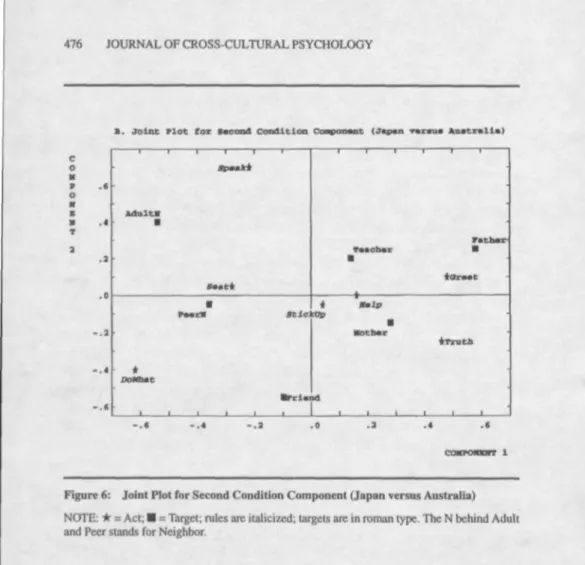
be drawn, connecting the zero point and the point for that act, and then the point representing a given target person may be projected onto those vectors. One point to note is that projections onto the positive side of a vector for an act indicate that the Japanese conditions tended to endorse or perform that act more than the Australians'; conversely, projections onto the negative side suggest a greater endorsement of the act to the targets by the Australian than by the Japanese children. This is because the Japanese conditions have positive weights on the second component, and the Australian conditions negative weights.
Some patterns that emerge from this analysis are generally consistent with the notion of individualism and collectivism (Triandis, 1990, 1995). On one hand, the Japanese children seem to exhibit the tendency of collectivists. The act of greeting the in-group adults (father and mother) more respectfully than other targets is more characteristic of the Japanese than of the Australian children. The act of speaking respectfully to adult neighbors relative to others is more Japanese than Australian. Taking into account differences in overall respect toward the in-group and differences in the overall level of speaking the truth, the act of sharing undesirable secrets with the in-group adults (i.e., telling the truth to father and mother though it gets you into trouble) is also more common among the Japanese children than among the Australian children. On the other hand, the Australian children tell the truth to adult neighbors more often than do the Japanese children, given again the differ-ences in overall levels. This reflects the tendency for individualists to empha-size sincerity (Kashima, Siegal, Tanaka, & Kashima, 1992).
However, some other aspects are not easily explicable in terms of indi-vidualism and collectivism. For instance, the Australian children greet re-spectfully adult and same-age neighbors more often than do their Japanese counterparts. The Australian children speak to their best friend with respect more often than do the Japanese children. This show of respect to neighbors and friends may indeed be a characteristic specific about Australia as Mann et al. suggested.
B. Joint Plot for ••coud conflit loo (Japu v*r«u »««tr.li«)
-.3
»duit«
•••t*
r«th«r
*mlp
-.4 -.2
Figure 6: Joint Plot for Second Condition Component (Japan versus Australia)
NOTE: if = Act; • = Target; rules are italicized; targets are in roman type. The N behind Adult and Peer stands for Neighbor.
amount of freedom and permission to spontaneously express their feelings. In contrast, the children are expected to behave obediently in soto, because this is the place that requires formality and restraining behavior. This pattern may be quite characteristic about Japanese culture today.
Kroonenherg. Kashima / RULES IN CONTEXT 477
teacher. Not taking into account the overall (average) differences in should and do, the Australian children say that compared to their average level of obedience, they obey their father more than they should, and that they should stick up more for their father than they do. In contrast, they say they should obey their teacher more than they do, and that they stick up more for their teacher than they should.
DISCUSSION
The advantage of examining rules in context is its capacity to reveal a cultural signature, a cultural pattern of contextualized social action. Cultural signatures reflect patterns of social action within a given cultural context. Mann et al. found that the Australian children appear to endorse respectful rules more than the Japanese children do. This cultural difference may be a striking finding. However, our concern for rules in context require us to ask the following questions. Within the context of the high level of respect shown by the Australian children, who commands what kinds of respectful behav-iors? Even if the Japanese children do not exhibit respectfulness, do they endorse respectful rules in some contexts more than others? The present reanalysis is an attempt to provide some answers to these questions. Mann et al.'s original report revealed some global trends: Japanese children's tendency to show greater respect to parents and teachers than to their friends and peers was more pronounced than that of Australian children, the trend Mann et al. interpreted as reflecting the collectivism of the Japanese culture. However, their analysis failed to reveal more detailed cultural differences. For instance, it is such social acts as greeting more respectfully to parents than to others and speaking more respectfully to adult neighbors than to others that mark Japanese children, rather than global respectfulness to higher status in-group adults such as parents and teachers. Moreover, the Japanese cultural signature was apparent in the Japanese children's tendency to obey nonfamily adults more than their parents (i.e., doing what they are told). Mann et al. did not discuss this finding. Australian children, on the other hand, tell the truth to their adult neighbors more than to others, but their Japanese counterparts tell the truth more to parents than to others. This tendency may be explicable in terms of individualism and collectivism, but it was not easily discernible from the traditional analysis Mann et al. carried out. The Australian children's show of respect to their friends and neighbors relative to others is surely one cultural signature that Mann et al. did not pick up.
C. Joint tlot for Third Condition Component (Auatralia-Do v«rcu* Au*tralia-Bhoulc
—I 1 1 1 1 1 1 1 I 1 1
T»«ch«r (ticket» • F«th»r DoMiat
-*—• •
*-_1 1 1
1--.4 -.1 .0 .1 .4
COMPOMDfT l
Figure 7: Joint Plot for Third Condition Component (Australia—Do versus Australia— Should)
NOTE: * = Act; • = Target; rules arc italicized; targets are in roman type. The N behind Adult and Peer stands for Neighbor
Krooncnberg, Kashima / RULES IN CONTEXT 479
cannot be easily accommodated into these theoretical constructs. The cases in point are Australian respectfulness and Japanese obedience outside family. Further, against these cultural patterns, the discrepancy between prescription and self-description in Australia may be peculiarly Australian, something that social psychologists can probe into more deeply.
REFERENCES
Gabriel, K. R. (1971). The hiplot graphic display of matrices with application to principal component analysis. Biometrika, 58, 453-467.
Hirschberg. N. (1980). Individual differences in social judgment: A multivariate approach. In M. Fishbein (Ed.), Progress in social psychology (pp. 73-126). Hillsdale. NJ: Lwarence Erlbaum.
Imada. A. S., & London. M. (1979). Relationships between subjects, scales, and stimuli in research on social perception. Perceptual and Motor Skills, 48, 691-697.
Kashima, Y, Siegal, M., Tanaka. K., & Kashima. E. S. ( 1992). Do people believe behaviours are consistent with attitudes? Towards a cultural psychology of attribution processes. British
Journal of Social Psychology, 31, 111-124.
Krooncnberg, P. M. (1983a). Annotated bibliography of three-mode factor analysis. British
Journal of Mathematical and Statistical Psychology, 36. 81 -113.
Kroonenberg, P. M. (I983b). Three-mode principal component analysis. Theory and
applica-tions. Leiden. The Netherlands: DSWO Press.
Kroonenberg, P. M. (1994). The TUCKALS line: A suite of programs for three-way analysis.
Computational Statistics and Data Analysis, 18, 73-96.
Kroonenberg, P. M. (1996). 3WAYPACK user's irumual: A package of three-way programs (Technical report + software). Leiden, The Netherlands: Vakgroep Algemene Pedagogiek. Rijksuniversiteit.
Krooncnberg, P. M., & De Leeuw, J. (1980). Principal component analysis of three-mode data by means of alternating least squares algorithms. Psychometrika. 45, 69-97.
Mann, L, Mitsui. H., Beswick, G., & Harmoni, R. V. (1994). A study of Japanese and Australian children's respect for others. Journal of Cmss-Cultural Psychology, 25, 133-145. Poortinga, Y. H. (1992). Towards a conceptualization of culture for psychology. In S. Iwawaki.
Y. Kashima. & K. Leung (Eds.), Innovations in cross-cultural psychology (pp. 3-17). Amsterdam: Swets & Zcitlinger.
Tobin, J. (1992). Japanese prcschools and the pedagogy of selfhood. In N. R. Rosenbcrger(Ed.),
.ln/xmese sense of self (pp. 21-39). New York: Cambridge University Press.
Triandis, H. C. (Ed.). (1972). The analysis of subjective culture. New York: John Wiley. Triandis, H. C. (1990). Cross-cultural studies of individualism and collectivism. In J J. Herman
(Ed.), Nebraska symposium on motivation 1989 (pp. 41-133). Lincoln: University of Ne-braska Press.
Triandis. H. C. (1995). Individualism and collectivism. Boulder. CO: Westview.
Tucker, L. R. (1966). Some mathematical notes on three-mode factor analysis. Psychometrika,
31, 279-311.
Fitter Kroonenberg works as a statistician in the Department of Education at University, the Netherlands. He has a mathematics degree f mm loeiden University, where he aim received his Ph. D. in the social sciences. His main research interests are methods for continuous and discrete three-way data analysis and the application of sophisticated data-analytic techniques to empirical data. He has published in both methodological and substantive journals in a wide range of disciplines.