IT’SSTILLNOT THE ECONOMY, STUPID!: AN EXAMINATION OF POLITICAL PARTY SUPPORT FOR EUROPEAN INTEGRATION
William B. Smith
A thesis submitted to the faculty of the University of North Carolina at Chapel Hill in partial fulfillment of the requirements for the degree of Master of Arts in the Department of Political Science, Concentration European Governance.
Chapel Hill 2015
ABSTRACT
WILLIAM B. SMITH: It’sStillNot the Economy, Stupid!: An Examination of Political Party Support for European Integration
(Under the direction of Liesbet Hooghe.)
TABLE OF CONTENTS
LIST OF TABLES . . . v
Introduction . . . 1
What is Euroskepticism . . . 2
Research Design . . . 9
Results and Discussion . . . 16
Concluding Remarks . . . 21
APPENDIX . . . 23
LIST OF TABLES
Table
1 Western Europe: Summary Statistics . . . 11
2 Eastern Europe: Summary Statistics . . . 11
3 Western Europe: OLS Regressions of Position on EU Integration . . . 17
4 Eastern Europe: OLS Regressions of Position on EU Integration . . . 20
5 Western Europe: Inclusiveness Scale Loading Factors . . . 23
6 Western Europe: Socio-Economic Scale Loading Factors . . . 23
7 Eastern Europe: Inclusiveness Scale Loading Factors . . . 24
Introduction
Until the 1990s, European integration was largely uncontested by the public; integration was characterized by the well-known “permissive consensus” (Lindberg and Scheingold 1970). Since the 1990s, however, public skepticism of the European Project has continually increased. The Dutch and French rejections of the Constitutional Treaty show this trend to be true even among the original signatories to the Treaty of Rome, considered until recently to be the most “euro-positive” states. Now, Europe has entered a stage of “constraining dissensus,” in which the public’s support for new stages of integration can no longer be taken for granted (Hooghe and Marks 2008). Both the general public as well as political elites are becoming increasingly skeptical of the European Project1.
But, what are the mechanisms driving this recent upsurge in euroskepticism? The lit-erature on euroskepticism and public opinion has identified two general theoretical strains:
national identity and socioeconomic. The national identity strain suggests that the pub-lic’s support for European integration (or lack thereof) is largely a factor of their national identity (Hooghe and Marks 2005). Other authors have expanded upon this to suggest that citizen’s perceptions of a threat to their national identity, either from the EU itself or from other groups, also strongly influences their support for integration (McLaren 2002, 2007; de Vries and van Kersbergen 2007). In contrast, the socioeconomic strain argues that sup-port for integration is a function of cost/benefit analysis—citizens are more likely to supsup-port integration if it results in a net benefit to either the national economy or their own pocket-books (Carrubba 1997; Gabel 1998). As recent scholarship has shown, however, it takes both strains working in conjunction to adequately explain euroskepticism (McLaren 2002;
Hooghe 2003; Krouwel and Abts 2007; de Vries and van Kersbergen 2007). This article will empirically test the extent to which various concerns about identity and utilitarian benefits influence party political support for European integration. It will also attempt to ascertain whether national identity or rational/utilitarian concerns is the stronger indicator of eu-roskepticism. In general, I hypothesize that greater tangible benefits from integration—i.e. positive utilitarian outcomes—should lead to greater support for integration. In particular, I expect the global financial crisis and the eurocrisis to be a highly significant predictor of euroskepticism.
The remainder of this article is structured as follows. First, I will present a general overview of what is meant by “euroskepticism.” Next, I will elaborate on the idea of na-tionalism, and present the dominant theoretical arguments as to how nationalist sentiment drives opposition to European integration. Then, I will detail the contrasting theories of the rational/utilitarian argument. In the fourth section, I will present my hypotheses and general research design. In the fifth section, I will examine the validity of those theories using data from the 2010 Chapel Hill Expert Survey. Finally, I will conclude with a discussion of the implications of my findings.
What is Euroskepticism?
to truly function as a cohesive unit. And thirdly, there are those who are not opposed to integration but who are skeptical of the EU because they see it as too exclusive. According to Taggart, this exclusivity can be either geographical or societal. For example, this group could oppose the EU because it excludes poorer regions of the world or because they see the EU as destabilizing to traditional societal groups.
For the purposes of this article, I use the term “euroskepticism” in the same way as Taggart (1998, 366):
“The term ‘Euroscepticism’ is. . . an encompassing term. [It] expresses the idea of contingent or qualified opposition, as well as incorporating outright and un-qualified opposition to the process of European integration. The justification for using the broad term Euroscepticism, apart from its popular usage, is that it exists, albeit in a variety of guises, in the face of an on-going de facto process of integration at the institutional and elite level. The context is one of Euro-pean integration, and so the term Euroscepticism encompasses those who stand outside the status quo. Scepticism in the face of an institutional reality is here taken as equivalent to opposition in the face of uncertainty. It is also used be-cause it is more inclusive. All opponents of the EU are, at least, sceptical, but not all sceptics are opponents.”
This inclusive definition of euroskepticism is salient not only due to the reasons Taggart proposes, but also due to the limitations of the data used for this study. While there are undoubtedly parties within the dataset that oppose the very idea of European integration, the data do not differentiate those parties from those that are merely highly skeptical of the EU2. Thus, I have utilized a broad definition for two reasons—firstly, to avoid being forced to make a purely value based-judgment as to which parties are and are not euroskeptic, and secondly, to extend the theoretical applicability of this study to the maximal number of po-litical parties. To that end, I have chosen to measure euroskepticism using the continuous scale of the Chapel Hill Expert Survey3 . Such a continuous scale has many virtues, but
2Taggart goes on the distinguish “hard” euroskeptics—those who oppose the very idea of integration— from “soft” euroskeptics—those who are merely skeptical about integration. As noted, the Chapel Hill Expert Survey does not make this distinction. However, Leonard Ray has suggested that when combining Taggart’s hard and soft euroskepticism with the 7-point scale utilized by the Chapel Hill Expert Survey, hard euroskep-tics would fall from 1–2.49 and soft euroskepeuroskep-tics would fall from 2.5–4 (Hooghe 2007).
chief among them is the ability to gain a more nuanced representation of euroskeptic posi-tions than would be possible using a categorical scale. Secondly, the continuous measure alleviates the need for the researcher to make arbitrary judgments concerning the cutoff points between categories.
National Identity
Previous research has established that there is a definite link between national iden-tity and support for European integration (McLaren 2002; Bruter 2004; Hooghe and Marks 2005; Brigevich 2012). These studies have demonstrated that nested, inclusive national identities foster support for a European identity and, in turn, support for European integra-tion. With such an identity, a citizen can easily conceive of herself as being both “German” and “European.” These identities are not mutually exclusive, and indeed, there is evidence to suggest that the nested nature of such identities may be self-reinforcing (Brigevich 2012). Conversely, however, national identity may be non-nested and exclusive. In such a case, a citizen would hypothetically perceive herself to be either “German”or “European4 ;” the levels would be mutually exclusive.
Nationalism
At the core of the exclusive national identity strain is the concept of nationalism. Michael Hechter (2000, 7) provides a preliminary definition of nationalism: “collective action designed to render the boundaries of the nation congruent with those of its gover-nance unit.” In other words, nationalism seeks to make the borders of the nation the same as those of the state. In its more benign forms, nationalism may use inclusive policies to incorporate and assimilate different groups within a single, multicultural state. Those with an inclusive, multi-faceted national identity should look favorably upon further integration, and thus express lower levels of euroskepticism (Hooghe and Marks 2005). However, na-tionalism more often takes an exclusive approach. It seeks to create a monocultural state
through internal homogenization and external exclusiveness (Mudde 2007). Internal ho-mogenization “ensures that the state includes only people from one’s ‘own’ nation,” while external exclusiveness “aims to bring all members of the nation within the territory of the state” (Mudde 2007, 16).
Hechter’s definition incorporates only state-centered nationalism, however, numerous studies have shown that nationalism also has a strong cultural (alternatively referred to as an ethnic or racial) component (McLaren 2002; Hooghe and Marks 2005; Mudde 2007). As Cas Mudde (2007, 17) notes, in practice, nationalism includes a combination of both state and cultural nationalism. By expanding the definition to include ethno-cultural com-ponents, nationalism can begin to account for those parties (or citizens) that are opposed to integration because they feel culturally threatened by the homogenization that often goes hand-in-hand with deeper integration.
Nativism
It would not be accurate, however, to say that all levels of nationalist sentiment envis-age an attack upon one’s sense of cultural identity. Thus, a more nuanced examination of nationalism is needed in order to understand the relationship between nationalism and a rejection of the European Project because of a perceived threat to one’s culture. By dif-ferentiating between more “moderate” nationalist sentiment and “radical” nationalist (i.e. nativist5) sentiment, one is able to more thoroughly understand the connection between the perceived threat to national identity and euroskepticism (Mudde 2007, 17).
For this study, nativism is defined as “an ideology [that] holds that states should be inhabited exclusively by members of the native group (‘the nation’) and that nonnative elements (persons and ideas) are fundamentally threatening to the homogeneous nation-state” (Mudde 2007, 19). “The nation,” much like the rest of society, is an artificial construct
(Anderson 1983); it is fluid and constantly changing. Nevertheless, nativists assume that the nation, however it is constructed, is correct and must be protected. Central to a nativist6 worldview is the delineation of the world into “good” (us, the Nation) and “bad” (them, the Other) (Mudde 2007). Cas Mudde (2007, 74) identifies several different forms that this worldview commonly takes, however, the most salient are fears of that which is “outside the state and outside the nation.” This category can include neighboring states or ethnic groups, ideas or beliefs, or international organizations such as the EU or UN. For the nativist, this group looms as the largest potential threat to the homogeneity of the nation—this category is neither of the state nor of the nation and, as such, has the best possibility of disrupting the nativists eagerly sought-after homogeneity.
With specific regard to the EU, the large post-Maastricht uptick in euroskepticism seems to have been driven in large part by nativist sentiments. For many citizens and political parties, the Maastricht Treaty took the idea of European integration a step too far; it was now beginning to infringe upon the sovereignty of the nation-state (Eichenberg and Dalton 2007; Krouwel and Abts 2007; Mudde 2007). These sentiments, ultimately, led to the now infamous defeat of Constitutional Treaty in 2005.
Socioeconomic Concerns
The second major strain of research into euroskepticism deals with socioeconomic con-cerns. This is, by far, the less theoretically complicated line of reasoning. At its core, these utilitarian arguments assume that citizens and parties implicitly weigh the costs and benefits of European integration. When the costs outweigh the benefits, there will be less support for integration and vice versa (Carrubba 1997; Gabel 1998; McLaren 2002; Boomgaarden, Shuck, Elenbaas and de Vreese 2011).
One of the primary expressions of these utilitarian considerations is in economic terms. Matthew Gabel (1998) argues that the liberalization of EU markets through European in-tegration affects citizens of different educational and socioeconomic backgrounds in
ferent ways. Low income, low skill workers are often negatively affected by integration; conversely, high income, high skill workers are often able to capitalize on market liber-alization to significant personal benefit. In addition, liberliber-alization of capital markets will adversely affect low-income workers by making it easier for capital to move to productive areas. Thus, it becomes harder to force capital-owners to accede to demands to main-tain the high wages upon which these low-income workers depend. Finally, Gabel argues that proximity to a border with another EU member will prove beneficial due to increased economic interaction between neighboring countries. Thus, Gabel presents a set of clear “winners”—high-income, high-skill workers; the wealthy; those living near borders—and “losers”—low-income, low-skill workers; the poor; those living away from borders—from integration. Given this dichotomy of economic winners and losers, it is possible to infer party support for integration based off their expected “median voter.” For parties whose median voter falls into the “economic winner” category, we can expect a stronger support for integration; conversely, parties whose median voter falls into the “economic losers” category should display less support for integration.
Similarly, Clifford Carrubba (1997) identifies national “winners” and “losers” from in-tegration. Specifically, he examines net national contributions to the EU budget to show that transfer payments from the Union are often used to further the integration process. He shows that budget contributions reflect the domestic concerns within each state, and refutes the notion that transfer payments are made out of “fairness” whereby the richer states give a “helping hand” to the poorer states (Carrubba 1997, 469). Unsurprisingly, he finds that states that give more to the EU budget than they receive—i.e. are net-contributors—tend to be less supportive of integration, while states that receive more from the Union than they give—i.e. are net-recipients—tend to be more supportive of integration.
predict levels of euroskepticism. Unsurprisingly, Serricchio, Tsakatika and Quaglia (2013, 58) acknowledges that those countries most detrimentally affected by the global financial crisis—namely Greece, Portugal, Ireland, and Spain—experienced a sharp rise in euroskep-ticism from 2007-2010; they are now showing roughly the same levels of euroskepeuroskep-ticism as the historically “euroskeptic” countries such as Austria, Denmark, or the UK. Thus, it seems highly plausible that this recent spike in euroskepticism among formerly europositive states is due, at least in part, to the financial crisis.
Regional Axes
Beyond the broader concerns over cultural identity and socioeconomic factors, eu-roskepticism is (or at least, has historically been) structured along differing axes for Western and Eastern Europe (Marks, Hooghe, Nelson and Edwards 2006).
In Western Europe, support for European integration has long been bipolar—the cen-ter generally supports integration while both ends of the political spectrum are generally opposed. A more nuanced understanding of this relationship can be gained by disaggregat-ing support for integration into two separate components. On the one hand, the left/right economic spectrum; on the other hand, a social politics spectrum ranging from socially “liberal” to socially conservative (Marks et al. 2006). Parties on the extreme left of the economic spectrum typically consider the EU to be too market-oriented, while parties on the extreme economic right believe that the EU interferes too much in the proper function-ing of the markets. On the social spectrum, the extreme “liberals” do not believe that the EU goes far enough to champion issues such as minority rights and environmental protec-tion, while extreme social conservatives believe that the EU goes too far in defending such issues. Thus, the extremes of both spectrums tend to be euroskeptic.
social preferences. After the fall of communism, many parties throughout Eastern Europe rejected these views and embraced the EU and market liberalism. Thus,at the other end of the political spectrum is the slightly weaker but growing constellation of market, pro-Europe, cosmopolitanism. The supporters of the old communist ideals rejected this new system, and with it, European integration.
These alignments have been resilient across time, however, they may now be changing, particularly in the East. After 25 years of political competition and free-market economics, the communist legacy no longer exerts the pull that it once did. Thus I hypothesize that party competition, particularly competition over European integration, in the East is aligning more closely with the bipolar structure seen in the West.
Research Design
Data
To test the validity of these theoretical strains, I utilize the 2010 Chapel Hill Expert Survey (CHES) data (Bakker, de Vries, Edwards, Hooghe, Jolly, Marks, Polk, Rovney, Steenbergen and Vachudova 2012) and OLS regressions. The CHES measures national political party positioning on European integration, party ideology, and several of the most salient EU and non-EU policies (e.g. cohesion policy, enlargement to Turkey, positioning towards the United States). These data place political parties on both a traditional economic left-right spectrum as well the GalTan spectrum of societal values—the so-called “new politics dimension” (Hooghe, Marks and Wilson 2002). A more detailed explanation of the economic left-right and the GalTan spectrums is provided below.
use the raw data in this study; rather, I utilize the “means” version in which the individual expert responses for each party have been aggregated.
Many scholars of the Sussex School of Euroskepticism7 (for instance, Aleks Szczer-biak, Paul Taggart, and Cas Mudde) have criticized the “experts” utilized in the CHES. They contend that, rather than a true expert survey, the CHES is merely apeer survey of scholars in the field, and thus, does not provide a truly valid description of party positions (Mudde 2012). Mudde (2012, 197) notes that the “true experts of the Sussex School” are often divided over what is and is not euroskepticism, thus, he views the assertions about the general agreement among CHES respondents on the positioning of parties as “overly optimistic.” Semantic differences aside, the CHES has been compared to other party po-sitioning datasets such as the Comparative Manifesto Project and the European Elections Study survey, and has been found to be just as accurate and reliable in predicting party positioning (Hooghe et al. 2010; Bakker et al. 2012).
Variables
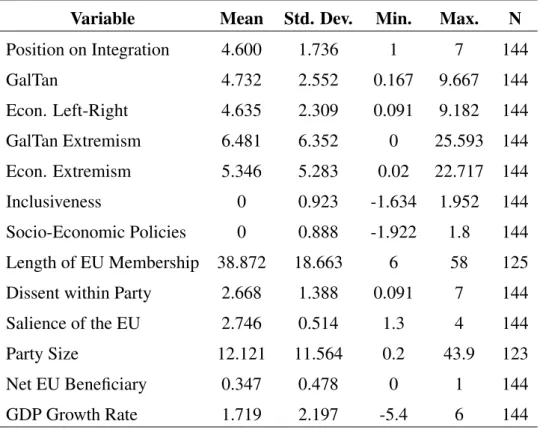
I will begin with a discussion of the dependent variable—position on European integration— and will then discuss the independent variables used in the study. The explanatory variables have been grouped into three general categories—general controls, national identity, and socioeconomic factors. Table 1 summarizes the main variables in this study for Western Europe. Similarly, Table 2 does the same for Eastern Europe. More detailed descriptions of all the variables can be found in the following sections.
Table 1: Western Europe: Summary Statistics
Variable Mean Std. Dev. Min. Max. N
Position on Integration 4.600 1.736 1 7 144
GalTan 4.732 2.552 0.167 9.667 144
Econ. Left-Right 4.635 2.309 0.091 9.182 144
GalTan Extremism 6.481 6.352 0 25.593 144
Econ. Extremism 5.346 5.283 0.02 22.717 144
Inclusiveness 0 0.923 -1.634 1.952 144
Socio-Economic Policies 0 0.888 -1.922 1.8 144
Length of EU Membership 38.872 18.663 6 58 125
Dissent within Party 2.668 1.388 0.091 7 144
Salience of the EU 2.746 0.514 1.3 4 144
Party Size 12.121 11.564 0.2 43.9 123
Net EU Beneficiary 0.347 0.478 0 1 144
GDP Growth Rate 1.719 2.197 -5.4 6 144
Note: Net EU Beneficiary is an indicator variable with a value of 0 if a country gave more money to the EU budget than it received from the EU and a value of 1 if the opposite is true.
Table 2:Eastern Europe: Summary Statistics
Variable Mean Std. Dev. Min. Max. N
Position on Integration 5.297 1.358 1.667 6.857 89
GalTan 5.612 2.316 1.412 9.538 89
Econ. Left-Right 4.832 1.851 0.333 8.571 89
GalTan Extremism 5.31 5.364 0 16.909 89
Econ. Extremism 3.447 4.241 0 18.063 89
Inclusiveness 0 0.879 -1.647 1.747 89
Socio-Economic Policies 0 0.92 -2.464 1.989 78
Length of EU Membership 5.385 1.219 3 6 78
Dissent within Party 2.756 1.307 0.5 7 89
Salience of the EU 2.825 0.58 1.286 4 89
Party Size 13.14 11.691 0.8 52.73 74
GDP Growth Rate 1.242 2.143 -2.9 4.8 89
Dependent Variable
The dependent variable for this study is a measure of positioning on European integra-tion. The expert respondents were asked to place each party on a seven-point scale in which 1 signifies that the party is “strongly opposed” to integration, 2 is “opposed,” 3 is “some-what opposed,” 4 is a neutral position, 5 is “some“some-what in favor,” 6 is “in favor,” and 7 is “strongly in favor.” Scores below 4 are considered to be euroskeptic.
The levels of support for integration range from Estonia and Romania at the high end (each with scores just under 6) to Greece and Norway on the low end (each with scores of about 3.75). Of the 233 parties included in the dataset, approximately 23% score below a 4 while approximately 68% score above a 4. Furthermore, 50% of the parties fall into the two most supportive categories. The mean value is 4.8 and the standard deviation is 1.6, further indicating that most parties are actually supportive of integration and that only a small plu-rality are euroskeptic. This does not, however, help explain which parties are euroskeptic and which are not. When parties are arranged on an ideological left-right spectrum, how-ever, a pattern becomes immediately clear—those parties on the far-left and far-right are the most euroskeptic while the parties of the center are the most supportive of integration. For instance, the far-left Greek Communist Party and far-right UKIP and FN all display strong levels of euroskepticism, while the centrist German SPD, CDU, and British Labour Party are all highly supportive of European integration. Interestingly, although it is a center-right party, the British Conservatives are also highly euroskeptic. However, this is due more to the historically high levels of euroskepticism of all British parties than to the Conservatives ideological position. The German CDU is a clearer example of a center-right party that is also strongly supportive of European integration.
Independent Variables
what values should the nation as a whole hold?
The first two variables in this group measure each party’s position on the GalTan spec-trum and the left-right economic specspec-trum. The first, the GalTan specspec-trum, places parties in terms of their ideological stance on democratic freedoms and rights. “Green, Alternative, Liberal” parties typically support more expansive person freedoms—greater civil liberties, same-sex marriage, a greater role for citizens in governing, etc. Conversely, parties on the “Traditional, Authoritarian, Nationalism” spectrum reject these ideas, favoring instead law and order, tradition, the belief that the government should be a strong moral authority, etc. (Marks et al. 2006). The second variable of interest is a measure of each party’s po-sition on an economic left-right spectrum. Parties on the economic left typically support an active role for government in the economy, while parties on the economic right empha-size more neoliberal economic policies—privatization, lower taxes, deregulation, reduced government spending, etc.
Both the GalTan and economic left-right variables are measured on a 0–10 scale. Scores of 0 indicate the extreme Gal/left for both variables, scores of 10 indicate the extreme Tan/right, and scores of 5 indicate centrist positions. The mean on the economic left-right spectrum is 4.7 while the mean on the GalTan spectrum is 5.1. On the economic spectrum, the extreme left receive scores from 0–1.5, the greens and social democrats are generally located between 2–5, while the Christian democrats, liberals, and extreme right are found from 6–10.
At the core of the theory, however, is not a party’s general position along either the social or the economic spectrums. Rather, it is how extreme each party’s position is compared to the median. Therefore, I created measures of party extremism for both the social and economic dimensions by squaring each party’s distance from the median on the respective dimension.
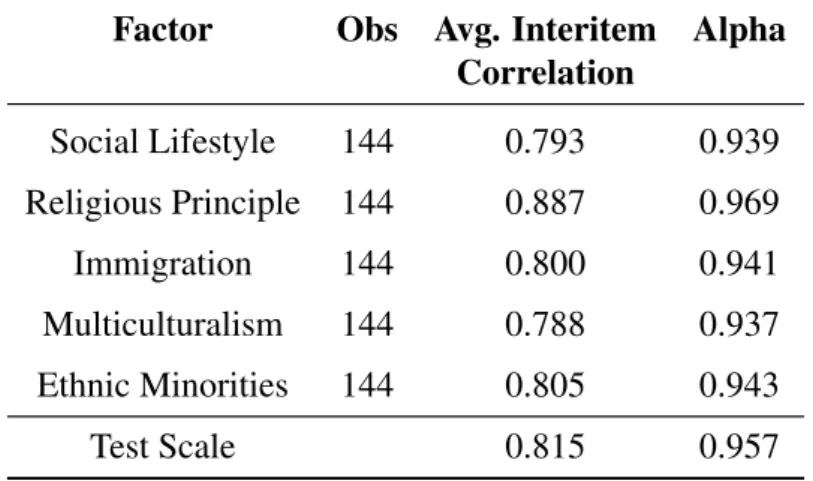
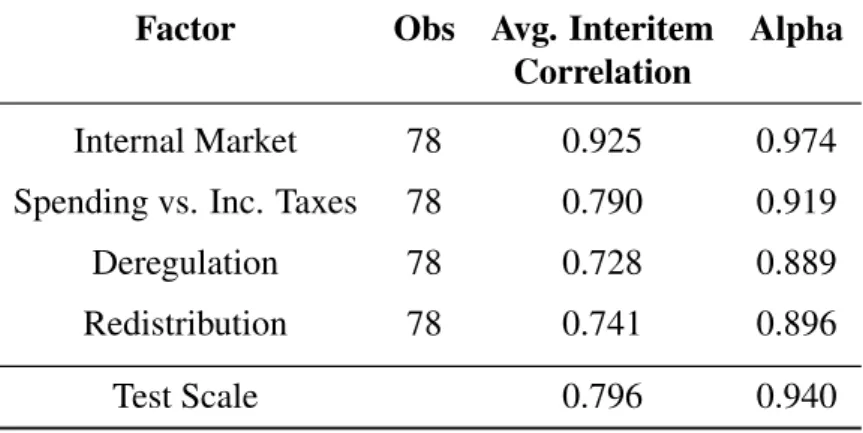
concepts of inclusiveness and socioeconomic preferences by utilizing Cronbach’s alpha to derive a scale that taps into these latent concepts. A full breakdown of all the loading factors for both the cultural and economic scales can be found in the appendix.
The measure of inclusiveness utilizes social policies that all load strongly together—for example, the party’s stance on inclusion of ethnic groups; the party’s stance on social is-sues like homosexuality and abortion; and the party’s stance on integration of immigrant groups—to approximate the overall level of cultural inclusiveness. In general, lower values on this scale indicate a preference for inclusive policies while higher values denote support for more exclusionary policies. Similarly, a general scale measuring each party’s socioe-conomic preferences was also created by combining issues such as the party’s support for deregulation, stance toward the internal market, and preference for economic redistribution. Smaller values on this scale indicate socioeconomic preferences that are more “leftist”— support for the internal market, support for governmental oversight of the economy, and support for economic redistribution—while higher values indicate an economic“rightist” identity.
A measure of the length of time (in years) that each party’s country has been a member of the EU is also included. As was mentioned earlier, various studies have shown that the length of EU membership has an impact on levels of euroskepticism, though this effect is not linear. This pattern has held relatively constant through time, though small fluctuations were observed after the ratification of the Maastricht Treat. However, it was only with the attempt to pass the Constitutional Treaty in 2005 and the financial crisis in 2008 that large shifts began occurring.
the mean value is a 2.7 and the standard deviation is 1.3. Taken together, this indicates that there is very little disagreement over integration among the majority of parties—party elites overwhelmingly agree on whether the party should be supportive or skeptical of integration. The next two general controls are a measure of the salience of the EU to the party’s over-all platform in 2010 and a measure of party size. These variables are intended to control for the effects of single-issue and fringe parties. As mentioned before, the strongest euroskeptic sentiments often arise from the extreme ends of the political spectrum and often manifest in smaller parties that have little broad appeal beyond their specific niche. Salience is mea-sured on a 4-point scale ranging from “no importance” to “great importance.” The party size8 is measured using the share of the vote that each party received in the most recent national election to the test date—i.e., the most recent national election to 2010.
The final two variables in this section attempt to account for country-level variations. As was mentioned in previous sections, the underlying concept of the socioeconomic strain is a rational, cost/benefit analysis—in essence, does the party in question feel that its nation has seen material benefits to EU integration. The first of these variables is a country-level indicator of each country’s net contribution to the 2010 EU budget9 and the second is the percent change in GDP growth in 201010 .
As Carrubba (1997) indicates, net-recipients to the budget should display stronger sup-port for integration while net-contributors should display less supsup-port for integration. There is little indication in previous studies that the magnitude of the money received from the EU impacts euroskeptic tendencies; the country simply needs to be a net-recipient of EU funds. Consequently, this variable was coded as a dummy indicating whether or not a country was a net-recipient in 2010.
The second country-level variable is a measure of national economic performance. GDP
8Data on party size were retrieved from www.parlgov.org on 20 February 2015.
9The budgetary data were drawn from the 2010 annual operating budget of the Commission as recorded in the 2010 Financial Report (European Commission 2010).
data were taken from Eurostat and attempt to gauge the impact of the financial crisis on each state. As was mentioned earlier in the paper, national economic performance is thought to be a strong predictor of euroskepticism. Thus, countries that were negatively impacted by the financial crisis—i.e. saw their GDP contract—should be less supportive of integration.
Results and Discussion
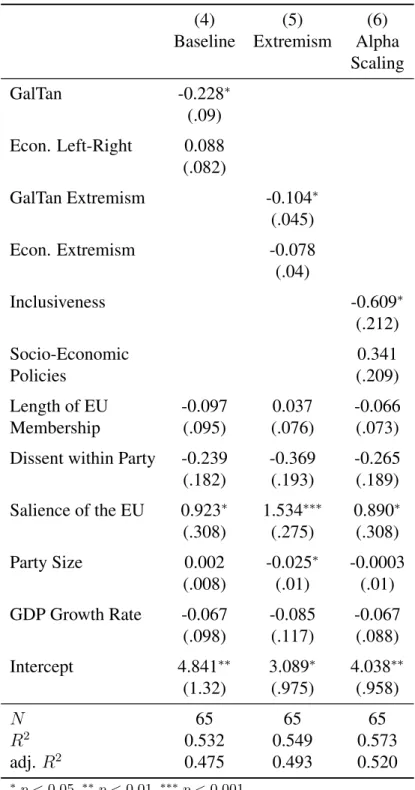
I utilize OLS regressions to test the effects of the independent variables on parties’ po-sitions regarding integration. Clustered standard errors were used to account for variance at the country-level. As both Marks et al. (2006) and Vachudova and Hooghe (2009) showed, larger parties have a larger impact on the overall party competition. Thus, in addition to controlling for party size, all models were weighted by the vote share for each party in the most recent national election to 2010.
As mentioned before, it is also well established that the economic and GalTan spectrums operate differently in the East than in the West. Thus, separate regressions were run on Western and Eastern parties. Finally, three versions of the model were run for Western and Eastern Europe—one version contains the baseline variables measuring general ideological placement (i.e. GalTan and economic left/right), another models party extremism, while the final model contains the measures of inclusiveness and socioeconomic preferences.
The majority of the following discussion will focus on the six different measures of social and economic issues, however, other relevant findings will be mentioned at the end of the section.
Table 3:Western Europe: OLS Regressions of Position on EU In-tegration
(1) (2) (3)
Baseline Extremism Alpha Scaling
GalTan -0.381∗∗∗
(.0543) Econ. Left-Right 0.280∗∗ (.0879)
GalTan Extremism -0.102∗∗∗
(.023)
Econ. Extremism -0.122∗∗
(.0334)
Inclusiveness -1.176∗∗∗
(.159)
Socio-Economic 1.049∗∗∗
Policies (.167)
Length of EU 0.009 0.016 0.006
Membership (.0119) (.0118) (.0125)
Dissent within Party -0.032 -0.117 -0.028 (.118) (.131) (.114) Salience of the EU -0.016 -0.325 0.134 (.319) (.274) (.326)
Party Size 0.038∗∗∗ 0.024 0.030∗∗
(.009) (.013) (.009) Net EU Beneficiary 0.989 1.859∗∗ 0.836 (.485) (.531) (.453) GDP Growth Rate 0.213∗ 0.267∗∗ 0.139 (.088) (.083) (.095) Intercept 4.110∗∗ 5.579∗∗∗ 3.513∗ (1.31) (1.03) (1.29)
N 104 104 104
R2 0.402 0.420 0.471
adj. R2 0.352 0.371 0.427
∗p <0.05,∗∗p <0.01,∗∗∗p <0.001
Note: Clustered standard errors in parentheses. All models weighted by vote share.
Parties which are economically leftist and Tan tend to be the most euroskeptic. This is to be expected. The EU has historically been a market liberalizing project and has largely championed “progressive” social issues such as multiculturalism, minority rights, etc. It must be stressed, however, that these trends are not linear. As Model 2 indicates, social and economic extremism are negatively related to support for integration. While the polit-ical center is supportive of integration, the extreme ends of both the economic and social spectrums are typically euroskeptic.
The results from the derived alpha-scales on inclusiveness and economic policies also performed as expected, and may even be better predictors of euroskepticism than the more generalized ideological or extremism indicators. While neither of these variables can be interpreted on a per-unit-increase basis, their general indications hold with the findings from the broader ideological scales. Having an inclusive identity continues to be one of the strongest predictors of support for integration. As one moves toward the exclusive end of the identity spectrum, support for integration declines sharply. Similarly, socioeconomic preferences prove to be a strong predictor of support for integration. Specifically, support for integration increases sharply as a party adopts a more economically “rightist” iden-tity. While not a perfect indicator, the adjusted R2 values indicate that, overall, the derived alpha-scales for inclusiveness and socioeconomic preference do a substantially better job of predicting support for integration than do the more general ideological indicators.
However, the results for party size are intriguing. While it remains true that larger parties will be more supportive of integration, this effect is rather small. All three models indicate that now is it entirely possible to be both largeandanti-establishment. Anti-establishment and anti-EU parties are no longer confined to the political fringes.
euroskep-ticism. One major caveat to this finding must be acknowledged, however. Namely, these data are from 2010. At that point, the greatest impact of the debt crisis was largely confined to Southern countries. Thus, it may be more precise to say that, in 2010, the eurocrisis had done little to inflame euroskeptic sentiment outside of the countries already being negatively affected by the crisis.
Table 4:Eastern Europe: OLS Regressions of Position on EU Integration
(4) (5) (6)
Baseline Extremism Alpha Scaling
GalTan -0.228∗
(.09) Econ. Left-Right 0.088
(.082)
GalTan Extremism -0.104∗
(.045)
Econ. Extremism -0.078
(.04)
Inclusiveness -0.609∗
(.212)
Socio-Economic 0.341
Policies (.209)
Length of EU -0.097 0.037 -0.066
Membership (.095) (.076) (.073)
Dissent within Party -0.239 -0.369 -0.265 (.182) (.193) (.189) Salience of the EU 0.923∗ 1.534∗∗∗ 0.890∗ (.308) (.275) (.308)
Party Size 0.002 -0.025∗ -0.0003
(.008) (.01) (.01)
GDP Growth Rate -0.067 -0.085 -0.067 (.098) (.117) (.088) Intercept 4.841∗∗ 3.089∗ 4.038∗∗
(1.32) (.975) (.958)
N 65 65 65
R2 0.532 0.549 0.573
adj. R2 0.475 0.493 0.520
∗p <0.05,∗∗p <0.01,∗∗∗p <0.001
Note: Clustered standard errors in parentheses. All models weighted by vote share.
issues like economic protection and minority protection; thus, it is unsurprising that Tan parties would object to these policies. Similarly, although for different historical reasons11 , economically rightist parties are also more supportive of integration. In the same vein, social and economic extremism is again negatively related to support for integration.
The derived scales on inclusiveness and socioeconomic preferences also show similar results. Parties with a more inclusive national identity are more likely to support integration than are those that adopt a more exclusionary national identity. And again, parties that identity more closely with the economic right also tend to be more supportive of integration. Similarly to the models for Western Europe, the adjusted R2values indicated that the
alpha-scales are a better predictor for Eastern parties than either the general ideological indicators or purely measuring party extremism. In the East, overall, it seems that the axes of party competition are changing. Eastern parties are aligning more closely to the Western bipolar model, though this alignment is still rather weak.
Concluding Remarks
Over the past several decades, there has been a marked increase in euroskepticism, both among European political elites and the general public. But what is driving this uptick in anti-EU sentiments, and how does the issue of Europe relate to broader issues of po-litical contestation? Significant scholarship has gone into answering these questions, and multiple theories have been proposed. These theories can generally be divided into two categories—those involving aspects of national identity and those involving socioeconomic concerns. The national identity theories center around the concept of inclusive versus ex-clusive national identity, and are a response to perceived threats to national identity. The socioeconomic theories center on implicit cost/benefit analyses—have I or my country di-rectly benefited from EU membership? Given the context of the ongoing global financial crisis and the eurocrisis, it seems logical that utilitarian concerns should be a quite potent predictor of euroskepticism.
I utilized OLS regressions to test this hypothesis. The results indicate that, while rhetor-ically and politrhetor-ically important, economic concerns are very poor predictors of euroskep-ticism. This is especially true of the eurocrisis. However, economic indicators do provide slightly more explanatory power when examining Eastern Europe. On the whole however, concerns over national identity remain much stronger predictors.
Two points must be kept in mind, however. Firstly, euroskeptic parties remain a numeric minority. Although they garner significant academic and media attention, these parties are small minority within each country. However, this study has shown that itisnow possible to be both a large, electorally-successful party and anti-EU. It can no longer be taken for granted that strong enuroskepticism is confined to small, fringe parties.
APPENDIX
Table 5:Western Europe: Inclusiveness Scale Loading Fac-tors
Factor Obs Avg. Interitem Alpha Correlation
Social Lifestyle 144 0.793 0.939 Religious Principle 144 0.887 0.969
Immigration 144 0.800 0.941
Multiculturalism 144 0.788 0.937
Ethnic Minorities 144 0.805 0.943
Test Scale 0.815 0.957
Table 6:Western Europe: Socio-Economic Scale Loading Factors
Factor Obs Avg. Interitem Alpha Correlation
Internal Market 144 0.947 0.982
Spending vs. Inc. Taxes 144 0.659 0.853
Deregulation 144 0.617 0.829
Redistribution 144 0.649 0.847
Table 7:Eastern Europe: Inclusiveness Scale Loading Fac-tors
Factor Obs Avg. Interitem Alpha Correlation
Social Lifestyle 89 0.709 0.907
Religious Principle 89 0.788 0.937
Immigration 89 0.680 0.895
Multiculturalism 89 0.665 0.888
Ethnic Minorities 89 0.740 0.919
Test Scale 0.716 0.927
Table 8:Eastern Europe: Socio-Economic Scale Loading Factors
Factor Obs Avg. Interitem Alpha Correlation
Internal Market 78 0.925 0.974
Spending vs. Inc. Taxes 78 0.790 0.919
Deregulation 78 0.728 0.889
Redistribution 78 0.741 0.896
REFERENCES
Anderson, Benedict. 1983. Imagined Communities: Reflections on the Origin and Spread of Nationalism. New York: Verso.
Bakker, Ryan, Catherine de Vries, Erica Edwards, Liesbet Hooghe, Seth Jolly, Gary Marks, Jonathan Polk, Jan Rovney, Marco Steenbergen and Milada Anna Vachudova. 2012. “Measuring Party Positions in Europe: The Chapel Hill Expert Survey Trend File, 1999-2010.”Party PoliticsNovember 29:1–15.
Boomgaarden, Hajo H., Andreas R. T. Shuck, Matthijs Elenbaas and Claes H. de Vreese. 2011. “Mapping EU Attitudes: Conceptual and Empirical Dimensions of Euroscepticism and EU Support.”European Union Politics12(2):241–266.
Brigevich, Anna. 2012. “Peeling Back the Layers: Territorial Identity and EU Support in Spain.”Regional & Federal Studies22(2):205–230.
Bruter, Michael. 2004. Civic and Cultural Components of a European Identity: A Pi-lot Model of Measurement of Citizens’ Levels of a European Identity. InTransnational Identities: Becoming European in the EU, ed. Richard K. Hermann, Thomas Risse and Marilynn B. Brewer. Lanham, MD: Rowman and Littlefield Publishers pp. 186–213.
Carrubba, Clifford J. 1997. “Net Financial Transfers in the European Union: Who Gets What and Why?” Journal of Politics59(2):469–496.
de Vries, Catherine E. and Kees van Kersbergen. 2007. “Interests, Identity and Political Allegiance in the European Union.”Acta Politica42(2):307–328.
Eichenberg, R.C. and R.J. Dalton. 1993. “Europeans and the European Community: The Dynamics of Public Support for European Integration.”International Organization
47(4):507–534.
Eichenberg, Richard C. and Robert J. Dalton. 2007. “Post-Maastricht Blues: The Transformation of Citizen Support for European Integration, 1973-2004.”Acta Politica
42(2):128–152.
European Commission. 2010. EU Budget 2010: Financial Report. Technical report Euro-pean Commission.
Hechter, Michael. 2000. Nationalist Puzzels. In Containing Nationalism, ed. M. Hechter. New York: Oxford University Press.
Hooghe, Liesbet. 2003. “Europe Divided?: Elites vs. Public Opinion on European Integra-tion.”European Union Politics4(3):281–304.
Hooghe, Liesbet. 2007. “What Drives Euroskepticism?: Party-Public Cueing, Ideology and Strategic Opportunity.”European Union Politics8(1):5–12.
Hooghe, Liesbet and Gary Marks. 2005. “Calculation, Community, and Cues: Public Opin-ion on European IntegratOpin-ion.”European Union Politics6(4):419–443.
Hooghe, Liesbet and Gary Marks. 2008. “A Postfuntionalist Theory of European Integra-tion: From Permissive Consensus to Constraining Dissensus.”British Journal of Political Science39:1–23.
Hooghe, Liesbet, Gary Marks and Carole J. Wilson. 2002. “Does Left/Right Structure Party Positions on European Integration?”Comparative Political Studies35(8):965–989.
Hooghe, Liesbet, Ryan Bakker, Anna Brigevich, Catherine de Vries, Erica Edwards, Gary Marks, Jan Rovney, Marco Steenbergen and Milada Vachudova. 2010. “Reliability and Validity of the 2002 and 2006 Chapel Hill Expert Surveys on Party Positioning.” Euro-pean Journal of Political Research42(4):684–703.
Krouwel, Andre and Koen Abts. 2007. “Varieties of Euroscepticism and Populist Mo-bilization: Transforming Attitudes from Mild Euroscepticism to Harsh Eurocynicism.”
Acta Politica42(2):252–270.
Lindberg, Leon N. and Stuart A. Scheingold. 1970. Europe’s Would-Be Polity: Patterns of Change in the European Community. Englewood Cliffs, NJ: Prentice-Hall.
Marks, Gary, Liesbet Hooghe, Moira Nelson and Erica Edwards. 2006. “Party Competition and European Integration in the East and West: Different Structure, Same Causality.”
Comparative Political Studies39(2):155–175.
McLaren, Lauren. 2007. “Explaining Mass-Level Euroscepticism: Identity, Interests, and Institutional Distrust.”Acta Politica42(2):233–251.
Mudde, Cas. 2007. Populist Radical Right Parties in Europe. New York: Cambridge University Press.
Mudde, Cas. 2012. “The Comparative Study of Party-Based Euroscepticism: The Sussex versus the North Carolina School.”East European Politics28(2):193–202.
Serricchio, Fabio, Myrto Tsakatika and Lucia Quaglia. 2013. “Euroscepticism and the Global Financial Crisis.”Journal of Common Market Studies51(1):51–64.
Steenbergen, Marco R., Erica E. Edwards and Catherine E. de Vries. 2007. “Who’s Cueing Whom? Mass-Elite Linkages and the Future of European Integration.”European Union Politics8(1):13–35.
Taggart, Paul. 1998. “A Touchstone of Dissent: Euroscepticism in Contemporary Western European Party Systems.”European Journal of Political Research33:363–388.