Recommendations for dealing with waste contaminated with
Ebola virus: a Hazard Analysis of Critical Control Points approach
Kelly L Edmunds,
aSamira Abd Elrahman,
bDiana J Bell,
aJulii Brainard,
cSamir Dervisevic,
cTsimbiri P Fedha,
dRoger Few,
eGuy Howard,
fIain Lake,
gPeter Maes,
hJoseph Matofari,
iHarvey Minnigh,
jAhmed A Mohamedani,
kMaggie Montgomery,
lSarah Morter,
mEdward Muchiri,
nLutendo S Mudau,
oBenedict M Mutua,
nJulius M Ndambuki,
nKatherine Pond,
pMark D Sobsey,
qMike van der Es,
cMark Zeitoun
r& Paul R Hunter
cIntroduction
Emerging infectious diseases present threats to global health.1
The 2014–2016 Ebola virus disease outbreak in western Africa – caused by the Democratic Republic of the Congo strain – caught local and global health-care communities unaware and unprepared. By 2 September 2015, the outbreak had been associated with at least 28 073 confirmed, probable or suspected cases – reported in 10 countries – and more than 11 290 deaths.2 There were extraordinary challenges for
the health-care systems and local governments involved in the response to the outbreak – and many of those challenges will persist long after the outbreak has passed.3 One such
challenge was the safe disposal of potentially infected faecal
and health-care waste – especially in the overcrowded urban communities where many of the cases occurred. It has been estimated that a patient in a bed within an African centre for Ebola treatment produced up to 300 litres of liquid waste and excreta per day.4 Every one of those litres could have been
contaminated with Ebola virus5 and needed to be disposed
of in such a way as to minimize the risks of transmission.6
The safe disposal of waste that could harbour Ebola virus is particularly challenging when that waste has been produced beyond any formal health-care setting. In the three countries most affected by the recent outbreak – i.e. Guinea, Liberia and Sierra Leone – severe shortages of water and sanitation services in health-care facilities and the affected communities often complicated the safe disposal of waste. According to the most
Objective To assess, within communities experiencing Ebola virus outbreaks, the risks associated with the disposal of human waste and
to generate recommendations for mitigating such risks.
Methods A team with expertise in the Hazard Analysis of Critical Control Points framework identified waste products from the care of
individuals with Ebola virus disease and constructed, tested and confirmed flow diagrams showing the creation of such products. After listing potential hazards associated with each step in each flow diagram, the team conducted a hazard analysis, determined critical control points and made recommendations to mitigate the transmission risks at each control point.
Findings The collection, transportation, cleaning and shared use of blood-soiled fomites and the shared use of latrines contaminated with
blood or bloodied faeces appeared to be associated with particularly high levels of risk of Ebola virus transmission. More moderate levels of risk were associated with the collection and transportation of material contaminated with bodily fluids other than blood, shared use of latrines soiled with such fluids, the cleaning and shared use of fomites soiled with such fluids, and the contamination of the environment during the collection and transportation of blood-contaminated waste.
Conclusion The risk of the waste-related transmission of Ebola virus could be reduced by the use of full personal protective equipment,
appropriate hand hygiene and an appropriate disinfectant after careful cleaning. Use of the Hazard Analysis of Critical Control Points framework could facilitate rapid responses to outbreaks of emerging infectious disease.
a Centre for Ecology, Evolution and Conservation, University of East Anglia, Norwich, England. b Department of Family and Community Medicine, University of Gezira, Gezira, Sudan. c Norwich Medical School, University of East Anglia, Norwich, NR4 7TJ, England. d Reproductive Health Department, Egerton University, Egerton, Kenya.
e School of International Development, University of East Anglia, Norwich, England. f Department for International Development, East Kilbride, Scotland.
g School of Environmental Sciences, University of East Anglia, Norwich, England. h Médecins Sans Frontières, Bruxelles, Belgium.
i Department of Dairy, Food Science and Technology, Egerton University, Egerton, Kenya.
j Centro de Educación, Conservación, e Interpretación Ambiental, Inter American University of Puerto Rico, San Germán, Puerto Rico. k Department of Pathology, University of Gezira, Gezira, Sudan.
l Water, Sanitation, Hygiene and Health Unit, World Health Organization, Geneva, Switzerland. m Norfolk and Norwich University Hospitals NHS Foundation Trust, Norwich, England. n Faculty of Engineering and Technology, Egerton University, Egerton, Kenya. o Tshwane University of Technology, Pretoria, South Africa.
p Department of Civil and Environmental Engineering, University of Surrey, Guildford, England.
q Gillings School of Global Public Health, University of North Carolina, Chapel Hill, United States of America. r Water Security Research Centre, University of East Anglia, Norwich, England.
Correspondence to Paul R Hunter (email: [email protected]).
Disposal of waste contaminated with Ebola virus Kelly L Edmunds et al.
recent data, nearly one third of health-care facilities in Guinea, Liberia and Sierra Leone have no piped water, 22% have no improved sanitation and 40% have no system to manage health-care waste.7 The corresponding percentages
for households within the same coun-tries are probably higher.8
Most transmission of Ebola virus probably results from direct contact with the bodily fluids of people who are in the latter stages of Ebola virus disease.9,10 The survival time of the virus
outside its human host is relatively short but – given the size and location of the recent outbreak and the frequent lack of disposal systems – we cannot exclude the possibility that, in some instances, people became infected indirectly, after coming into contact with contaminated waste.
In the present study, we used the Hazard Analysis of Critical Control Points framework to generate recom-mendations for mitigating the risks posed by virus-contaminated waste within health-care facilities and commu-nities experiencing outbreaks of Ebola virus disease. Although this framework was originally developed for food pro-duction systems, it has been successfully adapted to manage and mitigate the risks associated with drinking water.11,12 It is
increasingly being used to reduce the risks related to emerging infectious dis-eases and other health threats.13 Since its
use is both low-technology and relatively cheap, the framework may be particu-larly useful in addressing the risks asso-ciated with emerging infectious disease in areas where the capacity of existing health-care systems is insufficient to cope with the impact of the disease. The framework’s methods encourage the use of interdisciplinary expertise while enabling the rapid generation of evidence-based recommendations. It therefore offers the potential to manage risks when the quick control of an out-break is essential even though – as with the survival of Ebola virus in sewage and other waste14 – the relevant research data are incomplete or can only be inferred. In our analyses, we defined waste as both human waste – e.g. faeces and urine – and the fomites generated by health-care activities. We identified those behaviours and practices linked to waste collection and disposal that are likely to present risks of direct or indirect transmission of Ebola virus between humans. We then evaluated the potential of assessments based on
the Hazard Analysis of Critical Control Points framework as a response tool during outbreaks of emerging infec-tious disease.
Methods
In conducting our Hazard Analysis of Critical Control Points analysis, we adapted the guidance contained within an annex to the Codex Alimentarius Commission’s General Principles of Food Hygiene.15 Although this guidance refers
to 12 steps in the analysis, we ignored some of the later steps in the process because we would not ultimately be re-sponsible for implementing the recom-mended control measures or for estab-lishing the subsequent on-the-ground monitoring. We used a seven-step process – similar to that used for highly pathogenic avian influenza.13 The seven
steps were: (i) assemble a team with ap-propriate expertise in Hazard Analysis of Critical Control Points analysis; (ii) identify waste products within the system of care of cases of Ebola virus disease; (iii) construct flow diagrams illustrating the system of care; (iv) test and confirm the accuracy of each flow diagram; (v) list potential hazards as-sociated with each step in each flow diagram and conduct a hazard analysis; (vi) determine critical control points; and (vii) establish critical limits for each critical control point.
Team
The international and multidisciplinary nature of the problems posed by Ebola virus meant that we – i.e. the members of the research team – were obliged to con-duct our analysis via a mixture of face-to-face meetings and email exchanges. The research team included experts in disaster response, environmental health, Hazard Analysis of Critical Control Points protocols, infection control nursing, infectious disease epidemiol-ogy, public health, risk assessment, small water systems, virology and water and sanitation engineering. The team members were drawn from 19 different institutional departments spread across multiple countries within Africa, Europe and North America. Our analysis began when team members from the Univer-sity of East Anglia (Norwich, England) held a series of small meetings. The progress made in these meetings was then shared with a wider group of team members – for comment and feedback
– before a two-day face-to-face meeting in Nairobi, Kenya, that was attended by all of the team members from Africa and several of those from Europe.
Process
In the analysis, a systematic approach that allows for the synthesis of expert opinion is combined with the available evidence. This can bring clarity in an otherwise complex public health system. In our early meetings we concentrated on defin-ing the most important waste products – in terms of risk of transmission – and then creating initial flow diagrams repre-senting the pathways that could be used for the collection and disposal of each of these waste products. The diagrams were then shared with other team members, by email – so that a wider group of experts could comment on them – before they were reviewed and simplified in a face-to-face meeting. At the two-day meeting, experts from the fields of health interven-tions, sanitation and wastewater hygiene gave their views on the flow diagrams. This review and a final critical analysis by an international panel of experts led to further modifications to – and simplifica-tions of – the diagrams.
We considered a hazard to be a pro-cess – within a developing world setting – that could lead to human contact with waste material contaminated with Ebola virus and so provide the opportunity for transmission of the virus to another per-son. Taking into account the likely viral load of the contaminated material and based on the frequency with which each hazard was likely to occur, we grouped the hazards into high-, medium- and low-risk categories.
Following the validation of each flow diagram, the research team de-termined appropriate critical control points – i.e. the points at which there is an opportunity to reduce or eliminate the risks of virus transmission. The team then made so-called critical limits, for each identified critical control point, us-ing a combination of expert knowledge – followed by validation via examination of the relevant published data on the epidemiology, prevention and control of Ebola virus disease – and the current relevant recommendations of Médecins Sans Frontières and the World Health Organization (WHO).
Recommendations
man-agement of waste produced in the care of cases of Ebola virus disease.
Results
Hazard analysis
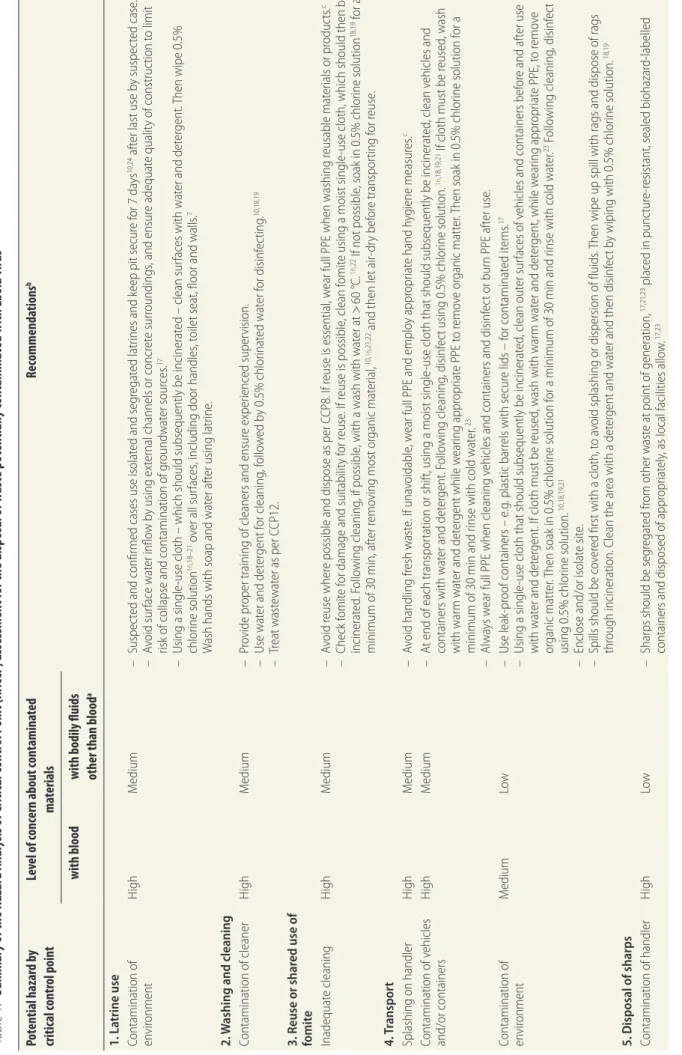
Our assessment of waste disposal within developing world settings affected by Ebola virus disease revealed multiple hazardous practices linked to the col-lection, transportation, disposal, clean-ing and storage of waste (Table 1). We believe that, if managed poorly, each of these practices presents an unaccept-able level of risk of the transmission of Ebola virus. All the practices that we categorized as high-risk involved po-tential contamination with blood: the collection, transportation, cleaning and shared use of blood-soiled fomites and the shared use of latrines contaminated with blood or bloodied faeces (Table 1). The practices identified as medium-risk were the collection and transportation of material contaminated with bodily fluids other than blood, the shared use of la-trines soiled with such fluids, the clean-ing and shared use of fomites soiled with such fluids and the contamination of the environment during the collection and transportation of blood-contaminated waste (Table 1). All of the other activities and practices linked to waste disposal were deemed to present a lower level of risk of the transmission of the virus.
Control points and limits
We identified 13 critical control points – i.e. 13 points at which there is an op-portunity to adopt measures to reduce the risks of transmission. For each such point, following extensive consultation and cross-referencing with the existing literature, one or more potential hazards were identified. Then, one or more sets of recommendations were made for reducing the risk presented by each identified hazard (Table 1). All of the critical control points identified could be assigned to one of five categories: waste collection, waste transportation, waste disposal, waste storage or waste clean-ing. The recommendations that we made for each critical control point derive from a combination of basic infection control – e.g. employing thorough hand hygiene measures – Ebola virus-specific recommendations produced following consultation with the existing literature and suggested behaviour changes that could reduce the chances of a person
exposing themselves to increased trans-mission risk.
Several of the recommendations we made include fundamental aspects of in-fection prevention and control – e.g. the correct and proper use of full personal protective equipment, appropriate hand hygiene and thorough cleaning followed by the use of an appropriate disinfectant.
Discussion
We used analysis based on the Hazard Analysis of Critical Control Points framework to make recommendations for protecting health workers, other staff in health facilities and the wider public from the risks posed by the disposal of potentially infected liquid and solid waste generated in the care and treat-ment of patients infected with Ebola virus. During this analysis, 13 critical control points associated with the col-lection, transportation, disposal, storage and cleaning of waste, the use and emp-tying of latrines and fomite reuse were identified. Our analysis took account of existing evidence presented in the published literature and guidance pub-lished by international organizations. When there were no or few relevant data available, expert opinion from an inter-national panel of experts with expertise in environmental health, epidemiology, health-care provision in low-income countries, virology and water and sanita-tion engineering was sought.
The framework allows for a rapid identification of the risks associated with a known hazard.13 In the present study,
that known hazard was the transmis-sion of Ebola virus between humans. The 2014–2016 Ebola virus disease outbreak resulted in widespread local-ized transmission of the virus. Much of this transmission was attributed to the social, environmental and cultural char-acteristics of the worst-affected coun-tries,10 including inadequate health-care
infrastructures that, even before the outbreak, were under great stress as the result of high population densi-ties in urban areas.31,32 For Ebola virus
disease, multiple gaps still exist in our understanding of potential transmission mechanisms and control measures.10 In
the context of such knowledge gaps, the framework provides a useful systematic approach that focuses on the prevention of harm and synthesizes hard evidence and expert opinion.15 Given such
knowl-edge gaps, however, it remains possible
that future research may produce results that require our current recommenda-tions to be modified.
Previous studies have shown that direct contact with a symptomatic per-son with Ebola virus disease is typically associated with relatively low risk of transmission during the early stages of the disease – whereas the risk of indirect transmission increases as the disease progresses. 11,33,34 The transmission of
the virus during burial rituals – which fall outside the scope of the present study – are known to be particularly hazardous practices. 11,33,34 The transport
and disposal of potentially contaminated waste also present opportunities for the virus to leave the household or care cen-tre and enter the wider community or environment. In our analysis, taking into account the likely viral load within the contaminated waste and the likely op-portunity for transmission of the virus via a particular activity, we only associ-ated activities involving blood-soiled waste with relatively high risks of Ebola virus transmission. For blood-soiled waste, the highest risks were associated with activities that could bring the waste into direct contact with either another person – e.g. the cleaning of a blood-contaminated container – or a potential viral vehicle – e.g. a container used to transport bloodied waste or a contami-nated fomite passed to another person without being adequately cleaned. Each of these risks could be eliminated or, at least, substantially decreased through the careful implementation of the rec-ommendations outlined in Table 1. As there is some evidence to suggest that spraying a potentially contaminated surface with disinfectant may promote transmission,35 we recommend
contain-ment of the spill, followed by cleaning of the surface with water and detergent and finally wiping with 0.5% chlorine solution. This recommendation, which follows published guidelines, 18,19,36 was
kept relatively simple because many of those undertaking the cleaning and the preparation of solutions for disinfecting within non-clinical settings would not be able to record times or determine chemical concentrations accurately.
Ebola virus can rarely be detected in the faeces or rectal swabs from persons with Ebola virus disease, even dur-ing periods of acute illness, 12,37–39 and
little is known about the persistence of the virus within faeces.11 With this in
Disposal of waste contaminated with Ebola virus Kelly L Edmunds et al.
Table 1.
Summar
y of the Hazar
d Analy
sis of C
ritic al C ontr ol P oint (HA CCP
) assessment f
or the disposal of w
ast
e pot
entially contamina
ted with Ebola virus
Pot ential hazar d b y critic al contr ol point Le
vel of concern about contamina
ted ma terials Recommenda tions b with blood
with bodily fluids other than blood
a 1. La trine use Con tamina tion of en vir onmen t H igh M edium – Suspec
ted and c
onfir
med cases use isola
ted and seg
rega
ted la
trines and keep pit secur
e f or 7 da ys 10,24 af
ter last use b
y suspec ted case . – Av oid sur fac e w at er inflo w b
y using ex
ter
nal channels or c
oncr
et
e sur
roundings
, and ensur
e adequa
te qualit
y of c
onstruc
tion t
o limit
risk of c
ollapse and c
on
tamina
tion of g
roundw at er sour ces . 17 – U
sing a single
-use cloth – which should subsequen
tly be inciner
at
ed – clean sur
fac
es with w
at
er and det
er
gen
t.
Then wipe 0.5%
chlor
ine solution
16
,18–21
o
ver all sur
fac
es
, including door handles
, t
oilet sea
t, floor and w
alls
.
7
W
ash hands with soap and w
at
er af
ter using la
trine
.
2.
W
ashing and cleaning
Con
tamina
tion of cleaner
H igh M edium – Pr ovide pr oper tr
aining of cleaners and ensur
e exper ienc ed super vision. – U se w at
er and det
er gen t f or cleaning , f ollo w ed b
y 0.5% chlor
ina ted w at er f or disinf ec ting . 10,18,19 – Tr ea t w ast ew at
er as per C
CP12.
3. Reuse or shar
ed use of
fomit e Inadequa te cleaning H igh M edium – Av oid r euse wher
e possible and dispose as per C
CP8. I
f r
euse is essen
tial
, w
ear full PPE when w
ashing r
eusable ma
ter
ials or pr
oduc ts . c – Check f omit e f
or damage and suitabilit
y f
or r
euse
. I
f r
euse is possible
, clean f
omit
e using a moist single
-use cloth, which should then be
inciner at ed . F ollo wing cleaning
, if possible
, with a w
ash with w
at
er a
t >
60 °C.
16
,22 If not possible
, soak in 0.5% chlor
ine solution
18,19
for a
minimum of 30 min, af
ter r
emo
ving most or
ganic ma ter ial , 10, 16 ,21,22
and then let air
-dr y bef or e tr anspor ting f or r euse . 4. T ranspor t
Splashing on handler
H igh M edium – Av
oid handling fr
esh w ast e. I f una voidable , w
ear full PPE and emplo
y appr
opr
ia
te hand h
yg iene measur es . c Con tamina
tion of v
ehicles and/or c on tainers H igh M edium –
At end of each tr
anspor
ta
tion or shif
t, using a moist single
-use cloth tha
t should subsequen
tly be inciner
at
ed
, clean v
ehicles and
con
tainers with w
at
er and det
er gen t. F ollo wing cleaning , disinf ec
t using 0.5% chlor
ine solution.
16
,18,19,21
If cloth must be r
eused , w ash with w ar m w at
er and det
er
gen
t while w
ear
ing appr
opr
ia
te PPE t
o r emo ve or ganic ma tter . T
hen soak in 0.5% chlor
ine solution f
or a
minimum of 30 min and r
inse with c
old w at er . 23 – Alw ays w
ear full PPE when cleaning v
ehicles and c
on
tainers and disinf
ec
t or bur
n PPE af
ter use . Con tamina tion of en vir onmen t M edium Lo w – U se leak -pr oof c on
tainers – e
.g
. plastic bar
rels with secur
e lids – f
or c on tamina ted it ems . 17 – U
sing a single
-use cloth tha
t should subsequen
tly be inciner
at
ed
, clean out
er sur
fac
es of v
ehicles and c
on
tainers bef
or
e and af
ter use
with w
at
er and det
er
gen
t. I
f cloth must be r
eused
, w
ash with w
ar
m w
at
er and det
er
gen
t, while w
ear
ing appr
opr
ia
te PPE, t
o r emo ve or ganic ma tter . T
hen soak in 0.5% chlor
ine solution f
or a minimum of 30 min and r
inse with c
old w
at
er
.
23 F
ollo
wing cleaning
, disinf
ec
t
using 0.5% chlor
ine solution.
10,18,19,21
–
Enclose and/or isola
te sit
e.
–
Spills should be c
ov
er
ed first with a cloth, t
o a
void splashing or dispersion of fluids
. T
hen wipe up spill with r
ags and dispose of r
ags
thr
ough inciner
ation. C
lean the ar
ea with a det
er
gen
t and w
at
er and then disinf
ec
t b
y wiping with 0.5% chlor
ine solution.
18,19
5. D
isposal of sharps
Con
tamina
tion of handler
H igh Lo w – Shar
ps should be seg
rega
ted fr
om other w
ast
e a
t poin
t of gener
ation,
17,21,23
plac
ed in punc
tur
e-r
esistan
t, sealed biohazar
d-labelled
con
tainers and disposed of appr
opr
ia
tely
, as local facilities allo
Pot ential hazar d b y critic al contr ol point Le
vel of concern about contamina
ted ma terials Recommenda tions b with blood
with bodily fluids other than blood
a
6. Empt
ying of la
trine
when mor
e than t
w o thir ds full Con tamina
tion of handler
Var
iable
,
depending on age of w
ast e, construc tion of la trine et c. Var iable , depending
on age of w
ast
e,
construc
tion of la
trine
et
c.
–
W
ait a minimum of 7
da
ys af
ter last use b
y a k
no
wn case bef
or e desludg ing . 19,24 –
If not possible t
o w
ait 7
da
ys
, w
ear full PPE.
25–27,b 7. St or age Exposur e t o c on tamina ted w ast e Var iable ,
depending on age of w
ast
e
Var
iable
, depending on
age of w
ast e – Seg rega te w ast e in
to a secur
e nonpor
ous c
on
tainer and destr
oy within 24 h.
19
8. Burning of w
ast e Inc omplet e c ombustion Lo w Lo w – If w ast
e is t
o be bur
ned
, use an inciner
at
or – tha
t r eaches sufficien t c omplet e bur ning t emper atur
es and meets en
vir
onmen
tal
emission standar
ds – ac
cor ding t o manufac tur er ’s oper ating manual . I
f an inciner
at
or is not a
vailable
, bur
n in a bar
rel or pit with
sufficien
t additional c
ombustible ma ter ial t o ensur e c omplet e c ombustion. 19 – If lar ge v
olumes of w
ast
e need t
o be bur
ned
, divide in
to smaller v
olumes bef or e bur ning . 19 –
PPE should be w
or
n but ex
treme caution needs t
o be taken t
o a
void the handler
’s PPE ca
tching aligh
t.
9. Cleaning and disinf
ec
ting of
non-human w
ast
e
Thef
t and r
euse Lo w Lo w – For fabr ic w ast
e – e
.g
. bed linen and clothing – discar
d if possible
. I
f r
euse nec
essar
y, w
ash with w
ar
m w
at
er and det
er gen t, while w ear ing appr opr ia
te PPE, t
o r emo ve or ganic ma tter . T
hen soak in 0.5% chlor
ine solution f
or a minimum of 30 min and r
inse with c
old wat er . – For har d w ast
e – e
.g
. cr
ocker
y and buckets – w
ash with a det
er
gen
t, while w
ear
ing appr
opr
ia
te PPE, t
o r emo ve or ganic ma tter . T hen
soak in 0.5% chlor
ine solution f
or a minimum of 10 min and r
inse with c
old w
at
er
.
–
Items can be r
eused if not damaged
. F
or it
ems not suitable f
or r
euse
, dump in a secur
e ar
ea and limit animal ac
cess t o the secur e ar ea. 10, 16 ,18,19,21
10. Burial of w
ast
e
Digg
ing up or thef
t of health-car e w ast e Lo w Lo w – Bur
y in r
eliably secur
e ar
eas
, with limit
ed ac
cess t
o animals
, and keep secur
e f
or 14 da
ys af
ter last disposal
.
Acidify or soak in 0.5% chlor
ine solution f
or 30 min
10, 16 ,18,19,21 bef or e dumping . 11. D
isposal on gr
ound
Con
tamina
tion of f
ood cr ops Lo w Lo w 13 – Pr ev en
t disposal on
to g
round used f
or f
ood cr
ops and ensur
e tha
t all cr
ops ar
e handled and pr
Kelly L Edmunds et al. Disposal of waste contaminated with Ebola virus
of a transmission risk than blood. It has been estimated that approximately one in four samples of non-blood bodily fluids collected during active illness was likely to contain viable virus.14 It remains possible that these non-blood bodily fluids only contain Ebola virus when contaminated with non-visible blood.
Whenever fomite-related transmis-sion has been suspected, it has rarely been possible to exclude the possibility of direct human-to-human contact as the transmission route.9 We considered
the risks of transmission via food crops and via disposal of waste directly onto the ground to be low – primarily because of the lack of evidence of such transmis-sion40 but also because solar radiation
and other environmental stressors, such as antiviral microbial activity in soils, may rapidly inactivate the virus. However, it is worth noting that there is evidence highlighting contact with raw sewage as a transmission route for many other pathogens.41 Previous research
into filoviruses has shown that, on clear days at tropical latitudes, it can take as little as 20 min to decrease the infectivity of sun-exposed virus by 90%.42 Although
some researchers have been concerned about the potential risk to wastewater workers posed by viable Ebola virus in sewer systems,43 others believe that
any predisposal treatment of sewage that would be potentially contaminated with Ebola virus could increase the transmission risk.44 Although some
Ebola virus survived more than two days in sterilized wastewater,45 the United
States Centers for Disease Control and Prevention believes that standard per-sonal protective equipment for sewage workers provides sufficient protection.30
In conclusion, our analysis has shown that, while there is limited rel-evant literature, waste from the care of cases of Ebola virus disease should not be discounted as a potential transmis-sion route. The cleaning, collection, disposal, storage and transportation of waste contaminated with blood prob-ably present the greatest waste-related transmission risks, particularly when the blood has come from a person in the advanced stages of the disease. We believe that waste contaminated with other bodily fluids poses a substan-tially lower transmission risk, which decreases further with time after con-tamination. However, it is important to keep in mind that our analysis was mainly based on the 2014–2016 Ebola
Pot ential hazar d b y critic al contr ol point Le
vel of concern about contamina
ted ma terials Recommenda tions b with blood
with bodily fluids other than blood
a
Con
tamina
tion of w
at er supply Lo w Lo w – Ensur e w at
er supply poin
t is desig
ned t o pr ev en t c on tamina tion f ollo wing pr
inciples of sanitar
y assessmen
ts included in w
at er saf et y plans . 12 – Enc our age saf e w at
er handling and st
or
age pr
ac
tic
es and enc
our
age pr
ov
en household w
at
er tr
ea
tmen
t methods – e
.g
. filtr
ation,
chlor
ina
tion or boiling
. 12,19 12. D ischar ge and tr ea tmen
t of w
ast ew at er thr ough se w er Con tac
t of gener
al public
with virus via open se
w ers Lo w Lo w – Giv
e public health educa
tion t o c ommunit y r epr esen ta tiv
es and c
onstruc
t ph
ysical bar
riers
.
12 Ensur
e appr opr ia te c onditions of car
riage – in man
y plac
es effluen
t str
eams ar
e used b
y neighbours
17 – b
y f
ollo
wing sanita
tion saf
et
y planning guidelines
.
17,29
Con
tac
t of se
w age w or kers with virus Lo w Lo w – Ensur e standar
d PPE and h
yg iene pr ac tic es ar e f ollo w ed . 30 13. O pen def ec ation
Human and animal c
on
tac
t
with virus via human excr
emen t Lo w Lo w – Disc our
age open def
eca
tion and enc
our
age pit la
trine use . R emo ve ex cr emen t t
o a pit la
trine or bur
y a
t a minimum depth of 0.5
m. I
f
una
voidable
, dump ex
cr
emen
t in secur
e ar ea. CCP : cr itical c on trol poin
t; PPE: personal pr
ot
ec
tiv
e equipmen
t.
a I
ncluding ur
ine
, faec
es and w
ash w
at
er
.
b Dur
ing the ex
ecution of this r
ec
ommenda
tion, appr
opr
ia
te hand h
yg
iene must be emplo
yed and full PPE w
or
n, with the c
or rec t pr ot oc ols obser ved . A
fter each use
, PPE should be tr
ea
ted as an inf
ec
ted f
omit
e and either disinf
ec
ted or bur
ned
.
c Due t
o the na
tur
e of E
bola viruses
, ther
e must be 100% c
omplianc
e with this r
virus disease outbreak. This outbreak was unusual because it expanded into densely populated urban centres and there was sustained transmission of the virus within such environments. Previ-ous outbreaks of Ebola virus disease have predominantly occurred in small, rural communities where containment and isolation were more feasible. The 2014–2016 outbreak was far larger than
any previously recorded outbreak and it is possible that the elevated quantity of virus entering the environment may yet reveal transmission routes that have gone undetected or unnoticed in previ-ous outbreaks. In the meantime, our recommendations should be followed to ensure that the potential for Ebola virus transmission via waste materials is minimized. ■
Acknowledgements
We thank everyone who commented on the flow diagram and hazard analy-sis of this manuscript. We also thank A Chepurnov, Institute of Clinical Immunology, Novosibirsk, Russian Federation.
Competing interests: MM is an employee of WHO.
صخلم
ةجرلحا مكحتلا طاقن في رطاخلما ليلحتل يجهنم بولسأ :لاوبيلإا سويرفب ةثوللما تايافنلا عم لماعتلا نأشب تايصوتلا
ةيشربلا تايافنلا نم صلختلاب ةطبترلما رطاخلما مييقت
ضرغلا
تاعمتجلما لخاد رطاخلما هذه لثم نم فيفختلل تايصوت عضوو
.لاوبيلإا سويرف شيفت تلااح نم نياعت يتلا
لمعلا راطإ عم لماعتلا في ينسرمتلما نم قيرف ماق
بولسلأا
لىإ ةراشلإاب ةجرلحا مكحتلا طاقن في رطاخلما ليلحتب صالخا
سويرف ضرمب ينباصملل ةيحصلا ةياعرلا نع ةتجانلا تايافنلا
قفدت تاططمخ مسرب اوماقو ،رطخلل اًردصم اهرابتعاب لاوبيلإا
تاططخلما كلت رابتخاب اوماق ماك ،ةرطلخا جتاونلا هذه ءوشن حضوت
في ةوطخ لكب ةطبترلما ةلمتحلما رطاخلما دسر دعبو .اهيلع ديكأتلاو
،رطاخلما ليلتح ءارجإب قيرفلا ماق ،قفدتلا تاططمخ نم ططمخ لك
انهأش نم يتلا تايصوتلا عضوو ،ةجرلحا مكحتلا طاقن ديدتحو
.مكحتلا طاقن نم ةطقن لك في ىودعلا رطامخ نم فيفختلا
اهلقنو مدلاب ةخستلما ةيدعلما تاودلأا عجم تايلمع نأ ودبي
جئاتنلا
كترشلما مادختسلاا كلذكو ،اله كترشلما مادختسلااو اهفيظنتو
عافترا ثودحب طبترت ىمدلما زابرلا وأ مدلاب ةثوللما ضيحارملل
لىعو .لاوبيلإا سويرف لاقتنلا رطلخا تايوتسم في سوملم
دق رطاخلما نم ًلاادتعا رثكلأا تايوتسلما تناك ،رخلآا بنالجا
ىرخلأا مسلجا لئاوسب ةثوللما داولما لقنو عجم تايلمعب تطبترا
هذه لثمب ةخستلما ضيحارملل كترشلما مادختسلااو ،مدلا يرغ
تاودلأل كترشلما مادختسلااو فيظنتلا تايلمعو ،لئاوسلا
لقنو عجم ءانثأ ةئيبلا ثولتو ،لئاوسلا هذه لثمب ةخستلما ةيدعلما
.مدلاب ةثوللما تايافنلا
قلعتلما لاوبيلإا سويرف لاقتنا رطخ ضفخ نكمي
جاتنتسلاا
،ةلماكلا ةيصخشلا ةيمالحا تادعم مادختسا قيرط نع تايافنلاب
دعب بسانم رهطم عضوو ،نيديلل ةبسانلما ةفاظنلاب مماتهلااو
راطإ لىع دماتعلاا دوقي نأ نكملما نمف ،كلذلو .ةيانعب فيظنتلا
يرسيت لىإ ةجرلحا مكحتلا طاقن في رطاخلما ليلحتب صالخا لمعلا
.ةئشانلا ةيدعلما ضارملأا شيفت تلاالح ةعيسرلا ةباجتسلاا لبس
摘要
处理受埃博拉病毒污染废弃物的建议 : 关键控制点危害分析方法 目的 旨在评估埃博拉病毒爆发社区内,与人类废弃物
处理相关的风险,并给出降低此类风险的建议。 方法 具备关键控制点框架危害分析专业知识的专家团 队,确定了护理埃博拉病毒患者产生的废弃物,并且 构建出此类废弃物产生的流程图,同时对该流程图进 行测试和确认。 列出与各流程图每一步骤相关的潜在 危害之后,该团队展开危害分析,确定了关键控制点 并给出了降低各控制点传播风险的建议。
结果 收集、运输、清洁和共用被血液污染的传染物,
共用被血液污染的厕所或血迹斑斑的粪便疑似与极高 的埃博拉病毒传播风险尤为相关。 收集和运输体液而 非血液污染的物质,共用被此类体液污染的厕所,清 洁和共用此类体液污染的传染物,以及收集和运输血 污染废弃物期间的环境污染与较低风险水平相关。 结论 可通过使用全方位个人防护装备、仔细清洁后正 确清洁手部和使用消毒剂,降低与废弃物相关的埃博 拉病毒传播风险。 使用关键控制点框架危害分析可促 进对新兴传染病疫情爆发的快速响应。
Résumé
Recommandations pour le traitement des déchets contaminés par le virus Ebola – une approche avec la méthode d’analyse des
risques et maîtrise des points critiques (HACCP)
Objectif Évaluer, au sein des communautés touchées par des flambées
de maladie à virus Ebola, les risques liés à l’élimination des déchets et excreta humains et formuler des recommandations pour limiter ces risques.
Méthodes Une équipe expérimentée dans l’application de la méthode
d’analyse des risques et maîtrise des points critiques (HACCP) a identifié les déchets issus des activités de soin prodiguées aux personnes infectées par le virus Ebola et a élaboré, testé et confirmé plusieurs diagrammes des opérations illustrant la génération de ces déchets. Après avoir répertorié les risques potentiels associés à chaque étape de chaque diagramme, l’équipe a mené une analyse des risques, identifié
les points critiques pour leur maîtrise et préparé des recommandations pour réduire les risques de transmission à chaque point de maîtrise.
Résultats La collecte, le transport, le nettoyage et l’utilisation partagée
Disposal of waste contaminated with Ebola virus Kelly L Edmunds et al.
de l’environnement pendant la collecte et le transport de déchets tachés de sang.
Conclusion Le risque de transmission du virus Ebola par des déchets
pourrait être réduit par l’utilisation d’équipements de protection individuelle complets, par une hygiène des mains appropriée et par
l’application d’un désinfectant adapté après un nettoyage scrupuleux. L’utilisation de la méthode d’analyse des risques et maîtrise des points critiques (HACCP) pourrait aider à réagir rapidement en cas de flambée de maladies infectieuses émergentes.
Резюме
Рекомендации по обращению с отходами, зараженными вирусом Эбола: анализ риска на основе
критических контрольных показателей
Цель Провести оценку рисков в связи с утилизацией человеческих отходов в общинах, страдающих от вспышек эпидемии лихорадки Эбола, и составить рекомендации для снижения таких рисков.
Методы Группа специалистов, обладающих опытом в анализе риска на основе критических контрольных показателей, определила отходы, которые образуются в результате ухода за заразившимися вирусом Эбола, спроектировала и протестировала блок-схемы, иллюстрирующие образование таких отходов, и подтвердила их правильность. Перечислив потенциальные риски, сопряженные с каждым этапом каждой блок-схемы, группа специалистов осуществила анализ риска, определила критические контрольные показатели и составила рекомендации для снижения риска передачи по каждому контрольному показателю.
Результаты Было определено, что сбор, транспортировка, очистка и коллективное использование загрязненных кровью фомитов и коллективное использование уборных, загрязненных кровью или
калом с кровью, ассоциируются с чрезвычайно высоким риском передачи вируса Эбола. Менее высокий уровень риска был связан со сбором и транспортировкой материала, загрязненного биологическими жидкостями, отличными от крови, совместным использованием уборных, содержащих такие жидкости, очисткой и совместным использованием фомитов, загрязненных такими жидкостями, а также с загрязнением окружающей среды при сборе и транспортировке отходов, загрязненных кровью.
Вывод Риск передачи вируса Эбола, присутствующего в отходах, может быть снижен путем использования полного комплекта средств индивидуальной защиты, следования правилам надлежащей гигиены рук и применения подходящего дезинфицирующего средства после тщательной очистки. Проведение анализа риска на основе критических контрольных показателей могло бы способствовать быстрому реагированию на вспышки эпидемии нового инфекционного заболевания.
Resumen
Recomendaciones para tratar desechos contaminados con el virus del Ebola: un análisis de peligros en puntos críticos de control
Objetivo Evaluar, dentro de las comunidades que han sufrido brotes
del virus del Ebola, los riesgos relacionados con la eliminación de los desechos humanos y redactar recomendaciones para mitigarlos.
Métodos Un equipo con experiencia en el análisis de peligros en puntos
críticos de control identificó productos de desecho generados por el cuidado de individuos infectados con el virus del Ebola y construyó, probó y confirmó diagramas de flujo que mostraban la creación de dichos productos. Tras redactar una lista de los potenciales peligros relacionados con cada paso de cada diagrama de flujo, el equipo realizó un análisis de peligros, determinó los puntos críticos de control y creó recomendaciones para mitigar los riesgos de contagio en todos los puntos de control.
Resultados La recolección, el transporte, la limpieza y el uso
común de fómites contaminados con sangre y el uso común de
letrinas contaminadas con sangre o heces con sangre parecían estar relacionados con riesgos especialmente elevados de contagio del virus del Ebola. Unos niveles de riesgo más moderados se relacionaron con la recolección y el transporte de material contaminado con fluidos corporales distintos a la sangre, el uso común de letrinas sucias con dichos fluidos, la limpieza y el uso de fómites contaminados con dichos fluidos y la contaminación del entorno durante la recolección y el transporte de desperdicios impregnados en sangre.
Conclusión El riesgo de contagio del virus del Ébola en relación con
los desechos podría verse reducido mediante el uso de un equipo de protección individual completo, una higiene de las manos adecuada y un desinfectante apropiado tras una limpieza exhaustiva. El uso del análisis de peligros en puntos críticos de control podría proporcionar una rápida respuesta ante brotes de enfermedades contagiosas emergentes.
References
1. Jones KE, Patel NG, Levy MA, Storeygard A, Balk D, Gittleman JL, et al. Global trends in emerging infectious diseases. Nature. 2008 Feb 21;451(7181):990– 3. doi: http://dx.doi.org/10.1038/nature06536 PMID: 18288193
2. Ebola situation report – 12 August 2015. Geneva: World Health Organization; 2015. Available from: http://apps.who.int/ebola/current-situation/ebola-situation-report-2-september-2015 [cited 2015 Sep 7].
3. Kieny MP, Evans DB, Schmets G, Kadandale S. Health-system resilience: reflections on the Ebola crisis in western Africa. Bull World Health Organ. 2014 Dec 1;92(12):850. doi: http://dx.doi.org/10.2471/BLT.14.149278 PMID: 25552765
4. Burning Ebola waste safely. Geneva: World Health Organization; 2015. Available from: http://www.who.int/features/2015/ebola-ppe-disposal/en/ [cited 2015 Apr 10].
5. Osterholm MT, Moore KA, Gostin LO. Public health in the age of Ebola in West Africa. JAMA Intern Med. 2015 Jan;175(1):7–8. doi: http://dx.doi. org/10.1001/jamainternmed.2014.6235 PMID: 25317856
6. Lowe JJ, Gibbs SG, Schwedhelm SS, Nguyen J, Smith PW. Nebraska Biocontainment Unit perspective on disposal of Ebola medical waste. Am J Infect Control. 2014 Dec;42(12):1256–7. doi: http://dx.doi.org/10.1016/j. ajic.2014.10.006 PMID: 25465251
7. Water, sanitation and hygiene in health care facilities. Geneva: World Health Organization; 2015. Available from: http://www.who.int/water_sanitation_ health/publications/wash-health-care-facilities/en/ [cited 2015 Jul 27]. 8. Progress on sanitation and drinking water – 2015 update and MDG
assessment. New York: United Nations Children’s Fund; 2015. Available from: http://www.unicef.org/publications/files/Progress_on_Sanitation_and_ Drinking_Water_2015_Update_.pdf [cited 2015 Jul 27].
10. Bausch DG, Towner JS, Dowell SF, Kaducu F, Lukwiya M, Sanchez A, et al. Assessment of the risk of Ebola virus transmission from bodily fluids and fomites. J Infect Dis. 2007 Nov 15;196(s2) Suppl 2:S142–7. doi: http://dx.doi. org/10.1086/520545 PMID: 17940942
11. Water safety planning for small community water supplies. Geneva: World Health Organization; 2012. Available from: http://www.who.int/ water_sanitation_health/publications/2012/water_supplies/en/ [cited 2015 Jul 27].
12. Bartram J, Corrales L, Davison A, Deere D, Drury D, Gordon B, et al. Water safety plan manual: step-by-step risk management for drinking-water suppliers. Geneva: World Health Organization; 2009. Available from: http:// whqlibdoc.who.int/publications/2009/9789241562638_eng_print.pdf [cited 2015 Jul 27].
13. Edmunds KL, Hunter PR, Few R, Bell DJ. Hazard analysis of critical control points assessment as a tool to respond to emerging infectious disease outbreaks. PLoS ONE. 2013;8(8):e72279. doi: http://dx.doi.org/10.1371/ journal.pone.0072279 PMID: 23967294
14. Brainard J, Pond K, Hooper L, Hunter PR. Presence and persistence of Ebola or Marburg virus in patients and survivors: a rapid systematic review. PLoS Negl Trop Dis. 2016;10(2):e0004475. http://dx.doi.org/10.1371/journal. pntd.0004475 PMID:26927697
15. General principles of food hygiene, annex to CAC/RCP 1-1969 (Rev. 4 – 2003). Rome: Codex Alimentarius Commission; 2003. Available from: http://www. codexalimentarius.org/input/download/standards/23/CXP_001e.pdf [cited 2015 Jul 27].
16. Chepurnov AA, Chuev IuP, P’iankov OV, Efimova IV. [The effect of some physical and chemical factors on inactivation of the Ebola virus.] Vopr Virusol. 1995 Mar-Apr;40(2):74–6. [Russian.] PMID: 7762236
17. Public health engineering in precarious situations. 2nd ed. Paris: Médecins Sans Frontières; 2010. Available from: http://refbooks.msf.org/msf_docs/en/ public_health_en.pdf [cited 2015 July 27].
18. Cook BW, Cutts TA, Nikiforuk AM, Poliquin PG, Court DA, Strong JE, et al. Evaluating environmental persistence and disinfection of the Ebola virus Makona variant. Viruses. 2015 Apr;7(4):1975–86. doi: http://dx.doi. org/10.3390/v7041975 PMID: 25875372
19. Rapid guidance on the decommissioning of Ebola care facilities. Geneva: World Health Organization; 2015. Available from: http://www.who.int/csr/ resources/publications/ebola/decommissioning-care-facilities/en/ [cited 2015 Jul 27].
20. Prescott J, Bushmaker T, Fischer R, Miazgowicz K, Judson S, Munster VJ. Postmortem stability of Ebola virus. Emerg Infect Dis. 2015 May;21(5):856–9. doi: http://dx.doi.org/10.3201/eid2105.150041 PMID: 25897646
21. Kuhn J, Calisher CH. Filoviruses: a compendium of 40 years of
epidemiological, clinical, and laboratory studies. New York: Springer; 2008. 22. Mitchell SW, McCormick JB. Physicochemical inactivation of Lassa, Ebola, and
Marburg viruses and effect on clinical laboratory analyses. J Clin Microbiol. 1984 Sep;20(3):486–9. PMID: 6490832
23. Infection prevention and control (IPC) guidance summary: Ebola guidance package. Geneva: World Health Organization; 2014. Available from: http:// www.who.int/csr/disease/ebola/evd-guidance-summary/en/ [cited 2015 Jul 27].
24. Chertow DS, Kleine C, Edwards JK, Scaini R, Giuliani R, Sprecher A. Ebola virus disease in West Africa – clinical manifestations and management. N Engl J Med. 2014 Nov 27;371(22):2054–7. doi: http://dx.doi.org/10.1056/ NEJMp1413084 PMID: 25372854
25. Casanova L, Alfano-Sobsey E, Rutala WA, Weber DJ, Sobsey M. Virus transfer from personal protective equipment to healthcare employees’ skin and clothing. Emerg Infect Dis. 2008 Aug;14(8):1291–3. doi: http://dx.doi. org/10.3201/eid1408.080085 PMID: 18680659
26. Casanova LM, Rutala WA, Weber DJ, Sobsey MD. Effect of single- versus double-gloving on virus transfer to health care workers’ skin and clothing during removal of personal protective equipment. Am J Infect Control. 2012 May;40(4):369–74. doi: http://dx.doi.org/10.1016/j.ajic.2011.04.324 PMID: 21831480
27. Guidance on personal protective equipment to be used by healthcare workers during management of patients with Ebola virus disease in U.S. hospitals, including procedures for putting on (donning) and removing (doffing). Atlanta: Centers for Disease Control and Prevention; 2014. Available from: http://www.cdc.gov/vhf/ebola/healthcare-us/ppe/ guidance.html [cited 2015 Jul 27].
28. Five keys to safer food manual. Geneva: World Health Organization; 2006. Available from: http://apps.who.int/iris/
bitstream/10665/43546/1/9789241594639_eng.pdf?ua=1 [cited 2015 Sep 7]. 29. Sanitation safety planning: manual for safe use and disposal of wastewater,
greywater and excreta. Geneva: World Health Organization; 2015. Available from: http://apps.who.int/iris/bitstream/10665/171753/1/9789241549240_ eng.pdf?ua=1 [cited 2015 Sep 7].
30. Interim guidance for managers and workers handling untreated sewage from individuals with Ebola in the United States. Atlanta: Centers for Disease Control and Prevention; 2014. Available from: http://www.cdc.gov/vhf/ ebola/prevention/handling-sewage.html [cited 2016 Jan 2].
31. Chan M. Ebola virus disease in West Africa – no early end to the outbreak. N Engl J Med. 2014 Sep 25;371(13):1183–5. doi: http://dx.doi.org/10.1056/ NEJMp1409859 PMID: 25140856
32. WHO Ebola Response Team. Ebola virus disease in West Africa–the first 9 months of the epidemic and forward projections. N Engl J Med. 2014 Oct 16;371(16):1481–95. doi: http://dx.doi.org/10.1056/NEJMoa1411100 PMID: 25244186
33. Dowell SF, Mukunu R, Ksiazek TG, Khan AS, Rollin PE, Peters CJ. Transmission of Ebola hemorrhagic fever: a study of risk factors in family members, Kikwit, Democratic Republic of the Congo, 1995. Commission de Lutte contre les Epidémies à Kikwit. J Infect Dis. 1999 Feb;179(s1) Suppl 1:S87–91. doi: http://dx.doi.org/10.1086/514284 PMID: 9988169
34. Faye O, Boëlle P-Y, Heleze E, Faye O, Loucoubar C, Magassouba N, et al. Chains of transmission and control of Ebola virus disease in Conakry, Guinea, in 2014: an observational study. Lancet Infect Dis. 2015 Mar;15(3):320–6. doi: http://dx.doi.org/10.1016/S1473-3099(14)71075-8 PMID: 25619149 35. OSHA FactSheet. Cleaning and decontamination of Ebola on surfaces.
Washington: Occupational Health and Safety Administration; 2014. Available from: https://www.osha.gov/Publications/OSHA_FS-3756.pdf [cited 2015 Jul 27].
36. Ebola virus disease: Key questions and answers concerning health care waste. Geneva: World Health Organization; 2014. Available from: http://www.who. int/csr/resources/publications/ebola/health-care-waste/en/ [cited 2015 Jul 27].
37. Rodriguez LL, De Roo A, Guimard Y, Trappier SG, Sanchez A, Bressler D, et al. Persistence and genetic stability of Ebola virus during the outbreak in Kikwit, Democratic Republic of the Congo, 1995. J Infect Dis. 1999 Feb;179(s1) Suppl 1:S170–6. doi: http://dx.doi.org/10.1086/514291 PMID: 9988181
38. Rowe AK, Bertolli J, Khan AS, Mukunu R, Muyembe-Tamfum JJ, Bressler D, et al. Clinical, virologic, and immunologic follow-up of convalescent Ebola hemorrhagic fever patients and their household contacts, Kikwit, Democratic Republic of the Congo. Commission de Lutte contre les Epidémies à Kikwit. J Infect Dis. 1999 Feb;179(s1) Suppl 1:S28–35. doi: http://dx.doi.org/10.1086/514318 PMID: 9988162
39. Kreuels B, Wichmann D, Emmerich P, Schmidt-Chanasit J, de Heer G, Kluge S, et al. A case of severe Ebola virus infection complicated by gram-negative septicemia. N Engl J Med. 2014 Dec 18;371(25):2394–401. doi: http://dx.doi. org/10.1056/NEJMoa1411677 PMID: 25337633
40. Roels TH, Bloom AS, Buffington J, Muhungu GL, Mac Kenzie WR, Khan AS, et al. Ebola hemorrhagic fever, Kikwit, Democratic Republic of the Congo, 1995: risk factors for patients without a reported exposure. J Infect Dis. 1999 Feb;179(s1) Suppl 1:S92–7. doi: http://dx.doi.org/10.1086/514286 PMID: 9988170
41. Sidhu JPS, Toze SG. Human pathogens and their indicators in biosolids: a literature review. Environ Int. 2009 Jan;35(1):187–201. doi: http://dx.doi. org/10.1016/j.envint.2008.07.006 PMID: 18790538
42. Lytle CD, Sagripanti JL. Predicted inactivation of viruses of relevance to biodefense by solar radiation. J Virol. 2005 Nov;79(22):14244–52. doi: http:// dx.doi.org/10.1128/JVI.79.22.14244-14252.2005 PMID: 16254359 43. Bibby K, Casson LW, Stachler E, Haas CN. Ebola virus persistence in the
environment: state of the knowledge and research needs. Environ Sci Technol Lett. 2014 Dec 9;2(1):2–6. doi: http://dx.doi.org/10.1021/ez5003715 44. Lantagne DS, Hunter PR. Comment on “Ebola virus persistence in the
environment: state of the knowledge and research needs”. Environ Sci Technol Lett. 2015 Jan 20;2(2):48–9. doi: http://dx.doi.org/10.1021/ ez500410t