ORIENTING TO OBJECT EXPLORATION IN INFANCY: EXAMINING THE GENETIC LIABILITY OF AUTISM
Jed Thomas Elison
A dissertation submitted to the faculty of the University of North Carolina at Chapel Hill in partial fulfillment of the requirements for the degree of Doctor of Philosophy in the Department of Psychology.
Chapel Hill 2011
ii
ABSTRACT
JED THOMAS ELISON: Orienting to Object Exploration in Infancy: Examining the Genetic Liability for Autism
(Under the Direction of J. Steven Reznick)
An optimal information processor is both flexible and efficient. Flexible and efficient allocation of attentional resources to salient aspects of the environment during infancy
contributes to adaptive cognitive and social-cognitive development. There is evidence to suggest that individuals with autism show circumscribed patterns of attentional allocation and that these profiles are associated with rigid and repetitive patterns of behavior. It is unknown whether circumscribed attentional patterns precede the onset of autistic symptoms, or more specifically, the onset of rigid and repetitive patterns of behavior. The current study was designed to examine the developmental association between attentional patterns and the presence of a restricted repertoire of object exploration in a large cohort of infants that
included both genetically high-risk infant siblings of children with autism and low-risk infant siblings of typically developing children. The gap/overlap paradigm was used to measure attentional and oculomotor performance and repetitive object exploration/manipulation was extracted from a behavioral coding scheme designed for use with a standardized
iii
iv
ACKNOWLEDGEMENTS
Midway along the journey of our life I woke to find myself in a dark wood, for I had wandered off from the straight path.
Dante Alighieri
Perhaps more modest than a poet‘s journey toward beauty and truth, the pursuit of substantive contributions to a cumulative developmental science remains similarly audacious. I share nothing in common with Dante‘s character in The Divine Comedy, and the journey through graduate training is nothing like a blistering inferno. The point of convergence lies with the significance and influence of the guide/mentor. I have had several guides/mentors, none of whom Virgil could replace.
As an undergraduate, Brooke Hopkins taught me how to read while thinking and how to think while reading. More specifically, he taught me how to critically examine and use a text in the Winnicottian sense, skills that directly translated into critical evaluation of theory and method in developmental science. Furthermore, Brooke was my mentor through an important and difficult time of individual development. As a catalyst, the scope of his influence is without match.
v
Peter Ornstein has also been close to my professional development. Peter‘s attention to detail and breadth of knowledge uniquely contribute to a mentoring style which I consider a privilege to have experienced. Joe Hopfinger has shaped my theoretical conceptualization of attention. I hope to maintain the methodological rigor exemplified by Joe and his
colleagues on their work in adults in my developmental research program. Beginning in the spring of 2007, Jim Bodfish generously allowed me attend his lab meetings. The majority of this time was spent generating and testing hypotheses, refuting conjectures, and wrestling with the details of experimental design: the grit of science. The questions examined in the current project emerged directly from this experience.
Finally, Joe Piven‘s unyielding support has been transformative. It is difficult to quantify his influence. Joe provided the context to ask big questions, a context not typically afforded to graduate students. Joe has believed in me and for this I am extremely
appreciative. Without the support of these mentors, Steve Reznick and Joe Piven in particular, I may still be wandering.
vi
TABLE OF CONTENTS
LIST OF TABLES……….………viii
LIST OF FIGURES…………..………ix
Chapter I. INTRODUCTION……….1
Guiding Questions and Primary Aims………...5
Background………5
Current Study: Aims and Hypotheses………..22
II. METHODS AND MATERIALS……….24
Context……….24
Participants………...25
Experimental Measures………27
Standardized Cognitive Assessment of Developmental Level………34
Analytic Strategy……….34
III. RESULTS………37
IV. DISCUSSION………..43
Summary of Findings for the Whole Sample………..43
Summary of Findings when Including Risk Status………..44
Orienting to Object Exploration………...45
vii
Limitations………...48
V. CONCLUSIONS……….50
viii
LIST OF TABLES
Table
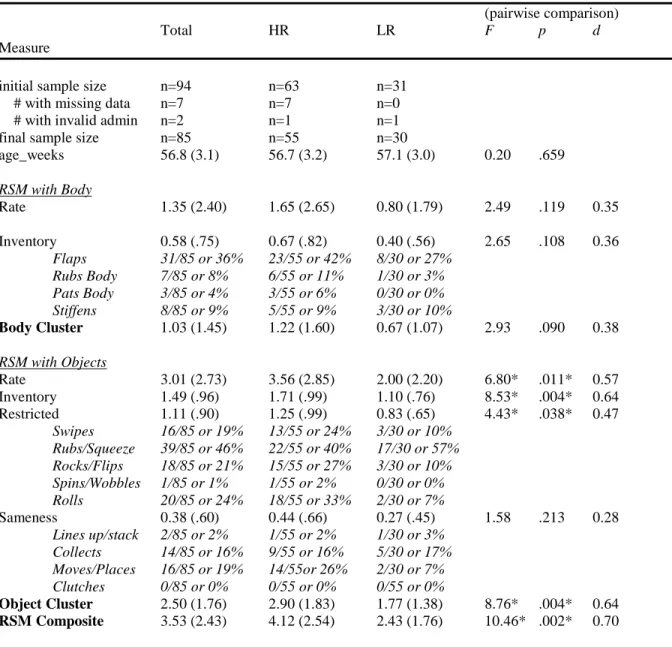
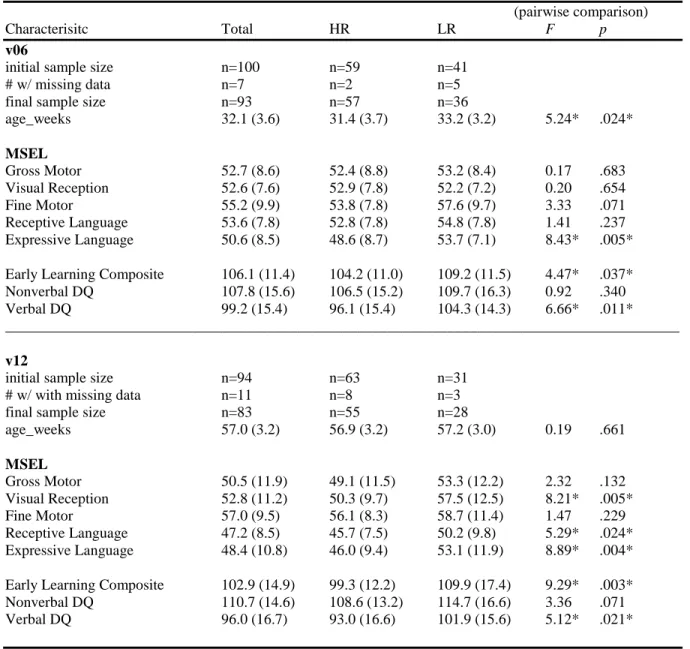
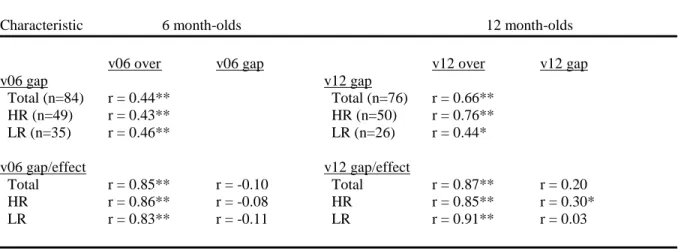
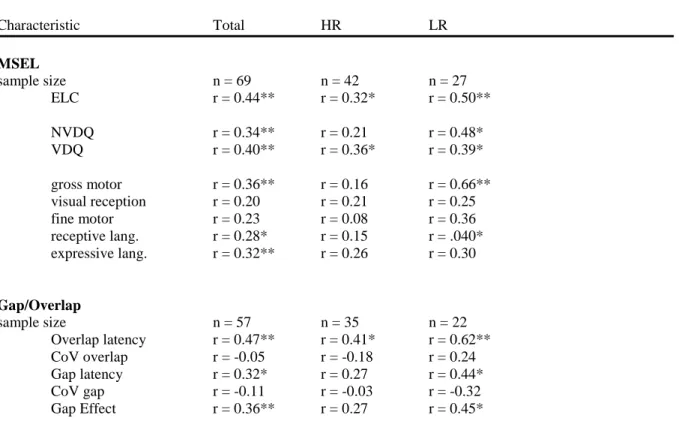
1. Summary of Repetitive and Stereotyped Movement Scales (RSMS)…………...52 2. Summary of Mullen Scales of Early Learning (MSEL) Characteristics………...53 3. Summary of Gap/Overlap Characteristics……….54 4. Cross-sectional Correlation Matrix for Gap/Overlap Variables for the Whole
Sample and by Risk Status……….55 5. Correlations between V06 and V12 Mullen and Gap/Overlap Values for the
ix
LIST OF FIGURES
Figure
CHAPTER 1
INTRODUCTION
An optimal information processor is both flexible and efficient. A suboptimal information processor is either inflexible, inefficient, or both. Inflexibility or inefficiency at important developmental periods could potentially result in atypical trajectories of cognitive development. This situation is particularly precarious during times when experience
dependent development drives the specialization of cortical circuitry (Cheour et al., 1998; Csibra et al., 2000; Kuhl et al., 1992; Pascalis, de Haan, & Nelson, 2002), such as the time period between 6 and 12 months of age.
2
The current project was designed to explore whether individual differences in the development of attentional flexibility during this time period are associated with individual differences in object exploration/manipulation at 12 months of age and whether this relation is modified by genetic liability for autism.
Autism is one form of a spectrum of related neurodevelopmental disorders
characterized by social and communication deficits and ritualistic-repetitive behaviors that are generally detected in early childhood and persist throughout life (APA, 2000). The prevalence of autism is estimated between 2-9/1000 (ADDMN, 2009; Chakrabarti &
Fombonne, 2001; Fombonne, 2009), and males are 4 times more likely to be diagnosed than females. Nearly 40% of children with autism have co-occurring intellectual disability and approximately 20% have co-occurring seizure disorder (Fombonne, 2003). Annual federal healthcare expenditures were estimated at approximately $23,000 per individual with autism in 2003 (Wang & Leslie, 2010) and the lifetime cost for families rearing a child with autism has been estimated to exceed the cost of rearing a typically developing child by over $3 million (Ganz, 2007). The notion that autism arises as an emotional response to abnormal attachment and/or suboptimal parental interactions has long been supplanted by unequivocal evidence of its genetic and neurobiological origins.
3
enhance general intellectual level in toddlers and preschoolers with autism (Dawson et al., 2009; Lovaas, 1987), the American Academy of Pediatrics (AAP) has issued a
recommendation for screening and evaluation in all infants during 18 and 24 month well-baby visits (Johnson & Myers, 2007). Research examining the early behavioral profile of autism has the potential to elucidate potential targets for early intervention. Additionally, characterizing the developmental course of symptom expression promises to yield
information related to genetic and neurobiological mechanisms that may be operating prior to the onset of the behavioral phenotype, therefore elucidating the pathogenesis of the disorder and suggesting possible targets for intervention.
As mentioned above, there is evidence indicating that autistic behaviors can be
identified between 12-14 months of age (Landa, Holman, & Garrett-Meyer, 2007; Ozonoff et al., 2010;Zwaigenbaum et al., 2005), but that children who develop autism cannot be
differentiated from children who develop typically at 6 months of age (Landa & Garrett-Meyer, 2006; Ozonoff et al., 2010; Rozga et al., 2010; Zwaigenbaum et al., 2005). These data point to a critical period for the onset of autism between 6 and 12 months, a time of rapid brain development and the emergence of a broad range of diverse cognitive and social-cognitive behaviors. Additionally, these findings suggest that more subtle phenotyping measures are needed to capture individual differences in certain domains that may lie outside the autism phenotype (i.e., attention and motor domains) at 6 months of age, which might in turn predict autistic behaviors between 12-14 months.
4
the first and second diagnostic domains (i.e., social behavior, communication) into a singular domain defined as social-communication deficits. What has been the third diagnostic
domain will become the second and is defined as ―restricted, repetitive patterns of behavior, interests, and activities,‖ hereafter labeled restricted and repetitive behavior (RRB).
Rigorous empirical investigation of RRB phenomena is a rather recent development. Social behavior, language and cognition were of central concern for many years as evidenced by a small sample of publications from current leaders in the field of autistic behavior
(Baron-Cohen, Leslie, & Frith, 1985; Dawson & Adams, 1984; Klin, 1991; Lord & Hopkins, 1986; Mundy et al., 1986; Ozonoff, Pennington, & Rogers, 1990; Shah & Frith, 1983;
Sigman & Ungerer, 1981; 1984; Stone & Caro-Martinez, 1990; Tager-Flusberg, 1981). With few exceptions (e.g., Baron-Cohen, 1989; Bartak & Rutter, 1976; McDougle et al., 1995; Ritvo, Ornitz, & LaFranchi, 1968; Sorosky et al., 1968), the phenomenology of RRBs
remained relatively unexplored in studies of autism until the late 1990‘s. In fact, clinical data published around this time suggested that the presence of RRBs failed to distinguish young children with autism from developmentally delayed controls as assessed by parent report (Lord, 1995; Stone & Hogan, 1993; Stone et al., 1999). And yet, a series of seminal
publications renewed interest in this theme (Turner, 1997; 1998; Lewis & Bodfish, 1998), the importance of which is in part reflected in the proposed changes to the DSM-V.
5
Concurrent with the goals of early identification mentioned above, examining the discrete subtypes of RRBs may assist in the discovery of unique aspects of autism pathogenesis and the development of focused interventions (Mandy & Skuse, 2008).
Guiding Questions and Primary Aims
Can comprehensive characterization of RRBs enhance early detection of autism? Is the network of associations for RRB subtypes stable over time, and if so, can we predict RRBs at 12 months of age through putative cognitive mechanisms examined at 6 months of age? Is a restricted repertoire of exploratory behavior at 12 months of age an endophenotype of the disorder? Is the presence of a circumscribed attentional pattern an intermediate
phenotype of autism? The primary aims of this study are to 1) characterize RRBs in a large cohort of 12 month-old infants, including both infants at high-risk for developing autism and low-risk, typically developing infants; and 2) demonstrate the relative contributions of attentional operations and oculomotor behavior at 6 and 12 months of age to RRBs measured at 12 months. An exploratory aim of this study is to refine the nomological network of associations for RRBs in infancy.
Background
Restricted, Repetitive Behaviors in Autism
6
2006). Furthermore, research has demonstrated that social-communication symptoms tend to diminish in severity over time, while the severity of RRBs tends to be stable across the lifespan (Piven et al., 1996; Seltzer et al., 2004). Repetitive behaviors can cause significant impairment in individuals with autism and their families; in more severe cases these
behaviors may consume the majority of waking hours of an individual and interfere with daily family activities.
RRBs are not a unitary construct. There are a variety of discrete forms of repetitive behavior that occur commonly in autism and that contribute independently to the
heterogeneity of phenotypic expression within even narrowly defined autistic disorder. This variety includes stereotyped movements, repetitive self-injury, repetitive use of objects, compulsions, daily routines, insistence on sameness, and circumscribed interests.
Furthermore, a number of separate research groups have demonstrated that the discrete forms of RRBs can reliably and validly grouped into discrete subtypes.
As expected, results from factor analytic studies depend upon the phenotyping instrument. When assessed with the gold standard parent-report diagnostic instrument, the Autism Diagnostic Interview-Revised (ADI-R, Lord et al., 1994), some results indicate 2 factor solutions that include an ―insistence on sameness‖ factor and a ―repetitive and
stereotyped motor‖ factor (Bishop, 2006; Cuccaro et al., 2003; Mooney et al., 2009; Richler et al., 2007; 2010; Szatmari et al., 2006) that corresponds with Turner‘s (1997; 1999) conceptualization of higher-order and lower-order repetitive behaviors. However, there is also evidence for a 3 factor model that includes ADI-R items tapping unusual
7
―circumscribed interest‖ is included in the model (e.g., this question is not asked of children under the age of 3 as per the ADI-R administration guidelines). The use of another
phenotyping instrument, namely the Repetitive Behavior Scales-Revised (RBS-R, Bodfish et al., 1999) has yielded factor solutions that exceed 3 subtypes (Mirenda et al., in press; Lam & Aman, 2007) reinforcing the fact that there are discrete subtypes of repetitive behavior that likely have separate neurobiological substrates and networks of associations.
Restricted, Repetitive Behaviors in Young Children with and without Autism
8
1997; Leekam et al., 2007; Tregay, Gilmour, & Charman, 2009), and the presence of these behaviors is associated with the development of sophisticated cognitive operations, namely executive functions (Tregay et al., 2009).
What RRBs distinguish typically developing infants, toddlers, and preschoolers from children who receive an early diagnosis of autism? The two primary subtypes of RRBs examined in the early autism phenotype include repetitive and stereotyped movement and insistence on sameness behaviors, both of which tend to differentiate children with autism. However, there is some question as to whether the actual behaviors that constitute these subtypes are appropriately categorized. For example, repetitive manipulation of objects (i.e., repetitive use of objects, lining up toys, etc.) often falls under the subtype of repetitive and stereotyped movements (Richler et al., 2010). While these are empirically derived subtypes, in this case from the ADI-R, research may gain theoretical leverage by considering an alternative subtype for early emerging RRBs in autism, namely a restricted repertoire of exploratory behaviors that categorizes how an infant or toddler interacts with the
environment and objects in the environment. There is accumulating evidence that children who receive diagnoses of autism at 2 or 3 years show a restricted and repetitive repertoire of object exploration and manipulation as early as 12 months (Morgan et al., 2008; Ozonoff et al., 2008; Watt et al., 2008). This data complements additional research that shows the vast majority of young children with autism show repetitive use of objects (Bishop, Richler, & Lord, 20076; Bruckner & Yoder, 2007).
9
school-aged children, and adults with developmental and/or intellectual disabilities (Symons et al., 2004). Consequently, associations with related constructs will likely differ across the lifespan. For example, rigid adherence to a daily routine (often captured under the insistence on sameness subtype of RRB) is associated with social impairments in adolescents and adults with autism (Lam et al., 2008). However, this association may not be readily apparent on a parent-report measure for a preschooler who has limited opportunities for social interaction. This example highlights developmental change in the nomological network (Cronbach & Meehl, 1955) of particular constructs, or rather, the potential for a network of associations to change across development. The presence of a changing nomological network of
associations for RRBs should directly inform attempts to extend clinical behaviors downward to younger ages, resulting in the adaptation of theoretical models to incorporate
developmentally appropriate behaviors. By considering the nomological network of associations, downward extension becomes more plausible.
Circumscribed Attentional Patterns: a Theoretical and Empirical Link to RRBs
10
the function of an ―insistence on sameness‖ behavior may change over time, the function of attentional disengagement, for example, remains relatively stable. We have shown that the vast majority of children with autism between the ages of 2 and 18, when presented with a complex visual array of images varying in categorical content, show a circumscribed attentional pattern (Elison et al., under review) characterized by reduced visual exploration, which demonstrates that this attentional pattern is stable throughout the course of autism.
To reiterate, the purpose of the proposed research is to examine relationships between individual differences in attentional flexibility in 6 and 12 month-olds and individual
11
Attention and Flexibly Attending in Infancy
The brain is a limited capacity information processor, and as such, must select certain inputs from the environment for further elaboration in the information processing stream and ignore irrelevant details that might otherwise engage valuable processing resources.
Attention functions to either bias (Desimone & Duncan, 1995) or enhance (Posner, Snyder, & Davidson, 1980) processing resources for particular stimuli. Attention can be biased or enhanced by goal oriented processes endogenous to the individual (top-down or cortex driven) or by specific attributes of a stimulus exogenous to the individual (bottom-up or mediated in part by subcortical structures). Bottom-up bias, enhancement, selection, or attentional capture can occur on a number of different stimulus categories including learned symbolic or conceptual information (Cherry, 1953; see also, Nadig et al., 2007), biologically relevant information, or visually salient information. Additionally, stimulus driven or exogenously captured attention can operate overtly in conjunction with the oculomotor system or covertly (Posner, 1980), in the absence of oculomotor movement. Covertly shifting attention and overt attentional shifting recruit some overlapping brain structures and some distinct brain structures. For example, the frontal-eye-fields are likely more active in overt selection and less active in covert shifts of attention.
12
include the brainstem (substantia nigra), superior colliculus, pulvinar, frontal eye-fields, and the lateral intraparietal area (Corbetta et al., 1998;Posner & Petersen,1990; Schiller, 1998). While the study of attention has been around since the emergence of psychology as an independent discipline, a new perspective on attention emerged with the development of procedures designed to assess specific components or operations of attention (Fantz, 1958; 1961; 1963; 1964; Posner, 1980;Saslow, 1967). However, many of the folk psychology concepts of attention are still prevalent within the scientific community. These terms
primarily relate to a state of sustained attentional engagement (e.g., Pay attention! Focus! Are you distracted?). A recent study of infants at-risk for autism fell victim to this type of
translational error in which the authors attempted to place their study within the context of a disengagement-as-operation deficit, but actually studied the state of being disengaged or distracted or detached or unfocused (Ibanez et al., 2008).
13
Orienting can be initiated endogenously and exogenously. The focus of the proposed research is on exogenous or stimulus driven orienting. For a comprehensive review of the development of voluntary/endogenous attention in infancy and early childhood see Colombo & Cheatham (2006). For a recent review of the cognitive neuroscience of attentional
orienting, see Corbetta, Patel, & Shulman (2008). Stimulus driven attentional orienting is typically elicited by an external or exogenous cue that directs attention to a target in the visual field, outside of foveal vision. The cue can appear in the periphery functioning to capture attention or it can appear in the center of a display and direct attention to a particular location.
The most common laboratory procedure for tapping attentional orienting is based on Posner‘s seminal work (Posner, 1980). Covert orienting (i.e., orienting without moving one‘s eyes) is measured by reduced reaction times in response to a correctly cued target, a phenomenon that has been termed the cue-validity effect. One variant of the procedure that detects covert orienting involves an attentional cue that appears in the periphery of a visual display (Jonides & Irwin, 1981) and this cue reflexively draws covert attention toward a location in space where a target may or may not appear. In an alternative variation of the procedure, a centrally displayed symbolic cue (e.g., an arrow or a face with eyes gazing in a particular direction) directs attention toward a peripheral location. Covertly orienting attention in response to a cue facilitates a motor and/or behavioral response. If a target is incorrectly cued or the target appears in a location other than where attention was directed, reaction times to detect that target are increased.
14
1996; Richards, 2000; 2001; 2005). Additionally, a number of studies have appeared in the autism literature attempting to isolate the covert shifting operation (for review see Elison & Reznick, in press). A survey of the shifting operation in autism (e.g., covertly attending to a peripheral cue, central nonsymbolic cue, or central symbolic cue) suggests no clear evidence of a shifting deficit (see Pruett et al., in press). However, there is accumulating evidence that individuals with autism suffer from a disengagement deficit (Elison et al., in prep; Goldberg et al., 2002; Landry & Bryson, 2004; Zwaigenbaum et al., 2005). Therefore, the
disengagement operation, as a component of the reflexive orienting system is the focus of the proposed research.
Stimulus driven orienting can be measured by overt responses to a peripheral target in conditions where no cue is presented to covertly orient attention. Overt responses can take the form of a motor response such as a button press or an oculomotor response such as latency to initiate a saccade to a target. The conventional gap/overlap paradigm specifically taps an overt oculomotor response by comparing saccadic reaction time (SRT) in two conditions (e.g. Fischer, Gezeck, & Hartnegg, 1997; Saslow, 1967). In both conditions a stimulus appears in the center of a display, after which a target appears in the periphery. In the overlap condition the central stimulus remains visible after the peripheral target appears, and in the gap condition the central stimulus disappears before the onset of the peripheral target. In the gap condition in which attention is ‗unbound‘ or ‗released‘ (or alternatively, a motor response is primed), SRTs are faster when compared to the overlap condition in which the competing stimulus remains present in the display.
15
unaware of any studies that have used this task in the context of functional neuroimaging, which may stem from the fact that eye movements introduce a substantial amount of noise into the hemodynamic signal. However, this task has been conducted in individuals across development from infancy to adulthood (Farroni et al., 1999; Fischer & Breitmeyer, 1987; Fischer, Biscaldi, & Gezeck, 1997; Klein, 2001; Munoz et al., 1998), in cognitively impaired individuals (Landry & Bryson, 2004), in nonhuman primates (Dorris & Munoz, 1995; Dorris, Pare, & Munoz, 1997; Pare & Munoz, 1996), and in infants and adults using event-related potentials (Csibra, et al., 1997; 1998; 2000; Spantekow et al., 1999).
Two separate lines of research using this task (or with conceptually similar
procedures) have remained relatively isolated from one another for the last 20 years with few exceptions (namely Farroni et al., 1999). One line was initiated in the adult cognitive
literature by Saslow (1967) and carried through the 80‘s and 90‘s by Fischer and colleagues (Fischer & Breitmeyer, 1987), Lorenz and colleagues (Fendrich, Hughes, & Reuter-Lorenz, 1991; Reuter-Reuter-Lorenz, Hughes, & Fendrich, 1991), and Kingstone and colleagues (Kingstone & Klein, 1993a; 1993b; Kingstone et al., 1995) all of whom attempted to integrate findings from nonhuman primate literature. This group of researchers was primarily interested in the gap effect, and therefore understanding performance in the gap condition was of central concern. More specifically, many of these studies aimed to
determine whether the gap effect (i.e., reduced latencies in the gap condition) was mediated primarily by motor functions or attentional functions (see Klein, Taylor, & Kingstone, 1995).
16
1974; Tronick, 1972). These researchers were primarily interested in the infant‘s ability to localize a peripheral target and quickly learned that performance was dependent upon the presence or absence of a central stimulus. This line of inquiry gained steam in the early 90‘s (Atkinson et al., 1992; Hood & Atkinson, 1990; 1993; Johnson, Posner, & Rothbart, 1990), in large part due to Posner‘s seminal work during the 80‘s, and questions pertaining to the developmental association between vision and attention contributed substantially to the field that would become developmental cognitive neuroscience (Colombo, 1995; Hood, 1995; Johnson, 1990). The observation that under certain circumstances young infants tend to perseverate on foveal objects, even in the presence of a peripheral target, motivated researchers to develop a term to describe this phenomenon, which would be referred to as obligatory attention (Stechler & Latz, 1966) or sticky fixation (Hood, 1995). Consequently, this line of inquiry would become quite interested in the disengagement operation and the overlap condition.
17
6 months, stability or slight increase between 6 and 8 months, and another decline between the 8 and 10 month period. The cross-sectional slopes of latencies in the gap condition were much less steep.
Research utilizing event-related-potentials (ERPs) has shown that 12 month-olds show evidence of a pre-saccadic spike potential over parietal regions similar to that in adults in the overlap condition (Csibra et al., 2000). Additionally, the amplitude of this spike potential correlated with the SRTs in the overlap condition. Considering that 6 month-olds do not show this ERP component (Csibra, Tucker, & Johnson, 1998) suggests that cortical control over overt oculomotor disengagement develops between 6 and 12 months, a time period directly relevant to the onset of autism.
The important question remains: how do disengagement latencies in the overlap condition correspond to flexibly attending? It should be noted that flexibly attending is not a research construct, but rather is a superordinate concept made up of subordinate research
18
disaggregate the effects of 1) motor/oculomotor development and 2) attentional functions on cognitive development. Understanding the independent contributions of oculomotor and attentional operations on general cognitive level is one way exploring and refining the construct of g, or general intelligence
An extensive body of work has characterized visual encoding or processing efficiency in infancy and subsequently demonstrated developmental continuity between early indices of visual attention and later cognitive function such as IQ and language capacity (Bornstein & Sigman, 1986; Colombo, 1993; Colombo et al., 2004; Sigman, Cohen, & Beckwith, 1997: Sigman et al., 1986; 1991). Colombo and colleagues (1990; 1993; 1999) have delineated subgroups of children and have discovered that short-looking infants in a habituation paradigm show enhanced cognitive gains in later childhood compared with long-looking infants. To reiterate, looking duration is thought to reflect encoding speed. Again, how does encoding speed relate to disengagement latencies? To my knowledge, this question has been asked in the research literature twice to date. Colombo and colleagues have shown that disengagement latencies significantly correlate with looking durations in 3 and 4 month-old infants (Blaga & Colombo, 2006; Frick, Colombo, & Saxon, 1999), but not in 7 month-old infants (Blaga & Colombo, 2006).
19
high-risk siblings who receive a diagnosis of autism show atypical patterns of disengagement (Zwaigenbaum et al., 2005). More specifically, infants who did not show the expected decrease in disengagement latency between 6 and 12 months of age subsequently received a diagnosis of autism at 24 months of age. Finally, it has been demonstrated that the vast majority of infant siblings who subsequently receive a diagnosis of autism show
abnormalities in visual tracking and visual exploration/inspection of objects at 12 months of age (Bryson et al., 2007; Ozonoff et al., 2008; Zwaigenbaum et al., 2005). Characterizing the associations between attentional and oculomotor functioning, cognitive functioning, and RRBs is the central goal of this proposal.
Infant Siblings and the Broad Autism Phenotype
The study of infant siblings of children with autism has revolutionized the field of autism research by providing a parsimonious method to prospectively capture the
developmental emergence of the autism phenotype. At 6 months of age, genetically high-risk infants who go on to develop autism cannot be differentiated on a wide range of cognitive, social, and social-cognitive measures from high-risk infants and low-risk infants who develop typically. Autistic behaviors emerge over the latter half of the first year and can be quantified between 12 and 14 months of age in a substantial proportion of infants
(Ozonoff et al., 2010; Rozga et al., in press; Zwaigenbaum et al., 2005). The examination of the early development of autism has benefited from additional methodological approaches such as retrospective reporting, retrospective video analysis, and population based screening. However, the study of infant siblings of children with autism yields unique aspects of
20
population screening studies, and increased validity when compared to retrospective reporting. Infant siblings of children with autism are deemed at-risk due to rates of
recurrence of the disorder in younger siblings of children with autism, which range between 10 and 20 % (Constantino et al., in press; Ritvo et al., 1989; L. Zwaigenbaum and the Baby Sibs Research Consortium personal communication). There is data from twin studies and adoption studies to suggest a strong role for genetic contributions to the recurrence rates (Bailey et al., 1995; Folstein & Rutter, 1977; Szatmari et al., 2000). On the contrary, there is no evidence to suggest that the recurrence rates can be accounted for by shared
environmental factors, parenting behaviors, or social modeling of the proband‘s behavior by the younger sibling. That being said, clearly a familial situation that includes a child with autism, parents managing challenging behaviors of a child with autism, and parents who themselves may present personality characteristics that are qualitatively similar to the clinical features of autism, together yield a sub-optimal developmental context.
The presence of personality characteristics that are qualitatively similar to the defining features of autism, as observed in non-autistic family members of children with autism, reflects genetic liability (Bailey et al., 1998; Piven et al., 1997; Losh et al., 2008; Szatmari et al., 2000). These characteristics are referred to as constituting a Broad Autism Phenotype (BAP) and include social deficits (e.g., aloof personality, fewer quality
friendships, etc.), communication abnormalities (e.g., language delay, pragmatic language deficits, etc.), and rigid personality attributes. Sub-clinical features, for example pragmatic language deficits, that aggregate to a greater degree in family members of children with autism are considered endophenotypes of the disorder. In the context of autism,
21
members of children with autism. Importantly, the behavior is qualitatively or quantitatively similar to a diagnostic feature of the disorder (Constantino et al., 2006). In contrast,
intermediate phenotypes refer to atypical behavioral markers observed in non-affected family members of children with autism, the behaviors of which are NOT diagnostic features of autism. Intermediate phenotypes could include attentional functioning, oculomotor
behaviors, and other social-cognitive behaviors (Losh & Piven, 2007; Mosconi et al., 2010). Not all researchers agree on this nomenclature. I have chosen to distinguish between these terms following P. Szatmari, as communicated by J. Piven. Both intermediate phenotypes and endophenotypes are considered to represent behavioral, cognitive, and/or neural attributes more proximal to underlying genetic phenotypes than the full constellation of behaviors that define the autism phenotype (Happe, Ronald, & Plomin, 2006).
The genetic liability of attributes associated with autism, or intermediate phenotypes, has been investigated in infant siblings of children with autism (e.g., Elsabbagh et al., 2009; McCleery et al., 2009). Additionally, research on endophenotypes in infant siblings has also yielded evidence of genetic liability (Toth et al., 2007). And yet, disease specific genetic liability cannot be determined unless a sufficient number of high-risk children have diagnostic outcome data (i.e., comparing HR children positive for autism (HR+) and HR children negative for autism (HR-) or unaffected siblings).
22
(Belmonte, Gomot, & Baron-Cohen, 2010; Mosconi et al., 2010). Therefore, understanding the early manifestations of attentional operations, oculomotor behavior, and stereotyped motor behaviors in infant siblings of children with autism may elucidate the genetic liability and pathogenesis of the disorder.
Current Study: Aims and Hypotheses
Specific Aim 1: To characterize individual differences in the rate and inventory of stereotyped motor behaviors and repetitive manipulation of objects in a large cohort of 12 month-olds, examine the association between repetitive behaviors and cognitive level, and compare the prevalence of repetitive behaviors between a group of infants at genetic high-risk for developing autism and a group of low-high-risk, typically developing infants.
Hypothesis: Repetitive manipulation of objects is an endophenotype of the disorder and therefore the rate of these behaviors will distinguish low-risk from high-risk infants. I also expect to see a unique association between nonverbal developmental quotient as measured by the Mullen Scales of Early Learning (MSEL; Mullen, 1995) and repetitive behaviors.
Specific Aim 2: To characterize individual differences in indices of orienting (i.e., oculomotor and attentional performance) in a large cohort of 6 and 12 month-olds, the development of these indices between 6 and 12 months of age, the concurrent and predictive association between these indices with measures of cognitive level, and the effect of genetic risk status on these constructs.
23
evidence of the gap-effect (significant difference between average latency in the gap
condition and average latency in the overlap condition) at both ages. I predict that there will be significant correlations between 6 and 12 month oculomotor performance (i.e., saccadic reaction time (SRT) in gap and overlap conditions) and attentional performance (i.e., the gap-effect value). I predict the structure of these longitudinal associations to differ by risk status, as there is reason to expect a proportion of infants in the genetic high-risk group to develop on an atypical trajectory. Lastly, I predict that 12 month performance on the gap/overlap task, specifically the gap-effect, to be associated with nonverbal developmental quotient as measured by the MSEL.
Specific Aim 3: To characterize the relative longitudinal and cross-sectional associations between oculomotor/attentional performance and repetitive behavior at 12 months of age and to evaluate whether risk status moderates this relationship.
CHAPTER 2
METHODS AND MATERIALS
Context
This study was conducted in the context of an international collaboration, the Infant Brain Imaging Study (IBIS). IBIS is ongoing and seeks to longitudinally characterize brain and behavioral development in approximately 660 infants. Genetically high-risk infant siblings of children with autism (n = ~ 540), and low-risk infant siblings of typically
developing children (n = ~120) receive brain scans and behavioral assessments at 6, 12, and 24 months at one of four clinical sites across the United States (i.e., UNC, the Children‘s Hospital of Philadelphia, Washington University in St. Louis, and University of
Washington). The scope of this project requires a collaborative network, as the probability of a younger sibling of a child with autism receiving a diagnosis is between 10-20%
(Constantino et al., in press; Ritvo et al., 1989; L. Zwaigenbaum personal communication, October, 2010). Including four data collection and clinical sites, each of which will recruit ~ 135 high-risk infant siblings is expected to yield approximately 60 children who will meet diagnostic criteria for an autism diagnosis at 24 months of age.
The primary hypotheses of IBIS attempt to elucidate atypical growth trajectories in both brain and behavior in high-risk infants who subsequently receive a diagnosis of autism. There is evidence that autistic behaviors are not present at 6 months of age but can be
25
shown that the onset of brain overgrowth in autism, a potential biomarker of the disorder, can be detected at around 12 months of age. These two findings suggest that the trajectory of development between 6 and 12 months of age may yield insight into the pathogenesis of the disorder and may also help identify specific targets for intervention.
The current study draws from data collected at the UNC site up until February 1, 2011. Recruitment and data collection are ongoing. However, the current sample size is large enough to evaluate important questions that don‘t require a complete data set. All procedures were reviewed and approved by the Biomedical Institutional Review Board through the School of Medicine, University of North Carolina at Chapel Hill.
Participants
A total of 113 infants participated in the current study. Infant siblings of children with autism were recruited through both national and local recruitment efforts. Local recruitment relies heavily on the statewide autism research registry that enrolls ~ 500
individuals with autism annually through visits to one of 9 regional centers (current census of ~5000 individuals with autism and ~3200 families). National recruitment efforts include a joint website recruiting for the entire IBIS network, presentations at national meetings, advertisements in nationally distributed publications, and ―e-blasts‖ from Autism Speaks. Recruitment efforts are designed to target enrollment of high-risk infants at 6 months of age. However, high-risk infants can also enter the study at 12 months of age if they meet a certain criterion on the First Year Inventory (FYI). The FYI was developed to assess
26
Social Communication Questionnaire (SCQ: Berument et al., 1999) and the Autism
Diagnostic Interview – Revised (ADI-R: Lord, Rutter, & LeCouteur, 1994). For the current investigation, 76 genetically high-risk infants have enrolled in the study. Thirteen were enrolled as new recruits at approximately 12 months of age and 59 were enrolled at approximately 6 months of age. Of those infants enrolled at 6 months, 50 have been followed up at approximately 12 months of age. Four families/children did not return for a 12 month visit.
Low-risk infant siblings of typically developing children were recruited through community resources (e.g., advertisements in local newspapers, child care centers, emails to UNC faculty and staff) and the Child Development Research Registry (CDRR). The CDRR operates within the Research Participant Registry Core supported by the Carolina Institute for Developmental Disabilities, and includes contact information for parents of typically
developing infants and children. For the current project, 41 low-risk infants of typically developing children were enrolled at approximately 6 months of age, and 31 of these infants have been followed up at 12 months of age. One family did not return for their 12 month visit.
Upon inspection of the demographic information, the groups did not differ in sex ratio (~60% male) or race/ethnicity (~85% white). The increased percentage of males enrolled likely reflects public awareness of the sex ratio in autism.
27
sclerosis, congenital heart disease) or sensory impairments such as significant vision or hearing loss (or evidence of such impairment during the course of study); 3) birth weights less than 2000 grams and/or gestational ages of less than 37 weeks, a history of significant perinatal adversity, exposure in-utero to neurotoxins (including alcohol, illicit drugs, selected prescription medications), or a history of maternal gestational diabetes, in order to reduce the possibility of including children who may have suffered significant perinatal injury; 4) a contraindication for MRI (pacemaker, vascular stents, metallic ear tubes, other metal implants or braces); 5) a predominant home language other than English; 6) having been adopted; 7) evidence of the FMR1 expansion for Fragile X Syndrome; and 8) a family history of a 1° degree relative with mental retardation, psychosis, schizophrenia, bipolar disorder. Low risk infants were excluded for a family history of a first degree or second degree relative with autism or if the low risk proband (older sibling) showed any evidence of autism on the SCQ (Berument et al., 1999).
Experimental Measures
Restricted and Repetitive Behavior
28
30 minutes. The digitally recorded interaction during the CSBS Behavioral Sample provides the context from which RRBs are extracted.
The Repetitive and Stereotyped Movement Scales (RSMS; Morgan et al., 2008) is a clinical coding scheme designed as a companion to the CSBS Behavioral Sample. The development of the RSMS was informed by two previous studies of repetitive manipulation of objects and stereotyped movements. The Systematic Observation of Red Flags (SORF) for autism spectrum disorders in young children identified repetitive movements with objects and repetitive movements or posturing of the body, arms, hands, or fingers as 2 of 9 red flag behaviors that differentiated young children with autism from typically developing children and children with developmental delay (Wetherby et al., 2004). A follow-up study using Noldus Observer for detailed micro-behavioral coding examined these two behavioral constructs and showed that children with autism exhibited a significantly higher frequency and longer durations of repetitive and stereotyped motor behaviors and repetitive and
stereotyped manipulation of objects than both typically developing toddlers and toddlers with developmental delay (Watt et al., 2008).
The RSMS was developed to capture the rate and inventory of stereotyped motor behaviors and repetitive manipulation of objects in real time, in contrast to the
29
stacks objects, and 9) clutches object. Many of the coding parameters were derived from those established by the seminal work of Thelen (1979; 1981). The coding scheme yields 2 sub-domain scores and a total RSM composite score. The body cluster subdomain score is derived from the total rate of stereotyped body movements divided by three + the number of different stereotyped motor behaviors exhibited by the child (i.e., the inventory). The object cluster subdomain score is derived in the same fashion.
I trained to reliability with the developers of the coding scheme and have manually coded every assessment blind to risk status of the child.
Gap Overlap Task
The gap overlap task was administered to each participant at 6 and 12 months of age. The task measures oculomotor and attentional performance and consists of two conditions. In both conditions a central stimulus appears for a variable duration of fixation period (to eliminate statistical contingencies in the presentation of the visual targets). A target then appears at approximately 8.0° of visual angle in the right or left periphery of the visual display. In the gap condition the central stimulus disappears after the initial fixation period and is followed by a brief temporal gap of 250 msec that precedes the onset of the peripheral target. In the overlap condition the peripheral target appears to the left or right of the visual display while the central stimulus remains visible. I have modified the original version of this task in order to characterize the effect of stimulus type on attentional/oculomotor metrics. This was achieved by including complex stimuli that vary in categorical content.
30
for easy and accessible task administration. The equipment calculates point-of-regard for both eyes based on reflection patterns of near infrared light from the pupil and cornea at a sampling rate of 50 Hz (spatial resolution is 0.25° and accuracy of ~ 0.5°). The system allows for head motion within a cubic space of 30 x 15 x 20 cm at a distance of 60 cm, which allows the participant to view the stimuli in a naturalistic manner. At 60 cm, the 17 inch visual display (~34 cm wide) subtends a visual angle of ~32°.
All children were tested in a darkened room with no visual or auditory distractions. Infants sat on their caregivers lap during the task administration. The eyes of the caregivers were generally out of the field of view of the infrared sensors. If there was ever a question as to whether the caregiver‘s eyes were in the field of view, they were asked to close their eyes, wear sunglasses, or turn their head to the side of the display.
The task was presented in Clearview, proprietary software designed specifically for Tobii products. All of the stimuli were static images, subtending a visual angle of
approximately 5.3° x 5.3° and varied in categorical content between social (i.e., 10 individual faces; 5 adults displaying happy expressions drawn from the NimStim face set (Tottenham et al., 2009), and 5 faces of infants and toddlers showing happy expressions) and nonsocial (10 images: e.g., a pumpkin, ball, flowers, geometric shapes, fruit, toys, etc.) exemplar images.
31
than 3 consecutive trials. The trial presentation was also paced to account for varying
degrees of stamina/fatigue in infant participants. This means that if an infant completed only 20 total trials, there would be equal representation of the trial types among the 20 completed (e.g., approximately 5 social overlap, 5 social gap, 5 nonsocial overlap, and 5 nonsocial gap).
For the current study, specific hypotheses pertain only to oculomotor and attentional orienting away from complex stimuli, therefore, social and nonsocial image categories are collapsed across condition. The following parameters were extracted for analyses: saccadic reaction time (SRT; latency to initiate an eye movement away from the center toward the peripheral target) for both gap and overlap conditions, the coefficient of variation (CoV; standard deviation/mean latency) for both gap and overlap conditions, and the gap-effect (difference between average latencies in the gap and overlap conditions). The gap-effect is thought to represent the additional processing time for three distinct neural components; 1)
oculomotor preparation that is induced by the offset of an event in the visual field, 2) the
fixation offset effect that is induced by the offset of an event in foveal vision, and 3)
oculomotor and attentional disengagement from a foveal stimulus (Fischer & Breitmeyer, 1987; Klein, Taylor, & Kingstone, 1995). Furthermore, I will extract difference scores between 6 month gap and overlap latencies and 12 month gap and overlap latencies as there is evidence from the extant literature that change in overlap latencies may be an important predictor of autism (Zwaigenbaum et al., 2005)
A custom Matlab script written in our lab extracted timestamps for each trial from the raw data file exported from Clearview (Tobii software). However, the author visually
32
timestamp at which the point-of-regard of at least one eye was no longer on the central image and moving in the correct direction toward the peripheral target, and 3) the timestamp that indicated the point-of-regard of at least one eye was on the peripheral target. Latency to initiate a saccade is the difference between 1 and 2. Saccade rate is the difference between 2 and 3. Saccades from the central image to the peripheral target (visual angle of ~ 8.0°) are included as valid if they occur between 100 and 1000 msec after the onset of the peripheral target, the first movement away from the center of the display is in the correct direction, and if the point of regard for at least one eye was on the central image for at least 500 msec prior to the shift in the overlap condition and 750 msec prior to the shift in gap condition. In order to accurately represent individual performance within a given condition, trials were also excluded if SRTs were more than 2 standard deviations from the nearest data point within a given condition (e.g., social overlap) for a given individual (Ratcliff, 1993). These trials always had latencies near the upper limit (i.e., 1000 msec), and occurred on less than 1% of all trials initially deemed valid. These trials were then binned with a specific type of invalid trial defined as ―late response or no movement away from the center,‖ which was
characterized for all infants by trial type.
It has been recommended and there is precedent in the extant literature to include an index of the number and nature of invalid trials (Canfield et al., 1997; Fischer, Gezeck, & Hartnegg, 1997). Some examples of invalid trials include 1) recording artifacts, 2) directional errors or erratic eye gaze behavior, 3) anticipatory saccades in the correct
33
the validity of the operational definition and the reliability of performance in the task. In the current task design, valid and invalid trials are mutually exclusive categories (e.g., if A then NOT B, if B then NOT A: represented via a probability statement as P (A or B) = P(A) + P(B)). Because trials are binned as either valid or invalid and are thus mutually exclusive, one event cannot occur without directly affecting the alternative. Therefore, IF a systematic bias occurs for trial types characterized as invalid, THEN this would be represented in the number of valid trials. In order to identify systematic biases in trial type inclusion OR exclusion, summary statistics of valid trials and inference tests on these values will be conducted.
34
Standardized Cognitive Assessment of Developmental Level
The Mullen Scales of Early Learning (MSEL: Mullen 1995) is administered at 6 and 12 months of age. The MSEL is an experimenter administered, standardized measure of cognitive and motor development for infants and preschool aged children from birth to 68 months, and assesses skills and abilities in five domains: gross motor, visual reception, fine motor, receptive language, and expressive language. This measure yields a composite score reflecting overall cognitive ability as well as subdomain scores (T-score, percentile rank, and age equivalence). Following precedent (Wetherby et al., 2004), a nonverbal developmental quotient (hereafter NVDQ) and verbal developmental quotient (hereafter VDQ) will be derived from the raw Mullen data. The NVDQ is derived from the average age equivalent scores from the fine motor and visual reception domains divided by the age at assessment multiplied by 100 (i.e., mental age/chronological age X 100). The same formula is used to derive the VDQ from the receptive and expressive language subscales. Norms were derived from a sample of children ranging in age from 2 days to 69 months (Mullen, 1995).
Analytic Strategy
35
SA 1. To characterize individual differences in the rate and inventory of stereotyped motor behaviors and repetitive manipulation of objects in a large cohort of 12 month-olds, examine the association between repetitive behaviors and cognitive level, and compare the prevalence of repetitive behaviors between high-risk and low risk-infants. First the
association between the body cluster index (a weighted linear combination of the rate and inventory of stereotyped motor behaviors) and the object cluster index (a weighted linear combination of the rate and inventory of repetitive manipulations of objects) was examined in order to justify including the RSM composite (linear combination of the two cluster
scores) in further analyses. Using the whole sample, the General Linear Model (PROC GLM in SAS) was used to subject these three dependent variables (body cluster, object cluster, RSM composite) to a Multivariate Analysis of Covariance (MANCOVA) with age, gender, and NVDQ included as independent predictors. Nonverbal developmental quotient was used as the index of cognitive functioning due to precedent in the literature that suggests
nonverbal IQ/performance IQ may be associated with lower-order repetitive behaviors in older samples of children. I then tested the effect of risk status by including this variable in the previous model. Exploratory analyses examined the effect of individual MSEL subscales on these dependent variables with and without the inclusion of the risk factor variable.
36
greater mean SRTs in the overlap condition when compared with the gap condition. The developmental associations between 6 and 12 month overlap latency, coefficient of variation in the overlap condition, gap latency, coefficient of variation in the gap condition, and the gap-effect value (difference between gap and overlap latencies) were examined with
bivariate Pearson correlations for the whole sample and for each group separately. Predictive and concurrent associations between the oculomotor indices and cognitive level were
examined using a MANOVA with and without risk status entered as a between group factor. As in SA1, the nonverbal developmental quotient was the primary index of cognitive level. Exploratory analyses were conducted that examined the association between oculomotor behavior and the Mullen subscales.
CHAPTER 3
RESULTS
SA1. To characterize individual differences in the rate and inventory of stereotyped motor behaviors and repetitive manipulation of objects in a large cohort of 12 month-olds, examine the association between repetitive behaviors and cognitive level, and compare the prevalence of repetitive behaviors between high-risk and low risk-infants. Infants with valid RSMS values did not differ from infants without RSMS values in age or NVDQ (p > 0.541). Bivariate Pearson correlations between the body cluster variable and the object cluster variable for the whole sample and by each group independently showed that the body cluster is not statistically correlated with the object cluster [rs (85, 55, 35) < 0.13 and ps > 0.22]. This analysis justified including a linear combination of the two subdomain scores to yield the RSM composite score. Summary scores and results from a MANOVA including risk status as a between-subject factor are reported in Table 1. Considering the sample as a whole, a MANCOVA revealed a unique main effect of NVDQ on the object cluster F (1, 73) = 6.62, p < 0.05, η2 = 0.08 and the RSM composite F (1, 73) = 4.65, p < 0.05, η2 = 0.06, such that lower nonverbal cognitive ability was associated with a higher rate of repetitive
38
The same model was recalculated after including risk status as a between-subject factor. There were no significant associations for the body cluster. However, the analysis revealed a unique main effect of risk status on the object cluster F (1, 72) = 4.23, p < 0.05, η2 = 0.09 and the RSM composite F (1, 72) = 5.03, p < 0.05, η2 = 0.10. Nonverbal
developmental quotient was also uniquely associated with the object cluster F (1, 72) = 4.29,
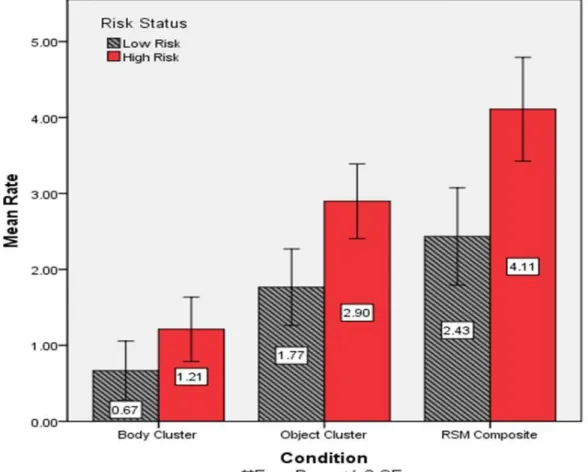
p < 0.05, η2 = 0.05, but the risk status by NVDQ interaction was not significant. As observed in Table 1, the high-risk children showed greater rates of repetitive manipulation of objects and a broader inventory of these behaviors when compared with the low-risk infants. Figure 1 represents group differences for the RSMS variables. Again, gender and age had no effect on repetitive behavior.
Exploratory analyses revealed no predictive relationship between cognitive level at 6 months with repetitive behaviors at 12 months. An additional exploratory analysis of the repetitive behavior dependent variables included the individual subscales of the MSEL as predictor variables and revealed a single unique association between the standardized gross motor score and the object cluster in the whole sample F (1, 71) = 5.73, p < 0.05, η2 = 0.03 and when including risk status as an additional predictor F (1, 70) = 6.70, p < 0.05, η2 = 0.04. Considered together, risk status and gross motor ability accounted for 13% of the variance in the object cluster score.
39
infants who had an insufficient number of trials or who were not tested on the task in age or NVDQ (p‘s > 0.432). No differences were observed between the number of valid trials by
condition across the entire sample nor were there differences between groups in the number of valid trials by condition (p‘s > 0.701). Nor was there a difference in the rate by which a
child failed to disengage from the central stimulus (p > 0.4). This invalid trial was
characterized as ―late response (greater than 1000 msec) or no saccadic shift away from the center.‖ See Table 3 for summary data on the gap/overlap task.
A 2x2x2 repeated measures ANOVA on the coefficient of variation with risk status as the between-group factor and both time (6 and 12 months) and condition (gap and overlap) as within-group factors yielded a unique main effect of condition F(1,55) = 4.80, p < 0.001, η2 = 0.66, but no unique effect of risk status or a risk status by condition interaction. This indicates that at both 6 and 12 months of age, the coefficient of variation is higher in the overlap condition than in the gap condition for all infants.
40
As shown in Table 4, cross-sectional Pearson bivariate correlation matrices were generated for the entire sample and by risk status, in order to examine the relationship between average gap latency, average overlap latency, and the gap-effect value (difference score between average overlap latency and average gap latency). The developmental
association between 6 and 12 month gap/overlap performance along with 6-12 month MSEL levels are summarized in Table 5. We observed strong correlations between 6 and 12 month gap latency, overlap latency, and gap-effect values for the whole sample. However,
examining the correlation structure of gap/overlap performance by group reveals a divergent pattern. Importantly, the high-risk group showed evidence of a significant correlation
between 6 and 12 month overlap latency r (35) = 0.41, p < 0.05, similar to the low risk group
r (22) = 0.62, p < 0.01. The high-risk group did not show a significant association between either the average gap latency or the gap-effect value, and furthermore, the magnitude of correlation was substantially smaller in the high-risk group than the low-risk group for these values.
A 2x2x2 repeated measures ANOVA with time and condition as within-group factors and risk status as a between-group factor revealed unique main effects of time F(1,55) = 64.61, p < 0.001, η2 = 0.54, condition F(1,55) = 413.27, p < 0.001, η2 = 0.88, and the interaction between risk status and condition F(1,55) = 4.77, p < 0.05, η2 = 0.08. These results demonstrate that the task successfully elicited different performance parameters in the gap and overlap conditions and that the task is sensitive to development over time.
41
No significant concurrent associations emerged between MSEL variables (composites or subscales) and latencies in the gap/overlap task at 6 months of age. Nor did significant associations emerge between 12 month gap/overlap performance and MSEL composite scores (ELC nor NVDQ). Exploratory analyses of the MSEL subscales revealed a unique significant association between the fine motor standardized score and 12 month gap latencies in the whole sample F(1, 66) = 4.24, p < 0.05 and when risk status is included F(1, 65) = 4.33, p < 0.05.
An additional exploratory analysis (2x2 repeated measures ANCOVA) revealed that risk status significantly predicted the gap effect value at 12 months of age F(1, 51) = 6.49, p
< 0.05, η2 = 0.11 when controlling for NVDQ. A final exploratory analysis examined the association between changes in overlap latencies from 6 to 12 months and revealed no association between risk status and/or MSEL composite scores.
SA 3: To characterize the relative longitudinal and cross-sectional associations between oculomotor/attentional performance and repetitive behavior at 12 months of age and to evaluate whether risk status moderates this relationship. There were no significant
42
manipulation of objects in the whole sample was significantly predicted by both NVDQ and the change in overlap latencies from 6 to 12 months F(2, 48) = 3.40, p < 0.05, but the unique main effect of the overlap change was not statistically significant F(1, 48) = 2.51, p = 0.12.
Lastly, risk status was entered as a between-subject factor into the general linear models produced in the preceding paragraph (i.e., predicting repetitive behavior with gap/overlap metrics while controlling for NVDQ). No significant effects emerged for the 6 month gap/overlap data. Nor were the 12 month gap latency, overlap latency or the gap-effect value unique predictors of repetitive behavior above and beyond risk status and NVDQ. However, examining the effect of the change in overlap latency between 6 and 12 months of age on repetitive behavior while controlling for risk status and NVDQ revealed an overall main effect on the object cluster variable F(3, 47) = 5.79, p < 0.005. The change in overlap latency accounted for a unique portion of variance in the object cluster, above and beyond risk status and NVDQ, F(1, 47) = 4.48, p < 0.05, η2 = 0.87. Considered together, risk status, NVDQ, and change in overlap latency from 6 to 12 months accounted for
CHAPTER 4
DISCUSSION
In the present study I sought to examine the association between repetitive behaviors, cognitive level, and metrics of oculomotor and attentional functioning in a large cohort of infants. Repetitive behaviors were manually coded in the context of a structured
experimenter administered assessment designed to elicit social and communicative behaviors (Morgan et al., 2008). Oculomotor and attentional performance was measured in the
traditional gap/overlap paradigm (Fischer et al., 1997), modified to include complex stimuli as central and peripheral targets. Cognitive level was ascertained using a standardized behavioral assessment (Mullen, 1995). An additional aim of the study sought to characterize differential effects of genetic liability for autism by comparing a large group of high-risk infant siblings of children with autism and a control group of low-risk infant siblings of typically developing children. The overarching goal of the research was to characterize individual differences in behavioral and attentional patterns that could eventually 1) enhance early identification of autism and/or 2) facilitate the search for autism related genetic markers by characterizing an endophenotype of the disorder early in development.
Summary of Findings for the Whole Sample
44
repetitive object manipulation decreased (c.f. SA1). Considered together, cognitive level and the change in overlap latency between 6 and 12 months of age also predicted the rate of repetitive object manipulation across the whole sample (c.f., SA3). Infants who showed less of a developmental decrease in overlap latencies between 6 and 12 months showed more repetitive object manipulation. Furthermore, the gap/overlap paradigm yielded significant developmental differences between 6 and 12 months of age as well as clear evidence of the gap effect at both ages. Interestingly, the experimental manipulation in the gap/overlap paradigm not only resulted in a gap effect for SRTs, but also for the coefficient of variation, such that the coefficient of variation was consistently higher in the overlap condition when compared to the gap condition (c.f., SA2).
Summary of Findings when Including Risk Status
The primary findings reported for the whole sample also remained when including risk status as an additional independent variable. As reported in Table 1 and illustrated in Figure 1, high-risk infants showed more repetitive object manipulation and a broader
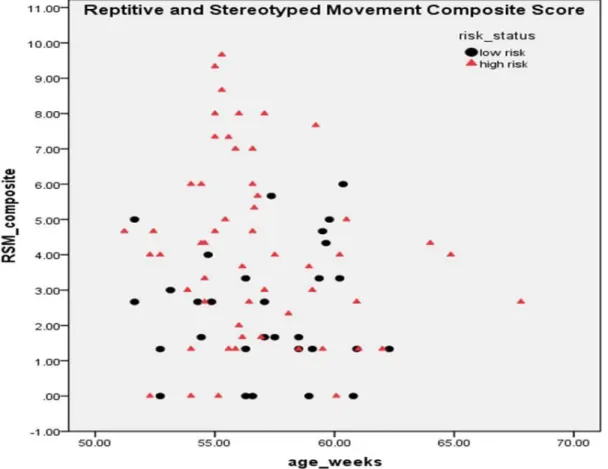
inventory of these behaviors than did age-matched low-risk infants (c.f., SA1). Of particular interest, inspection of the RSM composite scores (Figure 2) revealed a cluster of high-risk infants that showed more repetitive behaviors than all of the other infants. This cluster included 11 high-risk infants, or 20% of the sample. As noted earlier, the probability of a younger sibling of a child with autism receiving a diagnosis is between 10-20% (Constantino et al., in press; Ritvo et al., 1989; L. Zwaigenbaum personal communication, October, 2010).
45
in the expected direction between 6 and 12 months of age (c.f., SA2). However, the magnitude of the gap-effect at 12 months differentiated the group of high-risk infants from low-risk infants, when controlling for nonverbal developmental quotient. To reiterate the gap-effect is the difference between average overlap latency and average gap latency and is thought to represent the cumulative effect of three distinct components of neural processing; 1) oculomotor preparation that is induced by the offset of an event in the visual field, 2) the
fixation offset effect that is induced by the offset of an event in foveal vision, and 3)
oculomotor and attentional disengagement from a foveal stimulus (Fischer & Breitmeyer, 1987; Klein, Taylor, & Kingstone, 1995).
Finally, we demonstrated that developmental change in the overlap latency between 6 and 12 months is significantly associated with repetitive object manipulation above and beyond both risk status and nonverbal developmental quotient (c.f., SA3). When considered together, risk status, NVDQ, and the 6-12 month change in overlap latency accounted for 27% of the variance in the rate of repetitive object manipulation.
Orienting to Object Exploration
46
significant concurrent associations between nonverbal cognitive level and repetitive behavior in 12 month-olds. A similarly extensive literature has characterized the association between executive/anterior attentional capacities and repetitive behaviors (Agam et al., 2010; Mosconi et al., 2009; Sasson et al., 2008; Thakkar, et al., 2008). Considering an underdeveloped anterior attention system in 12 month-olds, we showed that individual differences in posterior attention systems are significantly associated with repetitive behaviors in this age group. Future studies will examine whether individual differences in posterior attention systems predict individual differences in anterior attention performance.
One strength of this approach was to isolate an attentional capacity that1) has been implicated in autism and 2) was expected to show developmental continuity between 6 and 12 months of age. Leveraging preliminary findings from Zwaigenbaum et al., (2005) that indicated 5 out 20 high-risk infants did not show decreases in the overlap latency between 6 and 12 months and all 5 went on to meet diagnostic criteria for autism at 24 months of age, we reasoned that a similar attentional trajectory (i.e., NOT becoming more flexible with one‘s attentional resources) would contribute to a restricted pattern of exploration that could be captured in the nature of object manipulation. This hypothesis was confirmed in the data. Our finding in 55 risk infants also corresponds with empirical data indicating that high-risk infants who received a diagnosis of autism at age 2 or 3 showed unusual object