ORIGINAL ARTICLE
Integrating family planning services into HIV care: use of a point-of-care
electronic medical record system in Lilongwe, Malawi
Hannock Tweyaa,b, Caryl Feldacker c, Lisa B. Haddadd, Chimango Munthalie, Mwatha Bwanalie, Colin Speightb, Layout G. Kachereb, Petros Temboband Sam Phirib,f,g
aCenter for Operational Research, The International Union Against Tuberculosis and Lung Disease, Paris, France;bMonitoring and Evaluation Department, Lighthouse Trust, Lilongwe, Malawi;cInternational Training and Education Center for Health, University of Washington, Seattle, WA, USA;dDepartment of and Obstetrics, Emory University School of Medicine, Atlanta, GA, USA;eDepartment of Informatics, Baobab Health Trust, Lilongwe, Malawi;fDepartment of Medicine, University of North Carolina School of Medicine, Chapel Hill, NC, USA;gLilongwe, Department of Public Health, College of Medicine, School of Public Health and Family Medicine, University of Malawi, Malawi
ABSTRACT
Background: Integrating family planning (FP) services into human immunodeficiency virus (HIV) clinical care helps improve access to contraceptives for women living with HIV. However, high patient volumes may limit providers’ability to counsel women about pregnancy risks and contraceptive options.
Objectives: To assess trends in the use of contraceptive methods after implementing an electronic medical record (EMR) system with FP questions and determine the reasons for non-use of contraceptives among women of reproductive age (15–49 years) receiving antiretro-viral therapy (ART) at the Martin Preuss Center clinic in Malawi.
Methods: In February 2012, two FP questions were incorporated into the ART EMR system (initialFP EMR module) to prompt providers to offer contraceptives to women. In July 2013, additional questions were added to the FP EMR module (enhanced FP EMR) to prompt providers to assess risks of unintended pregnancies, solicit reasons for non-use of contra-ceptives and offer contracontra-ceptives to non-pregnant women . We conducted a retrospective, longitudinal cohort study using the EMR routinely collected data. The primary outcome was the use of any modern contraceptive method. Descriptive statistics were used to describe the study population and report trends in contraceptive use during the initial and enhanced study periods.
Results: Between February 2012 and December 2016, in HIV clinics, 20,253 women of
reproductive age received ART, resulting in 163,325 clinic visits observations. The proportion of women using contraceptives increased significantly from 18% to 39% between February 2012 and June 2013, and from 39% to 67% between July 2013 and December 2016 (chi-square for trend p < 0.001). Common reasons reported for the non-use of contraceptives among those at risk of unintended pregnancy were: pregnancy ambivalence (n = 234, 51%) and never thought about it (n = 133, 29%).
Conclusion: Incorporating the FP EMR module into HIV clinical care prompted healthcare workers to encourage the use of contraceptives.
ARTICLE HISTORY
Received 29 May 2017 Accepted 20 September 2017
RESPONSIBLE EDITOR
Jennifer Stewart Williams, Umeå University, Sweden
KEYWORDS
Family planning services; integration; contraceptives; electronic medical record system; antiretroviral therapy; Malawi; sub-Saharan Africa
Background
The scale-up of antiretroviral therapy (ART) for people living with human immunodeficiency virus (PLHIV) in sub-Saharan Africa (SSA) is one of the most remarkable achievements in public health in the past decade. In 2015, approximately 12.1 mil-lion PLHIV were on ART in the region [1]. The availability of ART has considerably decreased mortality and morbidity and improved quality of life [2,3]. This, together with the cultural signifi-cance of parenthood, may be reason for the increased fertility rates that have been observed in populations of women on ART in several SSA settings [4–6]. Helping women living with HIV
achieve their family planning (FP) intentions is an important public health objective in SSA.
SSA has the lowest rate of contraceptive use in the world; only 28% of married women in SSA used modern contraceptive methods in 2015 [7]. The fertility rate in Malawi is 4.4 per woman and is one of the highest in SSA. Yet, it is estimated that 41% of pregnancies in Malawi are unintended [8]. The prevention of unintended pregnancy is a critical public health issue for HIV-positive women. There are significant consequences such as HIV-related maternal morbidity [9], the vertical transmission of HIV [10], mental health problems [11], and financial and social costs. In SSA, FP
CONTACTHannock Tweya [email protected] The International Union Against Tuberculosis and Lung Disease, Paris, France https://doi.org/10.1080/16549716.2017.1383724
© 2017 The Author(s). Published by Informa UK Limited, trading as Taylor & Francis Group.
services are mostly provided in clinics that are not connected to HIV clinics. However, a growing body of evidence suggests that integrating FP ser-vices into HIV care can be a way of increasing contraceptive use among HIV-positive women [12–14].
In 2010, the Lighthouse Trust in Malawi piloted the integration of FP services into routine HIV care at the Lighthouse Clinic. A wide range of modern contraceptives were offered to HIV posi-tive women. The pilot demonstrated that the inte-gration of FP services into HIV care is achievable, is well received by women on ART and can lead to an increased uptake of contraceptives [15]. In 2011, the Malawi HIV programme integrated FP services into HIV clinical care in all ART facilities [16]. Healthcare providers were encouraged to routinely provide condoms to all adults receiving HIV care and offer all women, as a minimum, an injectable contraceptive, Depot medroxyprogester-one Acetate, (DMPA). In 2016, 23% of women on ART in Malawi were on DMPA provided within the country’s ART clinics [17].
Although the coordinated integration of FP services into HIV services is starting to occur, health system strengthening is challenged by inadequate enforcement of policies and guidelines, limited resources and fund-ing, and a lack of leadership [18,19]. In addition, providers in HIV settings faced with high patient numbers often have limited time to counsel women about pregnancy risks and contraceptive options. Some women are therefore unable to access available FP services in HIV clinics. Ensuring that women receive comprehensive FP services remains a critical challenge for HIV clinical care.
One innovative means of addressing FP integration in HIV care is user-friendly, point-of-care (POC) elec-tronic medical record (EMR) systems; A POC EMR system is a digital version of a paper chart that com-bines data collection and patient care processes simul-taneously, making both the past and current medical history of the patient available to the provider. EMR systems can improve healthcare by increasing adher-ence to therapeutic guidelines and protocols, inform-ing clinical decisions and limitinform-ing medication errors [20,21]. The use of POC EMR systems in HIV care can offer opportunities to improve adherence to FP guide-lines and ensure that women of reproductive age (15– 49 years) are offered FP services when they receive their HIV clinical care. This paper: describes the use of EMR systems to support healthcare providers to better meet the FP needs of HIV-infected women of repro-ductive age; investigates trends in contraceptive use among these women; and explores some of the reasons for the non-use of contraceptives among women at a high volume HIV clinic in Lilongwe, Malawi.
Methods
Study design and setting
We conducted a retrospective, longitudinal, cohort analysis of 20,253 HIV-positive women aged 15–49 who accessed ART services between 17 February 2012 and 31 December 2016, at a public ART clinic, the Martin Preuss Centre (MPC) at Bwaila Hospital situ-ated in urban Lilongwe, Malawi. During this time, there were 163,325 clinic visits among these women. The Lighthouse Trust operates two public ART clinics, the MPC and the Lighthouse Clinic. These are described in detail elsewhere [22]. In brief, both clinics are located in Malawi’s capital, Lilongwe. The clinics use an ART EMR system for the clinical man-agement of ART patients. The EMR system was developed by Baobab Health Trust, a local non-gov-ernmental organization that leads the development of EMR systems in Malawi in collaboration with the Lighthouse Trust. The ART EMR is real-time, POC, intranet-based software that employs the MySQL OpenMRS data model. The EMR system uses touchscreen technology with terminals in reception and clinical consultation rooms [23]. Key EMR sys-tem components include the registration of demo-graphics and anthropometric measurements, WHO HIV clinical staging, tuberculosis screening, record of pregnancy status, clinical review, drug dispensing, and the management of laboratory samples and test results (CD4 count, viral load, etc.). Data manage-ment is now entirely based on the EMR system resulting in near complete patient level data [23]. The system also allows documentation of co-morbid-ities and infections such as hypertension and cancer. ART visits for new patients are scheduled monthly for the first six months on ART, and every two or three months thereafter if no clinical complications occur. ART programme outcomes (alive and on ART, lost to follow-up (LTFU), stopped ART, dead or transferred-out) are updated in EMRs at each clinic visit or retrospectively. LTFU is defined as failure to come to the clinic for at least 60 days from the patient’s appointment date.
Although integrated FP services were piloted at Lighthouse Clinic in 2010, the FP questions were not incorporated in the EMR until July 2014.
Data for this analysis were obtained from the POC EMR system at MPC. In December 2016, the MPC had approximately 22,000 ART patients in care (10,887 or 49% of women of reproductive age), There were, on average, 450 attendances each day.
Integration of FP services at MPC
of HIV guidelines, the MPC integrated FP services into HIV clinical care. Healthcare providers routi-nely offered condoms and DMPA to women. Initially, some contraceptive methods were not offered at MPC because of its location adjacent to a family health unit [15]. Women who preferred other contraceptives were referred to this unit which was just 60 meters away, in the grounds of Bwaila Hospital. On 17 February 2012, the Lighthouse Trust, in partnership with Baobab Health Trust, incorporated two FP questions (initial FP EMR module) into the ART EMR. The initial FP EMR module prompted providers to ask women about their contraceptive use and methods. In July 2013, the initial FP EMR module was enhanced by prompting providers to assess non-pregnant women for risks of unintended pregnancy, solicit reasons for the non-use of contraceptives, counsel patients, and offer condoms and DMPA to women. Women who preferred other types of contraceptives were referred to the family health unit. Possible self-reported reasons for contraceptive non-use included: partner’s wish, religion, fear of side effects, never thought about it and uninterested. Women were classified as ‘not at risk’ of unintended preg-nancy if they were not sexually active, wanted to become pregnant or did not need contraceptives because of medical reasons (e.g. hysterectomy). The enhanced FP EMR separately prompted health providers to offer condoms during the consultation timeframe. In February 2015, FP services were fully integrated at MPC. Providers were trained in FP services and a wide range of long-acting reversible contraceptive (LARC) methods were offered within the ART clinic. These methods included oral contra-ceptive pills (OCPs), DMPA, copper intrauterine devices (IUDs) and contraceptive implants. From that point forwards, patients were informed about the availability of FP services through both oral and visual methods such as flip charts and films.
Data management and variables
Clinical and other data for all women, aged 15–49 years, who accessed ART between 17 February 2012 and 31 December 2016 were extracted from the EMR system. The following variables were generated from the EMR: age, clinic visit date, preg-nancy status, contraceptive use (yes or no), names of contraceptive methods, offered contraceptive meth-ods, offered dual contraceptive methmeth-ods, reasons for not using contraceptive methods, ART programme outcome and outcome date. Information on marital status was not included as this is not captured in the EMR.
For the purposes of the analysis, each woman’s index visit was identified within three
monthscalendar quarter. A visit close to the middle of each quarter was selected as the woman’s index visit. The implementation of the integrated FP mod-ule was in two stages: 1) the initial FP EMR modmod-ule (February 2012 to June 2013), and 2) the enhanced FP EMR module (July 2013 to December 2016) which includes the period of more comprehensive integra-tion of FP services from February 2015. Women who were given ART during both of these periods were included in the analysis that covered both stages.
Contraceptive methods were categorized as: 1) implants; 2) DMPA; 3) OCPs; 4) other highly effec-tive contracepeffec-tives (IUDs, tubal ligation and vasect-omy); and 5) less effective contraceptive methods (female/male condoms and traditional methods). Dual contraceptive methods were defined as con-doms plus any other effective contraceptive methods recommended by the World Health Organization (e.g. sterilization, hormonal methods (implant, OCPs, DMPA), IUDs) [24].
Statistical analysis
The primary outcome was contraceptive use, which was defined as the self-reported use of any modern contraceptive method during the index visit. We calcu-lated the proportion of contraceptive use as the number of women reported using contraceptives at the time of their ART clinic visit over the total number of non-pregnant women who accessed ART care during each quarter. The denominator included some women who were not sexually active because 1) sexual activity status may change within a short time and 2) women might have falsely reported not being sexually active due to the sensitivity of discussing their sexual life.
Descriptive statistics were undertaken. They included the median and interquartile range (IQR) for the women’s age, and frequencies for categorical variables (proportions of contraceptive use, contraceptive assess-ment, contraceptive methods, reasons for non-use, etc.). We analysed information reported as reasons for contra-ceptive non-use at the time of the first FP review during the implementation of the enhanced EMR FP module. We acknowledge that reasons for non-use might change over time. The chi-square test for trend was used to test for statistically significant change in the proportion of women using contraceptives over time.
Results
implementation of initial FP EMR module and 18,013 women received ART during the implementation of the enhanced EMR FP module. On average, informa-tion on contraceptive use was not available for 16% of the clinic visits. The median age of the women was 30 (IQR: 25–35) years at first review. Between February 2012 and June 2013, the use of contraceptives increased significantly from 18% to 39% during implementation of the initial FP EMR module, and from 39% to 67% during the implementation of the enhanced FP EMR module (chi-square for trend p < 0.001) (Figure 1).
Figure 2 presents the flow diagram of contracep-tive use and reasons for non-use at the first FP review during the implementation of the enhanced EMR FP module. Only the enhanced EMR module prompted providers to ascertain their reasons for non-use. Of the 18,013 women who accessed ART services during the enhanced FP EMR module, 3852 (22%) were pregnant and pregnancy status was unknown in 617 (3%). Of the 13,544 non-pregnant women, use of contraceptives was unknown in 1737 (13%) of women. Out of the remaining 11,807 women, 5870 (50%) were using FP contraceptive methods. Of these
Figure 1.Contraceptive use among HIV-positive women of reproductive age accessing antiretroviral therapy in Lilongwe, Malawi (N = 20,253).
41% used DMPA, 26% used less effective methods, 17% used other highly effective methods, 11% had implants and 4% used OCPs. Of the 5,939 women who were not using contraceptives, the risk of unin-tended pregnancy was not established in 61(1%) women. Of the remaining 5878 women, 459 (8%) were found to be at risk of unintended pregnancy and 5419 (92%) not at risk. Of those who were not at risk of becoming pregnant, 310 (6%) reported that they wanted to become pregnant, 332 (6%) had med-ical reasons for not requiring contraceptives, and 4767 (88%) reported that they were not sexually active. All women who were at risk of unintended pregnancy during the implementation of the enhanced FP EMR period were asked to give reasons for not using contraceptives. Reasons given included: pregnancy ambivalence [n = 234, 51%], never thought about it [n = 133, 29%], fear of side effects [n = 47, 10%], and husband’s wish [n = 37, 8%]. Women who were at risk of unintended pregnancy were offered contraceptives: 56 (12%) women started using contraceptives on the same day, 141 (31%) wanted to seek their partner’s approval and 261 (57%) declined. At six-month follow-up, 339 (74%) of the 459 at risk women were still in care and 18 (5%) of these women were at risk of unintended pregnancy.
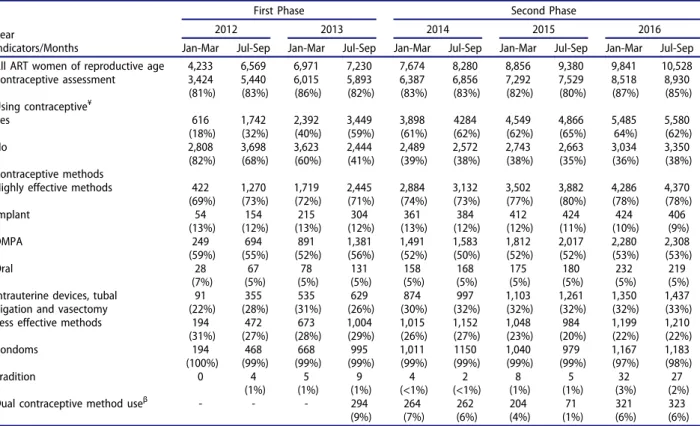
The use of more effective contraceptives increased from 69% to 78%, during the study period largely because of the increase in the use of IUD, tubal
ligation and vasectomy (chi-square for trend, p < 0.001) (Table 1). DMPA was the most common contraceptive method (53%). The use of OCPs remained constant at 5%. The proportion of dual contraceptive method use remained low over time (< 10%) while the proportion of less effective meth-ods declined from 31% to 22%.
Discussion
This study reports on the development, implementa-tion and evaluaimplementa-tion of an EMR-based intervenimplementa-tion designed to prompt providers to facilitate access to contraceptives among HIV-infected women in ART care in Malawi. Contraceptive use increased signifi-cantly during the intervention and providers identi-fied reasons for non-use that can be considered in future ART programmes that integrate FP. There was a rapid increase in contraceptive use during the implementation of the enhanced FP EMR module compared with the initial FP EMR module, possibly due to increased counselling and FP-related commu-nication with the women.
This study demonstrates the benefits of using a FP-focused EMR in HIV clinics with high patient volume. The FP EMR helps ensure adherence to guidelines and should be included as an important strategy to successfully integrate provider-initiated FP services into HIV clinical care. Human resource shortages may inhibit integration of FP services in
Table 1.Frequency and percentage distribution of ART women aged 15− 49, by contraceptive use and method in selected calendar quarters, 2012 to 2016.
First Phase Second Phase
Year 2012 2013 2014 2015 2016
Indicators/Months Jan-Mar Jul-Sep Jan-Mar Jul-Sep Jan-Mar Jul-Sep Jan-Mar Jul-Sep Jan-Mar Jul-Sep All ART women of reproductive age 4,233 6,569 6,971 7,230 7,674 8,280 8,856 9,380 9,841 10,528 Contraceptive assessment 3,424
(81%) 5,440 (83%) 6,015 (86%) 5,893 (82%) 6,387 (83%) 6,856 (83%) 7,292 (82%) 7,529 (80%) 8,518 (87%) 8,930 (85%) Using contraceptive¥
Yes 616 (18%) 1,742 (32%) 2,392 (40%) 3,449 (59%) 3,898 (61%) 4284 (62%) 4,549 (62%) 4,866 (65%) 5,485 64%) 5,580 (62%) No 2,808 (82%) 3,698 (68%) 3,623 (60%) 2,444 (41%) 2,489 (39%) 2,572 (38%) 2,743 (38%) 2,663 (35%) 3,034 (36%) 3,350 (38%) Contraceptive methods
Highly effective methods 422 (69%) 1,270 (73%) 1,719 (72%) 2,445 (71%) 2,884 (74%) 3,132 (73%) 3,502 (77%) 3,882 (80%) 4,286 (78%) 4,370 (78%) Implant 54 (13%) 154 (12%) 215 (13%) 304 (12%) 361 (13%) 384 (12%) 412 (12%) 424 (11%) 424 (10%) 406 (9%) DMPA 249 (59%) 694 (55%) 891 (52%) 1,381 (56%) 1,491 (52%) 1,583 (50%) 1,812 (52%) 2,017 (52%) 2,280 (53%) 2,308 (53%) Oral 28 (7%) 67 (5%) 78 (5%) 131 (5%) 158 (5%) 168 (5%) 175 (5%) 180 (5%) 232 (5%) 219 (5%) Intrauterine devices, tubal
ligation and vasectomy
91 (22%) 355 (28%) 535 (31%) 629 (26%) 874 (30%) 997 (32%) 1,103 (32%) 1,261 (32%) 1,350 (32%) 1,437 (33%) Less effective methods 194
(31%) 472 (27%) 673 (28%) 1,004 (29%) 1,015 (26%) 1,152 (27%) 1,048 (23%) 984 (20%) 1,199 (22%) 1,210 (22%) Condoms 194 (100%) 468 (99%) 668 (99%) 995 (99%) 1,011 (99%) 1150 (99%) 1,040 (99%) 979 (99%) 1,167 (97%) 1,183 (98%)
Tradition 0 4
(1%) 5 (1%) 9 (1%) 4 (<1%) 2 (<1%) 8 (1%) 5 (1%) 32 (3%) 27 (2%)
Dual contraceptive method useβ - - - 294
(9%) 264 (7%) 262 (6%) 204 (4%) 71 (1%) 321 (6%) 323 (6%) ¥Chi-square for trend p < 0.001;βDual contraceptive method use was defined as use of condoms plus any other effective contraceptive methods
limited resource settings [19]. Although task shifting and decentralization merit consideration in addres-sing shortages of healthcare workers [25], healthcare providers in high HIV prevalence settings still strug-gle to cope with high ART patient volumes. The high patient volumes negatively impact on providers’ abil-ity to address broad and diverse patient needs. In this study, contraceptive use increased from 18% to 67% during the study period. The proportion of contra-ceptive use observed at MPC in 2016 is higher than both Malawi’s national average of 58% [8] and the average of 42% for HIV-positive women attending Lighthouse Clinics and 29% reported by Phiri et al. [15]. The data from Phiri et al. [15] were for the period, August 2010 to February 2013, before inte-grated FP services were offered at MPC. Although not all increases in the observed contraceptive prevalence can be attributed exclusively to the FP EMR, the FP-based EMR helps to ensure that healthcare providers adhere to FP guidelines, including providing consis-tent ongoing FP counselling. These results strongly suggest that the FP-EMR prompts contribute to the observed increase in contraceptive use.
During the intervention an increase in modern contraceptives use was observed. This was largely due to an increase in highly effective contraceptives such IUDs, tubal ligation and vasectomy. These highly effective contraceptives were accessed through referral to the nearby family health clinic during the study period. Ensuring the availability of these meth-ods is a way of helping HIV-infected women attain their fertility goals. The relatively constant use of DMPA and OCPs during the study period also sug-gests that women may prefer to remain with known familiar methods. However, expanding access to a broad contraceptive mix is important for providing options to women who wish to better space their pregnancies or delay childbearing.
The enhanced FP EMR module offered a struc-tured prompt to providers for discussion of reasons for non-use with women within a short consultation timeframe. This brief counselling and education com-munication is repeated at each visit, and this approach may help dispel common misconceptions about contraceptives and assist women to make informed contraceptive choices. Addressing these FP issues at every visit is important because an indivi-dual’s FP needs may change. The enhanced FP EMR may also assist providers to recognize and address the full range of FP needs for ART patients within the constraints of their high clinic workloads. This enables providers to identify individuals who are planning pregnancies but also need information on safe conception practices. Unlike previous studies that evaluated reasons for non-use [26,27], the study showed that pregnancy ambivalence and ‘never thought about it’ were the most common reasons.
With knowledge of contraceptive methods almost universal in Malawi [8], it was expected that indeci-sion associated with modern contraceptive methods would not be so common a reason for non-use in this population. Moreover, almost a third of the women reported not being sexually active. While many of these women may not be at risk of unwanted preg-nancy, it is possible that some women did not want to discuss their sexual life with providers. This high-lights that having prompts may not be enough to ensure that FP assessment for contraceptive needs is suitable for all women. Other factors may limit the provider’s ability to address all relevant issues during the clinic consultation. Increased attention to provi-der–patient interactions and ensuring a sensitive enabling environment for the discussion of sensitive issues should be considered in future interventions.
Unfortunately, few women (6%) reported dual-method use, highlighting that, despite an increase in pregnancy prevention, protection from sexually transmitted infections and HIV transmission to unin-fected partners is inadequate. Although these findings are not surprising [28,29], the decreasing trend in condom use both alone and in conjunction with other more effective contraceptive methods is con-cerning. The EMR routinely prompts health provi-ders to offer condoms to all adults in ART clinics, yet despite these attempts, the use of condoms in combi-nation with other contraceptives remains low. In another study in Malawi, the most common reason for the non-use of condoms was related to the male partner [30]. Women required their partner’s approval, indicating the crucial role that male part-ners have in reproductive choices [31]. Given the importance of condom use for dual prevention, the development of novel condom promotion strategies that take into account the role of the male partners should be promoted to encourage the use of condoms among HIV-infected women and their partners. Providers could also be encouraged to ensure ongoing counselling on HIV prevention as part of the FP-centered conversation.
Limitations
Nevertheless, the rapid increase in contraceptive use after implementation of the FP EMR module strongly suggests the positive effect of the intervention on contraceptive use. Last, men and male partners were not included in the FP EMR.We did not attempt to investigate FP issues for HIV-infected men on ART.
Conclusions
Overall, for HIV programmes with high patient volumes, the use of EMR systems for integrated FP services may assist in prompting healthcare workers to offer contraceptives to women who need them and also improve the documentation of contraceptive usage. Despite the positive effects of the FP EMR mod-ule, few women used dual contraceptive methods. Follow-up research could further improve the benefits of the FP EMR by exploring factors that reduce dual-method uptake, examining the provider–patient rela-tionship, and gaining improved understanding of preg-nancy ambivalence among this population.
Acknowledgements
The authors would like to thank women who were involved in the study, Baobab Health Trust, Reproductive Health Unit within the Ministry of Health in Malawi, all the staff and numerous donors supporting the Martin Preuss Centre. We thank the Department for International Development (DFD), UK, for funding the Global Operational Research Fellowship Program at the International Union Against Tuberculosis and Lung Disease (The Union), Paris, France in which Dr Hannock Tweya works as a senior operational research fellow.
Author contributions
CF, LBH, CS and HT conceived and developed the con-cept. CM, MB, HT, CS and SP developed the system, CS and HT contributed to the analysis, and HT wrote the first draft of the manuscript. LGK, SP and PT reviewed and commented on the analysis. All authors read and approved the final manuscript.
Disclosure statement
No potential conflict of interest was reported by the authors.
Ethics and consent
The Malawi National Health Science Research Committee in Lilongwe granted an approval for all analyses of routine programme data that cover this study. No personal identi-fiers were extracted: the datasets were de-identified and pseudo study IDs were assigned to study participants and used throughout. The Ethics Board waived the need for patient consent in the study because the study used routine programme data and did not include any personal identifier.
Funding information
None
Paper context
In high HIV prevalence settings, healthcare providers are unable to properly counsel women about contraceptive options due to high patient volumes in HIV clinics. We implemented a family planning focused, electronic medical record system in an ART clinic to ensure that women are educated and offered the contraception method of their choice. This information may help providers working in high HIV prevalence settings to more successfully integrate FP services into HIV clinical care.
ORCID
Caryl Feldacker http://orcid.org/0000-0002-8152-6754
References
[1] UNAIDS. Global AIDS update 2016. UNAIDS: Geneva; 2016. [cited 2017 Apr 30]. Available from:
http://www.unaids.org/sites/default/files/media_asset/ global-AIDS-update-2016_en.pdf
[2] Jahn A, Floyd S, Crampin AC, et al. Population-level effect of HIV on adult mortality and early evidence of reversal after introduction of antiretroviral therapy in Malawi. Lancet.2008;371:1603–1611.
[3] Alibhai A, Martin LJ, Kipp W, et al. Quality of life of HIV patients in a rural area of western Uganda: impact of a community-based antiretroviral treatment program. Curr HIV Res.2010;8:370–378.
[4] Tweya H, Feldacker C, Breeze E, et al. Incidence of pregnancy among women accessing antiretroviral therapy in urban Malawi: a retrospective cohort study. AIDS Behav.2012;17:471–478.
[5] Mmbaga EJ, Leyna GH, Ezekiel MJ, et al. Fertility desire and intention of people living with HIV/AIDS in Tanzania: a call for restructuring care and treat-ment services. BMC Public Health.2013;30:86. [6] Cooper D, Harries J, Myer L, et al.‘Life is still going
on’: reproductive intentions among HIV-positive women and men in South Africa. Soc Sci Med.
2007;65:274–283.
[7] United Nations Department of Economic and Social Affairs Population Division. Trends in contraceptive use worldwide 2015 (ST/ESA/SER.A/349). United Nations: New York; 2015.
[8] National Statistical Office (NSO) [Malawi] and ICF. Malawi Demographic and Health Survey 2015-16. Zomba: NSO and ICF;2017.
[9] Calvert C. Ronsmans C. HIV and the risk of direct obstetric complications: a systematic review and meta-analysis. PLoS One.2013;8(10): e74848.
[10] Halperin DT, Stover J, Reynolds HW. Benefits and costs of expanding access to family planning programs to women living with HIV. AIDS. 2009;23:SS123– S130.
[12] Church K, Mayhew SH. Integration of STI and HIV prevention, care, and treatment into family planning services: a review of the literature. Stud Fam Plann.
2009;40:171–186.
[13] Kennedy CE, Spaulding AB, Brickley D, et al. Linking sexual and reproductive health and HIV interventions: a systematic review. J Int AIDS Soc.2010;13:26. [14] GNP+, ICW, IPPF, UNAIDS, UNFPA W and YP. Rapid
assessment tool for sexual & reproductive health and hiv linkages: a generic guide. 2008. [cited 2017 Apr 30]. Available from: http://data.unaids.org/pub/Manual/ 2009/2009_rapid_assesment_brochure_en.pdf
[15] Phiri S, Feldacker C, Chaweza T, et al. Integrating reproductive health services into HIV care: strategies for successful implementation in a low-resource HIV clinic in Lilongwe, Malawi. J Fam Plan Reprod Heal Care. 2016;42:17–23.
[16] Malawi Ministry of Health. Clinical management of HIV in children and adults: Malawi integrated guide-lines for providing HIV services. 1st ed. Lilongwe (Malawi): Malawi Ministry of Health;2011.
[17] Malawi Ministry of Health. Government of Malawi Ministry of Health, Integrated HIV Program Report July - September 2016. Lilongwe (Malawi): Malawi Ministry of Health;2016. p. 1–68.
[18] Dickinson C, Attawell K, Druce N. Progress on scaling up integrated services for sexual and reproductive
health and HIV. Bull World Health Organ.
2009;87:846–851.
[19] Smit JA, Church K, Milford C, et al. Key informant perspectives on policy- and service-level challenges and opportunities for delivering integrated sexual and reproductive health and HIV care in South Africa. BMC Health Serv Res.2012;27:48.
[20] Chaudhry B, Wang J, Wu S, et al. Systematic review: impact of health information technology on quality, efficiency, and costs of medical care. Ann Intern Med.
2006;144:742–752.
[21] Blumenthal D, Glaser JP. Information technology comes to medicine. N Engl J Med. 2007;356:2527– 2534.
[22] Feldacker C, Johnson D, Hosseinipour M, et al. Who starts? factors associated with starting antiretroviral therapy among eligible patients in two, public HIV clinics in Lilongwe, Malawi. PLoS One.2012;7:11. [23] Douglas GP, Gadabu OJ, Joukes S, et al. Using
touchscreen electronic medical record systems to sup-port and monitor National Scale-Up of Antiretroviral Therapy in Malawi. PLoS Med.2010;7:e1000319. [24] SAfAIDS. Dual protection against unwanted
preg-nancy and HIV/STDs. Sex Health Exch.1998;3:8. [25] World Health Organization. Task shifting: rational
redistribution of tasks among health workforce teams. Geneva (Swirtzerland): World Health Organization; 2008. [cited 2017 Apr 30]. Available from: www.who.int/healthsystems/TTR-TaskShifting. pdf
[26] Chipeta EK, Chimwaza W, Kalilani-Phiri L. Contraceptive knowledge, beliefs and attitudes in rural Malawi: misinformation, misbeliefs and misper-ceptions. Malawi Med J.2010;22:38–41.
[27] Sedgh G, Hussain R. Reasons for contraceptive nonuse among women having unmet need for contraception
in developing countries. Stud Fam Plann.
2014;45:151–169.
[28] Antelman G, Medley A, Mbatia R, et al. Pregnancy desire and dual method contraceptive use among peo-ple living with HIV attending clinical care in Kenya, Namibia and Tanzania. J Fam Plan Reprod Heal Care.
2015;41:e1–e1.
[29] Chibwesha CJ, Li MS, Matoba CK, et al. Modern contraceptive and dual method use among HIV-infected women in Lusaka, Zambia. Infect Dis Obstet Gynecol.2011;2011:261453.
[30] Haddad LB, Feldacker C, Jamieson DJ, et al. Pregnancy prevention and condom use practices among HIV-infected women on antiretroviral therapy seeking family planning in Lilongwe, Malawi. Pacheco AG, editor. PLoS One.2015;10:e0121039.