The Human Sodium Iodide Symporter as a Reporter Gene for
Studying Middle East Respiratory Syndrome Coronavirus
Pathogenesis
Svetlana Chefer,aJurgen Seidel,aAdam S. Cockrell,bBoyd Yount,bJeffrey Solomon,cKatie R. Hagen,aDavid X. Liu,a Louis M. Huzella,aMia R. Kumar,dElena Postnikova,aJ. Kyle Bohannon,aMatthew G. Lackemeyer,aKurt Cooper,a Ariel Endlich-Frazier,dHeema Sharma,dDavid Thomasson,aChristopher Bartos,aPhilip J. Sayre,aAmy Sims,bJulie Dyall,a Michael R. Holbrook,aPeter B. Jahrling,a,dRalph S. Baric,bReed F. Johnsond
aIntegrated Research Facility, National Institute of Allergy and Infectious Diseases, National Institutes of Health,
Frederick, Maryland, USA
bDepartment of Epidemiology, University of North Carolina—Chapel Hill, Chapel Hill, North Carolina, USA
cClinical Research Directorate/Clinical Monitoring Research Program, Leidos Biomedical Research, Inc.,
Frederick National Laboratory for Cancer Research, Frederick, Maryland, USA
dEmerging Viral Pathogens Section, Laboratory of Immunoregulation, Division of Intramural Research, National
Institute of Allergy and Infectious Diseases, National Institutes of Health, Frederick, Maryland, USA
ABSTRACT Single photon emission computed tomography (SPECT) is frequently
used in oncology and cardiology to evaluate disease progression and/or treatment efficacy. Such technology allows for real-time evaluation of disease progression and when applied to studying infectious diseases may provide insight into pathogenesis. Insertion of a SPECT-compatible reporter gene into a virus may provide insight into mechanisms of pathogenesis and viral tropism. The human sodium iodide symporter (hNIS), a SPECT and positron emission tomography reporter gene, was inserted into Middle East respiratory syndrome coronavirus (MERS-CoV), a recently emerged virus that can cause severe respiratory disease and death in afflicted humans to obtain a quantifiable and sensitive marker for viral replication to further MERS-CoV animal model development. The recombinant virus was evaluated for fitness, stability, and reporter gene functionality. The recombinant and parental viruses demonstrated equal fitness in terms of peak titer and replication kinetics, were stable for up to six in vitro passages, and were functional. Further in vivoevaluation indicated variable stability, but resolution limits hampered in vivo functional evaluation. These data support the further development of hNIS for monitoring infection in animal models of viral disease.
IMPORTANCE Advanced medical imaging such as single photon emission computed
tomography with computed tomography (SPECT/CT) enhances fields such as oncol-ogy and cardioloncol-ogy. Application of SPECT/CT, magnetic resonance imaging, and pos-itron emission tomography to infectious disease may enhance pathogenesis studies and provide alternate biomarkers of disease progression. The experiments described in this article focus on insertion of a SPECT/CT-compatible reporter gene into MERS-CoV to demonstrate that a functional SPECT/CT reporter gene can be inserted into a virus.
KEYWORDS MERS, coronavirus, medical imaging, reporter gene
R
ecombinant viruses expressing reporter genes such as luciferase or fluorescent proteins or viral proteins fused with a reporter protein have been used as screeningReceived28 September 2018Accepted26 October 2018 Published12 December 2018
CitationChefer S, Seidel J, Cockrell AS, Yount B, Solomon J, Hagen KR, Liu DX, Huzella LM, Kumar MR, Postnikova E, Bohannon JK, Lackemeyer MG, Cooper K, Endlich-Frazier A, Sharma H, Thomasson D, Bartos C, Sayre PJ, Sims A, Dyall J, Holbrook MR, Jahrling PB, Baric RS, Johnson RF. 2018. The human sodium iodide symporter as a reporter gene for studying Middle East respiratory syndrome coronavirus pathogenesis. mSphere 3:e00540-18.https://doi.org/10.1128/mSphere .00540-18.
EditorMatthew B. Frieman, University of Maryland, College Park
This is a work of the U.S. Government and is not subject to copyright protection in the United States. Foreign copyrights may apply.
Address correspondence to Reed F. Johnson, [email protected].
exper-imentsarefrequentlyhamperedbysacrificingthesubjecttoidentifythesourceofthe reporter gene signal (5–7). Applying medical imaging technology, such as single photon emission computed tomography(SPECT) or positron emission tomography (PET),toanimalmodelsofhumaninfectiousdiseaseprovidesthecapabilitytoserially monitoranatomicalandphysiologicalresponsestoinfectioninthesamesubjectthat can be clinically translated. Generating avirus that carries aSPECT/PET-compatible reporter genefurthers thatcapabilitybyserial,real-timeevaluation ofviruskinetics, identification of tissuetropism, and determination of pathogenicmechanisms. The humansodiumiodidesymporter(hNIS)genehasemergedasoneofthemost prom-isingreporter genes inpreclinicalandtranslationalresearch foroncologyandgene therapy(8,9).
The hNIS symporter is an intrinsic plasma membrane protein belonging to the sodium/solute symporter family, which drives negatively charged solutes into the cytoplasmusingasodiumionelectrochemicalgradient(10).TheadvantagesofhNIS as animagingreportergeneincludeitsrelativelysmallsize(⬃2kb),wideavailability of substrates,suchasradioiodines,tetrafluoroborate,and99mTc-pertechnetate,and well-understoodmetabolismandclearancemechanismsofthesesubstrates(11).Oncolytic viruses such asmeasles virusandreplication-deficient adenovirusthat containhNIS havedemonstratedvalueastheranostics,ashNIS isusedbothasatherapeuticplatform andtotrackthetherapeuticeffect(8,9).Inaddition,hNIS isunlikelytoperturbthe underlyingcellbiochemistry,andnonegativeeffectsofresultantsodiuminfluxhave been observed (12). Finally, onceincorporated into theviralgenome, the relatively small sizeof thereporter geneislesslikelythanlargerreporter genestoalter viral pathogenicproperties(13).
MiddleEastrespiratorysyndrome-CoV(MERS-CoV)recentlyemergedandis associ-atedwithMiddleEastrespiratorysyndrome(MERS),asevere,frequentlylethal pneu-moniainhumans(14–16).Viralpathogenesisisnotwellunderstood,inpart,because of limited autopsy information and a lack of animal models that fully recapitulate humandisease.Aswithmostlethalinfectiousdiseases,animalmodelsarethe corner-stone for preclinical countermeasure evaluation and understanding pathogenesis. MERS-CoVprovidesauniqueopportunitytoincorporatereportergenetechnologyto better understand viralpathogenesis because its largergenome size may be more amenabletoreportergeneinsertionthanotherviruses.
AnimalmodelsforMERSareunderdevelopmentwithnosinglemodelidentifiedas thestandard.NewWorldandOldWorldnonhumanprimatesinfectedwithMERS-CoV develop transient respiratory disease with little or no virus replication and varying disease outcome (17–19). MERS-CoV-exposed New Zealand White rabbits develop limitedlungpathologywithevidenceofviralreplicationbutdidnotshowovertclinical signs of disease (20, 21). Transgenic mice globally expressing the human CD26/ dipeptidylpeptidase4(DPP4)receptor(22),expressingthehumanreceptorunderthe murinepromoter(23)ortransducedwithDPP4receptor(24)becomepermissivetothe virusbutdonot developfulminant,lethalrespiratorydisease.Therefore, changesin reportergenesignalmayserveasabiomarkerforcountermeasureevaluation.
TheobjectiveofthisstudywastoincorporatehNIS intoMERS-CoVtoimprovethe MERSanimalmodels.IncorporationofaSPECT/PET-compatiblereportergenewithan emergingvirussuchasMERS-CoV requiresfunctional evaluationoftherecombinant virustoensuresimilarfitnesstotheparentalpathogen.Wehypothesizedthatinsertion ofhNISwouldresultinstableexpressionofaSPECT/PET-compatiblereportergene.A recombinantMERS-CoV carryinghNIS (rMERS-CoV/hNIS)wasgenerated. Weassessed the stability, fitness, andfunctionality of this recombinantpathogen in vitro andin CRISPR-generatedtransgenicmicethatsupportreplicationofwild-typeMERS-CoV(25).
RESULTS
multi-FIG 1 Kinetics of rMERS-CoV/hNISand parentalrMERS-CoV replication inVero E6cells. (aandb)
Multistep(a)andone-step(b)growthcurvesofVeroE6cellsinfectedwithrMERS-CoV(Parental)and
rMERS-CoV/hNIS(hNIS).Quantificationofthereleaseofinfectiousvirusat theindicatedtimepoints
(hourspostexposure)wasdeterminedbyplaqueassays.Eachdatapointrepresentsthemean⫾ standard
deviation(SD)(errorbar)averagedfromthreeindependentexperiments.(candd)Cytopathologyof
rMERS-CoV andrMERS-CoV/hNISinVeroE6cells.The cellswereinfectedwitheitherrMERS-CoVor
rMERS-CoV/hNISatanMOIof0.01(c)or3(d)andanalyzedbylightmicroscopyattheindicatedtime
points.Photomicrographsweretakenusinga40⫻ objective.
plicityofinfection(MOI)of0.01withapeakinvirusyieldof4log10plaque-forming units(PFU)/mlat24h.AtanMOIof3,viralyieldspeakedat7log10PFU/mlat48hand plateauedat72hpostinfection(Fig.1aandb).Thecorrelationsbetweenthemultistep growth curvesfor cells infected at an MOI of 0.01 g (r ⫽0.96Pearson correlation, P ⫽0.0082) (Fig. 1a) and one-step growth curves of cells infected at an MOI of 3 (r ⫽0.90,P ⫽0.03)(Fig.1b)forbothviruseswerehigh.Bothviruseshadcomparable cytopathiceffects(Fig.1candd).
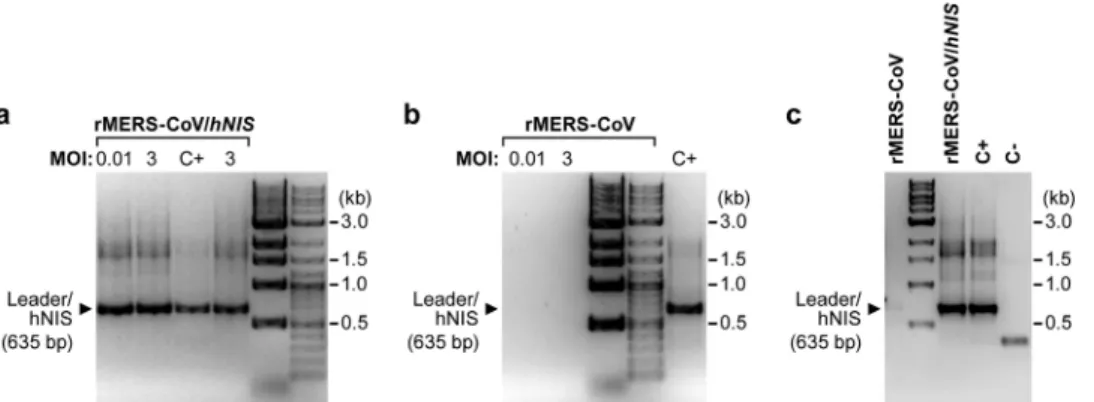
Expression of the hNIS transgene was evaluated by reverse transcriptase PCR (RT-PCR)usingprimerstospecificallydetecthNISexpressionbyMERS-CoV.The result-ing635-bpPCRproductincludestheMERS-CoVleadersequenceandaportionofthe hNIS transgene.RT-PCRconfirmedhNIS expressioninrMERS-CoV/hNIS-infectedVeroE6 cellsupto96h(Fig.2a).ThePCRproductwasnotdetectedinparental rMERS-CoV-infectedcells(Fig.2b).TheRT-PCRassaywasalsoperformedtodeterminethestability of the hNIS transgene following serial passage. The hNIS transgene was stable in rMERS-CoV/hNISforuptosixcellculturepassages(Fig.2c).
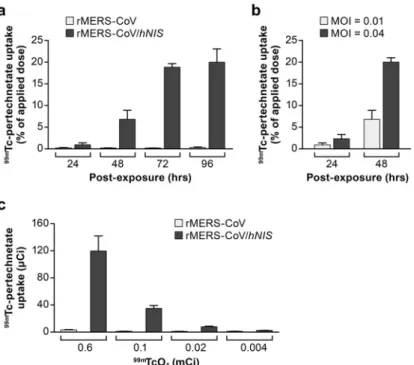
99mTc-pertechnetate uptake was dependent on the virus MOI (Fig. 4b). Higher MOI
was associated with greater accumulation of99mTc-pertechnetate by rMERS-CoV/hNIS -infected cells.
Uptake by rMERS-CoV/hNIS-infected cells was also dependent on the dose of 99mTc-pertechnetate (Fig. 4c). The relationship between radioactivity measured by the
gamma camera on plate images and the dose of99mTc-pertechnetate added to each well was linear with high correlation (R2 ⫽ 0.99, linear regression). At 96 hours postinfection with an MOI of 0.01, uptake was slightly above the background level when the99mTc-pertechnetate dose of 0.02 mCi per well was applied, and no uptake was detected when 0.004 mCi of99mTc-pertechnetate was added to each well (Fig. 4c). Therefore, the 99mTc-pertechnetate dose should be considered a limiting factor for detection ofhNISexpression in rMERS-CoV/hNIS-infected cells. Importantly, no changes FIG 2 Retention ofhNIStransgene following viral kinetics analysis and serial passage. (a and b) Vero E6 cells were infected with rMERS-CoV/hNIS (a) or parental rMERS-CoV (b) at an MOI of 0.01 or 3 and then collected at 96 h
postinfection for RT-PCR. (c) Retention of thehNISgene following serial passage. RNA was extracted from cells 72
h postinfection followed by RT-PCR at passage 6. A positive-control virus (C⫹) and uninfected negative-control cells
(C⫺) were used as controls.
FIG3 Radio-uptakeof99mTc-pertechnetatebyplanarscintigraphy.(a)Experimentaloverviewofinvitro
evaluationoftherMERS-CoV/hNISvirus.VeroE6cellswereinfectedwithrMERS-CoVorrMERS-CoV/hNIS
atanMOIof0.01or0.04.Atvarioustimepointspostinfection,thecellswereincubatedwith99m
Tc-pertechnetate,andimagesoftheplateswereacquired.(b)PlatelayoutforhNISfunctionalassays.(c)
Representativeimagesoftheplatesacquiredat24hpostinfectionatanMOIof0.01(topplates)or0.04
in 99mTc-pertechnetate accumulation were detected in the wells infected with the parental virus rMERS-CoV regardless of the dose.
The specificity of99mTc-pertechnetate uptake by rMERS-CoV/hNIS-infected cells was confirmed by adding sodium perchlorate, a specific and competitive inhibitor of hNIS protein function, and assessing uptake at 24 h postinfection (Fig. 5a). At a concentration of 0.1 mM, sodium perchlorate blocked 99.5% of the cellular uptake of 99m Tc-pertechnetate in rMERS-CoV/hNIS-infected cells at an MOI of 0.01. Sodium perchlorate concentrations below 0.1 mM reduced the inhibitory effect. For example, radiotracer uptake was inhibited by 50% at sodium perchlorate concentrations of 0.001 mM at 24 h postinfection (Fig. 5a). The effective inhibition of99mTc-pertechnetate uptake with 0.1 mM sodium perchlorate declined between 48 and 96 h postinfection (Fig. 5b), sug-gesting that viral transcription can overcome the inhibitory effect. By 96 h postinfec-FIG 4 Quantification of 99mTc-pertechnetate uptake by rMERS-CoV/hNIS-infected cells. (a) 99m
Tc-pertechnetate uptake by rMERS-CoV- or rMERS-CoV/hNIS-infected cells at an MOI of 0.01 at 24, 48, 72,
and 96 h postinfection. (b)99mTc-pertechnetate uptake by rMERS-CoV/hNIS-infected cells at an MOI of
0.01 or 0.04 at 24 and 48 h postinfection. (c) Quantitative analysis of99mTc-pertechnetate uptake applied
at doses ranging from 0.6 to 0.004 mCi per well.
FIG5 Sodiumperchlorate-mediatedinhibitionof99mTc-pertechnetateuptake.(a)Quantitationof99m
Tc-pertechnetate uptake inthe presence of sodium perchlorate at doses rangingfrom 0 and 0.1mM.
99mTc-pertechnetateuptakewasreducedinrMERS-CoV/hNIS-infectedcellswithincreasingsodium
per-chlorateconcentrations.(b)99mTc-pertechnetateuptakebyrMERS-CoV-orrMERS-CoV/hNIS-infectedcellsat
tion,99mTc-pertechnetateuptakeinrMERS-CoV/hNIS-infectedcellswasnearlydouble theuptakeat24hpostinfectioninthepresenceofsodiumperchlorate(Fig.5b).
In vivo evaluationof rMERS-CoV/hNIS.CRISPR-generated288/330⫹/⫹DPP4
hu-manizedmice were challengedwithparental rMERS-CoVorrMERS-CoV/hNIS bythe intranasalroute andmonitoredbySPECTimaging.Onegroup eachof miceinfected withrMERS-CoV/hNIS andparentalrMERS-CoVwereeuthanizedonday3postexposure (pe),whileanothersetwasmonitoredtoday7peandeuthanized.SPECT/CTimaging wasperformedtodeterminewhethersitesofvirusreplicationwereevidentinthese animals.Unfortunately,thelowresolutionoftheclinicalscannerusedinour biocon-tainmentfacilitypreventedcleardiscriminationofhNIS-expressingtissuesandlimited theutilityoftheimaging.DetailsoftheSPECT/CTdatacanbefoundinFig.S1andthe methodologyisdescribedinTextS1inthesupplementalmaterial.
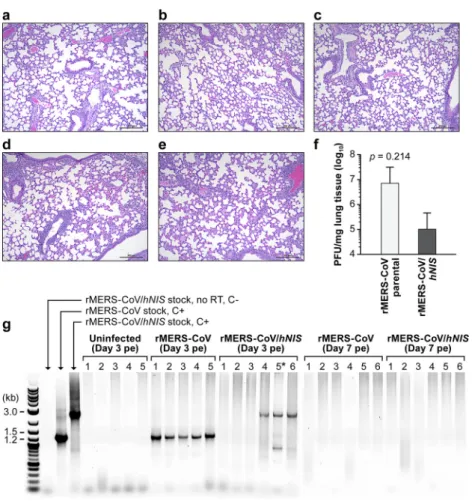
Macroscopicevaluationofthelungsfromvirus-andsham-exposedanimalsdidnot revealanysignificantpathologicalchangesexceptinoneofthefivemiceingroup2 (rMERS-CoV). The rightcaudodorsal lunglobe of this animal wascongested. Micro-scopically,minimal-to-mild perivascularandperibronchiolarinflammationwasnoted multifocallywithvariablecongestioninrMERS-CoV-andrMERS-CoV/hNIS-infectedmice (Fig.6atoe).Kidneycongestionwasalsonoticeablein40and50%ofmiceingroups 2and3,respectively,onday3peand33and50%onday7peinmiceingroups4and 5,respectively,infectedwithrMERS-CoVorrMERS-CoV/hNIS (Table1).Thepercentage ofmicewithalterationsinthelungwashigheronday7pecomparedtothatobserved onday3pe(100%vs⬍83%,respectively).Extensivefocalcongestioninthelungsand multifocalcongestioninthekidneyswereobservedinoneoffivemicefromgroup1 receivingshaminfection,butinflammationwasnotmanifestedinthisgroup(Table1). Infectious viruscouldbe detectedonly inthelungsfrom3/6 micefromgroup 3 (5.01⫾0.45log10PFU/mg)butwasdetectedinthelungtissuebyplaqueassayin4of 5micefromgroup2(6.7⫾0.43log10[mean⫾SD]PFU/mg)(Fig.6f).Thedifferences inviralloadsbetweengroups2and3werenotstatisticallysignificant(two-tailedt test, P ⫽0.214).RT-PCRindicatedmaintenanceofthehNIS transgenein3of6miceingroup 3 (Fig.6g).Theinabilitytodetectvirusin3of6miceandthenearly2log10decrease inPFU/mgobservedforrMERS-CoV/hNIS atday3supportsalossofviralfitnessin vivo. ViruscouldnotbedetectedbyplaqueassayorRT-PCRat7dayspostinfection.
DISCUSSION
This is the first report describing the application of a recombinant RNA virus expressingaSPECT/PET reportergenetostudy viralpathogenesis.Ourdata demon-stratethefeasibilityof usinghNISasareporter proteininanimalmodelsof human disease, provided a higher-resolution SPECT/CT or PET/CT is available. Despite the presenceofarobustsignal,theclinicalgradeSPECT/CTinourfacilitydidnotprovide thenecessaryresolutiontodemonstratein vivo functionalityoftherMERS-CoV/hNIS in mice. Ifavailable, amicro-PET/CTandthe useof tetrafluorborate,an alternatehNIS ligand, couldbe used to increase sensitivity andimprove signal tonoise (26). The recombinantMERS-CoV/hNIS has similar fitness totheparental virus,rMERS-CoV,as evidencedbysimilarkinetics,fitness,andcytopathiceffectin vitro. Theresultsofin vivo evaluation also support similarfitness; however,furtherdevelopmentwouldrequire insertionofthehNIStransgeneintootherlocationswithinthevirusandinsertionofthe transgene intotheMERS-15 virus,which can causelethalrespiratory disease inthe 288/300⫹⫹mice.
FIG6 LunghistopathologyininfectedmiceanddetectionofrMERS-CoV/hNISorrMERS-CoVinlung
tissue.(atoe)Histopathologyofthelungsofonerepresentativemouseeachfromgroups1,2,3,4,and
5infectedwithrMERS-CoVorMERS-CoV/hNIS.ThecellswerevisualizedwithHEstain.Magnification,
⫻10.Bars⫽ 200m.(a)Uninfectedcontrolmouse.(b)RepresentativemouseinfectedwithrMERS-CoV
(group1)withmultifocal,minimal-to-mildperivascularandperibronchiolarinflammation,with
conges-tiononday3postexposure(pe).(c)RepresentativemouseinfectedwithrMERS-CoV/hNIS(group2)with
multifocal,minimal-to-mildperivascularandperibronchiolarinflammation,withcongestiononday3pe.
(d)RepresentativemouseinfectedwithrMERS-CoV(group4)withmultifocal,minimal-to-mild
perivas-cularandperibronchiolarinflammationwithcongestionatday7pe.(e)Representativemouseinfected
withrMERS-CoV/hNIS(group5)withmultifocal,minimal-to-mildperivascularandperibronchiolar
in-flammationwithcongestionatday7pe.(f)Viralloadinlungtissueonday3peinmiceinfectedwith
rMERS-CoVorrMERS-CoV/hNISasdeterminedbyplaqueassay.(g)RT-PCRanalysisofthelungsrecovered
fromrMERS-CoV/hNIS-orrMERS-CoV-infectedmice.Theleftmostlanecontainsmolecularsizemarkers(in
kilobases).Thenextthreelanescontainstockcontrols,rMERS-CoV/hNIS(stockcontrol,withoutRTstep),
rMERS-CoV stock, and rMERS-CoV/hNIS stock. C⫹ indicates positive-control virus, andC⫺ indictes
uninfectednegative-controlcells.Samplesfromgroups1to5areshowninthefivesetsoflanesas
follows:group1,uninfectedcontrol(C⫺)group,lanes1to5;group2,exposedtorMERS-CoV,lanes1
to5;group3,exposedtorMERS-CoV/hNIS,lanes1to6;group4,exposedtorMERS-CoV,lanes1to5;
group5,exposedtorMERS-CoV/hNIS,lanes1to6.Theasteriskinlane5*oftherMERS-CoV/hNIS-treated
grouponday3peindicatesalteredPCRconditions(48°Cannealingtemperature,3%dimethylsulfoxide)
toimprovethesensitivitytodetectrMERS-CoV/hNIS.
carcinomacells,radionuclideaccumulationof99mTc-pertechnetatecorrelatedwiththe amountofadenovirusdeliveredandtheactivityoftheaddedradioisotope(27).
Consistent with otherstudies (28), sodium perchlorategreatly decreased rMERS-CoV/hNIS uptakeincellculture.However, thesodium perchloratedosethatblocked hNISproteinfunctionby99.5%at24hpostinfectionbecamelesseffectiveat⫹96h postinfection, corresponding with increased viral replication, and presumably sym-porterexpressionfromthevirus.
includ-TABLE 1Pathological summary of mice
Mouse group (n)
Recombinant virus
Day of tissue sampling
% mice in group with lung inflammation (n)
% mice in group with congestion (n)
Minimal Mild Lung Kidney
Group 1 (5) None (sham) 7 0 0 20 (1) 20 (1)
Group 2 (5) rMERS-CoV 3 40 (2) 40 (2) 80 (4) 40 (2)
Group 3 (6) rMERS-CoV/hNIS 3 33 (2) 33 (2) 83 (4) 50 (3)
Group 4 (6) rMERS-CoV 7 33 (2) 50 (3) 100 (6) 33 (2)
Group 5 (6) rMERS-CoV/hNIS 7 17 (1) 67 (4) 100 (6) 50 (3)
ingdecreasedsurvival,extremeweightloss,decreasedpulmonaryfunction,pulmonary hemorrhage,andpathologicalsignsindicativeofend-stagelungdisease(25).Similarto thepreviouslypublishedwork,theparental(MERS-CoV)andrecombinantvirus (MERS-CoV/hNIS)grewtohightitersinthe288/330⫹/⫹mice,butthemicedidnotdevelop disease (25). Although the SPECT signal was dependent on theviral load intissue culture,theSPECTsignalfrominfectedmiceasdeterminedbycomparinglung-to-heart ratios wasnot sufficiently differentbetweeninfected anduninfectedmice. Unfortu-nately,rMERS-CoV/hNIS wasdetectedbyPCRinonly50%ofinfectedmiceonday3pe, suggestinglimitedin vivo geneticstability.
This inconsistent detection of rMERS-CoV/hNIS could be due to hNIS transgene insertionintotheORF5gene,whichantagonizesinnateimmunityandthusmayimpact viralpathogenesisin vivo (29).Cockrelletal.demonstratedthatacloneoftheMERS-15 viruswithanORF5deletionwasattenuatedcomparedtoacloneinwhichtheORF5 genewas notdeleted (25). Thisattenuation mayalso explain thelowertiter inthe rMERS-CoV/hNIS mice compared to that observed with the parental virus (Fig. 6f). FurtherutilizationofhNIS asareporterforvirusgrowthandlocalizationwouldinclude developingthemouse-adaptedversion(rMERS-15/hNIS-CoV)forevaluationandmodel improvementandinsertionofthehNIS intootherlocationsoftheviralgenome.
Imagingwithasmall-animalPETscannerandPETradiotracer18F-tetrafluoroborate wouldimproveimagequalityandsensitivityforvisualizingrMERS-CoV/hNIS replication. AnalternativetotheSPECTisuseofagammacountertomeasuretheradioactivityin thetissues;unfortunately,asuitablegammacounterisnotavailableinourbiosafety level4(BSL-4)laboratory.Alternatively,utilizationofrMERS-CoV/hNIS inlargeranimals, i.e., nonhumanprimates, should help overcomethe SPECTclinicalscanner’s limited spatialresolution. Thistechnologyalso aidsidentificationof tissuesthataredirectly infected, whichwouldimprove virologicalanalysis,histological analysis,and charac-terizationoftissue-specificresponsetoinfection.
Although the animal models of MERS require further improvement, the model chosenforthisexperimentwasusefulinsupportingtherelativein vivo stabilityofthe hNIS reporter in MERS-CoV. The results from the mouse experiments agree with publishedstudies(20,21,25)andcorroboratepreviousdatathatindicatethatwild-type virusgrowstoahightiterinthe288/300⫹⫹transgenicmice.Realizingthepotential and limitations of the existing MERS-CoV animal models, further incorporation of real-timeimagingtechnologywillexpandMERS-CoVresearch.Developmentof recom-binant viruseswith imagingreportergenes anditsapplication with suitableanimal models will be instrumental in furthering our understanding of viral pathogenesis, potentiallyleadingtoimprovedanimalmodelsofhumandisease andmoreefficient countermeasureevaluation.
MATERIALSANDMETHODS
Cells,viruses,andanimals. Recombinantparentalvirus(rMERS-CoV)andMERS-CoVexpressinghNIS
(rMERS-CoV/hNIS)weregeneratedaspreviouslydescribed(30).Briefly,thehNISopen readingframe
(ORF)wasinsertedintotheNS5ORFofMERS-CoV.Theninebases,UCCUUCAUA,betweentheMgene
TRSanditsstartcodonwereincludedatthestartofthehNISsequenceandclonedusingtheSanDI
restrictionenzymesiteupstreamofORF6.Transfectionsforrecoveryoftherecombinantviruseswere
TEXT S1, DOCX file, 0.01 MB.
FIG S1, TIF file, 2.1 MB.
procedureswereconductedatBSL-4biocontainmentlaboratoriesduetothelocationoftheSPECT
clinical scanner. MERS-CoV isolateHu/Jordan-N3/2012 was propagated in MRC-5 cells (ATCC)at a
multiplicity of infection(MOI)of 0.1 for5days followingpublished procedures (19,31). Virus was
recoveredbyremovalofthetissueculturemediafollowedbycentrifugation,titersoftheviruswere
determinedbyplaqueassay,andthecultureswereevaluatedformycoplasmaandendotoxin
contam-ination(19,31).VeroE6cells(ATCCCRL-1586)weremaintainedinDulbecco’smodifiedEaglemedium
(DMEM)(Lonza)supplementedwith5%fetalbovineserum(FBS)andincubatedat37°Cand5%CO2
withoutantibioticsorantimycotics.
CRISPR-Cas9-engineeredmice(288/330⫹/⫹;n⫽ 30)encodingtwoaminoacids(positions288and
330)thatmatchthehumansequenceintheDPP4receptoronbothchromosomeswereobtainedfrom
theUniversityofNorthCarolina(25).
rMERS-CoVandrMERS-CoV/hNIS plaqueassays. PlaqueassayswereperformedinVeroE6cellsas
previouslydescribed(32).Fortitrationofvirusintissues,thecollectedtissueswerehomogenizedusing
abead-basedtissuehomogenizertomakea10%homogenateinDMEMplus2%FBS(Sigma).
One-stepandmultistepgrowthcurvesandserialpassage.KineticstudieswithrMERS-CoVand
rMERS-CoV/hNISwereperformedinparallelexperimentsintriplicate.VeroE6cellswereinfectedwith
rMERS-CoVorrMERS-CoV/hNISatanMOIof0.01or3.Sampleswerecollectedat0,24,36,48,72,and
96hpostinfection,andvirustitersweredeterminedasdescribedabove.Serialpassagewasperformed
todemonstratestabilityofthehNIStransgene.Viruswaspassagedevery72hforsixpassages.Analiquot
wascollectedandassayedbyreversetranscriptasePCR(RT-PCR)todetectthehNIStransgene.
RT-PCRofviralRNA. ForevaluationofstabilityofthehNISgene,totalRNAwasisolatedfromVero
E6cellscollected24,36,48,72,and96hafterrMERS-CoVandrMERS-CoV/hNISinfectionatMOIsof0.01
and3.TheRNAwasreversetranscribedintocDNAusingdeoxythymidineoligonucleotideprimersand
SuperScriptreversetranscriptaseII(ThermoFisherScientific)accordingtothemanufacturer’sprotocol.
Twocustomprimers,hNISLeader(forwardprimersequence,5=CTATCTCACTTCCCCTCGTTCTC)withhNIS6
(reverseprimersequence,5=GAAGCCACTTAGCATCAC)wereusedtocreatePCRproducts.PCRproducts
wereseparatedandidentifiedonaSYBRsafeDNA-stainedagarosegel(ThermoFisherScientific).Stock
rMERS-CoV/hNISwasusedasapositivecontrol,anduninfected-celllysateswereusedasanegative
controlforRT-PCR.
Cellcultureradio-uptakeassay.FunctionalityofthehNISgenewasassessedbyhNIS-mediated
accumulationof99mTc-pertechnetatebyrMERS-CoV/hNIS-infectedcells.VeroE6cellswereinfectedwith
rMERS-CoVorrMERS-CoV/hNISattwodifferentMOIs,0.01and0.004,andincubatedfor0,24,36,48,72,
and96h.99mTc-pertechnetate,0.004to0.6mCiin0.2ml,wasaddedtoeachwellandincubatedfor60
min.99mTc-pertechnetatewasremovedfromthewells,andthecellswerewashedwithroom
temper-aturemedia.Planarimagesoftheplateswereacquiredover30minwithasinglegammacamerahead
usingthePrecedenceSPECT/computedtomography(CT)clinicalsystem(PhilipsMedicalSystems),that
wasmodifiedtooperateinabiocontainmentenvironment(33).Theinvitrosampleswerequantified
usingtheSPECT/CTscanner.Uninfectedcellsweretreatedwith99mTc-pertechnetatetodeterminethe
background level. Specificity of 99mTc-pertechnetate uptake by rMERS-CoV/hNIS-infected cells was
assessedbyaddingsodiumperchlorate,NaClO4, 1 to 100M,tothewellspriorto99mTc-pertechnetate
introduction.99mTc-pertechnetatecountsfromeachwellwereconvertedintoradioactivityunitsand
decay-correctedrelativetothetimeofprobeintroductiontothewells.Uptakeof99mTc-pertechnetate
byinfected cells wasexpressed as a percentageof theradioactive doseapplied tothewell.The
radio-uptakeassayswereconductedintriplicate.
Transgenicmouseexperiments. Thirty288/330⫹/⫹mice,15malesand15females,weresplitinto
5groupsof 6animals.Twomice,one fromgroup1andonefromgroup4,did notrecoverfrom
anesthesia after a preexposure scan and were not replaced. Mice were lightly anesthetized with
isofluraneandwereexposedintranasallywithphosphate-bufferedsaline(PBS)withoutvirus(group1)or
withrMERS-CoV(groups2and4)orrMERS-CoV/hNIS(groups3and5).Thevirus/PBSwasinstilledinto
bothnostrils,25lpernostril.Themiceweremonitoreddailyforclinicalsignsofdisease.Theanimals
fromgroups2and3wereeuthanizedonday3postexposure(pe),andtheanimalsfromgroups1,4,and
5were euthanizedon day 7pe. Thelungs werecollected forgross pathologicalandmicroscopic
evaluationandvirusdetectionviaplaqueassay.
Ethicsstatement.AllworkwithanimalswasperformedinanAAALAC-accreditedresearchfacility
andapprovedbytheNationalInstituteforAllergyandInfectiousDiseaseDivisionofClinicalResearch
AnimalCareandUseCommittee.TheexperimentscompliedwiththeAnimalWelfareActregulations,
PublicHealthServicepolicy,andtheGuidefortheCareandUseofLaboratoryAnimals(34).Animalswere
monitoreddaily.Clinicalhealth,bodyweight,andfoodconsumptionwererecorded.
Statisticalanalysis.StatisticalanalysiswasperformedusingGraphpadPrism7.03(Graphpad
Soft-wareInc.)asindicatedinthetext.
SUPPLEMENTALMATERIAL
S.C., D.T., E.P., and J.D., all employees of Tunnell Government Services, Inc.; M.G.L., an employee of Lovelace Respiratory Research Institute; C.B. and P.J.S., employees of MedRelief; D.L., an employee of Charles River Laboratories.
S.C., C.B., P.J.S., J.D., D.X.L., L.M.H., E.P., J.K.B., A.E.-F., M.G.L., K.C., M.R.K., and J.S. performed experiments and analyzed data. A.S., R.S.B., B.Y., and A.S.C. provided 288-330⫹/⫹mice and reagents and generated the recombinant viruses. S.C., K.R.H., M.R.K., M.R.H., D.T., P.B.J., and R.F.J. designed experiments. S.C. and R.F.J. wrote the manuscript. All authors read and edited the manuscript.
We declare that we have no competing financial interests.
The content of this publication does not necessarily reflect the views or policies of the U.S. Department of Health and Human Services (DHHS) or of the institutions and companies affiliated with the authors.
REFERENCES
1. Hoenen T, Groseth A, Callison J, Takada A, Feldmann H. 2013. A novel Ebola virus expressing luciferase allows for rapid and quantitative
test-ing of antivirals. Antiviral Res 99:207–213. https://doi.org/10.1016/j
.antiviral.2013.05.017.
2. Marsh GA, Virtue ER, Smith I, Todd S, Arkinstall R, Frazer L, Monaghan P, Smith GA, Broder CC, Middleton D, Wang LF. 2013. Recombinant Hendra viruses expressing a reporter gene retain pathogenicity in ferrets. Virol J
10:95.https://doi.org/10.1186/1743-422X-10-95.
3. Rennick LJ, de Vries RD, Carsillo TJ, Lemon K, van Amerongen G, Ludlow M, Nguyen DT, Yuksel S, Verburgh RJ, Haddock P, McQuaid S, Duprex WP, de Swart RL. 2015. Live-attenuated measles virus vaccine targets dendritic cells and macrophages in muscle of nonhuman primates. J
Virol 89:2192–2200.https://doi.org/10.1128/JVI.02924-14.
4. Rozelle DK, Filone CM, Dower K, Connor JH. 2014. Vaccinia reporter viruses for quantifying viral function at all stages of gene expression. J Vis Exp 15:e51522.
5. Altenburg AF, van de Sandt CE, Li BWS, MacLoughlin RJ, Fouchier RAM, van Amerongen G, Volz A, Hendriks RW, de Swart RL, Sutter G, Rimmel-zwaan GF, de Vries RD. 2017. Modified vaccinia virus Ankara preferen-tially targets antigen presenting cells in vitro, ex vivo and in vivo. Sci Rep
7:8580.https://doi.org/10.1038/s41598-017-08719-y.
6. Goff A, Twenhafel N, Garrison A, Mucker E, Lawler J, Paragas J. 2007. In vivo imaging of cidofovir treatment of cowpox virus infection. Virus Res
128:88 –98.https://doi.org/10.1016/j.virusres.2007.04.014.
7. Kato SI, Nagata K, Takeuchi K. 2012. Cell tropism and pathogenesis of
measles virus in monkeys. Front Microbiol 3:14.https://doi.org/10.3389/
fmicb.2012.00014.
8. Ahn BC. 2012. Sodium iodide symporter for nuclear molecular imaging and gene therapy: from bedside to bench and back. Theranostics
2:392– 402.https://doi.org/10.7150/thno.3722.
9. Penheiter AR, Russell SJ, Carlson SK. 2012. The sodium iodide symporter (NIS) as an imaging reporter for gene, viral, and cell-based therapies. Curr
Gene Ther 12:33– 47.https://doi.org/10.2174/156652312799789235.
10. Dohan O, Carrasco N. 2003. Advances in Na(⫹)/I(-) symporter (NIS)
research in the thyroid and beyond. Mol Cell Endocrinol 213:59 –70. https://doi.org/10.1016/j.mce.2003.10.059.
11. Haddad D, Chen NG, Zhang Q, Chen CH, Yu YA, Gonzalez L, Carpenter SG, Carson J, Au J, Mittra A, Gonen M, Zanzonico PB, Fong Y, Szalay AA. 2011. Insertion of the human sodium iodide symporter to facilitate deep tissue imaging does not alter oncolytic or replication capability of a
novel vaccinia virus. J Transl Med 9:36.https://doi.org/10.1186/1479
-5876-9-36.
12. Kang JH, Chung JK. 2008. Molecular-genetic imaging based on reporter
gene expression. J Nucl Med 49(Suppl 2):164S–179S.https://doi.org/10
.2967/jnumed.107.045955.
13. Sun C, Gardner CL, Watson AM, Ryman KD, Klimstra WB. 2014. Stable, high-level expression of reporter proteins from improved alphavirus expression vectors to track replication and dissemination during
en-cephalitic and arthritogenic disease. J Virol 88:2035–2046.https://doi
.org/10.1128/JVI.02990-13.
14. Assiri A, McGeer A, Perl TM, Price CS, Al Rabeeah AA, Cummings DA, Alabdullatif ZN, Assad M, Almulhim A, Makhdoom H, Madani H, Alhakeem R, Al-Tawfiq JA, Cotten M, Watson SJ, Kellam P, Zumla AI, Memish ZA. 2013. Hospital outbreak of Middle East respiratory
syn-drome coronavirus. N Engl J Med 369:407– 416. https://doi.org/10
.1056/NEJMoa1306742.
15. Guery B, Poissy J, el Mansouf L, Sejourne C, Ettahar N, Lemaire X, Vuotto F, Goffard A, Behillil S, Enouf V, Caro V, Mailles A, Che D, Manuguerra JC, Mathieu D, Fontanet A, van der Werf S. 2013. Clinical features and viral diagnosis of two cases of infection with Middle East Respiratory Syn-drome coronavirus: a report of nosocomial transmission. Lancet 381:
2265–2272.https://doi.org/10.1016/S0140-6736(13)60982-4.
16. Bhatia PK, Sethi P, Gupta N, Biyani G. 2016. Middle East respiratory
syndrome: a new global threat. Indian J Anaesth 60:85– 88.https://doi
.org/10.4103/0019-5049.176286.
17. de Wit E, Rasmussen AL, Falzarano D, Bushmaker T, Feldmann F, Brining DL, Fischer ER, Martellaro C, Okumura A, Chang J, Scott D, Benecke AG, Katze MG, Feldmann H, Munster VJ. 2013. Middle East respiratory syn-drome coronavirus (MERS-CoV) causes transient lower respiratory tract infection in rhesus macaques. Proc Natl Acad Sci U S A 110:
16598 –16603.https://doi.org/10.1073/pnas.1310744110.
18. Yao Y, Bao L, Deng W, Xu L, Li F, Lv Q, Yu P, Chen T, Xu Y, Zhu H, Yuan
ACKNOWLEDGMENTS
We thankRussellByrum,DannyRagland,andMarisaSt.ClaireandtheentireIRF Comparative Medicine and Imaging staff for successful implementation of SPECT scanning procedures inmice inthe biosafetylevel 4 environment. We thank Laura BollingerforcriticallyeditingthemanuscriptandJiroWadaforfiguredevelopment.We alsothankMatthiasSchnell,ThomasJeffersonUniversity,forhiscriticalreviewofthe manuscript.
J, Gu S, Wei Q, Chen H, Yuen KY, Qin C. 2014. An animal model of MERS produced by infection of rhesus macaques with MERS coronavirus. J
Infect Dis 209:236 –242.https://doi.org/10.1093/infdis/jit590.
19. Johnson RF, Via LE, Kumar MR, Cornish JP, Yellayi S, Huzella L, Postnikova E, Oberlander N, Bartos C, Ork BL, Mazur S, Allan C, Holbrook MR, Solomon J, Johnson JC, Pickel J, Hensley LE, Jahrling PB. 2015. Intratra-cheal exposure of common marmosets to MERS-CoV Jordan-n3/2012 or MERS-CoV EMC/2012 isolates does not result in lethal disease. Virology
485:422– 430.https://doi.org/10.1016/j.virol.2015.07.013.
20. Haagmans BL, van den Brand JM, Provacia LB, Raj VS, Stittelaar KJ, Getu S, de Waal L, Bestebroer TM, van Amerongen G, Verjans GM, Fouchier RA, Smits SL, Kuiken T, Osterhaus AD. 2015. Asymptomatic Middle East respiratory syndrome coronavirus infection in rabbits. J Virol 89:
6131– 6135.https://doi.org/10.1128/JVI.00661-15.
21. Houser KV, Gretebeck L, Ying T, Wang Y, Vogel L, Lamirande EW, Bock KW, Moore IN, Dimitrov DS, Subbarao K. 2016. Prophylaxis with a Middle East respiratory syndrome coronavirus (MERS-CoV)-specific human monoclonal antibody protects rabbits from MERS-CoV infection. J Infect
Dis 213:1557–1561.https://doi.org/10.1093/infdis/jiw080.
22. Agrawal AS, Garron T, Tao X, Peng BH, Wakamiya M, Chan TS, Couch RB, Tseng CT. 2015. Generation of a transgenic mouse model of Middle East respiratory syndrome coronavirus infection and disease. J Virol 89:
3659 –3670.https://doi.org/10.1128/JVI.03427-14.
23. Pascal KE, Coleman CM, Mujica AO, Kamat V, Badithe A, Fairhurst J, Hunt C, Strein J, Berrebi A, Sisk JM, Matthews KL, Babb R, Chen G, Lai KM, Huang TT, Olson W, Yancopoulos GD, Stahl N, Frieman MB, Kyratsous CA. 2015. Pre- and postexposure efficacy of fully human antibodies against Spike protein in a novel humanized mouse model of MERS-CoV
infec-tion. Proc Natl Acad Sci U S A 112:8738 – 8743.https://doi.org/10.1073/
pnas.1510830112.
24. Zhao J, Li K, Wohlford-Lenane C, Agnihothram SS, Fett C, Zhao J, Gale MJ, Jr, Baric RS, Enjuanes L, Gallagher T, McCray PB, Jr, Perlman S. 2014. Rapid generation of a mouse model for Middle East respiratory
syn-drome. Proc Natl Acad Sci U S A 111:4970 – 4975. https://doi.org/10
.1073/pnas.1323279111.
25. Cockrell AS, Yount BL, Scobey T, Jensen K, Douglas M, Beall A, Tang XC, Marasco WA, Heise MT, Baric RS. 2016. A mouse model for MERS coronavirus-induced acute respiratory distress syndrome. Nat Microbiol
2:16226.https://doi.org/10.1038/nmicrobiol.2016.226.
26. Khoshnevisan A, Jauregui-Osoro M, Shaw K, Torres JB, Young JD,
Ra-makrishnan NK, Jackson A, Smith GE, Gee AD, Blower PJ. 2016. [(18)F]tet-rafluoroborate as a PET tracer for the sodium/iodide symporter: the
importance of specific activity. EJNMMI Res 6:34. https://doi.org/10
.1186/s13550-016-0188-5.
27. Niu G, Gaut AW, Ponto LL, Hichwa RD, Madsen MT, Graham MM, Domann FE. 2004. Multimodality noninvasive imaging of gene transfer using the human sodium iodide symporter. J Nucl Med 45:445– 449. 28. Zuckier LS, Dohan O, Li Y, Chang CJ, Carrasco N, Dadachova E, Dohan O.
2004. Kinetics of perrhenate uptake and comparative biodistribution of perrhenate, pertechnetate, and iodide by NaI symporter-expressing tis-sues in vivo. J Nucl Med 45:500 –507.
29. Menachery VD, Mitchell HD, Cockrell AS, Gralinski LE, Yount BL, Jr, Graham RL, McAnarney ET, Douglas MG, Scobey T, Beall A, Dinnon K, III, Kocher JF, Hale AE, Stratton KG, Waters KM, Baric RS. 2017. MERS-CoV accessory ORFs play key role for infection and pathogenesis. mBio
8:e00665-17.https://doi.org/10.1128/mBio.00665-17.
30. Scobey T, Yount BL, Sims AC, Donaldson EF, Agnihothram SS, Menachery VD, Graham RL, Swanstrom J, Bove PF, Kim JD, Grego S, Randell SH, Baric RS. 2013. Reverse genetics with a full-length infectious cDNA of the Middle East respiratory syndrome coronavirus. Proc Natl Acad Sci U S A
110:16157–16162.https://doi.org/10.1073/pnas.1311542110.
31. Johnson RF, Bagci U, Keith L, Tang X, Mollura DJ, Zeitlin L, Qin J, Huzella L, Bartos CJ, Bohorova N, Bohorov O, Goodman C, Kim DH, Paulty MH, Velasco J, Whaley KJ, Johnson JC, Pettitt J, Ork BL, Solomon J, Oberlander N, Zhu Q, Sun J, Holbrook MR, Olinger GG, Baric RS, Hensley LE, Jahrling PB, Marasco WA. 2016. 3B11-N, a monoclonal antibody against MERS-CoV, reduces lung pathology in rhesus monkeys following intratracheal inoculation of MERS-CoV
Jordan-n3/2012. Virology 490:49 –58. https://doi.org/10.1016/j.virol
.2016.01.004.
32. Kumar M, Mazur S, Ork BL, Postnikova E, Hensley LE, Jahrling PB, Johnson R, Holbrook MR. 2015. Inactivation and safety testing of Middle East
Respiratory Syndrome Coronavirus. J Virol Methods 223:13–18.https://
doi.org/10.1016/j.jviromet.2015.07.002.
33. de Kok Mercado F, Kutlak F, Jahrling PB. 2011. The NIAID Integrated
Research Facility at Fort Detrick. Appl Biosaf 16:58 – 66.https://doi.org/
10.1177/153567601101600202.