i
Differences in the Use of Macro-level Self-Regulated Learning Processes between Students that Gain Declarative Knowledge and Students that Gain Conceptual Understanding about
Complex Science Topics
Victor M. Deekens
A Thesis submitted to the faculty of the University of North Carolina at Chapel Hill in partial fulfillment of the requirements for the degree of Master of Arts in Educational Psychology,
Measurement, and Evaluation in the School of Education
Chapel Hill
2009
ii Abstract Victor M. Deekens
Differences in the Use of Macro-level Self-Regulated Learning Processes between Students that Gain Declarative Knowledge and Students that Gain Conceptual Understanding about
Complex Science Topics
(Under the Direction of Jeffrey A. Greene)
Learning complex science topics is an important part of students’ education. Learning these complex topics is difficult, and students often fail to gain a conceptual understanding of them. Research shows that the use of hypermedia based learning environments can enhance students’ ability to learn complex science topics. However, the use of hypermedia as a learning tool does not always improve students’ learning. Additional research has shown that the use of self-regulated learning (SRL) processes enhances students’ ability to reach a conceptual understanding of complex topics with hypermedia. In this study, to improve understanding of self-regulated learning with hypermedia, I examined what differentiates students that gain conceptual understanding from those that only gain declarative knowledge about a complex science topic. Specifically, I examined differences in the frequency of students’ use of macro-level SRL processes. After completing the analysis, no statistically significant differences were found in the frequency participants in the conceptual
iii
Table of Contents
Introduction………1
The Difficulties of Complex Systems ... 3
Using Hypermedia as a Teaching Tool for Complex Topics ... 5
How SRL Supports Hypermedia ... 6
Current Study ... 7
Research Questions ... 9
Literature Review ... 10
Conceptual Understanding ... 11
Hypermedia and Conceptual Understanding... 14
Problems with Hypermedia as a Teaching Tool ... 15
Self-Regulated Learning ... 18
Measuring SRL ... 23
Research Questions ... 25
Method ... 27
Participants ... 27
Measures... 27
Hypermedia Learning Environment…. ... 28
Procedure ... 29
Scoring ... 32
Transcribing and Coding ... 34
Data Preparation ... 36
Data Analysis ... 37
Results ... 38
Descriptive Statistics ... 38
Correlations ... 39
iv
Planning ... 42
Strategy Use ... 42
Monitoring ... 44
Task Difficulty and Demands ... 44
Interest ... 45
Summary ... 45
Discussion ... 46
Limitations ... 47
Directions for Future Research ... 49
Conclusion ... 50
Appendix A: Self-Regulated Learning Processes ... 51
Appendix B: Blank Pretest ... 54
Appendix C: Mental Models ... 57
v List of Tables Table
1
Quality education is important for the success of students in the United States and worldwide. The Federal Interagency Forum on Child and Family Statistics (2008) captured the significance of education in its publication, America’s Children in Brief: Key National Indicators of Well-Being, by stating: “Education shapes the personal growth and life chances
of children, as well as the economic and social progress of our nation” (p. 14). Educators agree that achieving a quality education requires that students focus on several diverse academic disciplines. Science is an important discipline in today’s schools. This focus on science is necessary because science drives the world’s economies. A 2007 U.S. government report entitled, Rising above the Gathering Storm: Energizing and Employing America for a Brighter Economic Future stated: “the growth of economies throughout the world has been
driven largely by the pursuit of scientific understanding, the application of engineering solutions, and continual technological innovation” (National Academy of Sciences, 2007, p. 41). The significance of scientific development to the world’s economies makes science education important in the U.S. and worldwide. According to the U.S. Department of Education’s Institute of Education Sciences, the number of high school graduates that have completed an advanced level science course rose from 35% in 1982 to 68% in 2004 (Planty, Provasnick, & Daniel, 2007). This growth points to an increased focus on the science curriculum in schools across the country.
2
Statistics publishes the National Assessment of Educational Progress (NAEP). According to the U.S. Department of Education, the NAEP “is the only nationally representative and continuing assessment of what America's students know and can do in various subject areas” (National Center for Education Statistics [NCES], n.d.). The NAEP report assesses students’ performance at both the national and state levels within 11 distinct subject areas. The NAEP uses three main measures to evaluate students’ performance in science topics. These three measures are conceptual understanding, scientific investigation, and practical reasoning. The highest grade-level assessed in the NAEP is the 12th grade. The NAEP’s scoring range is zero to 300. In 1996, 2000, and 2005, the average scores for 12th graders on the science
3
The U.S. Department of Education’s data discussed previously showed that more students are exposed to advanced scientific content in the classroom now than were exposed to it 20 years ago. However, the NAEP data on scientific performance indicated that in the period between 1996 and 2005 student performance decreased on the standardized science module. Therefore, students’ increased exposure to science is having little effect upon the education system’s goal of improving students’ overall performance in the complex field of science. Students in the United States must improve their scientific knowledge to continue to be leaders in the pursuit of the scientific understanding that drives economic growth.
The Difficulties of Complex Systems
Understanding the core concepts of science topics is important for today’s students and educators (Carey, 2000). In order to fully grasp these challenging topics, students must be able to understand and explain complex systems. Complex scientific systems such as the solar system, chemical interactions, or the circulatory system are often difficult to grasp because the components of the system are not physically available to students in the classroom (Azevedo, Guthrie, & Seibert, 2004). Thus, students must attempt to create an overall understanding of a complex topic by synthesizing a diverse set of representations of the component concepts. These representations could include text, videos, diagrams, and graphs (Azevedo, Guthrie et al., 2004).
4
subcomponents of knowledge: declarative, procedural, and self-regulatory knowledge (Schraw, 2006). Declarative knowledge includes specific labels, facts, definitions, and descriptions. The term procedural knowledge describes knowledge about how to use particular information to solve problems. The final term of the three, self-regulatory
knowledge, describes an individual’s knowledge about managing his or her personal learning (Schraw, 2006). Self-regulatory knowledge includes learners’ beliefs about regulating their memory and thoughts as well as facts about what learning skills work best for them in certain domains.
Students combine these three types of knowledge to form a conceptual understanding. According to the science education literature, conceptual understanding is more than simply a large amount of declarative knowledge. Instead, to demonstrate a conceptual understanding of a science topic a student must be able to apply knowledge to real world problems (Roth, 1990). This application can include using existing knowledge to explain a phenomenon or as the basis for exploring a new phenomenon. Achieving conceptual understanding leads learners to ask clarifying questions that demonstrate an ability to utilize the knowledge.
Students that are just being introduced to a complex topic may successfully gain declarative knowledge about the topic, but often fail to reach a conceptual understanding (Greene & Azevedo, 2008). Science literacy requires that students have a mental model that includes both declarative knowledge and conceptual understanding. The creation and use of mental models is so important for understanding complex topics that “students have
5
based learning tools can help students reach a conceptual understanding of complex science topics (Scheiter & Gerjets, 2007).
Using Hypermedia as a Teaching Tool for Complex Topics
Developments in computer capabilities have allowed for the creation of hypermedia based tools. Hypermedia learning environments include multiple types of representations such as text, video, diagrams, and animation. These separate representations are
6
all the students using hypermedia tools possess the self-regulated learning (SRL) skills necessary to facilitate learning in the environments (Azevedo, 2005; Scheiter & Gerjets). How SRL Supports Hypermedia
Recent research suggests that students using a hypermedia environment to learn complex science topics learn more and perform better on subsequent assessment when they effectively employ SRL processes (Azevedo, Guthrie et al., 2004; Greene & Azevedo, 2007; Jacobson & Archodidou, 2000; Schraw et al., 2006). Several models exist to describe the basic concepts of SRL. Each of these models has at its core the concept that students perform better when they regulate their own motivation, cognition, and behavior (Hofer, Yu, & Pintrich, 1998). Paul Pintrich (2000) defined SRL as “an active, constructive process whereby learners set goals for their learning and then attempt to monitor, regulate, and control their cognition, motivation and behavior, guided and constrained by their goals and the contextual features in the environment” (p. 453).
7
selected in phase two and adapts these strategies to ensure success. The fourth phase, adapting tactics, is optional and is performed when the learner feels that different tactics would have improved performance on the task. Results from the fourth phase alter the way a student approaches a similar problem in the future. Throughout each of these four phases, learners monitor their progress toward the completion of that phase and toward the overall learning goal. According to Winne and Hadwin (1998), “metacognitive monitoring is the key to self-regulating one’s learning” (p. 169). Monitoring progress towards a goal allows the learner to adjust the tactics and strategies being used during each phase, if necessary.
Research conducted using hypermedia as a tool to teach complex science topics has shown that the use of SRL processes improves learning (Azevedo, Winters, & Moos, 2004; Greene & Azevedo, 2007, 2008). Specifically, this research has shown that students who employ SRL processes while learning with hypermedia reach a conceptual understanding more often than students that do not effectively employ SRL processes. While certain SRL processes have been identified as aiding in the creation of a sophisticated mental model, more research is needed to determine if learners that reach a complex conceptual
understanding use certain SRL processes more frequently than learners who gain declarative knowledge, but fail to reach a conceptual understanding.
Current Study
Researchers have studied SRL as it relates to hypermedia. Until recently, much of that research focused simply on changes in students’ declarative knowledge. New research into the use of SRL with hypermedia environments has begun to focus on the study of
8
difficult topics at the conceptual level will aid educators seeking to improve science education in the United States. Recent research conducted by Greene and Azevedo (2007) identified SRL processes associated with the acquisition of a sophisticated mental model of a complex science topic.
The research by Greene, Azevedo and others led me to ask a follow up question: Are there differences in the frequency with which students who reach an effective conceptual understanding of a topic utilize SRL processes as compared to students who gain only declarative knowledge about the topic, but do not reach a conceptual understanding? Previous research has studied differences between students that gain little to no knowledge and students that reach a conceptual understanding. However, researchers have not examined the differences between the latter group and students that gain only declarative knowledge.
9
and handle task difficulties (Greene & Azevedo, 2008; Pintrich, 2000; Winne, 2001; Zimmerman, 2001).
Research Questions
In this study, I will focus on five research questions:
Research Question 1: Are there differences in the frequency with which students use SRL planning processes between participants who only gain declarative knowledge from pretest to posttest versus participants who gain declarative knowledge and conceptual understanding? Research Question 2: Are there differences in the frequency students use strategies between participants who only gain declarative knowledge from pretest to posttest versus participants who gain declarative knowledge and conceptual understanding?
Research Question 3: Are there differences in the frequency with which students monitor progress between participants who only gain declarative knowledge from pretest to posttest and participants who gain declarative knowledge and conceptual understanding?
Research Question 4: Are there differences in the frequency with which students handle task difficulty and demands between participants who only gain declarative knowledge from pretest to posttest and participants who gain declarative knowledge and conceptual understanding?
10
Literature Review
Science is an important discipline within the academic system in the United States. The U.S. Department of Education’s 2005 National Assessment of Educational Progress stated, “the goal of school science is to engender conceptual understanding” (Grigg et al., 2006, p. 22). In this report, the Department of Education clarified that conceptual
understanding requires that students must be able to use information to conduct scientific inquiry and reason practically in scientific endeavors. In concert with this statement, Schraw, Crippen, and Hartley (2006) stated that science instruction must help students construct conceptual knowledge.
Inherent in this requirement to reach a conceptual understanding of science is a need for students to understand the complex topics within science (Jacobson & Wilensky, 2006). Learning complex systems is frequently difficult for students (Jacobson, 2008). Some of the difficulty associated with learning complex systems is that the entire system is rarely
available for direct study by the student (Azevedo, Guthrie et al., 2004; Kozma, Chin, Russell, & Marx, 2000). When properly used, hypermedia and other learning environments can help students gain conceptual understanding of complex science topics. Hypermedia assists students by allowing them to explore a complex topic using multiple representations in ways other learning environments cannot support. Additionally, students can use
11
2008). Research suggests that certain self-regulated learning (SRL) processes are necessary for students to gain a conceptual understanding of science subjects when using hypermedia (Azevedo, 2005). A discussion of the factors that make learning a complex science topic difficult, as well as an understanding of how hypermedia environments can encourage learning of complex topics under the right conditions, is necessary when considering the factors that influence learning. Understanding differences in the use of self-regulated learning processes between students that gain only declarative knowledge and students that gain both declarative knowledge and a conceptual understanding will help researchers reach a better understanding of how students self-regulate their learning in hypermedia environments. This will allow researchers to help educators foster the conceptual understanding needed for science education.
Conceptual Understanding
Today there is a general agreement within the research community that conceptual understanding is comprised of at least three subcategories of knowledge (Schraw, 2006). Declarative knowledge is factual information about a particular topic. Procedural knowledge is information about how to utilize declarative knowledge. Finally, self-regulatory knowledge is knowledge about how to manage learning.
These three types of knowledge combine to form an individual’s conceptual understanding of a topic. Conceptual understanding is more than just large amounts of
declarative knowledge. Instead, in order to demonstrate conceptual understanding of a topic a student must successfully apply knowledge to explain real world problems (Roth, 1990.) The National Science Education Standards (National Research Council, 1996) define conceptual
12
Assessment Governing Board (NAGB) published a new framework that will be used to conduct the NAEP’s national science assessment in 2009. The focus of this framework is on conceptual understanding, which the NAGB defines as the “knowledge and use of science facts, concepts, principles, laws and theories” (NAGB, 2008, p. vii). For example, a student could demonstrate a conceptual understanding of the circulatory system by accurately describing the repercussions of a blockage of the flow of blood between the right ventricle and the lungs. The student may not have encountered this particular example before, but could draw upon declarative, procedural, and self-regulatory knowledge to describe this incident. In sum, science educators define conceptual understanding as knowledge that a student can apply and explain.
13
It is important for students to build accurate and useful mental models of complex science topics, but this is a difficult process (Greene & Azevedo, 2007). One reason that complex topics may be difficult for students to learn is that some key concepts within the topic may be counterintuitive (Jacobson & Wilensky, 2006). For example, students may have a difficult time understanding that the moon does not create its own light, rather the sun’s light reflects off it. In the absence of formal teaching about a topic, students construct their own conceptual framework to explain phenomena that they observe (Hayes, Goodhew, Heit, & Gillan, 2003). These conceptual frameworks are difficult to correct and can be resistant to future revision (Carey, 2000). Vosniadou (1994) expressed this same concept when she described conceptual change in terms of shifts in mental models about a topic. Altering existing mental models is a difficult task. Carey (2000) advocated a shift in classroom cultures to allow students to build and construct their own knowledge to help combat problems with conceptual change and allow students to build accurate mental models. Research into conceptual understanding must account for both prior knowledge and the difficulties inherent in building a sophisticated understanding of a complex topic.
14
representations that can include photos, videos, models, lecture, and other instructional techniques. Hypermedia learning environments can assist learners as they attempt to build more accurate mental models about complex topics.
Hypermedia and Conceptual Understanding
Improvements in electronic technologies allow for the development of a diverse and readily available set of interactive learning environments that are having a notable effect on learning in today’s classrooms (Aleven, Stahl, Schworm, Fischer, & Wallace, 2003). The increase in the availability of electronic learning environments includes growth in the use of hypermedia as an instructional tool. Hypermedia tools are computer-based and consist of separate nodes of electronic information that are connected together using hyperlinks to form a network (Gerjets, Scheiter, & Schuh, 2008; Jacobson, 2008). The numerous unique
teaching and learning characteristics of hypermedia tools have led many researchers and educators to predict that hypermedia learning environments would profoundly alter the way students learn complex science topics (Dillon & Gabbard, 1998).
Researchers have advocated for the use of hypermedia in teaching because it is “considered to improve comprehension by virtue of its capability of supporting structured access, rapid manipulation, and individual learner control” (Dillon & Gabbard, 1998, p. 326). Additionally, hypermedia environments are more engaging to learners than traditional
15
traditional teaching methods, hypermedia environments allow students more flexibility to construct knowledge in their own way. Hypermedia environments allow users to exert a higher level of learner control than traditional teaching techniques such as textbooks or the classroom. Learner control allows students to manipulate multiple pieces of information, and alter the way they interact with this information. For example, learning environments that offer students learner control allow them to change their view, alter the sequence of material, select different content, and control the pace of their learning (Scheiter & Gerjets, 2007). Learner control allows learners to pursue information in the learning environment not only in a non-linear fashion but also at the pace that best fits their needs (Dillon & Gabbard, 1998). This freedom facilitates students’ ability to construct knowledge into accurate mental models (Lawless & Brown, 1997). In sum, there are authors that advocate hypermedia as an
instructional tool because it allows learners to access large quantities of information
presented in unique ways over which the learner has a degree of control (Gerjets et al., 2008). Problems with Hypermedia as a Teaching Tool
Despite the advantages advocated by some researchers, applications of hypermedia as a teaching tool have not produced all of the improvements in teaching and learning that have been predicted. Researchers have cited several reasons why using hypermedia as a teaching tool has not generated the results many thought it would. Two of the principle concerns about the use of hypermedia are disorientation and cognitive overload (Gerjets et al., 2008). Due to the non-linear nature of hypermedia tools, users can become disoriented as they move
16
Some authors have argued that the amount of learner control provided by hypermedia environments can be detrimental to the learning of students with low prior knowledge or limited experience operating a hypermedia environment. Dillon and Gabbard (1998)
reviewed five quantitative learner control studies to determine if learner control had an effect on learning. They concluded that individual differences in both prior knowledge about a topic and experience with hypermedia environments can alter the effectiveness of learner control. Low prior knowledge about a topic influences the information students select, and the way they link that information to existing knowledge (Mitchell, Chen, & Macredie, 2005). Students with low prior knowledge about a topic are less likely to navigate the environment efficiently. These learners tend to move more haphazardly across the subject matter without exploring it in-depth. Learners with low prior knowledge are also more likely to experience disorientation within the environment because they are less able to remember where they have been or where to find the information they seek (Mitchell et. al., 2005). Students can also exhibit low ability to operate the hypermedia environment. This ability influences students’ navigation techniques in several ways. Experienced users are able to navigate through more pages faster than inexperienced users. Experienced users are also more likely to take a non-linear path through the information. Inexperienced users typically follow a linear path reducing one of the key strengths of hypermedia learning environments. Students with low prior knowledge or little experience operating in a hypermedia environment
frequently were unable to capitalize on the advantages that learner control affords in hypermedia learning environments.
17
on an individual’s cognitive resources (Niederhauser, Reynolds, Salmen, & Skolmoski, 2000). Working memory is the system that handles the temporary storage and processing of new information (Baddeley, 2001). In this capacity, it draws on knowledge already stored in long-term memory (LTM) and processes the new information presented in a learning
environment. There are limits to the number of items that can be processed in working
memory at any one time. Exceeding these limits can cause cognitive overload. Users learning in a hypermedia environment must navigate the environment while simultaneously planning what content areas to investigate, how to manage time, and what goals are important (Greene & Azevedo, 2007). Learning in a hypermedia environment requires that students
simultaneously integrate new information into their existing knowledge and monitor their understanding to aid them in selecting future content (Niederhauser, et. al., 2000). The constant processing required when learning in a hypermedia environment places increased demands on learners’ working memory. The additional requirements created by the increased learner control in a hypermedia environment can be germane cognitive load (van
18 Self-Regulated Learning
Self-regulated learning is important for successful learning and academic
achievement (Boekaerts & Cascallar, 2006). Students with better self-regulated learning skills typically outperform students with weak self-regulated learning skills in academic settings (Schraw et al., 2006). Self-regulated learning refers to the processes students use to actively manage their learning by setting goals, selecting strategies to reach those goals, implementing these strategies, monitoring their progress, and adapting the strategies to meet the goals (Winne, 2001). This process includes the monitoring, regulation, and control of behavior, motivation, and cognition (Pintrich, 2000). There are several different definitions of self-regulated learning. However, there are core concepts that are central to most SRL theories. The self-regulated student actively constructs meanings, goals, and strategies from both external and internal sources of information (Pintrich, 2000). SRL theories generally involve a feedback loop whereby learners monitor their effectiveness at a given task and alter their actions to improve performance (Zimmerman, 2001). In addition, SRL processes act as a mediator between the person, the environment, and actual achievement (Pintrich, 2000).
The development of self-regulated learning theory began in the 1970s after several changes in the educational focus of schools in the United States. Following World War II, there was a focus in schools on the mental ability of students. Educators classified students by mental ability, and advised teachers to teach material in ways that maximized an
19
(Zimmerman, 2001). In the 1970s, there was a backlash to this movement and a push across the country for improved standards of education for teaching, curriculum requirements, and achievement. All three shifts in educational focus had at their core the same fundamental assumption that students were generally reactive to their environments (Zimmerman, 2001). Self-regulated learning theory was developed based on a belief among theorists and
researchers that students can and do improve their own learning proactively.
Self-regulated learning theory began with Albert Bandura’s work on Social Cognitive Theory (Dinsmore, Alexander, & Loughlin, 2008). In Bandura’s learning theory, he outlined his concept of reciprocal determinism, which was his addition to the prominent theory at the time, behaviorism. Reciprocal determinism described the interaction between the person, the person’s environment, and the person’s behavior (Bandura, 1986). Specifically, Bandura noted that while the environment influences a person’s behavior, the individual’s behavior also influences the environment (Miller, 1993). Bandura’s theories led to the development of SRL as a field of study in the 1980s. Self-regulated learning became increasingly important in educational research in the 1990s (Dinsmore et al., 2008). Self-regulated learning is
generally discussed in terms of its use in academic domains. The focus of SRL researchers on a proactive view of learning sets SRL theory apart from the theories that dominated learning in the past (Zimmerman, 2001).
20
This includes material from the written instructions for a task, from fellow classmates that ask questions, and from the course textbook. The second parameter, cognitive conditions, is information the learner retrieves from long-term memory (Winne, 2001). For example, cognitive conditions include facts the student has stored about similar assignments in the past, such as the emotions generated by a similar type of assignment. In the next phase, setting goals and planning, the learner creates a goal and a plan to reach that goal. The learner’s previous experiences influence both the goal and the plan. The third phase of the process begins when the learner starts to apply the strategies and tactics selected in the second phase. This phase is where the actual task is accomplished. The fourth phase is optional and is performed only if the learner notes that significant changes need to be made to the processes that will be used to solve similar problems in the future.
Throughout each of the four phases of Winne and Hadwin’s (1998) model of SRL, learners monitor their progress toward the completion of that phase and toward the overall learning goal. Self-regulated learning is not a purely linear process; instead, it is recursive in nature. A student monitoring progress in the second phase, setting goals and planning, may determine that more planning is needed before moving into phase three. This monitoring decision can cause the student to repeat phase two. Additionally, the student may make a decision in phase three that current strategies are not going to lead to successful completion of the task. This decision requires the student to reassess the overall task again by repeating phase one.
21
expands upon them by identifying both macro and micro-level SRL processes. In their work (Azevedo, Cromley, & Seibert, 2004; Azevedo, Guthrie et al., 2004; Azevedo, 2005; Greene & Azevedo, 2008) they have outlined 31 micro-level SRL processes that can be used to describe the actions and thoughts of learners working in a hypermedia environment. These micro-level processes include tangible actions such as taking notes, cognitive decisions about whether or not the individual has learned a particular subject, and goal setting. These micro-level processes are grouped into five macro-micro-level categories that align with the processes described by the models of Winne and Hadwin, Pintrich, and Zimmerman. These five groups are planning, monitoring, strategy use, interest, and handling of task difficulty and demands (Greene & Azevedo, 2008). Thus, micro-level SRL processes are the specific activities that learners engage in when they regulate their learning at a macro-level. (See Appendix A for a list of all the micro and macro-level SRL processes).
Previous studies using Azevedo and colleagues’ model have examined links between these micro-level SRL processes and several different aspects of learning. These studies have focused on a diverse range of topics including the use of scaffolding, differences between gifted and grade-level students, and differences in learning outcomes (Azevedo, 2005; Azevedo, Cromley, Winters, Moos, & Greene, 2005; Greene, Moos, Azevedo, & Winters, 2008). The learning outcomes research is most pertinent to this study.
Azevedo and colleagues (Azevedo, Guthrie et al., 2004) explored the hypothesis that training college students on SRL would improve their ability to learn a complex topic using hypermedia. In this study, Azevedo divided students into a control group and an
22
experimental group received 30 minutes of training on SRL and were given the opportunity to practice regulating their own learning on a practice test. After completing the practice test, the experimental group received the same amount of time to complete the same task in the hypermedia environment. The researchers concluded that more students in the experimental group reached a conceptual understanding of the circulatory system than students that did not receive the training, and attributed this difference to differences in the use of SRL processes.
When learning about complex science topics, students often gain declarative
knowledge but fail to reach a conceptual understanding (Azevedo, 2005). The Azevedo and colleagues model was used in two studies to show that students who effectively regulated their learning while working in a hypermedia environment were better able to obtain a conceptual understanding (Azevedo, Guthrie et al., 2004; Greene & Azevedo, 2007). Both of these studies explored the differences in the use of micro-level SRL processes between students that improved their conceptual understanding and students that failed to improve their conceptual understanding. For example, Azevedo, Guthrie, et al. (2004) found that learners that gained a conceptual understanding of a complex topic used three micro-level SRL processes, create sub-goals, activate prior knowledge, and plan, more frequently than learners that did not reach a conceptual understanding. Greene and Azevedo (2007) found four different micro-level SRL processes that students that reached a conceptual
understanding used more frequently than students that failed to reach a conceptual understanding. These micro-level processes were inference, coordinating information
sources, expectation of adequacy of content, and feeling of knowing. However, researchers in both of these studies did not account for changes in declarative knowledge among
23
declarative knowledge. This study focused on these students because past researchers have studied self-regulated learning and conceptual understanding of complex science topics including students’ changes in both conceptual understanding and declarative knowledge. However, researchers have not specifically compared those who gained both declarative and conceptual knowledge with those who only gained declarative knowledge (Azevedo et al., 2005).
Measuring SRL
Two key methodological issues must be resolved to effectively measure SRL
processes. First, what is the best way to capture the SRL processes learners are performing? Previous studies have used both self-report procedures and think-aloud procedures. The second question that must be resolved is whether to use micro-level or macro-level processes to describe students’ self-regulatory actions. Using the Azevedo and colleagues model, it is possible to determine how often learners perform each of 31 micro-level SRL processes. It is also possible to combine these values to get a frequency for the use of the five macro-level processes.
24
recall their activities or report them inaccurately. In contrast to self-report measures, Azevedo and colleagues have used a think-aloud protocol to capture students’ SRL processes
(Ericsson & Simon, 1993). Researchers using a think-aloud protocol request that participants verbalize all their thoughts and actions. Ericsson and Simon’s research demonstrated that the use of think-aloud protocol to capture what participants are thinking does not alter the participants’ thoughts (Ericsson & Simon, 1998). The crucial step to ensuring that using a think-aloud protocol does not alter participants’ thoughts is to ask participants to verbalize but not describe or explain their actions. The think-aloud protocol has advantages over self-report because students’ actions are captured and recorded by trained observers instead of relying on students’ recall of events (Zimmerman, 2008). Zimmerman (2008) stated that “clearly the think-aloud methodology is an effective way to assess students’ self-regulatory processes” (p. 173).
25
notes are different micro-level SRL processes, but they are both classified as the same macro-level process, strategy use. Focusing strictly on the micro-level SRL processes (e.g., draw or take notes) may blind researchers to the predictive nature of the macro-level SRL process (e.g., strategy use.) In this example, the two participants’ opposite use of micro-level processes would essentially cancel out the effect of each process in the analysis. It is possible that the use of strategies in general is more predictive of students’ success than the use of any specific strategy (Greene & Azevedo, 2008). More research is needed regarding the
predictive utility of macro-level SRL processes. Research Questions
26
developers as they work to improve students’ learning of complex topics with hypermedia (Azevedo et. al, 2005). In this study, I used a think-aloud protocol to assess differences in the macro-level SRL processes used by students learning about a complex science topic, the circulatory system, to answer these five research questions:
Research Question 1: Are there differences in the frequency with which students use SRL planning processes between participants who only gain declarative knowledge from pretest to posttest versus participants who gain declarative knowledge and conceptual understanding? Research Question 2: Are there differences in the frequency students use effective strategies between participants who only gain declarative knowledge from pretest to posttest versus participants who gain declarative knowledge and conceptual understanding?
Research Question 3: Are there differences in the frequency with which students monitor progress between participants who only gain declarative knowledge from pretest to posttest and participants who gain declarative knowledge and conceptual understanding?
Research Question 4: Are there differences in the frequency with which students handle task difficulty and demands between participants who only gain declarative knowledge from pretest to posttest and participants who gain declarative knowledge and conceptual understanding?
27
Method Participants
For this study, I conducted a secondary analysis of data collected for an ongoing study (Greene, Costa, Robertson, Yi, & Deekens, accepted for presentation). During the 2007-2008 school year at a large public University in the Southeast, 170 undergraduate students participated in this study. Participants were recruited in their education classes. The participants consisted of 103 females and 67 males (mean age 19.9 years, SD=2.14 years). In exchange for their participation, students received extra credit in the course in which they were recruited. Only one potential participant elected not to participate after reviewing the procedures. No data are available for this individual. Pretest scores indicated that in general these participants did not have much knowledge about the circulatory system.
Measures
Materials for this study consisted of a consent form, demographic questionnaire, and a paper and pencil pretest and posttest. All participants completed the demographic
questionnaire that included basic information such as gender, age, academic major, and grade point average. The questionnaire also contained a section where participants stated
28
Appendix B for a blank pretest. The pretest and posttest were exactly the same, although participants were not told this. Both tests consisted of three distinct sections. The first section participants encountered was the matching section where participants attempted to identify the definitions of 13 terms by matching the term with the appropriate definition. This section measured participants’ declarative knowledge about the circulatory system. On the second section of the test, labeling, participants were asked to label 14 components of the human heart. The results of the labeling section were not used in this study. The final section of the tests consisted of an open-ended essay prompt that asked participants to “Please write down everything you can about the circulatory system. Be sure to include all the parts and their purpose, explain how they work both individually and together, and also explain how they contribute to the healthy functioning of the body.” Researchers designed this essay to measure participants’ conceptual understanding of the circulatory system. Previous researchers have reviewed the reliability and validity of scores from both the pretest and posttest (Azevedo, Moos, & Greene, 2007). Reliability estimates were computed for the full 171-participant sample. Pretest reliability, across all three measures, was 0.78 and posttest reliability was 0.82. Azevedo and colleagues (2007) used factor analysis to confirm support for the construct validity of these measures.
Hypermedia Learning Environment (HLE)
29
hyperlinked outline allowing learners to link to particular topics. The articles also contained hyperlinks to the video and photos. Participants were not limited to the three articles; they could access anything in Encarta, but they were asked not to access the internet or use Encarta’s dictionary function.
Procedure
The procedure for this study was similar to the one used by Azevedo and colleagues in previous studies (Azevedo, Guthrie et al., 2004). Sessions were conducted by appointment and with only one participant and one researcher present. Participants were welcomed to the lab and informed that the entire study would take approximately 90 minutes. The researcher told participants they could leave the experiment at any time without penalty and participants were asked to sign in to receive their extra credit. Once they agreed to participate,
participants read and signed the consent form. The researcher was available to answer any questions about the consent form. After completing the consent form, participants were given as much time as they needed to complete the demographic questionnaire.
30
test. When participants finished the pretest, the researcher conducted a tour of the hypermedia-learning environment.
The tour introduced participants to the three primary articles, heart, blood, and circulatory system, while simultaneously introducing the participant to the controls of
Encarta. The orientation to the controls included instruction on how to access and control the heart video, how to utilize Encarta’s search functions, and how to navigate within Encarta using the forward and back buttons. The researcher also showed participants how to use highlighted hyperlinks within articles to get more information on a topic or to move between articles. While small variations in the tour between researchers were possible, researchers were trained to follow a script designed to standardize all research procedures.
After the researcher answered any questions the participants had about the
hypermedia environment, the participants were introduced to the think-aloud process. The researcher told the participants that they should verbalize everything they were thinking. This included reading aloud, stating any actions they were taking in the hypermedia environment (e.g., clicking on the heart article), and stating when they took notes. To solidify their understanding of the think-aloud process, participants practiced thinking-aloud using an Encarta article unrelated to the learning task. The researcher directed participants to an Encarta article on Michael Jordan and asked them to think-aloud for one to two minutes. The researcher answered any questions participants had about the think-aloud process or Encarta navigation.
31
participants and posted a written copy of the learning task where the participants could see it throughout the experiment. The learning task stated:
You are being presented with a hypermedia encyclopedia, which contains textual information, static diagrams, and a digitized video clip of the circulatory system. We are trying to learn more about how participants use hypermedia environments to learn about the circulatory system. Your task is to learn all you can about the circulatory system in 30 minutes. Make sure you learn about the different parts and their purpose, how they work both individually and together, and how they support the human body. We ask you to ‘think aloud’ continuously while you use the hypermedia environment to learn about the circulatory system. I’ll be here in case anything goes wrong with the computer or equipment. Please remember that it is very important to say everything that you are thinking while you are working on this task.
Participants were given 30 minutes to learn as much as they could about the
circulatory system. Participants were allowed to take notes. The researcher remained in the room to answer any procedural questions, help with the technology, and provide time
prompts at 20 minutes, 10 minutes and two minutes remaining. During this 30-minute period, participants were both audio and video taped. The audio tape captured the think-aloud
process, while the video camera was utilized to capture what the participants were doing in the hypermedia environment and when they took notes. The video camera captured only the screen, desk area, and the side of participants’ head. The video camera did not show
32
recording was stopped, the hypermedia environment was closed, and any notes that were taken were removed from the participant’s work area and placed in the participant’s file. Finally, participants were given the posttest. Participants were informed that they could take up to 20 minutes to complete the posttest, but that they could stop whenever they were finished. The posttest was the same as the pretest, and participants were again asked to move through the test in the order it was presented without flipping back and forth between sections. Participants did not have access to any notes or to the hypermedia environment during the posttest. When the participants completed the posttest their elapsed time for the posttest was recorded, and they were asked not to discuss the experiment with any of their classmates.
Scoring
Scoring and coding of the transcripts was done based on the method developed by Azevedo and colleagues and used in previous studies (Azevedo, 2005). Trained graduate students graded each pretest and posttest on each of the three sections: matching, labeling, and the mental-model essay.
33
Two graduate students scored the mental-model essay portion of each test
individually. A scoring rubric was used that has been applied in previous studies (Azevedo, 2005; Azevedo, Cromley, et al., 2004). The scoring rubric was originally developed with the help of a nurse practitioner familiar with the subject matter (Azevedo, Cromley, et al., 2004). The primary goal of the analysis of the essays was to note qualitative shifts in participants’ mental models from pretest to posttest. The Azevedo and colleagues mental model scheme consists of 12 separate mental models that represent various levels of understanding from zero understanding to an accurate and complete understanding. The 12 mental models are: 1) no understanding, 2) basic global concept, 3) basic global concept with purpose, 4) basic single loop model, 5) single loop with purpose, 6) advanced single loop model, 7) single loop model with lungs, 8) advanced single loop model with lungs 9) double loop concept, 10) basic double loop model, 11) detailed double loop model, 12) advanced double loop model (Azevedo, 2005). See Appendix C for a complete view of the mental model scheme.
Each value on this mental model scale represents a different degree of conceptual understanding of the circulatory system. However, there are three qualitatively different levels of understanding within the 12 scores (Greene & Azevedo, 2008). Models one through six represent slightly different mental models of the circulatory system. Models one, two, and three are the lowest levels of understanding. Models four, five, and six are single loop
34
difference in mental models occurs between models eight and nine with the recognition that blood flows in a double loop instead of a single loop around the body. The broader mental model categories are “low” (models 1-6), “intermediate” (models 7-8), and “high” (models 9-12). The use of the broader mental model categories captures participants’ qualitative shifts in mental models.
Two trained graduate students reviewed the essay portion of each participant’s pretest and posttest and assigned the proper numerical value to each essay according to the mental model scheme. Essays received a score from one to 12. For example, a participant who stated that the heart is the circulatory system’s pump, blood circulates, and the purpose of the circulatory system is to transport oxygen and nutrients, but failed to mention that it is a double loop that includes the lungs would receive a score of five. Inter-rater agreement for this process was 99.4% (agreement on 334/336 essays). The primary investigator, a faculty member, scored the two essays where there was a disagreement and this score was used. Transcribing and Coding
35
After a transcript was completed, it was coded. Coding is the process of labeling each of the participants’ verbalizations as either one of the SRL micro-level codes or labeling the segment as not codable. See Appendix D for a sample coded transcript. Before graduate students began coding transcripts, they received individual training from the primary investigator. Graduate students in training conducted coding on sample transcripts and met with the primary investigator to ensure competence. Only after completing training did graduate students begin coding transcripts from this study.
36
micro-level processes, interest (plus and minus). Further details on the coding scheme are provided in Appendix A.
The first coder reviewed the transcript and the video, physically labeling each segment on the transcript with one of the micro-level SRL processes. The video was
predominantly used to verify the transcript and to view items not recorded on the audio tape (e.g., participant takes notes). A second coder reviewed the transcript and video and noted any segments that he or she believed were miscoded. Differences were resolved through discussion between the two coders.
Data Preparation
Participants were divided into two groups for analysis. The first group consisted of participants that improved their declarative knowledge from pretest to posttest, but failed to reach a conceptual understanding. This group consisted of participants that improved their matching score by four or more, but failed to reach a high mental model of the circulatory system. These participants were placed into the “declarative knowledge” group (26 participants). Thus, the “declarative knowledge” group contained participants with mental model scores on the posttest that were classified as “low” or intermediate” (values of eight or less). The second group consisted of students that improved their declarative knowledge (improvement of four or more on matching) and did reach a high conceptual understanding on the posttest. Participants that improved their mental model to “high” (score of 9 or higher) were placed into the “conceptual understanding” group (36 participants). Participants that failed to make an improvement of at least four on the matching section (declarative
37
circulatory system. The required change of four was selected after reviewing participants’ scores to ensure that enough participants reached the criteria. Of the 159 participants, 62 had an improvement of at least four on the matching section of the tests. No participants had lower mental model scores on the posttest essay than on the pretest essay. To satisfy my interest in macro-level SRL codes, the micro-level codes were summed for each participant to generate a single value representing the number of times each participant performed one of the five macro-level processes. For example, a participant’s total value for the macro-level process interest was calculated by adding the number of interest-plus and interest-minus codes recorded for that participant.
Data Analysis
These two groups were compared using the macro-level codes of planning,
monitoring, strategy use, task difficulty and demands, and interest. I used a combination of t-tests, chi-squared t-tests, and Mann-Whitney U tests to see if there were statistically significant differences in the number of times participants in the “conceptual understanding” group performed the five macro-level processes when compared to the number of times members of the “declarative knowledge” group performed the macro-level processes. To control for Type I errors, I employed the Holm’s Sequential Bonferroni adjustment technique to evaluate the p-values generated by these tests (Hancock & Klockars, 1996). This analysis was done to determine if there were differences between students that reach a conceptual understanding and students that gained only declarative knowledge in terms of the frequency that
38 Results
This study addressed five research questions. The hypotheses for the study were that there would be differences in the frequency with which students in the two groups performed each of the five macro-level SRL processes. This section describes the analyses conducted to answer each of the research questions. Prior to the discussion of the questions, descriptive statistics are presented along with correlations.
Descriptive Statistics
Table 1
Descriptive statistics are shown for each variable. Measure Mean Standard
deviation
Skewness Kurtosis Median DK CU DK CU DK (se) CU (se) DK (se) CU (se) DK CU Matching
Pretest
4.85 6.67 2.34 2.27 -0.39 (0.46) -0.74 (0.39) -0.91 (0.89) -0.82 (0.77)
5.00 7.00 Matching
posttest
10.62 12.3 3
2.25 1.57 -0.97 (0.46) -2.38 (0.39) 0.44 (0.89) 4.70 (0.77)
11.00 13.00 Mental
model pretest
4.12 6.08 2.07 1.83 0.07 (0.46) -1.35 (0.39) -1.06 (0.89) 1.11 (0.77)
4.00 7.00
Mental model posttest
6.88 11.0 8
1.97 1.29 -2.26 (0.46) -0.91 (0.39) 4.90 (0.88) -1.03 (0.77)
8.00 12.00
Planning 4.69 6.17 4.13 5.10 1.05 (0.32) 0.869 (0.39) 0.319 (0.88) -0.431 (0.77)
3.5 5 Monitor 16.27 19.7 12.3 14.2 0.949
(0.46) 0.626 (0.39) 0.154 (0.88) -0.854 (0.77)
13 16 Strategy
Use
83.5 89.2 26.6 24.0 0.262 (0.46) -0.142 (0.39) -0.318 (0.88) -0.642 (0.77)
80.5 91.5 Strategy
No SNIS
48.8 55.8 26.9 24.1 0.62 (0.46) 0.153 (0.39) 0.125 (0.88) -0.502 (0.77)
45 55.5 Task
Difficulty
0.039 0.05 0.19 0.23 5.1 (0.46) 4.05 (0.39) 26 (0.88) 15.2 (0.77)
0 0
Interest 0.46 2.28 3.69 3.39 -0.926 (0.46) 1.96 (0.39) 5.42 (0.88) 3.9 (0.77)
0 1
39 Correlations
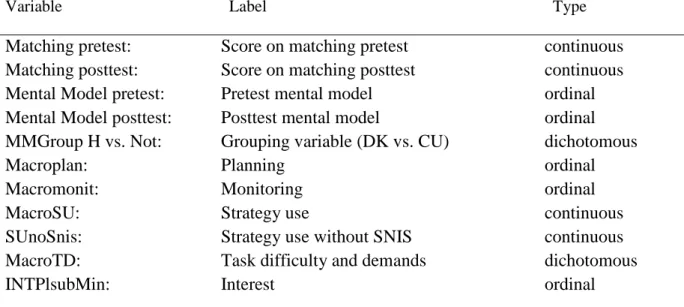
The descriptive statistics table above shows that not all the variables used in this study were normally distributed. To account for this, several variables were treated as either ordinal or dichotomous. In order to compute appropriate statistics for the correlation matrix, each variable was classified by type as shown in the table below.
Table 2 Variable Type
Variable Label Type
Matching pretest: Score on matching pretest continuous Matching posttest: Score on matching posttest continuous Mental Model pretest: Pretest mental model ordinal Mental Model posttest: Posttest mental model ordinal MMGroup H vs. Not: Grouping variable (DK vs. CU) dichotomous
Macroplan: Planning ordinal
Macromonit: Monitoring ordinal
MacroSU: Strategy use continuous
SUnoSnis: Strategy use without SNIS continuous
MacroTD: Task difficulty and demands dichotomous
INTPlsubMin: Interest ordinal
40 Table 3 Correlation matrix Matching pretest Mental model pretest Matching Posttest Mental Model posttest
Group Planning Monitoring Strategy Use Strategy use no SNIS Task difficulty Mental model pretest 0.426** Matching posttest
0.692** 0.280*
Mental Model posttest
0.340** 0.440** 0.469**
Group -0.369** -0.469** -0.417** -0.884**
Planning -0.057 0.077 0.027 0.153 -0.149
Monitoring 0.142 0.139 0.112 0.117 -0.109 0.555**
Strategy Use
0.019 0.146 0.054 0.041 -0.113 0.500** 0.549**
Strategy use no SNIS
-0.054 0.061 0.017 0.111 -0.138 0.396** 0.539* 0.809**
Task Difficulty
-0.084 -0.046 -0.216 0.061 -0.39 -0.061 -0.002 0.152 0.097
Interest 0.106 0.131 0.104 0.303* -0.255* -0.122 -0.018 0.107 0.149 0.075
41 The Sample and Prior Knowledge
The sample for this project was selected from an original sample of 159 participants. Participants chosen for this project had an increase from pretest to posttest of at least four on the declarative knowledge measure. Thus, participants that scored a 10 or higher out of a possible 13 on the pretest could not be included regardless of performance. Of the 159 participants in the larger sample, 50 (31%) had an initial score on the matching pretest that was 10 or higher.
Of the 62 participants in the sample for this project, 26 were placed in the declarative knowledge group and 36 were placed in the conceptual understanding group. Within the conceptual understanding group, all participants scored at least a seven on the posttest
matching measure. Twenty-nine of the 36 (81%) participants in the conceptual understanding group scored the maximum 13 on the posttest matching section. By comparison, of the 26 participants in the declarative knowledge group only 7 (27%) scored the maximum score of 13 on the matching posttest. Similarly, within the larger sample of 159 participants, 88 participants demonstrated a conceptual understanding by scoring a nine or higher on the posttest mental model measure. Of these 88 participants, no one scored lower than six on the matching measure. This demonstrated that participants that scored high on the posttest conceptual understanding measure also demonstrated declarative knowledge on the posttest.
42
participants in the larger sample, 110 scored less than 10 on the matching section of the pretest. This group had taken an average of 1.08 biology courses. Forty-nine participants scored a 10 or higher on the pretest matching section; however, one of those participants did not report the number of biology courses taken and was excluded from further analysis. The remaining 48 reported having taken an average of 1.85 biology courses. A two-tailed Mann-Whitney U test was used to evaluate the hypothesis that there were differences in the number of biology courses taken between the two groups. The Mann-Whitney U test was used because the number of biology courses taken was not normally distributed. The results of the test were statistically significant, z=-2.95, p<0.05. The group that scored 10 or higher on matching had a mean rank of 94.25 and the group that scored nine or lower on matching had an average rank of 73.06. These results indicated that the number of biology courses taken prior to participating in this project was related to students’ scores on the pretest matching section within the larger sample.
Planning
A two-tailed Mann-Whitney U test was used to evaluate the hypothesis that there were differences between the two groups in the frequency that students planned. The Mann-Whitney U test was used because the macro-level SRL process variable planning was not normally distributed. The results of the test were not statistically significant, z=-1.16, p=0.246. The conceptual understanding group had an average rank of 33.75 and the
declarative knowledge group had an average rank of 28.38. Strategy Use
43
employed strategies between students that gained only declarative knowledge and students that reached a conceptual understanding. The first variable, strategy use, was calculated by adding all occurrences of the micro-level processes that are part of the macro-level process strategy use. The second variable, strategy use without SNIS, was calculated by adding the occurrences of all micro-level processes listed as part of strategy use except Select New Information Source (SNIS). This variable was calculated to eliminate the potential effect that SNIS could have on data analysis. Students frequently conduct the micro-level SRL process select new information source. Selecting new information source is a strategy, but it is a very low-level strategy. Frequent use of SNIS is an indicator of poor use of SRL. Participants that overuse SNIS are frequently moving rapidly and haphazardly through the environment. For this reason, it was removed from the analysis.
An independent-samples t test was conducted to evaluate the hypothesis that there was a difference in the frequency with which students used strategies between the two groups. The result of Levene’s Test for Equality of Variances, F=0.19, p=0.657, was not statistically significant and indicated that equal variances could be assumed. The t-test was not statistically significant, t (60) =0.878, p=0.657. The 95% confidence interval for the difference in means ranged from -7.3 to 18.6.
44
not statistically significant, t (50.5) =0.864, p=0.39. The 95% confidence interval for the difference in means ranged from -6.01 to 20.0.
Monitoring
A two-tailed Mann-Whitney U test was used to evaluate the hypothesis that there were differences in the frequency that students monitor progress between the two groups. The Mann-Whitney U test was used because the macro-level SRL process variable was not normally distributed. The results of the test were not statistically significant, z=-0.85, p=0.395. The conceptual understanding group had an average rank of 33.15 and the
declarative knowledge group had an average rank of 29.21. Task Difficulty and Demands
A two-way contingency table analysis was conducted to evaluate whether there was a statistically significant difference between the number of times participants in the conceptual understanding group and participants in the declarative knowledge group monitored task difficulty and demands. The contingency table analysis was selected after reviewing the distribution of the task difficult and demand variable. The scores on this variable resembled a binomial distribution: a subset of the participants monitored task difficulty once, and the remaining students did not monitor task difficulty at all. There was no statistically significant relationship between group and frequency of monitoring task difficulty and demand, Pearson χ2 (1, N=62) =0.096, p=0.757, Cramer’s V=0.039. Thirty-four participants in the conceptual understanding group (N=36) monitored task difficulty and demands zero times while two participants did it once. Twenty-five participants in the declarative knowledge group (N=26) monitored task difficulty and demands zero times and one participant monitored task
45 Interest
The macro-level SRL process interest was calculated by subtracting the number of times each student used the micro-level process INT- from the number of times the student used the micro-level process INT+. This was done so that the macro-level variable interest captured a student’s overall level of interest. For example, a student that made two positive interest comments and three comments about not being interested or bored received an overall interest score of negative one.
A two-tailed Mann-Whitney U test was used to evaluate the hypothesis that there were differences in the interest level of students between the two groups. The Mann-Whitney U test was used because the macro-level SRL process variable interest was not normally distributed. The results of the test were not statistically significant, z=-1.99, p=0.047. This value was not significant because the Holm’s sequential Bonferonni adjustment required a p value less than 0.01 for significant results. The conceptual understanding group had an average rank of 35.29 and the declarative knowledge group had an average rank of 26.25. Summary
46
Discussion
The intent of this project was to contribute to research regarding the use of self-regulated learning processes in hypermedia environments. The goal was to identify differences in the SRL processes employed by students that reached a conceptual
understanding when compared with students that gained only declarative knowledge from the same learning task. Specifically, I sought to investigate differences in the frequency that students employed the five macro-level SRL processes: planning, strategy use, monitoring, task difficulty and demands, and interest. Statistically and practically significant results from this study would have helped educators and creators of hypermedia environments in the future by identifying particular SRL processes that potentially contribute to students’ ability to reach a conceptual understanding. Educators would benefit from this analysis because identifying these macro-level processes would allow them to emphasize and train students in the SRL processes that lead to conceptual understanding. Identification of these SRL
processes would allow hypermedia developers to incorporate SRL learning processes into hypermedia learning environments.
A variation of Azevedo and colleagues’ (Azevedo, Cromley, & Seibert, 2004;
47
The research questions for this project concerned whether there were differences in the frequency with which the conceptual understanding group and the declarative knowledge group employed the macro-level SRL processes. The results of this study did not show statistically significant differences between the two groups in terms of use of the five macro-level processes.
The lack of statistically significant results from this study limits what can be
generalized from this study. The results from this study are limited to similar populations of college students and cannot be applied to learners of different ages, sociocultural contexts or academic backgrounds. Additionally, these results apply only to learning the circulatory system with hypermedia environments and do not necessarily describe differences in the use of SRL while learning in the classroom or learning different topics.
Limitations
This study focused on a relatively homogeneous group of academically successful college students. It is possible that within a more diverse group of students there could be differences in the frequency that SRL processes are employed between the two groups. For example, diversity in the group could be increased by studying students of different ages, sociocultural backgrounds, or with more diverse academic achievement. Additionally, the relatively small sample size for this project may have reduced the power of the analysis and precluded statistically significant results.
The two groups for this project, declarative knowledge only and conceptual
48
created using similar rules. Changes in the criteria for inclusion in either the declarative knowledge or the conceptual understanding group might alter the results. The conceptual understanding group was created by selecting only students that reached a high mental model according the Azevedo and colleagues’ rubric. Students that reached either a low or an intermediate mental model were placed in the declarative knowledge group. It is possible that splitting the groups at a different point on the mental model continuum would yield different results. For example, there may be significant differences in the frequency of the use of macro-level SRL processes between students that reach only a low mental model of the circulatory system and students that reach an intermediate mental model. Understanding this divide would still be useful for educators and designers of hypermedia learning
environments. It is also possible that altering the requirements for the declarative knowledge group would change the results. For this study, a minimum change between pretest and posttest of four was required for inclusion. Raising or lowering this value would alter the sample of students included and might change the findings considerably.
49
focusing on micro-level processes has the potential to block researchers’ ability to see trends in SRL processes that may be seen using macro-level processes.
Directions for Future Research
While learning complex science topics in hypermedia environment some students reach a conceptual understanding of the topic while some gain declarative knowledge, but fail to reach a conceptual understanding. Science educators advocate that students reach a conceptual understanding of topics so they can apply what they learn to real world situations (Roth, 1990). Educators, students, and hypermedia designers will benefit from an
understanding of what SRL processes distinguish students that reach a conceptual
understanding from students that gain only declarative knowledge. Future research on the use of SRL processes to learn complex science topics in hypermedia environments should seek to identify differences between these two groups.
Future research into the differences in the frequency with which students that gain a conceptual understanding employ SRL processes might include a more diverse group of students. Further research might also divide students into groups at a different point along the conceptual understanding continuum defined by the Azevedo and colleagues model or alter the change in declarative knowledge required to participate in the study. Measuring SRL using the micro-level processes instead of the macro-level processes may alter results and lead to significant results.