Copyright © 2012 IJECCE, All right reserved
Differential Evolution with Control Parameters Pool for
Economic Dispatch including Multiple Fuels and Valve
Point Effects
R. Balamurugan
Department of Electrical Engineering, Annamalai University, Annamalai Nagar–608 002, Tamil Nadu, India
Abstract — This paper presents the application of differential evolution (DE) algorithm for the solution of economic dispatch problem with multiple fuels and valve point effects. DE is the one of the most prominent new generation evolutionary algorithms for global optimization. The important control parameters of DE algorithm such as the scaling factor F and crossover rate CR are kept constant in the classical DE algorithm. These parameters are randomly varied within a specified range so as to minimize the overall objective function. The selection of these control parameter values is a problem dependent task and which requires previous experience of the user. In the proposed approach, the scaling factor and crossover rate are predefined which constitute the control parameter pool. The search ability of the DE algorithm is improved by employing the control parameter pool. The performance of the algorithm is further improved by generating more number of trial vectors for each target vector and the concept of aging is implemented to avoid the premature convergence. The proposed algorithm is implemented for ten unit sample test system including multiple fuel options and valve point effects. The simulation results of the proposed algorithm are compared with the results using other methods reported in the recent literature. The comparison of results shows that the proposed DE algorithm outperformed other methods in terms of solution quality.
Keywords — Control Parameters Pool, Differential Evolution, Economic Dispatch, Multiple Fuel Option, Piecewise Quadratic Function.
I. I
NTRODUCTIONThe objective of economic dispatch problem is to minimize the generation cost of a power system. This is achieved by allocating optimal generation schedule for the committed generating units so as to meet the required load demand while satisfying various practical constraints. In the traditional economic dispatch problem, the valve-point effects are not considered which lead to introduction of inaccuracy into the resulting dispatch. Large steam turbine generators in a thermal power plant have a number of steam admission valves. These steam admission valve are opened in sequence as the generating unit output is increased. The valve-point effects introduce ripples in the heat-rate curves of thermal units. The generating unit with multi-valve steam turbines shows the great variation in the fuel cost function. The incremental fuel cost function should be modeled in a more practical way by including valve-point effects. Therefore the generator cost functions are represented by quadratic functions with sine components. The rippling effects produced by the steam admission valve opening are represented by the
superimposed sine components [1], [2].
Multiple fuels like coal, natural gas and oil are used in thermal plants due to increasing fuel prices. The economic dispatch problem is represented as piecewise quadratic function because of multiple fuels options. The task of economic dispatch with multiple fuel options refers to the optimization problem for the determination of most economic fuel to burn and optimal generation scheduling of committed units. The generation cost function of economic dispatch with multiple fuel options should be realistically modeled. The loss of accuracy by using traditional single quadratic cost functions has to be eliminated. Since the dispatching units are practically supplied with multi-fuel sources, each unit should be represented with several piecewise quadratic functions reflecting the effects of fuel type changes. With multiple fuels, the objective function is a superposition of piecewise quadratic functions. To obtain an accurate and practical economic dispatch solution, the realistic operation of the economic dispatch problem should be considered with both valve-point loadings and the fuel changes into one frame [3]. In reality, the cost function of a generator is highly nonlinear due to valve-point loadings effects and multiple fuel options.
A number of conventional approaches such as lambda iteration method, linear programming algorithm, quadratic programming, lagrangian relaxation algorithm and the gradient method were reported for solving the economic power dispatch problem. These numerical methods require monotonically increasing incremental cost curves. Practically the cost functions of modern power generation units are highly nonlinear and discrete in nature. Hence these numerical methods failed to give global optimal solution for the realistic economic dispatch problem in a power system.
Recently modern heuristic optimization techniques had been given much attention due to their ability to determine the global or near global optimal solution. The metaheuristics are methods that are often based on process observed in physics and biology. The metaheuristic techniques such as genetic algorithm [4], [5], evolutionary programming [6], particle swarm optimization methods [7], simulated annealing [8], ant colony optimization [9], artificial bee colony algorithm [10] etc were applied to solve economic dispatch problems. A hybrid algorithm that combines the DE with dynamic programming approach was developed for the solution economic dispatch with multiple fuel options [11].
Copyright © 2012 IJECCE, All right reserved valve-point loadings and multiple fuel options. An
improved genetic algorithm with multiplier updating had been applied to power economic dispatch of units with valve-point effects and multiple fuels [3]. This algorithm integrated the improved genetic algorithm and the multiplier updating. The improved genetic algorithm equipped with an improved evolutionary direction operator and a migration operation can search efficiently and actively explore solutions. The multiplier updating was employed to handle the equality and inequality constraints of economic dispatch problem. Anti-predatory particle swarm optimization method was presented for solution of the economic dispatch problem with valve-point effects and multiple fuel options [12]. In the classical PSO, a particle (bird) searches the global optimum solution with the help of three behaviors: inertial, cognitive and social. The cognitive and social behaviors were the components of the foraging activity, which help the swarm of birds to locate food. Another activity that was observed in birds is the anti-predatory nature, which helps the swarm to escape from the predators. The anti-predatory activity was modeled and embedded in the classical PSO to form anti-predatory PSO. This inclusion enhanced the exploration capability of the swarm.
A self-adaptive differential evolution algorithm for the solution economic dispatch problems with non-smooth cost functions was reported in [13]. The important control parameters F and CR are automatically adapted during the evolutionary process, which avoids the complication of tuning these control parameters in the DE algorithm. Barisal [14] developed an improved particle swarm optimization approach to solution of optimal power generation for economic dispatch problem. Dynamic search space squeezing strategy is devised to accelerate the convergence of particle swarm optimization algorithm. In this paper, DE algorithm with a group of fixed control parameter settings is implemented for the solution of economic dispatch problem with multiple fuel options and valve point effects. The various values of mutation factor and crossover operator are employed in the proposed approach to find global or near global optimal solution for the economic dispatch with multiple fuel options and valve point effects. The computational results show that the proposed algorithm provides a better solution for the realistic economic dispatch problem.
II. P
ROBLEMF
ORMULATIONThe main goal of economic dispatch with multiple fuel options is to find the optimal combination of fuel options and optimal power generations for the given load demand that minimizes the total generation cost while satisfying an equality constraint and inequality constraints The inclusion of valve-point loading effects and multiple fuel options makes the modeling of the incremental fuel cost function of the generators more practical [3]. This increases the non-linearity as well as number of local optima in the solution space of economic dispatch problem. For a generator with k fuel options, the cost curve is divided into k discrete regions between lower and
upper bounds. The economic dispatch problem with piecewise quadratic function and valve-point effects [3] is defined as
Minimize = ∑ ( )$/h (1)
( ) =
⎩ ⎪ ⎪ ⎪ ⎨ ⎪ ⎪ ⎪
⎧ + + + sin − ,
1, ≤ ≤
+ + + sin – ,
2, ≤ ≤
⋮
+ + + sin – ,
3, ≤ ≤
(2)
where Fi(Pi) is the fuel cost function of ith unit, Piis the power output of ith unit, n is the number of generating units in the system, and where aik, bik, cik are cost coefficients of unit i for the kth fuel type and eik, fikare the constants of the ith unit with valve point effects for the kth fuel type .
Minimization of the generation cost is subjected to the following constraints
(i) Power balance constraint: The total generation of committed units should be equal to the system demand. This is represented the following equality constraint
∑ = MW (3)
where is PDthe total system demand.
(ii) Generating capacity constraints: The generation output of each unit should be between its minimum and maximum limits. This is represented by the following inequality constraints.
≤ ≤ for i=1,2,…, n (4)
Where and are the minimum and maximum
power outputs of the ith unit.
III. D
IFFERENTIALE
VOLUTIONDifferential evolution (DE) is a simple and powerful evolutionary algorithm for global optimization introduced by Price and Storn [15]. DE is a population based stochastic evolutionary algorith. DE creates new candidate solutions by combining the parent individual and several other individuals of same population. A candidate replaces the parent only if it has better fitness. DE has three control parameters: amplification factor of the difference vector, that is the scaling factor F, crossover rate CR and population size NP. The important advantage of DE is easy to implement for solving complex practical optimization problem and DE has few control parameters, which are kept fixed throughout the entire optimization process. The crucial idea behind DE is a scheme for generating trial parameter vectors. Mutation and crossover are used to generate new vectors, and selection then determines which of the vector will survive into the next generation.
A set of D optimization parameters is called an individual. It is represented by D-dimensional parameter vector. A population consists of NP parameter vectors ,
i = 1, 2, 3, … , NP. G denotes the iteration number. NP is
Copyright © 2012 IJECCE, All right reserved during the minimization process. The evolutionary process
of the differential evolution algorithm is as follows: Initialization: To construct a starting point for the optimization process, the population with NP individuals should be initialized. Usually, the population vectors are initialized by randomly generated individuals within the boundary constraints.
(L) j (L) j (U) j j,i
j,i rand (X - X ) X
X0 [0,1] (5)
where i=1,2,…, NP,j=1,2,…, D, X(L)j and X(U)j are the
lower and upper boundary of jth component, respectively, and rand [0,1] denotes a uniformly distributed random value in the range [0,1].
Mutation: For each target vector, or parent vector, a mutant vector is generated according to
) X (X F X
ViG1 nG1 nG2 nG3 (6) where random indexes n1, n2, and n3 are integers, mutually different, and also chosen to be different from the running index i so that NP must be at least four vectors. Scaling factor F is a real number and constant factor during the entire optimization process, and the variable range is (F[0,2]).
Crossover: The trial vector UGi1 is generated using the parent and mutated vectors as follows:
ise , otherw X
k j CR , d , if ran V
U
G j, i
j, i G
j, i G
j, i
or ] 1 0 [ 1
1
(7)
where k{1,2,...,D}is the randomly selected index chosen once for each i, which ensures that gets at least one element from VGj, i1. CR is the parameter, which is a
real-valued crossover factor in the range [0,1] and controls the probability that a trial vector component comes from the randomly chosen, mutated vector Vj, iG1, instead of the
current vector XGj,i. If CR is 1, then the trial vector UGi1
is the replica of the mutated vectorVGi 1.
Selection: To decide the population for the next generation, the trial vector UGi1 and the target vector
G i
X are compared, and the individual of the next
generation XGi1 is decided according to the following rule for the function minimization:
ise , otherw X
) f(X ) , if f(U U
X
G i
G i G
i G
i G
i
1 1
1
(8)
The feature of differential evolutions selection scheme is that a trial vector is compared with only one individual, not all the individuals in the current population. Due to the greedy selection scheme, all the individuals of the next generation are as good as or better than their counterparts in the current generation.
Stopping criterion: Increment the generation number to G=G+1. Proceed to mutation operation until stopping criterion, usually a maximum number of iterations, is met. The stopping criterion depends on the type of problem.
Differential evolution has several advantages over numerical methods. The advantages of DE are simple and easy to understand concept, compact structure, ease of use, high convergence characteristics, and robustness, which make it a high-class optimization technique for real-valued parameter optimization. It requires information about the objectives function itself, which can be either explicit or implicit. Other accessory properties such as differentiability or continuity are not necessary. As such, they are more flexible in dealing with a wide range of practical engineering problems. Even though the DE algorithm described above already works remarkably well, its performance can be improved and its methodology can be adapted to a wide variety of practical optimization problems.
IV. D
IFFERENTIALE
VOLUTIONA
LGORITHMFOR
E
CONOMICD
ISPATCHW
ITHM
ULTIPLEF
UELO
PTIONS ANDV
ALVEP
OINTE
FFECTSThe modified DE algorithm is developed to determine optimal combination of fuel options for the given load demand and the optimal generation schedule of committed generators so as to minimize the total fuel cost of thermal generating units while satisfying various constraints. The search procedure of the proposed differential evolution for economic dispatch problem is described as follows:
Initialization: Differential evolution uses NP D-dimensional parameter vectors
G i
P, ; for i=1,2,… , NP (9)
in a generation G, with the number of NP vectors in a population will be constant over the entire optimization process. A set of D optimization parameters in a population is called an individual. At the beginning of the procedure, i.e., generation G = 1, the population vectors have to be generated randomly within the limits. The elements of Pi,Gvectors are the real power generations of the committed generating units.
Mutation: For the following generation G+1, new mutant vector Vi,G+1 for each target vector are generated according to the following mutation scheme ,
) - P (P F P
Vi, G1 i, G r1, G r2, G
for i = 1,2,…,NP (10) The integers r1 and r2 are chosen randomly over [1, NP] and should be mutually different from the running index i. Under certain situation, the index i will be exchanged by an arbitrary random number r3 within [1, NP].
Crossover operation: Each gene of ith individual is replaced from the mutant vectors Vi, G+1and the present individual Pi, G. That is,
CR V
- CR) ( P
Copyright © 2012 IJECCE, All right reserved population diversity and encourages the global search
potential of the algorithm. In the proposed approach, any one control parameter setting from the control parameter pool is randomly selected for generating each trail vector using (10) and (11).
Estimation and Selection: Each individual in the population is evaluated using the fitness function of the problem to minimize the fuel cost function. The power balance constraint is augmented with the objective to form a generalized fitness function fkas given below
2
1 1
)
(
n
i
D i i
n
i i
k F P P P
f (12)
where is penalty parameter. The penalty term reflects the violation of the equality constraint and assigns a high cost of penalty function to candidate point far from feasible region. If any of the generation limits are violated then generation at that unit is fixed at the violated limit. To form the population for the next generation, the fitness function values of the target vector and the trail vector are compared. The target vector is replaced by its trail vector if the fitness of the trail vector is better than that of its target vector. Differential selection method is based on local competition only. i.e., a trail vector Ui, G+1will try to win against one population member Pi,G and survivor will enter the new population. The number NT of trail vectors which may be produced to compete against Pi,G should be chosen sufficiently high so that sufficient number of trail vectors will enter the new population. If the fitness value of trail vector is worse than that of its target vector, the vector generation process defined by equations (10) and (11) is repeated up to NT times. If Ui, G+1still worse than that of its target vector, Pi, G+1 will be set to Pi, G. An insufficient number NT leads to survival of too many old population vectors, which may induce stagnation. To prevent a vector Pi, Gfrom surviving indefinitely, proposed DE employs the concept of aging. NR defines how many generations a population vector may survive before it has to be replaced due to excessive age. To this end Pi,Gin (9) is verified first for how many generations it has already lived. If Pi,Ghas an age of less than NG generations it remains unaltered, otherwise Pi,Gis replaced by randomly selected vector Pr3, G with r3 being a randomly selected integer r3[1, NP]. In other words , if Pi,Gis too old it may not serve as a parent vector any more but will be replaced by a randomly chosen member of the current generation
G.
Stopping Criterion: The procedure from steps mutation to estimation and selection will be repeated until there is no significant improvement in the minimum fitness value or predefined maximum number of iterations is reached.
V. C
OMPUTATIONALR
ESULTS ANDD
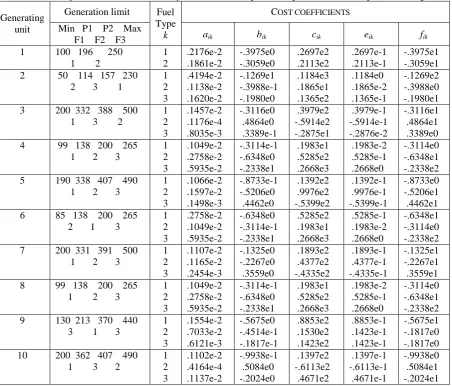
ISCUSSIONThe proposed DE is implemented to ten generating units sample system with multiple fuel options and valve point effects are considered. The system data for economic dispatch with multiple fuel options and valve point effects is taken from [3]. The program is developed using MATLAB 6.5 and has been executed in Intel core i3 CPU 2.4 GHz with a 4 GB RAM. The system data for economic power dispatch with multiple fuel options is given in Appendix. This economic dispatch problem includes one objective function with ten variable parameters (P1, P2,
…, P10), one equality and twenty inequality constraints i.e. total generation should meet the total demand, maximum and minimum generation limits of each unit. The proposed DE algorithm uses six control variables i.e. population size NP, maximum number of generations NG, number of trial per iteration NT, number of generations a population vector may survive in the evolutionary process before it has to be replaced due to excessive age NR, scaling factor F, and crossover rate CR. The following control parameters have been chosen for the proposed algorithm: NP = 50, NG = 300, NT = 10, NR = 5. The F and CR are chosen from the control parameter pool as described in section IV. Due to the randomness of the evolutionary algorithms, their performance cannot be judged by the result of a single execution. To obtain a useful conclusion about the performance of the algorithm, many independent trials should be made. An algorithm is robust, if it gives consistent result during all the trials. In order to show the performance of the proposed algorithm, twenty independent runs have been conducted with the total system demand varying from 2400MW to 2700MW in steps of 100 MW. The difference between the best and worst operating costs found by proposed methods is very low, which show robustness of the algorithm for getting global or near global optimal solutions for economic dispatch problem with multiple fuels and valve point loadings.
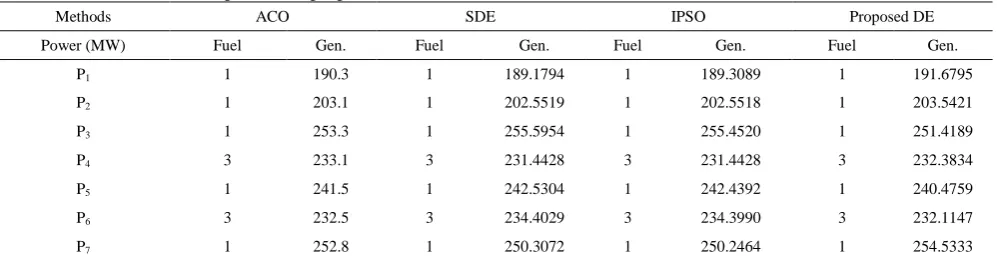
Table I : Comparison of proposed DE results with other methods for load demand of 2400 MW
Methods ACO SDE IPSO Proposed DE
Power (MW) Fuel Gen. Fuel Gen. Fuel Gen. Fuel Gen.
P1 1 190.3 1 189.1794 1 189.3089 1 191.6795
P2 1 203.1 1 202.5519 1 202.5518 1 203.5421
P3 1 253.3 1 255.5954 1 255.4520 1 251.4189
P4 3 233.1 3 231.4428 3 231.4428 3 232.3834
P5 1 241.5 1 242.5304 1 242.4392 1 240.4759
P6 3 232.5 3 234.4029 3 234.3990 3 232.1147
Copyright © 2012 IJECCE, All right reserved
P8 3 233.1 3 232.5178 3 232.5178 3 233.8615
P9 1 320.1 1 321.5026 1 321.5403 1 322.0562
P10 1 240.2 1 239.9736 1 240.0479 1 237.9345
Total power (MW) 2400.0 2400.0 2400.0 2400.0
Total cost ($/h) 482.5267 481.8628 481.8044 481.7698
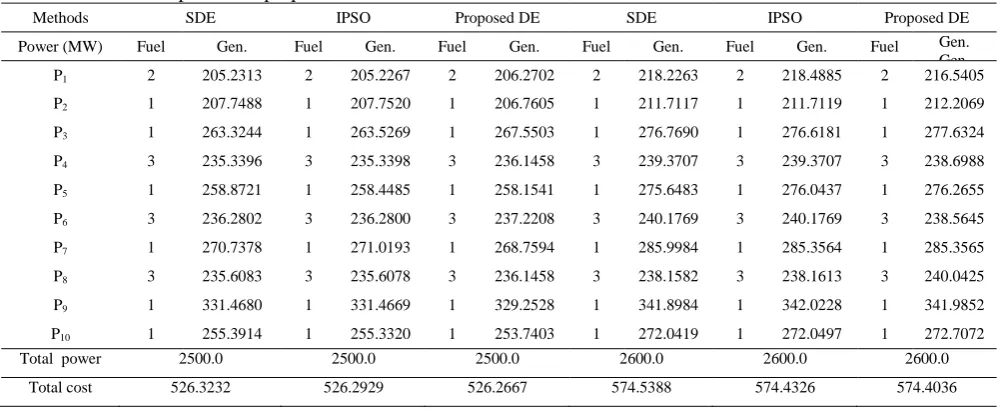
Table II : Comparison of proposed DE results with other methods for load demand of 2500 MW & 2600 MW
Methods SDE IPSO Proposed DE SDE IPSO Proposed DE
Power (MW) Fuel Gen. Fuel Gen. Fuel Gen. Fuel Gen. Fuel Gen. Fuel Gen. Gen. P1 2 205.2313 2 205.2267 2 206.2702 2 218.2263 2 218.4885 2 216.5405
P2 1 207.7488 1 207.7520 1 206.7605 1 211.7117 1 211.7119 1 212.2069
P3 1 263.3244 1 263.5269 1 267.5503 1 276.7690 1 276.6181 1 277.6324
P4 3 235.3396 3 235.3398 3 236.1458 3 239.3707 3 239.3707 3 238.6988
P5 1 258.8721 1 258.4485 1 258.1541 1 275.6483 1 276.0437 1 276.2655
P6 3 236.2802 3 236.2800 3 237.2208 3 240.1769 3 240.1769 3 238.5645
P7 1 270.7378 1 271.0193 1 268.7594 1 285.9984 1 285.3564 1 285.3565
P8 3 235.6083 3 235.6078 3 236.1458 3 238.1582 3 238.1613 3 240.0425
P9 1 331.4680 1 331.4669 1 329.2528 1 341.8984 1 342.0228 1 341.9852
P10 1 255.3914 1 255.3320 1 253.7403 1 272.0419 1 272.0497 1 272.7072
Total power 2500.0 2500.0 2500.0 2600.0 2600.0 2600.0
Total cost 526.3232 526.2929 526.2667 574.5388 574.4326 574.4036
Table III : Comparison of proposed DE results with other methods for load demand of 2700 MW
Methods IGA-MU ACO SDE IPSO Proposed DE
Power (MW) Fuel Gen. Fuel Gen. Fuel Gen. Fuel Gen. Fuel Gen.
P1 2 219.1261 2 221.45 2 218.9403 2 217.5692 2 217.5673
P2 1 211.1645 1 211.53 1 212.7204 1 211.2166 1 210.7215
P3 1 280.6572 1 281.62 1 282.6327 1 279.6488 1 279.6489
P4 3 238.4770 3 239.90 3 239.7738 3 240.1769 3 240.0425
P5 1 276.4179 1 276.99 1 277.4606 1 276.5743 1 279.6343
P6 3 240.4672 3 239.11 3 240.1769 3 239.9082 3 240.0425
P7 1 287.7399 1 284.76 1 287.2932 1 285.3796 1 289.8426
P8 3 240.7614 3 240.70 3 239.9082 3 240.4456 3 240.4457
P9 3 429.3370 3 429.61 3 426.0885 3 430.0665 3 428.1910
P10 1 275.8518 1 274.31 1 275.0054 1 279.0143 1 273.8637
Total power (MW) 2700.0 2699.98 2700.0 2700.0 2700.0
Total cost ($/h) 624.5178 624.193 623.9225 623.8730 623.8621
Copyright © 2012 IJECCE, All right reserved Tables I-III show best dispatch results obtained through
the proposed method for various system demands and are compared with ant colony optimization algorithm (ACO) [9,14], self adaptive differential evolution method (SDE) [13], Improved particle swarm optimization (IPSO) [14], improved genetic algorithm with multiplier updating (IGA-MU) [3]. From the tables, it is found that the proposed method provides better results than all other reported methods. From the Tables 1–3, it is clear that the optimal generation schedule of committed generating units satisfies the load demands and generator operating limits. The optimal power generation schedules obtained through the proposed method are different from the results reported in other methods. The average computation time taken by the algorithm is 15.34 seconds. The convergence characteristic of the proposed algorithm for the load demand of 2500 MW is shown in Fig. 1. From the comparison, it is clear that the proposed algorithm provides high quality solution with reasonable computational time.
VI. C
ONCLUSIONA differential evolution based approach to economic dispatch problem with multiple fuel options and valve-point loading is presented in this paper. The search capability of the DE algorithm is improved by employing control parameters pool which avoids the need of tuning F and CR. The performance of the proposed method has been demonstrated with ten-unit sample systems with piecewise quadratic functions and valve point loading effects. The simulation results shows that the optimal dispatch solution obtained through the proposed DE with control parameter pool gives less operating cost than that found by other methods reported in the literature. The comparison shows the superiority of the proposed method and its effectiveness for solving non-smooth economic dispatch problems in a power system.
A
CKNOWLEDGEMENTThe author gratefully acknowledge the authorities of Annamalai University, Annamalai Nagar, Tamilnadu, India, for their continued support, encouragement and the extensive facilities provided to conduct this research work.
R
EFERENCES[1] D.C.Walters and G.B.Sheble, “Genetic algorithm solution of economic dispatch with valve point loading,” IEEE Trans. Power Syst., vol. 8, pp. 1325-1332, Aug. 1993.
[2] N.Sinha, R.Chakrabarti, and P.K.Chattopadhyay, “Evolutionary programming techniques for economic load dispatch,” IEEE Trans. Evol. Comput., vol. 7, pp. 83-94, Feb. 2003.
[3] C.L.Chiang, “Improved genetic algorithm for power economic dispatch of units with valve-point effects and multiple fuels,” IEEE Trans. Power Syst., vol. 20, pp. 1690-1699, Nov. 2005. [4] S.O.Orero and M.R.Irving, “ Economic dispatch of generators
with prohibited operating zones: a genetic algorithmapproach,” IEE Proc.- Gener. Transm. Distrib., vol. 143, pp. 529-534, Nov. 1996.
[5] J.Won and Y.Park, “Economic dispatch solutions with piecewise quadratic cost functions using improved genetic algorithm,” Elect. Power Energy Syst., vol. 25 pp. 355-361, 2003.
[6] T.Jayabarathi, K.Jayaprakash, D.N.Jeyakumar, and T.Raghunathan, “Evolutionary programming techniques for different kinds of economic dispatch problems,” Elect. Power Syst. Res., vol. 73, pp. 169-176, 2005.
[7] Z.L.Gaing, “Particle swarm optimization to solving the economic dispatch considering the generator constraints,”IEEE Trans. Power Syst., vol. 18, pp. 1187-1195, Aug. 2003. [8] K.P.Wong and C.C.Fung, “Simulated annealing based economic
dispatch algorithm,” IEE Proc.- Gener. Transm. Distrib., vol. 140, pp. 509-515, Nov. 1993.
[9] S.Pothiya, I.Ngamroo, and W.Kongprawechnon. Ant colony optimisation for economic dispatch problem with non-smooth cost functions. Elect. Power Energy Syst ., vol. 32, 478–87, 2010.
[10] S.Hemamalini and SP.Simon Artificial bee colony algorithm for economic load dispatch problem with non-smooth cost functions. Int J Electr Power Compon Syst.,vol. 38, 786–803, 2010. [11] R.Balamurugan and S.Subramanian, “Hybrid integer coded
differential evolution – dynamic programming approach for economic load dispatch with multiple fuel options”, Energy Convers. Manage., vol. 49, no.4, pp. 608-614, April 2008. [12] A.I.Selvakumar and K.Thanushkodi, “Anti-predatory particle
swarm optimization: Solution to nonconvex economic dispatch problems,”Elect. Power Syst. Res., vol.78 , pp.2-10, 2008. [13] R.Balamurugan and S.Subramanian, “Self-Adaptive differential
evolution based power economic dispatch of generators with valve-point effects and multiple fuel options”, International Journal of Computer Science and Engineering, vol. 1, no.1, pp. 10-17, 2007.
[14] A.K.Barisal, “Dynamic search space squeezing strategy based intelligent algorithm solutions to economic dispatch with multiple fuels,” Elect. Power Energy Syst., vol. 45 pp. 50-59, 2013.
[15] R.Storn and K.Price, “Differential evolution – A simple and efficient heuristic for global optimization over continuous spaces,”J. Global Optimiz., vol. 11, pp. 341-359, 1997. [16] Y.Wang, Z.Cai, and Q.Zhang, “Differential evolution with
composite trial vector generation strategies and control parameters,”IEEE Trans. Evol. Comput., vol. 15, pp. 55-66, Feb. 2011.
A
UTHOR’
SP
ROFILER. Balamurugan
received B.E (EEE)., M.E (Power system)., and Ph.D (Electrical Engineering) degrees from Annamalai University, Annamalai Nagar, Tamil Nadu, India, in 1994, 1996, 2008, respectively
Copyright © 2012 IJECCE, All right reserved
A
PPENDIXTable A: System data for 10-Unit system with multiple fuel options and valve point loading
Generating unit
Generation limit Fuel Type
k
COST COEFFICIENTS
Min P1 P2 Max
F1 F2 F3 aik bik cik eik fik
1 100 196 250 1 2
1 2 .2176e-2 .1861e-2 -.3975e0 -.3059e0 .2697e2 .2113e2 .2697e-1 .2113e-1 -.3975e1 -.3059e1 2 50 114 157 230
2 3 1
1 2 3 .4194e-2 .1138e-2 .1620e-2 -.1269e1 -.3988e-1 -.1980e0 .1184e3 .1865e1 .1365e2 .1184e0 .1865e-2 .1365e-1 -.1269e2 -.3988e0 -.1980e1 3 200 332 388 500
1 3 2
1 2 3 .1457e-2 .1176e-4 .8035e-3 -.3116e0 .4864e0 .3389e-1 .3979e2 -.5914e2 -.2875e1 .3979e-1 -.5914e-1 -.2876e-2 -.3116e1 .4864e1 .3389e0 4 99 138 200 265
1 2 3
1 2 3 .1049e-2 .2758e-2 .5935e-2 -.3114e-1 -.6348e0 -.2338e1 .1983e1 .5285e2 .2668e3 .1983e-2 .5285e-1 .2668e0 -.3114e0 -.6348e1 -.2338e2 5 190 338 407 490
1 2 3
1 2 3 .1066e-2 .1597e-2 .1498e-3 -.8733e-1 -.5206e0 .4462e0 .1392e2 .9976e2 -.5399e2 .1392e-1 .9976e-1 -.5399e-1 -.8733e0 -.5206e1 .4462e1 6 85 138 200 265
2 1 3
1 2 3 .2758e-2 .1049e-2 .5935e-2 -.6348e0 -.3114e-1 -.2338e1 .5285e2 .1983e1 .2668e3 .5285e-1 .1983e-2 .2668e0 -.6348e1 -.3114e0 -.2338e2 7 200 331 391 500
1 2 3
1 2 3 .1107e-2 .1165e-2 .2454e-3 -.1325e0 -.2267e0 .3559e0 .1893e2 .4377e2 -.4335e2 .1893e-1 .4377e-1 -.4335e-1 -.1325e1 -.2267e1 .3559e1 8 99 138 200 265
1 2 3
1 2 3 .1049e-2 .2758e-2 .5935e-2 -.3114e-1 -.6348e0 -.2338e1 .1983e1 .5285e2 .2668e3 .1983e-2 .5285e-1 .2668e0 -.3114e0 -.6348e1 -.2338e2 9 130 213 370 440
3 1 3
1 2 3 .1554e-2 .7033e-2 .6121e-3 -.5675e0 -.4514e-1 -.1817e-1 .8853e2 .1530e2 .1423e2 .8853e-1 .1423e-1 .1423e-1 -.5675e1 -.1817e0 -.1817e0 10 200 362 407 490
1 3 2