Performance Evaluation for Super-Orthogonal
Concatenated Convolutional Coding Scheme for
Multiple Access Applications over Nonlinear Satellite
Channels
Hala M. A. Mansour, Labib Francis Gergis, Mostafa A. R. Eltokhy, Hoda Z. Said
Abstract — In digital satellite communications there are many earth stations and satellites sharing the transmission channel hence, a multiple access scheme is needed in order to increase the number of simultaneous users and make efficient utilization of power and bandwidth of the channel. Code-division multiple-access (CDAM)has been considered as one of the most efficient and reliable schemes for multiple access satellite communications. In CDMA system, ultimate capacity can be achieved using low rate error correcting codes to perform both coding and spreading. Orthogonal and super-orthogonal convolutional codes have been proposed for this purpose. The super-orthogonal convolutional code performs well in very low rates and requires less bandwidth expansion than the orthogonal convolutional code. Concatenating two or more super-orthogonal convolutional codes through interleavers achieves near Shannon limit performance. A major drawback in satellite communications is the presence of high power amplifier which is needed to provide the signal power required to overcome the large distance between transmitter and receiver. The high power amplifier introduces nonlinear distortion to the amplified signal when it operates in its maximum power efficiency region which results in degradation to the CDMA signal. In order to compensate for this nonlinear response a linearization technique is employed or the operating point of the amplifier is backed-off to its linear region. In this paper we present a new low rate concatenated convolutional coding scheme suitable for spread spectrum CDMA applications. Analysis for the bit error probability performance of the proposed coding scheme is derived in both additive white Gaussian noise (AWGN) channel, and nonlinear satellite channel. Results showed that, the proposed coding scheme achieves superior performance compared to the conventional low rate convolutional codes.
Keywords—CDMA, Code Concatenation, HPA, Low Rate Codes.
I. I
NTRODUCTIONCode-division multiple-access [1]-[3] is a widely employed multiple access technique in satellite systems. It has robustness in multipath fading channels and in addition, it has the ability to accommodate large number of users with lower interference levels.
In conventional CDMA system, the presence of the multiple-access interference (MAI) limits the number of simultaneous users supported by the channel. To minimize the effect of MAI, powerful error correcting codes are employed followed by the spreading process which is accomplished using pseudo random sequences [4][5]. It was proved by Viterbi [6][7] that, spread spectrum CDMA systems can reach their maximum theoretical performance
by employing low-rate error correcting codes alone to performboth coding andbandwidth spreading which is known as code-spread. Theselow rate codes are suitable only for spread spectrum applications where the code rate can be as small as the inverse of the spreading factor of the spreading process.
The early introduced low rate error correcting codes are orthogonal [6], and super-orthogonal convolutional codes [8][9]. Later, super-orthogonal turbo codes [10] was presented which is a concatenation of two or more super-orthogonal convolutional codes.Super-super-orthogonal turbo code has superior performance to both orthogonal and super-orthogonal convolutional codes.A significant amount of work has been done in order to obtain good low rate codes for application in CDMA systems [11]-[15].
Powerful error correcting codes can be obtained by concatenating at least two codes through interleavers which is known as code concatenation [16]. Two concatenated coding schemes are commonly used: serial concatenation [17], and parallel concatenation [18] [19].
In satellite communications, in order to provide the transmit signal levels needed to overcome the loss between the transmitter and receiver, an efficient high power amplifier (HPA) is employed. Power amplifier operates most efficiently at its saturation region. As driven near saturation, the power amplifier exhibits nonlinear distortion [20],[21] which causes degradation to the signal-to-noise ratio (SNR), and interference to adjacent channels.
In this study, a new low rate concatenated convolutional coding scheme is presented called super-orthogonal parallel-serial concatenated convolutional code (SOPSCCC). The proposed concatenated coding scheme is suitable for spread spectrum applications. The bit error probability performance of the coding scheme is studied in both AWGN channel, and nonlinear satellite channel where a nonlinear high power amplifier is employed. Results proved the superior performance of the proposed concatenated coding scheme to that of the classical low rate concatenated convolutional codes.
This paper is organized as follows, in section II a brief review on orthogonal and super-orthogonal convolutional codes is presented. Section III presents an overview for the conventional concatenated convolutional coding schemes. In section IV, a review on high power amplifier is introduced. Section V introduces the construction of the
proposedSOPSCCC. Analysis of the SOPSCCC is
a
Copyright © 2012 IJECCE, All right reserved 1595
International Journal of Electronics Communication and Computer Engineering Volume 3, Issue 6, ISSN (Online): 2249–071X, ISSN (Print): 2278–4209
II. O
RTHOGONAL ANDS
UPER-O
RTHOGONALC
ONVOLUTIONALC
ODEOrthogonal convolutional codes are low rate codes whose codewords are orthogonal to each other. Encoder structure for anorthogonal convolutional code is shown in Fig. 1. The encoder consists of a k-stage shift register, the states of the shift register are connected to an orthogonal signal selector. One of the possible ways to obtain orthogonal signal set is by using Hadmard matrices [10].
Fig.1. Block diagram for an orthogonal convolutional encoder.
Every one bit input, all the k bits (contents of the shift register) are used to select a row from the orthogonal code. The selected codewords are orthogonal to each other since they are generated form an orthogonal signal set. Every bit interval the encoder outputs one of 2k codewords each of length 2kbits so, the code rate of the orthogonal encoder is 1/2k.By performing some modification on the orthogonal convolutional encoder, a new class of orthogonal convolutional codes is obtained called, super-orthogonal convolutional codes. Encoder structure of the super-orthogonal convolutional code is the same as that of orthogonal convolutional code except that, only the inner
k-2 stages of the shift register are used to select a
codeword from the orthogonal code hence, the code rate of the super-orthogonal convolutional codeis 1/2k-2.
III. C
ODE CONCATENATIONA. Serial concatenated convolutional code
Serial concatenated convolutional code, as shown in Fig. 2, is derived by combining an outer code Co, and an inner
code Ci, through an interleaver with length N. The outer
code has rate Ro= h/p and the inner code has rate Ri= p/n,
the resulting SCCC, Cshas rate Rs=h/n.
Fig.2. Serial concatenated convolutional code.
For aserial concatenated convolutional code,the conditional weight enumerating function (CWEF),ACs(w,
X)which enumerates the weights of all codewords
associated with particular information weightsis expressed as [17]
N
z
C C
z w C
z N
X z A A X
w A
i o
P
0
, ( , )
) ,
( (1)
where Co z w
A
, is the number of codewords of the outer code, Cothat have weight z associated with an informationword of weight w, and ACi(z, X) is the CWEF of the inner code Ci.
B. Parallel concatenated convolutional code
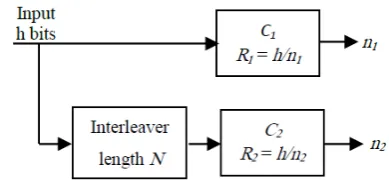
Parallel concatenated convolutional code (PCCC), that is shown in Fig. 3, consists of two codes, C1 with
rateR1=h/n1 , and C2 with rate R2=h/n2 joined by an
interleaver with length N. The output code word lengthn =
n1+ n2and the overall PCCC rate is Rp= h/n.
Fig.3. Parallel concatenated convolutional code.
CWEF of a parallel concatenated convolutional code is expressed as [18][19]
w
N
X
w
A
X
w
A
X
w
A
C C
CP
(
,
)
(
,
)
(
,
)
2 1
(2)
where AC1(w, X) and AC2(w, X) are the CWEFs of the two constituent codes C1and C2respectively.
IV. H
IGHP
OWERA
MPLIFIERIn satellite communication systems, because the large distances between transmitter and receiver, high efficiency power amplifiers are needed. There are two major types of power amplifiers, travelling wave tube amplifiers (TWTA) and solid state power amplifiers (SSPA). At high power levels, TWTAs offer the best performance in terms of size, cost and efficiency, but lag behind SSPAs in linearity. The non-linear behavior of TWTA is usually described according to Saleh model [22] using amplitude/amplitude (AM/AM), and amplitude/phase (AM/PM) conversions that are illustrated in Fig. 4.One method to avoid the nonlinear effect of the HPA is to utilize a linearization technique which generates a nonlinear inverse function to that introduced by the HPA.The most widely used linearization technique is the predistortion linearization [23]-[24]. Another simple method to compensate for the amplifier nonlinearity is to back-off the operating point of the HPA from saturation to the linear region. The output back-off (OBO) of the HPA is defined as [25]
dB P
P OBO
av sat
log 10
Fig.4. AM/AM and AM/PM conversion curves for travellingwave tube amplifier.
where Psatis the saturation power of the HPA, and Pavis
the average output power of the transmitted signal. For large back-off values, the nonlinear distortion of the HPA can be greatlyreduced but, on the other hand, the power efficiency of the amplifier decreases, which leads to an unacceptable performance. So, a trade-off must be made between minimizing the nonlinear effects and maximizing the power efficiency of the HPA.
V. C
ONSTRUCTION OF THEP
ROPOSEDL
OWR
ATEC
ONCATENATEDC
ODINGS
CHEMEThe super-orthogonal parallel-serial concatenated coding scheme presented in this study combines the principles of low rate coding with that of both parallel and serial concatenation. Block diagram of the coding scheme is illustrated in Fig. 5.It constructed out of two serially concatenated codes, each of them is a serial concatenation of a classical convolutional code and a super-orthogonal convolutional code. The two serially concatenated codes are then further concatenated in parallel. The two outer codes, Co1and Co2of the two serially concatenated codes,
CS1and CS2are two identical rate 1/1 convolutional codes
whose generator matrix is
G (D) = [1 (1+D2)/ (1+D+D2)] (4)
and whose encoder block diagram is shown in Fig. 6. The rate 1/1 convolutional encoder can be obtained from the rate 1/2 recursive systematic convolutional encoder of Fig. 7 by not sending the systematic bit of the encoder. The two inner codes, Ci1and Ci2are two identical
super-orthogonal convolutional codes that described in section II. In the proposed concatenated coding scheme, we have 2k-2output bits from CS1and 2k-2 output bits from CS2so,
the overall SOPSCCC rate is R=1/(2 × 2k-2).
VI. P
ERFORMANCEA
NALYSISThe proposed coding scheme is originally a parallel concatenation of two convolutional codes, CS1 and CS2.
Fora parallel concatenated convolutional code, the bit error
Fig.5. Block diagram of the proposed SOPSCCC.
Fig.6. Block diagram of the outer rate 1/1 convolutional Encoder.
Fig.7. Block diagram of a rate 1/2 recursive systematic convolutional encoder.
probability Pb(e) under maximum-likelihood decoding
for binary phase shift keying modulation in an AWGN channel can be upper-bounded as [18]
N w e X W C wb RcEb N
p X w A W N w e P 1 0 / | ) , ( ) ( (5)
where ACp(w, X) is the CWEF of the parallel concatenated convolutional code, Rc is the rate of the
parallel concatenated code, N is the interleaver length and
Eb/No is the signal–to–noise ratio (SNR) per bit. So, to
analyze the performance of the proposed coding scheme, first we have to calculate its CWEF which is determined by the CWEFs of the constituent codes from which the code is constructed.In the analysis.
A. Calculating CWEF of the outer code C
o1An important tool that is used to calculate the weight enumerating functions of a convolutional encoder is the transfer function of the encoder which is determined using its modified state diagram. Modified state diagram of an encoder is a modified version of its state diagram.It provides a complete description for the Hamming weights Fig.4. AM/AM and AM/PM conversion curves for
travellingwave tube amplifier.
where Psatis the saturation power of the HPA, and Pavis
the average output power of the transmitted signal. For large back-off values, the nonlinear distortion of the HPA can be greatlyreduced but, on the other hand, the power efficiency of the amplifier decreases, which leads to an unacceptable performance. So, a trade-off must be made between minimizing the nonlinear effects and maximizing the power efficiency of the HPA.
V. C
ONSTRUCTION OF THEP
ROPOSEDL
OWR
ATEC
ONCATENATEDC
ODINGS
CHEMEThe super-orthogonal parallel-serial concatenated coding scheme presented in this study combines the principles of low rate coding with that of both parallel and serial concatenation. Block diagram of the coding scheme is illustrated in Fig. 5.It constructed out of two serially concatenated codes, each of them is a serial concatenation of a classical convolutional code and a super-orthogonal convolutional code. The two serially concatenated codes are then further concatenated in parallel. The two outer codes, Co1and Co2of the two serially concatenated codes,
CS1and CS2are two identical rate 1/1 convolutional codes
whose generator matrix is
G (D) = [1 (1+D2)/ (1+D+D2)] (4)
and whose encoder block diagram is shown in Fig. 6. The rate 1/1 convolutional encoder can be obtained from the rate 1/2 recursive systematic convolutional encoder of Fig. 7 by not sending the systematic bit of the encoder. The two inner codes, Ci1and Ci2are two identical
super-orthogonal convolutional codes that described in section II. In the proposed concatenated coding scheme, we have 2k-2output bits from CS1and 2k-2 output bits from CS2so,
the overall SOPSCCC rate is R=1/(2 × 2k-2).
VI. P
ERFORMANCEA
NALYSISThe proposed coding scheme is originally a parallel concatenation of two convolutional codes, CS1 and CS2.
Fora parallel concatenated convolutional code, the bit error
Fig.5. Block diagram of the proposed SOPSCCC.
Fig.6. Block diagram of the outer rate 1/1 convolutional Encoder.
Fig.7. Block diagram of a rate 1/2 recursive systematic convolutional encoder.
probability Pb(e) under maximum-likelihood decoding
for binary phase shift keying modulation in an AWGN channel can be upper-bounded as [18]
N w e X W C wb RcEb N
p X w A W N w e P 1 0 / | ) , ( ) ( (5)
where ACp(w, X) is the CWEF of the parallel concatenated convolutional code, Rc is the rate of the
parallel concatenated code, N is the interleaver length and
Eb/No is the signal–to–noise ratio (SNR) per bit. So, to
analyze the performance of the proposed coding scheme, first we have to calculate its CWEF which is determined by the CWEFs of the constituent codes from which the code is constructed.In the analysis.
A. Calculating CWEF of the outer code C
o1An important tool that is used to calculate the weight enumerating functions of a convolutional encoder is the transfer function of the encoder which is determined using its modified state diagram. Modified state diagram of an encoder is a modified version of its state diagram.It provides a complete description for the Hamming weights Fig.4. AM/AM and AM/PM conversion curves for
travellingwave tube amplifier.
where Psatis the saturation power of the HPA, and Pavis
the average output power of the transmitted signal. For large back-off values, the nonlinear distortion of the HPA can be greatlyreduced but, on the other hand, the power efficiency of the amplifier decreases, which leads to an unacceptable performance. So, a trade-off must be made between minimizing the nonlinear effects and maximizing the power efficiency of the HPA.
V. C
ONSTRUCTION OF THEP
ROPOSEDL
OWR
ATEC
ONCATENATEDC
ODINGS
CHEMEThe super-orthogonal parallel-serial concatenated coding scheme presented in this study combines the principles of low rate coding with that of both parallel and serial concatenation. Block diagram of the coding scheme is illustrated in Fig. 5.It constructed out of two serially concatenated codes, each of them is a serial concatenation of a classical convolutional code and a super-orthogonal convolutional code. The two serially concatenated codes are then further concatenated in parallel. The two outer codes, Co1and Co2of the two serially concatenated codes,
CS1and CS2are two identical rate 1/1 convolutional codes
whose generator matrix is
G (D) = [1 (1+D2)/ (1+D+D2)] (4)
and whose encoder block diagram is shown in Fig. 6. The rate 1/1 convolutional encoder can be obtained from the rate 1/2 recursive systematic convolutional encoder of Fig. 7 by not sending the systematic bit of the encoder. The two inner codes, Ci1and Ci2are two identical
super-orthogonal convolutional codes that described in section II. In the proposed concatenated coding scheme, we have 2k-2output bits from CS1and 2k-2 output bits from CS2so,
the overall SOPSCCC rate is R=1/(2 × 2k-2).
VI. P
ERFORMANCEA
NALYSISThe proposed coding scheme is originally a parallel concatenation of two convolutional codes, CS1 and CS2.
Fora parallel concatenated convolutional code, the bit error
Fig.5. Block diagram of the proposed SOPSCCC.
Fig.6. Block diagram of the outer rate 1/1 convolutional Encoder.
Fig.7. Block diagram of a rate 1/2 recursive systematic convolutional encoder.
probability Pb(e) under maximum-likelihood decoding
for binary phase shift keying modulation in an AWGN channel can be upper-bounded as [18]
N w e X W C wb RcEb N
p X w A W N w e P 1 0 / | ) , ( ) ( (5)
where ACp(w, X) is the CWEF of the parallel concatenated convolutional code, Rc is the rate of the
parallel concatenated code, N is the interleaver length and
Eb/No is the signal–to–noise ratio (SNR) per bit. So, to
analyze the performance of the proposed coding scheme, first we have to calculate its CWEF which is determined by the CWEFs of the constituent codes from which the code is constructed.In the analysis.
A. Calculating CWEF of the outer code C
o1a
Copyright © 2012 IJECCE, All right reserved 1597
International Journal of Electronics Communication and Computer Engineering Volume 3, Issue 6, ISSN (Online): 2249–071X, ISSN (Print): 2278–4209
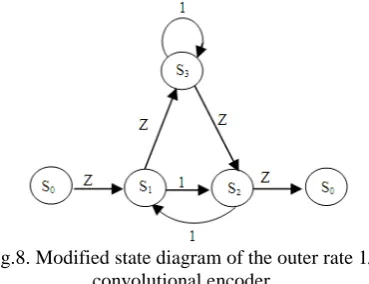
of all nonzero codewords, that is, a codeword weight
enumerating function (WEF).The modified state diagram
of the outer rate 1/1 convolutional encoder of Fig. 6 is shown in Fig. 8.
Fig.8. Modified state diagram of the outer rate 1/1 convolutional encoder.
In the modified state diagram of Fig. 8, the power of Zin a branch is the weight of the n encoded bits on that branch. There are two definitions related to the modified state diagram and are used in computing itstransfer function. These definitions are:
Forward path: Forward path is the path connecting theinitial state to the final state and does notgo through any sate twice. The path gain isthe product of the branch gains along thepath. We will denote the gain of theithforward pathas Fi.
Cycle: A cycle is a closed path starting at any state andreturning to the same state without going throughany other state twice. The gain of theithcycle will bedenoted asCi.A set of cycles is non-touching if no state belongs to more than one cycle in the set. Let {i} be the set of all cycles in the modified state diagram, {i', j'} be the set of all pairs of non-touching cycles, {i'', j'', l''} be the set of all triples of non-touching cycles, and so on. A quantity∆ is then defined as [26]
, ... 1
'
' '' '' ''
'' '' '' '
'
, , ,
i i j i j l
l j i j
i
i C C C C C
C (6)
where∑iCiis the sum of the cycle gains, ∑i',j'Ci'Cj'is the
product of the cycle gains of two non-touching cycles
summed over all pairs of non-touching
cycles,∑i'',j'',l''Ci''Cj''Cl''is the product of the cycle gains of
three touching cycles summed over all triples of non-touching cycles, and so on. Finally,∆iis a quantity defined exactly like ∆ but only for the portion of the graph not touching the ith forward path. Transfer function, A(Z) of the modified state diagram can then be calculated as [27]
iF
i iZ
A
(
)
(7)If the modified state diagram is augmented by labeling each branch corresponding a nonzero information block with Ww, where the power of W is the weight of the input information bits in that branch, and labeling each branch with L, then, the codeword input-output weight enumerating function (IOWEF)of the encoder, which is
the transfer function of its augmented modified state diagram, is expressed as [26]
l z w
l z w l z
w W Z L
A L
Z W A
, ,
, ,
) , ,
( (8)
whereAw,z,l denotes the number of codewords with
weight z, whose associated information weight is w, and whose length is l branches. The augmented modified state diagram for the outer encoder is shown in Fig. 9.
Fig. 9. Augmented modified state diagram of the outer rate 1/1 convolutional encoder.
In the augmented modified state diagram of Fig.9:
There are 3 cycles;Cycle 1: S1S3S2S1(C1= Z2L3) Cycle 2 : S1S2S1(C2= WL2) Cycle 3 : S3S3 (C3= WL)
There is one pair of non-touching cycles; Cycle pair 1: Cycle 2, Cycle 3(C2C3=W2L3)
There are no other sets of non-touching cycles. Therefore, according to (6),∆ can be expressed as ∆= 1─( Z2L3+WL2+ WL )+ (W2L3)= 1─Z2L3─W( L + L2)+ W2L3(9)
After computing∆ we need to calculate the quantity ∆i. In the augmented modified state diagram of Fig.9 there are two forward paths, the paths and their gains are:
Forward path 1: S0S1S2S0(F1= W3Z2L3) Forward path 2: S0S1S3S2S0(F2= W2Z4L4) (10)
The subgraph not touching the forward path 1 is the single branch around state S3which is shown in Fig.10.
Fig.10. Subgraph of Fig.9 not touching the forward path 1.
For the sub-graph illustrated in Fig. 10 we can find∆1as
∆1= 1─WL (11)
Forward path 2 touching all states in the graph so, there are no subgraphs not touching the forward path 2 then,
∆2= 1 (12)
Now, we can findƩFi∆ifor the augmented modified state diagram as
ƩFi∆i= F1∆1+ F2∆2
= W3Z2L3(1─WL) + W2Z4L4.1
= W2Z4L4+ W3Z2L3─W4Z2L4 (13)
CWEF of the encoder, which enumerates the weights of all information blocksgenerating a particular output weight
z,is expressed as [26]
w
w z w W
A z
W
A( , ) , (15)
where Aw,z is the number of codewords having output
weight z generated by information words of weight w. From (14), and following the procedures illustrated in [26], CWEF, ACo1(W, z) of the outer constituent codeCo1can becalculatedas
ACo1(W,2)=7W3+5W4+3W5+W6 ACo1(W,3)=0
ACo1(W,4) = 6W2+13W3+16W4+10W5+14W6+7W7 ACo1(W,5)=0
ACo1(W, 6)= 3W2+7W3+3W4+ 12W5+12W6+W7+ W9 ACo1(W, 7)=0
ACo1(W, 8)= 3W4+2W5(16)
From the above equation we can calculate the
parameters 1
,
o C
z w
A
which is the number of codewords of the outer code having output weight z generated by information words of weight w. For example, there are 7 codewords that have input weight w=3 and output weighz=2, 5 codewords have input weight w=4 and output
weigh z=2,… and so on.
B. Calculating CWEF of the inner code C
i1For a super-orthogonal convolutional code with k-stage shift register, the input-output weight enumerating function (IOWEF), A(Z, X, L),which enumerates the number of codewords with weight xgenerated from information word with weight z and whose length is l branches, is expressed as [28]
1 2 3 3 2
) ....
1 ( 1 ) , ,
(
k k k k
k k
L Z L
L L Z
L X L
X Z A
(17)
where 2 3
)
(
k
X
In this study we investigated the performance of the SOPSCCC for an inner super-orthogonal convolutional code with memory size k= 4, 5, 6, 7, and 8 which results in an overall SOPSCCC rate R= 1/8, 1/16, 1/32, 1/64, and 1/128.For k = 4, equation (17) can be written as
3 4 2 4 2
4 12
1 ) , , (
L Z X L Z X L Z X
L Z X L
X Z A
(18)
Using (18) and following the procedures described in [26] we can calculate the CWEF, ACi1(z, X) of the inner super-orthogonal convolutional code for k=4 which is get as
ACi1(1, X) = 7X12
ACi1(2, X) = 6X14+ 9X16+X24
ACi1(3, X) = 5X16+8X18+4X18+8X20+4X26+2X28 ACi1(4, X) = 4X18+15X20+12X22+6X24
ACi1(5, X) =12X20+12X22+6X24 ACi1(6, X) =2X22+10X24
ACi1(7, X) =X24 (19)
CWEFs of Ci1for the remaining values of k can then be
calculated. For each of the calculated CWEFs,substituting into (1) bythe CWEF of the inner code, and bythe
parameters 1
,
o C
z w
A
calculated from (16) for the outer codeCo1, we can calculate the CWEF, ACs1(w, X)of theserially concatenated code CS1.
As the overall proposed coding scheme is a parallel concatenation of the two codes, CS1and CS2, the CWEF of
the SOPSCCC can be expressed using (2) as
w N
X w A X w A X w A
Cs Cs
SO ( , ) ( , )
) , (
2
1 (20)
Since the two outer codes Co1and Co2are identical and
the two inner codes Ci1and Ci2are also identical, the two
serially concatenated codes CS1and CS2are identical and
then their CWEFs are the same so, equation (20) can be rewritten as
w N
X w A X w A
Cs SO
2
] ) , ( [ ) , (
1 (21)
Substituting into the above equation by the calculated CWEFs of the code CS1for each value of kwe can calculate
the CWEF of the SOPSCCC at ratesR= 1/8, 1/16, 1/32, 1/64, and 1/128.
VII. P
ERFORMANCER
ESULTS OF THESOPSCCC
Bit error probability performance of the proposed low rate concatenated coding scheme is evaluated for rates R= 1/8, 1/16, 1/32, 1/64, and 1/128 at interleaver lengthsN1=N2=N3=N=200 and results are illustrated in
Fig.10.From performance figure we can see that increasing the memory size, k of the inner super-orthogonal convolutional code and hence, decreasing the rate of the SOPSCCCimproves the performance of the code.At very low rates, the performance improvement is slightly increases for further decreasing in rate.On the other hand, increasing the memory size of the encoder results in increaseddecoding complexity. So, trade-off must be made between improving the performance and decreasing the complexity of the system.
a
Copyright © 2012 IJECCE, All right reserved 1599
International Journal of Electronics Communication and Computer Engineering Volume 3, Issue 6, ISSN (Online): 2249–071X, ISSN (Print): 2278–4209
Fig.10. Bit error probability performance of the proposed SOPSCCCin an AWGN channel for interleaver length
N=200.
VIII. C
ONCLUSIONSA low rate concatenated convolutional coding scheme suitable for spread spectrum multiple access applications is investigated. The coding scheme is a parallel-serial concatenation of conventional convolutional codes and super-orthogonal convolutional codes. performance of the new coding scheme is studied in AWGN channel and results proved that, the proposed coding scheme has betterperformance than that of the existing super-orthogonal concatenated convolutional codes specially at high SNRs.Performance of the proposed concatenated coding scheme is also studied in the presence of nonlinear high power amplifier which is an essential component in satellite communications. The performance is studied for two OBO values 5 and 7. Smaller OBO values results in larger output power which means higher power efficiency of the amplifier but, on the other hand, this leads to more signal
distortion resulting in more required signal-to-noise ratio for a given bit error rate.
Fig.11. Comparison of the bit error probability performance of SOPSCCC, SOTC, and RPSOTC for rate
R=1/15 and N=200.
Fig.12. Performance of SOPSCCC at OBO=5, and 7 for interleaver length N=200.
R
EFERENCES[1] A. Richardson, WCDMA Design Handbook. United kingdom, the press syndicate of the university of Cambridge, 2005. [2] W. C. Lee. “Overview of Cellular CDMA” IEEE Trans. On
Vehicular Technology, vol. 40 no.2 May 1991, pp. 291-302. [3] K. Kim, Handbook of CDMA System Design, Engineering, and
Optimization. U. S. A., Prentice Hall, 2000.
[4] E. H. Dinan, B.Jabbari "Spreading codes for direct sequence CAMA and wideband CDMA cellular networks" IEEE Communications Magazine, vol. 26, no.9, Sep. 1998, pp. 48-54. [5] S. Jos, P. Kumar, S. Chakrabarti, "A code selection criterion
based on autocorrelation properties for quasi-synchronous CDMA communication system" Spread Spectrum Techniques and Applications, 2008. ISSSTA '08. IEEE 10th International Symposium, Aug. 2008, pp. 151-155.
[6] A. J. Viterbi, "Orthogonal tree codes for communication in the presence of white Gaussian noise" IEEE Trans. on Communication Technology, vol.15, no.2, April 1967, pp. 238-242.
[7] A. J. Viterbi "Very low rate convolutional codes for maximum theoretical performance of spread-spectrum multiple-access channels" IEEE Journal of Selected Areas in Communications. vol. 8, no. 4, May 1990, pp. 641-649.
[8] A.J. Viterbi and E.Zehavi, "On new class of orthogonal convolutional codes," Bilkent International Conference Proc. in New Trends in Communication, Control, and Signal Processing, Ankara, Turky, 1990.
[9] A. J. Viterbi,CDMA principles of spread spectrum communications. Addison-Wesley, 1995.
[10] P. Komulainen, K. Pehkonen, "Performance evaluation of super-orthogonal turbo codes in AWGN and flat Rayleigh fading channels" IEEE Jouranl onSelected Areas in Communications, vol.16, no. 2, Feb. 1998,pp. 196-205.
[11] P. Frenger,P. Orten,T.Ottoson, "Code-spread CDM using low-rate convolutional codes" Spread Spectrum Techniques and Applications, 1998. Proc., 1998 IEEE 5th International Symposium. vol. 2, pp. 374-378.
[12] P. Frenger, P.Orten, and T.Ottosson "Code-spread CDMA using maximum free distance low-rate convolutional code" IEEE Transactions on Communications, vol. 48, Jan. 2000,pp. 135-144.
[13] D.Thirupathi, K. M. Chugg "A simple low rate turbo-like code design for spread spectrumsystems" Signals, Systems and Computer, 2002. Conference Record of the Thirty-Sixth Asilomar Conference. vol. 1, Nov. 2002,pp. 108-112.
[14] N. Pillay, H.Xu, F.Takawira, "Repeat-punctured super-orthogonal convolutional turbo codes on AWGN and flat Rayleigh fading channels" South Africa Journal of science, vol. 106 no.11-12 Nov./Dec. 2010.
[15] M. Z. Mushtaq et el, "Improving quality of security for CDMA using orthogonal coding method" Computer Science and
a
Copyright © 2012 IJECCE, All right reserved 1599
International Journal of Electronics Communication and Computer Engineering Volume 3, Issue 6, ISSN (Online): 2249–071X, ISSN (Print): 2278–4209
Fig.10. Bit error probability performance of the proposed SOPSCCCin an AWGN channel for interleaver length
N=200.
VIII. C
ONCLUSIONSA low rate concatenated convolutional coding scheme suitable for spread spectrum multiple access applications is investigated. The coding scheme is a parallel-serial concatenation of conventional convolutional codes and super-orthogonal convolutional codes. performance of the new coding scheme is studied in AWGN channel and results proved that, the proposed coding scheme has betterperformance than that of the existing super-orthogonal concatenated convolutional codes specially at high SNRs.Performance of the proposed concatenated coding scheme is also studied in the presence of nonlinear high power amplifier which is an essential component in satellite communications. The performance is studied for two OBO values 5 and 7. Smaller OBO values results in larger output power which means higher power efficiency of the amplifier but, on the other hand, this leads to more signal
distortion resulting in more required signal-to-noise ratio for a given bit error rate.
Fig.11. Comparison of the bit error probability performance of SOPSCCC, SOTC, and RPSOTC for rate
R=1/15 and N=200.
Fig.12. Performance of SOPSCCC at OBO=5, and 7 for interleaver length N=200.
R
EFERENCES[1] A. Richardson, WCDMA Design Handbook. United kingdom, the press syndicate of the university of Cambridge, 2005. [2] W. C. Lee. “Overview of Cellular CDMA” IEEE Trans. On
Vehicular Technology, vol. 40 no.2 May 1991, pp. 291-302. [3] K. Kim, Handbook of CDMA System Design, Engineering, and
Optimization. U. S. A., Prentice Hall, 2000.
[4] E. H. Dinan, B.Jabbari "Spreading codes for direct sequence CAMA and wideband CDMA cellular networks" IEEE Communications Magazine, vol. 26, no.9, Sep. 1998, pp. 48-54. [5] S. Jos, P. Kumar, S. Chakrabarti, "A code selection criterion
based on autocorrelation properties for quasi-synchronous CDMA communication system" Spread Spectrum Techniques and Applications, 2008. ISSSTA '08. IEEE 10th International Symposium, Aug. 2008, pp. 151-155.
[6] A. J. Viterbi, "Orthogonal tree codes for communication in the presence of white Gaussian noise" IEEE Trans. on Communication Technology, vol.15, no.2, April 1967, pp. 238-242.
[7] A. J. Viterbi "Very low rate convolutional codes for maximum theoretical performance of spread-spectrum multiple-access channels" IEEE Journal of Selected Areas in Communications. vol. 8, no. 4, May 1990, pp. 641-649.
[8] A.J. Viterbi and E.Zehavi, "On new class of orthogonal convolutional codes," Bilkent International Conference Proc. in New Trends in Communication, Control, and Signal Processing, Ankara, Turky, 1990.
[9] A. J. Viterbi,CDMA principles of spread spectrum communications. Addison-Wesley, 1995.
[10] P. Komulainen, K. Pehkonen, "Performance evaluation of super-orthogonal turbo codes in AWGN and flat Rayleigh fading channels" IEEE Jouranl onSelected Areas in Communications, vol.16, no. 2, Feb. 1998,pp. 196-205.
[11] P. Frenger,P. Orten,T.Ottoson, "Code-spread CDM using low-rate convolutional codes" Spread Spectrum Techniques and Applications, 1998. Proc., 1998 IEEE 5th International Symposium. vol. 2, pp. 374-378.
[12] P. Frenger, P.Orten, and T.Ottosson "Code-spread CDMA using maximum free distance low-rate convolutional code" IEEE Transactions on Communications, vol. 48, Jan. 2000,pp. 135-144.
[13] D.Thirupathi, K. M. Chugg "A simple low rate turbo-like code design for spread spectrumsystems" Signals, Systems and Computer, 2002. Conference Record of the Thirty-Sixth Asilomar Conference. vol. 1, Nov. 2002,pp. 108-112.
[14] N. Pillay, H.Xu, F.Takawira, "Repeat-punctured super-orthogonal convolutional turbo codes on AWGN and flat Rayleigh fading channels" South Africa Journal of science, vol. 106 no.11-12 Nov./Dec. 2010.
[15] M. Z. Mushtaq et el, "Improving quality of security for CDMA using orthogonal coding method" Computer Science and
a
Copyright © 2012 IJECCE, All right reserved 1599
International Journal of Electronics Communication and Computer Engineering Volume 3, Issue 6, ISSN (Online): 2249–071X, ISSN (Print): 2278–4209
Fig.10. Bit error probability performance of the proposed SOPSCCCin an AWGN channel for interleaver length
N=200.
VIII. C
ONCLUSIONSA low rate concatenated convolutional coding scheme suitable for spread spectrum multiple access applications is investigated. The coding scheme is a parallel-serial concatenation of conventional convolutional codes and super-orthogonal convolutional codes. performance of the new coding scheme is studied in AWGN channel and results proved that, the proposed coding scheme has betterperformance than that of the existing super-orthogonal concatenated convolutional codes specially at high SNRs.Performance of the proposed concatenated coding scheme is also studied in the presence of nonlinear high power amplifier which is an essential component in satellite communications. The performance is studied for two OBO values 5 and 7. Smaller OBO values results in larger output power which means higher power efficiency of the amplifier but, on the other hand, this leads to more signal
distortion resulting in more required signal-to-noise ratio for a given bit error rate.
Fig.11. Comparison of the bit error probability performance of SOPSCCC, SOTC, and RPSOTC for rate
R=1/15 and N=200.
Fig.12. Performance of SOPSCCC at OBO=5, and 7 for interleaver length N=200.
R
EFERENCES[1] A. Richardson, WCDMA Design Handbook. United kingdom, the press syndicate of the university of Cambridge, 2005. [2] W. C. Lee. “Overview of Cellular CDMA” IEEE Trans. On
Vehicular Technology, vol. 40 no.2 May 1991, pp. 291-302. [3] K. Kim, Handbook of CDMA System Design, Engineering, and
Optimization. U. S. A., Prentice Hall, 2000.
[4] E. H. Dinan, B.Jabbari "Spreading codes for direct sequence CAMA and wideband CDMA cellular networks" IEEE Communications Magazine, vol. 26, no.9, Sep. 1998, pp. 48-54. [5] S. Jos, P. Kumar, S. Chakrabarti, "A code selection criterion
based on autocorrelation properties for quasi-synchronous CDMA communication system" Spread Spectrum Techniques and Applications, 2008. ISSSTA '08. IEEE 10th International Symposium, Aug. 2008, pp. 151-155.
[6] A. J. Viterbi, "Orthogonal tree codes for communication in the presence of white Gaussian noise" IEEE Trans. on Communication Technology, vol.15, no.2, April 1967, pp. 238-242.
[7] A. J. Viterbi "Very low rate convolutional codes for maximum theoretical performance of spread-spectrum multiple-access channels" IEEE Journal of Selected Areas in Communications. vol. 8, no. 4, May 1990, pp. 641-649.
[8] A.J. Viterbi and E.Zehavi, "On new class of orthogonal convolutional codes," Bilkent International Conference Proc. in New Trends in Communication, Control, and Signal Processing, Ankara, Turky, 1990.
[9] A. J. Viterbi,CDMA principles of spread spectrum communications. Addison-Wesley, 1995.
[10] P. Komulainen, K. Pehkonen, "Performance evaluation of super-orthogonal turbo codes in AWGN and flat Rayleigh fading channels" IEEE Jouranl onSelected Areas in Communications, vol.16, no. 2, Feb. 1998,pp. 196-205.
[11] P. Frenger,P. Orten,T.Ottoson, "Code-spread CDM using low-rate convolutional codes" Spread Spectrum Techniques and Applications, 1998. Proc., 1998 IEEE 5th International Symposium. vol. 2, pp. 374-378.
[12] P. Frenger, P.Orten, and T.Ottosson "Code-spread CDMA using maximum free distance low-rate convolutional code" IEEE Transactions on Communications, vol. 48, Jan. 2000,pp. 135-144.
[13] D.Thirupathi, K. M. Chugg "A simple low rate turbo-like code design for spread spectrumsystems" Signals, Systems and Computer, 2002. Conference Record of the Thirty-Sixth Asilomar Conference. vol. 1, Nov. 2002,pp. 108-112.
[14] N. Pillay, H.Xu, F.Takawira, "Repeat-punctured super-orthogonal convolutional turbo codes on AWGN and flat Rayleigh fading channels" South Africa Journal of science, vol. 106 no.11-12 Nov./Dec. 2010.
network Technology (ICCSNT), 2011 International Conference. vol. 4, pp. 2649-2653.
[16] G. D. Forney, "Concatenated Codes", thesis submitted to the department of electrical engineering, M. I. T.,March1965, in partial fulfillment of the requirements for the degree of Doctor of Science. Cambridge, MA:MIT Press, 1966.
[17] S. Benedetto, D. Divsalar, G. Montorsi, F. Pollara, “Serial
concatenation of interleaved codes: performance analysis,
design, and iterative decoding” IEEE Tran. on Information Theory, vol. 44, no. 3,May 1998,pp. 909-926.
[18] S. Benedetto, G. Montors, “Design of parallel concatenated convolutional codes” IEEE Trans.onCommunications, vol. 44, no. 5, May 1996,pp. 591-600.
[19] S. Benedetto,G. Montorsi,"Unveiling turbo codes: some results onparallel concatenated coding schemes"IEEE Trans. on Information Theory, vol. 42, no. 2,March1996, pp.409-428. [20] C. Liang, J. Jong, W. E. Stark, R. Jack., "Nonlinear amplifier
effects in communications systems" IEEE Trans.on Microwave Theoryand Techniques, vol. 47, no. 8, Aug. 1999, pp. 1461-1466.
[21] P. B. Kennington, High-Linearity RF Amplifier Design.Artech House 2000.
[22] A.A.M. Saleh, "Frequency-independent and frequency-dependent nonlinear models of TWT amplifiers," IEEE Trans. Communications, vol. 29, Nov. 1981, pp.1715-1720.
[23] L. G., Anding, "Low-cost FPGA implementation of Voltera series-based digital predistorter for RF power amplifiers" IEEE Trans. on Microwave Theory Techniques, vol. 58, no.4, April 2010, pp. 866-872.
[24] C. Rapp, "Effects of HPA-nonlinearity on a4-DPSK/OFDM-signal for digital sound broadcasting system" Proc. of the Second European Conference on Satellite Communications, Liege, Belgium, Oct. 1991, pp. 179-184.
[25] B. Lin, Y. Wang , B.Feuvrie, Q. Dai "A novel power amplifier linearization technique based on pre-distortion principle and wiener model" International Journal of Advanced Science and Technology. vol. 22, Sep. 2010, pp. 59-70.
[26] S. Lin, D. J. Costello, Error Control Coding.2nd ed., Pearson Education Inc. 2004.
[27] S. J. Mason "Feedback theory-further properties of signal flow graphs" IEEE, Proc. of the I.R.E., vol. 44, no. 7, July 1956, pp.920-926.
[28] R. McEliece, S. Dolinar, F. Pollara, "Some easily analyzed convolutional codes" Telecommunications and Data Acquisition Progress Report 42-99, Nov. 1989,pp.105-114.
A
UTHOR’SP
ROFILEProf. Hala M. A. Mansour
Electronics & Communications Deptt, Shoubra Faculty of Engineering, Benha University, Egypt.
As. Prof. Labib Francis Gergis
Misr Academy of Engineering and Technology, Mansoura, Egypt.
Dr. Mostafa A. R. Eltokhy
Electronics Technology Deptt, Industrial education College, Helwan University, Egypt.