Copyright © 2012 IJECCE, All right reserved
Optimal Relay Selection Using Efficient Beaconless
Geographic Contention-Based Routing Protocol in
Wireless Ad hoc Networks
G.SRIMATHY
M.E/Communication Systems, S.A Engineering College, Chennai-600 077, Tamil Nadu, India.
mail id:[email protected]
Abstract—In Wireless Ad hoc network, cooperation of nodes can be achieved by more interactions at higher protocol layers, particularly the MAC (Medium Access Control) and network layers play vital role. MAC facilitates a routing protocol based on position location of nodes at network layer specially known as Beacon-less geographic routing (BLGR)
using Contention-based selection process. This paper
proposes two levels of cross-layer framework -a MAC network cross-layer design for forwarder selection (or routing) and a MAC-PHY for relay selection. CoopGeo; the proposed cross-layer protocol provides an efficient, distributed approach to select next hops and optimal relays to form a communication path. Wireless networks suffers huge number of communication at the same time leads to increase in collision and energy consumption; hence focused on new Contention access method that uses a dynamical change of channel access probability which can reduce the number of contention times and collisions. Simulation result demonstrates the best Relay selection and the comparative of
direct mode with the cooperative networks. And
Performance evaluation of contention probability with Collision avoidance.
Key Words: Ad hoc networks, relay selection, cross-layer design, geographic routing, cooperative networks.
I. INTRODUCTION
Ad Hoc wireless network which means the users or nodes that want to communicate with each other form self organising temporary network without any centralized administrator. Ad Hoc - a Latin phrase which means "for this purpose" (i.e.) no advance planning [1] [2]. An autonomous system of mobile hosts connected by wireless links, called Mobile Ad hoc NETworks (MANETs) [1] [5]. To achieve efficient communication benefits from cooperation, more interactions at higher protocol layers, particularly the MAC (Medium Access Control) [2] [9] and network layers, are vitally required. For this purpose, Beacon-less geographic routing (BLGR) [1] [3], based on position location of nodes and contention process.
A. BLGR Concept:
BLGR is one of the most efficient and scalable routing solutions for wireless ad hoc and sensor networks. The key advantage of BLGR is that it needs neither the prior knowledge of network topology for making a route decision nor the periodic exchange of control messages (i.e., beacons) for acquiring neighbours’ geographic locations. A current node can make its own routing decisions by using local information. In general, a BLGR
protocol comprises two operating phases: forwarding phase and recovery phase. A forwarding node executes the greedy mechanism in the forwarding phase, and, if failing, switches to recovery mode to perform a face routing algorithm, finding another path to the destination.
B. MAC in multihop Ad hoc networks:
Ad Hoc networks consist of small, inexpensive, resource constrained nodes/host/router that communicate wirelessly in a multihop network [2]. Each node collaborates with other devices in the network to perform some operation for the end user, such as environmental monitoring or target tracking. End users typically desire to deploy nodes randomly throughout the target area in large numbers hundreds to thousands of nodes; however, some special cases may require the precise deployment of a smaller network.
Nodes communicate via multihop network [2] [3] to forward messages to the destination. Despite using it is to reduce energy requirements for communication, the wireless transceiver often consumes the largest amount of energy-per time period of use-within a node and, thus, provides the greatest potential for energy savings. Beyond improving the radio design, an efficient Medium Access Control (MAC) protocol possesses the greatest capability to decrease the energy consumption of the transceiver since it directly controls the transceiver operation.
In Section II, the paper summarizes related work. Section III, presents the proposed CoopGeo [1] with the cross-layer design for cooperative networks with the problem statement. Section IV gives the network model using BLGR, in which beaconless geographic routing and relay selection, along with it includes the protocol description. Section V, discusses the simulation results and evaluate its performance [1]. Finally, the paper concludes in section VI with future outlook.
II. RELATED WORK
Copyright © 2012 IJECCE, All right reserved wireless networks. This paper propose a protocol
CoopGeo [1] [4], based on position location of nodes obtained using GPS technology [7].
In traditional geographic routing protocols, each node exchanges periodic one-hop “Beacons” to determine the position of its neighbours [2] [4]. Since these beacons can create severe problems in real deployments due to the highly dynamic and error-prone nature of wireless links, it uses Beacon-less geographic routing protocol (BLGR) [3]. Based on location knowledge and contention based selection processes [15] [16], the proposed protocol, aims at providing an efficient, distributed approach to select next hops and optimal operates properly with varying densities of nodes.
A geographic relay selection scheme [4] based on the knowledge of location information of nodes. By jointly combining the source-relay and relay-destination distances, the optimal relay offering the best cooperative link can be efficiently determined. However, the selection process proposed by requires a central controller to decide which relay [6] is most helpful, leading to more overhead and power consumption.
To perform position-based unicast forwarding without the help of beacons, using contention-based forwarding scheme (CBF) [11] the next hop is selected through a distributed contention process based on the actual positions of all current neighbours. For the contention process, CBF makes use of biased timers. The BLGF mechanism [6] is carried out using the timer’s settings [11], applying an area-based assignment function. In addition, a solution to detect malicious nodes [13] normally operates during determination of a route.
Existing BLGR protocol called BOSS protocol, uses a
three-way handshake [7]
(DATA/RESPONSE/SELECTION) and an area-based timer-assignment function to reduce collisions among responses during the forwarder selection phase. Geographic Routing (GR) algorithms require nodes to periodically transmit HELLO messages to allow neighbours know their positions (beaconing mechanism) [9]. To reduce the control overhead due to these messages, beacon-less routing algorithms have recently been proposed. However, existing beacon-less algorithms have not considered realistic physical layers.
Other Existing protocol named CSMA/p* [16] [17], is non persistent carrier sense multiple access (CSMA) [3] with a carefully chosen non uniform probability distribution p* that node s use to randomly select contention slot. It compares the optimal non-persistent CSMA, discussed possible implementation directions for the optimal protocol, and finally discussed sift. Sifts back-off distribution approximately p* no matter how many stations are backlogged, obviating the need to track this figure with a contention window and bounded back-off.
The traditional contention access technique [11] [14] [15] is reviewed to reduce collision in networks. In traditional networks like Ethernet and WIFI when collision occurs, nodes apply the binary exponential back-off technique (BEB) to reduce collisions. In BEB fairness is the most important criteria. BEB ensures the same channel
access probability for every node in the network. However this technique does not take the criteria of energy consumption. In BEB contention window size is varied according to the traffic level [15].
III.
PROPOSED
COOPERATIVE
CROSS-LAYER PROTOCOL
To avoid the drawback of existing protocol, it presents a fully beaconless protocol without requiring beacons in both the greedy forwarding and recovery modes.
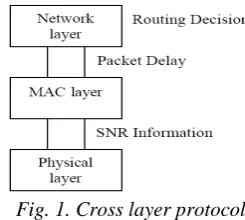
Fig. 1. Cross layer protocol
The paper introduces the role of interactions between the MAC and physical layers and between the network and MAC layers in a cooperative scenario as in Fig.1. The proposed cross-layer framework, called CoopGeo, consists of two joint cross-layer designs:
a. A joint network-MAC design for next hop selection and
b. A joint MAC-physical design for relay selection. A. Issues over existing COOPMAC design with
Relay solution:
Two issues, routing and relay selection, are two chief considerations.
(1) When to cooperate?
(2) Whom to cooperate with and how to do selection?
For the first question, intuitively cooperation may not be a requisite for reliable transmission if the direct link is of high quality. Therefore a cooperative MAC protocol should be carefully designed to prevent unnecessary cooperation [2]. A cooperation metric related to the instantaneous source-relay and relay-destination channel measurements was proposed in [5] to decide if cooperation is needed.
Fig. 2. Ad hoc network with relay selection
Copyright © 2012 IJECCE, All right reserved the optimal one(s) efficiently and effectively is of vital
importance to a practical MAC protocol. In particular, both the routing and relay selection solutions in CoopGeo are beaconless geographic protocols using contention-based selection processes, providing a strongly practical multi-layer integration for cooperative networks.
B. Hidden and Exposed node problems:
The transmission range of stations in wireless network is limited by the transmission Power. This means that normal carrier sense mechanism which assumes that all stations can listen to each other, fails. In particular, this gives rise to hidden node and exposed node problem. A simple and elegant solution to the hidden node problem is to use small packets called RTS (Request to send) and CTS (Clear to Send) for handshaking before transmission of data packet.
C. Contention-based Relay selection:
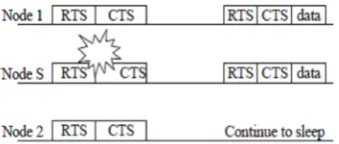
When there is a collision in the network, it means that there are many contending transmissions in the network. In the next contending period, if every node wakes up to contend to the channel [8] [15], there would be two problems. First, the collision probability stays the same. Second, only one node can win the channel, the other nodes waste energy to wake-up and to sense the channel.
To avoid these problems, when there is a collision, all contending sensors reduce its contending probability to a half [8]. Contending probability is the probability that sensors wake-up and go to contention period. Therefore, after a collision, a half of the contending sensors will not contend the channel in the next period as in Fig.3. They can save wake-up energy.
Fig.3. collision avoidance with two nodes Consider p as the contending probability of a node. This probability is always initialized to 100%, which means that when a node wants to transmit a packet, it always switches its transceiver on to sense the channel. With the contending probability p, when a node wants to send a package, it has the probability p to wake-up and contend the channel and a probability 1-p to stay sleeping to wait for the next period.
D. CoopGeo: Geographic routing protocol:
The routing process works in two phases, i.e. BLGF and BLRF. Both phases share equally a time interval within which the forwarder selection is executed. The first half of the period is allocated to the BLGF phase and the second half to the BLRF phase. In the BLGF phase, a next hop that provides maximum progress toward the destination is selected through a timerbased contention process. As failing to find a next hop in the BLGF phase, the routing process enters transparently to the BLRF phase and applies face routing by using graph planarization along with a select-and-protest principle.
Fig. 4. CoopGeo phases.
Cooperative relaying is required after the routing task whenever the selected next hop decodes the data packet erroneously. In this case, CoopGeo starts out to execute the relay selection task within another time interval , selecting an optimal relay that offers the best cooperative link between the current source and next hop. In Fig. 4, both the routing and relay selections among nodes in CoopGeo network are given.
IV.
NETWORK MODEL FOR BLGR
Consider a wireless ad hoc network of nodes randomly deployed in an area, expressed as a dynamic graph ( ,), where = { 1, 2, . . . , } is a finite set of nodes and = { 1, 2, . . . , } is a finite set of links between nodes. It also denotes a subset ( ) ⊂, = 1, . . . , , as the neighbourhood of the node , i.e., those nodes within the radio range of . Fig. 5. depicts the wireless ad hoc network model, in which the source sends its data to the destination in a multihop manner.
Fig. 5. Network model using BLGR.
In this figure the dashed circle centred at illustrates the radio range of , and so on. At the beginning of every data transmission, broadcasts the data to its neighbours ( ).
A. SER performance metric:
The Selection metric, indicates the SER performance at the destination.
mi=A
2
dpS,Ri+Bd
p
Ri ,D (1)
where, i=1, 2, .., N(nodes), mi- selection metric,
Copyright © 2012 IJECCE, All right reserved In case of -QAM modulation, the value of A and B are
estimated using,
= −1/2 + (1−1/√ ) 2/ , and = 3( −1)/8 + (1−1/ √ ) 2/
*Smaller the metrics, better the resulting SER performance.
Probability of Collision (Pcolln) is calculated as,
Pcolln=1- {(N/CW)∑k=1CW[(CW-k)/CW]N-1} (2) Where, N- No. of contending transmissions,
CW- Contention window size, K- no. of slot.
V. SIMULATION
AND
RESULT
ANALYSIS
First consider a single-hop cooperative relay network with n = 5 available relays, deployed in R. Denote ( , ) as the coordinates of nodes. It locates the source and the destination at (0, 0) and (1, 0) respectively, and randomly place, with uniform distribution, the relays in a square field following {( , )∣0≤ ≤1,∣ ∣≤0.5}, where the path loss exponent is taken to be = 2 in these simulations.
Table 1. Simulation Settings
Input Value
No. of Neighbours Channel model Path Loss Exp. Modulation Type Constellation Size
1-15 Rayleigh
2 QPSK 4-128
A. RESULT ANALYSIS:
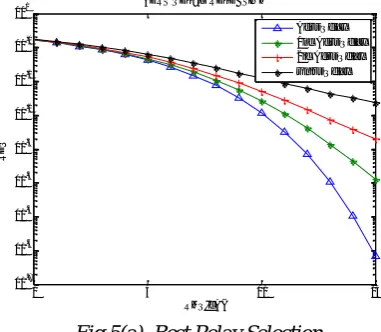
The resulting figure depicts the SER versus SNR performance, where SNR is defined as / 0 and is the total transmit power fixed. Fig.5(a), shows that the selected best relay contributes to the minimum SER at the destination as compared to other relays.
0 5 10 15
10-8 10-7
10-6 10-5
10-4
10-3 10-2
10-1 100
SNR(dB)
S
E
R
BEST RELAY SELECTION
Best Relay 2nd Best Relay 3rd Best Relay worst Relay
Fig.5(a). Best Relay Selection
In addition, it also reveals that worst relays corresponds to larger selection metrics, that is, the smaller the selection metrics, the better the resulting SER
performances. This is because each relay has the same opportunities to be selected such that the performance will be averaged over all the distributed relays.
0 5 10 15
10-5 10-4 10-3
10-2
10-1
100
SNR(dB)
S
E
R
COMPARISON: DIRECT AND COOPERATIVE RELAY SELECTION
Direct relay selection Cooperative random Relay Selection
F ig.5(b).Cooperative mode Vs Direct mode In the Fig.5(b)., the performance of direct transmission from the source to the destination is provided as a benchmark for a non-cooperation scheme is compared with the Cooperative relay selection scheme, which results in High Performance with the Cooperative scheme.
0 2 4 6 8 10 12 14 16 18 20 75
80 85 90 95 100
No of contending nodes
P
ro
ba
bl
ity
o
f c
ol
lis
io
n
Collisiion Avoidance by varying contending probability
CW=32(fixed-CSMA/CA) CW=4
CW=8 CW=16
Fig.5(c).Collision reduced -varying CW size
Copyright © 2012 IJECCE, All right reserved
1 2 3 4 5 6 7 8
0 0.05 0.1 0.15 0.2 0.25 0.3 0.35 0.4
No of contending node
P
E
R
Error performance:
Contending probability reduced
Fig.5(d). Error performance
At the first period, the probability of collision is the same as CSMA/CA. But, after each collision, the nodes reduce their contending probability in Fig.6.4, so that the number of contending transmission is reduce which implies a reduction of collision number.
VI. CONCLUSION
The advantage of position-based geographic routing over other ad hoc routing protocols is the fact that nodes require only knowledge about the local neighborhood and the destination’s location instead of global route topology. Therefore, position-based routing is better suited for networks with a certain degree of mobility. Thus this paper have proposed a cross-layer protocol CoopGeo based on geographic information to effectively integrate the Network, MAC, and PHY layers for cooperative wireless ad hoc networks. Simulation demonstrates that the selected best relay contributes to the minimum SER at the destination as compared to other relays. It reveals that the smaller the selection metrics, the better the resulting SER performances. Also presented and analyzed a new contention access method to reduce collisions in scalable sensor network. Proposed method uses a fixed contention window, and changes the contending probability. Error performance is also evaluated based on contention and probability error rate.
REFERENCES
[1] Teck Aguilar, Syue-Ju Syue, Vincent Gauthier,
Hossam Afifi, and Chin-Liang Wang; “CoopGeo: A Beaconless Geographic Cross-Layer Protocol for
Cooperative Wireless Ad Hoc Networks”, IEEE
Transactions on Wireless Communications, Accepted
For Publication.
[2] H. Shan, W. Zhuang, and Z. Wang, “Distributed
cooperative MAC for multihop wireless networks,”
IEEE Commun. Mag., vol. 47, no. 2, pp.126–133, Feb. 2009.
[3] J. A. Sanchez, P. M. Ruiz, R. Marin-Perez, “Beacon-less geographic routing made practical: challenges,
design guidelines, and protocols,”IEEE Commun.
Mag., vol.47, no. 8, pp.85–91, Aug. 2009.
[4] C.-L. Wang,S.J. Syue, “A geographicbased approach
to relay selection for wireless ad hoc relay networks,” in Proc. 2009 IEEE Vehic.Tech. Conf. (VTC
2009-Spring), Apr. 2009, pp. 1–5.
[5] A. S. Ibrahim, A. K. Sadek, W. Su, K. J. R. Liu, “Cooperative communications with relay selection:
when to cooperate and whom to cooperate with?”IEEE
Trans. Wireless Commun., vol. 7, no. 7, pp. 2814– 2827, July 2008.
[6] H. Kalosha, A. Nayak, S. Ruhrup, and I. Stojmenovic, “Select-and protest-based beaconless georouting with guaranteed delivery in wireless sensor networks,” in
Proc. INFOCOM 2008, Apr. 2008, pp. 346–350.
[7] J. A. Sanchez, R. Marin-Perez,P. M. Ruiz, “BOSS:
beacon-less on demand strategy for geographic routing
in wireless sensor networks,” inProc. 4th IEEE Int.
Conf. on Mobile Ad-hoc and Sensor Systems, Oct.2007,
pp. 1–10.
[8] H-C. Le, H. Guyennet, N. Zerhouni, “A New
Contention Access Method for Collision Avoidance in
Wireless Sensor Networks”, inProc. 6thIEEE Inter.
Conf. on Networking, 0-7695-2805-8/07 -2007.
[9] P. Liu, Z. Tao, Z. Lin, E. Erkip, S. Panwar, “Cooperative wireless communications: a cross-layer
approach,” IEEE Trans. Wireless Commun., vol. 13,
no. 4, pp. 84–92, Aug. 2006.
[10]Kurtis Kredo IIa Prasant Mohapatra b, “Medium
Access Control in Wireless Sensor Networks” 29 June 2006.
[11]P. Liu, Z. Tao, and S. Panwar, “A cooperative MAC
protocol for wireless local area networks,” in Proc.
2005 IEEE Int. Conf. Commun., May 2005, pp. 2962– 2968.
[12]Polastre, J., Hill, J., Culler, D.: “Versatile Low Power
Media Access for Wireless Sensor Networks.” In:
Proc. of the ACM sensys conf., Baltimore, MD (2004)
95-107.
[13] Y. C. Tay, K. Jamieson, H. Balakrishnan, “Collision-Minimizing CSMA and Its Applications to Wireless
Sensor Networks”,IEEE Journal on Selected Areas in
Communications. Volume: 22, issue: 6, pages:
1048-1057, August 2004.
[14] M. Heissenb uttel, T. Braun, T. Bernoulli, and M.
Walchli, “BLR: beacon-less routing algorithm for
mobile ad-hoc networks,”Computer Commun., vol. 27,
no. 11, pp. 1076–1086, 2003.
[15] H. Fubler, J. Widmer, M. Kasemann, M. Mauve, and H. Hartenstein,“Contention-based forwarding for
mobile ad hoc networks,”Ad Hoc Networks, vol. 1, no.
4, pp. 351–369, Nov. 2003.
[16] M. Zorzi,R. R. Rao, “Geographic random forwarding
(GeRaF) for adhoc & sensor etworks: multihop
performance,” IEEE Trans. Mobile Comput., vol. 2,
no. 4, pp. 337–348, Dec. 2003.
[17] V. Rajendran, K. Obraczka, J.J.Garcia-Luna-Aceves,
“Energy –Efficient, Collision-Free Medium Access
Control for Wireless Sensor Networks”, Proc. ACM
sensys 03, pages: 181–192, Los Angeles, California, 5-7 November 2003.
[18]C. E. Perkins and E. M. Royer, “Ad-hoc On Demand
Distance Vector Routing,” inProc. of the 2nd IEEE
Workshop on Mobile Computing Systems and Applications (WMCSA'99), 1999.
[19]Tony Larson and Nicklas Hedman, “Routing Protocols
in Wireless Ad-Hoc Networks-A Simulation Study”,
Copyright © 2012 IJECCE, All right reserved
1998:362. ISSN: 1402-1617. ISRN: LTU-EX—
98/362—SE.
[20] Abdelmalik Bachir and Dominique Barthel, France
Telecom R&D; Martin Heusse and Andrzej Duda, LSR-IMAG Laboratory, “Hidden Nodes Avoidance in Wireless Sensor Networks”.
[21]A Tanenbaum, “Computer Networks”, 4th edition,
Prentice Hall, Pearson Education 2003.
G. Srimathy
received B.E in Electronics and Communication Engineering from SKP Engineering College
affiliated to Anna University, Chennai.