REVIEW
Accurate identification and epidemiological
characterization of
Burkholderia cepacia
complex: an update
Naveen Kumar Devanga Ragupathi and Balaji Veeraraghavan
*Abstract
Bacteria belonging to the Burkholderia cepacia complex (Bcc) are among the most important pathogens isolated from cystic fibrosis (CF) patients and in hospital acquired infections (HAI). Accurate identification of Bcc is questionable by conventional biochemical methods. Clonal typing of Burkholderia is also limited due to the problem with identifica-tion. Phenotypic identification methods such as VITEK2, protein signature identification methods like VITEK MS, Bruker Biotyper, and molecular targets such as 16S rRNA, recA, hisA and rpsU were reported with varying level of discrimi-nation to identify Bcc. rpsU and/or 16S rRNA sequencing, VITEK2, VITEK MS and Bruker Biotyper could discriminate between Burkholderia spp. and non-Burkholderia spp. Whereas, Bcc complex level identification can be given by VITEK MS, Bruker Biotyper, and 16S rRNA/rpsU/recA/hisA sequencing. For species level identification within Bcc hisA or recA sequencing are reliable. Identification of Bcc is indispensable in CF patients and HAI to ensure appropriate antimicro-bial therapy.
Keywords: Burkholderia cepacia complex, Cystic fibrosis, Hospital acquired infections, recA, hisA, rpsU
© The Author(s) 2019. This article is distributed under the terms of the Creative Commons Attribution 4.0 International License (http://creat iveco mmons .org/licen ses/by/4.0/), which permits unrestricted use, distribution, and reproduction in any medium, provided you give appropriate credit to the original author(s) and the source, provide a link to the Creative Commons license, and indicate if changes were made. The Creative Commons Public Domain Dedication waiver (http://creat iveco mmons .org/ publi cdoma in/zero/1.0/) applies to the data made available in this article, unless otherwise stated.
Background
Burkholderia cepacia is generally an environmental plant pathogen, second common to ESKAPE pathogens in humans. They were uncovered due to natural calamities and construction activities due to lack of infrastructure in developing nations. Differentiation of species within the B. cepacia complex (Bcc) can be particularly problematic,
even with an extended panel of biochemical tests [1], as
they are phenotypically very similar and most commer-cial bacterial identification systems cannot reliably dis-tinguish between them. Further, reliable differentiation of these species from other related taxa, such as Ralsto-nia, Cupriavidus, Pandoraea, Achromobacter, Brevundi-monas, Comamonas and Delftia species is challenging.
In most cases from developing nations, BCC has been misidentified as non-fermentative Gram-negative bacilli
(NFGNB) especially Pseudomonas spp. [2, 3]. Due to
which, reports on Bcc infections are rare in India [4].
Selection of literature for review
The articles were searched using PubMed (https ://www.
ncbi.nlm.nih.gov/pubme d/) and Google Scholar. Multiple keywords were used for the literature search in combina-tion or in alone. Some of the important keywords used for literature search were Burkholderia cepacia complex (Bcc), hospital acquired infections, phenotypic identifica-tion of Bcc, molecular identificaidentifica-tion of Bcc. B. cepacia, B. cenocepacia, phoenix, VITEK2, VITEK MS, Bruker biotyper, recA, hisA, rspU, 16S rRNA and WGS of B. cepacia/Bcc.
Main text
Classification of Burkholderia cepacia complex Basic taxonomy
Walter H. Burkholder described a phytopathogenic bacterium causing onion rot in New York State in the
mid-1940s and named the species ‘cepacia’ [5]. This was
initially known as Pseudomonas cepacia, later in 1992 included in the Betaproteobacteria class, with holderiales order and Burkholderiaceae family as Burk-holderia cepacia [6]. Burkholderia includes former rRNA
Open Access
*Correspondence: [email protected]
group II pseudomonads (Pseudomonas gladioli, Pseu-domonas mallei, Pseudomonas pseudomallei, and Pseu-domonas caryophylli), except PseuPseu-domonas pickettii and Pseudomonas solanacearum, which were later grouped
under the genus Ralstonia [7]. Burkholderia species were
known as plant pathogens and soil bacteria, except B. mallei and B. pseudomallei, which are humans and
ani-mal pathogens [8].
The genus now includes 22 validly described species: B. cepacia (the type species), Burkholderia caryophylli, Burkholderia mallei, Burkholderia pseudomallei, Bur-kholderia gladioli, Burkholderia plantarii, Burkholde-ria glumae, Burkholderia vietnamiensis, Burkholderia andropogonis, Burkholderia multivorans, Burkholderia glathei, Burkholderia pyrrocinia, Burkholderia thailan-densis, Burkholderia graminis, Burkholderia phenazin-ium, Burkholderia caribensis, Burkholderia kururiensis, Burkholderia ubonensis, Burkholderia caledonica, Burk-holderia fungorum, BurkBurk-holderia stabilis, and Burkholde-ria ambifaBurkholde-ria [9].
Since the mid-1990s, heterogeneity was noted among the B. cepacia strains isolated from different ecological niches. This caused problems in accurate identification of B. cepacia isolates, and evaluation of the techniques used showed that they were either not very sensitive, not very
specific, or neither sensitive nor specific [10–13].
Further, Vandamme et al. [14] evaluated a polyphasic
taxonomic approach to demonstrate that presumed “B. cepacia” from CF patients and other sources were differ-ent and belonged to five distinct genomovars (phenotypi-cally similar genomic species). This includes, B. cepacia genomovar I, B. multivorans genomovar II, genomo-var III, B. stabilis genomogenomo-var IV and B. vietnamiensis genomovar V. Initially these five genomic species were
collectively referred to as the B. cepacia complex (Bcc).
Subsequent polyphasic taxonomic studies identified genomovar VI and B. ambifaria genomovars VII which
added to Bcc [15, 16]. In addition, B. pyrrocinia was
added to Bcc [17].
Ralstonia, Cupriavidus, Pandoraea, Achromobacter, Brevundimonas, Comamonas and Delftia are the most common genus those are closely related to the Burk-holderia and cause problems in accurate identification of Bcc. These are hitherto referred as non-Burkholderia spp. in this manuscript. Similarly, Burkholderia spp. (B. humptydooensis and B. pseudomallei complex) which interferes in correct identification of Bcc are referred as non-Bcc.
Molecular phylogeny
Previously, different species within the B. cepacia com-plex had shown to have DNA–DNA hybridisation val-ues between 30 and 60%, while strains of same species
showed values > 70%. Whereas, values obtained with
non-Bcc Burkholderia were below 30% [14–16, 18–20].
The DNA relatedness is rated as high (> 70%) in strains of same species, low (30–60%) but significant below the species level, and non-significant (< 30%).
Coenye et al. [15], has compared the 16S rDNA
sequences of B. cepacia complex and related species, where, the similarities of strains within B. cepacia com-plex were higher (> 97.7%) compared to other Burkholde-ria species (< 97.0%).
Biochemical reactions
Different media composition were in use for years to selectively isolate B. cepacia complex from samples of CF patients. This includes, P. cepacia medium (PC agar) (300 U of polymyxin B/ml and 100 µg of ticarcilline/ml)
[21]; Oxidation-fermentation agar with lactose and
pol-ymyxin B (OFPBL agar) (300 U of polpol-ymyxin B/ml and
0.2 U of bacitracin/ml) [22], and B. cepacia selective agar
(BCSA) (1% lactose and 1% sucrose in an enriched base of casein and yeast extract with 600 U of polymyxin B/ ml, 10 µg of gentamicin/ml, and 2.5 µg of vancomycin/
ml) [23]. BCSA was proven effective than the other two
in recovering B. cepacia complex from CF respiratory
specimens by inhibiting growth of other organisms [24].
Though, B. gladioli and Ralstonia spp. are exceptions
which could grow on BCSA. On isolation, few biochemi-cal reactions used to differentiate B. cepacia complex, B. gladioli, Pandoraea spp., R. pickettii, A. xylosoxidans, and S. maltophilia are enlisted in Table 1.
Recent developments had led to invention of auto-mated/commercial test systems for pathogen identifi-cation. However, there are several reports pertaining to inability of these commercial systems to identify or
dif-ferentiate B. cepacia complex isolates from other
Burk-holderia spp. [25].
Bcc in cystic fibrosis
Most often, cases with fulminating pneumonic infection along with fever and respiratory failure, occasional asso-ciation with septicaemia, is known as “cepacia syndrome”
[26]. The overwhelming B. cepacia complex infections in
cystic fibrosis patients have prompted an unusual num-ber of studies and variety of data. B. cepacia was also frequently encountered in nosocomial outbreaks due to contaminated disinfectants, nebulizer solutions, mouth wash, medical devices and intravenous solutions due to
contamination of lipid emulsion stoppers [27]. Though,
B. multivorans and B. cenocepacia were reported pre-dominant amongst CF patients than non-CF patients as reported from United States, Canada, Italy and Australia
Table 1 Bio chemic al char ac teristics t o diff er en tia te B. c epac ia c omple x, B. gladioli , P andor aea spp ., R. pick ettii
, A. x
yloso xida ns , and S. malt ophilia B. c epacia B. gladioli Pa ndor aea sp ecies R. pick ettii
A. xyloso
xida ns S. malt ophilia G enomo var I G enomo var II G enomo var III G enomo var IV G enomo var V G enomo var VI G enomo var VII Oxidase + + + + + + + ‒ v + + ‒ Oxidation of : Sucr ose v ‒ v ‒ + ‒ + ‒ ‒ ‒ ‒ v A donit ol v + v v – + + + – – – – Lac tose v + v + + + + ‒ ‒ ‒ ‒ + Lysine decar bo xy -lase + v + + + ‒ + ‒ ‒ ‒ ‒ + Or nithinie decar -bo xylase v ‒ v + ‒ ‒ ‒ ‒ ‒ ‒ ‒ ‒ G elatine liquefac -tion v ‒ v + ‒ ‒ + v ‒ ‒ ‒ + A esculine h ydr olysis v ‒ v ‒ ‒ ‒ v v ‒ v ‒ + β-G alac tosidase ac tivit y + + + ‒ + + + + ‒ ‒ ‒ + Gr
owth at 42
Problems in accurate identification of Burkholderia spp. Phenotypic tests either manual or automated commer-cial systems were in use to identify Bcc in routine clini-cal laboratories. Though, species level identification is not achieved due to high similarity of biochemical results between species. Automated identification systems including Phoenix, VITEK 2, VITEK MS and Bruker identifies Bcc, non-Bcc and non-Burkholderia spp. at
dif-ferent specificities (Table 2) [30–33].
There is considerable interest in recent days on the reli-ability of MALDI-TOF MS for accurate bacterial identi-fication. It is based on the spectral analysis of bacterial proteins, mainly ribosomal proteins, ionized by laser
irradiation of the bacterial cell. Fehlberg et al. [25] has
evaluated the performance of MALDI-TOF MS for spe-cies identification of Bcc clinical isolates in comparison to recA sequencing. MALDI-TOF MS results were 100% in concordant with recA sequencing for genus level
iden-tification (n = 91), while 76.9% (n = 70) concordance was
seen for species level identification. Another study by
Gautam et al. [34], has compared MALDI-TOF MS with
an expanded MLST and recA sequencing for Bcc identi-fication. MALDI-TOF MS exhibited 100% concordance
for genus identification and 82% for species level identification.
The accuracy in the identification and differentiation of Burkholderia spp. in clinical specimens with the close
neighbours Pandoraea, Cupriavidus and Ralstonia is
essential for the treatment of patients. These three are the most prevalent genera identified outside Burkholderia genus. Most of the time these are phenotypically misi-dentified as Bcc.
Pandoraea species have been reported from both cystic fibrosis (CF) and non-CF patients. The invasive potential of this genus can be understood through various reported cases of Pandoraea bacteraemia caused by P. pnomenusa, P. apista, P. pulmonicola and P. sputorum [35–40], where identification was a major setback when conventional biochemical methods were used.
The Ralstonia genus includes R. pickettii and R. nacearum (formerly Burkholderia pickettii and B. sola-nacearum), R. insidiosa, and R. mannitolilytica, where R. pickettii is still regarded as the main pathogenic
spe-cies [41]. Though R. pickettii, is considered with minor
clinical significance, many instances of infections are reported in the literature. Due to high similarity
Table 2 Biochemical and molecular identification of Burkholderia cepacia complex in hospital acquired infections
Methods Target Identification Remarks
Phenotypic methods Conventional biochemical method
Catalase, Gluconate, Malate, Phe-nylacetate, leucine arylamidase activity
Overlapping biochemical profiles for Bcc, Ralstonia spp. and
Pandoraea spp.
Bcc and non-Bcc cannot be distin-guished
Phoenix Biochemicals—automated Cannot identify Ralstonia pickettii Misidentification rate for Bcc is 23% VITEK 2 Biochemicals—automated Can identify Ralstonia pickettii
(83%) Misidentification rate for Bcc is 12% Protein signature VITEK MS Mass spectrogram of the protein Genus level identification of B.
cepacia—55–63%
R. pickettii
identifica-tion—85–100%
Pandoraea spp.—87%
Species within Bcc cannot be distinguished
Bruker Biotyper Mass spectrogram of the protein Agreement between Bruker Bio-typer and recA sequencing Genus level—100% Species level—76.9%
B. cenocepacia—95.8–100%
B. multivorans—78.5%
B. contaminans—0%
B. vietnamiensis—100%
B. cepacia—30–33.3%
Can identify and discriminate Bcc from non-Burkholderia spp. Few species within Bcc cannot be
distinguished
Molecular targets recA DNA recombinase enzyme for
DNA repair Promising for differentiation of Burkholderia species including Bcc
Non-Bcc cannot be distinguished
hisA Encodes for an enzyme involved
in histidine biosynthesis Could discriminate among the Bcc species Non-Bcc cannot be distinguished
rspU Coding for a ribosomal protein
S21 Burkholderia spp. and non-kholderia spp. can be distin- Bur-guished
Species within Bcc cannot be distinguished
16S rRNA Component of the 30S small subunit of a prokaryotic ribo-some
Burkholderia spp. and non-
Bur-kholderia spp. can be
distin-guished
between R. pickettii and Bcc, many of the Bcc cases might have been misidentified which are actually R. pickettii [42]. Contaminated solutions including water for injection, saline solutions made with purified water, and sterile drug solutions were regarded as the cause of R. pickettii infections in many of the cases. Major conditions associated with R. pickettii infection are bacteraemia/septicaemia and respiratory infections/
pneumonia [41, 43, 44].
Very often, Ralstonia and Pandaroeae are misidenti-fied as Bcc. These genus are very closely related to Bur-kholderia spp., such that they cannot be distinguished
by standard biochemical method [35]. The species
include Bcc (B. cepacia, B. multivorans, B.
cenocepa-cia, B. vietnamiensis, B. stabilis, B. ambifaria, B. dolosa, B. anthina, B. pyrrocinia and B. ubonensis), B. hump-tydooensis, Cupriavidus spp., Pandoraea spp., and B. pseudomallei.
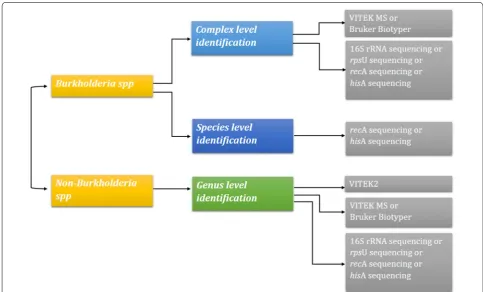
Bcc and non-Burkholderia spp. could not be distin-guished by conventional biochemical methods. Due to problem with identification, clonal typing of Burk-holderia is questionable. Molecular targets such as 16S
rRNA, recA, hisA and rpsU were reported to increase
the discrimination of Bcc. Representation of various
techniques and its ability to accurately identify Bcc is
given in Fig. 1.
Need for molecular identification of Bcc
Isolates from CF patients with persistent pathogenic colonization often lose their characteristic phenotypes or growth conditions which leads to difficulty in accurate identification of Bcc. To overcome this, molecular identi-fication is required to distinguish species within Bcc and from the related genus/species. Though molecular tar-gets for identification are not reliable when used individ-ually, a multi-target approach is essential to improve the identification of Bcc and non-Bcc organisms. Some of the reported molecular targets are hisA, rpsU, recA and 16S rRNA. Discriminating ability on genus/complex/species
level using these targets were listed in Table 2.
hisA and rpsU gene sequencing
Sequencing of hisA gene, encodes for an enzyme involved in histidine biosynthesis was reported to distinguish
spe-cies within Bcc [45]. Neighbour-joining method analysis
of 134 Bcc organisms revealed high degree of sequence similarity between strains of same species. Meanwhile, each species was clearly separated from each other. The
hisA based analysis separated 17 Bcc species in different clusters (including 4 lineage divisions of B. cenocepacia)
with high bootstrap values (> 75%) [45]. Burkholderia
strains used for hisA based analysis were previously iden-tified using a polyphasic taxonomy or recA sequencing
[46, 47].
Similarly, rpsU was recognized to identify different
spe-cies among the Burkholderia genus [48]. Frickmann et al.
[48] has employed rpsU sequencing method to
com-pare Burkholderia strains of known identity from ATCC (American Type Culture Collection, Manassas, Virginia, USA), DSMZ (German Collection of Microorganisms and Cell Cultures, Braunschweig, Germany), JCM (Japan Collection of Microorganisms, Tsukuba, Ibaraki Prefec-ture, Japan), BCCM/LMG (Bacteria Collection, Ghent, Belgium), and NCTC (National Collection of Type Cul-tures, Porton Down, UK). Also few clinical strains were included in the analysis for comparison, after ensuring their identity using recA sequencing. rpsU sequences formed four clusters including B. plantarii, B. glumae, B. cocovenenans and B. gladioli in cluster I, the Burkholderia pseudomallei complex (B. mallei, B. pseudomallei, and B. thailandensis) in cluster II, B. caryophylli, B. multivorans, P. norimbergensis, B. ubonensis, B. stabilis, B. cenocepa-cia, B. cepacenocepa-cia, B. pyrrocinia, B. ambifaria, B. anthina, B. vietnamiensis and B. dolosa in cluster III, and B. sacchari, B. graminis, B. fungorum, B. phytofirmans, B. xenovorans, B. phenoliruptrix, B. phenazinium, B. caribensis, B. hos-pita and B. phymatum in cluster IV. B. glathei, B. cale-donica and B. kururensis were observed as outliers.
Moreover, the rpsU sequence homology for Burkholde-ria and Pandorea was > 86%. Most of the clinical patho-gens of Bcc belongs to cluster III of rpsU sequencing, where B. caryophylli, B. multivorans, and P. norimbergen-sis had identical sequences and B. cenocepacia clustered with B. cepacia. Limitation of rpsU sequencing is it could not reliably discriminate Burkholderia spp. at the species level as single target.
recA gene sequencing
recA is another well-known target promising for
differ-entiation of Burkholderia species [46]. recA can
differ-entiate the following 19 species of Burkholderia namely, B. pseudomallei, B. mallei, B. thailandensis, B. humpty-dooensis, B. oklahomensis, B. oklahomensis-like, B. ubon-ensis, B. ambifaria, B. multivorans, B. vietnamiensis, B. fungorum, B. glumae, B. cepacia, B. xenovorans, B. dolosa, B. gladioli and Bcc [49]. However, non-Burkholderia spp. cannot be distinguished by recA sequencing. Burkholde-ria strains used for evaluation of recA sequencing were characterised using whole-cell protein profile analysis
and a polyphasic approach [47, 50].
16S rRNA sequencing
16S rRNA sequencing is one important option for differ-entiating non-Burkholderia spp. from Burkholderia spp.
[49]. The 16S rRNA similarity between Burkholderia spp.
and non-Burkholderia spp. is given in Table 3. In a study
from environmental sample, the different species of Bur-kholderia including non-BurBur-kholderia spp. were found in the same consortium suggesting that same environmen-tal niche hosts the sharing of genes through lateral gene
transfer [51]. Due to these challenges in identification,
the clonality of these species is also difficult to investi-gate, as the MLST housekeeping genes are species spe-cific. As of now, MLST database is available only for Bcc and B. pseudomallei. HAI outbreaks caused due to non-Burkholderia spp. could not be typed.
Whole genome sequences of B. cepacia
Due to recent developments in the molecular genetics of bacteria, usage of whole genome sequences (WGS) of the bacterial pathogens is gaining interest among clini-cal microbiologists. The WGS data helps in typing of the pathogens and in identifying the evolutionary pattern of the organism based on whole genome single nucleotide polymorphisms (SNPs). Till date 102 genome sequences have been deposited in NCBI for B. cepacia. This includes complete genomes and shotgun genome sequences. Fur-ther baseline data on B. cepacia WGS will help to identify region specific clones, which will be handy in identifying an outbreak situation.
Antimicrobial resistance mechanisms and therapy of Bcc The mechanisms of antibiotic resistance of Bcc species have been intensively studied. Major resistance mecha-nism in Bcc is due to efflux pump overexpression mostly by members of the resistance-nodulation-division (RND)
family [52–54]. B. cenocepacia strain J2315 was reported
to encode 16 RND efflux systems [55, 56].
Ceftazidime and other extended-spectrum cephalo-sporins are the reliable treatment options for Bcc due to intrinsic resistance to many other classes of antimi-crobials. Bcc were reported with class A β-lactamases conferring resistance to β-lactam antibiotics such as ceftazidime. This was first described in B. cepacia as the
PenA-PenR system [57], which were later known as PenB
and PenR (AmpR) [58]. Due to their complex role in
acti-vation of penB and ampC targets in the presence of an antibiotic susceptibilities to ceftazidime, cefotaxime, and
meropenem were greatly reduced [58, 59].
Table
3
Similarit
y of 16S rRNA sequenc
es b et w een Burk holderia and non-Burk holderia spp .
% Similarit
y
of 16S rRNA
study by Hwang and Kim [58], a B. cenocepacia strain J2315 PenB β-lactamase had shown a Ser72Tyr substitu-tion, due to which B. cenocepacia has intrinsic
clavula-nate resistance [58].
In addition, B. multivorans was reported to have a
PenA enzyme (Bmul_3689 in B. multivorans ATCC
17616), that is closely related to PenB reported in Bcc [58,
61]. This PenB is also similar to KPC-2 a significant
car-bapenemase [62]. However, the B. multivorans enzyme is
an inhibitor-resistant carbapenemase, unlike in B.
pseu-domallei which is an extended spectrum β-lactamase. Though the active role of PenA in clinical B. multivorans is it yet established. There were also reports on difference in efflux pump and outer membrane protein mediated resistance especially for colistin in Bcc and B. pseudomal-lei complex (Bpc) [63]. Due to these multiple differ-ence in their resistance mechanisms, it is imperative to accurately identify Bcc from other Burkholderia spp for appropriate therapy.
The choice for antimicrobial therapy is usually chosen based on in vitro susceptibility, while duration of therapy be based upon clinical and microbiologic response. Use of combination regimen is commonly reported for Bcc
[64]. However, it is still uncertain as the evidences were
mostly limited to in vitro studies or small clinical expe-riences. For serious infection with susceptible strains, a two-drug combination of parenteral trimethoprim-sul-famethoxazole (5 mg/kg trimethoprim component every 6–12 h) plus a β-lactam (e.g., ceftazidime, piperacillin,
meropenem) or a fluoroquinolone should be utilized [65].
For serious infection with trimethoprim-sulfamethoxa-zole-resistant strains or sulfa drug allergy, combination therapy guided by in vitro susceptibility results should be
administered [66]. In a study by Blumer et al. [67], in 102
CF patients, meropenem/tobramycin and ceftazidime/ tobramycin improved clinical status and reduced bacte-rial burden in 96 and 92% of treated patients, respectively. Bonacorsi et al. had proven enhanced bactericidal activity of ciprofloxacin in combination with other agents
[68]. Further, triple antimicrobial combination based on
meropenem was suggested useful than double or single
agents [69].
Macrolides in combination with other antimicrobials
had shown moderate synergism [70], while specific
com-binations including fosfomycin/tobramycin exhibited
poor activity against Bcc [71].
Conclusions
Conventional phenotypic methods could not discrimi-nate Bcc and related genus, as there is an overlap in the biochemical characteristics. A single molecular tar-get for differentiation of Bcc from Bcc and non-Burkholderia spp. is not reliable, while two or more
molecular targets significantly improves the species level discrimination in Bcc. rpsU and/or 16S rRNA sequenc-ing, VITEK2, VITEK MS and Bruker Biotyper could discriminate between Burkholderia spp. and non-Bur-kholderia spp. Whereas, Bcc complex level identifica-tion can be given by VITEK MS, Bruker Biotyper, 16S rRNA/rpsU/recA/hisA sequencing. For species level identification within Bcc hisA or recA sequencing are reliable. Recent advancements in genome sequencing using SNP phylogeny might help to accurately identify the clone of Bcc from non-Bcc and non-Burkholderia spp. Such identification is necessary to help in timely diagnosis of hospital acquired infections and to provide appropriate antimicrobial therapy.
Authors’ contributions
DRNK and VB conceptualized the article. VB and DRNK did the review of literature. The article was written, reviewed and finalised by VB and DRNK. Both authors read and approved the final manuscript.
Acknowledgements Not applicable.
Competing interests
The authors declare that they have no competing interests.
Availability of data and materials Not applicable.
Consent for publication Not applicable.
Ethics approval and consent to participate Not applicable.
Funding
No funding was obtained for this study.
Publisher’s Note
Springer Nature remains neutral with regard to jurisdictional claims in pub-lished maps and institutional affiliations.
Received: 21 April 2018 Accepted: 25 January 2019
References
1. Henry DA, Mahenthiralingam E, Vandamme P, Coenye T, Speert DP. Phe-notypic methods for determining genomovar status of the Burkholderia cepacia complex. J Clin Microbiol. 2001;39:1073–8.
2. Araque-Calderon Y, Miranda-Contreras L, Rodriguez-Lemoine V, Palacios-Pru EL. Antibiotic resistance patterns and SDS-PAGE protein profiles of
Burkholderia cepacia complex isolates from nosocomial and environmen-tal sources in Venezuela. Med Sci Monit. 2008;14(2):BR49–55.
3. Gautam V, Ray P, Vandamme P, Chatterjee SS, Das A, Sharma K, et al. Identification of lysine positive non-fermenting gram negative bacilli (Stenotrophomonas maltophilia and Burkholderia cepacia complex). Indian J Med Microbiol. 2009;27(2):128–33.
4. Gautam V, Singh M, Singhal L, Kaur M, Kumar A, Ray P. Burkholderia cepacia complex in Indian cystic fibrosis patients. Indian J Med Res. 2012;136(5):882–3.
6. Yabuuchi E, Kosako Y, Oyaizu H, Yano I, Hotta H, Hashimoto Y, et al. Pro-posal of Burkholderia gen. nov. and transfer of seven species of the genus Pseudomonas homology group II to the new genus, with the type spe-cies Burkholderia cepacia Palleroni and Holmes 1981 comb. nov. Microbiol Immunol. 1992;36(12):1251–75.
7. Yabuuchi E, Kosako Y, Yano I, Hotta H, Nishiuchi Y. Transfer of two Burk-holderia and an Alcaligenes species to Ralstonia gen. nov.: proposal of
Ralstonia pickettii (Ralston, Palleroni and Doudoroff, comb nov, Ralstonia solanacearum (Smith 1896) comb. nov. and Ralstonia eutropha (Davis 1969) comb. nov. Microbiol. Immunol. 1973;1995(39):897–904.
8. Coenye T, Vandamme P. Diversity and significance of Burkholderia species occupying diverse ecological niches. Environ Microbiol. 2003;5(9):719–29. 9. Coenye T, Vandamme P, Govan JR, Lipuma JJ. Taxonomy and
iden-tification of the Burkholderia cepacia complex. J Clin Microbiol. 2001;39(10):3427–36.
10. Kiska DL, Kerr A, Jones MC, Caracciolo JA, Eskridge B, Jordan M, Miller S, Hughes D, King N, Gilligan P. Accuracy of four commercial systems for identification of Burkholderia cepacia and other gram-negative, nonfermenting bacilli recovered from patients with cystic fibrosis. J Clin Microbiol. 1996;34:886–91.
11. Larsen GY, Stull TL, Burns JL. Marked phenotypic variability in Pseu-domonas cepacia isolated from a patient with cystic fibrosis. J Clin Microbiol. 1993;31:788–92.
12. Liu PYF, Dhi ZY, Lau YJ, Hu BS, Shyr JM, Tsai WS, Lin YH, Tseng CY. Com-parison of different PCR approaches for characterization of Burkholderia (Pseudomonas) cepacia isolates. J Clin Microbiol. 1995;33:3304–7. 13. Simpson IN, Finlay J, Winstanley DJ, Dehwurst N, Nelson JW, Butler SL,
Govan JRW. Multi-resistance isolates possessing characteristics of both Burkholderia (Pseudomonas) cepacia and Burkholderia gladioli from patients with cystic fibrosis. J Antimicrob Chemother. 1994;34:353–61. 14. Vandamme P, Holmes B, Vancanneyt M, Coenye T, Hoste B, Coopman
R, Revets H, Lauwers S, Gillis M, Kersters K, Govan JRW. Occurrence of multiple genomovars of Burkholderia cepacia in cystic fibrosis patients and proposal of Burkholderia multivorans sp. nov. Int J Syst Bacteriol. 1997;47:1188–200.
15. Coenye T, LiPuma JJ, Henry D, Hoste B, Vandemeulebroucke K, Gillis M, Speert DP, Vandamme P. Burkholderia cepacia genomovar VI, a new member of the Burkholderia cepacia complex isolated from cystic fibrosis patients. Int J Syst Evol Microbiol. 2001;51:271–9.
16. Coenye T, Mahenthiralingam E, Henry D, LiPuma JJ, Laevens S, Gillis M, Speert DP. Vandamme P. Burkholderia ambifaria sp. nov, a novel member of the Burkholderia cepacia complex including biocontrol and cystic fibrosis-related isolates. Int J Syst Evol Microbiol. 2001;51:1481–90. 17. Balandreau J, Viallard V, Cournoyer B, Coenye T, Laevens S, Vandamme P.
Burkholderia cepacia genomovar III is a common plant-associated bacte-rium. Appl Environ Microbiol. 2001;67:982–5.
18. Coenye T, Holmes B, Kersters K, Govan JRW, Vandamme P. Burkholderia cocovenenans (van Damme et al. 1960) Gillis et al. 1995 and Burkholderia vandii Urakami et al. 1994 are junior subjective synonyms of Burkholderia gladioli (Severini 1913) Yabuuchi et al. 1993 and Burkholderia plantarii (Azegami et al. 1987) Urakami et al. 1994, respectively. Int J Syst Bacteriol. 1999;49:37–42.
19. Coenye T, Schouls LM, Govan JRW, Kersters K, Vandamme P. Identification of Burkholderia species and genomovars from cystic fibrosis patients by AFLP fingerprinting. Int J Syst Bacteriol. 1999;49:1657–66.
20. Gillis M, Van Van T, Bardin R, Goor M, Hebbar P, Willems A, Segers P, Kersters K, Heulin T, Fernandez MP. Polyphasic taxonomy in the genus Burkholderia leading to an emended description of the genus and proposition of Burkholderia vietnamiensis sp nov for N2- fixing isolates from rice in Vietnam. Int J Syst Bacteriol. 1995;45:274–89.
21. Gilligan PH, Gage PA, Bradshaw LM, Schidlow DV, DeCicco BT. Isolation medium for the recovery of Pseudomonas cepacia from respiratory secretions of patients with cystic fibrosis. J Clin Microbiol. 1985;22:5–8. 22. Welch DF, Muszynski MJ, Pai CH, Marcon MJ, Hribar MM, Gilligan PH,
Matsen JM, Ahlin PG, Hilman BC, Chartrand SA. Selective and differential medium for the recovery of Pseudomonas cepacia from the respiratory tract of patients with cystic fibrosis. J Clin Microbiol. 1987;25:1730–4. 23. Henry DA, Campbell ME, LiPuma JJ, Speert DP. Identification of
Burkholde-ria cepacia isolates from patients with cystic fibrosis and use of a simple new selective medium. J Clin Microbiol. 1997;35:614–9.
24. Henry D, Campbell M, McGimpsey C, Clarke A, Louden L, Burns JL, Roe MH, Vandamme P, Speert D. Comparison of isolation media for recovery of Burkholderia cepacia complex from respiratory secretions of patients with cystic fibrosis. J Clin Microbiol. 1999;37:1004–7.
25. Fehlberg LCC, Lucas Henrique Sales Andrade, Diego Magno Assis, Rosana Helena Vicente Pereira, Ana Cristina Gales, Elizabeth Andrade Marques. Performance of MALDI-ToF MS for species identification of
Burkholderia cepacia complex clinical isolates. Diagn Microbiol Infect Dis. 2013;77:126–8.
26. Jones AM, Dodd ME, Govan JR, Barcus V, Doherty CJ, Morris J, et al. Burk-holderia cenocepacia and Burkholderia multivorans: influence on survival in cystic fibrosis. Thorax. 2004;59(11):948–51.
27. Antony B, Cherian EV, Boloor R, Shenoy KV. A sporadic outbreak of
Burkholderia cepacia complex bacteremia in pediatric intensive care unit of a tertiary care hospital in coastal Karnataka. South India. Indian J Pathol Microbiol. 2016;59:197–9.
28. Mahenthiralingam E, Urban TA, Goldberg JB. The multifarious, multirepli-con Burkholderia cepacia complex. Nat Rev Microbiol. 2005;3:144–56. 29. Reik R, Spilker T, Lipuma JJ. Distribution of Burkholderia cepacia complex
species among isolates recovered from persons with or without cystic fibrosis. J Clin Microbiol. 2005;43:2926–8.
30. Marko DC, Saffert RT, Cunningham SA, Hyman J, Walsh J, Arbefeville S, et al. Evaluation of the Bruker Biotyper and Vitek MS matrix-assisted laser desorption ionization-time of flight mass spectrometry systems for iden-tification of nonfermenting gram-negative bacilli isolated from cultures from cystic fibrosis patients. J Clin Microbiol. 2012;50(6):2034–9. 31. Alby K, Gilligan PH, Miller MB. Comparison of Matrix-Assisted Laser
Desorption Ionization-Time of Flight (MALDI-TOF) Mass Spectrometry Platforms for the Identification of Gram-Negative Rods from Patients with Cystic Fibrosis. J Clin Microbiol. 2013;51(11):3852–4.
32. Manji R, Bythrow M, Branda JA, Burnham CA, Ferraro MJ, Garner OB, et al. Multi-center evaluation of the VITEK® MS system for mass spectrometric identification of non-Enterobacteriaceae Gram-negative bacilli. Eur J Clin Microbiol Infect Dis. 2014;33(3):337–46.
33. Plongla R, Panagea T, Pincus DH, Jones MC, Gilligan PH. Identification of Burkholderia and uncommon glucose non-fermenting Gram-negative Bacilli isolated from patients with cystic fibrosis using matrix-assisted laser desorption ionization-time of flight mass spectrometry (MALDI-TOF MS). J Clin Microbiol. 2016;54(12):3071–2.
34. Gautam V, Sharma M, Singhal L, Kumar S, Kaur P, Tiwari R, Ray P. MALDI-TOF mass spectrometry: an emerging tool for unequivocal identifi-cation of non-fermenting Gram-negative bacilli. Indian J Med Res. 2017;145(5):665–72.
35. Stryjewski ME, LiPuma JJ, Messier RH, Reller LB, Alexander BD. Sepsis, multiple organ failure, and death due to Pandoraea pnomenusa infection after lung transplantation. J Clin Microbiol. 2003;41(5):2255–7.
36. Jørgensen IM, Johansen HK, Frederiksen B, Pressler T, Hansen A, Van-damme P, et al. Epidemic spread of Pandoraea apista, a new pathogen causing severe lung disease in cystic fibrosis patients. Pediatr Pulmonol. 2003;36:439–46.
37. Atkinson RM, LiPuma JJ, Rosenbluth DB, Dunne WM. Chronic colonization with Pandoraea apista in cystic fibrosis patients determined by repetitive-element-sequence PCR. J Clin Microbiol. 2006;44:833–6.
38. Pimentel JD, MacLeod C. Misidentification of Pandoraea sputorum isolated from sputum of a patient with cystic fibrosis and review of
Pandoraea species infections in transplant patients. J Clin Microbiol. 2008;46(9):3165–8.
39. Caraher E, Collins J, Herbert G, Murphy PG, Gallagher CG, Crowe MJ, et al. Evaluation of in vitro virulence characteristics of the genus Pandoraea in lung epithelial cells. J Med Microbiol. 2008;57:15–20.
40. Martina PF, Martínez M, Frada G, Alvarez F, Leguizamón L, Prieto C, et al. First time identification of Pandoraea sputorum from a patient with cystic fibrosis in Argentina: a case report. BMC Pulm Med. 2017;17:33. 41. Ryan MP, Pembroke JT, Adley CC. Ralstonia pickettii: a persistent
Gram-negative nosocomial infectious organism. J Hosp Infect. 2006;62:278–84. 42. Waugh JB, Granger WM, Gaggar A. Incidence, relevance and response for
Ralstonia respiratory infections. Clin Lab Sci. 2010;23(2):99–106. 43. Orme J, Rivera-Bonilla T, Loli A, Blattman NN. Native valve endocarditis
•fast, convenient online submission
•
thorough peer review by experienced researchers in your field
• rapid publication on acceptance
• support for research data, including large and complex data types
•
gold Open Access which fosters wider collaboration and increased citations maximum visibility for your research: over 100M website views per year
•
At BMC, research is always in progress.
Learn more biomedcentral.com/submissions
Ready to submit your research? Choose BMC and benefit from:
44. Lai HW, Shen YH, Chien LJ, Tseng SH, Mu JJ, Chan YJ, et al. Outbreak of
Ralstonia pickettii bacteremia caused by contaminated saline solution in Taiwan. Am J Infect Control. 2016;44(10):1191–2.
45. Papaleo MC, Perrin E, Maida I, Fondi M, Fani R, Vandamme P. Identification of species of the Burkholderia cepacia complex by sequence analysis of the hisA gene. J Med Microbiol. 2010;59(10):1163–70.
46. Mahenthiralingam E, Bischof J, Byrne SK, Radomski C, Davies JE, Av-Gay Y, et al. DNA-based diagnostic approaches for identification of Burkholderia cepacia complex, Burkholderia vietnamiensis, Burkholderia multivorans,
Burkholderia stabilis, and Burkholderia cepacia genomovars I and III. J Clin Microbiol. 2000;38:3165–73.
47. Vandamme P, Holmes B, Vancanneyt M, Coenye T, Hoste B, Coopman R, et al. Occurrence of multiple genomovars of Burkholderia cepacia in cystic fibrosis patients and proposal of Burkholderia multivorans sp. nov. Int J Syst Bacteriol. 1997;47:1188–200.
48. Frickmann H, Neubauer H, Loderstaedt U, Derschum H, Hagen RM. rpsU-based discrimination within the genus Burkholderia. Eur J Microbiol Immunol (Bp). 2014;4(2):106–16.
49. Ginther JL, Mayo M, Warrington SD, Kaestli M, Mullins T, Wagner DM, et al. Identification of Burkholderia pseudomallei near-neighbor species in the northern territory of Australia. PLoS Negl Trop Dis. 2000;9(6):e0003892. 50. Vandamme P, Pot B, Gillis M, de Vos P, Kersters K, Swings J. Polyphasic
taxonomy, a consensus approach to bacterial systematics. Microbiol Rev. 1996;60:407–38.
51. Suarez-Moreno ZR, Devescovi G, Myers M, Hallack L, Mendonca-Previato L, Caballero-Mellado J, et al. Commonalities and differences in regula-tion of N-acyl homoserine lactone quorum sensing in the beneficial plant-associated Burkholderia species cluster. Appl Environ Microbiol. 2010;76(13):4302–17.
52. Guglierame P, Pasca MR, De Rossi E, Buroni S, Arrigo P, Manina G, Riccardi G. Efflux pump genes of the resistance-nodulation-division family in Burkholderia cenocepacia genome. BMC Microbiol. 2006;6:66. https ://doi. org/10.1186/1471-2180-6-66.
53. Tseng SP, Tsai WC, Liang CY, Lin YS, Huang JW, Chang CY, Tyan YC, Lu PL. The contribution of antibiotic resistance mechanisms in clinical Burk-holderia cepacia complex isolates: an emphasis on efflux pump activity. PLoS ONE. 2014;9:e104986. https ://doi.org/10.1371/journ al.pone.01049 86.
54. Podnecky NL, Rhodes KA, Schweizer HP. Efflux pump-mediated drug resistance in Burkholderia. Front Microbiol. 2015;6:305. https ://doi. org/10.3389/fmicb .2015.00305 .
55. Bazzini S, Udine C, Sass A, Pasca MR, Longo F, Emiliani G, Fondi M, Perrin E, Decorosi F, Viti C, Giovannetti L, Leoni L, Fani R, Riccardi G, Mahenthi-ralingam E, Buroni S. Deciphering the role of RND efflux transporters in Burkholderia cenocepacia. PLoS ONE. 2011;6:e18902. https ://doi. org/10.1371/journ al.pone.00189 02.
56. Buroni S, Matthijs N, Spadaro F, Van Acker H, Scoffone VC, Pasca MR, Ric-cardi G, Coenye T. Differential roles of RND efflux pumps in antimicrobial drug resistance of sessile and planktonic Burkholderia cenocepacia cells. Antimicrob Agents Chemother. 2014;58:7424–9. https ://doi.org/10.1128/ AAC.03800 -14.
57. Trepanier S, Prince A, Huletzky A. Characterization of the penA and penR genes of Burkholderia cepacia 249 which encode the chromosomal class
A penicillinase and its LysR-type transcriptional regulator. Antimicrob Agents Chemother. 1997;41:2399–405.
58. Hwang J, Kim HS. Cell wall recycling-linked coregulation of AmpC and PenB beta-lactamases through ampD mutations in Burkholderia cenoce-pacia. Antimicrob Agents Chemother. 2015;59:7602–10.
59. Vadlamani G, Thomas MD, Patel TR, Donald LJ, Reeve TM, Stetefeld J, Standing KG, Vocadlo DJ, Mark BL. The beta-lactamase gene regulator AmpR is a tetramer that recognizes and binds the D-Ala-D-Ala motif of its repressor UDP-N-acetylmuramic acid (MurNAc)-pentapeptide. J Biol Chem. 2015;290:2630–43.
60. Winsor GL, Khaira B, Van Rossum T, Lo R, Whiteside MD, Brinkman FSL. The
Burkholderia genome database: facilitating flexible queries and compara-tive analyses. Bioinformatics. 2008;24:2803–4.
61. Poirel L, Rodriguez-Martinez JM, Plesiat P, Nordmann P. Naturally occur-ring Class A ss-lactamases from the Burkholderia cepacia complex. Antimicrob Agents Chemother. 2009;53:876–82.
62. Papp-Wallace KM, Taracila MA, Gatta JA, Ohuchi N, Bonomo RA, Nukaga M. Insights into beta-lactamases from Burkholderia species, two phy-logenetically related yet distinct resistance determinants. J Biol Chem. 2013;288:19090–102.
63. Rhodes Katherine A, Schweizer Herbert P. Antibiotic resistance in Burk-holderia species. Drug Resist Updat. 2016;28:82–90.
64. Gautam V, Shafiq N, Singh M, Ray P, Singhal L, Jaiswal NP, Prasad A, Singh S, Agarwal A. Clinical and in vitro evidence for the antimicrobial therapy in Burkholderia cepacia complex infections. Expert Rev Anti Infect Ther. 2015;13(5):629–63.
65. Pegues DA. Burkholderia cepacia complex. http://www.antim icrob e.org/ b19.asp.
66. Nimri L, Sulaiman M, Hani OB. Community-acquired urinary tract infections caused by Burkholderia cepacia complex in patients with no underlying risk factor. JMM Case Rep. 2017;4(1):e005081.
67. Blumer JL, Saiman L, Konstan MW, Melnick D. The efficacy and safety of meropenem and tobramycin vs ceftazidime and tobramycin in the treat-ment of acute pulmonary exacerbations in patients with cystic fibrosis. Chest. 2005;128(4):2336–46.
68. Bonacorsi S, Fitoussi F, Lhopital S, Bingen E. Comparative in vitro activi-ties of meropenem, imipenem, temocillin, piperacillin, and ceftazidime in combination with tobramycin, rifampin, or ciprofloxacin against
Burkholderia cepacia isolates from patients with cystic fibrosis. Antimicrob Agents Chemother. 1999;43(2):213–7.
69. Aaron SD, Ferris W, Henry DA, et al. Multiple combination bactericidal antibiotic testing for patients with cystic fibrosis infected with Burkholde-ria cepacia. Am J Respir Crit Care Med. 2000;161(4 Pt 1):1206–12. 70. Saiman L, Chen Y, Gabriel PS, Knirsch C. Synergistic activities of macrolide
antibiotics against Pseudomonas aeruginosa, Burkholderia cepacia,
Stenotrophomonas maltophilia, and Alcaligenes xylosoxidans isolated from patients with cystic fibrosis. Antimicrob Agents Chemother. 2002;46(4):1105–7.