DEMOGRAPHIC RESEARCH
VOLUME 33, ARTICLE 24, PAGES 665–700
PUBLISHED 23 SEPTEMBER 2015
http://www.demographic-research.org/Volumes/Vol33/24/ DOI: 10.4054/DemRes.2015.33.24
Research Article
Adapting chain referral methods to sample new
migrants: Possibilities and limitations
Lucinda Platt
Renee Luthra
Tom Frere-Smith
©2015Lucinda Platt, Renee Luthra & Tom Frere-Smith.
This open-access work is published under the terms of the Creative Commons Attribution NonCommercial License 2.0 Germany, which permits use, reproduction & distribution in any medium for non-commercial purposes, provided the original author(s) and source are given credit.
1 Introduction 666
2 Background 667
2.1 The socio-cultural integration of new immigrants in Europe 667
2.2 Current surveys: potential and limitations 668
2.3 Respondent-driven sampling 670
2.4 RDS and migrant surveys 671
3 RDS for studies of new immigrants 672
3.1 Network size and recency of arrival 674
3.2 Trust and privacy (‘unseen’ referral process of RDS vs. contacting directly; surveying in-home vs. surveying centres)
674
3.3 Clustering 675
3.4 Interest 675
4 Adapting RDS for the study of new migrants 676
4.1 RDS adaptations 676
4.2 Researcher-led chain referral 678
5 Results 679
5.1 Network size and response 681
5.2 Privacy and trust 682
5.3 Clustering 683
5.4 Interest: Findings 684
5.5 Researcher-led referral 684
6 Conclusions and reflections 688
7 Acknowledgements 691
Adapting chain referral methods to sample new migrants:
Possibilities and limitations
Lucinda Platt1
Renee Luthra2
Tom Frere-Smith3
Abstract
BACKGROUND
Demographic research on migration requires representative samples of migrant populations. Yet recent immigrants, who are particularly informative about current migrant flows, are difficult to capture even in specialist surveys. Respondent-driven sampling (RDS), a chain referral sampling and analysis technique, potentially offers the opportunity to achieve population-level inference of recently arrived migrant populations.
OBJECTIVE
We evaluate the attempt to use RDS to sample two groups of migrants, from Pakistan and Poland, who had arrived in the UK within the previous 18 months, and we present an alternative approach adapted to recent migrants.
METHODS
We discuss how connectedness, privacy, clustering, and motivation are expected to differ among recently arrived migrants, compared to typical applications of RDS. We develop a researcher-led chain referral approach, and compare success in recruitment and indicators of representativeness to standard RDS recruitment.
RESULTS
Our researcher-led approach led to higher rates of chain-referral, and enabled us to reach population members with smaller network sizes. The researcher-led approach resulted in similar recruiter-recruit transition probabilities to traditional RDS across many demographic and social characteristics. However, we did not succeed in building up long referral chains, largely due to the lack of connectedness of our target populations and some reluctance to refer. There were some differences between the two
1 London School of Economics and Political Science, U.K. E-Mail: [email protected]. 2 University of Essex, U.K.
migrant groups, with less mobile and less hidden Pakistani men producing longer referral chains.
CONCLUSIONS
Chain referral is difficult to implement for sampling newly arrived migrants. However, our researcher-led adaptation shows promise for less hidden and more stable recent immigrant populations.
1. Introduction
Demographic research on migration requires representative samples of migrant populations, yet recent immigrants are difficult to capture in standard or even specialist surveys. The underrepresentation of recent immigrants in existing surveys inhibits understanding of the causes and consequences of migration, as well as the distinctive features of current migration flows (Engberson et al. 2013). For example, in order to obtain a representative account of the individual motivations driving migration, it is necessary to survey migrants close to the point of arrival and before return migration, or elapsed time will bias the results. Understanding immigrant adaptation processes similarly requires data that capture migrants shortly after migration, when structural and social integration trajectories are developing and potentially informing each other. Given that immigrant integration is one of the most contested issues in contemporary Europe, it is critical to have information on immigrants at all points of the settlement process.
This paper outlines an attempt to gather data on new immigrants to London. The aim was to reach two distinct groups of migrants (from Poland and Pakistan) who had arrived within the preceding 18 months, and to re-interview them after a further 15−18 months. Only eight countries in the world maintain population registers that can be used as a sampling frame for recent immigrants. Other potential sampling frames, such as existing surveys, rarely contain sufficient numbers of recent migrants. We therefore set out to employ and adapt chain referral methods, informed by promising applications of Respondent-Driven Sampling (RDS) to Polish immigrant populations (Tyldum and Johnston 2014; Mühlau, Kaliszewska, and Röder 2011; Hansen and Hansen 2009), in order to reach a representative sample of each group.
not dealing with a hidden population, in the sense of many populations that RDS has been used with, such as people who inject drugs or sex workers (Goodman 2011; Handcock and Gile 2011; Johnston et al. 2008) We thus considered that we could benefit from a more open approach. We also attempted to address sources of intra-group clustering that are likely to be common across migrant intra-groups, as well as a potential lack of interest in participation.
We experienced limited success with traditional RDS sampling techniques. However, the new researcher-led approach that we developed, based both on our expectations prior to the start of fieldwork and on our experiences during the early phases of data collection, enabled us to recruit a diverse sample of 778 Poles and 751 Pakistanis with characteristics largely in line with other data sources. We exploit variation across our two migrant groups to discuss the success or failure of each of our adaptations. Specifically, the target Pakistani population formed a more selected (through immigration policy), less mobile, and more ethnically embedded population, rendering them more susceptible to chain recruitment efforts than the Polish population. Focusing on our Pakistani sample, we further compare recruitment patterns using standard RDS methods and our researcher-led approach. Results suggest that researcher-led methods perform similarly to RDS in recently arrived immigrant populations, with the added benefits of increased monitoring and control and the inclusion of population members who are less well networked. Overall, we conclude that RDS is not necessarily the most appropriate way to reach new migrants, and that our adapted chain referral approach also has limitations. Nevertheless, our researcher-led approach may be useful in reaching other somewhat less networked and non-stigmatized groups, while still obtaining network and recruitment probabilities to estimate weighted population parameters.
2. Background
2.1 The socio-cultural integration of new immigrants in Europe
The lack of such data has inhibited research on this topic, particularly cross-national research, which can provide additional purchase on questions of the relationship between social and structural integration processes in differing country contexts. Hence, an international team of migration scholars, supported by New Opportunities for Research Funding Agency Co-operation in Europe (NORFACE), set out to conduct a four-country (Germany, UK, Ireland, and the Netherlands) survey of the socio-cultural integration of new immigrants. The aim was to describe and explain the nature, causes, and consequences of immigrants’ early socio-cultural integration patterns, charting individual-level dynamics through two observations over a three-year period (Gresser and Schacht 2015).
The choice of destination countries was based on their contrasting migration histories and integration regimes (Joppke 2004; Joppke 1999). The selection of migrant groups comprised a) those from countries with long-standing labour migration connections to the destination country, i.e., Turks (in Germany and the Netherlands), Moroccans (in the Netherlands), and Pakistanis (in the UK); and b) migrants from Eastern European countries that joined the EU in 2004, specifically Poles (in Germany, the UK, the Netherlands, and Ireland). Sampling immigrants from each of the specified groups within 18 months of arrival and following them up after a further 15–18 months, this study provides the only harmonised cross-national data on the early socio-cultural integration of migrants. In 2015, data for all four countries and both waves will be deposited with the data archive maintained at GESIS: Leibniz Institute for the Social Sciences.
2.2 Current surveys: potential and limitations
Howat et al. 2011), even if extra effort is made in these cases to reach the minority populations.
An alternative has been to develop surveys of specific immigrant or ethnic minority populations. For example, The Integration of the European Second Generation (TIES) project sampled second-generation individuals from three ethnic origins in 15 European cities, utilising different methods in different countries (Crul and Schneider 2010). A telephone survey also focusing on specific cities was the basis for a study of Muslim minorities in three countries (Karlsen and Nazroo 2013). The Migrations Between Africa and Europe Project linked migrants to Europe from three African countries with origin-country surveys (Beauchemin and González-Ferrer 2011; Obucina 2013). The European Union Minorities and Discrimination Survey (EU-MIDIS) carried out face-to-face interviews with migrant/minority groups in all 27 member states, utilising random route sampling, focused enumeration, and network sampling (EU Agency for Fundamental Rights 2009).
Such studies have provided major gains in our understanding of immigrant-origin populations, though not without the challenges of reaching representative samples and obtaining good response rates (Font and Mendez 2013). For example, response rates among children of immigrants were only 25%–30% in the Dutch (Hornstra, Groenewold, and Lessard-Phillips 2012), 28% in the German, and 43%–48% in the Belgium TIES data (Teney et al. 2010), and the overall response rate totalled 38%–58% among the EU-MIDIS samples (EU Agency for Fundamental Rights 2009). Moreover, a reliance on administrative sampling frames results in samples dominated by more settled populations and, increasingly, second-generation respondents. Even an explicit attempt to sample new immigrants, the US New Immigrant Survey (NIS), used a sampling frame of those achieving legal permanent status, which excludes all immigrants until they decide to settle permanently.
Given that most immigrants arrive with at least the intention of return, the use of administrative definitions of ‘immigrant’ makes it impossible to investigate the interplay between structural and sociocultural integration in the first months and years following arrival, precisely when adjustments in language acquisition, friendship formation, labour market adjustment, and residential settlement are expected to be greatest. This issue touches on a central dilemma for the study of immigrants: how to define who is an immigrant and who is a sojourner. Given the complexity of immigrant intentions and their fluctuation in the period close to arrival, formal definitions regarding intentions or legal statuses may exclude many immigrants who will later decide to stay.
comprehensive register data (Myrberg 2013), there are limited options. Typically, area-based approaches with direct screening, sometimes in combination with focused enumeration, have proved fruitful, particularly where minority or immigrant groups of interest are relatively clustered (Erens 2013; Smith 1997). However, these are very costly, requiring many times the target number of households to be screened to achieve the desired sample size, even with a carefully targeted design (Berthoud et al. 2009). They are, moreover, less effective – and more costly – if the groups of interest are less geographically clustered, or if sub-populations, such as specific immigration statuses or more recent or more mobile populations, are the target (Ipsos MORI / Institute of Education 2011).
Alternatives to address screening include piggy-backing on existing surveys by following up those who have already been identified as belonging to the relevant minorities (Erens 2013); but this is clearly not suitable for recent immigrants. Other studies have used more ad hoc methods, including careful quota sampling (Drinkwater and Garapich 2011), snowballing (Beauchemin and González-Ferrer 2011), centre sampling (Baio, Blangiardo, and Blangiardo 2011), and workplace sampling (Agadjanian and Zotova 2012). Many of these, however, focus on particular, economically active groups of migrants. Name-identification has also shown some promise and works well for some groups (Font and Mendez 2013), but it typically requires sufficient duration of stay to allow for inclusion in commercial data sources and enough residential stability to track names to addresses.
2.3 Respondent-driven sampling
Recently, interest has developed in applying respondent-driven sampling to the study of immigrant populations (Tyldum and Johnston 2014). RDS was developed by Douglas Heckathorn in conjunction with the AIDS prevention intervention program in the US (Heckathorn 1997), as a means of providing robust, representative information on hard-to-reach groups (Johnston et al. 2008; Lansky et al. 2007; Malekinejad et al. 2008; McCreesh et al. 2012).
RDS is a complex method of both data gathering and analysis that aims to overcome biases arising from traditional chain referral methods.4 Instead of sampling individuals from a sampling frame, RDS seeks to sample individuals from a target population network, assumed to encompass all members through social ties. The sampling process begins with the recruitment and interviewing of seed members, who then go on to recruit N (usually N=<3) referrals using recruitment coupons with unique
4 For a more complete discussion of the methods and the assumptions underlying statistical analysis of RDS
code numbers that trace the link between recruiter and recruited. Restricting recruitment helps to reduce bias resulting from the tendency for respondents to recruit others like themselves, and tracing the link between respondents allows such homophily to be subsequently modelled.
All respondents are asked for the size of their personal social network (PSN) in the target population to ascertain relative likelihoods of selection into the sample. Gathering PSN size and referral chain information allows researchers to adjust for the fact that chain referral methods tend to oversample well-connected respondents. Referrals are then interviewed and encouraged to recruit further referrals, with each round of referrals representing a wave of data collection in that network. Recruitment continues until the target size is reached and bias arising from the initial sampling of seed members is reduced across important characteristics of interest; for example, gender. RDS thus requires frequent monitoring of sample characteristics while the survey is still in field.
Both seed and referral participation are incentivized: one sum is provided for the interview itself and additional, secondary incentives, usually smaller, for each recruitment effort that yields a referral interview. In this way, recruitment can occur completely independently of researchers, enabling anonymity in participation. By restricting the number of coupons assigned to each respondent, RDS aims to encourage longer recruitment chains, with greater degrees of separation between the seeds and final referrals, thereby ideally increasing the diversity of the sample. Peer pressure motivated to secure the secondary incentive should encourage recruitment, and recruitment from trusted others is expected to reduce non-response bias.
While many of the above features are shared by other chain referral methods, RDS differs in that it requires analysis that adjusts respondents’ reported social network sizes for biases arising from over- and under-recruitment of specific subgroups within the target population. RDS achieves this largely at the analysis stage through statistical programs such as RDS Analyst (Handcock, Fellows, and Gile 2014) and RDSAT (Volz et al. 2012) that allow adjustments for both homophily and PSN size. Unlike other chain referral methods, RDS offers the possibility of population estimates, including standard errors and other common measures of statistical significance, and hence was initially the preferred sampling option for the UK.
2.4 RDS and migrant surveys
of migration operates through social network channels (Kalter 2011; Massey et al. 1999). Migrants may have undocumented or tenuous legal status in the country of destination, and may therefore be more likely to avoid interviews from unknown others (Agadjanian and Zotova 2012; Montealegre et al. 2013). RDS thus presents a unique possibility to reach all types of recently arrived immigrant populations and gather sufficient social network information to obtain weighted estimates of population parameters.
As a result, migration-related surveys using RDS have multiplied in recent years, including surveys of migrant health (Montealegre et al. 2012; Montealegre et al. 2011; Strathdee et al. 2008; Wagner et al. 2011), workplace practices (Alsos and Eldring 2008; Bernhardt et al. 2009), and transnational behaviours (Friberg and Horst 2014; Horvath 2012; Napierala and Gorny 2013).
However, the method requires the target population to be densely connected, without impregnable barriers − for example, between men and women - and with some motivation to participate and recruit others. These requirements can present challenges for RDS-based immigrant studies, particularly when considering recently arrived immigrants. We next review these issues and how we attempted to address them.
3. RDS for studies of new immigrants
The decision of whether and how to use chain referral methods, including RDS, will rest on a variety of considerations, including other available options. To assess the potential risks of using such methods on a recently arrived and residentially relatively dispersed sample, we first consulted experts on Polish and Pakistani immigrant communities in London, surveyed secondary literature, and discussed the method with Irish colleagues who successfully conducted an RDS study of Polish migrants in Dublin between 2009 and 2010 (Mühlau, Kaliszewska, and Röder 2011). Overall, our review and the consultation raised some concern about the use of chain referral methods for recent arrivals. Most importantly, there was concern that recent arrivals would lack the dense network ties necessary to facilitate chain referral (Friberg 2012), since they may not have yet had time to socialise in their new country of residence.5 Garapich (2008) highlights the weak support and community involvement provided by traditional organisations such as the Church to post-accession Polish migrants, and the lack of non-employment-related links; while Burrell (2010) outlines the evidence on the mutual suspicion and limited networks that were seen to characterise Eastern European migration flows (see also Ryan et al. 2008; Ryan 2010). While the Dublin Polonia study
5 Main published discussion of these potential limits was, however, only forthcoming subsequent to the
had demonstrated the effectiveness of RDS for an established population, the findings on networks and recruitment by time of arrival, particularly in a period of declining migration, suggested that recent Polish migrants might lack the density for successful implementation of RDS (Mühlau, Kaliszewska, and Röder 2011).6 However, in the face of some uncertainty as to network density, particularly for recent Pakistani immigrants, and in light of the success of the RDS-recruitment of the Polish sample in Ireland and the very strong demand for cross-nationally comparable data on new immigrants in the UK, we determined to continue, using RDS methods as consistently as possible.
We conducted a small pre-test of 10 respondents (four Poles and six Pakistanis), diverse in demographic characteristics, to scope out the likely network sizes we might expect during the main stage of fieldwork. Three of our Polish respondents said they did not know anyone who met the criteria, reporting that the Poles they knew in London were more settled (>18 months) immigrants. Pakistani respondents were more likely to know eligible people (recently arrived Pakistanis), reporting knowing multiple contacts and expressing willingness to both recommend and provide information about their background. All respondents reported that the majority of their contacts lived in their local area. A common comment, however, was that new migrants were likely to be very busy, stemming from the fact that they would be setting up house and adjusting to a new linguistic, institutional, and social context. In addition, many were working long hours as target earners in low-wage jobs (Anderson et al. 2006; Drinkwater, Eade, and Garapich 2009). Such low-wage long-hours work has been suggested to be a particular feature of the employment of newly arrived or temporary migrants as they accumulate resources and before they make the transition to jobs more in line with their qualifications (Parutis 2014). Hence, our pre-test respondents voiced concern that it might be difficult to persuade them to take part in a survey.
Our pre-testing was thus relatively modest in scale and its results on the extent of networks were not especially encouraging. While we would ideally have wished to conduct further formative research and a formal pilot, we were heavily constrained by timing, given that we were expected to enter the field concurrently with the other countries, which in the Netherlands and Germany were using register data and in Ireland were drawing on experience from their earlier study. We therefore continued, noting four potential sources of concern likely to be important in any chain referral survey of (newly arrived) migrants: i) networks (especially given recency of arrival), ii) trust and privacy, iii) clustering and intra-group heterogeneity, and iv) interest. We therefore modified several aspects of RDS at the outset in anticipation of distinctive issues in these areas. After observing a lack of connections and slow recruitment during the early stages of fieldwork, we substantially altered our recruitment strategy,
departing significantly from classical RDS approaches and introducing what we term ‘researcher-led’ referral.
3.1 Network size and recency of arrival
The success of RDS is facilitated by a densely networked target population. Time of arrival of the immigrant group is likely to be one of the strongest predictors of the density of network ties, because better established immigrant groups will have ethnic institutions and press, and other channels of communication that less established groups lack (Breton 1964; Yancey, Ericksen, and Juliani 1976; Park and Iceland 2011; Wright, Ellis, and Parks 2010). Moreover, recently arrived immigrants are likely to have smaller network sizes and shorter expected durations of stay than settled migrants (Friberg 2012). It thus appeared likely that there would be limitations in obtaining referrals and long chains from new migrants.
3.2 Trust and privacy (‘unseen’ referral process of RDS vs. contacting directly; surveying in-home vs. surveying centres)
RDS was originally designed for populations that may prefer to remain anonymous to survey researchers. Clearly, the degree to which an immigrant group will prefer anonymity is contingent on a variety of factors, most importantly their legal status and the degree of stigma in the receiving community. Undocumented immigrants are highly vulnerable and may only be willing to be approached by trusted others, and may decline to be interviewed in their home or provide identifying details (De La Rosa et al. 2012; Montealegre et al. 2012). Even immigrants with formal legal status may be distrustful of ‘officials’ or interviewers unknown to them if their presence is highly politicized or they are victims of discrimination or harassment (Deding, Fridberg, and Jakobsen 2008). However, for immigrants who face a more neutral reception context, issues of privacy and trust may be much less salient.
minority/migrant groups (EU Agency for Fundamental Rights 2009). Although South Asian immigrants face more negative sentiment than European migrants (Ford 2011), they are less likely to experience harassment in areas of high concentration such as London (Dustmann, Fabbri, and Preston 2011).
Polish migrants enjoy rights to freedom of movement within the European Union as citizens of a member state. For Pakistani immigrants, visa overstaying is the main route to illegal residency, but any visa overstayers would by definition tend to be outside our target population of recent (<18 months) migrants. Hence, we felt issues to do with legal residency were unlikely to create significant privacy concerns among either of the two groups of migrants.
3.3 Clustering
Immigrant groups which are strongly clustered into subgroups – for instance by gender, socioeconomic status, or ethnicity – may be difficult to survey comprehensively with RDS. An RDS survey of low-wage workers in New York, Los Angeles, and Chicago found that even among Central American immigrants who shared a language (Spanish) and worked in similar occupations, national origin barriers served as cleavages within the network that impeded obtaining a representative sample (Milkman, Gonzales, and Narro 2010). Similarly, social class may split an immigrant group. For instance, Cubans in Miami are strongly divided into elite and mass refugee waves (Portes and Jensen 1989).
In our survey the Pakistani population we were trying to reach was divided along visa-status lines, reflecting contemporary routes of access for migrants from outside the EU. Specifically, recent arrivals from Pakistan in London are dominated by (predominantly male) students, and, to a lesser extent, (predominantly female) family migrants. By contrast, as a result of EU freedom of movement, Poles represent a more diverse migration flow and for them we anticipated fewer cleavages.
3.4 Interest
question, particularly given that recently arrived immigrants may be working long hours (Anderson et al. 2006). Polish and Pakistani migrant participants in the focus groups that were carried out as part of the early monitoring of fieldwork endorsed the level of proposed incentives; but they suggested that work and the general ‘busyness’ of life could act as a barrier to participation. Where populations with particular needs, such as those at risk of HIV, may possess a kind of ‘subterranean solidarity’ that leads them to recognise the importance of the research to the group, recent immigrants may have less obvious reasons for ‘buying in’ to the aims of a multi-topic survey.
4. Adapting RDS for the study of new migrants
Our initial goal was to adhere as closely as possible to RDS methodology in order to capitalize on the superior inference capabilities of the method over other chain referral techniques. We began with two clearly defined populations: foreign-born individuals with Pakistani citizenship, and foreign-born individuals with Polish citizenship, living in the UK for 18 months or less, currently residing in the Greater London area and between 18–60 years of age. In light of the fluctuation in migration intentions in the first months of arrival, we decided to use self-identification as an immigrant to define our target population. Their PSN was obtained through a series of questions designed to maximize accuracy, concerning the total number of people known in Greater London, who among those were of Pakistani/Polish origin, how many the respondent thought had arrived in the previous 18 months, and how many they knew for sure had arrived in the previous 18 months. This provided the upper and lower bounds on the PSN.
Given the issues raised in Section 3, we recognised from the outset that there were aspects of RDS that we would need to adjust to maximise our samples of the two target populations. We therefore developed a chain-referral sampling approach informed by a number of the key features of RDS that would be likely to enhance the diversity and representativeness of our sample, while adjusting to the key characteristics of our target populations.
4.1 RDS adaptations
networks. In setting the number we were informed by the use of 55 seeds in the Dublin Polonia study (Mühlau, Kaliszewska, and Röder 2011), which had resulted in a successful implementation of RDS. By recruiting a large number of seeds we hoped to maximize the diversity of our sample by providing ample chances for long referral chains to develop from recruiters, representing different age, employment status, and gender compositions. Following standard RDS practice (Abdul-Quader et al. 2006), we limited the number of potential referrals to three, allowing one of these to be a member of the respondent’s household, in order to reduce over-representation of large networks in the sample. However, as the results below show, our referral rates were extremely low and hence we continued recruiting ‘seeds’ throughout the project.
In response to the pre-testing result that many new migrants did not know other new migrants but might know longer-standing members of the group, our second adaptation involved giving respondents the opportunity to recruit one migrant who had lived in Britain for more than 18 months. These ‘pseudo-seeds’ would not be interviewed, as they did not fit the survey criteria, but would be used as channels to find and recruit other eligible migrants. To recruit ‘pseudo-seeds’, respondents were asked whether they knew a ‘longer-term migrant’: someone from the same country of origin as the respondent who had lived in Britain for more than 18 months. We used a version of the coupon for respondents to give to such pseudo-seeds. We offered referral incentives to the pseudo-seed if s/he could in turn recommend up to three respondents from our (recent) target population. Because our PSN question included the size of both sample population members (recently arrived) and all Pakistani/Polish immigrants in Greater London, weights and transition probabilities for both populations could be used in the analysis stage.
In relation to privacy/trust, because we believed that our target groups faced a more neutral context of reception, we decided to use mobile-site interviewing (Johnston 2013) rather than the more standard site-specific interview technique. The referral coupons requested that the recipient contact the research team to arrange an interview at their home or another location convenient for them. This obviated having to travel to an interview site, which, given the noted busyness of respondents, the cost, and the possible distance, particularly in London, could have inhibited participation. Where respondents preferred a site outside their home, we did not reimburse travel costs, but this was typically somewhere where they were already present for work or study. In the event that the respondent knew someone on site who was prepared to be referred for interview immediately, we also enabled interviewers to carry out interviews with them straight away rather than needing them to be routed through the research team, in order to maintain momentum.
We also used loose quotas to constrain the seed samples and ensure some degree of diversity: every four seeds in an interviewer’s assignment had to include at least one person aged 30 or over and one person under 30; one woman and one man; one working and one not working. Interviewers were not allowed to recruit seed respondents who knew each other. A particular issue among our Pakistani population was potential cleavages along the visa status lines of student and family migrant, which also represented a gender division. Shortly after beginning fieldwork, we ensured that only women interviewers approached Pakistani women as seeds. We also emphasized to survey participants that a referral could be a woman within their own household.
Finally, we did not expect that our respondents would have intrinsic interest in the study. Hence we set the interview incentive at a fairly generous £10 (about 60% above the UK hourly minimum wage at that time) and offered £5 for each referral. These rates were endorsed in our pre-test and focus groups, and follow the common practice of aligning incentives with average salaries for the group (Tyldum and Johnston 2014: 52). Nevertheless, once it became clear that the initial seed respondents were not referring, we increased the referral incentive to £10.
Based on information on English language fluency among both Polish and Pakistani migrants, we originally fielded a diverse field force including UK- as well as Pakistani- and Polish-origin interviewers, and both women and men. The selection of interviewers was based on both language skills and experience, drawing on evidence that the more experienced interviewers will deliver the highest quality data and be most skilled at converting contacts to interviews (Blom, de Leeuw, and Hox 2011). Despite much discussion in the literature on the value of ethnic matching of interviewers, results are inconclusive (Davis et al. 2010; van Heelsum 2013), though language matching can be relevant. Since information was provided in Polish and Urdu and the phone lines for the respondents to call to arrange an interview were language-specific, interviewer language-matching for referrals could take place when arranging the interview. However, we soon realised that origin-country language skills were also important for establishing trust in communities, aside from issues of communication in seed recruitment. The interviewer field force was therefore swiftly reduced from the 19 original interviewers to the six most successful Polish- or Urdu-speaking interviewers.
4.2 Researcher-led chain referral
interviewers early in fieldwork, we decided that a more significant departure from RDS recruitment methods was necessary to ensure successful recruitment and obtain our target sample size. We therefore devised a researcher-led recruitment strategy. This strategy adhered to the concept of peer-referral and it gathered the network information on PSN and referral homophily necessary to estimate RDS sampling weights for the analysis stage. However, rather than allowing the referral process to unfold amongst population members, it involved gathering contact information and recruiting from respondent networks directly.
We implemented this new strategy in two steps. First, the research team began calling seed respondents who had already participated in the survey to ask for the contact details of potential referrals in their network. The research team then called the referred persons directly to screen their eligibility and invite them to take part. This allowed us to capture potential recruits from respondents who had already been sampled using the typical RDS methods.
Second, alongside these ‘call-backs’, we amended the questionnaire so that interviewers asked respondents directly for the contact details of persons they knew who were eligible for the study. The contact details were then passed to the research team to make contact. The call-backs and questionnaire adaptation represented an inversion of the typical RDS process between respondent and research team, placing the initiative in the hands of the researchers rather than the respondents. While researcher-led referral was a significant modification of the standard approach, it maintained a key advantage of RDS methodology: namely, that social network information and homophily in referral could still be monitored.
In order to ensure that the researcher-led referral process would still yield the necessary information for weighting at the analysis stage, an additional PSN question was included to cover knowledge of contact details of sample population members: ‘Of the Polish (Pakistani) people you know in London and who are aged 18 years or more and have arrived in Britain in the past 18 months, how many of these can you provide a name and number for?’ Because referrals were still provided by survey participants, we were able to monitor recruitment probabilities across all variables in the survey and adjust for homophily accordingly.
5. Results
some clear differences between our two groups of Poles and Pakistanis, as Figure 1 and Figure 2 illustrate, which suggest that RDS, or chain referral more generally, is more (or less) suitable in specific contexts.
Figure 1: Overall numbers of seed and referral interviews across the fieldwork period, by country of origin
Figure 1 shows the progress of seed and referral interviews over the course of fieldwork. The change to researcher-led referral from June can be clearly seen to have had an impact on the number of Pakistani referral interviews achieved, but it had little effect on the number of Polish referral interviews. Seed respondents thus constituted 91% of the final Polish sample and 48% of the Pakistani sample.
Consistent with this overall pattern, the lengths of chains varied between the two groups, with longer chains among the Pakistani group, as shown in Figure 2. Indeed a small number of chains among the Pakistanis reached to a sixth or further wave, accounting for close to 50 interviews.
In what follows we attempt to unpick from our data why the results were both disappointing overall and differed between the two groups. We also investigate
0 100 200 300 400 500 600 700 800
Jan-11 Feb-11 Mar-11 Apr-11 May-11 Jun-11 Jul-11 Aug-11 Sep-11 Oct-11 Nov-11 Dec-11
Polish - seed interviews Polish - referral interviews
Pakistani - seed interviews Pakistani - referral interviews
711
differences in recruitment between the traditional RDS recruitment approach and researcher-led referral.
Figure 2: Length of referral chains among referral interviews, by country of origin
5.1 Network size and response
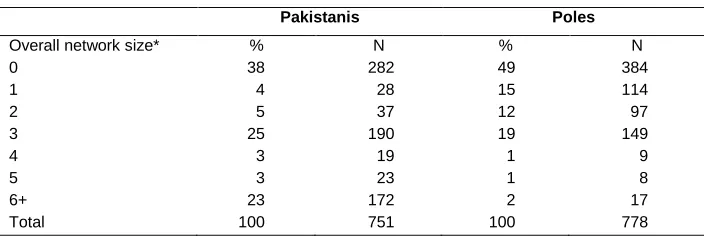
Following the completion of fieldwork we were able to ascertain the extent to which our respondents lacked networks of eligible recruits. Table 1 shows the reported network size of both seed and referred Polish and Pakistani respondents. Close to half the Poles reported not having had contact with anyone in the previous three weeks who they knew, for a fact, met the eligibility criteria. A smaller though still substantial proportion (38%) of Pakistani respondents reported the same. These respondents would have therefore been impossible to reach by traditional chain referral methods: they were recruited to our study only because we continued to recruit seeds throughout the study.
48
12
5 2
158
83
48
28 27 28
18
3
1 2 3 4 5 6 7 8
Waves
Table 1: Reported network size by country of origin
Pakistanis Poles
Overall network size* % N % N
0 38 282 49 384
1 4 28 15 114
2 5 37 12 97
3 25 190 19 149
4 3 19 1 9
5 3 23 1 8
6+ 23 172 2 17
Total 100 751 100 778
* Question: ‘And of the (CO) people you have been in contact with in about the past three weeks, how many do you know FOR A FACT arrived in Britain in the past 18 months?’
In addition to the large proportion of survey respondents who did not know anyone eligible, among the 56% that did have an eligible connection, 77% still did not recruit.
With such a large number of seed respondents reporting that they did not know any person who had recently arrived, and such low referral rates, our attempt to use traditional RDS recruitment was ineffective. Even expanding our target population to less recently arrived immigrants through the use of ‘pseudo-seeds’ was ineffective. Polish rather than Pakistani migrants were more connected through migrants who had been in the UK longer than 18 months, with 55% of Poles not knowing any such ‘older’ migrants, as compared to 81% of Pakistanis. When they did know older migrants, respondents were reasonably willing to take coupons for them (around two-thirds agreed); but this did not translate into any referral interviews.
Thus we appeared to face the obstacles of a lack of connectedness combined with some failure to refer, which was particularly acute for the Poles.
5.2 Privacy and trust
The fact that our two target migrant groups were not ‘hidden’ populations enabled us to implement at-home interviewing, as well as employ researcher-led referrals (see below).
referrer. This method provided over half of the Polish referral interviews (see also Table 3 below).
5.3 Clustering
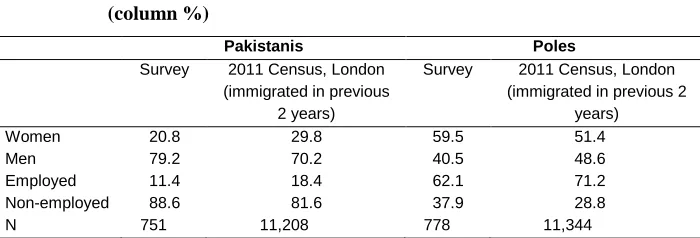
Despite the large number of seeds recruited and the effort to recruit diverse seeds, our sample was slightly skewed across two dimensions, gender and main activity status. While we do not by definition have a reference population of new migrants to compare against, the distribution should approximate the relatively recently arrived in London according to the 2011 Census. We can compare our sample with two census tables, covering those Poles and Pakistanis in London aged up to 35 who arrived in the two years preceding the census.
Table 2: Gender distribution and primary activity status, by country of origin (column %)
Pakistanis Poles
Survey 2011 Census, London (immigrated in previous
2 years)
Survey 2011 Census, London (immigrated in previous 2
years)
Women 20.8 29.8 59.5 51.4
Men 79.2 70.2 40.5 48.6
Employed 11.4 18.4 62.1 71.2
Non-employed 88.6 81.6 37.9 28.8
N 751 11,208 778 11,344
Sources: SCIP survey, UK data; Office for National Statistics England and Wales Census 2011, Table CT0375 and Table CT0487.
Notes: Census employed excludes those full-time students in work, but includes self-employed.
long chains, we therefore see that our sample shows characteristics broadly in line with other existing data sources.
5.4 Interest: Findings
Interest in the study is crucial to the success of RDS. To a degree, this can be achieved using incentives, but the incentive cannot be so large that it leads to people lying about their eligibility (Johnston and Sabin 2010). Hence, the aims, objectives, and content of the study should also have a motivational pull on respondents.
It was not possible to calculate response rates for the study. However, as noted above, only 13% of eligible people who were contacted as referrals refused to participate. Moreover, most respondents (84% of Pakistanis and 94% of Poles) were happy to be contacted about the study again in the future. Among those few who did not want to be contacted again, not living in the UK at the time of the next interview was the most cited reason.
Lack of interest did not feature highly, and interview intrusiveness/privacy was the least cited reason. However, around half of the 16% of Pakistanis and 6% of Polish who did refuse re-contact were concerned about providing confidential information, suggesting some suspicion of data security.
5.5 Researcher-led referral
Table 3: Methods for achieving referral interviews, by country of origin
Traditional RDS Researcher-led Referral
Coupons Immediate Referral
Call-backs
Questionnaire recruitment
Total referral interviews
Polish N 9 38 10 10 67
Row % 13.5 56.7 14.9 14.9 100
Pakistani N 17 50 55 271 393
Row % 4.3 12.7 14.0 69.0 100
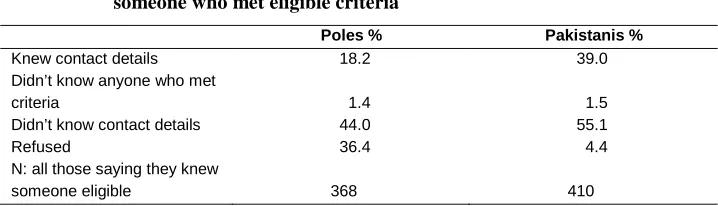
A further strength of the researcher-led referral procedure is that it provides further insight into the point at which the referral process broke down: lack of familiarity with how to contact potential referees, reluctance to refer, and/or reluctance of referrals to participate. Table 4 shows the development of response among those who had the new script. It focuses on the approximately 50% of Poles and under two-thirds of Pakistanis who had already said they knew someone who met the eligibility criteria.
Table 4: Responses to script changes among those who stated they knew someone who met eligible criteria
Poles % Pakistanis %
Knew contact details 18.2 39.0
Didn’t know anyone who met
criteria 1.4 1.5
Didn’t know contact details 44.0 55.1
Refused 36.4 4.4
N: all those saying they knew
someone eligible 368 410
Note: We see that a very small number of those who had reported knowing someone eligible then responded that they did not know anyone meeting the criteria (1.4%).
researcher-led referral was likely to have been less appropriate for Poles than for Pakistanis, who appeared less sensitive about sharing contact information.
We can pursue this issue further by considering the quality of the contact information, the response among referrals, and the ultimate recruitment rate with this script and the call-backs. When respondents did provide contact details they were generally reliable. Of the persons referred, we were unable to make contact with 12%. A further 10% were found to be ineligible and 10% refused. In total, 58% of referred persons completed an interview, rising to 75% among eligible contacts.
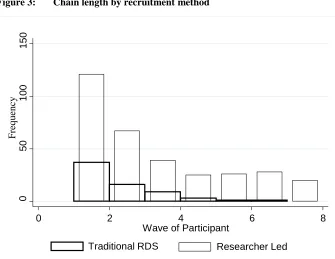
Finally, we focus on the Pakistani sample to compare the recruitment patterns under traditional RDS approaches (immediate referral and coupon use) and under our researcher-led referral approach (call-backs and questionnaire recruitment). Figure 3 shows the length of referral chains by each recruitment method. Clearly, we were able to obtain much longer chains with the researcher-led method than with the traditional RDS.
Figure 3: Chain length by recruitment method
0
50
100
150
F
re
q
ue
nc
y
0 2 4 6 8
Wave of Participant
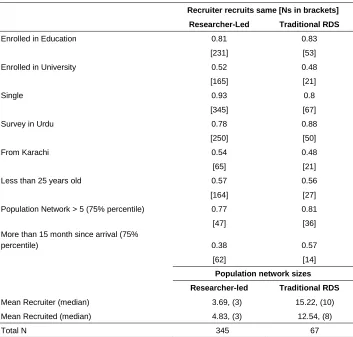
A key assumption of RDS is that longer chains facilitate movement away from more homogenous to more diverse (and hence representative) samples, even if the networks are expected to be dominated by homophily. Table 5 shows recruitment transition matrices for a variety of demographic indicators, including education, marital status, language, city of origin, and age. Particularly important given our target population of recently arrived immigrants, we also show recruitment patterns by time since arrival and size of the population network.
Table 5: Recruitment patterns using researcher-led and traditional RDS methods, Pakistanis
Recruiter recruits same [Ns in brackets]
Researcher-Led Traditional RDS
Enrolled in Education 0.81 0.83
[231] [53]
Enrolled in University 0.52 0.48
[165] [21]
Single 0.93 0.8
[345] [67]
Survey in Urdu 0.78 0.88
[250] [50]
From Karachi 0.54 0.48
[65] [21]
Less than 25 years old 0.57 0.56
[164] [27]
Population Network > 5 (75% percentile) 0.77 0.81
[47] [36]
More than 15 month since arrival (75%
percentile) 0.38 0.57
[62] [14]
Population network sizes
Researcher-led Traditional RDS
Mean Recruiter (median) 3.69, (3) 15.22, (10)
Mean Recruited (median) 4.83, (3) 12.54, (8)
Reassuringly, transition probabilities are similar across demographic characteristics: the referrals obtained using researcher-led methods do not appear to be more homophilous than those obtained with traditional RDS. This was also true of the socio-cultural characteristics that were the focus of the survey itself; for instance, regular prayer, social engagement, and life satisfaction (not shown in the table). Importantly, our researcher-led referrals led to the recruitment of respondents with much smaller network sizes: whereas the average network size of a respondent recruited by traditional RDS methods was 13, it was only 5 for those recruited via the researcher-led methods. Moreover, the tendency to recruit those with similarly longer durations of stay was lower among researcher-led referrals.
Overall, the researcher-led referral drastically improved referral for the Pakistani population. Under researcher-led referral (and excluding the very few who continued to be reached by coupons) there was 1 follow up for every 1.7 seeds who confirmed they knew someone eligible (rather than 1 for every 8 seeds before the implementation of the researcher-led referral approach). While the changes in the script and the abandonment of the principle of non-identification did not resolve all the problems of connectivity and resistance, it can be seen as an effective adaptation for a non-hidden and relatively sparsely distributed (and poorly connected) population. The resulting recruitment chains were longer, and did not appear to be more biased than those obtained under ‘classic’ RDS methods. And it has the additional advantage associated with more conventional sampling procedures in giving us some information (in terms of the characteristics of referrers) about those who did not respond.
6. Conclusions and reflections
Immigration and the integration of immigrants remain polarizing political topics and subjects of intense academic debate across Western Europe. Much of this debate focuses on outcomes such as language acquisition and the adoption of receiving country values and identities, as well as labour market success and social integration. The early years following arrival in a receiving country are a time of intense change and interaction across these outcomes. To fully understand these processes and how they inform each other requires surveys that capture immigrants close to the point of arrival and follow them over the early period of settlement.
generally yield very small numbers of recent immigrants, and targeted quota samples of the foreign-born are also skewed towards more settled immigrants and the second generation.
This paper presents an evaluation of our attempt to use RDS to overcome these challenges and produce a large and representative sample of recent immigrants. RDS has shown promise in surveys of immigrants in Europe, in particular the Polish in Dublin, Oslo, and Reykjavik (Tyldum and Johnston 2014), as well as in epidemiological studies of mobile populations in the United States (Montealegre et al. 2013; Wagner et al. 2011) and Morocco (Johnston et al. 2013). RDS has several potentially attractive properties for the study of recent immigrants: it allows greater flexibility in defining the target population, it enables coverage of both undocumented and documented immigrant populations, and it should, in theory, enable researchers to target the most recently arrived. In particular, RDS can be used to create weights that account for the probability of selection through networks, enabling the estimation of population prevalence. We therefore used this method as a starting point for sampling recently arrived Poles and Pakistanis in London.
Although other migrant surveys have had success with RDS, these studies have not tried to solely reach recently arrived immigrants or to sample a target size of more than 600 respondents, as we did. We identified four distinctive features of recently arrived migrant populations that could impact the implementation of RDS relative to typical applications: recency and network size, clustering, privacy and trust, and interest. Recency of arrival presented a particular challenge for us in that our population was not well networked. We also identified clustering as an issue for achieving a representative sample. However, clustering can also apply to more established immigrant populations, which often consist of smaller subgroups with substantial bottlenecks. For instance, Spanish-speaking low-wage workers in the US were significantly clustered by country of origin (Milkman, Gonzales, and Narro 2010), and bottlenecks existed between students and workers among migrants in Warsaw (Napierala and Gorny 2013), as they did between students and family migrants in our Pakistani sample.
To overcome the resulting problems of slow referral and short recruitment chains, we identified and implemented a researcher-led referral method, suited to a dispersed and non-hidden population. This method replaced the anonymity and respondent-controlled recruitment of traditional RDS with control by the researcher, entailing the direct collection of contact details of referrals both through call-backs and within the survey questionnaire. Where contact details were both available and supplied we achieved a rather high response – nearly 60% overall and 75% of those eligible. The level of homophily achieved through this method was similar to traditional RDS approaches, and researcher-led referral led to the recruitment of respondents with smaller PSN, as well as longer recruitment chains. Thus researcher-led referral achieves the desirable qualities of network penetration without increasing homophily, and provides network information on homophily and PSN necessary for RDS analysis.
Overall, our experiences can help guide future research efforts in deciding on their sampling strategy, using the four identified elements (recency and network size, clustering, privacy and trust, and interest) as critical factors in deciding whether to use RDS (with our without adaptations) for migrant populations. If formative research reveals a dense but homogeneous network with high levels of trust and interest in the survey within the population, but low levels of trust towards researchers, RDS is probably ideal. This seems to have been the case in many of the early Polonia surveys, including the Dublin Polonia survey that informed our choice of RDS. It is, of course, difficult to ascertain whether a population has these characteristics in advance. However, it is likely that more established immigrant populations that are strongly concentrated geographically as well as in terms of (low) socioeconomic status would be likely to meet these requirements.
By contrast, the researcher-led approach we developed may be preferable in a situation where the population network is less dense and more fragmented, but there are fewer privacy concerns. We felt that the Pakistani group in London represented such a group. These recent arrivals were nearly all on student or family visas, there was a general willingness to participate and provide contact information, yet the network was strongly fragmented by visa status and interest in the survey was generally low. For those in the more advantaged socio-economic position that marks more recent non-EU migrants, cash incentives alone are less likely to provide a compelling motivation.
less mobile (cf. Massey and Pren 2012). For such immigrant groups, our researcher-led method provides more control over the recruitment process by placing contact in the hands of the interviewer. It is flexible, allowing random recruitment of potential contacts or more purposive selection of underrepresented elements in the group if needed (although the latter may increase bias). And if the PSN is altered to include only those population members for whom the respondent has contact information, the resulting data can still be weighted using RDS analysis techniques, provided that the methodological assumptions outlined above are met.
In conclusion, if a population can be expected to be reasonably stable, moderately well-connected, and reasonably geographically concentrated, it may be worth considering some element of chain referral within the sample, whether researcher-led for the less-hidden but more disengaged, or respondent-led for the less-trusting but more densely connected populations. However, the more densely networked and geographically concentrated such populations are, the more homogenous they are likely to be, with less to tell us about diverse migration flows. If diversity and mobility of small populations are themselves central to the desired sample, it is unlikely that complete reliance on chain-referral methods is advisable. Some degree of pragmatism is likely to continue to be needed.
7. Acknowledgements
References
Abdul‐Quader, A.S., Heckathorn, D.D., McKnight, C., Bramson, H., Nemeth, C., and Sabin, K. (2006). Effectiveness of respondent-driven sampling for recruiting drug users in New York City: Findings from a pilot study. Journal of Urban Health 83(3): 459–476. doi:10.1007/s11524-006-9052-7.
Agadjanian, V. and Zotova, N. (2012). Sampling and surveying hard-to-reach populations for demographic research: A study of female labor migrants in Moscow, Russia. Demographic Research 26(5): 131–50. doi:10.4054/Dem
Res.2012.26.5.
Alsos, K. and Eldring, L. (2008). Labour mobility and wage dumping: The case of Norway. European Journal of Industrial Relations 14(4): 441–59. doi:10.1177/
0959680108097495.
Anderson, B., Ruhs, M., Rogaly, B., and Spencer, S. (2006). Fair enough? Central and East European migrants in low-wage employment in the UK. Oxford: COMPAS.
Baio, G., Blangiardo, G.C., and Blangiardo, M. (2011). Centre sampling technique in foreign migration surveys: a methodological note. Journal of Official Statistics 27(3): 451–465.
Beauchemin, C. and González-Ferrer, A. (2011). Sampling international migrants with origin-based snowballing method: New evidence on biases and limitations. Demographic Research 25(3): 103–34. doi:10.4054/DemRes.2011.25.3.
Bernhardt, A., Milkman, R., Theodore, N., Heckathorn, D., Auer, M., DeFilippis, J., González, A.L., Narro, V., Perelshteyn, J., and Polson, D. (2009). Broken laws, unprotected workers. National Employment Law Project. New York: NELP.
Berthoud, R., Fumagalli, L., Lynn, P., and Platt, L. (2009). Design of the Understanding Society ethnic minority boost sample. Colchester: Institute for Social and Economic Research, University of Essex (Understanding Society Working Paper 2009-02).
Blom, A.G., de Leeuw, E.D., and Hox, J.J. (2011). Interviewer effects on nonresponse in the European Social Survey. Journal of Official Statistics 27(2): 359–377. Breton, R. (1964). Institutional completeness of ethnic communities and the personal
relations of immigrants. American Journal of Sociology 70(2): 193–205.
Burrell, K. (2010). Staying, returning, working and living: Key themes in current academic research undertaken in the UK on migration movements from Eastern Europe. Social Identities: Journal for the Study of Race, Nation and Culture 16(3): 297–308.
Crul, M. and Schneider, J. (2010). Comparative integration context theory: participation and belonging in new diverse European cities. Ethnic and Racial Studies 33(7): 1249–1268. doi:10.1080/01419871003624068.
Davis, R.E., Couper, M.P., Janz, N.K., Caldwell, C.H., and Resnicow, K. (2010). Interviewer effects in public health surveys. Health Education Research 25(1): 14–26. doi:10.1093/her/cyp046.
De La Rosa, M., Babino, R., Rosario, A., Martinez, N.V., and Aijaz, L. (2012). Challenges and strategies in recruiting, interviewing, and retaining recent Latino immigrants in substance abuse and HIV epidemiologic studies. The American Journal on Addictions 21(1): 11–22. doi:10.1111/j.1521-0391.2011.00193.x. Deding, M., Fridberg, T., and Jakobsen, V. (2008). Non-response in a survey among
immigrants in Denmark. Survey Research Methods 2(3): 107–21.
Drinkwater, S. and Garapich, M. (2011). The TEMPO survey of recent Polish migrants in England and Wales. Swansea: WISERD (WISERD/WDR/004).
Drinkwater, S., Eade, J., and Garapich, M. (2009). Poles apart? EU enlargement and the labour market outcomes of immigrants in the United Kingdom. International Migration 47(1): 161–190. doi:10.1111/j.1468-2435.2008.00500.x.
Duffy, B. and Frere-Smith, T. (2014). Perceptions and reality: Public attitudes to immigration. London: Ipsos MORI.
Dustmann, C., Fabbri, R., and Preston, I. (2011). Racial harassment, ethnic concentration, and economic conditions. The Scandinavian Journal of Economics 113(3): 689–711. doi:10.1111/j.1467-9442.2011.01660.x.
Engbersen, G., Leerkes, A., Grabowska-Lusinska, I., Snel, E., and Burgers, J. (2013). On the differential attachments of migrants from central and eastern Europe: A typology of labour migration. Journal of Ethnic and Migration Studies 39(6): 1–
23. doi:10.1080/1369183X.2013.765663.
EU Agency for Fundamental Rights (2009). European Union Minorities and Discrimination Survey (EU-MIDI), Main Results Report. European Union Agency for Fundamental Rights.
Font, J. and Mendez, M. (eds.) (2013). Surveying ethnic minorities and immigrant populations: Methodological challenges and research strategies. Amsterdam: IMISCOE/Amsterdam University Press.
Ford, R. (2011). Acceptable and unacceptable immigrants: How opposition to immigration in Britain is affected by migrants’ region of origin. Journal of Ethnic and Migration Studies 37(7): 1017–37. doi:10.1080/1369183X.2011.5
72423.
Friberg, J.H. (2012). The stages of migration. From going abroad to settling down: Post-accession Polish migrant workers in Norway. Journal of Ethnic and Migration Studies 38(10): 1589–605. doi:10.1080/1369183X.2012.711055. Friberg, J.H. and Horst, C. (2014). Respondent driven sampling and the structure of
migrant populations. In: Tyldum, G. and Johnston, L. (eds.). Applying respondent driven sampling to migrant populations: Lessons from the field. London: Palgrave Pivot: 17–26.
Garapich, M.P. (2008). The migration industry and civil society: Polish immigrants in the United Kingdom before and after EU enlargement. Journal of Ethnic and Migration Studies 34(5): 735–752. doi:10.1080/13691830802105970.
Gile, K.J., Johnston, L.G., and Salganik, M.J. (2015). Diagnostics for respondent-driven sampling. Journal of the Royal Statistical Society 178(1): 241–269. doi:10.1111/
rssa.12059.
Goodman, L.A. (2011). Comment: On respondent-driven sampling and snowball sampling in reach populations and snowball sampling not in hard-to-reach populations. Sociological Methodology 41(1): 347–53. doi:10.1111/j.
1467-9531.2011.01242.x.
Gresser, A. and Schacht, D. (2015). SCIP Survey – Methodological Report. Konstanz. www.scip-info.org.
Handcock, M.S., Fellows, I.E., and Gile, K.J. (2014). RDS Analyst: Software for the analysis of respondent-driven sampling data, Version 0.42. http://hpmrg.org. Handcock, M.S. and Gile, K.J. (2011). Comment: On the concept of snowball
sampling. Sociological Methodology 41(1): 367–71. doi:10.1111/j.1467-9531.
Hansen, J.A. and Hansen, N.W. (2009). Polonia i København. ‘Et studie af polske arbejdsmigranters’, løn-, arbejds- og levevilkår i Storkøbenhavn. Lo-dokumentation, 1.
Heckathorn, D.D. (1997). Respondent-driven sampling: A new approach to the study of hidden populations. Social Problems 44(2): 174–199. doi:10.2307/3096941. Hornstra, N.E., Groenewold, G., and Lessard-Phillips, L. (2012). The Turkish and
Moroccan second generation and their comparison group peers in Amsterdam and Rotterdam. The Integration of the European Second Generation Technical Report and Codebook. TIES 2006–2007 – The Netherlands. DANS Data Guide 9, Amsterdam: DANS / Pallas Publications. Amsterdam: University Press. Horvath, K. (2012). National numbers for transnational relations? Challenges of
integrating quantitative methods into research on transnational labour market relations. Ethnic and Racial Studies 35(10): 1741–1757. doi:10.1080/01419870.
2012.659270.
Howat, N., Norden, O., Williams, J., and Pickering, E. (2011). 2010 Ethnic Minority British Election Study: Technical report. London: TNS BMRB.
Ipsos MORI / Institute of Education. (2011). A feasibility study for a survey of immigrants. London: Home Office (Occasional Paper 92).
Johnston, L.G. (2013). Introduction to HIV/AIDS and sexually transmitted infection surveillance: Module 4: Introduction to Respondent Driven Sampling. Switzerland, Geneva.
Johnston L.G., Alami, K., El Rhilani, M.H., Karkouri, M., Mellouk, O., Abadie, A., Rafif, N., Ouarsas, L., Bennani, A., and El Omari, B. (2013). HIV, syphilis and sexual risk behaviours among men who have sex with men in Agadir and Marrakesh, Morocco. Sexually Transmitted Infections 89 Suppl 3:iii: 45–8. Johnston, L.G., Malekinejad, M., Kendall, C., Iuppa, I.M., and Rutherford, G.W.
(2008). Implementation challenges to using respondent-driven sampling methodology for HIV biological and behavioral surveillance: Field experiences in international settings. AIDS and Behavior 12: 131–41.
doi:10.1007/s10461-008-9413-1.
Joppke, C. (2004). The retreat of multiculturalism in the liberal state: Theory and policy. British Journal of Sociology 55: 237–57. doi:10.1111/j.1468-4446.2004.
00017.x.
Joppke, C. (1999). Immigration and the nation-state. Oxford: Oxford University Press.
doi:10.1093/0198295405.001.0001.
Kalter, F. (2011). Social capital and the dynamics of temporary labour migration from Poland to Germany. European Sociological Review 27(5): 555–69. doi:10.1093/
esr/jcq025.
Karlsen, S. and Nazroo, J.Y. (2013). Influences on forms of national identity and feeling ‘at home’ among Muslim groups in Britain, Germany and Spain. Ethnicities 13(6): 689–708. doi:10.1177/1468796812470795.
Lansky, A., Abdul-Quader, A.S., Cribbin, M., Hall, T., Finlayson, T.J., Garfein, R.S., Lin, L.S., and Sullivan, P.S. (2007). Developing an HIV behavioral surveillance system for injecting drug users: The national HIV behavioral surveillance system. Public Health Rep 122 Suppl 1: 48–55.
Malekinejad, M., Johnston, L.G., Kendall, C., Kerr, L.R., Rifkin, M.R., and Rutherford, G.W. (2008). Using respondent-driven sampling methodology for HIV biological and behavioral surveillance in international settings: A systematic review. AIDS and Behavior 12: 105–30. doi:10.1007/s10461-008-9421-1. Massey, D.S., Arango, J., Hugo, G., Kouaouci, A., Pellegrino, A., and Taylor, J.E.
(1999). Worlds in motion: Understanding international migration at the end of the millennium. Oxford: Oxford University Press.
Massey, D.S. and Pren, K.A. (2012). Unintended consequences of US immigration policy: Explaining the post-1965 surge from Latin America. Population and Development Review 38: 1–29. doi:10.1111/j.1728-4457.2012.00470.x.
McCreesh, N., Frost, S.D.W., Seeley, J., Katongole, J., Tarsh, M.N., Ndunguse, R., Jichi, F., Lunel, N.L., Maher, D., and Johnston, L.G. (2012). Evaluation of respondent-driven sampling. Epidemiology 23(1): 138. doi:10.1097/EDE.0b01
3e31823ac17c.
Milkman, R., Gonzales, A.L., and Narro, V. (2010). Wage theft and workplace violations in Los Angeles: The failure of employment and labor law for low-wage workers. Los Angeles, University of California: Institute for Research on Labor and Employment.
Montealegre, J.R., Risser, J.M., Selwyn, B.J., McCurdy, S.A., and Sabin, K. (2012). Prevalence of HIV risk behaviors among undocumented Central American immigrant women in Houston, Texas. AIDS and Behavior 16(6): 1641–8.
doi:10.1007/s10461-011-0130-9.
Montealegre, J.R., Risser, J.M., Selwyn, B.J., McCurdy, S.A., and Sabin, K. (2013). Effectiveness of respondent driven sampling to recruit undocumented Central American immigrant women in Houston, Texas for an HIV behavioral survey. AIDS and Behavior 17(2): 719–27. doi:10.1007/s10461-012-0306-y.
Montealegre, J.R., Risser, J.M., Selwyn, B.J., Sabin, K., and McCurdy, S.A. (2011). HIV testing behaviors among undocumented Central American immigrant women in Houston, Texas. Journal of Immigrant and Minority Health 14(1): 116–23. doi:10.1007/s10903-011-9534-x.
Mühlau, P., Kaliszewska, M., and Röder, A. (2011). Polonia in Dublin: Preliminary Report of Survey Findings. Dublin: Trinity College Dublin.
Myrberg, G. (2013). Surveying migrants and migrant associations in Stockholm. In: Font, J. and Mendez, M. (eds.). Surveying ethnic minorities and immigrant populations: Methodological challenges and research strategies. Amsterdam: IMISCOE / Amsterdam University Press: 131–146.
Napierala, J. and Gorny, A. (2013). Assessment of effectiveness of RDS sampling method in migration studies. Paper presented at Themis conference, Examining migration dynamics: Networks and beyond. UK: Oxford. September 24–26 2013.
Obucina, O. (2013). Occupational trajectories and occupational cost among Senegalese immigrants in Europe. Demographic Research 28(19): 547–80. doi:10.4054/
DemRes.2013.28.19.
Parutis, V. (2014). ‘Economic migrants’ or ‘middling transnationals’? East European migrants’ experiences of work in the UK. International Migration 52(1): 36–55.
doi:10.1111/j.1468-2435.2010.00677.x.