World Maritime University
The Maritime Commons: Digital Repository of the World
Maritime University
World Maritime University Dissertations Dissertations
1999
Training of deck cadets in India : STCW and
beyond
Kaushalendra Gupta World Maritime University
Follow this and additional works at:http://commons.wmu.se/all_dissertations Part of theHigher Education Commons
This Dissertation is brought to you courtesy of Maritime Commons. Open Access items may be downloaded for non-commercial, fair use academic purposes. No items may be hosted on another server or web site without express written permission from the World Maritime University. For more information, please [email protected].
Recommended Citation
Gupta, Kaushalendra, "Training of deck cadets in India : STCW and beyond" (1999).World Maritime University Dissertations. 487.
WORLD MARITIME UNIVERSITY
Malmö, Sweden
TRAINING OF DECK CADETS IN INDIA:
STCW AND BEYOND
By
KAUSHALENDRA GUPTA
IndiaA dissertation submitted to the World Maritime University in partial fulfilment of the requirements for the award of the degree of
MASTER OF SCIENCE
in
MARITIME EDUCATION AND TRAINING (Nautical)
1999
DECLARATION
I certify that all the material in this dissertation that is not my own work has been identified, and that no material is included for which a degree has previously been conferred on me.
The contents of this dissertation reflect my own personal views, and are not necessarily endorsed by the university.
……… (Signature)
……… (Date)
Supervised by: Professor P. Muirhead
Professor of Maritime Education World Maritime University Malmö, Sweden
Assessed by: Professor Toshio Hikima
Associate Professor
World Maritime University Malmö, Sweden
Co-assessed by: Captain F. Arbeider
Head of Nautical Studies
Faculty of Engineering and Maritime Sciences Amsterdam Maritieme Techniek
Weesperzijde 190, 1097 DZ Amsterdam The Netherlands
ACKNOWLEDGEMENT
So many wonderful people have helped me to make this dissertation possible that words alone cannot express my deep gratitude to them. My humble and extensive thanks go to all of them for their encouragement, advice and support.
I also would like to express my sincere gratitude to:
- The Shipping Corporation of India Ltd. (SCI), Mumbai, for nominating and sponsoring me for this prestigious post-graduate programme;
- My colleagues at the SCI and the Maritime Training Institute, Mumbai,
Captain T. D. Hazari, Shri A. V. Chaubal, Shri T. Narayan, Captain K. S. Nair, Shri A. Gopalkrishanan, Captain V. C. D'paiva, Captain R. Cheerath, Captain K. J. Miranda, Captain S. K. Thapliyal, Captain M. C. Yadav, for their kind advice and guidance;
- Shri R. Prasad, my Ex-Principal at the Maritime Training Institute and presently research fellow / lecturer at the World Maritime University for his kind affection and continuous encouragement;
- Professor Peter Muirhead, my course professor and supervisor of this
dissertation for his untiringly excellent supervision, professional guidance, constructive suggestions and inspiration;
- Professor Toshio Hikima, the assessor of this dissertation, for his valuable suggestions and discussions;
- Professors, visiting professors, lecturers, librarians and other staff of the World Maritime University for providing me with information and data for the dissertation;
- My fellow students at the World Maritime University for sharing their
knowledge and experience with me during our stay in Malmö;
- The Directorate General of Shipping, within the Ministry of Surface
Transport of the Government of India for granting me their kind permission for reproducing the relevant text of META Manual of the MS (STCW) Rules, 1998 in my dissertation;
- Captain Superintendents, Principals and Faculty of various Maritime Training Institutes in India and abroad for providing me with the information on cadets' training;
- Shipmasters, Ship-managers and the Maritime Trainers who whole-heartedly and very promptly responded to my questionnaire and made my survey a great success with their opinions and suggestions on cadets' training. I am deeply touched with their concern towards cadets' training;
- The entire SCI Family in general, Mrs. and Captain B. B. Sinha and Shri R.R. Patil in particular for the assistance they provided to my family in my absence;
To my lovely wife, Dr. Baljit Gupta mother of our two sweet children who was forced to take over the helm at home when I was away at the World Maritime University,
and
to the many other good wives and families of those WMU students
whose career and strong pursuit of maritime education brings them to this great university,
Abstract
This dissertation examines the effectiveness of maritime education and training of deck cadets in India in providing competent and skilled officers in charge of a navigational watch. It further investigates whether the training of deck cadets in India is effective in developing awareness, concern and sincerity in deck officers towards their duties and responsibilities on board ships. The combination of these qualities with competence and skills is absolutely necessary in navigational watchkeeping officers for safe and efficient operation of ships.
Continuous technical developments and changes in ship-design and operations create challenges for the job of deck officers. It is therefore necessary to ascertain the effectiveness of the cadets' training and assessment programme periodically and improve it. This will provide competent and skilled deck officers, who can face the challenges in their sea career.
To accomplish the above, the existing training and assessment programme of deck cadets and its implementation has been studied. A survey was conducted by means of a questionnaire to a large number of shipmasters, ship-managers and faculty of training institutions in order to analyse post-training performance of cadets from various entry streams.
A comparative study of cadets' training programmes of some leading maritime nations has also been made. The author has taken into account the comparative study and the results of the survey mentioned above in defining a strategy for enhancing the effectiveness of maritime education and training of deck cadets in India.
Keywords:
TABLE OF CONTENTS
Declaration ii
Acknowledgements iii
Abstract vi
Table of Contents vii
List of Tables x
List of Figures xi
List of Abbreviations xii
1.0 Introduction 1
1.1. Background 1
1.2. Objectives 3
1.3. Methodology 4
2.0 Training of deck cadets in India 5
2.1. Maritime trade and industry 5
2.2. Requirements for deck officers 6
2.3. Government's policy on training standards 8
2.4. Entry streams and eligibility criteria 10
2.5. Training institutions for pre-sea training 14
2.6. Training institutions for post-sea training 16
3.0 Training and assessment programme for deck cadets 17
3.1. Pre-sea education and training 17
3.1.1. B.Sc. (Nautical Sciences) entry stream 17
3.1.2. Pre-sea (16 weeks) entry stream 23
3.2. On board training 29 3.2.1. Implementation of structured shipboard training programme 31 3.2.2. Monitoring and assessment of structured shipboard training 32
3.3. Post-sea education and training 35
3.4. Assessment and certification 40
4.0 Survey on post-training performance of cadets as officers 42
4.1. Scope of survey 42
4.2. Feedback on competence and skills 45
4.3. Feedback on general conduct, behaviour and sense of discipline 46
4.4. Feedback on improving the standards of training 47
4.5. Suggested improvement in cadets' training 49
4.6. Evaluation of the survey 51
5.0 Strategy for enhancing the effectiveness of training 54
5.1. Base and background of strategy 54
5.2. Eligibility criteria and selection procedures 57
5.3. Training and assessment programme 61
5.3.1. Training and assessment programme of other maritime nations 62 5.3.2. Comparative study of the training and assessment programmes 64
5.3.3. Course curriculum 69
5.3.4. Proposals for additions to the curriculum 70
5.3.5. Emphasis on practical training 72
5.4. Training in human skills, motivation and discipline 75
5.5. Continuous on-the-job training 77
5.6. Quality assurance and records 80
5.7. Involvement of industry 82
5.8. Training resources and their adequacy 85
5.8.1. Training institutions 85
5.9. Summary 88
6.0 Conclusions and recommendations 91
6.1. Conclusions 92
6.2. Recommendations 96
Bibliography 99
Appendices 104
Appendix 1 A typical campus weekly order in T.S. Chanakya 104
Appendix 2 Questionnaire sent to masters, ship-managers and trainers 105
LIST OF TABLES
2.1 Training and assessment programme of deck cadets (stream-wise) 11
2.2 Pre-sea (16 weeks) training institutions and their capacities 15
3.1 Subject-related lecture hours of the degree course 20
3.2 Break-up of daily hours in pre-sea (16weeks) training programme 25
3.3 Pre-sea (16 weeks): break-up of 576 teaching hours 26
3.4 Average pass-marks in the final examination 28
3.5 Subjects and examination structure of the foundation course 37
3.6 Schedule of 2nd Mate competency course 38
3.7 Schedule of Radar Observer and ARPA simulator training 39
3.8 Officer in charge of a navigational watch: examination structure 40
4.1 Response to Question "A": Feedback on competence and skills 45
in all functions.
4.2 Response to Question "B": feedback on conduct, behaviour and 46
discipline.
4.3 Entry streams in order of the effectiveness of their training 47
4.4 Suggestions for improvement in the cadets' training 48
4.5 Evaluation of competence and conduct of officers from different 51
entry streams and their training period
5.1 Comparison of the training and assessment programmes of B.Sc. / 65
Diploma entry streams of the selected maritime nations
5.2 Training and assessment programme for the issue of certificate 68
LIST OF FIGURES
2.1 Career profile of a deck cadet 13
3.1 Stage-wise progress of the structured shipboard training programme 34
3.2 Post-sea education and training of deck cadets 36
4.1 Graphical display of feedback on competence and skills of the officers 45
in all three functions passed out from 4 different entry streams
4.2 Graphical display of feedback on general conduct, behaviour and sense 46
of discipline of the officers passed out from 4 different entry streams
LIST OF ABBREVIATIONS
ARI Applied Research Institute, New Delhi
ARPA Automatic Radar Plotting Aid
B.Sc. (NS) Bachelor of Science in Nautical Sciences
BE Bachelor of Engineering
BITS Birla Institute of Technology and Science, Pilani, India
COC Certificate of Competency
CTO Company Training Officer
DF Direction Finder
DGS Directorate General of Shipping (The Government of India)
DWT Dead Weight Tonnage
ECDIS Electronic Chart and Display System
Ed. Education
FG Foreign Going
FOSMA Foreign Owners' Ship-Management Association, India
GMDSS Global Maritime Distress and Safety System
GOC General Operator's Certificate
GPS Global Positioning System
GRT Gross Registered Tonnage
Hrs Hours
IBS Integrated Bridge System
I.M.I. International Maritime Institute, New Delhi
IMO International Maritime Organisation
INDos Indian National Database of Seafarers
INSLC International Navigation Simulators Lecturers' Association
LBSCAMSAR Lal Bahadur Shastri College of Advance Maritime Studies and
Research, Mumbai
LORAN Long Range Navigation
MET Maritime Education and Training
META Maritime Education, Training and Assessment Manual
MS Merchant Shipping
MSC Maritime Safety Committee (of IMO)
NCV Near-coastal Voyage
NI Nautical Institute, London
NIPM National Institute of Port Management, Chennai
NW Navigational Watch
NWKO Navigational Watchkeeping Officer
OIC (NW) Officer In charge of a Navigational Watch
OIC Officer In charge
OMBO One Man Bridge Operation
Opn. Operational level
10 + 2 PCM 12 years of general education with Physics, Chemistry and
Mathematics as main subjects
Pr. Practicals
PSC&RB Proficiency in Survival Craft and Rescue Boats
RT Radio Telephone
SATNAV Satellite Navigation
SCI Shipping Corporation of India Ltd.
SSTP Structured Shipboard Training Programme
STCW International Convention on Standards of Training,
Certification and Watchkeeping for Seafarers, 1978, as amended in 1995
STO Ship Training Officer
Th. Theory
TRB Training Record Book
T.S. Training Ship
VHF Very High Frequency
Chapter1
Introduction
The most important element in the safe operation of any ship is the competence and experience of its master and crew. A well-trained and experienced master and crew can avoid disaster by compensating for defects in or damage to their ship. No ship has been designed or built that can save an incompetent master or unskilled crew from the consequences of their ill-considered action or inaction.
Morrison (1997, 10) On Global Standards in Maritime Education and Training
The topic of the dissertation is the maritime education and training of deck cadets in India. Well-groomed and efficiently trained deck cadets eventually rise in their career to take up the responsibilities of shipmasters and ship-managers. The competence and skills of the shipmasters and ship-managers ensure the safety of life and protection of environment at sea through their efficient management of ship operations afloat and ashore respectively. A good background in maritime education and training by deck cadets therefore lays a strong career-foundation for the future shipmasters and ship-managers. The training prepares the young aspiring deck cadets to face the challenges of a sea career with adequate knowledge and confidence.
1.1 Background
merchant marine training ship "Dufferin" in the year 1927, the standards of this proven traditional training have been maintained. Under close monitoring and control of India's maritime administration, these were upgraded from time to time to meet the requirement of safe manning on account of the rapid changes in technology and working conditions in the shipping industry. All sections of the shipping industry in India helped the administration in achieving the excellence in cadets' training. It was for this reason, that the well-trained and competent Indian deck officers not only enabled the national shipping industry to operate successfully but have also been a major source of manpower for the global shipping industry.
With the fast changing worldwide scenario due to the introduction of the latest technology and various safety conventions, the shipping industry now looks vigorously for more and more well trained and qualified seafarers. Competition in the industry for the speedy and safe transportation of cargo also underlines the need of competent and skilled deck officers. The latter are crucial for safe operation and management of ships. The training of deck cadets who are the future mates and masters/managers, has a pivotal role and bearing on the safe manning of the ships at sea. It is therefore necessary to examine its quality and effectiveness from time to time and find methods to improve the efficiency of training. It is obvious that efficiently trained cadets shall ensure safer ships and cleaner oceans. These cadets thus will earn a good name and fame to our country, which is already a potential manpower supplier to the global shipping.
effectiveness of deck cadets' training, and to make recommendations, if any, for improving the training standards.
The author is employed at the Maritime Training Institute of the Shipping Corporation of India, which is one of the largest shipping companies in the world having a DWT of over 5 million tonnes. The author has been the co-ordinator of the deck cadets' training in the Maritime Training Institute prior to his coming to the World Maritime University. The institute trains annually about 120 deck cadets for the large diversified fleet of the Shipping Corporation of India and has global recognition for its quality of training of the cadets. The dissertation is expected to benefit the author's institute, other training institutes, the maritime administration, the shipowners and all sections of the shipping industry, which are directly or indirectly involved with deck cadets' training for enhancing its quality and effectiveness.
1.2 Objectives
The research intends to achieve the following objectives:
• Review the need of deck cadets' training in India, the national cadets' training policy and training resources available, taking into account the technological changes afloat and ashore.
• Examine the curriculum and methods of training in each entry stream of deck cadets including the provisions of STCW-95.
• Examine the methods adopted to monitor the progress of deck cadets' training at various stages and also the methods of assessment and certification.
• Conclude whether or not deck cadets' training is effective in providing competent and qualified deck officers to the shipping industry.
1.3 Methodology
The research examines the policies, guidelines and manuals of the Government of India on deck cadets' maritime education, training and assessment. The training and assessment programme on deck cadets' training has been reviewed. The curriculum, learning activities, training resources and methods of assessment followed in various training institutes in India have been inspected. These inspections helped the author to assess the implementation of the cadets' national training programme as well as the compliance to the requirements of STCW-95. Data on India's maritime trade, fleet, manpower particularly deck officers, output of training institutions, etc. has been collected from the appropriate sources.
In order to ascertain the effectiveness of maritime education and training of deck cadets, feedback on quality of training and post-training performance of deck cadets has been obtained from the shipmasters, ship-managers and the training institutions by conducting a broad based survey. The survey covered the post training performance of cadets from all the entry streams available in India. The results of the survey have assisted the author to pinpoint the areas, which need improvements for better quality and effectiveness in training and education of cadets.
Chapter 2
Training of deck cadets in India
2.1 Maritime trade and industry
India’s geographical location, long coastline with numeral ports and maritime trade interests had given a vital importance to the training of the seafarers including the deck cadets. Set midway between the eastern and western world, she is surrounded by the Bay of Bengal, the Indian Ocean and the Arabian Sea. According to Hariharan (1998, 44), it has a coastline of about 7516 Kms. and includes two groups of islands located far from the mainland. These are the Andaman & Nicobar Islands in the Bay of Bengal and the Lakshadweep Islands in the Arabian Sea. There are a total of 150 ports at present on the coast. Eleven are major ports and the remaining ones are intermediate and minor ports. 251 million tonnes of cargo handled by these ports in 1998, which represents 80% of the country’s trade. The cargo traffic is likely to grow to 415 million tonnes by 2002 and 1273 million tonnes by 2020. Besides these, a number of coastal, mainland-island passenger services, off shore services, survey services, dredging operations and specialized services etc. are operated through these ports.
(Bose, 1999, IV)
among the world maritime nations. (Indian Shipping, 1998, 8,32) This fleet is likely to grow steadily, as the present size is still not adequate to handle India’s total maritime trade of diversified cargo. For example, at present only 30 % of the total overseas cargo is handled by the Indian ships. In addition to the said fleet of large vessels, India also has a number of fishing vessels, steamers and multipurpose supply vessels manned by the near coastal, home trade, inland masters and mates.
2.2 Requirement for deck officers
There has always been an acute shortage of trained deck officers to man the national fleet. It was not because the training programmes or facilities were less. In fact, from the inception of India’s first training ship T.S. Dufferin in 1927, till date over 10000 deck officers have been trained through long and short-term pre-sea training. In addition another about 3000 deck officers have been trained directly on board ships. It implies that after allowing a reasonable figure of 30 % for the retired deck officers at least 9100 Indian trained deck officers are expected to be working ashore or afloat. However, for the purpose of manning 500 odd national ships at present, we do not have adequate deck personnel and the shipowners often face a great deal of hardships in manning their ships efficiently. It is not difficult to pinpoint the cause of this shortage.
done, the industry may suffer very badly and it will be too late to undo the losses later.
As Indian deck officers are well trained, properly certificated and competent, a large number of them opt for work on foreign flag vessels and companies ashore. It is because the foreign companies are paying high salaries to the qualified Indian deck officers for quality management of their ships and offices ashore. At present, over 200 foreign ship-management companies and their agencies are recruiting Indian deck officers for about 1500 foreign flag vessels. This exodus of qualified and dynamic officers creates the actual shortage of deck officers for national ships, where salaries are not so low but the national tax structure reduces the net salary considerably.
A study carried out by the Indian National Shipowners' Association in 1990 revealed that out of 14000 certificated Indian officers, only 3000 were available against a requirement of 4500 needed to man about 400 Indian ships. (Agrawal, 1997, 35)
2.3 Government's policy on training standards
The Government of India has always accorded great importance to the quality and standards in the training and certification of all seafarers. The Directorate General of Shipping (DGS), functioning under the ministry of surface transport, is responsible for the marine education and training of seafarers in India. The directorate is situated in Mumbai, with its branches in all the major ports in India. The DGS has a team of competent and experienced officers, who control and monitor the maritime education and training of the seafarers.
For the implementation of the STCW-95 effectively the DGS has made new Merchant Shipping (STCW) Rules, 1998, supported by a training and assessment programme. The programme provides details for various certificates of competencies, which are produced in a simplified manner in the form of META Manual (Maritime Education, Training and Assessment Manual). The training and assessment programme for the deck cadets too, is covered in the manual. The training and assessment programme lays considerable emphasis on " functional " approach in marine education and training of the cadets. The said " functional " approach in turn, demands from cadets aspiring to be officers a clear demonstration of their ability to perform various tasks related to the shipboard operation satisfactorily before a certificate of competency is issued.
The DGS itself, to set an example has accreditation from the Bureau of Indian Standards for its Quality & Assurance System. Similarly the META Manual of the DGS requires that the training institutions, methods of training, competence of faculty, assessing and examining bodies, etc., dealing with the cadets' training must have Quality Management System of proven standards.
The Government of India considers that the training of the deck cadets is the equal responsibility of all sections of the shipping industry alike, viz. Administration (DGS), training institutions and the shipowners/managers.
The pre-sea training institutions have the young trainee cadets in India from families varying in social, cultural, geographic, linguistic and economic backgrounds. The Government requires these institutes to provide a regimental disciplined training schedule, laying adequate emphasis on classroom and out door activities such as physical training, swimming, games, etc. The institute has a responsibility to ensure that each trainee cadet is fully re-oriented to be suitable for the seafaring profession with regard to cheerful obedience to the lawful orders of superiors, team spirit, leadership and other officer like qualities.
The training programme of cadets makes the shipowners and managers responsible for the effective execution of the structured shipboard training of the cadets. They are to identify the responsible ship and shore officers, who will supervise the training and submit the periodical compliance reports to the Government designated assessment centres.
The collective responsibility, as envisaged by the Government, through the training programme of cadets, ensures that the required quality and standards are maintained throughout the marine education and training of deck cadets.
2.4 Entry streams & eligibility criteria
The DGS in its META Manual has prescribed three main entry streams of the deck cadets. These streams are:
1. B.Sc. (Nautical Sciences) stream 2. Pre-sea (16weeks) stream
3. Direct Entry stream
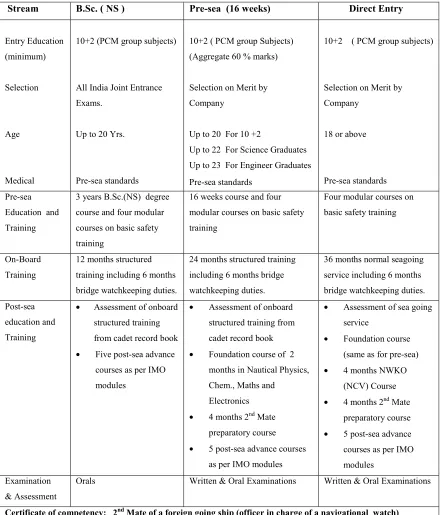
The eligibility criteria, selection methods and the training and assessment programme for the three said streams are illustrated in table 2.1 on the next page.
Table 2.1 Training and assessment programme of deck cadets (stream-wise)
Stream B.Sc. ( NS ) Pre-sea (16 weeks) Direct Entry
Entry Education (minimum)
Selection
Age
Medical
10+2 (PCM group subjects)
All India Joint Entrance Exams.
Up to 20 Yrs.
Pre-sea standards
10+2 ( PCM group Subjects) (Aggregate 60 % marks)
Selection on Merit by Company
Up to 20 For 10 +2
Up to 22 For Science Graduates Up to 23 For Engineer Graduates
Pre-sea standards
10+2 ( PCM group subjects)
Selection on Merit by Company
18 or above
Pre-sea standards Pre-sea
Education and Training
3 years B.Sc.(NS) degree course and four modular courses on basic safety training
16 weeks course and four modular courses on basic safety training
Four modular courses on basic safety training
On-Board Training
12 months structured training including 6 months bridge watchkeeping duties.
24 months structured training including 6 months bridge watchkeeping duties.
36 months normal seagoing service including 6 months bridge watchkeeping duties. Post-sea
education and Training
• Assessment of onboard structured training from cadet record book • Five post-sea advance
courses as per IMO modules
• Assessment of onboard structured training from cadet record book • Foundation course of 2
months in Nautical Physics, Chem., Maths and
Electronics • 4 months 2nd Mate
preparatory course • 5 post-sea advance courses
as per IMO modules
• Assessment of sea going service
• Foundation course (same as for pre-sea) • 4 months NWKO
(NCV) Course • 4 months 2nd Mate
preparatory course • 5 post-sea advance courses as per IMO modules
Examination & Assessment
Orals Written & Oral Examinations Written & Oral Examinations
Certificate of competency: 2nd Mate of a foreign going ship (officer in charge of a navigational watch)
All aspiring young boys and girls are required to meet the standards of the medical fitness physical as well as mental as per Merchant Shipping (Medical Examination) Rules, 1986. In addition, they should have no colour blindness and must have normal vision in each eye separately (6/6).
After the selection, the cadets of each stream undergo the maritime education and training in following three phases of varying duration:
1. Pre-sea education and training 2. On board training
3. Post-sea education and training
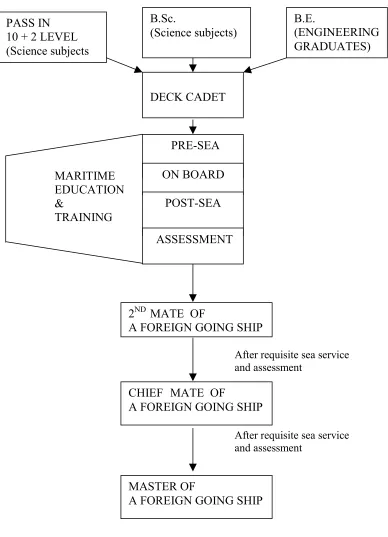
The training in these three phases is imparted in such a manner, that at the end, the cadet irrespective of which stream he/she followed, acquires the requisite knowledge and competence to appear for assessment and examination for the certificate of competency as 2nd Mate (Foreign Going) i.e. Officer in charge of a navigational watch on ships of 500 gross tonnage or more. A career profile of the deck cadet is illustrated in the figure 2.1 on the next page.
The deck cadets, after becoming the Master, may even obtain the Extra Master's certificate of competency after the requisite sea time and assessments/examinations.
Figure 2.1 Career Profile of a Deck Cadet
MARITIME EDUCATION &
TRAINING
After requisite sea service and assessment
After requisite sea service and assessment
PASS IN 10 + 2 LEVEL (Science subjects
B.Sc.
(Science subjects)
B.E.
(ENGINEERING GRADUATES)
DECK CADET
PRE-SEA
ON BOARD
POST-SEA
ASSESSMENT
2ND MATE OF
A FOREIGN GOING SHIP
CHIEF MATE OF
A FOREIGN GOING SHIP
MASTER OF
2.5 Training institutions for pre-sea training
B.Sc. (Nautical Sciences) Entry Stream
At present the maritime education and training for the deck cadets under this stream is provided at T.S. Chanakya. It is a state-owned shore based Nautical Academy situated in Mumbai with a very big campus along the sea. T.S. Chanakya is well equipped and has all training facilities in compliance to the quality and standards as required by META Manual and STCW-95 Convention.
The Government of India set up this academy in 1993 to meet the requirement of the cadets training after the decommissioning of earlier famous training ships T.S. Dufferin (1927-72) and T.S. Rajendra (1972-93). T.S. Dufferin had a unique competence based induction training of 2 to 3 years duration and same was maintained by T.S. Rajendra. Both these training ships have given together until 1993, 4916 officers to India as well as to the world shipping. It is a tribute to the excellence of training of these two training ships that their ex-cadets are serving all throughout the world and most of them are heading their organisations.
In January 1988, the University of Mumbai (Earlier known as Bombay) granted affiliation to T.S. Rajendra as its college of Nautical Sciences and a B.Sc. degree was awarded after a three-year course. This was a great recognition to the excellent training provided in T.S. Rajendra. This degree course continues as a pre-sea training for this stream of entry through T.S. Chanakya.
A total of 613 deck cadets have passed out as B.Sc. (Nautical Sciences) under this stream since 1990 from T.S. Rajendra and T.S. Chanakya. T.S. Chanakya inducts on average 90 cadets every year in the first year of B.Sc. (NS) course including cadets from overseas.
Pre-sea (3 month) entry stream
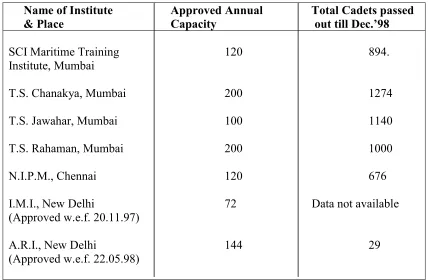
This entry stream was started in India to tackle the acute shortage of trained deck officers in early eighties. At present following Government approved training institutions are imparting pre-sea training under this stream.
Table 2.2 Pre-sea (16 weeks) training institutions and their capacities
Name of Institute Approved Annual Total Cadets passed & Place Capacity out till Dec.’98
SCI Maritime Training 120 894.
Institute, Mumbai
T.S. Chanakya, Mumbai 200 1274
T.S. Jawahar, Mumbai 100 1140
T.S. Rahaman, Mumbai 200 1000
N.I.P.M., Chennai 120 676
I.M.I., New Delhi 72 Data not available
(Approved w.e.f. 20.11.97)
A.R.I., New Delhi 144 29
(Approved w.e.f. 22.05.98)
(Source: Individual Training Institutes, 1998)
The selection under this stream is made by individual shipping companies through written tests, orals and interviews.
growth in the industry, an estimated 1500-2000 cadets are required to be inducted every year to meet the actual demand at present. This fact indicates clearly that the present supply position of the cadets is still far below the existing demand of the cadets in the national shipping industry.
Direct entry Stream
The entry of deck cadets through this stream has been very insignificant. This stream is mainly used by ratings, who meet the requirements and aspire to become officers. The companies, after selection of cadets through this entry stream, send the cadets to do the pre-sea training in the Government approved institutes. This brings them at par with pre-sea (16 weeks) entry stream cadets. Regarding ratings, they undergo the pre-sea ratings' training of 4/6 months at the approved training institutions before joining the ships. On completion of the requisite seagoing service, ratings may opt for this entry stream for their assessment and certification as the officer in charge of a navigational watch.
2.6 Training institutions for post-sea training
Lal Bahadur Shastri College of Advance Maritime Studies and Research (popularly known as LBS CAMSAR) provides various post-sea training courses for the deck cadets. This is a pioneer maritime college in India and situated in Mumbai. It is also a Government approved Training and Assessment Centre for assessing the competence acquired by the deck cadets.
Besides LBS CAMSAR, the following institutes provide the post-sea training to deck cadets.
1. SCI, Maritime Training Institute, Mumbai 2. National Institute of Port Management, Chennai 3. FOSMA Maritime Institute, Delhi
Chapter 3
Training and assessment programme for deck cadets
3.1 Pre-sea education and training
3.1.1. B.Sc. (Nautical Sciences) entry stream
The eligible candidates do their three years degree course in Nautical Sciences in the shore-based academy T.S. Chanakya. On successful completion of same, they are awarded degree of B.Sc. in Nautical Sciences from the University of Mumbai.
Educational and Training Programme
The 3-year course is fully residential with good hostel facilities with all necessary amenities. Each year has two academic semesters as follows:
1st Semester : 24th August to 14th December 2nd Semester : 15th January to 31st May
There are two vacations namely winter and monsoon vacations at the end of 1st and 2nd semester respectively. In the 2nd year, during monsoon vacations, the cadets sail on Indian and foreign vessels for 2 ½ months to have a feel of the sea and get acquainted with shipboard routine.
Syllabus of the Degree Course
According to the syllabus prescribed by Mumbai University (1996-99, Year I to III), the subjects taught during the three years are arranged hereunder, in following groups and include practicals:
1. Scholastic: English and communication skills, Applied Mathematics, Physics and Electronics, Computer Science and Maritime Management.
2. Professional: Navigation, Astronomy, Practical Navigation, Voyage planning including Chart work, Magnetic and Gyro compasses, Electronic Navigational aids viz. Radar, Decca, Loran, Satellite Navigation, GPS, GMDSS and Ship Operation Technology, Naval Architecture, Cargo Work, Ship Maintenance, Collision Prevention and Maritime Communications, etc.
3. Applied Subjects: Maritime Law, Maritime Commerce, Maritime Engineering and Control Systems and Environmental Sciences (Meteorology, Geology, Oceanography, Maritime Pollution, Hydrographic Survey, etc.)
4. Maintenance and Repairs at operational level as per chapter III of STCW-95 First year of B.Sc.
Second year of B.Sc.
(A) Basic Maritime Workshop: cutting, preparing plates and all components, welding, removal & fitting of ball bearings, overhauling of pumps/valves, dealing with dove tail joints.
(B) Basic Electrical Workshop: Drawing & laying of electrical circuits, installation of electrical fittings & appliances.
Third year of B.Sc.
Automation and Control Engineering:
(A) Auto helm and UMS operation of the ship, various sensors, transmitters and control instruments
(B) Bridge control of main engine, information, display, data-logging and alarm system.
5. Basic Safety Training Courses as per STCW-95 Code A-VI/1
During the degree course, the cadets are required to do the following 4 basic safety training model courses.
Personal Survival Techniques (3 days) Fire prevention and Fire Fighting (3 days) Proficiency in Elementary First Aid (2 days)
Personal Safety and Social Responsibilities (3 days)
Allocation of Lecture Hours (Subject Wise)
Table 3.1 Subject-related lecture hours of the degree course
B.Sc. 1st YEAR (HRS) B.Sc. 2nd YEAR (HRS) B.Sc. 3rd YEAR (HRS)
SR.
NO. SUBJECTS Th. Pr. TOTAL Th. Pr. TOTAL Th. Pr. TOTAL
Scholsatic Group
1. English& communication skills 75 25 100 - -
-2. Applied Mathematics 100 - 100 100 - 100 3. Applied Mathematics 100 - 100 100 - 100
4. Nautical Physics & Electronics 75 25 100 75 25 100 5. Nautical Physics & Electronics 75 25 100 75 25 100
6. Computer Science - - 100 75 25 100 Professional Group
7. Navigational Principles /Practicals
75 25 100 75 25 100 90 30 120
8. Voyage Planning & Collision rules
50 50 100 50 50 100 60 60 120
9. Ship operation technology Cargo-work, Seamanship, Maintenance, etc.
75 25 100 75 25 100 90 30 120
10. Cargo-Work & Marine Communication
75 25 100 - - - 90 30 120
11. Naval Architecture (Ship stability & construction)
100 - 100 100 - 100 120 - 120
12. Bridge procedure & Legal knowledge
75 25 100
13. Ship compass and Electronic Navigational Aids
90 30 120
Applied Group
14. Environmental Science 75 25 100 75 25 100 90 30 120 15. Marine Engineering & Control
systems
75 25 100 75 25 100 90 30 120
16. Shipping Management (Marine Management & Maritime Commerce)
- - - 120 - 120
17. Maritime Law - - - 120 - 120
TOTAL NO. OF HRS. IN YEAR
950 250 1200 950 250 1200 960 240 1200
Examination and Award of Degree
To monitor and assess the progress of the cadets, regular tests during and on conclusion of each semester are carried out by the academy. Proficiencies and grades are assigned to the cadets in practical and professional activities.
The promotional examinations of 1st and 2nd year and final examination of third year on conclusion of the course are conducted by the University of Mumbai. On successful completion of all basic safety training courses, workshop training, swimming test and the final examinations, conducted by the University, the B.Sc.(NS) degree is awarded to the cadet.
The University has kept pass marks considerately high in each group of subjects to maintain a very high standard in their graduates. While 70% pass marks are fixed for professional group subjects, 50% and 40% pass marks are for the applied group and scholastic group subjects respectively. (University of Mumbai, 1996-99, Year I to III)
Training Facilities in Campus
The review and analysis of the training facilities are based on the author's visit to T.S. Chanakya (1999) and interview with Baveja (1999). Some details are quoted from Information Brochure on TS "Chanakya"/ "MERI" (Session 1996).
For navigation at operational level
T.S. Chanakya has a bridge control room equipped with modern navigational equipment and simulators to give realistic training as required by the curriculum. These include following:
Navigation Simulator: Integrated navigational system, “LAN” type, with 7 monitors Ship Control Simulator:For training in ship handling
Radars: Two with ARPA and collision avoiding devices. Gyro compasses
Auto pilot Echo-sounder Magnetic compasses Course recorder
Life boat radio with Accessories
Communication and various other common bridge equipments
For Cargo Handling and Storage
A concrete model of a ship with all cargo gears, hatches, hatch covers, decks, mast houses, etc. is under construction. Cranes and winches are being installed. Prior to this, the training was imparted in the cargo gear workshops and on board ships during ship-visits.
For controlling the operation of ship and care of persons
T.S. Chanakya’s location on the coast provides the jetty and the facility of boat launching devices installed there. The campus has lifeboats, rowing boats and other life saving appliances required for cadets' training. Equipment like EPIRB, SART, immersion suits and other life boat equipment are kept in the demonstration lab. The campus has an approved fire fighting mock-up ship for training in fire prevention and fire fighting.
Maintenance and Repairs at operational level
Full-fledged mechanical, electrical and electronic workshops with shipboard machinery are located in the campus with competent supervisors and mechanics.
Curricular / Extra Curricular Facilities
character. They are taught boat-work, karate, physical training, parade, drills, etc. The campus provides many facilities for outdoor and indoor games, sports, hobbies, cultural activities, learning band music, debates, quiz competitions, ship visits, picnics and excursions, etc. Annual athletic and aquatic meets are held. The campus also has a very well equipped library and recreation rooms for the cadets. The latter has audio and video facilities.
Classrooms, labs and simulator rooms are quite spacious and adequate use of audio and visual aid is made to teach and train the cadets.
The faculty is comprised of very efficient, learned and experienced mariners and academicians, who are approved by the DGS in accordance to META Manual.
Campus Routine
The cadets and faculty wear appropriate uniform for the different activities and it is compulsory. The cadets strictly follow a standard daily routine, which is documented in the form of weekly orders. The cadets of all three years batches are divided in 8 groups called tops and each top has a cadet captain to lead it. One cadet captain takes over as a chief cadet captain for a week by rotation and is given responsibility to carryout all orders of the training officer. Many other cadets are also assigned special duties on up-keep and maintenance of campus facilities. The weekly orders also list all events of the week, activities, various assigned duties of the cadets, officers and instructors on duty, etc. The disciplinary actions against defaulters are also recorded in the weekly orders. A copy of a weekly order is placed at Appendix 1.
3.1.2 Pre-Sea (16 weeks) entry stream
author himself was co-ordinating the pre-sea training at SCI Maritime Training Institute (1999). The selected candidates for this entry stream are also trained in shore based institutions for a period of 16 weeks. During this period the applied and nautical subjects are taught, however the course content is brief and is meant only to familiarise the cadets with the sea-life, the ship's equipment and basics of Nautical Sciences. They are carefully groomed for the seafaring profession with a regimented and disciplined training schedule comprising of various activities.
The course covers part of the function-wise education and training prescribed in section A-II/1 of the STCW Code (same as Appendix M-II/1B of the META Manual). The course also covers the training on maintenance and repairs in accordance to chapter III of STCW Code. The basic safety training courses are also conducted on completion of pre-sea training and the final passing out certificate is issued thereafter. Training also covers a large number of extra curricular and sports activities to keep the cadets healthy and to develop their character with high moral values.
Since a number of institutes provide the training under this stream, the DGS has documented the standard guidelines and requirements applicable for all such institutes. These guidelines specify the requirements of selection procedures, training facilities, equipment, course intake and faculty ratio, teaching syllabus with list of text books, continuous monitoring and assessment criteria, uniform for trainees and trainers, training in general etiquette, etc. Only those institutes, which meet these requirements, are approved for training and thus trainees passing out of these institutes have a uniform standard in knowledge, competence and code of behavior.
Educational and training programme
The programme includes classroom studies and practicals, workshop training, basic safety training courses and other physical and extra curricular activities.
The subjects taught are in accordance with the standards of competence for officer in charge of a navigational watch of 500 GRT and above stated in STCW-95 Code A-II/1. It is the same as Appendix M-II/1B of META Manual. The syllabus of each function is framed to give the basic and fundamental knowledge to familiarize the cadets with various shipboard activities and tasks relating to the particular function. More emphasis has been placed on the Seamanship practicals and workshop training to develop the confidence in the cadets to perform the shipboard tasks independently.
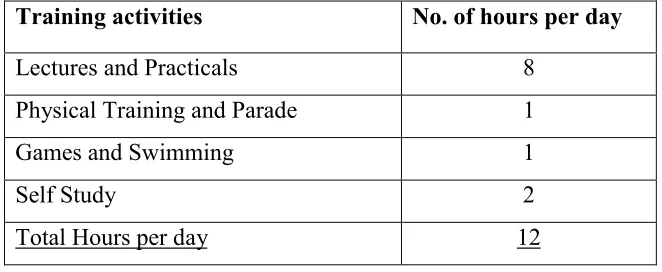
The training programme of 16 weeks has 6 working days per week and Sundays are given off to the cadets for shore leave, letter writing and personal jobs. The break-up of the daily hours for the training activities on working days is as follows:
Table 3.2 Break-up of daily hours in Pre-sea (16 weeks) training programme
Training activities No. of hours per day
Lectures and Practicals 8
Physical Training and Parade 1
Games and Swimming 1
Self Study 2
Total Hours per day 12
"Source: Guidelines for pre-sea course by DGS (India), 1998, Annex.7, page24"
Class Room Studies, Practicals and Workshop Training
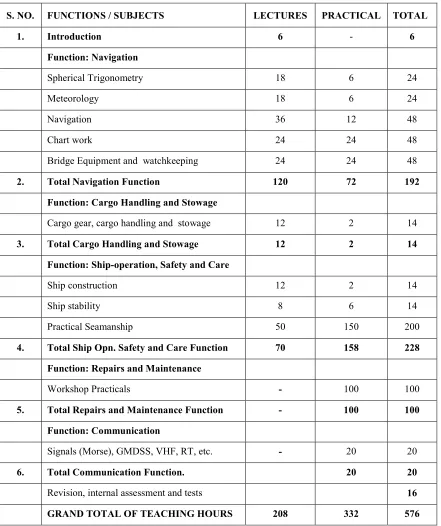
Table 3.3 Pre-Sea (16 weeks): break-up of 576 teaching hours
S. NO. FUNCTIONS / SUBJECTS LECTURES PRACTICAL TOTAL
1. Introduction 6 - 6
Function: Navigation
Spherical Trigonometry 18 6 24
Meteorology 18 6 24
Navigation 36 12 48
Chart work 24 24 48
Bridge Equipment and watchkeeping 24 24 48
2. Total Navigation Function 120 72 192
Function: Cargo Handling and Stowage
Cargo gear, cargo handling and stowage 12 2 14
3. Total Cargo Handling and Stowage 12 2 14
Function: Ship-operation, Safety and Care
Ship construction 12 2 14
Ship stability 8 6 14
Practical Seamanship 50 150 200
4. Total Ship Opn. Safety and Care Function 70 158 228
Function: Repairs and Maintenance
Workshop Practicals - 100 100
5. Total Repairs and Maintenance Function - 100 100
Function: Communication
Signals (Morse), GMDSS, VHF, RT, etc. - 20 20
6. Total Communication Function. 20 20
Revision, internal assessment and tests 16
GRAND TOTAL OF TEACHING HOURS 208 332 576
Basic Safety Training and Familiarisation Courses
During the 14th, 15th and 16th weeks, the cadets undergo the 4 basic safety training courses and the familiarisation course as required by chapter V and VI of the STCW Code. These are the same as stated earlier for the B.Sc. (NS) entry stream.
General Campus Routine
The training course is fully residential. A strict campus routine is followed during the cadets' stay in the campus of the training institute. Each cadet is given an opportunity to act as a cadet captain for the day in rotation and other cadets are assigned watchkeeping duties in rotation such as gangway watches, anti-pilferage watches, campus rounds, etc. Cadets are also given responsibilities for maintaining cleanliness of living quarters, workshops and various laboratories, recreation rooms, sport-centres, gymnasium, boats, life saving appliances, fire fighting appliances, etc.
Weekly orders are made which give a full account of all activities to be undertaken by the cadets. Two to three times a day, the cadets muster for attendance and briefing by the training officers. Inspections of uniform and living quarters are made weekly to ensure that the cadets are groomed in a most seaman like manner.
A number of games' and sports' events are organised and tournaments are held to create competitions. Prizes and proficiency badges are awarded to those cadets, who excel in the various sports and games. Similarly, the cadets are encouraged to take part in group discussions and debates.
Visits to Ships & Places of Maritime Interest
During training, a number of visits to ships, ports, harbours, workshops and also to meteorological offices, maritime museums, beaches, scrap-yards, container terminals, offices of the shipping companies, etc. are made, accompanied by training officers of the institute. The cadets are thus made to see things themselves and co-relate their classroom studies and practicals.
Structure Of Final Examinations and Issue of the Final Passing-out Certificate
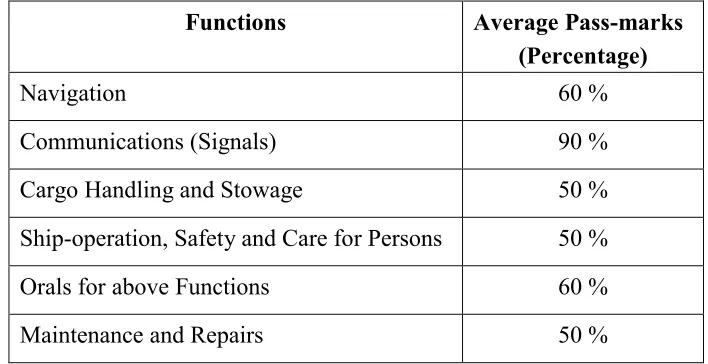
As stated earlier, the cadets are examined under the functional approach in written and oral examinations during the 13th week of the training. The subjects and passing percentage of marks are as per following table:
Table 3.4 Average pass-marks in the final examination
Functions Average Pass-marks
(Percentage)
Navigation 60 %
Communications (Signals) 90 %
Cargo Handling and Stowage 50 %
Ship-operation, Safety and Care for Persons 50 %
Orals for above Functions 60 %
Maintenance and Repairs 50 %
The final passing-out certificate is issued to a cadet if he/she meets the following criteria:
• Pass in each written paper and practical
• Minimum classroom attendance of 90 %
• If attendance is not to the required limit, the cadet must make it up in the subsequent batch of training.
• Demonstration of good conduct and discipline.
•
No adverse remarks by any faculty or training officers.3.1.3. Direct cadet entry stream
This entry stream is common to a certain category of cadets and general ratings, who aspire to become the officer in charge of a navigational watch. The cadets selected by the individual shipping companies, who meet the eligibility criteria as set out by the DGS in the META Manual are required to do four basic safety training courses (same as for the pre-sea training of the earlier two streams). They also do additional familiarisation courses for the type of the ship to which they are likely to be posted. After this these cadets are directly placed on board the company’s ship to complete their 36 months' approved seagoing service including 6 months' bridge watchkeeping. No pre-sea training for this entry stream is prescribed in the META Manual of the DGS. However, it is observed that most of the shipping companies ensure that their cadets pass through this stream too, do the pre-sea training of 16 weeks, same as for the pre-sea (16 weeks) stream at the approved training institutions.
3.2 On board training
training" of the cadets during their seagoing service. On board training is an on-the-job systematic acquisition of the competence and skills required for the certificate of competency as 2nd Mate of a foreign going ship (Officer in charge of a Navigational Watch).
Onboard training needs to be differentiated from maritime education. Maritime education is gaining of underpinning knowledge theoretically as per syllabus, for a particular job on a ship. The onboard training is imparted for assimilation of skills to perform shipboard tasks. The revised STCW-95 Convention puts stress on acquisition of competence, which is based on skills and also an ability to demonstrate it to prove that the trainee is capable of performing all shipboard tasks. The convention requires that the onboard (shipboard) training of the cadets should be systematically structured and it should be carried out under a structured shipboard training programme (SSTP). This programme must have a reasonable time frame and must be supervised, monitored and assessed throughout by competent persons in compliance with STCW-95 Reg. I/6. It is imperative that the requisite function-wise competencies are covered in the programme for the desired qualifying standard. The convention also requires that there should be documentary evidence for the above accomplishment.
In compliance with above, the DGS has fixed the period of 12 months and 24 months of SSTP for B.Sc. (NS) and pre-sea (16 weeks) entry streams respectively for the 2nd phase of the shipboard training. For the third stream of direct entry, 36 months of approved seagoing service is required with normal shipboard training for this phase. If a cadet of the first two streams fails to complete the SSTP successfully, he/she will be required to undergo 36 months of seagoing service.
3.2.1 Implementation of Structured Shipboard Training Programme (SSTP)
For effective and systematic execution of SSTP, the DGS has published a comprehensive training record book for the cadets. This book lists all the tasks/jobs to be performed by the cadet to train him/her for the functional competencies as per requirement of STCW Code A-II/1. The shipping company makes a SSTP of 12 months or 24 months for cadet of B.Sc. (NS) stream or of pre-sea (16 weeks) stream respectively for the approval of the DGS. This approved SSTP is implemented on board the ship to enable the deck cadet to complete all the tasks and acquire proficiencies listed in the record book. The effective implementation of SSTP is carried out under proper supervision, monitoring and assessment by the following designated officers/units.
(1) Shipboard Training officer (STO) (2) Master of the ship
(3) Company’s Training Officer (CTO)
(4) Assessment Centre authorised by the DGS (The Govt. of India) The functions and duties of above are explained later in this chapter.
Contents Of Cadets' Training Record Book
The training record book has the entire record of the cadet’s shipboard training with the documentary evidence of the tasks and jobs performed by him/her. This also keeps the record of all vessels on which he/she worked and various inspections, supervisions and endorsements made by the designated training officers afloat and ashore.
related to tanker practice, dry docking, steering, collision regulations and bridge watchkeeping. The last two sections contain the tasks for the cadet's journal, sketch book, daily work diary and record of quarterly reports sent to the CTO/Assessment centre.
In the case of cadets from the pre-sea entry stream, all tasks are completed in 24 months over four stages of six months each. The tasks on the functional competencies are covered in three stages and tanker practice/dry docking sections are completed in the 4th stage, whenever the cadet gets an opportunity for these tasks. The cadet achieves the proficiencies in the remaining sections during the entire shipboard training period.
In the case of cadets from B.Sc. (NS) stream, they too have to perform all the tasks of the record book in the same manner. The four stages in their shipboard training shall be of 3 months each.
3.2.2 Monitoring and Assessment of Structured Shipboard Training
The following designated ship and shore officers/centre monitor and assess the structured shipboard training programme of the cadet and their assignments are explained as follows:
Shipboard Training Officer (STO)
• Monitors the SSTP and endorses the cadet's TRB with suitable remarks on successful completion of an activity or task.
• Inspection of TRB, journal, sketchbook and daily workbook at least every two weeks.
Master
• He is a link between STO and CTO and ensures that the SSTP is implemented effectively.
• Reviews the progress of the cadet in SSTP every month and enters remarks in TRB
Company’s Training Officer
• Ensures overall planning and administration of SSTP
• Monitors the progress of the cadet till completion of SSTP and seagoing service. Sends quarterly report on progress of the SSTP for each cadet and also sends final completion report of SSTP, to the assessment centre along with his comments.
Assessment Centre
This centre is authorised by the DGS to monitor the execution of SSTP in respect of each cadet on the basis of reports received from CTO periodically.
At the end of SSTP, the centre examines all the documents such as TRB, journals, sketch book, work diary, watchkeeping certificates, steering certificate, sea time certificates, etc. of the cadet. The centre carries out on-spot evaluation and assessment of the skills and competence of the cadet in compliance with the requirements of STCW Code A-I/6 and A-I/8. For this purpose the centre has all necessary navigational equipment and simulators to test the cadet's skills and competence. If the centre is satisfied with the demonstration of required skills in the functions of operational level by the cadet, it allows the cadet for admission in to the post-sea education phase.
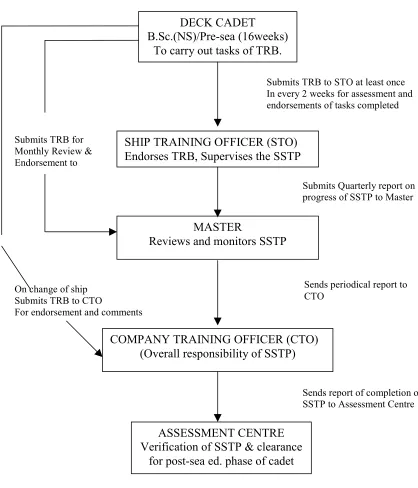
Figure 3.1 Stage-wise progress of the structured shipboard training programme
Submits TRB to STO at least once In every 2 weeks for assessment and endorsements of tasks completed
Submits TRB for Monthly Review & Endorsement to
Submits Quarterly report on progress of SSTP to Master
On change of ship Submits TRB to CTO
For endorsement and comments
Sends report of completion of SSTP to Assessment Centre
1
TRB includes Journal, Sketch-book and the daily work-diary
DECK CADET B.Sc.(NS)/Pre-sea (16weeks)
To carry out tasks of TRB.
SHIP TRAINING OFFICER (STO) Endorses TRB, Supervises the SSTP
COMPANY TRAINING OFFICER (CTO) (Overall responsibility of SSTP)
ASSESSMENT CENTRE Verification of SSTP & clearance
for post-sea ed. phase of cadet MASTER
Reviews and monitors SSTP
3.3 Post-sea education and training
The aim of the post-sea training is to prepare the deck cadet for the evaluation of their competence by the examining and assessing authority for their certification. The post-sea education and training of deck cadets is conducted by the approved training institutions. The training and assessment programme of the cadets (META Manual) clearly outlines the courses, to be conducted in the post-sea training. The syllabus of these courses conforms to the standards of competence as required by the STCW Code A-II/1, B-II/1 and A-VIII/2 part 3-1 for the officer in charge of a navigational watch (2nd Mate Foreign Going).
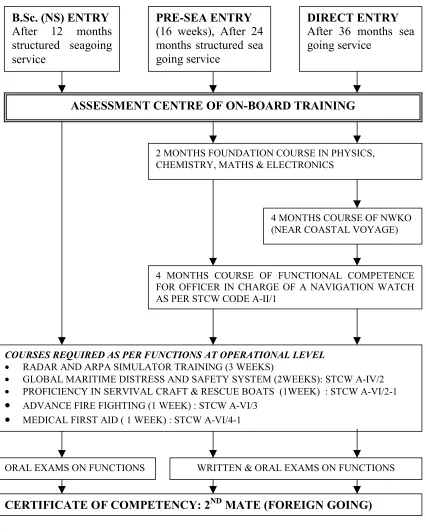
Post-sea courses give the final touch to the skills and knowledge acquired by the deck cadets during their earlier seagoing service. The courses, which have been developed as per the functional competency tables of STCW Code A-II/1, help cadets to apply their practical knowledge gained at sea in understanding the in-depth theory behind all the shipboard operations and the responsibilities. Figure 3.2 on the next page illustrates the post-sea education and training applicable to the three different entry streams of the cadets. The figure also gives the procedures of their assessments for the issue of the certificate of the competency.
Details of Post-sea Courses
PRE-SEA ENTRY
(16 weeks), After 24 months structured sea going service
DIRECT ENTRY
After 36 months sea going service
Figure 3.2 Post-sea education & training of deck cadets
"Source: META Manual (DGS, India), Vol. I, 1998, page II/6"
ASSESSMENT CENTRE OF ON-BOARD TRAINING
2 MONTHS FOUNDATION COURSE IN PHYSICS, CHEMISTRY, MATHS & ELECTRONICS
4 MONTHS COURSE OF NWKO (NEAR COASTAL VOYAGE)
4 MONTHS COURSE OF FUNCTIONAL COMPETENCE FOR OFFICER IN CHARGE OF A NAVIGATION WATCH AS PER STCW CODE A-II/1
COURSES REQUIRED AS PER FUNCTIONS AT OPERATIONAL LEVEL
• RADAR AND ARPA SIMULATOR TRAINING (3 WEEKS)
• GLOBAL MARITIME DISTRESS AND SAFETY SYSTEM (2WEEKS): STCW A-IV/2
• PROFICIENCY IN SERVIVAL CRAFT & RESCUE BOATS (1WEEK) : STCW A-VI/2-1
• ADVANCE FIRE FIGHTING (1 WEEK) : STCW A-VI/3
• MEDICAL FIRST AID ( 1 WEEK) : STCW A-VI/4-1
ORAL EXAMS ON FUNCTIONS WRITTEN & ORAL EXAMS ON FUNCTIONS
CERTIFICATE OF COMPETENCY: 2ND MATE (FOREIGN GOING) B.Sc. (NS) ENTRY
Foundation Course
This course is of 2 months' duration. The objective of this course is to revalidate the knowledge of the deck cadet from pre-sea (16 weeks) stream and direct stream in the under mentioned subjects covering those portions, which are applicable to Nautical Science.
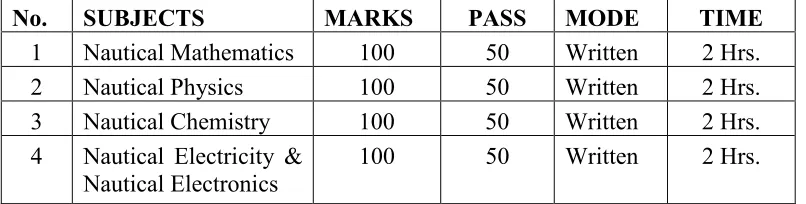
Table 3.5 Subjects and examination structure of the foundation course
No. SUBJECTS MARKS PASS MODE TIME
1 Nautical Mathematics 100 50 Written 2 Hrs.
2 Nautical Physics 100 50 Written 2 Hrs.
3 Nautical Chemistry 100 50 Written 2 Hrs. 4 Nautical Electricity &
Nautical Electronics
100 50 Written 2 Hrs.
"Source: MS Notice (DGS, Govt. of India), 1998, Annex II, page 4"
The deck cadets from pre-sea (16 weeks) stream can do this course any time after their pre-sea training. The direct stream cadet can do this course after a minimum 6 months of approved seagoing service. Approved training institutes conduct this course.
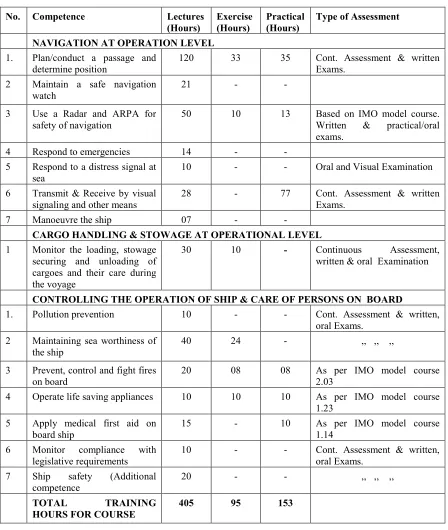
Course on functional competence
Table 3.6 Schedule of 2nd Mate Competency Course
No. Competence Lectures
(Hours) Exercise(Hours) Practical(Hours) Type of Assessment NAVIGATION AT OPERATION LEVEL
1. Plan/conduct a passage and
determine position 120 33 35 Cont. Assessment & writtenExams. 2 Maintain a safe navigation
watch
21 -
-3 Use a Radar and ARPA for
safety of navigation 50 10 13 Based on IMO model course.Written & practical/oral exams.
4 Respond to emergencies 14 - -5 Respond to a distress signal at
sea 10 - - Oral and Visual Examination
6 Transmit & Receive by visual
signaling and other means 28 - 77 Cont. Assessment & writtenExams.
7 Manoeuvre the ship 07 -
-CARGO HANDLING & STOWAGE AT OPERATIONAL LEVEL
1 Monitor the loading, stowage securing and unloading of cargoes and their care during the voyage
30 10 - Continuous Assessment, written & oral Examination
CONTROLLING THE OPERATION OF SHIP & CARE OF PERSONS ON BOARD
1. Pollution prevention 10 - - Cont. Assessment & written, oral Exams.
2 Maintaining sea worthiness of
the ship 40 24 - ,, ,, ,,
3 Prevent, control and fight fires
on board 20 08 08 As per IMO model course2.03 4 Operate life saving appliances 10 10 10 As per IMO model course
1.23 5 Apply medical first aid on
board ship 15 - 10 As per IMO model course1.14 6 Monitor compliance with
legislative requirements 10 - - Cont. Assessment & written,oral Exams. 7 Ship safety (Additional
competence
20 - - ,, ,, ,,
TOTAL TRAINING HOURS FOR COURSE
405 95 153
These competencies shall be from each function at operational level as required by STCW Code A-II/1. During the course, the cadets shall also complete all the post-sea modular courses, which are part of the three functions at operational level namely Navigation, Cargo work and Safety and Care at Sea. The schedule of the course also gives the method of assessment for each competence of the prescribed 3 functions.
Radar Observer and ARPA Simulator Training
The simulator training is given as part of navigation function in the competency course as listed at serial number 3 in table 3.6 on the previous page. It is additional simulator based training on the use of Radar and ARPA for the safety of navigation. The break up of training hours is shown in the table 3.7.
Table 3.7 Schedule of Radar Observer and ARPA Simulator Training
No. Simulator Course Lectures Demos. Exercises Simulator Total
1 Radar Observer 27 6.5 12 - 45.5
2 ARPA 07 - - 26 33.0
Total 34 6.5 12 26 78.5
"Source: META Manual (DGS, India), 1998, Appendix M-II/1C"
GMDSS Operator's Course (GOC)
3.4 Assessment and Certification
The final assessment of the competence of the cadets for the certification is done by the written and oral examinations. The summary of the examinations is stated in the following table.
Table 3.8 Officer in charge of a navigational watch: examination structure
No Function: Navigation at the operation level Marks Pass Mode Time
1 Coastal & Terrestrial Navigation 200 140 Written 3 Hrs.
2 Celestial Navigation (Principal & Practicals) 200 140 Written 3 Hrs.
3 Meteorology 100 50 Written 2 Hrs
4 Bridge watchkeeping and Emergencies 200 100 Written 3 Hrs
5 Communication 100 90 Visual 1 Hr.
6 Radar Observer Simulator Course Modular 2 weeks
7 ARPA Simulator Course Modular 1 week
8 Orals for Navigation Function only after completing 1 to 7 above
Oral
Function: Cargo Handling & Stowage (Opn.) Marks Pass Mode Time
1 Cargo Handling & Stowage 200 120 Written 3 Hrs.
2 Orals for Cargo Handling & Stowage Function only after completing 1 above
Oral
Function: Ship operation & care of personnel at the operational level
Marks Pass Mode Time
1 Ship construction, Stability, Ship safety and Environmental Protection
200 120 Written 3 Hrs.
2 PSC & RB Modular 1 week
3 Advanced Fire fighting Modular 1 week
4 Medical First Aid Modular 1 week
5 Orals for Function after completing 1 to 4 above Oral
Function: Radio Communication Marks Pass Mode Time
1 GMDSS-GOC Modular 2 weeks
The assessment and the evaluation referred to earlier comprise of the written and oral examinations in each of the three functions of the competency. The cadets are eligible for the Final Assessment Stage only after successful completion of the post-sea training and all required operational level courses. The cadets from B.Sc. (NS) entry stream are exempted from the written examinations and are required to pass the oral examination of each function. The cadets from the other two entry streams are required to pass the written examinations prior to appearing for oral examinations of any function.
Chapter 4
Survey on post-training performance of cadets as officers
4.1 Scope of the survey
In the foregoing chapters, the training and assessment programme of the deck cadets of all three entry stream has been reviewed. Each entry stream has three phases of training of various duration, depending upon their level of education and training. The training programme complies with the national training policy, the needs of the industry and the standards of the STCW-95 Convention. On completion of their final assessment and evaluation, the successful cadets are issued a certificate of
competency as 2nd Mate (Foreign Going). The cadets after being certified,
irrespective of their entry stream, are expected to have uniform level of competence and proficiency in performing their functions at operational level on board their ships. The training is also expected to develop a high degree of motivation and dedication in these officers towards their new duties and responsibilities.