F O R U M
Open Access
‘
Fit-for-purpose?
’ –
challenges and
opportunities for applications of blockchain
technology in the future of healthcare
Tim K. Mackey
1,2,3,4*, Tsung-Ting Kuo
5, Basker Gummadi
6, Kevin A. Clauson
7, George Church
8,9, Dennis Grishin
8,9,
Kamal Obbad
9, Robert Barkovich
10,11and Maria Palombini
12Abstract
Blockchain is a shared distributed digital ledger technology that can better facilitate data management, provenance and security, and has the potential to transform healthcare. Importantly, blockchain represents a data architecture, whose application goes far beyond Bitcoin–the cryptocurrency that relies on blockchain and has popularized the technology. In the health sector, blockchain is being aggressively explored by various stakeholders to optimize business processes, lower costs, improve patient outcomes, enhance compliance, and enable better use of healthcare-related data. However, critical in assessing whether blockchain can fulfill the hype of a technology characterized as‘revolutionary’ and‘disruptive’, is the need to ensure that blockchain design elements consider actual healthcare needs from the diverse perspectives of consumers, patients, providers, and regulators. In addition, answering the real needs of healthcare stakeholders, blockchain approaches must also be responsive to the unique challenges faced in healthcare compared to other sectors of the economy. In this sense, ensuring that a health blockchain is‘fit-for-purpose’is pivotal. This concept forms the basis for this article, where we share views from a multidisciplinary group of practitioners at the forefront of blockchain conceptualization, development, and deployment.
Keywords:Blockchain, Distributed ledger technology, Healthcare technology, Health informatics, Supply chain, Clinical trials, Medical licensure, Genomics, Electronic health records
Background
Tim Mackey (Fig.1)
Whether you are a clinician, researcher, entrepreneur, administrator, or executive, you are probably familiar with the term ‘blockchain’. At its core, blockchain is a new type of digital architecture, consisting of a shared, immutable ledger that can better ensure the resilience, provenance, traceability, and management of health data. It has been hailed as a revolutionary technology, but whether it meets this potential remains to be tested.
To understand blockchain’s potential for healthcare, we first need to understand some basic technical
elements. Unlike traditional centralized databases, data on a blockchain can be distributed across multiple data-bases/computers (also known as ‘nodes’) so that every-one has the same copy (ledger) of a transaction [1]. ‘Blocks’ of data are linked together by a hash (a digital signature of random letters and numbers) to form a ‘chain’ of data that contains the complete history of the transaction and renders it tamper resistant [2,3]. Block-chain data is also secured through cryptography (ad-vanced encryption) so that participants can trust that ‘blocks’ of data are authenticated and verifiable [2]. These technological features result in decentralized data systems (not held by a central authority vulnerable to breach or potentially acting as a single point of failure), represent a single source of information among all par-ticipants, and have inherently higher levels of trust (as transactions are immutable, secure, and subject to con-sensus of the participants). Blockchains can also be
* Correspondence:[email protected]
1Department of Anesthesiology and Division of Infectious Disease and Global
Public Health, University of California, San Diego School of Medicine, San Diego, CA, USA
2Department of Healthcare Policy, Technology and Research, University of
California, San Diego–Extension, San Diego, CA, USA
Full list of author information is available at the end of the article
permissioned to limit participation and access to or sharing of data [4]. Finally, there are public blockchains (e.g., public network-based blockchains such as the popular cryptocurrency Bitcoin) and private or‘business’ blockchains (e.g., private networks not open to the pub-lic but instead used by a select group of trusted partici-pants) [5]. Some popular platforms for blockchain deployment include Ethereum and Hyperledger, though offerings are growing.
Beyond these core features, blockchains can also en-able other technologies such as distributed applications (those that run on multiple computers in a network) and smart contracts (computer code that can execute terms
of a contract between parties) as well as the use of cryp-tocurrencies (digital or virtual currencies) [2, 6–8]. Blockchains can also act as a digital backbone for other technologies able to interface with blockchain systems such as cloud computing, artificial intelligence, eHealth and mHealth devices/applications, and the broader Internet of Medical Things (IoMT) [6, 9, 10]. Thus, the blockchain environment is expansive and modular, and has the flexibility to be adopted for various use cases in healthcare and beyond (see technology architecture summary in Fig.2).
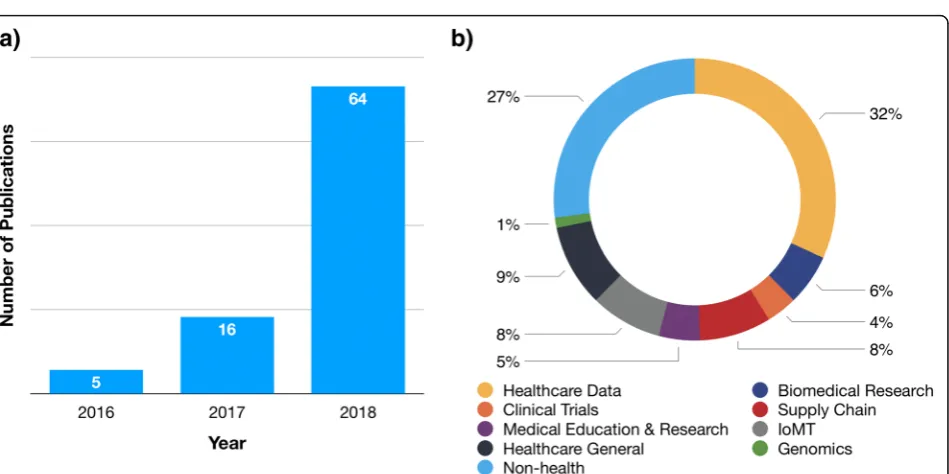
Reflecting the increased attention given to blockchain in healthcare and life sciences, the number of PubMed indexed articles including the keyword‘blockchain’in the title or abstract fields has increased dramatically, from only 5 in 2016 to 64 in 2018 (Fig.3). The published papers evidence the wide variety of use cases that are being researched for health blockchains, including management and interoperability of healthcare data (e.g., patient health-care, consumer health, and hospital data), improving in-tegrity of published research, clinical trial management, use and integration into IoMT applications (including mHealth and remote patient monitoring), advancing gen-omics and precision medicine, applications for biomedical and medical education and research, pharmaceutical supply chain management and security, implications of blockchain for global health, and general articles of the various opportunities for blockchain in medicine, engin-eering and the life sciences [3–5,7,11–24]. However, it is important to note that the published literature represents only a snapshot of global blockchain activity, as many health-related blockchain projects are published in white papers, news articles, press releases, presented at confer-ences, or are otherwise undisclosed as they are developed for commercialization purposes. Several large technology firms, such as IBM, Intel, and Microsoft, are heavily invested in blockchain technology development, and the World Economic Forum estimates that, by 2025, 10% of the global gross domestic product will be stored on block-chain technology [25].
Despite blockchain’s potential as an emerging technol-ogy to be innovative and disruptive, it remains imma-ture, particularly in healthcare. According to Gartner [26], blockchain technology is in a‘hype cycle’ character-ized by stages of innovation triggers, inflated expecta-tions, disillusionment, enlightenment, and ending in a “plateau of productivity”, with healthcare and life sci-ences currently squarely in the middle of phase one and two of the curve. Reflecting the fact that it is still early days for health blockchains, there are few real-world ex-amples of blockchain systems that have gone into pro-duction and that also have strong commercial or user adoption in healthcare. In contrast, other sectors of the economy have seen much faster adoption, including
Fig. 2Depiction of blockchain data architecture components. This includes the core functions of blockchain data by generation of a first (genesis) block that is timestamped and may include certain transaction data/metadata (transation data) or state-of-data information. These blocks of data are chained together via a cryptographic hash of the data. The data layer represents where data can reside on the blockchain, primarily either storing data on the blockchain itself (on-chain storage) or storing the data in a different source but including a pointer or using a distributed application as an intermediary (off-chain storage). The core functions of the blockchain should also assess certain design considerations (in far right yellow box), including whether the blockchain is public, private or consortium, the consensus mechanism to be used, the type of permissions structure, where data should reside and how it should be managed, and the governance of the blockchain (who are the users, peers, validators, nodes, etc.). Finally, a feature layer including blockchain-enabled technology options, such as the use of cryptocurrencies/tokens, digital wallets, smart contracts, and distributed applications, can also be added if needed for a particular healthcare use case
financial technology services and supply chain and logistics.
Despite the core characteristics of decentralization, se-curity, provenance, transparency, trust, and better man-agement of data being clear benefits to address acute healthcare needs, an approach that ensures that block-chain technology is ‘fit-for-purpose’ for specific and di-verse healthcare challenges is required. Importantly, when assessing the viability of a blockchain for health, what core blockchain characteristics and design princi-ples need to be taken into account, and how can they address the real-world legal, regulatory, privacy, busi-ness, and provider and patient-centric considerations unique to healthcare?
In an attempt to address these challenges, this Forum article presents a‘fit-for-purpose’health blockchain design framework that includes fundamental questions regarding basic blockchain design principles, data sharing and man-agement, and decisions about governance, as well as ex-ploring the technologies that can be used to enhance blockchain function and defining the ultimate goal for the blockchain solution. If these questions can be appropri-ately mapped, then there is a higher likelihood that the blockchain approach will be ‘fit-for-purpose’for whatever healthcare challenge has been identified. The framework questions are based on six principles, as follows:
1. Blockchain design types:Decision of whether your blockchain design will be a public blockchain (generally open to participation by anyone and not permissioned), private blockchain (involving limited participation and having permission structures), or a hybrid (blockchain systems with both public and private designs).
2. Data sharing and access:In healthcare, sharing and access to health-related data is subject to various privacy, legal, and regulatory requirements (such as the Health Insurance Portability and Accountability Act (HIPAA) and the General Data Protection Regulation (GDPR)). Decisions need to be made about what type of data will be shared with and among participants, if any, whether data will be stored on-chain, off-chain or on a side-chain, and the type of permission structures that will be utilized.
3. Decisions about blockchain governance:
Governance is a crucial component to the design of a blockchain system. The nodes, users, peers, and/or validators of the blockchain will need to be defined, as well as whether it will be comprised of only trusted partners, a consortium of participants, or participation of public entities or regulators, and include patients/consumers/the public. Finally, how these actors will make decisions about how to
govern the blockchain (including choices regarding consensus mechanisms, permissions, and data governance) will also need defining.
4. Added technology to enhance blockchain function:As previously discussed, the blockchain architecture can also enable the use of other technologies, including the development of an application layer that interfaces with the blockchain, the use of smart contracts to automate processes when certain agreed upon conditions are met, and the use of a cryptocurrency/tokens to incentivize participation that ideally provides shared benefits to all participants.
5. Ultimate healthcare goal of the blockchain:
Although it may seem obvious, a critical issue that must be addressed is the definition of the ultimate goal of the blockchain to improve healthcare. Beyond the core benefits of a distributed, immutable, transparent, and higher trust system, the unique benefits a blockchain system can provide for healthcare processes over other existing technologies must also be assessed. Not all blockchains will have the same goal(s). For example, some may be designed to simply lower healthcare transaction-related costs by improving and automating processes (such as the use of smart contracts), removing intermediaries, or reducing administrative burden. Others may focus on creating mechanisms to drive revenue generation. Some will prioritize enabling better data collection, use, and sharing from patients, consumers, and providers through the offer of incentives (such as tokens). Further, others may focus on more indirect benefits such as increasing compliance or preventing fraud. Eventually, some blockchains may be designed to achieve multiple goals, yet may start with the most pragmatic use first.
6. The need for a blockchain:A final question may simply ask whether the healthcare-related challenge or goal really needs a blockchain, or if it can be better facilitated by another form of technology.
together a diverse and multidisciplinary group of experts from academia, the private sector, healthcare startups, and professional technology associations to discuss use cases in healthcare records, clinical trial management, medical credentialing and licensing, genomics and precision medi-cine, pharmaceutical supply chain, and biomedical re-search. It closes with a discussion from the IEEE Standards Association about the importance of setting technical and industry standards to ensure blockchain in healthcare moves forward and realizes its potential as a revolutionary force for 21st century healthcare.
Using privacy-preserving predictive models and blockchain technology for electronic health records
Tsung-Ting Kuo (Fig.4)
Healthcare record management is one of the most im-portant application domains for blockchain technology
[4, 19, 25, 27]. Blockchain healthcare record manage-ment focuses on the sharing of data across different healthcare stakeholders, while preserving the source, prov-enance and, oftentimes, privacy of such data in a way that can enable more powerful data analysis and insights from population health analytics [25,28–34]. Among healthcare record applications, this section focuses on an example of blockchain-based privacy-preserving prediction modeling that leverages many of the strengths of blockchain technology [35–37].
In this specific use case, hospitals or healthcare institu-tions aim at training a machine learning model from the healthcare records stored in their electronic healthcare record (EHR) systems, and then using the learnt model to predict patient outcomes (e.g., the risk of having a certain condition or disease). Specifically, while targeting rare conditions/diseases (e.g., Kawasaki disease), there may not be enough patient records for a single hospital/institution to learn a generalizable model solely from its own EHR data. To solve this problem, intuitively, hospitals/institu-tions can share their data to enlarge the number of re-cords; however, sharing patient data directly may lead to privacy risks such as re-identification [38] and data breaches [39]. Therefore, several privacy-preserving pre-diction modeling methods have been proposed [40, 41], enabling the hospitals/institutions to collaboratively train a predictive model by sharing only partially trained ma-chine learning models (i.e., a set of aggregated parameters) instead of patient-level records.
However, these state-of-the-art methods are mainly cen-tralized (i.e., client-server architecture), which may lead to several concerns such as the single-point-of-failure on the server. To mitigate these issues, the combination of block-chain and privacy-preserving prediction modeling provides a solution for the hospitals/institutions to collab-orate and train a generalizable predictive model without exchanging patient-level data, while obtaining the benefits of a distributed (i.e., peer-to-peer) architecture without architectural concerns (e.g., single-point-of-failure). In this blockchain-based solution approach, the users are the hospitals or healthcare institutions participating in the cross-institutional model learning. The data that users’ in-put is the patient-level data from the EHR, with the same format and semantic meaning. Importantly, direct data is not shared across hospitals/institutions, with only the pre-dictive models learnt from the EHR data being shared via the blockchain network. In such a blockchain network, the peers are actually the same as the users.
To ‘validate’ (train a predictive model collaboratively in this use case) the data (i.e., models), each peer en-closes their partial models in the transactions (at the transaction metadata level, as shown in Fig. 2) to create blocks, retrieves the models from other peers, and then updates the model using their own EHR data. The
learning process is conducted in an‘online’fashion, such that the model is updated using only partial data in a se-quential order. Additionally, training errors are used to guide the order of the online learning on the blockchain, based on an intuition that the site containing data with higher error may provide more information to improve the model. This iterative learning process is repeated until a consensus predictive model for all peers is identified. In this way, blockchain provides specific benefits for problem solving such as protecting privacy by exchanging models only, avoiding the single-point-of-failure, and generating immutable logs for the learning process.
Following this Forum’s framework of the ‘ fit-for-pur-pose’ blockchain design elements, the design type of the privacy-preserving learning based on blockchain is private. In terms of data sharing, the models and their meta-information (e.g., the local training error of a model) are shared on-chain, while there is no off-chain data shar-ing. For governance, only participating hospitals and insti-tutions are included in the blockchain network, and the incentive of these users/peers to participate is the im-proved predictive power of the models to glean new in-sights into patient and population health outcomes.
Ultimately, the goals of this blockchain-based learning method for health records management include support-ing comparative effectiveness studies, biomedical re-search, and eventually patient care.
Blockchain-enabled medical professional credentialing and licensing
Kevin A. Clauson (Fig.5)
Processes for the management of healthcare workforce competencies, including degree verification, credential-ing, and continuing education, are largely based on leg-acy systems that can suffer from inefficiencies, lack of transparency, and avoidable costs [42, 43]. These chal-lenges are further exacerbated by bad actors, as highlighted by a survey of hiring managers (n = 2532) that found 28% of observed job candidates claiming un-earned academic credentials [44]; this occurs across sec-tors, including high profile cases like a nationally known US college football coach resigning days after his hire after it was unearthed that he had falsified a master’s de-gree in education [45]. In a more troubling case, a man falsified both degrees and transcripts to secure a federal leadership position for a technology role in law enforce-ment and security [46]. Another recent paper docu-mented that 89% of human resource and risk experts reported candidates misrepresent information on appli-cations [47]. Thus, the dual threats of suboptimal pro-cesses and bad actors have negatively transformed the credentialing arena from a seemingly mundane activity to a time-intensive, cost-inflated pursuit that can even negatively impact patient safety [48].
Professional credentialing and licensure is also a crit-ical function of most highly regulated sectors of the economy, including multiple actors in the healthcare system. Since the early 1960s, hospitals have been re-quired to verify the competency of physicians in their in-stitutions [49]. In general, medical credentialing of hospital staff and physicians can be time-consuming and, if processed incorrectly, can lead to increases in costs (including disrupting a hospital’s revenue cycle), potential legal liability, and inhibit the ability of a health system to process reimbursements [50, 51]. Included in the process is independent verification of certifica-tions, licenses, qualifications, education, relevant training (e.g., continuing medical education), board certifications (if applicable), relevant accreditations,
practitioner’s employment history and, in the case of the US, querying the National Practitioner Data Bank for negative information. Further, providers may maintain independent credentials with multiple sys-tems based on their admitting privileges and may also have practiced in another state [52].
In its simplest terms, a blockchain medical credential-ing solution would act as a decentralized data directory where data on the provider’s identity could be verified to its trusted source and continuously updated and recon-ciled to ensure trust and confidence in the provider’s ability to practice. One model envisions accreditors, hos-pitals, medical schools and other educational institu-tions, licensing boards, national health agencies, and other sources of credentialing information serving as nodes and participants in the blockchain (potentially re-ducing the need for medical credentialing services and other intermediaries). Other models would position a blockchain structure that served as either interstitial or as second layer solutions that could provide connectivity for all of the current data silos involved in credentialing. Analogous to the ‘fit-for-purpose’ model that leverages blockchain enhancement for health supply chain man-agement (as discussed later by TKM and MP), medical credentialing has similarly distributed sets of stake-holders that require varying levels of permissions across the assets’lifecycle (e.g., in this case, the information re-lating to a provider’s identity).
One such credentialing lifecycle tool that has been con-ceived is the Comprehensive Learner Record, which in-cludes coursework, degree(s), competencies, co-curricular activities, experiential learning, microcredentials, and pro-fessional (e.g., medical) credentials that could map into li-censure and continuing medical education [53]. The Comprehensive Learner Record also includes the Open Badges functionality, which in turn is data aligned with Blockcerts standards. Blockcerts has separately been ad-vanced as an “open standard for blockchain credentials”
[54]; notably, initial Blockcerts support was for public (e.g., Bitcoin and Ethereum) blockchains, with expansion to other blockchains outlined in their roadmap.
Reflecting again on the‘fit-for-purpose’model, this use case can be characterized as individual centric rather than process centric. As such, identity is central to all of these processes, but can be approached via public, pri-vate, hybrid, or consortium designs. One such example of a public design is through the Decentralized Identity Foundation, which aims to use an Identity Hub architec-ture [55] to help accomplish this goal.
Within this broader framework, efforts to leverage the strengths of blockchain to secure provider identities and credentialing include private (e.g., Piper Jaffray), government (e.g., State of Illinois), commercial (e.g., Pro-fessional Credentials Exchange), and educational (e.g.,
Lipscomb University) entities [2]. One collaborative pilot between state government and industry in this area pro-poses a blockchain-based registry for data sharing, but also adds smart contract functionality to ‘automate workflow’ for medical licensure tied to more than one state in order to further enhance efficiency and reduce costs [56].
While educational credentialing remains limited in scope and onerous to conduct for many institutions of higher education, and medical credentialing and licen-sure can be disproportionately resource intensive, thoughtfully designed blockchain-based systems and the enhanced functionality of smart contracts offer promise as a means to contemporize these fundamental but anti-quated elements of education and healthcare.
Can we use blockchain to improve clinical trial management?
Basker Gummadi (Fig.6)
“If you have a hammer, everything looks like a nail” –
technology professionals tend to assume their favorite technologies are the solutions for virtually any problem. The ‘hammer’ bias in technology has always been there, and the hammer keeps changing based on the latest trend, with currently trending technologies being block-chain, artificial intelligence, and robotic process automa-tion [57]. However, a better approach is to identify the business problems that need solving and subsequently to evaluate the available technologies, tools, and solutions, while also assessing the attributes and features that are a ‘perfect fit’ to solve that problem. No single tool or process is a ‘silver bullet’ or ‘golden hammer’; it is the combination of the different technologies and tools, se-lected based on the problem being tackled, and their in-dividual attributes, that are best suited for problem solving. This approach ties in well to the‘fit-for-purpose’ framework that views blockchain technology as modular and with different technology features that can be cus-tomized; it also applies to blockchain development in healthcare verticals like clinical trial management.
Once we have identified the different actors involved in clinical trial management, we can then identify challenges and map blockchain solutions based on a‘fit-for-purpose’ approach. Some of the most pressing challenges in clinical trials include (1) access and management of clinical trial data; (2) data integrity and provenance for clinical trial processes for regulatory purposes; (3) updating and main-taining patient consent; and (4) patient recruitment. Below, some blockchain approaches to address clinical trial management challenges are described, which also il-lustrate the variety of blockchain designs.
Arguably, the most important stakeholder in a clinical trial is the patient; currently, when a patient leaves a clinical trial, they rarely have access to any of their clin-ical trial results. If a sponsor wants to share their clinclin-ical trial data with a patient, they can easily do so without a blockchain, but it is more beneficial for the patient to be part of a network where multiple sponsor companies share data on the network and data is verifiable to the patient’s identity [59]. On a blockchain platform,
additional sources of data, such as from hospitals, care providers, genomic data, proteomic data, and other medical data (e.g., from medical devices), can be added by enabling the respective data providers or systems to share the data with the patient in a blockchain-enabled digital wallet or other patient-centric database.
More robust data access can also enable better patient recruitment into clinical trials. With recruitment costs ranging between US$ 2 billion and US$ 3 billion (also depending on the phase of the clinical trial), this repre-sents a major barrier that continues to increase [60]. Blockchains can aggregate patient and trial data that is anonymized or else subject to patient-driven permissions [59]. In this way, patients and sponsors/sites could con-nect better with eligible patient populations where there is mutual interest for trial participation. With this chal-lenge, permissioned-based blockchains with the patient at the center of data governance might be the best approach.
Data integrity and data provenance are key in clinical trials. Sponsors and investigational sites have to prove data provenance and respond to queries from regulatory authorities to help ensure that clinical results maintain their integrity from data capture through to interim and final analyses. This process is burdensome and time con-suming and increases the costs of a clinical trial’s data sharing and management procedures [61]. Blockchain has an architecture that can transparently show the provenance of the data from the origin to the final clin-ical summary report. The underlying trust in the data is enhanced, accelerating the regulatory approval process, and regulatory authorities will be better equipped to evaluate clinical trial results and determine if a treat-ment is safe and beneficial to patients. With regards to clinical trial data management, the design of a block-chain will likely be on a private network, with only trusted nodes associated with the study protocol. In the event of a regulatory inquiry, private key management could also enable a regulator to inspect the data for integrity [61].
Another challenge arises when sponsors are planning a clinical study, as the protocol often goes through several revisions and is revised even after patient enrollment to provide the best outcome for the patients. Sites man-aging the trial have to ensure appropriate patient con-sent (often via paper format) with the latest version of the protocol, which is a challenge as consent collection is a dynamic process. Sponsors are accountable for this process, and it is a key area of focus for regulatory au-thorities in their inspections. In response, sponsors can build a consent workflow using blockchain to implement a process allowing for collection of patient informed consent (including, potentially, e-consent through smart contracts), which is bound to protocol revisions. This
process would allow for a built-in layer of transparency and traceability by time-stamping each step of a patient’s consent and potentially automating it via set rules in smart contracts.
The fundamental design elements of clinical trial blockchains requires a private blockchain. In this model, the different stakeholders of sponsors, sites, regulatory authorities, and data providers (claims, proteomic, gen-omic, hospitals, and physician’s offices) can all be nodes, and patients can act as the participants. In terms of data sharing, the clinical trial data will likely reside within the respective company’s database; the patient will be able to access their data via a pointer to their data on-chain through a unique hash, enabling the patient to have con-trol of their data and share their clinical trial results.
For shared governance of a clinical trial blockchain, only screened and selected patients who are permis-sioned, with similarly permissioned institutions, would be included in the blockchain network. The incentive for these users/peers is the improved predictive power of the models associated with clinical trial data, collabora-tively trained in a distributed and privacy-preserving way (as discussed by T-TK above).
Ultimately, clinical trial blockchains show immense promise to be one of the first successful use cases enter-ing production and show real-world benefits in the healthcare vertical. Shared value, lowering costs, enhan-cing regulatory compliance, and streamlining clinical trial processes all position blockchain as a critical tool in the future of clinical trial management.
Blockchain technology to advance biomedical research?
Robert Barkovich (Fig.7)
Blockchain is being heralded as a breakthrough tech-nology for healthcare and the life sciences. As an ex-ample, the Icahn School of Medicine at Mount Sinai in New York opened a Center for Biomedical Blockchain Research in July of 2018 [62]. Nevertheless, there re-mains much skepticism about blockchain in these indus-tries, in particular regarding how it can solve real-world problems and whether there will be more broad-scale adoption. Blockchain technology shows great promise for biomedical research as it has the potential to address many long-standing challenges in the field. These issues include authenticity and integrity of data, data proven-ance, consent, data privacy, and data sharing. It also has the potential to enhance efforts towards promoting ‘open science’ to enable transparency, accessibility, reproducability, and mobilization of scientific knowledge and data through collaborative networks [63]. In this section, the uses and features of blockchain technology for biomedical research will be discussed.
The nature of biomedical research data implies that much of the data will be considered protected health information and/or personally identifiable information. All blockchain systems offer immutable data and an easily accessible audit trail. Most public blockchain implementations offer ano-nymity, but not data privacy, as all transactions are transpar-ent and visible to the general public. With private or permissioned blockchains, a user must be given credentials to access the blockchain. Additionally, there are hybrid blockchains that can act as both a public and private chain at different times. In the vast majority of biomedical data use cases using protected health information or personally identifiable information, a private or hybrid system is necessary.
Data is retrieved from many sources in biomedical re-search, both from within a lab and between labs. In order to ensure reproducibility of the research, it is very important to have access to the data, be able to prove that the data is authentic, show a full history of what has happened to each data point (data provenance), and be able to show that the data is the same at the time of ana-lysis as it was when it was collected (data integrity and reproducibility). Blockchain technology is ideal for this purpose as it can mathematically prove the integrity of the data and record the full history of a data point through hash chains. Provenance, in particular, is ex-tremely important for research as it is directly related to data quality [64]. A blockchain-based system can record not only references to the original data but also every transformation and function applied to the data, leading
to better reproducibility and potential detection of falsi-fied data.
With the onset of the GDPR [65] in the European Union and changes to the Common Rule in the United States [66], consent has moved to the forefront as a con-cern for clinical trials data and other research data. Con-sent can be recorded in a mathematically provable and immutable fashion by blockchains. Smart contracts, which are self-executing contracts between two parties, have been utilized to enable quick and efficient record-ing of consent (as mentioned above by BG) [16,67]. The use of smart contracts has also been outlined by the Pharmaceutical Users Software Exchange for health data mining in a way that patients/subjects can monetarily benefit from the use of their personal data for research purposes [68].
An increasing volume of biomedical research data is being directly obtained from devices. Distributed ledger technology has been shown to ensure the authenticity and integrity of data from wearables and IoMT devices [10] as well as in the more general Internet of Things (IoT) community [69]. With this increasing amount of data, it has also been shown that this technology can be used as a foundational layer for artificial intelligence and machine learning approaches to classify and analyze‘big data’[5].
Blockchain technology features exhibit significant promise for biomedical research applications, but many challenges remain. The technology is still evolving and enabling a wider range of use cases by the day. Amidst all this interest, it is important to remember that block-chain technology is not a panacea for all issues related to biomedical research data or open science. However, when combined with other technologies, it has the potential to provide a solution that can address the long-standing challenges related to reproducibility, in-tegrity, and trust in biomedical research.
Blockchain technology set to modernize the pharmaceutical supply chain?
Tim K. Mackey (Fig.1) and Maria Palombini (Fig.8)
In the era of globalization, most supply chains now span multiple countries, actors, and products. Pharma-ceutical supply chains are no exception and are charac-terized by complexity and fragmentation [70], including the different actors who participate in the drug supply chain such as manufacturers, wholesalers, repackagers, logistic providers, regulators, hospitals, pharmacies/dis-pensers and, of course, the end user patient [71]. They are global in nature, often involving trading partners in several different countries, oftentimes subject to a multi-tude of different trade, legal, and regulatory regimes. Throughout the health supply chain, the potential for drugs to experience breakdowns in management, quality,
safety, or authenticity are a serious concern for public health [70,72].
Blockchain has the potential to address many pharma-ceutical supply chain challenges, though a prominent use case has been its application to combating falsified and substandard (i.e., counterfeit) medicines [12, 21, 70, 73]. Tackling this issue focuses on developing blockchain solutions that can enable trust and verification of supply chain data as medicines traverse the global supply chain, while also enabling participants to identify potential in-filtrations of fake medicines through greater visibility of rogue supply chain transaction data [12, 21]. These
Fig. 8In 2017, Maria Palombini joined the IEEE Standards Association with a directive to build communities and advance initiatives to develop standards for enterprise adoption of emerging technologies. Her area of focus includes research on challenges and opportunities in integrating cutting-edge technologies such as artificial intelligence, Internet of Things, machine learning, virtual/ augmented reality, smart materials and blockchain/distributed ledger technology (DLT) into the areas of pharmaceuticals, precision medicine, agriculture, and digital citizenship. She founded the Pharma Blockchain Initiative, which seeks to educate all stakeholders
–patients, regulatory personnel, clinicians, pharmaceutical professionals, scientists, technologists–on the benefits and challenges of applying blockchain/DLT platforms to enable a patient-centric identity system that would benefit both the patient and critical operational areas of the pharmaceutical value chain. The work includes educating and building a global collaborative community that can reach consensus on technical standards and new protocol guidance required to enable industry buy-in for these emerging technologies and their breakthrough applications. Maria currently holds an MBA from the Rutgers Graduate School of Business and a BA and BS from Rutgers College at Rutgers University, the State University of New Jersey. She is an
systems could also act as a data architecture to enhance interoperability, track-and-trace, and e-pedigree require-ments, all important characteristics of a modern digital supply chain [70].
Though different approaches have been explored, in-cluding by the Center for Supply Chain Studies, virtually all of these conceptual models focus on private or con-sortium business blockchains that adopt GS1 (open glo-bal standard for tracking healthcare products commonly used in barcodes) pedigree standards, with different de-grees of permissions to transaction data on and off chain [74]. However, a major challenge to these drug safety-and regulatory-centric blockchains is governance, namely who will participate in the blockchain, how will data be validated, and most importantly, how will sensitive and confidential supply chain data be shared or not among participants? Many of these challenges necessitate building a consortium of interested parties that can agree upon these rules before a solution is even developed.
Several large companies and blockchain startups are active in the development of pharmaceutical supply chain blockchains [71]. Research and experimentation is also occurring, with one example of a published protocol that proposes a pharmacosurveillance blockchain system on a simulated network using distributed applications, smart contracts, and prototype instances built on both the Ethereum and Hyperledger fabric blockchain plat-forms [12]. However, design elements to ensure these blockchains are ‘fit-for-purpose’, scalable, and can with-stand real-world testing remain in the early stages.
Uniquely, global pharmaceutical supply chains are also undergoing a period of policy modernization. Specifically, the FDA’s Drug Supply Chain Security Act outlines the ne-cessary steps to implement an electronic, interoperable system to identify and trace prescription drugs distributed in the US [75]. This will enhance the FDA’s ability to pro-tect consumers, including from drugs that may be coun-terfeit, stolen, contaminated, or otherwise harmful. The Drug Supply Chain Security Act also has a counterpart in the European Union, where the EU Falsified Medicines Directive requires measures to prevent falsified medicinal products from entering the legal supply chain by demand-ing safety features (includdemand-ing a unique product identifier and anti-tampering devices on packaging) to ensure iden-tification and authentication [76].
Importantly, both of these policy instruments have regulatory requirements that can be facilitated via block-chain technology. For example, both policies require a unique identifier (through the use of serialization) to verify drug authenticity to deter counterfeit, or any other suspect medicine, from reaching patients. However, there are differences, with the EU Falsified Medicines Directive using a centralized approach where drug
manufacturers upload serial numbers to a centralized EU regulator database, allowing distributors to connect and verify the authenticity of the drug. In the US, there is no centralized regulator database planned and it will be logistically challenging to have distributors integrate their data with that of pharmaceutical manufacturers. Thus, blockchain offers a potential solution to meet the needs of both markets to better ensure the integrity of serialization data and the provenance of pedigree and track-and-trace information. Blockchain systems could en-able pharmaceutical manufacturers to share their serial numbers on the blockchain – decentralized and distrib-uted with timestamps – where wholesalers, dispensaries, and prescribers would access to verify the provenance of the drug.
However, blockchain technology is not the panacea for combating the global criminal trade in falsified and sub-standard medicines. Though a noble goal, the unique challenges associated with the criminal nature of this trade, the presence of the grey market (i.e., access to medi-cines outside of the controlled supply chain such as the Internet), and the need for other forms of technology to appropriately authenticate and verify the physical product (e.g., analytical chemistry and anti-counterfeiting technol-ogy), may render blockchains ineffective when tested in the real-world and against nefarious actors [70,77]. Thus, other use cases in the medicines supply chain vertical, in-cluding enhancing pharmaceutical public procurement, pharmacovigilance, recall management, returnable sales, enabling cold chain management integration with IoT, and even streamlining licensure and credentialing of sup-ply chain actors, may have greater short- and even long-term utility than the fake medicines use case.
Finally, the true value of a pharmaceutical blockchain may not be found in specific use cases. Instead, unlock-ing the potential of blockchain might best be used for broader goals of accelerating health supply chain modernization, unlocking data to improve supply chain performance and management, increasing transparency to enhance governance and accountability, moving to-wards regulatory harmonization of supply chain net-works, and addressing issues regarding ‘last mile’ barriers in medicines access, quality, and affordability.
Entering the genomics age with the help of blockchain technology
George Church (Fig.9), Dennis Grishin (Fig.10), and
Kamal Obbad (Fig.11)
The development of next-generation DNA sequencing technologies has resulted in exponentially declining costs of human genome sequencing and has made per-sonal genome sequencing affordable to many people. This unprecedented advancement has seemingly brought us closer to an age of genomic data-driven medicine and drug development. However, though there has been an increase in direct-to-consumer genetic testing, this
transformation continues to be delayed due to lagging consumer adoption of whole genome sequencing and si-loed datasets [80].
We have explored various approaches to popularizing personal genome sequencing and making genomic data more accessible. In 2005, we initiated the Personal Gen-ome Project – a public genomic database – and have thus far recruited thousands of volunteers who have agreed to be sequenced and share their genomic data [81, 82]. In 2015, we helped make personal genome se-quencing available for less than $1000, a price point that marked an important barrier broken towards an era of precision medicine. Our experiences have taught us two important lessons. Firstly, that few people are comfort-able publicizing their personal genetic information and many are concerned about privacy policies of personal genomics companies [83]. Therefore, while the Personal Genome Project has made admirable progress, it has not experienced exponential growth. Secondly, most people do not value personal genome sequencing since the probability that they will immediately and significantly
Fig. 9George Church is a Professor at Harvard and MIT. His lab developed methods used for the first genome sequence (1994) and million-fold cost reductions since (via NGS and nanopores), plus barcoding, DNA assembly from chips, and genome editing, writing and recoding
benefit from it is relatively low [84]. Thus, decreasing se-quencing prices has not been enough to incentivize a mass adoption.
These lessons have led us to the conclusion that strong data privacy guarantees and novel incentive mechanisms are needed to drive genomic data gener-ation and encourage data sharing. Blockchain technology can help catalyze a genomics data revolution by reducing personal genome sequencing costs, democratizing gen-omic data ownership, and enabling transparent gengen-omic data sharing. This is made possible by two core proper-ties of blockchain networks.
First, blockchain facilitates the creation of decentra-lized networks that enable participants to exchange data. The blockchain typically serves as an access control layer and can be used to implement a cryptocurrency that cre-ates economic incentives to share data that is stored off chain. These general design principles can be applied to create a platform that enables individuals to control ac-cess to their personal genomic data and incentivizes data sharing with researchers and others who might benefit from access to the data. However, blockchain technology must be adapted to accommodate the unique challenges of genomic data. In particular, genomic data differs from many other data types in its scarcity, which is caused by the low adoption of personal genome sequencing. Thus, in addition to data access sharing, a genomic data ex-change platform must also drive genomic data
generation. Therefore, network protocols must be adapted to incorporate genomic data generators (DNA sequencing providers) as a third type of network partici-pant. Together, genomic data generators, sellers, and buyers can create an economy that shifts sequencing costs from data sellers to data buyers and thereby drives genomic data generation.
Second, blockchain can act as a public ledger that im-mutably stores transaction records. This property can be leveraged to implement transparent consent manage-ment that incentivizes data sharing. To this end, data owners can add time-stamped entries to the blockchain that allows data buyers with permission to access their data. However, this functionality must also be ‘ fit-for--purpose’ to ensure protection of highly sensitive per-sonal genomic data. In particular, an effective consent management system for genomic data must require data buyers to reveal their identity (e.g., name and institu-tional affiliation) while data owners must be able to re-main anonymous to protect their privacy. This can be implemented with a permissioned blockchain that allows only verified data buyers to access the network. Thus, transaction validator nodes must be operated by a con-sortium of collectively trusted ‘data guardians’. Such nodes can, for example, be operated by independent third-party, non-profit organizations whose aim is to support biomedical research and that can act as a fidu-ciary for a data owner’s interest.
Blockchain has been described as a revolutionary tech-nology that will transform many different industries. Yet, for the nascent field of genomics, precision medicine, and pharmacogenomics, blockchain can be a truly enab-ling technology with an unparalleled impact.
The future of the health blockchain: promising use cases and the importance of technical standards setting
Maria Palombini (Fig.8)
There is no doubt that for every touchpoint in the healthcare ecosystem there could be a blockchain appli-cation. The reason is simple–the healthcare ecosystem is nourished with data generation and sharing, from bio-medical research in a lab with cell/tissue analysis all the way through to insurance payments when care is pro-vided. However, in order to have a functional healthcare ecosystem, the data needs to be shared to all the critical parts so that patient care has continuity [85]. The neces-sity to share data throughout the ecosystem is what makes blockchain a viable application for healthcare.
The many features of blockchain technology lend themselves to one undisputable reality, namely the abil-ity to evenly negotiate the tension between data sharing and privacy. For decades, healthcare delivery
organizations, pharmaceutical companies, physicians, and health service providers have relied on policy to maintain a valuable asset, such as patient data, siloed and protected. In the absence of technology platforms that could guarantee an equal balance of patient data sharing and privacy, these organizations not only bene-fitted from leveraging the data but also compromised it.
The reality of the need to collaboratively share and maintain the privacy of healthcare data has resulted in 2 years of blockchain experimentation, with mixed results. This period of early health blockchain exploration has been characterized by the rise and fall of proof-of-con-cepts and pilot projects that have yet to enter into ro-bust production and usability. However, there is now growing‘consensus’and progress on use cases (e.g., drug supply chain, clinical trials and research, and patient centric identity) deemed viable for blockchain and health, some of which have been covered in this Forum article.
In addition to these use cases, one of the greatest op-portunities that blockchain offers is to accelerate preci-sion medicine (as previously discussed by GC, DG, and KO). Specifically, patient-centric identity empowers the patient with rights to consent to, and choose how to, use their data in exchange for health services or even com-pensation. It also provides auditability of whom, when, and where personal health data are utilized. For ex-ample, based on our discussions with patient advocacy groups, patients who suffer from rare, chronic or ter-minal diseases, are more incentivized to find or contrib-ute to a therapy or treatment. However, these same patients often do not have access to, or portability of, their healthcare profiles, which can inform clinical trial matching, access to potential experimental treatment, or aid in drug discovery.
Blockchain technology can address the issue of health-care data silos that are provider-centric and not patient-centric by enabling open health data exchange markets driven by patients. These open health data mar-kets will not be the average data warehouse; they will be populated with what is termed ‘V3 Data’ – validated, verified, and valuable. Market data will not be passively collected from mobile or internet searches or generic wearable data; rather, it would consist of clinically verified diagnostics, treatment outcomes, real-world evi-dence, genetics, DNA profiling, and more. Some exam-ples of current and operational personal health data exchanges include Embleema, which launched the first patient-driven, HIPAA-compliant, health records block-chain aiming to solve the challenges associated with the collection and safe sharing of real-world evidence [86], and Shivom, which is creating a global platform for the secure storage and sharing of genomic data [87]. Thus, the open health data market creates many opportunities
that were once considered impossible, including (1) pla-cing the patient as the driver of data through empower-ment and the right to consent to sharing their data, receiving compensation, and viewing audits of transac-tions; (2) creating a more competitive marketplace for smaller pharmaceutical and biotech companies that cur-rently cannot afford to compete in clinical research and development because the cost of generating data out of trials is prohibitively expensive; and (3) providing access to much needed data to address challenges in population health and precision medicine.
However, in order to drive compliant and efficient blockchain adoption at larger scale in life science and health applications, technical data standards and regula-tory policies need to be developed to ensure proper proto-cols and policies are created as it relates to distribution, management, and control of patient data [15]. Regulatory agencies do not create technical standards and standards organizations do not create policy; however, regulatory agencies are more likely to adopt policy and guidance on technologies that have market-driven, consensus-built technical standards. Therein lies the critical link between policy and standards setting.
Some have argued that technical standards can con-strain innovation in uncertain markets [88]. The reality is that, if new technologies enter the market without some credibility, they will not be adopted for industrial nor consumer applications. Thus, market-driven and consensus-built technical standards directly address some of the uncertainties associated with the adoption of new technologies such as blockchain, including supporting interoperability with existing technology sys-tems, reducing the cost of integration by removing the need for customization, establishing credibility (through consensus-built standards), enabling industry-wide adoption, driving competition through the creation of open-platform standards (‘platform agnostic’), and offer-ing the ability to harmonize policy specifically around the use of technologies (where possible).
standard, it would need to include GS1 Standards that provide a common language to identify, capture, and share supply chain data [91]. Additionally, blockchain for clin-ical trial data sharing will need to utilize the HL7 (Health Level Seven International) standards, which provide a framework (and related standards) for the exchange, integration, sharing, and retrieval of electronic health in-formation [92]. Along with the release of HL7 Ver-sion 2, the FHIRChain (Fast Health Interoperability Records + Blockchain) was launched [93], which is a blockchain-based architecture for shared clinical data that can enable blockchain solutions focused on healthcare record management.
As expected, technologists and industry executives are focused on the now –successfully implementing a fully operational blockchain for an identified use case. How-ever, standards organizations need to focus on develop-ing solutions for the challenges that will arrive tomorrow. The roll out of multiple blockchains will re-quire more standards as it relates to chain-to-chain interoperability, providing insight to regulatory agencies for establishing policies and guidance, and continuous education for industry stakeholders, as well as patients.
The greatest benefits of blockchain are yet to be real-ized. However, the outcomes of successful and failed blockchain pilots will eventually lead to the promise of patient-driven healthcare systems in the form of open health data markets and precision medicine, finally reaching the patient.
Acknowledgments
T-TK acknowledges support from the National Human Genome Research Institute (https://www.genome.gov) of the US National Institutes of Health under Award Number K99HG009680 and R00HG009680. The content is solely the responsibility of the authors and does not necessarily represent the official views of the National Institutes of Health. The funders had no role in the study design, data collection and analysis, decision to publish, or preparation of the manuscript.
Authors’contributions
All authors were involved in drafting, editing and revising the manuscript, and agreed to its publication. All authors read and approved their sections of the final manuscript. TKM (corresponding author) read and approved all sections of the final manuscript.
Competing interests
TKM has received speaker fees and reimbursement for travel from Cardinal Health to present on blockchain and healthcare research. He is also the co-Chair of the IEEE Standards Association Supply Chain/Clinical Trials Technology Implementation Industry Connections Program that focuses on stakeholder collaboration around blockchain technology for the pharmaceutical supply chain and has received reimbursement for travel expenses associated with speaking at IEEE-sponsored events. Additionally, he is a non-compensated advisory board member for the blockchain and pharmaceutical company FarmaTrust. T-TK and KC declare that they have no competing interests. BG is the IEEE Lead for Digitalization of Clinical Trials and is employed by Bayer Corporation; the opinions expressed in this article are the author’s personal views based on the research from articles and do not represent any view of any organizations. RB runs Productive Consulting and is the founder of Health Linkages Inc. GC, DG, and KO are co-founders of Nebula Genomics. GC is co-founder of Veritas
Genetics. MP is the Emerging Communities & Initiatives Development Director at the IEEE Standards Association.
Publisher’s Note
Springer Nature remains neutral with regard to jurisdictional claims in published maps and institutional affiliations.
Author details
1
Department of Anesthesiology and Division of Infectious Disease and Global Public Health, University of California, San Diego School of Medicine, San Diego, CA, USA.2Department of Healthcare Policy, Technology and Research, University of California, San Diego–Extension, San Diego, CA, USA.3Global
Health Policy Institute, San Diego, CA, USA.4BlockLAB, San Diego Supercomputer Center, La Jolla, CA, USA.5UCSD Health Department of
Biomedical Informatics, University of California San Diego, La Jolla, CA, USA.
6Bayer Corporation, 100 Bayer Boulevard, Whippany, NJ 07981, USA. 7
Department of Pharmacy Practice, Lipscomb University College of Pharmacy & Health Sciences, Nashville, TN, USA.8Department of Genetics, Harvard
Medical School, Boston, MA, USA.9Nebula Genomics, Inc., San Francisco, CA, USA.10Productive Consulting, Mountain View, CA, USA.11Health Linkages
Inc., Mountain View, CA, USA.12IEEE Standards Association, 445 Hoes Lane, Piscataway, NJ 08854, USA.
Received: 27 February 2019 Accepted: 27 February 2019
References
1. Yli-Huumo J, Ko D, Choi S, Park S, Smolander K. Where is current research on blockchain technology?–A systematic review. PLoS ONE. 2016;11: e0163477.
2. Kamel Boulos MN, Wilson JT, Clauson KA. Geospatial blockchain: promises, challenges, and scenarios in health and healthcare. Int J Health Geogr. 2018; 17:25.
3. Chen Y, Ding S, Xu Z, Zheng H, Yang S. Blockchain-based medical records secure storage and medical service framework. J Med Syst. 2018;43:5. 4. Kuo T-T, Kim H-E, Ohno-Machado L. Blockchain distributed ledger
technologies for biomedical and health care applications. J Am Med Inform Assoc. 2017;24:1211–20.
5. Mamoshina P, Ojomoko L, Yanovich Y, Ostrovski A, Botezatu A, Prikhodko P, et al. Converging blockchain and next-generation artificial intelligence technologies to decentralize and accelerate biomedical research and healthcare. Oncotarget. 2017;9:5665–90.
6. Griggs KN, Ossipova O, Kohlios CP, Baccarini AN, Howson EA, Hayajneh T. Healthcare blockchain system using smart contracts for secure automated remote patient monitoring. J Med Syst. 2018;42:130.
7. Nugent T, Upton D, Cimpoesu M. Improving data transparency in clinical trials using blockchain smart contracts. F1000Res. 2016;5:2541. 8. Park J-S, Youn T-Y, Kim H-B, Rhee K-H, Shin S-U. Smart contract-based
review system for an IoT data marketplace. Sensors (Basel). 2018;18:3577. 9. Firdaus A, Anuar NB, Razak MFA, Hashem IAT, Bachok S, Sangaiah AK. Root
exploit detection and features optimization: mobile device and blockchain based medical data management. J Med Syst. 2018;42:112.
10. Brogan J, Baskaran I, Ramachandran N. Authenticating health activity data using distributed ledger technologies. Comput Struct Biotechnol J. 2018;16: 257–66.
11. RadanovićI, LikićR. Opportunities for use of blockchain technology in medicine. Appl Health Econ Health Policy. 2018;16:583–90.
12. Sylim P, Liu F, Marcelo A, Fontelo P. Blockchain technology for detecting falsified and substandard drugs in distribution: pharmaceutical supply chain intervention. JMIR Res Protoc. 2018;7:e10163.
13. Li H, Zhu L, Shen M, Gao F, Tao X, Liu S. Blockchain-based data preservation system for medical data. J Med Syst. 2018;42:141.
14. Funk E, Riddell J, Ankel F, Cabrera D. Blockchain technology: a data framework to improve validity, trust, and accountability of information exchange in health professions education. Acad Med. 2018;93:1791–4. 15. Gordon WJ, Catalini C. Blockchain technology for healthcare: facilitating the
transition to patient-driven interoperability. Comput Struct Biotechnol J. 2018;16:224–30.
17. Shabani M. Blockchain-based platforms for genomic data sharing: a de-centralized approach in response to the governance problems? J Am Med Inform Assoc. 2018;28:1145.
18. Pirtle C, Ehrenfeld J. Blockchain for healthcare: the next generation of medical records? J Med Syst. 2018;42:172.
19. Angraal S, Krumholz HM, Schulz WL. Blockchain technology: applications in health care. Circulation: Cardiovascular Quality and Outcomes. 2017;10(9): e003800.
20. Cichosz SL, Stausholm MN, Kronborg T, Vestergaard P, Hejlesen O. How to use blockchain for diabetes health care data and access management: an operational concept. J Diabetes Sci Technol. 2018.https://doi.org/10.1177/ 1932296818790281.
21. Tseng JH, Liao YC, Chong B, Liao SW. Governance on the drug supply chain via gcoin blockchain. Int J Environ Res Public Health. 2018;15(6):1055. 22. Ozercan HI, Ileri AM, Ayday E, Alkan C. Realizing the potential of blockchain
technologies in genomics. Genome Res. 2018;28:1255–63.
23. Engel A. Could blockchain technology add value to surgical outcomes research? Color Dis. 2018;20:369–70.
24. Till BM, Peters AW, Afshar S, Meara J. From blockchain technology to global health equity: can cryptocurrencies finance universal health coverage? BMJ Global Health. 2017;2:e000570.
25. Mettler M. Blockchain technology in healthcare: The revolution starts here. In: 2016 IEEE 18th International Conference on e-Health Networking, Applications and Services (Healthcom) 2016;1-3. IEEE.https://ieeexplore.ieee. org/document/7749510.
26. Furlonger D, Kandaswamy R. Hype Cycle for Blockchain Business. 2018. https://www.gartner.com/doc/3884146/hype-cycle-blockchain-business. Accessed 3 Dec 2018.
27. Kuo T-T, Zavaleta Rojas H, Ohno-Machado L. Comparison of blockchain platforms: a systematic review and healthcare examples. JAMIA. 2019. https://doi.org/10.1093/jamia/ocy185.
28. Ivan D. Moving Toward a Blockchain-based Method for the Secure Storage of Patient Records. In: ONC/NIST Use of Blockchain for Healthcare and Research Workshop. Gaithersburg, MD; 2016.https://www.healthit.gov/sites/ default/files/9-16-drew_ivan_20160804_blockchain_for_healthcare_final.pdf. Accessed 18 Feb 2019.
29. Yue X, Wang H, Jin D, Li M, Jiang W. Healthcare data gateways: found healthcare intelligence on blockchain with novel privacy risk control. J Med Syst. 2016;40(10):218.
30. Xia Q, Sifah EB, Asamoah KO, Gao J, Du X, Guizani M. MeDShare: Trust-less medical data sharing among cloud service providers via blockchain. IEEE Access. 2017;5:14757–67.
31. Healthbank.coop. HealthBank.https://www.healthbank.coop. Accessed 20 Dec 2016.
32. Linn LA, Koo MB. Blockchain for Health Data and its Potential Use in Health IT and Health Care Related Research. In: ONC/NIST Use of Blockchain for Healthcare and Research Workshop. Gaithersburg, MD; 2016.https://www. healthit.gov/sites/default/files/11-74-ablockchainforhealthcare.pdf. Accessed 18 Feb 2019.
33. Ekblaw A, Azaria A, Halamka JD, Lippman A. A Case Study for Blockchain in Healthcare:“MedRec”Prototype for electronic Health Records and Medical Research Data. In: ONC/NIST Use of Blockchain for Healthcare and Research Workshop. Gaithersburg, MD; 2016.https://www.healthit.gov/sites/default/files/ 5-56-onc_blockchainchallenge_mitwhitepaper.pdf. Accessed 18 Feb 2019. 34. Azaria A, Ekblaw A, Vieira T, Lippman A. MedRec: Using Blockchain for
Medical Data Access and Permission Management. International Conference on Open and Big Data (OBD). Vienna: IEEE; 2016. p. 25–30.
35. Kuo T-T, Ohno-Machado L. ModelChain: decentralized privacy-preserving healthcare predictive modeling framework on private blockchain networks. arXiv. 2018;arXiv:1802.01746.
36. Kuo T-T, Gabriel RA, Ohno-Machado L. EXpectation Propagation LOgistic REgRession on Permissioned BlockCHAIN (ExplorerChain): decentralized privacy-preserving online healthcare/genomics predictive model learning. 2018.https://doi.org/10.5281/zenodo.1492820.
37. Kuo T-T, Gabriel RA, Ohno-Machado L. Fair compute loads enabled by blockchain: sharing models by alternating client and server roles. JAMIA. 2019.https://doi.org/10.1093/jamia/ocy180.
38. Sweeney L. Simple demographics often identify people uniquely. Health (San Francisco). 2000;671:1–34.
39. Munro D. Data Breaches in Healthcare Totaled Over 112 Million Records in 2015. 2015.
https://www.forbes.com/sites/danmunro/2015/12/31/data-breaches-in-healthcare-total-over-112-million-records-in-2015/ #15b74ef7b07f. Accessed 18 Feb 2019.
40. Wang S, Jiang X, Wu Y, Cui L, Cheng S, Ohno-Machado L. Expectation propagation logistic regression (explorer): distributed privacy-preserving online model learning. J Biomed Inform. 2013;46(3):480–96.
41. Wu Y, Jiang X, Kim J, Ohno-Machado L. Grid Binary LOgistic REgression (GLORE): building shared models without sharing data. JAMIA. 2012;19(5):758–64. 42. Blankenship JC, Rosenfield K, Jennings HS 3rd. Privileging and credentialing
for interventional cardiology procedures. Catheter Cardiovasc Interv. 2015; 86(4):655–63.https://doi.org/10.1002/ccd.25793.
43. Council on Credentialing in Pharmacy. Credentialing and privileging of pharmacists: a resource paper from the Council on Credentialing in Pharmacy. J Am Pharm Assoc. 2014;54(6):e354–64.https://doi.org/10.1331/ JAPhA.2014.14545.
44. CareerBuilder. Annual CareerBuilder Survey. 2015.http://www.careerbuilder. com/share/aboutus/pressreleasesdetail.aspx?ed=12%2F31%2F2015&id= pr909&sd=8%2F13%2F2015. Accessed 18 Feb 2019.
45. Fountain JW, Wong E. Notre Dame Coach Resigns After 5 Days and a Few Lies. New York Times. 2001. https://www.nytimes.com/2001/12/15/sports/notre-dame-coach-resigns-after-5-days-and-a-few-lies.html. Accessed 18 Feb 2019. 46. Waddell K. How a Federal Employee with Fake Diplomas Worked at the
Department of the Interior for Five Years. The Atlantic. 2015.https://www. theatlantic.com/politics/archive/2015/07/how-a-federal-employee-with-fake-diplomas-worked-at-the-department-of-the-interior-for-five-years/458424/. Accessed 18 Feb 2019.
47. HireRight. HireRight EMEA Employment Screening Benchmark Report. 2018. https://www.hireright.com/emea/resources/view/2018-hireright-emea-employment-screening-benchmark-report. Accessed 18 Feb 2019. 48. Youssef A, McCoubrie P. Credentialing in radiology: current practice and
future challenges. World J Radiol. 2016;8(5):506–12.https://doi.org/10.4329/ wjr.v8.i5.506.
49. van Amerongen D. Physician credentialing in a consumer-centric world. Health Aff. 2002;21(5):152–6.
50. Hawkins M. 2016 Physician Inpatient/Outpatient Revenue Survey. Coppell: Merritt Hawkins; 2016.
51. Salzman S. Vetting Physician Credentials: Tech to the Rescue?–Blockchain touted as ensuring that docs are who they say they are. MEDPAGE TODAY. 2018.https://www.medpagetoday.com/practicemanagement/
practicemanagement/74651. Accessed 18 Feb 2019.
52. Clauson KA, Breeden EA. Pharmacy, pharma, and blockchain: healthcare financials, pharmaceutical supply chain, clinical trials, and social good. In: Dhillon V, Bass J, Hooper M, Metcalf D, Cahana A, editors. Blockchain in Healthcare: Innovations that Empower Patients, Connect Professionals and Improve Care. Boca Raton: Productivity Press; 2019.
53. IMS Global Learning Consortium. Comprehensive Learner Record.http:// www.imsglobal.org/activity/comprehensive-learner-record. Accessed 18 Feb 2019.
54. Blockcerts. Blockcerts Roadmap.https://www.blockcerts.org/guide/roadmap. html. Accessed 18 Feb 2019.
55. GitHub. Decentralized-identity/identify hub. 2018.https://github.com/ decentralized-identity/hubs. Accessed 18 Feb 2019.
56. Hollerith D. The State of Illinois Moves Provider Credentialing to the Blockchain. https://distributed.com/news/state-illinois-moves-provider-credentialing-blockchain/. Accessed 18 Feb 2019.
57. Mangles C. Gartner Hype Cycle 2018–Most emerging technologies are 5-10 years away. 2018. https://www.smartinsights.com/managing-digital- marketing/managing-marketing-technology/gartner-hype-cycle-2018-most-emerging-technologies-are-5-10-years-away/. Accessed 18 Feb 2019. 58. Center Point Clinical Services. Driving Drug Innovation and Market
Access: Part 1-Clinical Trial Cost Breakdown. 2016.https://www. centerpointclinicalservices.com/blog-posts/driving-drive-drug-innovation-and-market-access-part-1-clinical-trial-cost-breakdown/. Accessed 18 Feb 2019.
59. H2020 Programme Guidelines on FAIR Data Management in Horizon 2020. Version 3.0. 2016.http://ec.europa.eu/research/participants/data/ref/h2020/ grants_manual/hi/oa_pilot/h2020-hi-oa-data-mgt_en.pdf. Accessed 18 Feb 2019.