RDOA Based Epicenter Location Estimation
Using RWLS Algorithm
Hyungkwan Kwon, Younghun Pyo, and Kwanho You
Department of Electrical Engineering, University of Sungkyunkwan, Suwon, Korea Email: {ant6565, vydudgns, khyou}@skku.edu
Abstract—Recently, the occurrence of the earthquake has been increasing around the world. The main purpose of the studies on the earthquake is to reduce the damage caused by an earthquake. To reduce the damage of earthquakes, we need to know the location of the epicenter exactly. Therefore, we propose a method to estimate the location of the epicenter based on the range difference of arrival (RDOA) algorithm. With a RDOA method, we can estimate the epicenter location from the distance data between the epicenter and the observatory. To determine a location of the epicenter from P-S time, we apply STA/LTA algorithm to measurement data. Also, we derive the objective function to minimize the estimation error by using recursive weighted least square (RWLS) algorithm. We prove the performance of the proposed algorithm through some simulation results.
Index Terms—STA/LTA algorithm, P-S time, range difference of arrival, recursive weighted least square
I. INTRODUCTION
Many attempts on understanding for nature have been persisted constantly. Earthquake is one of the major research areas on natural phenomena. In seismology, many researchers have studied on earthquake to investigate magnitude, epicenter, scale, tsunamis, and frequency spectrum. The main purpose of the studies about the earthquake is to reduce the damage caused by an earthquake. However, there are too many external factors to consider for earthquake estimation. Various methods for estimating the epicenter distance have been studied.
Bakun [1] suggested a method to determine the magnitude and location of an earthquake by using the intensity size calculated by modified Mercalli intensity (MMI) and epicenter distance. Chang [2] proposed a method to derive probabilistic bias considering the possibility of measuring time residuals at nearby stations. Bondar [3] proposed the development of a method to collect location accuracy from the catalog by evaluating network coverage on an event-by-event basis. Zhu [4] proposed an epicenter location estimation algorithm using low frequency seismic signal. It can compensate the error caused by low sampling rate and it is faster than the time domain method. Jih [5] suggested epicenter estimation using crustal model and skew regional networks. This paper leads to a hypothesis that epicenters could be a better
Manuscript received February 20, 2017; revised June 29, 2017.
constraint through triangulation using back azimuths. Satriano [6] suggested a real-time earthquake location estimation technique for early warning and a probabilistic approach for epicenter estimation based on an equal differential time formulation.
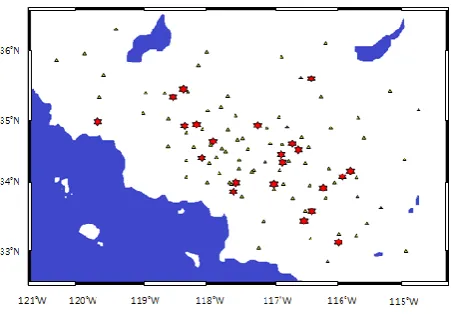
In this paper, we propose a method to estimate the position of an epicenter using RDOA methods. The vibration of the horizontal component until the arrival of the S-wave is called as the initial P-S time. The data in time-frequency domain is applied as a ratio of a STA/LTA to calculate the distance from the epicenter. We can find the location of the epicenter using the velocity of the P-wave and the S-wave and the P-S time. Using the difference between the distances which are measured from several observatories, we can estimate the epicenter location more accurately. To obtain a solution that minimizes the estimation error value, we propose the RWLS algorithm. We used seismic records of regional earthquake from the Southern California Seismic Network (SCSN) operated jointly by the United States Geological Survey [7]. Fig. 1 shows the distributions of the epicenters and the SCSN stations used in this paper.
Figure 1. Locations of seismic stations (triangles) of the Southern California Seismic Network (SCSN) and the epicenters of events (red
stars) used in this paper.
II. P-STIME DETECTION WITH INSTANTANEOUS
FREQUENCY
When the earthquake happens, the seismic signals are measured in the observation as P-wave and S-wave form, respectively. According to the differences of velocity and amplitude between P-wave and S-wave, P-S time can be determined. Although the P-wave and S-wave start at the same time, the S-wave arrives after the P-wave due to the difference of their propagation speed. The initial P-S time means the vibration of the horizontal component until the arrival of the S-wave. Fig. 2 shows that the interval between the arrival of the first P-wave and the arrival of the S-wave is P-S time.
0 5 10 15
-1 -0.8 -0.6 -0.4 -0.2 0 0.2 0.4 0.6 0.8 1 Time [sec] A m p lit u d e [ m m /s 2] P-S time P wave S wave Surface wave
Time(sec) A m pl it u de (m m /s 2)
Figure 2. Seismic data detection by seismometer.
STA/LTA algorithm is commonly used in seismology to detect P-S time [8]-[9]. This algorithm uses the overall average values of seismic wave data by moving the short time window and the long time window. We can improve the analyzing accuracy from the seismic data with a threshold trigger algorithm. STA/LTA algorithm parameters which are threshold values are determined by the seismic environments. This algorithm uses the two moving windows which have different window sizes. One has a short time window size and the other has a long time window size. As the short time window size of seismic wave needs to be measured for a short period, it is more sensitive to seismic signal. Assuming the amplitude of a seismic signal is defined as a t( ), the short-term average is represented as follows,
1 ( ) ( ) s k t k s
STA k a t
(1)where
s
means the short time window size. The long time window size of seismic wave has a slow slope. The long-term average is represented as follows,1 ( ) ( ) l k t k l
LTA k a t
(2)where
l means the long time window size. The distance from an observatory to the epicenter can be calculated by the following equation.p s ps e
p s
v v t D
v v
(3)
where vp and vs represents the velocity of P-wave and S-wave, respectively.
ps
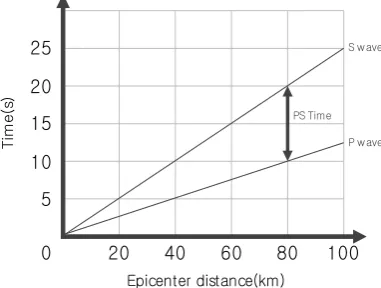
t denotes the P-S time which is obtained by STA/LTA algorithm. Fig. 3 shows that the P-S time gradually increases as the distance from the epicenter is increased. 5 10 15 20 25 T im e (s ) Epicenter distance(km)
0 20 40 60 80 100
S wave
P wave PS Time
Figure 3. Epicenter distance according to P-S time.
III. EPICENTER DETERMINATION AND ERROR
COMPENSATION
In this section, we can propose a method of the epicenter location measurement using RDOA algorithm [10]-[12]. The location of the epicenter can be predicted by applying the RDOA method to epicenter distance data. The RDOA measurements can be expressed as follows,
i i
r m n , i1, 2, ,M (4) where m[ , ]x yT is an unknown location of epicenter and
[ , ]
i i i
n x y is a known location of epicenter of i th observatory. In real condition, the measured RDOA data contains measurement error due to environmental noise. Assuming that there is no environmental error in the RDOA measurements, we can obtain the following linear equation.
1 1 1 1 1 1
2 2 2
1 1 1
( )( ) ( )( )
1
( ) ( )
2
i i i
i i i
x x x x y y y y r r
x x y y r
(5)
The (5) that represents the relation between the location of epicenter and the RDOA method can be rewritten as a following matrix form,
with
2 1 2 1 21
1 1 1
2 2 2
2 1 2 1 21
2 2 2
1 1 1
,
( ) ( )
( ) ( )
M M M
M M M
x x y y r
X
x x y y r
x x y y r
Y
x x y y r
(7)
where parameter vector
1 1 1
T
x x y y r
in (7) isthe solution of the formulated RDOA. We propose the RWLS algorithm to compensate a measurement error value [13]. The object function for minimizing error between the epicenter estimation and real one can be obtained as the following equation.
ˆ ˆ ˆ
( ) ( )T ( )
f
YX
W YX
(8) In (8),
ˆ denotes the estimated value of variable
. Considering the measurement error, the RDOA data is given by,[ T]
W E e e , e m m0 (9) where W represents the covariance matrix that determines the weight of each RDOA data value. The WLS solution that minimizes the sum of error resulted from each single equation can be expressed as follows,
1
ˆ (X WXT ) X WYT
(10)The RWLS algorithm is applied to the location equation based on the WLS solution. We use the RWLS algorithm to obtain a much more accurate location of epicenter with additional RDOA data. Compared to the WLS algorithm, the iterative process of the RWLS method also provides fast convergence rates. We need to represent other types of system equations to apply RWLS algorithm. Equation (6) can be rewritten as,
1 1 1 k k k k k X Y
X
Y (11) where k
Y and
k
X express the values which contain k s' past measurement data in equation (11).
1 k
Y and
1 k
X
represent (k+1)-th measured seismic data.
1
ˆ
k
can be obtained through the WLS algorithm as follows,1
1 1 1 1 1 1 1
ˆ ( T ) T
k Xk Wk Xk Xk W Yk k
(12)
With the definition of 1
1 ( 1 1 1)
T
k k k k
G X WX for a notational simplicity, the following equation can be derived.
1 1
1 1 1 1
T
k k k k k
G G X W X (13)
Using the (13), the (12) can be rewritten as follows,
1 1 1 1 1
ˆ T T
k Gk X W Yk k k Xk W Yk k
1
1 1 1 1
T T
k k k k k k k k k
G G G X W Y X W Y
(14)
The (14) can be rewritten as follows,
1
1 1 1 1 1
ˆ ˆ T
k Gk Gk k Xk W Yk k
1 1 1 1 1
ˆ T ˆ
k Gk Xk Wk Yk Xk k
(15)
The (15) is the solution of RWLS algorithm. The epicenter location is more accurately estimated through RWLS algorithm using the previously acquired data and additional measurement data.
IV. SIMULATION RESULTS
In this section, we prove the measurement of P-S time by using STA/LTA method. Finally, we also demonstrate the performance by comparing the root mean square error (RMSE) of the RWLS algorithm using RDOA data.
0 5 10 15
0 0.5 1 1.5 2 2.5 3 3.5 Time [sec] S T A /L T A STA/LTA
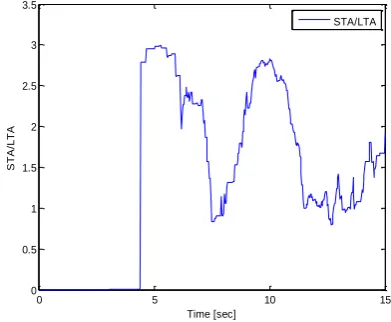
Figure 4. Estimation of STA/LTA ratio.
Fig. 4 shows the seismic wave data with STA/LTA algorithm. We use STA/LTA algorithm to measure P-S time for calculating the epicenter location. When STA/LTA value is over the threshold value, we can determine the P-wave arrival and S- wave arrival time, respectively. P-wave arrival time was measured as 5.1 second and S-wave arrival time was measured as 9.63 second, respectively. If we suppose the velocities of P-wave and S-wave as 8 km/s and 4 km/s, we can determine the distance to the epicenter as 36.24 km according to the (3).
Figure 5. The epicenter location using RDOA algorithm.
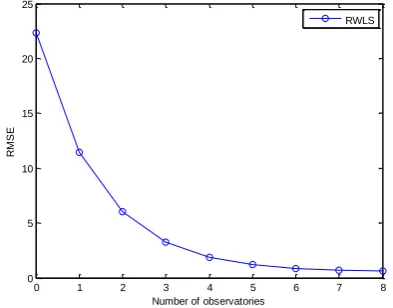
As a result, we can determine the estimated epicenter location. Fig. 6 shows that the RMSE of estimated location is decreased with the increased number of observatories. The RMSE of estimation converges to a minimized error that is calculated by optimized solution of an object function. The accuracy of epicenter location is improved when additional RDOA data is measured by a new observatory.
0 1 2 3 4 5 6 7 8
0 5 10 15 20 25
Number of observatories
R
M
S
E
RWLS
Figure 6. RMSE change for different number of observatories using RWLS algorithm.
V. CONCLUSION
In this paper, we suggested the RDOA based epicenter location estimation algorithm. We computed P-S time using STA/LTA algorithm and obtained the distance data between the epicenter and observatory through our proposed scheme. We precisely estimated the location of epicenter using the RDOA method based on a distance difference from epicenter to each observatory. Moreover, we proposed a RWLS based optimization method to minimize the estimation error of the epicenter. We confirmed that the epicenter location can be estimated more accurately by our proposed algorithm.
ACKNOWLEDGMENT
This work was supported by the National Research Foundation of Korea (NRF) grant funded by the Korea
REFERENCES
[1] W. H. Bakun and C. M. Wentworth, “Estimating earthquake location and magnitude from seismic intensity data,” Bulletin of the
Seismological Society of America, vol. 87, no. 6, pp. 1502-1521,
Dec. 1993.
[2] A. C. Chang, R. H. Shumway, R. R. Blandford, and B. W. Barker, “Two methods to improve location estimates-preliminary results,”
Bulletin of the Seismological Society of America, vol. 73, no. 1, pp.
281-295, Feb. 1983.
[3] I. Bondar, S. C. Myers, E. R. Engdahl, and E. A. Bergman, “Epicentre accuracy based on seismic network criteria,”
Geophysical Journal International, vol. 156, no. 3, pp. 483-496,
March 2004.
[4] W. Zhu, L. Sun, and X. Zhu, “New estimation algorithm for epicenter location of low frequency seismograms,” in Proc.
International Conference on Systems and Informatics, May 2009,
pp. 1706-1710.
[5] R. S. Jih, “Epicenter estimation using erroneous crustal model and skew regional networks,” Physics of the Earth and Planetary
Interiors, vol. 113, no. 4, pp. 303-319, June 1999.
[6] C. Satriano, A. Lomax, and A. Zollo, “Real-time evolutionary earthquake location for seismic early warning,” Bulletin of the
Seismological Society of America, vol. 98, no. 3, pp. 1482-1494,
June 2008.
[7] Y. M. Wu and L. Zhao, “Magnitude estimation using the first three seconds P-wave amplitude in earthquake early warning,”
Geophysical Research Letters, vol. 33, no. 23, Aug. 2006.
[8] R. Sleeman and T. V. Eck, “Robust automatic P-phase picking: an on-line implementation in the analysis of broadband seismogram recordings,” Physics of the Earth and Planetary Interiors, vol. 113, no. 4, pp. 265-274, June 1999.
[9] M. Withers, R. Aster, C. Young, J. Beiriger, M. Harris, S. Moore, and J. Trukillo, “A comparison of select trigger algorithms for automated global seismic phase and event detection,” Bulletin of
the Seismological Society of America, vol. 88, no. 1, pp. 95-106
Feb. 1998.
[10] J. Xu, M. Ma, and C. L. Law, “Performance of time difference of arrival ultra wideband indoor localisation,” IET Science,
Measurement and Technology, vol. 5, no. 2, pp. 46-53, March
2011.
[11] F. Gustafasson and F. Gunnarsson, “Positioning using time difference of arrival measurements,” IEEE Trans. Signal Process, vol. 6, pp. 553-556, April 2003.
[12] D. Musicki, R. Kaune, and W. Koch, “Mobile emitter geolocation and tracking using TDOA and FDOA measurements,” IEEE Trans.
Signal Process, vol. 58, no. 3, pp. 1863-1874, Nov. 2009.
[13] J. A. K. Suykens, J. D. Brabanter, L. Lukas, and J. Vandewalle, “Weighted least squakres suppor vector machines: robustness and sparse approximation,” Neurocomputing, vol. 48, no. 4, pp. 85-105, Oct. 2002.
Hyungkwan Kwon received his B.S. degree in
electrical engineering from Myongji University in 2017. He is working as a research staff in applied optimization lab. in Sungkyunkwan University. His research interests fields are seismic wave detection with laser interferometer, and sliding-mode control.
Younghun Pyo received his B.S. degree in