Iterative Annotation Transformation with Predict-Self Reestimation
for Chinese Word Segmentation
Wenbin Jiang and Fandong Meng and Qun Liu and Yajuan L ¨u
Key Laboratory of Intelligent Information Processing Institute of Computing Technology
Chinese Academy of Sciences
{jiangwenbin, mengfandong, liuqun, lvyajuan}@ict.ac.cn
Abstract
In this paper we first describe the technol-ogy of automatic annotation transformation, which is based on the annotation adaptation algorithm (Jiang et al., 2009). It can auto-matically transform a human-annotated cor-pus from one annotation guideline to another. We then propose two optimization strategies, iterative training and predict-self reestimation, to further improve the accuracy of annota-tion guideline transformaannota-tion. Experiments on Chinese word segmentation show that, the it-erative training strategy together with predict-self reestimation brings significant improve-ment over the simple annotation transforma-tion baseline, and leads to classifiers with sig-nificantly higher accuracy and several times faster processing than annotation adaptation does. On the Penn Chinese Treebank 5.0, it achieves an F-measure of 98.43%, signif-icantly outperforms previous works although using a single classifier with only local fea-tures.
1 Introduction
Annotation guideline adaptation depicts a general pipeline to integrate the knowledge of corpora with different underling annotation guidelines (Jiang et al., 2009). In annotation adaptation two classifiers are cascaded together, where the classification re-sults of the lower classifier are used as guiding fea-tures of the upper classifier, in order to achieve more accurate classification. This method can automat-ically adapt the divergence between different an-notation guidelines and bring improvement to
Chi-nese word segmentation. However, the need of cas-caded classification decisions makes it less practical for tasks of high computational complexity such as parsing, and less efficient to incorporate more than two annotated corpora.
In this paper, we first describe the algorithm of automatic annotation transformation. It is based on the annotation adaptation algorithm, and it focuses on the automatic transformation (rather than adapta-tion) of a human-annotated corpus from one annota-tion guideline to another. First, a classifier is trained on the corpus with an annotation guideline not de-sired, it is used to classify the corpus with the an-notation guideline we want, so as to obtain a corpus with parallel annotation guidelines. Then a second classifier is trained on the parallelly annotated cor-pus to learn the statistical regularity of annotation transformation, and it is used to process the previous corpus to transform its annotation guideline to that of the target corpus. Instead of the online knowl-edge integration methodology of annotation adapta-tion, annotation transformation can lead to improved classification accuracy in an offline manner by using the transformed corpora as additional training data for the classifier. This method leads to an enhanced classifier with much faster processing than the cas-caded classifiers in annotation adaptation.
We then propose two optimization strategies, iter-ative training and predict-self reestimation, to fur-ther improve the accuracy of annotation transfor-mation. Although the transformation classifiers can only be trained on corpora with autogenerated (rather than gold) parallel annotations, an iterative training procedure can gradually improve the
formation accuracy by iteratively optimizing the par-allelly annotated corpora. Both source-to-target and target-to-source annotation transformations are per-formed in each training iteration, and the trans-formed corpora are used to provide better annota-tions for the parallelly annotated corpora of the next iteration; then the better parallelly annotated corpora will result in more accurate transformation classi-fiers, which will generate better transformed corpora in the new iteration. The predict-self reestimation is based on the following hypothesis, a better trans-formation result should be easier to be transformed back to the original form. The predict-self heuristic is also validated by Daum´e III (2009) in unsuper-vised dependency parsing.
Experiments in Chinese word segmentation show that, the iterative training strategy together with predict-self reestimation brings significant improve-ment over the simple annotation transformation baseline. We perform optimized annotation trans-formation from the People’s Daily (Yu et al., 2001) to the Penn Chinese Treebank 5.0 (CTB) (Xue et al., 2005), in order to improve the word segmenter with CTB annotation guideline. Compared to anno-tation adapanno-tation, the optimized annoanno-tation transfor-mation strategy leads to classifiers with significantly higher accuracy and several times faster processing on the same data sets. On CTB 5.0, it achieves an F-measure of 98.43%, significantly outperforms pre-vious works although using a single classifier with only local features.
The rest of the paper is organized as follows. Section 2 describes the classification-based Chinese word segmentation method. Section 3 details the simple annotation transformation algorithm and the two optimization methods. After the introduction of related works in section 4, we give the experimental results on Chinese word segmentation in section 5.
2 Classification-Based Chinese Word
Segmentation
Chinese word segmentation can be formalized as the problem of sequence labeling (Xue and Shen, 2003), where each character in the sentence is given a boundary tag denoting its position in a word. Fol-lowing Ng and Low (2004), joint word segmenta-tion and part-of-speech (POS) tagging can also be
Algorithm 1 Perceptron training algorithm. 1: Input: Training examples(xi, yi)
2: α~ ←0
3: fort←1..Tdo
4: fori←1..Ndo
5: zi←argmaxz∈GEN(xi)Φ(xi, z)·~α 6: ifzi6=yithen
7: ~α←α~+Φ(xi, yi)−Φ(xi, zi)
8: Output: Parametersα~
solved in a character classification approach by ex-tending the boundary tags to include POS informa-tion. For word segmentation we adopt the 4 bound-ary tags of Ng and Low (2004),b,m,eands, where
b,mand emean the beginning, the middle and the end of a word, and s indicates a single-character word. The word segmentation result can be gen-erated by splitting the labeled character sequence into subsequences of pattern sorbm∗e, indicating single-character words or multi-character words, re-spectively.
We choose the perceptron algorithm (Collins, 2002) to train the character classifier. It is an online training algorithm and has been successfully used in many NLP tasks, including POS tagging (Collins, 2002), parsing (Collins and Roark, 2004) and word segmentation (Zhang and Clark, 2007; Jiang et al., 2008; Zhang and Clark, 2010).
The training procedure learns a discriminative model mapping from the inputsx∈Xto the outputs
y ∈Y, whereXis the set of sentences in the train-ing corpus andY is the set of corresponding labeled results. We use the functionGEN(x)to enumerate
the candidate results of an inputx, and the function
Φto map a training example (x, y) ∈ X ×Y to a
feature vector Φ(x, y) ∈ Rd. Given the character
sequence x, the decoder finds the outputF(x) that maximizes the score function:
F(x) = argmax
y∈GEN(x)
S(y|~α,Φ, x) = argmax
y∈GEN(x)
Φ(x, y)·~α (1)
Whereα~ ∈ Rdis the parameter vector (that is, the discriminative model) and Φ(x, y)·~α is the inner
product ofΦ(x, y)and~α.
Type Feature Templates
Unigram C−2 C−1 C0
C1 C2
Bigram C−2C−1 C−1C0 C0C1
C1C2 C−1C1
Property P u(C0)
[image:3.612.316.538.59.231.2]T(C−2)T(C−1)T(C0)T(C1)T(C2)
Table 1: Feature templates for classification-based Chi-nese segmentation model.
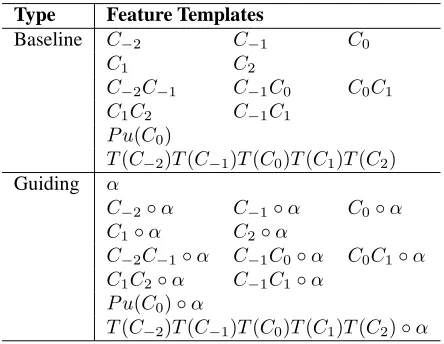
technology (Collins, 2002) is used for better per-formance. The feature templates for the classifier is shown in Table 1. C0 denotes the current char-acter, whileC−i/Ci denote the ith character to the left/right of C0. The function P u(·) returns true for a punctuation character and false for others, the function T(·) classifies a character into four types: number, date, English letter and others.
3 Iterative and Predict-Self Annotation
Transformation
This section first describes the technology of au-tomatic annotation transformation, then introduces the two optimization strategies, iterative training and predict-self reestimation. Iterative training takes a global view, it conducts several rounds of bidi-rectional annotation transformations, and improve the transformation performance round by round. Predict-self reestimation takes a local view instead, it considers each training sentence, and improves the transformation performance by taking into account the predication result of the reverse transformation. The two strategies can be adopted jointly to obtain better transformation performance.
3.1 Automatic Annotation Transformation
Annotation adaptation can integrate the knowledge from two corpora with different underling annota-tion guidelines. First, a classifier (source classi-fier) is trained on the corpus (source corpus) with an annotation standard (source annotation) not de-sired, it is then used to classify the corpus (target corpus) with the annotation standard (target annota-tion) we want. Then a second classifier (transforma-tion classifier1) is trained on the target corpus with
1It is called target classifier in (Jiang et al., 2009). We
think that transformation classifier better reflects its role, the
Type Feature Templates
Baseline C−2 C−1 C0
C1 C2
C−2C−1 C−1C0 C0C1
C1C2 C−1C1
P u(C0)
T(C−2)T(C−1)T(C0)T(C1)T(C2)
Guiding α
C−2◦α C−1◦α C0◦α
C1◦α C2◦α
C−2C−1◦α C−1C0◦α C0C1◦α
C1C2◦α C−1C1◦α
P u(C0)◦α
[image:3.612.81.290.59.147.2]T(C−2)T(C−1)T(C0)T(C1)T(C2)◦α
Table 2: Feature templates for annotation transformation, whereαis short forα(C0), representing the source
an-notation ofC0.
the source classifier’s classification result as guid-ing features. In decodguid-ing, a raw sentence is first de-coded by the source classifier, and then inputted into the transformation classifier together with the anno-tations given by the source classifier, so as to obtain an improved classification result.
However, annotation adaptation has a drawback, it has to cascade two classifiers in decoding to inte-grate the knowledge in two corpora, thus seriously degrades the processing speed. This paper describes a variant of annotation adaptation, name annotation transformation, aiming at automatic transformation (rather than adaptation) between annotation stan-dards of human-annotated corpora. In annotation transformation, a source classifier and a transforma-tion classifier are trained in the same way as in an-notation adaptation. The transformation classifier is used to process the source corpus, with the classi-fication label derived from the segmented sentences as the guiding features, so as to relabel the source corpus with the target annotation guideline. By inte-grating the target corpus and the transformed source corpus for the training of the character classifier, im-proved classification accuracy can be achieved.
Both the source classifier and the transforma-tion classifier are trained with the perceptron algo-rithm. The feature templates used for the source classifier are the same with those for the baseline
Algorithm 2 Baseline annotation transformation. 1: function ANNOTRANS(Cs,Ct)
2: Ms←TRAIN(Cs)
3: Cs
t ←ANNOTATE(Ms,Ct)
4: Ms→t←TRANSTRAIN(Cts,Ct)
5: Ct
s←TRANSANNOTATE(Ms→t,Cs)
6: Ct
∗← C
t s∪ Ct
7: returnCt
∗
8: function DECODE(M,Φ,x)
9: returnargmaxy∈GEN(x)S(y|M,Φ, x)
character classifier. The feature templates for the transformation classifier are the same with those in annotation adaptation, as listed in Table 2. Al-gorithm 2 shows the overall training algorithm for annotation transformation. Cs and Ct denote the source corpus and the target corpus; Ms and
Ms→t denote the source classifier and the trans-formation classifier; Cpq denotes the p corpus re-labeled in q annotation guideline, for example Ct s is the source corpus transformed to target annota-tion guideline; Funcannota-tions TRAINand TRANSTRAIN both invoke the perceptron algorithm, yet with different feature sets; Functions ANNOTATE and TRANSANNOTATE call the function DECODE with different models (source/transformation classifiers), feature functions (without/with guiding features), and inputs (raw/source-annotated sentences).
The best training iterations for the functions TRAINand TRANSTRAINare determined on the de-veloping sets of the source corpus and the target corpus, respectively. In the algorithm the param-eters corresponding to developing sets are omitted for simplicity. Compared to the online knowledge integration methodology of annotation adaptation, annotation transformation leads to improved perfor-mance in an offline manner by integrating corpora before the training procedure. This manner could achieve processing several times as fast as the cas-caded classifiers in annotation adaptation. In the fol-lowing we will describe the two optimization strate-gies in details.
3.2 Iterative Training for Annotation Transformation
The training of annotation transformation is based on an auto-generated (rather than gold) parallelly an-notated corpus, where the source annotation is
pro-Algorithm 3 Iterative annotation transformation. 1: function ITERANNOTRANS(Cs,Ct)
2: Ms←TRAIN(Cs)
3: Cs
t ←ANNOTATE(Ms,Ct)
4: Mt←TRAIN(Ct)
5: Ct
s←ANNOTATE(Mt,Cs)
6: repeat
7: Ms→t←TRANSTRAIN(Cst,Ct)
8: Mt→s←TRANSTRAIN(Cts,Cs)
9: Ct
s←TRANSANNOTATE(Ms→t,Cs)
10: Cs
t ←TRANSANNOTATE(Mt→s,Ct)
11: Ct
∗← C
t s∪ Ct
12: M∗←TRAIN(C∗t)
13: until EVAL(M∗)converges
14: returnCt
∗
15: function DECODE(M,Φ,x)
16: returnargmaxy∈GEN(x)S(y|M,Φ, x)
vided by the source classifier. Therefore, the perfor-mance of transformation training is correspondingly determined by the accuracy of the source classifier.
We propose an iterative training procedure to gradually improve the transformation accuracy by iteratively optimizing the parallelly annotated cor-pora. In each training iteration, both source-to-target and target-to-source annotation transformations are performed, and the transformed corpora are used to provide better annotations for the parallelly anno-tated corpora of the next iteration. Then in the new iteration, the better parallelly annotated corpora will result in more accurate transformation classifiers, so as to generate better transformed corpora.
Algorithm 3 shows the overall procedure of the iterative training method. The loop of lines 6-13 iteratively performs source-to-target and target-to-source annotation transformations. The target-to-source an-notations of the parallelly annotated corpora,Cs
t and
Ct
s, are initialized by applying the source and tar-get classifiers respectively on the tartar-get and source corpora (lines 2-5). In each training iteration, the transformation classifiers are trained on the current parallelly annotated corpora (lines 7-8), they are used to produce the transformed corpora (lines 9-10) which provide better annotations for the parallelly annotated corpora of the next iteration. The itera-tive training terminates when the performance of the classifier trained on the merged corpusCt
The discriminative training of TRANSTRAIN pre-dicts the target annotations with the guidance of source annotations. In the first iteration, the trans-formed corpora generated by the transformation classifiers are better than the initialized ones gener-ated by the source and target classifiers, due to the assistance of the guiding features. In the follow-ing iterations, the transformed corpora provide bet-ter annotations for the parallelly annotated corpora of the subsequent iteration, the transformation ac-curacy will improve gradually along with optimiza-tion of the parallelly annotated corpora until conver-gence.
3.3 Predict-Self Reestimation for Annotation Transformation
The predict-self hypothesis is implicit in many unsu-pervised learning approaches, such as Markov ran-dom field. This methodology has also been success-fully used by Daum´e III (2009) in unsupervised de-pendency parsing. The basic idea of predict-self is that, if a prediction is a better candidate for an input, it can be easier converted back to the original input by a reverse procedure. If applied to the task of an-notation transformation, predict-self indicates that a better transformation candidate following the target annotation guideline can be easier transformed back to the original form following the source annotation guideline.
The most intuitionistic strategy to introduce the predict-self methodology into annotation transfor-mation is using a reversed annotation transforma-tion procedure to filter out unreliable predictransforma-tions of the previous transformation. In detail, a source-to-target annotation transformation is performed on the source annotated sentence to obtain a prediction that follows the target annotation guideline, then a sec-ond, target-to-source transformation is performed on this prediction result to check whether it can be transformed back to the previous source annota-tion. Transformation results failing in this reversal verification are discarded, so this strategy is named predict-self filtration.
A more precious strategy can be called predict-self reestimation. Instead of using the reversed transformation procedure for filtration, the rees-timation strategy integrates the scores given by the source-to-target and target-to-source annotation
transformation models when evaluating the transfor-mation candidates. By properly tuning the relative weights of the two transformation directions, bet-ter transformation performance would be achieved. The scores of the two transformation models are weighted integrated in a log-linear manner:
S+(y|Ms→t,Mt→s,Φ, x) = (1−λ)×S(y|Ms→t,Φ, x)
+λ×S(x|Mt→s,Φ, y)
(2)
The weight parameter λ is tuned on the develop-ing set. To integrating the predict-self reestima-tion into the iterative transformareestima-tion training, a re-versed transformation model is introduced and the enhanced scoring function above is used when the function TRANSANNOTATE invokes the function DECODE.
4 Related Works
Researches focused on the automatic adaptation between different corpora can be roughly clas-sified into two kinds, adaptation between differ-ent domains (with differdiffer-ent statistical distribution) (Blitzer et al., 2006; Daum´e III, 2007), and adapta-tion between different annotaadapta-tion guidelines (Jiang et al., 2009; Zhu et al., 2011). There are also some efforts that totally or partially resort to man-ual transformation rules, to conduct treebank con-version (Cahill and Mccarthy, 2002; Hockenmaier and Steedman, 2007; Clark and Curran, 2009), and word segmentation guideline transformation (Gao et al., 2004; Mi et al., 2008). This work focuses on the automatic transformation between annotation guidelines, and proposes better annotation transfor-mation technologies to improve the transfortransfor-mation accuracy and the utilization rate of human-annotated knowledge.
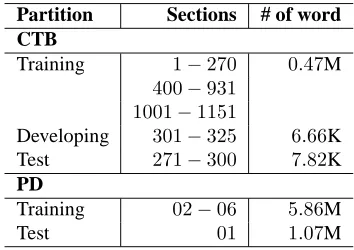
Partition Sections # of word CTB
Training 1−270 0.47M 400−931
1001−1151
Developing 301−325 6.66K
Test 271−300 7.82K
PD
Training 02−06 5.86M
[image:6.612.96.273.59.184.2]Test 01 1.07M
Table 3: Data partitioning for CTB and PD.
to train the transformation models. The predict-self methodology is implicit in many unsupervised learning approaches, it has been successfully used by (Daum´e III, 2009) in unsupervised dependency parsing. We adapt this idea to the scenario of anno-tation transformation to improve transformation ac-curacy.
In recent years many works have been devoted to the word segmentation task. For example, the in-troduction of global training or complicated features (Zhang and Clark, 2007; Zhang and Clark, 2010); the investigation of word structures (Li, 2011); the strategies of hybrid, joint or stacked modeling (Nakagawa and Uchimoto, 2007; Kruengkrai et al., 2009; Wang et al., 2010; Sun, 2011), and the semi-supervised and unsemi-supervised technologies utilizing raw text (Zhao and Kit, 2008; Johnson and Gold-water, 2009; Mochihashi et al., 2009; Hewlett and Cohen, 2011). We estimate that the annotation trans-formation technologies can be adopted jointly with complicated features, system combination and semi-supervised/unsupervised technologies to further im-prove segmentation performance.
5 Experiments and Analysis
We perform annotation transformation from Peo-ple’s Daily (PD) (Yu et al., 2001) to Penn Chi-nese Treebank 5.0 (CTB) (Xue et al., 2005), follow-ing the same experimental settfollow-ing as the annotation adaptation work (Jiang et al., 2009) for convenience of comparison. The two corpora are segmented fol-lowing different segmentation guidelines and differ largely in quantity of data. CTB is smaller in size with about 0.5M words, while PD is much larger, containing nearly6M words.
Test on (F1%)
Train on CTB SPD
[image:6.612.327.522.60.109.2]CTB 97.35 86.65(↓10.70) SPD 91.23(↓3.02) 94.25
Table 4: Performance of the perceptron classifiers for Chinese word segmentation.
Model Time (s) Accuracy (F1%)
Merging 1.33 93.79 Anno. Adapt. 4.39 97.67 Anno. Trans. 1.33 97.69 Baseline 1.21 97.35
Table 5: Comparison of the baseline annotation transfor-mation, annotation adaptation and a simple corpus merg-ing strategy.
To approximate more general scenarios of anno-tation adapanno-tation problems, we extract from PD a subset which is comparable to CTB in size. We ran-domly select20,000sentences (0.45M words) from the PD training data as the new training set, and
1000/1000 sentences from the PD test data as the new test/developing set.2 We name the smaller ver-sion of PD as SPD. The balanced source corpus and target corpus also facilitate the investigation of an-notation transformation.
5.1 Baseline Classifiers for Word Segmentation
We train the baseline perceptron classifiers de-scribed in section 2 on the training sets of SPD and CTB, using the developing sets to determine the best training iterations. The performance measure-ment indicators for word segmeasure-mentation is balanced F-measure,F = 2P R/(P +R), a function of Pre-cisionP and Recall R. whereP is the percentage of words in segmentation result that are segmented correctly, andR is the percentage of correctly seg-mented words in the gold standard words.
Accuracies of the baseline classifiers are listed in Table 4. We also report the performance of the clas-sifiers on the test sets of the opposite corpora. Ex-perimental results are in line with our expectations. A classifier performs better in its corresponding test set, and performs significantly worse on a test set following a different annotation guideline.
2
95.4 95.6 95.8 96 96.2 96.4
0 1 2 3 4 5 6 7 8 9 10
Accuracy (F%)
[image:7.612.332.526.62.204.2]Training iterations Iterative training Baseline annotation transformation
Figure 1: Learning curve of iterative training for annota-tion transformaannota-tion.
5.2 Annotation Transformation vs. Annotation Adaptation
Experiments of annotation transformation are con-ducted on the direction of SPD-to-CTB. The trans-formed corpus can be merged into the regular cor-pus, so as to train an enhanced classifier. As com-parison, the cascaded model of annotation adapta-tion (Jiang et al., 2009) is faithfully implemented (yet using our feature representation) and tested on the same adaptation direction.
Table 5 shows the performances of the classi-fiers resulted by the baseline annotation transforma-tion and annotatransforma-tion adaptatransforma-tion, as well as the clas-sifier trained on the directly merged corpus. The time costs for decoding are also listed to facilitate the comparison of practicality. We find that the sim-ple corpus merging strategy leads to dramatic de-crease in accuracy, due to the different and incom-patible annotation guidelines. The baseline annota-tion transformaannota-tion method leads to a classifier with accuracy increment comparable to that of the anno-tation adapanno-tation strategy, while consuming only one third of the decoding time.
5.3 Iterative Training with Predict-Self Reestimation
We adopt the iterative training strategy to the base-line annotation transformation model. The CTB de-veloping set is used to determine the best training iteration for annotation transformation from SPD to CTB. After each iteration, we test the performance of the classifier trained on the merged corpus. Fig-ure 1 shows the performance curve, with iterations
95.4 95.6 95.8 96 96.2 96.4
0 0.1 0.2 0.3 0.4 0.5 0.6 0.7 0.8 0.9 1
Accuracy (F%)
Predict-self ratio Predict-self reestimation
[image:7.612.92.287.63.203.2]Predict-self filtration Baseline annotation transformation
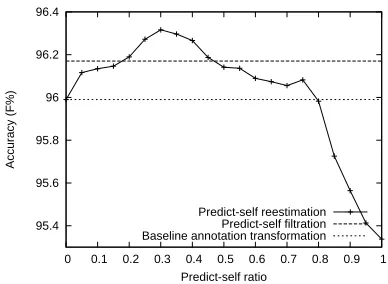
Figure 2: Performance of predict-self filtration and predict-self reestimation.
95.4 95.6 95.8 96 96.2 96.4
0 1 2 3 4 5 6 7 8 9 10
Accuracy (F%)
Training iterations Iterative training with predict-self reestimation
[image:7.612.330.527.258.397.2]Iterative training
Figure 3: Learning curve of iterative training with predict-self reestimation for annotation transformation.
ranging from1to10. The performance of the base-line annotation transformation model is naturally in-cluded in the curve (located at iteration 1). The curve shows that the performance of the classifier trained on the merged corpus consistently improves from iteration2to iteration5.
Model Time (s) Accuracy (F1%)
SPD→CTB
Anno. Adapt. 4.39 97.67 Opt. Trans. 1.33 97.97
PD→CTB
Anno. Adapt. 4.76 98.15 Opt. Trans. 1.37 98.43
Previous Works
(Jiang et al., 2008) 97.85 (Kruengkrai et al., 2009) 97.87 (Zhang and Clark, 2010) 97.79
[image:8.612.86.282.58.207.2](Sun, 2011) 98.17
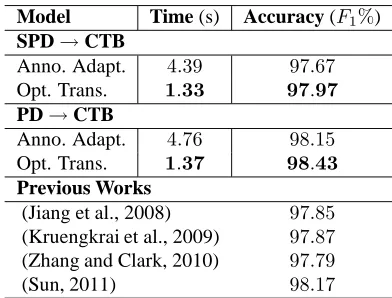
Table 6: The performance of the iterative annotation transformation with predict-self reestimation compared with annotation adaptation.
shows that, the filtration discards 5% of the train-ing sentences and these discarded sentences contain nearly10% of training words. It can be confirmed that the sentences discarded by predict-self filtra-tion are much longer and more complicated. With a properly tuned weight, predict-self reestimation can make better use of the training data. The best F-measure improvement achieved over the annotation transformation baseline is0.3points, a little worse than that brought by iterative training.
Figure 3 shows the performance curve of iterative annotation transformation with predict-self reesti-mation. We find that the predict-self reestimation brings improvement to the iterative training at each iteration. The maximum performance is achieved at iteration 4. The corresponding model is evalu-ated on the test set of CTB, table 6 shows the ex-perimental results. Compared to annotation adapta-tion, the optimized annotation transformation strat-egy leads to a classifier with significantly higher ac-curacy and several times faster processing. When using the whole PD as the source corpus, the final classifier 3 achieves an F-measure of98.43%, sig-nificantly outperforms previous works although us-ing a sus-ingle classifier with only local features. Of course, the comparison between our system and pre-vious works without using additional training data is unfair. This work aim to find another way to im-prove Chinese word segmentation, which focuses on the collection of more training data instead of
mak-3The predict-self reestimation ratioλis fixed after the first
training iteration for efficiency.
ing full use of a certain corpus. We believe that the performance can be further improved by adopting the advanced technologies of previous works, such as complicated features and model combination.
Considering the fact that today some corpora for word segmentation are really large (usually tens of thousands of sentences), it is necessary to ob-tain the latest CTB and investigate whether and how much does annotation transformation bring im-provement to a much higher baseline. On the other hand, it is valuable to conduct experiments with more source-annotated training data, such as the SIGHAN dataset, to investigate the trend of im-provement along with the increment of the addi-tional annotated sentences. It is also valuable to evaluate the improved word segmenter on the out-of-domain datasets. However, currently most cor-pora for Chinese word segmentation do not explic-itly distinguish the domains of their data sections, it makes such evaluations difficult to conduct.
6 Conclusion and Future Works
In this paper, we first describe an annotation trans-formation algorithm to automatically transform a human-annotated corpus from one annotation guide-line to another. Then we propose two optimization strategies, iterative training and predict-self reesti-mation, to further improve the accuracy of anno-tation guideline transformation. On Chinese word segmentation, the optimized annotation transforma-tion strategy leads to classifiers with obviously bet-ter performance and several times fasbet-ter processing on the same datasets, compared to annotation adap-tation. When adopting the whole PD as the source corpus, the final classifier significantly outperforms previous works on CTB 5.0, although using a single classifier with only local features.
As future works, we will investigate the accel-eration of the iterative training and the weight pa-rameter tuning, and extend the optimized annotation transformation strategy to joint Chinese word seg-mentation and POS tagging, parsing and other NLP tasks.
Acknowledgments
and 61100082, and 863 State Key Project No. 2011AA01A207. We are grateful to the anonymous reviewers for their thorough reviewing and valuable suggestions.
References
John Blitzer, Ryan McDonald, and Fernando Pereira. 2006. Domain adaptation with structural correspon-dence learning. In Proceedings of EMNLP.
Aoife Cahill and Mairead Mccarthy. 2002. Automatic annotation of the penn treebank with lfg f-structure in-formation. In in Proceedings of the LREC Workshop. Stephen Clark and James R. Curran. 2009. Comparing
the accuracy of ccg and penn treebank parsers. In Pro-ceedings of ACL-IJCNLP.
Michael Collins and Brian Roark. 2004. Incremental parsing with the perceptron algorithm. In Proceedings of ACL 2004.
Michael Collins. 2002. Discriminative training meth-ods for hidden markov models: Theory and experi-ments with perceptron algorithms. In Proceedings of EMNLP, pages 1–8, Philadelphia, USA.
Hal Daum´e III. 2007. Frustratingly easy domain adapta-tion. In Proceedings of ACL.
Hal Daum´e III. 2009. Unsupervised search-based struc-tured prediction. In Proceedings of ICML.
Jianfeng Gao, Andi Wu, Mu Li, Chang-Ning Huang, Hongqiao Li, Xinsong Xia, and Haowei Qin. 2004. Adaptive chinese word segmentation. In Proceedings of ACL.
Daniel Hewlett and Paul Cohen. 2011. Fully unsuper-vised word segmentation with bve and mdl. In Pro-ceedings of ACL.
Julia Hockenmaier and Mark Steedman. 2007. Ccgbank: a corpus of ccg derivations and dependency structures extracted from the penn treebank. In Computational Linguistics, volume 33(3), pages 355–396.
Wenbin Jiang, Liang Huang, Yajuan Lv, and Qun Liu. 2008. A cascaded linear model for joint chinese word segmentation and part-of-speech tagging. In Proceed-ings of ACL.
Wenbin Jiang, Liang Huang, and Qun Liu. 2009. Au-tomatic adaptation of annotation standards: Chinese word segmentation and pos tagging–a case study. In Proceedings of the 47th ACL.
Mark Johnson and Sharon Goldwater. 2009. Improving nonparameteric bayesian inference: experiments on unsupervised word segmentation with adaptor gram-mars. In Proceedings of NAACL.
Canasai Kruengkrai, Kiyotaka Uchimoto, Junichi Kazama, Yiou Wang, Kentaro Torisawa, and Hitoshi
Isahara. 2009. An error-driven word-character hybrid model for joint chinese word segmentation and pos tagging. In Proceedings of ACL-IJCNLP.
Zhongguo Li. 2011. Parsing the internal structure of words: A new paradigm for chineseword segmenta-tion. In Proceedings of ACL.
Haitao Mi, Deyi Xiong, and Qun Liu. 2008. Research on strategy of integrating chinese lexical analysis and parser. In Journal of Chinese Information Processing. Daichi Mochihashi, Takeshi Yamada, and Naonori Ueda. 2009. Bayesian unsupervised word segmentation with nested pitman-yor language modeling. In Proceedings of ACL-IJCNLP.
Tetsuji Nakagawa and Kiyotaka Uchimoto. 2007. A hy-brid approach to word segmentation and pos tagging. In Proceedings of ACL.
Hwee Tou Ng and Jin Kiat Low. 2004. Chinese part-of-speech tagging: One-at-a-time or all-at-once? word-based or character-word-based? In Proceedings of EMNLP. Anoop Sarkar. 2001. Applying co-training methods to
statistical parsing. In Proceedings of NAACL.
Weiwei Sun. 2011. A stacked sub-word model for joint chinese word segmentation and part-of-speech tagging. In Proceedings of ACL.
Kun Wang, Chengqing Zong, and Keh-Yih Su. 2010. A character-based joint model for chinese word segmen-tation. In Proceedings of COLING.
Nianwen Xue and Libin Shen. 2003. Chinese word seg-mentation as lmr tagging. In Proceedings of SIGHAN Workshop.
Nianwen Xue, Fei Xia, Fu-Dong Chiou, and Martha Palmer. 2005. The penn chinese treebank: Phrase structure annotation of a large corpus. In Natural Lan-guage Engineering.
Shiwen Yu, Jianming Lu, Xuefeng Zhu, Huiming Duan, Shiyong Kang, Honglin Sun, Hui Wang, Qiang Zhao, and Weidong Zhan. 2001. Processing norms of mod-ern chinese corpus. Technical report.
Yue Zhang and Stephen Clark. 2007. Chinese segmenta-tion with a word-based perceptron algorithm. In Pro-ceedings of ACL 2007.
Yue Zhang and Stephen Clark. 2010. A fast decoder for joint word segmentation and pos-tagging using a sin-gle discriminative model. In Proceedings of EMNLP. Hai Zhao and Chunyu Kit. 2008. Unsupervised
segmen-tation helps supervised learning of character tagging for word segmentation and named entity recognition. In Proceedings of SIGHAN Workshop.