RATIO CHANGES OF SELECTED COMPONENTS OF BODY COMPOSITION
AFTER LYMPHATIC MASSAGE
Jarmila Riegerová, Aleš Gába, Michal Valenta, Ondřej Chromý
Faculty of Physical Culture, Palacký University, Olomouc, Czech Republic
Submitted in September, 2009
BACKROUND: The application of lymphatic massages has a highly preventive eff ect as it reinforces the drainage and transport functions of the lymph pump and thus activates the lymphatic fl ow and helps detoxify the body.
OBJECTIVE: This pilot report inquires into the eff ect of lymphatic massages on selected components of body composition.
METHODS: We conducted an examination of body composition using the InBody 720 device (multifrequency bioelectrical impedance analysis) in a population of 30 women before and after having received practical training in lymphatic massages. Our study has pilot features due to professional selection and the low number of participants. We have presented a data analysis which defi nes the population anthropometrically (in terms of body height and weight and body mass index), waist hip ratio, body fat mass, skeletal muscle mass, rate changes in body water (total body water, intr acellular water, extracellular water), proteins, total minerals, bone mineral content and changes to Edema indexes. RESULTS: A signifi cant reduction of total body water (p = 0.042, = 0.0) and Edema 2 (p = 0.021, = 0.1) was indicated in the massaged area. In the case of Edema 1, signifi cant eff ects of lymphatic massage were determined in both the right (p = 0.042, = 0.4) and the left (p = 0.012, = 0.2) upper extremity, and the left lower extremity (p = 0.014, = 0.2). Signifi cant diff erences in Edema 2 were found in both the upper and lower extremities (p < 0.05) between the 1st and 2nd examination. A reduction and equilibration to the standard deviation values was also shown.
CONCLUSIONS: Our results suggest the necessity of repeating the experiment in a diff erent time frame.We con-fi rm the positive intervention of lymphatic massage on the interstitium and cellular body environment.
Keywords: InBody 720, body water, reconditioning, women.
INTRODUCTION
The lymphatic system provides drainage, transporta-tion and immunological functransporta-tions to the organism. The adequate function of the lymphatic system is a princi-ple of balance preservation between the absorption and transport capacity of lymphatic circulation and tissue proteolysis. Lymphatic capillaries originate at the capil-lary lymphatic pump in the intercellular spaces which are suff used with extracellular water. Almost every tissue cell receives oxygen and nutrients (carbohydrates, lipids and amino acids) from the extracellular water (ECW) and drains carbon dioxide and metabolism products within it. Cells, molecules and possibly microorganisms sized 20 µm pass through the endothelium of the lym-phatic capillaries. Blood capillaries also continuously transmit up to 200 mg of blood proteins daily into the interstitial tissue and lymphatic circulation is essential for its return to the blood circulation path. An impair-ment of the given balance results in the congestion of proteins and other macromolecular substances in the tissues. Proteins bind water osmotically and thus cause oedemas to develop (Benda et al., 2007).
ECW represents on average 16% to 20% of the body weight; approximately 20 litres of ECW is produced within 24 hours; the absorbed amount in the capillary blood circulation system presents approximately 80% of ECW. The residual 20% must be drained by lymphatic circulation. Lymphokinetic factors (such as muscle con-tractions, subcutaneous tissue movement, changes in intraabdominal pressure, respiratory movements of the thorax, pulse wave, etc.) help the lymph fl ow. Intracel-lular water is the principal metabolically active compo-nent of the cellular cytoplasm (Johnston, 2008).
and pain and for enhancing the rate and the quality of healing (Premkumar, 2003). It has had a positive ef-fect during the recovery of and physiotherapy treatment for sportspeople. Sports therapists are concerned with promoting healing, restoring normal function following injury and achieving optimum performance from their clients. Massage can assist with each of these process-es by acting upon arterial and venous blood fl ow, the blood clotting process, oedema, lymphatic drainage and the properties of connective tissue and muscle (Goats, 1994).
METHODS Research group
We conducted an examination of body composition using the InBody 720 device (multifrequency bioelec-trical impedance analysis) in the second half of two courses which were dedicated to practical training of lymphatic massages during which the students should have mastered stroke technique. Thus we worked with al-ready partially optimized body environment conditions. We examined 30 women across a wide age range (22 to 59 years of age); this population was professionally selected (physiotherapists, masseuses). The examination was conducted in the morning prior to beginning the massage teaching and before the end of the teaching day. The 1st and the 2nd examination were separated by 8 hours. All participants performed mutual lymphatic massages to the neck and upper extremity. The acquired data was subsequently processed collectively and by de-cenniums due to the diverse age range. In the latter case, the population was divided into 4 sub-populations with a low number of participants.
Aim and Proceedings
We monitored the effect of lymphatic massages on body composition and examination stability. We have presented a data analysis which anthropometri-cally defi nes the population (in terms of body height and weight, body mass index – BMI), waist hip ratio (WHR), absolute and relative amount of the body fat mass (BFM), skeletal muscle mass (SMM), rate changes of body water (total body water – TBW, intracellular water – ICW, extracellular water – ECW), proteins, total minerals, bone mineral content (BMC) and changes to Edema 1 and Edema 2.
Fat is the principal and a highly variable component of the human body. To diagnose obesity, we used BMI (a value of 30 kg/m2 and more units was considered to
be a risk margin), fat percentage (a value above 28% was considered to be the risk margin in women; Heyward & Wagner, 2004), WHR (a value above 0.85 units was
considered to be a risk margin in women; Riegerová, Přidalová, & Ulbrichová, 2006), visceral fat area (VFA) and obesity degree. Visceral fat predicates abdominal obesity. Accumulation of fat in the visceral region plays an important role in the ethiopathogenesis of serious non infectious diseases of collective incidence such as diabetes mellitus, ischemic heart disease, myocardial in-farction, hypertension, etc. The abdominal obesity risk margin is above 100 cm2 (moderate risk: 100–150 cm2,
high risk: > 150 cm2; Biospace, 2008).
Proteins qualify the absolute representation of pro-teins in the body, whereas minerals qualify the absolute representation of minerals. They are part of dry body mass. Minerals can be further divided into bone miner-als and non bone minerminer-als.
Edema 1 presents information on the amount of wa-ter in the extracellular environment. Standard values of Edema 1 (ECW/TBW) range between 0.36–0.40; the formation of oedema can occur if the index value exceeds 0.40. Edema 2 relates to the determination of ECW/TBW ratio with added proteins and minerals in a 2:1 ratio. Values exceeding 0.36 again predicate the formation of oedemas.
Statistical processing
The acquired data has been processed collectively and by decenniums due to the varied age range. In the latter case, the population was divided into 4 sub popu-lations with a low number of participants. The data was analysed using Statistica 8 software (StatSoft, 2008). The diff erences were analysed using the pair t-test, Wil-coxon test, and the eff ect size. (Cramer’s phi) was used for the determination of eff ect size between two vari-ables. In terms of Cramer’s phi we distingu ish among small (0.10 < < 0.29), medium (0.30 < < 0.49) and large eff ects ( > 0.50). Our study has pilot features.
RESULTS AND DISCUSSION
TABLE 1
The basic statistical characteristics of selected body composition data (InBody 720, n = 30)
Characteristic 1st examination 2nd examination
M SD M SD
Age (years) 39.75 11.33 39.75 11.33 Height (cm) 168.00 6.45 168.00 6.45 Weight (kg) * 68.02 15.81 68.29 15.81 BMI (kg/m2) * 23.89 4.19 23.98 4.19
BFM (kg) * 18.82 8.94 19.34 9.51
BFM (%) * 26.50 6.23 26.98 6.84
WHR 0.86 0.05 0.86 0.05
VFA (cm2) 79.76 38.98 79.92 38.18
SMM (kg) 27.05 4.43 26.88 4.12
Proteins (kg) 9.63 1.47 9.56 1.36 Minerals (kg) 3.52 0.61 3.50 0.58
BMC (kg) 2.91 0.52 2.91 0.50
Recommended BMC (kg)
2.62 0.20 2.62 0.20
ICW (l) 22.27 3.41 22.15 3.17
ECW(l) 13.79 2.13 13.75 2.03
TBW (l) * 36.06 5.52 35.90 5.18
Legend:
diff erences between 1st and the 2nd examination were analysed by pair t-test (* p < 0.05)
This is related to the signifi cance of changes in the reduction of TBW (p = 0.042, = 0.0). Intracellular water passed through greater reduction than extracel-lular, but those differences did not reach statistical signifi cance. The reduction of the standard deviation values of all body water components also supports the claim that lymphatic massages have a positive eff ect on the interstitium and cellular environment of the body.
The weight amount of the muscle component, pro-teins and total minerals encountered a small reduction in relationship to TBW reduction, but without any statis-tical signifi cance of those diff erences. Skeletal muscles have a 39.76% share in the total weight.The amount of bone minerals remained stable and at a good level. In terms of quantities which underwent rate reductions, the standard deviation value was also reduced. The incre-ment of average values was accompanied by stability or by an increase in standard deviation values (TABLE 1).
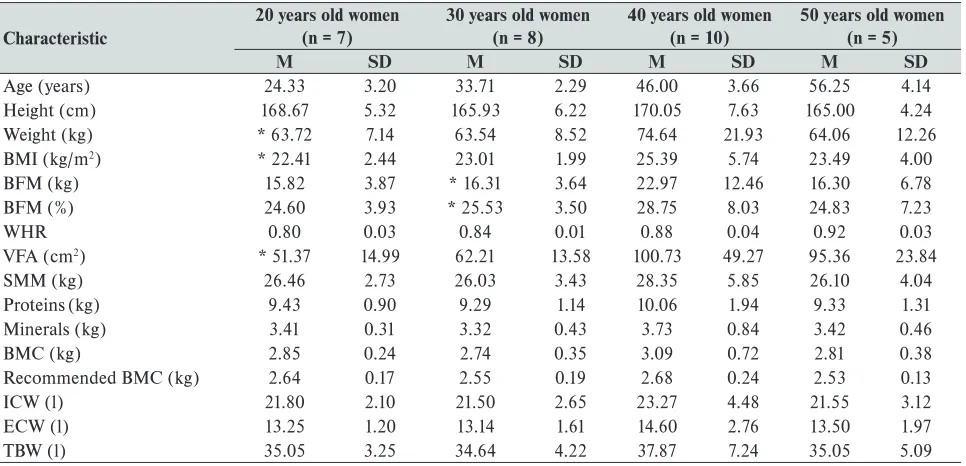
The same trend in increments and decrements of monitored quantities was shown even in the division into sub populations according to age and therefore we do not consider this to be a measurement error, but rather to be the eff ect of introducing the massage. In TABLE 2, the low values of diff erences serve to present only the principal statistical characteristics of the data from the 1st examination. The signifi cance of diff erences
prior to and after massages was confi rmed in the
popu-TABLE 2
The basic statistical characteristics of the selected data concerning body composition (InBody 720) – division accord-ing to decenniums; women aged 20 to 50 years (n = 30)
Characteristic
20 years old women (n = 7)
30 years old women (n = 8)
40 years old women (n = 10)
50 years old women (n = 5)
M SD M SD M SD M SD
Age (years) 24.33 3.20 33.71 2.29 46.00 3.66 56.25 4.14
Height (cm) 168.67 5.32 165.93 6.22 170.05 7.63 165.00 4.24
Weight (kg) * 63.72 7.14 63.54 8.52 74.64 21.93 64.06 12.26
BMI (kg/m2) * 22.41 2.44 23.01 1.99 25.39 5.74 23.49 4.00
BFM (kg) 15.82 3.87 * 16.31 3.64 22.97 12.46 16.30 6.78
BFM (%) 24.60 3.93 * 25.53 3.50 28.75 8.03 24.83 7.23
WHR 0.80 0.03 0.84 0.01 0.88 0.04 0.92 0.03
VFA (cm2) * 51.37 14.99 62.21 13.58 100.73 49.27 95.36 23.84
SMM (kg) 26.46 2.73 26.03 3.43 28.35 5.85 26.10 4.04
Proteins(kg) 9.43 0.90 9.29 1.14 10.06 1.94 9.33 1.31
Minerals (kg) 3.41 0.31 3.32 0.43 3.73 0.84 3.42 0.46
BMC (kg) 2.85 0.24 2.74 0.35 3.09 0.72 2.81 0.38
Recommended BMC (kg) 2.64 0.17 2.55 0.19 2.68 0.24 2.53 0.13
ICW (l) 21.80 2.10 21.50 2.65 23.27 4.48 21.55 3.12
ECW (l) 13.25 1.20 13.14 1.61 14.60 2.76 13.50 1.97
TBW (l) 35.05 3.25 34.64 4.22 37.87 7.24 35.05 5.09
Legend:
lation of women 20 years of age in case of increased weight (p = 0.046), BMI (p = 0.042) and amount of visceral fat (p = 0.028), in the population of women 30 years of age in the case of an increased fat fraction in both absolute (p = 0.028) and relative values (p = 0.043) in the population of women 40 years of age in the case of decrement of Edema 1 (p = 0.005) and Edema 2 (p = 0.007) values on the right upper extremity. The results correspond with those recorded for the analysis for the whole population.
The low frequency of sub population and profes-sional selection of probands underline the pilot nature of this research. With regard to age changes, we dedi-cated our attention to TBW value changes, visceral fat and to estimated changes in minerals representation in the whole organism and in bones.
Total body water consisted of 55.00%, 54.52%, 50.74% and 54.71% of the body weight in the monitored panel and 53.01% of the whole population. The ECW range was rather stable between 19.56% and 21.07% with the highest mean value in group of women aged 50 years. The ICW ranged from 31.17% to 34.21% with the highest rate in the group of women aged 20 years which then decreased with age.
Schoeller (1989) reports an incidence of 49% of TBW in women aged 30 and 40 years and 48% in wom-en aged 50 years. Riegerová, Přidalová, Valwom-enta and Dostálová (2008) present the following values in women aged 62 years ICW 29.00%, ECW 23.94% and TBW 52.53% (measured using QuadScan 4000); Gába, Rieg-erová and Přidalová (2008) present the following values
in seniors aged 64 years ICW 28.92%, ECW 18.36% and TBW 47.28% (measured using InBody 720). Our highest ICW values are probably connected with the already optimized ratio of body fl uids after lymphatic massages.
Values of visceral fat increase with age; an extreme increase in the sub population of 40 year old women was caused by a proband weighing 111.32 kg with a body height of 179 cm. The value of her visceral fat was high-ly risky (200.18 cm2). Women of 50 years of age have
rather a high amount of visceral fat even when weighing relatively little (95.36 cm2,64.01 kg). The mean value of
the weight amount of total mineral and bone minerals did not show a signifi cant regressive trend with increas-ing age. The recommended level of bone minerals was always lower than the actual value.
Riegerová, Gába, Přidalová and Langrová (2009) published a suggestion of risk value for the estimate of total minerals and bone minerals when measurement was performed using the InBody 720 – 3.08 kg a lower and 2.55 kg and lower.
Results of 4 women were found under this risk mar-gin. Their case reports:
E. K., 50 years, BMC 2.15 kg, minerals 3.16 kg, height 160 cm, weight 49.15 kg, BMI 19.20;
T. G., 50 years, BMC 2.06 kg, minerals 2.54 kg, height 158 cm, weight 45.46 kg, BMI 18.21;
L. P., 33 years, BMC 2.23 kg, minerals 2.77 kg, height 160 cm, weight 53.15 kg, BMI 20.76;
D. H., 22 years, BMC 2.45 kg, minerals 2.97 kg, height 166 cm, weight 51.42 kg, BMI 18.66.
Fig. 1
There were women with gracilis skeleton and low weight. BMI signalized participants to be underweight in the case of T. G. and D. H. All other probands were of normal weight. Women were informed about their state and they were advised to seek a specialist. We received feedback in three cases. T. G. was diagnosed with oste-oporosis and a clinical level of osteopenia was found in E. K. and L. P.
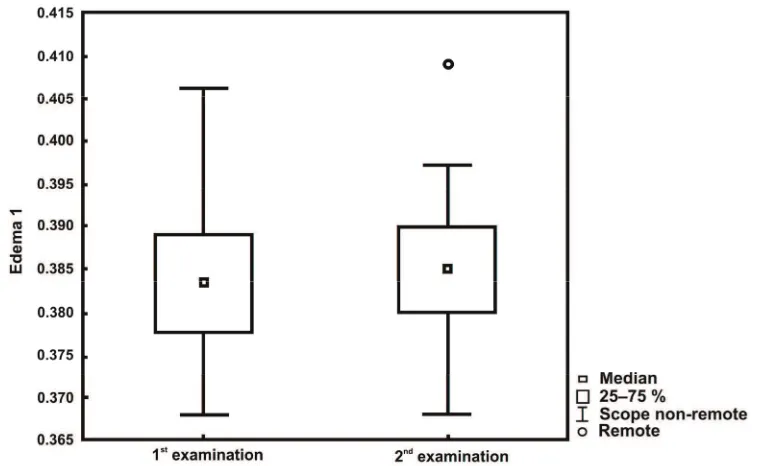
The mean of Edema 1 values was lower than the lower limit of the standard range 0.36–0.40. They fl uc-tuated evenly within the 0.33–0.34 unit range. The rea-son for that could be the practical training of lymphatic massages during the week prior to the examination. The statistically signifi cant decrease appearing in the upper extremities (which were massaged) included an Edema 1 mean value (right upper extremity – p = 0.042, TABLE 3
The basic statistical characteristics of Edema 1 and Edema 2 (n = 30)
1st examination 2nd examination
Characteristic M SD M SD
Edema 1 0.3354 0.06 0.3361 0.01
Edema 2 * 0.3823 0.07 0.3830 0.01
Right upper extremity Edema 1 * 0.3313 0.04 0.3298 0.01 Left upper extremity Edema 1 * 0.3324 0.04 0.3316 0.01
Trunk Edema 1 0.3356 0.06 0.3364 0.01
Right lower extremity Edema 1 0.3354 0.07 0.3354 0.01 Left lower extremity Edema 1 * 0.3366 0.08 0.3383 0.01 Right upper extremity Edema 2 * 0.3779 0.04 0.3776 0.01 Left upper extremity Edema 2 * 0.3791 0.04 0.3784 0.01
Trunk Edema 2 0.3826 0.06 0.3834 0.01
Right lower extremity Edema 2 * 0.3837 0.08 0.3853 0.01 Left lower extremity Edema 2 * 0.3823 0.08 0.3828 0.01
Legend:
Edema1– information on the amount of water in the extracellular enviroment
Edema 2 – relates to the determination of ECW/TBW ratio added proteins and minerals at a 2:1 ratio Diff erences between the 1st and the 2nd examination were analysed by means of the pair t-test (* p < 0.05).
Fig. 2
= 0.4; left upper extremity – p = 0.012, = 0.2) and was found by repeated measurements after carrying out a lymphatic massage. The reduction and equilibration of standard deviation values was also shown. A mod-erate increase in mean values occurred in the case of the total index, trunk index and lower extremities in-dex. A signifi cant increase occurred only in the case of the left lower extremity (p = 0.014, = 0.2). Mean Edema 2 values were higher than the given limit value by 0.02 units. A statistically signifi cant decrease in the index was found after massaging the upper extremities (right upper extremity – p = 0.008, = 0.3; left upper extremity – p = 0.009, = 0.2). A significant incre-ment of both lower extremities and trunk indexes was reported. Signifi cant diff erences rise from the fi gure 2 and 3 past the decimal point, but they do not play an important role from a general perspective. The medium eff ect was confi rmed for Edema 1 and Edema 2 for the right upper extremity based on eff ect size test results ( = 0.4). Low eff ect size was shown on the left upper extremity ( = 0.2) as well as in other Edema indexes ( = 0.2–0.1).
Our results confirmed the hypothesis of positive body composition changes. However, they suggest the necessity to repeat the experiment following a diff erent time frame. Currently, we have not registered any stud-ies that focused on specifi c changes in body composi-tion after lymphatic massage intervencomposi-tion. Therefore, we consider this pilot study, despite some limits (e.g. small sample size, age variability), benefi cial to both theory and practice.
CONCLUSION
We confi rm the positive intervention of lymphatic massage on the interstitium and cellular body environ-ment based on data analysis using InBody 720.
The whole population showed signifi cant diff erenc-es in small weight, BMI and body fat mass increments which were probably conditioned by the increased liquid intake and short time period after their utilization. This fact is also related to the signifi cant decrease in TBW mean values, the decrease in ICW and ECW and the decrease in standard deviations in the case of all body water components.
The same increments and decrements trend of moni-tored quantities was demonstrated even when dividing the population into sub populations according to age. Values of visceral fat increase with age, meaning that the estimated values of the weight amount of total miner-als and bone minerminer-als did not experience a signifi cant decrease with age.
Edema 1 indexes values were lower on average (op-timized) than the lower limit of the standard range and the values equally fl uctuated within the 0.33–0.34 unit range. After a lymphatic massage of the upper extremi-ties, we noticed a signifi cant reduction of Edema 1 and Edema 2 indexes in the massaged area. A reduction and equilibration of the standard deviation values was also indicated. A small increment of Edema indexes occurred in non massaged body areas with signifi cance in the case of Edema 1 for the left lower extremity and Edema 2 for both lower extremities. The eff ect size anal-ysis confi rmed a medium eff ect in the case of Edema Fig. 3
1 and Edema 2 on the right upper extremity and only a small eff ect on the left upper extremity.
Our results confi rmed the presumption of positive changes in body composition. This hypothesis comes from a partially optimized state and it suggests the need for repeating the experiment repetition using a diff erent time frame.
ACKNOWLEDGEMENT
The study has been supported by the research grant from the Ministry of Education, Youth and Sports of the Czech Republic (No. MSM 6198959221) “Physical Activity and Inactivity of the Inhabitants of the Czech Republic in the Context of Behavioral Changes”.
REFERENCES
Biospace (2008). InBody 720 – The precision body composition analyzer. Retrieved 25. 10. 2008 from the World Wide Web: https://www.e-inbody.com/ product/pdf/720_catalog_10P_eng.pdf
Benda, K., Bendová, M., Cagášková, J., Eliška, O., Houdová, H., Navrátilová, Z., Wald, M., & Witt-nerová, M. (2007). Lymfedem – komplexní fyzio-terapie lymfodrenáže a doplňující léčebná péče. Brno: Mikadapress.
Gába, A., Riegerová, J., & Přidalová, M. (2008). Evalu-ation of body composition in females aged 60–84 years using the multi frequency bioimpedance meth-od (InBmeth-ody 720). New Medicine, 12(4), 82–88. Goats, G. C. (1994). Massage – the scientifi c basis of
an ancient art: Part 2. Physiological and therapeu-tic eff ects. British Journal of Sports Medicine, 28(3), 153–156.
Heyward, V. H., & Wagner, D. R. (2004). Applied Body Composition Assessment. Champaign, IL: Human Kinetics.
Johnston, M. G. (2008). New research developments in understanding lymphovenous disorders. Retrieved 24. 4. 2008 from the World Wide Web: http://www. lymphovenous-canada.ca/research.htm
Mazzocut, L. (2008). Move your lymph and thrive. Retrieved 24. 4. 2008 from the World Wide Web: http://www.sfgate.com/cgi-bin
Moyer, Ch. A., Rounds, J., & Hannum J. W. (2004). A meta analysis of massage therapy research. Psy-chological Bulletin, 130(1), 3–18.
Premkumar, K. (2003). The massage connection: Anato-my and physiology. Philadelphia: Lippincott Williams & Wilkins.
Riegerová, J., Gába, A., Přidalová, M., & Langrová, I. (in press). Hodnocení osteopenie a osteoporózy
u žen ve věku senescence pomocí přístroje Dexa a InBody 720. Slovenská antropológi.
Riegerová, J., Přidalová, M., Valenta, M., & Dostálová, I. (2008). Analýza složení těla pomocí bioimpedan-ce a antropometrie u moravských žen ve věku se-nescence, vliv střednědobého pohybového experi-mentu. Medicina Sportiva Bohemica et Slovaca, 17(4), 191–196.
Riegerová, J., Přidalová, M., & Ulbrichová, M. (2006). Aplikace fyzické antropologie v tělesné výchově a sportu (příručka funkční antropologie). Olomouc: Hanex. Schoeller, D. A. (1989). Changes in total body water
with age. American Journal of Clinical Nutrition, 50(11), 1176–1181.
StatSoft, Inc. (2008). Statistica 8 [Computer Software]. Tulsa, OK: StatSoft.
ZMĚNY POMĚRŮ VYBRANÝCH SLOŽEK TĚLESNÉHO SLOŽENÍ
PO LYMFATICKÉ MASÁŽI (Souhrn anglického textu)
Na dvou výukových kurzech lymfatických masáží jsme ve druhé polovině kurzu provedli vyšetření složení těla přístrojem InBody 720. Vyšetření jsme realizovali ráno před zahájením výuky a před koncem výukového dne, mezi prvním a druhým vyšetřením uplynula časo-vá pauza 8 hodin. Vyšetřili jsme 30 žen, nízká četnost a profesní selekce probandek podtrhují sondážní cha-rakter výzkumu. V předložené pilotní studii jsme sle-dovali vliv lymfatické masáže na vybrané složky složení těla a stabilitu vyšetření. Získaná data jsme zpracovali souhrnně a vzhledem k věkovému rozpětí i po decéni-ích programem Statistica 8, diference jsme testovali párovým t-testem. Věcná významnost byla posuzována pomocí koefi cientu (Cramer’s phi).
Potvrzujeme pozitivní intervenci lymfatické masáže na intersticium a buněčné prostředí těla. U souboru se projevila signifi kance (p < 0,05) rozdílů v malém nárůs-tu hmotnosti, BMI a nárůs-tukového podílu, což bylo zřejmě podmíněno zvýšeným přísunem tekutin a krátkou dobou pro její utilizaci. S tím souvisí i signifi kantní snížení prů-měrných hodnot TBW (p = 0,042; = 0,0), úbytek ICW i ECW a snížení hodnot směrodatných odchylek u všech složek tělesné vody.
Stejný trend přírůstků a úbytků sledovaných veličin se projevil i při rozdělení na subsoubory podle věku. Hodnoty viscerálního tuku narůstaly s věkem, průměrné hodnoty váhového množství celkových minerálů a kost-ních minerálů neprojevily ve věkové řadě výraznější se-stupný trend.
pro-jevilo signifi kantní snížení indexu Edema 2 (p = 0,021; = 0,1) pro masírovanou oblast. Projevilo se také sní-žení a vyrovnání hodnot směrodatných odchylek. Test věcné významnosti potvrdil účinek malé a střední úrov-ně u indexu Edema 1 a Edema 2 pro pravou horní kon-četinu, pro levou horní končetinu pouze efekt malého účinku. Naše výsledky potvrdily předpoklad pozitivních změn ve složení těla, vychází však z již částečně opti-malizovaného stavu v druhé polovině kurzu a nazna-čují nutnost opakování experimentu v jiném časovém rozvržení.
Klíčová slova: InBody 720, tělesná voda, rekondice, ženy.
Prof. RNDr. Jarmila Riegerová, CSc.
Palacký University Faculty of Physical Culture tř. Míru 115
771 11 Olomouc Czech Republic
Education and previous work experience
1968–1987 – assistant professor, Department of Zo-ology and AnthropZo-ology, Faculty of Natural Science, Palacký University, Olomouc.
1987–1990 – associate professor, Department of Zo-ology and AnthropZo-ology, Faculty of Natural Science, Palacký University, Olomouc.
1991–2000 – associate professor, Department of Func-tional Anthropology and Physiology, Faculty of Physical Culture, Palacký University, Olomouc.
Since 2001 – professor, Department of Functional An-thropology and Physiology, Faculty of Physical Culture, Palacký University, Olomouc.
Scientifi c orientation
Functional anthropology, kinesiology, enviromentalism of human, massage.
First-line publications
Until now she has published 160 papers and research studies in Czech as well as in foreign literature, 1 mono-graph, 7 instructional texts and 2 popular books.
Riegerová, J., Szotkowská, J., Přidalová, J., & Krejčí, J. (2006). Vliv čínského léčebného cvičení na posturu a pohybový aparát seniorek. Med Sport Boh Slov, 15(5), 212–216.
Riegerová, J. a kol. (2007). Rekondiční a sportovní masáže. Olomouc: Univerzita Palackého.
Riegerová, J., Sluka, R., & Přidalová, M. (2007). Determination of body composition by means of anthropometry and bioimpedance and the calculation of body adipose tissue in obese children undergoing a spa treatment. Auksologia a Promocja Zdrowia, 4, 81–91.
Riegerová, J. (2007). Severská chůze ve výběru pohy-bových aktivit pro seniory. Česká antropologie, 57, 64–65.
Riegerová, J., & Přidalová, M. (2007). Analýza složení těla pomocí antropometrie a bioimpedance u senio-rek České republiky. Slov. Antropol, 10(1), 119–122. Riegerová, J., Přidalová, M., & Gába, A. (2008). Roz-bor morfologie nohy u žen ve věku senescence. Med Sport Boh Slov, 17(1), 2–8.
Riegerová, J., Krejčí, J., Kolisko, P., & Přidalová, M. (2008). Posture analysis using position detector DTP-2 in senescent women after the application of a targeted excercise program. Acta Universitatis Palackianae Olomucensis. Gymnica, 38(1), 27–33. Riegerová, J., Přidalová, M., Valenta, M., & Dostálová, I.
(2008). Analýza složení těla pomocí bioimpedance a antropometrie moravských žen ve věku senescen-ce, vliv střednědobého pohybového experimentu. Med Sport Boh Slov, 17(4), 191–196.