ISSN 0975-928X
723
Research Article
Generation of insect resistant marker-free transgenic rice with a novel
cry2AX1
gene
G. Rajadurai1, A. Kalaivani2, S. Varanavasiyappan2, N. Balakrishnan2, V. Udayasuriyan2, D. Sudhakar2 and
N. Natarajan1*
1Department of Agricultural Entomology 2
Department of Plant Biotechnology, Tamil Nadu Agricultural University, Coimbatore -03. E-mail: [email protected]
(Received: 20 Jun 2018; Revised: 25 Jun 2018; Accepted:25 Jun 2018) Abstract
A synthetic cry2AX1 gene, consisting sequence of cry2Aa and cry2Ac genes, driven by green tissue specific rbcS promoter was used to develop insect resistant marker-free transgenic rice events. The gene of interest cry2AX1 and the selectable marker gene hpt were present in two independent T-DNAs of the Agrobacterium strain, C58C1. Seventy seven hygromycin and GUS positive T0 transgenic plants were recovered. Among them, 48 were found to be co-transformed with cry2AX1. The Cry2AX1 protein
expression level in T0 transgenic events ranged from 0.027 to 0.110 μg/g of fresh leaf tissue. The toxicity level of Cry2AX1
protein was assessed through in vitro bioassay against target insects. The larval mortality ranged from 46.66 to 66.67 per cent against rice leaffolder (C. medinalis) while it ranged from 60 to 100 per cent against rice yellow stem borer (S. incertulas)in T0
transgenic plants. A marker free transgenic event, which expressed 0.043 μg/g of Cry2AX1 in fresh leaf tissue exhibited 45 and 55 per cent larval mortality against rice leaffolder and rice yellow stem borer, respectively in T2 generation.
Key words
Transgenic plants, cry2AX1, insectresistance, rice leaffolder, rice yellow stem borer Introduction
Rice is a major staple food crop of the world, particularly Asia, Africa, Central America, and the Middle East (Zhang et al., 2011; Durand-Morat et al.,
2015). The predicted global demand for rice is gradually increasing by 0.9 and 1.2 per cent every year (Durand-Morat et al., 2015). Insect pests have been identified as the major factor causing yield loss in rice (Waddington et al., 2010). However, yield loss due to lepidopteran insects inflicted damage between 5 to 25 % with occasional localized outbreaks of up to 60 per cent and remains a major challenge (Pathak and Khan, 1994; Bandong and Litsinger, 2005). In India, average yield losses in recent years due to rice stem borers and leaffolders account for 30 and 10 per cent, respectively (Krishnaiah and Varma, 2012), while the co-incidence of yellow stem borer and rice leaffolder cause more damage than when these insects infest the crop separately (Selvaraj et al., 2012).
Chemical pesticides are predominantly used to control rice insect pests. Indiscriminate use of pesticides in rice is becoming a major concern for rice ecosystem, affecting the beneficial insects (Waddington et al., 2010). However, application of chemical pesticides is becoming less effective in
controlling yellow stem borer and rice leaffolder due to their feeding nature. They live either inside the stem or inside folded leaf nests or in the soil, avoiding direct contact with the applied pesticides. On the contrary, due to non-availability of rice germplasm that are resistant to these insects, breeding high yielding insect resistant rice cultivars through conventional breeding approaches is as well a challenge.
Genetic engineering technology is considered as an alternative tool to develop insect resistant crop varieties. Crop varieties developed through Bt
technology represent one of the most commercially successful technologies in modern agriculture. Bt
crop technology has been demonstrated to be economically viable and environmentally sustainable approach for pest management (Sreevathsa et al.,
ISSN 0975-928X
724 rice has the potential to eliminate yield losses caused
by lepidopteran pest besides substantially reducing the use of broad-spectrum chemical insecticides, which has health and environment benefits (High et al., 2004).
Transgenic rice plants which express the fusion proteins of Cry1Ac and Cry1I (Yang et al., 2014) and that of Cry1Ab and Cry1Ac (Cheng et al., 1998) were reported to be effective against rice leaffolder and yellow stem borer. A broad-spectrum of toxicity against lepidopterans was observed in Cry2A family of proteins (Mandal et al., 2007). Rice lines expressing cry1Ac and cry2A genes separately exhibited high level of resistance to yellow stem borer, rice leaffolder and rice skipper (Bashir et al.,
2004), while the codon optimized cry2A was found to be effective against yellow stem borer and leaffolder (Chen et al., 2005) in laboratory and field studies. Recently, expression of a chimeric cry2AX1 gene (fusing cry2Aa and cry2Ac genes) was reported to be toxic against Helicoverpa armigera and Spodoptera litura in tobacco (Udayasuriyan, 2012; Jayaprakash
et al., 2014) as well as tomato (Balakrishnan et al.,
2012) and against rice leaffolder in rice (Manikandan
et al., 2014a).
Transgene driven by constitutive promoters, viz.
CaMV35S or maize ubiquitin1 express in all parts of the plants. However, tissue specific promoters drive the expression of transgenes only in desirable tissues and one such promoter is green tissue specific rbcS
promoter, which is regulated by light (Kyozuka et al.,
1993; Huang et al., 1999; Nomura et al., 2000). In the present study, an attempt was made to express the Cry2AX1 protein in greener parts of rice plant which are fed by the larvae of target pests.
Selectable marker genes (SMGs) are essential components for transgenic plant development but their retention in transgenic plants may negatively impact public acceptance, even though the products of SMGs are proved to be safe. In order to improve public acceptance and successful commercial deployment, removal of selectable marker after selection process could lead a safer publically acceptable produce. Hence, in the present study, the marker gene, hpt gene was segregated from the gene of interest leading to development of marker free transgenic event.
Materials and Methods
Agrobacterium tumefaciens strain, C58C1 harbouring a co-integrate plasmid pGV2260::pSSJ1 and a binary plasmid pMF-rbcS-tp-cry2AX1 was used for co-transforming rice cultivar, ASD16. The T-DNA of the binary plasmid pMF-rbcS-tp-cry2AX1 (Fig. 1A) harbours cry2AX1 gene driven by green tissue
specific promoter, rbcS and its chloroplast transit peptide (Jang et al., 1999) and the co-integrate vector pGV2260::pSSJ1 (Jacob and Veluthambi, 2002) carries hph and gus genes (Fig. 1B). The binary vector was mobilized into A. tumefaciens strain, C58C1 by triparental mating.
Agrobacterium-mediated rice transformation was followed as per the protocol of Hiei and Komari (2008). Two days old bacterial culture were suspended in AA infection medium with 50 μM acetosyringone for infecting embryos. Fourteen day old immature seeds were collected from the rice var. ASD16, healthy seeds were dehusked and sterilized. Surface sterilization involves 70% ethanol treatment for 1 min and 0.1% mercuric chloride for 3 min intervened by three washes with sterile distilled water. Isolated healthy immature embryos were transferred into sterile eppendorf tubes containing sterile water and incubated at 43 oC for 30 min in water-bath followed by one min incubation on ice and centrifuged at 1,100 rpm for 10 min. Cocultivation was carried out with the pretreated immature embryos by placing on NB-As (10X N6 major salts 100ml L-1, 100x FeEDTA 10ml L-1, 100X B5 minor salts 10 ml L-1, 100X B5 vitamins 10 ml L
-1
, 100 mg L-1 2,4-D, 100 mg L-1 NAA, 100 mg L-1 6BA, sucrose 20 g L-1, glucose 10 g L-1, proline 500 mg L-1 and vitamin assay casamino acids 500 mg L-1) medium containing 100 mM acetosyringone and 5 μl of the Agrobacterium suspension was dropped on each embryo and incubated at 26 oC in dark for 30 min. Infected embryos were transferred to fresh place on the same plate and incubated at 26 oC in dark for seven days. Putative embryogenic calli from co-cultivated immature embryos were separated from shoots and cultured for 15 days at 31 ºC under continuous illumination on resting medium (10X CC major salts 100 ml L-1, 100X FeEDTA 10 ml L-1, 100X CC minor salts 10 ml L-1, 100 X CC vitamins 10 ml L-1, 100 mg L-1 2,4-D, 100mg L-1 NAA, 100 mg L-1 6BA, maltose 20 g L-1, mannitol 36 g L-1, proline 500 mg L-1 and vitamin assay casamino acids 500 mg L-1) containing 250 mg l-1 cefotaxime. The proliferated embryogenic calli were subcultured twice on selection medium (10X CC major salts 100 ml L-1, 100X FeEDTA 10 ml L-1, 100X CC minor salts 10 ml L-1, 100 X CC vitamins 10 ml L-1, 100 mg L-1 2,4-D, 100 mg L-1 NAA, 100 mg L-1 6BA, maltose 20 g L-1, mannitol 36 g L-1, proline 500 mg L-1 and vitamin assay casamino acids 500 mg L-1) containing hygromycin 50 mg 1-1 and 250 mg l-1 cefotaxime for 17 days and transferred to pre-regeneration medium (10X N6 major salts 100 ml L
-1
ISSN 0975-928X
725 L-1 NAA, 100 mg L-1 6BA, 30 g L-1 maltose, 500 mg
L-1 proline, 500 mg L-1 vitamin assay casamino acids and 30 g L-1 glutamine) containing hygromycin 40 mg 1-1 incubated at 31 oC for 7 days under continuous illumination. The proliferated calli with green spots were transferred to regeneration medium containing 30 mg l-1 hygromycin. The regenerated plantlets were transferred to half strength MS medium containing 30 mg l-1 hygromycin for rooting. Well developed putative transformants were transferred to protray filled with soil and maintained in transgenic greenhouse for hardening.
GUS expression in regenerated plantlets were determined using the histochemical GUS assay as described by Wu et al. (2003). About 3-5mm of leaf and root bits were incubated overnight at 37 oC in 10 μl of Gluc buffer (pH 7.0) containing 1 mM X-Gluc, 100mM sodium phosphate buffer (pH 7.0), 0.5 mM potassium ferricyanide, 0.5 mM potassium ferrocyanide, and 0.1% (v/v) Triton X-100. Untransformed ASD 16 plant samples were used as negative control. GUS positive plantlets were tagged and grown in a greenhouse.
Plant genomic DNA were isolated from the putative transformants and wild type control plants by CTAB method (Dellaporta et. al., 1983). Presence of
cry2AX1 gene were analysed with gene specific
primers(CRY2FP-5’-CTAACATTGGTGGACTTCCAG - 3’ and
CRY2RP- 5’-GAGAAACGAGCTCCGTTATCGT-3’). PCR of 20 μl reactions were carried out in Eppendorf thermocycler (Vapo protect). The amplified products were subjected to 0.8 % agarose gel electrophoresis and visualized on UV transilluminator upon ethidium bromide staining. Thirty milligram of fresh leaves were collected and homogenized with 500 μl of extraction buffer (prepared 1X working extraction buffer from the stock provided with kit), centrifuged at 6000 rpm for 7 min at 4 oC. Supernatant of 100 μl were used for assay with Envirologix ELISA kit (Envirologix, USA) and experiment was done as per manufacturer’s instructions with two replications for each sample. Untransformed ASD16 plants were used as negative control. Cry2AX1 protein levels were expressed as μg/ gram of fresh leaves.
Adult moths of rice leaffolder were collected from rice fields of Paddy Breeding Station, TNAU, Coimbatore and reared on TN1 rice plants maintained in insect cages (65 cm x 65 cm x 75 cm). The egg laying capacity of adult moths was enhanced by supplementation of 10 % honey solution with vitamin E. The neonate stage larvae were used for the bioassay. About 5 cm long leaf bits from transgenic and non-transgenic plants were placed on a moist
filter paper in a plastic petriplate. For each treatment, thirty neonate (five larvae/ leaf bit) larvae of rice leaffolder were released. The experiment was done with three replications and maintained at 25 oC ± 1, 60 % relative humidity for 6 days. Larval mortality and leaf area feeding was recorded daily from the 3rd day. The larval mortality and leaf area damage was expressed in percentage.
Adult moths of rice yellow stem borer collected from rice fields of Paddy Breeding Station, TNAU, Coimbatore were released on TN1 rice plants maintained in insect cages (65 cm x 65 cm x 75 cm). Egg masses were collected and maintained at insect bioassay laboratory with optimum environmental conditions. About 5 cm length of stem bits from transgenic and non-transformed plants were placed on a moist filter paper in a plastic petriplate. Cut end of the stem bits were damaged using knife to ensure that the neonates get soft tissues for feeding. In each stem bit, five active neonates were released and thirty larvae were used per treatment with three replications. Non transgenic ASD16 rice was used as a control. The experimental setup was maintained at 25 oC ± 1, 60 % relative humidity for 6 days. The larval mortality and feeding damage was recorded on 6th day by split opening of the stem bits.
T1 seeds collected form the T0 generation were used
for segregation analysis in order to identify marker-free transgenic plants. After 10 days of sowing, the seedlings were subjected to GUS histochemical analysis. The plants which showed negative for GUS expression were subjected to PCR analysis to check the presence of cry2AX1 gene with gene specific
primers (CRY2FP–
5’-CCTAACATTGGTGGACTTCCAG – 3’ and
CRY2RP- 5’-GAGAAACGAGCTCCGTTATCGT-3’). Plants which were negative for GUS expression and PCR positive for cry2AX1 were considered marker-free plants.
Results and Discussion
The elite indica rice cultivar, ASD16 was transformed with cry2AX1 gene through
ISSN 0975-928X
726 Genomic DNA from the transgenic plants was
subjected to PCR analysis to confirm the presence of
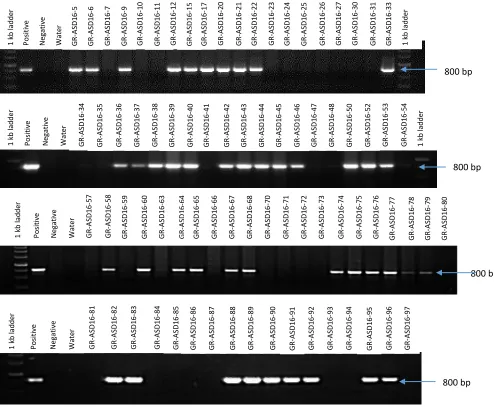
hpt and cry2AX1 genes with gene specific primers. All the transgenic plants were positive for hpt (data not shown). However, out of 77 plants generated, 48 were found to be positive for cry2AX1 (Fig. 2). The co-transformation frequency was 62 per cent.
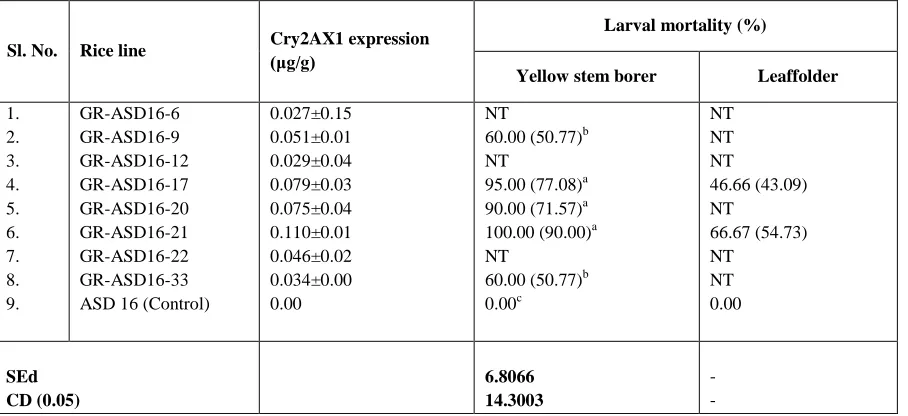
PCR positive transgenic plants were subjected to expression assay for cry2AX1 using Cry2A quantitative ELISA kit. Out of 48 PCR positive plants, 9 plants showed detectable level of Cry2AX1 protein in fresh leaf tissues (Table 1). The expression level ranged from 0.027±0.02 to 0.110±0.03 μg/gram of fresh leaf tissues, while non-transformed ASD16 did not show detectable level of expression. Among the transgenic events tested, the maximum expression level (0.110 μg/g) of Cry protein was observed in GR-ASD16-21.
The larval mortality ranged from 46.66 to 66.67 per cent and the transgenic event, GR-ASD16-21 showed highest larval mortality of 66.67 per cent, while no mortality was observed in ASD 16 control plant. Similarly, 5 positive events were assayed against neonates of yellow stem borer and larval mortality ranged from 60 to 100 per cent while non-transformed ASD16 did not show any larval mortality. Among the transgenic events tested, the transgenic event, GR-ASD16-21 showed maximum larval mortality of 100 % (Table 1).
Eight transgenic events selected based on relative level of Cry2AX1 expression in T0 generation were
established in transgenic greenhouse in order to identify marker-free transgenic plants. Out of eight transgenic events tested, a progeny of the event, GR-ASD16-17 was found to be free of selectable marker gene with presence of cry gene (Table 2).
The marker-free transgenic plants (event GR-ASD16-17) were forwarded to T2 generation to check their
efficacy against target insects. The protein expression level in transgenic plants was 0.043 μg/gram of fresh leaf tissues, while non-transformed ASD16 did not show any detectable level of expression. When subjected to insect bioassay, marker-free plants of event GR-ASD16-17 showed a mortality of 45 per cent for leaffolder and 55 per cent for yellow stem borer (Table 3). Moreover, the surviving larvae on transgenic palnts were found to be stunted and deformed (Fig. 3).
Transgenic plants expressing insecticidal crystal proteins are known to impart resistance against lepidopteran insect pests and could potentially reduce the use of broad-spectrum insecticides. However, there is a risk that the target insects, on continuous exposure, could develop resistance to the Bt toxins. To overcome this risk, gene pyramiding for
simultaneous expression of two or more cry genes in transgenic plants is advocated and routinely followed (Datta et al., 2002). In our centre, a chimeric Bt gene (cry2AX1) was developed with cry2Aa and cry2Ac
sequences from indigenous isolates of Bt with a view to enhance the insecticidal property of the Cry2 toxin. Our earlier reports showed that the chimeric Cry2AX1 protein expressed in transgenic rice was toxic to lepidopteran insects (Manikandan et al.,
2014a; Chakraborty et al., 2016; Manikandan et al.,
2016a).
Out of 77 events generated in the study, 48 events found to be positive for gene of interest (cry2AX1
gene) with a co-transformation efficiency of 62.34 per cent. Among the PCR positive transformants 9 putative events showed detectable level of Cry2AX1 protein with varying levels by expression. Variation in levels of expression in Bt rice was reported by earlier researchers (Wu et al., 2001; Yang et al.,
2014; Chakraborty et al., 2016; Manikandan et al.,
2016 a and b). However, the level of expression observed in the present study was low. The expression could provide a moderate level of protection (47 % - 67 % larval mortality) against rice leaffolder. Several earlier workers have demonstrated that the expression of Bt protein in transgenic plants had offered significant level of protection against neonate larvae of which insect? (Zaidi et al., 2009; Manikandan et al., 2014b; Chakraborty et al., 2016; Manikandan et al., 2016 a) in rice.
However, the same level toxin could achieve upto 100 per cent of larval mortality in yellow stem borer. This result indicates that the neonate larvae of yellow stem borer is more susceptible to Cry2AX1 protein even at low concentration. Earlier studies have reported 100 per cent mortality of yellow stem borer in transgenic rice plants expressing cry1Ac gene(Tu
et al., 2000; Li et al., 2005), cry2A gene (Chen et al.,
2005; Chakraborty et al., 2016) and cry1C gene (Tang et al., 2006).
Out of eight transgenic events tested in T1 generation,
an event GR-ASD16-17 found to be free of selectable marker gene with 0.037 μg/gram of Cry2AX1 protein expression level. The low level of protein expression (0.043 μg/gram) in marker-free T2 transgenic plants
could provide a mortality of 45 per cent in rice leaffolder and 55 per cent in yellow stem borer. Moreover, the surviving larvae on transgenic palnts were found to be stunted with abnormal development.
ISSN 0975-928X
727 free plant transformation strategies have been
reported and they include Agrobacterium-mediated co-transformation. In present study, the strategy of ‘two T-DNAs in separate vectors’ in a single
Agrobacterium strain, C58C1 was used for genetic transformation and marker- free transgenic rice was identified in T1 generation. Single Agrobacterium
strain method is found to improve co-transformation frequency. Two compatible binary vectors, first with the gene of interest and the second with the selectable marker gene were successfully used for marker elimination which yielded a 50 % co-transformation efficiency and a 50 % segregation frequency (Daley
et al., 1998; Parkhi et al., 2005). The co-transformation frequency was improved by placing the gene of interest (GOI) on a multicopy binary plasmid and the selectable marker gene on a low copy number co-integrate Ti plasmid (Jacob and Veluthambi, 2002).
Co-transformation of two T-DNAs from a single strain of Agrobacterium is more efficient than two
Agrobacterium strains with independent binary vectors (Komari et al., 1996; Miller et al., 2002; Poirier et al., 2000). In the single-strain method involving a cointegrate vector and a binary vector, the co-transformation efficiency of the non-selected T-DNA (carrying nptII) was high (56-74%) when the non-selected GOI was placed in a multi-copy binary plasmid (Jacob and Veluthambi, 2002). The marker-free cry1Ab/Ac transgenic indica rice TT51 has been issued with security certificate by Chinese government in 2014, indicating its commercialization potential (Ling et al., 2016). In the present study, a broad host-range SMG-free binary vector pCAMBIA0390 was constructed and used for co-transformation experiments. By placing the GOI (cry2AX1) in the T-DNA of pCAMBIA0390 and the SMG in a single-copy cointegrate vector, a co-transformation efficiency of 62 per cent was obtained.
The expression of recombinant protein in unwanted tissue (e.g. grains) is the major concern when constitutive promoters are used in transformation. Transgene driven by tissue specific promoter will be expressed only in tissues where the transgene product is desired, leaving the rest of the tissues unmodified by transgene expression. The rbcS promoter is a tissue-specific expression gene, especially present in green tissue and its expression pattern is regulated by light. Earlier workers demonstrated that the protein expression was detected only in green tissues and not in seeds when the cry genes driven by the rbcS
promoter were used to transform rice (Ye et al., 2009; Kim et al., 2009; Qi et al., 2012; Yang et al.,
2014). The expression level of cry2AX1 gene driven
by the rbcS promoter and transit peptide could possibly reduce the spread of Bt toxin into the environment through seeds and pollen of transgenic plants.
The local rice cultivar ASD16 was transformed with
cry2AX1 gene driven by green tissue specific promoter rbcS through Agrobacterium mediated transformation to generate the marker-free transgenic plants. In this study, co-transformation of transgenic rice harbouring SMG-free cry2AX1 gene with A. tumefaciens C58C1 (pG2260::pSSJ1) were used to generate marker-free transgenic plants and 48 of the 77 transgenic plants (62.34%) were found to be co-transformed. The marker-free transgenic plants identified had moderate level of resistance to rice leaffolder and yellow stem borer.
References
Balakrishnan, N., Ruturajrajan, B., Naveenkumar, A., Sozhavendan, A.E., Nandeesha, P., Illakkiyapriya, A., Balasubramani, V., Kumar, K.K., Sudhakar, D. and Udayasuriyan, V. 2012. Genetic transformation of tomato with cry2AX1 gene for resistance to fruit borer. In: Proceeding of 3rd world congress on biotechnology. Hyderabad international convention centre (HICC), Hyderabad, 13–15 Sept 2012.
Bandong, J.P. and Litsinger, J.A. 2005. Rice crop stage susceptibility to the rice yellow stemborer Scirpophaga incertulas (Walker) (Lepidoptera: Pyralidae). Int. J. Pest Manag., 51:37–43.
Bashir, K., Husnain, T., Fatima, T., Latif, Z., Mehdi, S.A., and Riazuddin, S. 2004. Field evaluation and risk assessment of transgenic indica basmati rice. Mol. Breed, 13: 301–312.
Bravo, A., Sarjeet S. G. and Soberon, M. 2007. Mode of action of B. thuringiensis Cry and Cyt toxins and their potential for insect control. Toxicon, 49: 423-435.
Chakraborty, M., Sairam Reddy, P., Mustafa, G., Rajesh, G., Laxmi Narasu, V. M., Udayasuriyan, V. and Debashis Rana. 2016. Transgenic rice expressing the cry2AX1 gene confers resistance to multiple lepidopteran pests. Transgenic Res., 25: 665– 678.
ISSN 0975-928X
728 Cheng, X., Sardana, R., Kaplan H., and Altosaar, I. 1998.
Agrobacterium transformed rice plants expressing synthetic cryIAb and cryIAc genes are highly toxic to striped stem borer and yellow stem borer. Proc. Natl. Acad. Sci., 95: 2767– 2772.
Daley, M., Knauf, V.C., Summerfelt, K.R. and Turner, J.C. 1998. Cotransformation with one Agrobacterium tumefaciens strain containing two binary plasmids as a method for producing marker-free transgenic plants. Plant Cell Rep, 17:489–496. Datta, K., Baisakh, N., Thet, K.M., Tu, J., and Datta, S.K.
2002. Pyramiding transgenes for multiple resistance in rice against bacterial blight, yellow stem borer and sheath blight. Theor. Appl. Genet., 106: 1-8.
Dellaporta, S.L., Wood, J. and Hicks, J.B. 1983. A plant DNA mini preparation: version II. Plant Mol. Biol. Rep., 1:19–21.
Durand-Morat A., Chavez, E.C. and Wailes, E.J. 2015. GM rice commercialization and its impact on the global rice economy. SAEA Annual Meeting, Atlanta, Georgia, February 2–3.
Hiei, Y. and Komari, T. 2008. Agrobacterium-mediated transformation of rice using immature embryos or calli induced from mature seed. Nat. Protoc., 3:824–834.
High, S.M., Cohen, M.B., Shu, Q.Y. and Altosaar, I. 2004. Achieving successful deployment of Bt rice. Trends Plant Sci, 9(6): 286-292.
Huang, F., Buschman, L.L., Higgins, R.A. and McGaughey, W.H. 1999. Inheritance to Bacillus thuringiensis toxin (Dispel ES) in European corn borer. Science, 284:965–967.
Jacob, S.S. and Veluthambi, K. 2002. Generation of selection marker-free transgenic plants by cotransformation of a cointegrate vector T-DNA and a binary vector T-DNA in one Agrobacterium tumefaciens strain. Plant Sci, 163:801–806.
Jang, I.C., Nahm, B.H. and Kim, J.K. 1999. Sub-cellular targeting of green fluorescent protein to plastids in transgenic rice plants provides a high-level expression system. Mol. Breed, 5:453–461. Jayaprakash, S.P., Nandeesha, P., Sozhavendan, A.E.,
Naveenkumar, A., Illakiyapriya, A., Balakrishnan, N., Balasubramani, V., Singh, P.K., Sudhakar, D., Balasubramanian P. and Udayasuriyan, V. 2014. Expression of a novel synthetic cry gene of Bacillus thuringiensis in transgenic tobacco confers resistance to
Helicoverpa armigera and Spodoptera litura. J. Pure Appl. Microbiol., 8(6):4687–4692.
Kim, E.H., Suh, S.C., Park, B.S., Shin, K.S., Kweon, S.J., Park, S.H., Kim, Y.S. and Kim, J.K. 2009. Chloroplast-targeted expression of synthetic cry1Ac in transgenic rice as an alternative strategy for increased pest protection. Planta, 230:397–405.
Komari, T., Hiei, Y., Saito, Y., Murai, N. and Kumashiro, T.1996. Vectors carrying two separate T-DNAs for co-transformation of higher plants mediated by Agrobacterium tumefaciens and segregation of transformants free from selection markers. Plant J. 10: 165–174.
Krishnaiah, K. and Varma, N.R.G. 2012. Changing insect pest scenario in the rice ecosystem- a national perspective. Directorate of Rice Research Rajendranagar, Hyderabad, p 28.
Kyozuka, J., McElroy, D., Hayakawa, T., Xie, Y., Wu, R. and Shimamoto, K. 1993. Light regulated and cell-specific expression of tomato rbcS-gusA and rice rbcS-gusA fusion gene in transgenic rice. Plant Physiol., 102:991–1000.
Li, Y.R., Hu, Y.Q., Zheng, Y., Hu, X.B., Zhang, M.J. and Li, B.J. 2005. Field evaluation of the resistance of transgenic rice expressing CpTI or CpTI? Bt to lepidopterous pests. J. Fujian Agric. For Univ. Nat. Sci. Ed., 34(2):181–184.
Mandal, C.C., Gayen, S., Basu, A., Ghosh, K.S., Dasgupta, S., Maiti, M.K., and Sen, S.K. 2007. Prediction-based protein engineering of domain I of Cry2A entomocidal toxin of Bacillus thuringiensis for the enhancement of toxicity against lepidopteran insects. Protein Eng. Des. Sel., 20(12):599–606. Manikandan, R., Balakrishnan, N., Sudhakar D. and
Udayasuriyan, V. 2016a. Transgenic rice plants expressing synthetic cry2AX1 gene exhibits resistance to rice leaffolder (Cnaphalocrosis medinalis). 3 Biotech, 6:10. DOI 10.1007/s13205-015-0315-4.
Manikandan, R., Balakrishnan, N., Sudhakar, D. and Udayasuriyan, V. 2016b. Development of leaffolder resistant transgenic rice expressing cry2AX1 gene driven by green tissue-specific rbcS promoter. World J. Microbiol. Biotechnol., 32:37. DOI 10.1007/s11274-015-2006-z.
ISSN 0975-928X
729 rice leaffolder (Cnaphalocrosis medinalis).
Trends Biosci., 7(11):1125–1130.
Manikandan, R., Sathish, S., Balakrishnan, N., Balasubramani, V., Sudhakar D. and Udayasuriyan, V. 2014a. Agrobacterium mediated transformation of indica rice with synthetic cry2AX1 gene for resistance against rice leaffolder. J. Pure Appl. Microbiol., 8(4):3135– 3142.
Miller, M., Tagliani, L., Wang, N., Berka, B., Bidney, D. and Zhao, Z.Y. 2002. High efficiency transgene segregation in co-transformed maize plants using an Agrobacterium tumefaciens 2 T-DNA binary system. Transgenic Res., 11: 381–396.
Nomura, M., Katayama K. and Nishimura, A. 2000. The promoter of rbcS in a C3 plant (rice) directs organ-specific, light-dependent expression in a C4 plant (maize), but does not confer bundle sheath cell-specific expression. Plant Mol. Biol., 44:99–106.
Parkhi, V., Rai, M., Tan, J., Oliva, N., Rehana, S., Bandyopadhyay, A., Torrizo, L., Ghole, V., Datta, K. and Datta, S.K. 2005. Molecular characterization of marker-free transgenic lines of indica rice that accumulate carotenoids in seed endosperm. Mol. Genet. Genomics, 274:325–336. Pathak, M.D. and Khan, Z.R. 1994. Insect pests of rice. International Rice Research Institute, Manila, p 35.
Poirier, Y., Ventre, G. and Nawrath, C. 2000. High-frequency linkage of co-expressing TDNA in transgenic Arabidopsis thaliana transformed by vacuum-infiltration of Agrobacterium tumefaciens.Theor. Appl. Genet., 100: 487– 493. Qi, Y.B., Chen, L., He, X.L., Jin, Q.S., Zhang, X.M. and He, Z.H. 2012. Marker-free, tissue-specific expression of Cry1Ab as a safe transgenic strategy for insect resistance in rice plants. Pest Manag. Sci., 69:135–141.
Selvaraj, K., Chander Subhash and Sujithra, M. 2012. Determination of multiple-species economic injury levels for rice insect pests. Crop Prot., 32:150–160.
Sreevathsa, R., Solanke A. U. and Kumar, P.A. 2015. Biotechnology for insect pest management in vegetable crops. In: Recent advancements in gene expression and enabling technologies in crop plants, Chapter 10. Springer, New York, pp 313–340.
Tang, W., Chen, H., Xu, C., Li, X., Lin Y. and Zhang, Q. 2006. Development of insect-resistant transgenic indica rice with a synthetic cry1C* gene. Mol. Breed, 18(1):1–10.
Tu, J., Zhang, G., Data, K., Xu, C., He, Y., Zhang, Q., Khush, G.S. and Datta, S.K. 2000. Field performance of transgenic elite commercial hybrid rice expressing B. thuringiensis d-endotoxin. Nat. Biotechnol., 18:1101–1104. Udayasuriyan, V. 2012. Efficacy of Cry2AX1 protein
expressed in tobacco plants against Helicoverpa armigera and Spodoptera litura. In: International conference on plant biotechnology for food security (ICPBFS): frontiers, Volume: ST 28— poster presentation, 22 Feb 2012.
Waddington, S.R., Li, X., Dixon, J., Hyman, G. and de Vicente, M. C. 2010. Getting the focus right: production constraints for six major food crops in Asian and African farming systems. Food Secur., 2(1):27–48.
Wu, G., Cui, H.R., Shu, Q.Y., Ye, G.Y., Xie, X.B., Xia, Y.W., Gao, M.W. and Altosaar, I. 2001. Expression patterns of cry1Ab gene in progenies Kemingdao and the resistance to striped stem borer. Sci. Agric. Sin., 34:465–468.
Wu, X., Dinneny, J.D., Crawford, K.M., Rhee, Y., Citovsky, V., Zambryski, P. and Weigel, D. 2003. Modes of intercellular transcription factor movement in the Arabidopsis apex.Development, 130: 3735–3745.
Yang, Y.Y., Mei, F., Zhang, W., Shen, Z. and Fang, J. 2014. Creation of Bt rice expressing a fusion protein of Cry1Ac and Cry1I like using a green tissue-specific promoter. J. Econ. Entomol., 107(4):1674–1679.
Ye, R., Huang, H., Yang, Z., Chen, T., Liu, L., Li, X., Chen, H. and Lin, Y. 2009. Development of insect-resistant transgenic rice with Cry1C-free endosperm. Pest Manag Sci., 65:1015–1020. Zaidi, M.A., Ye, G.Y. and Yao, H.W. 2009. Transgenic
rice plants expressing a modifed cry1Ca1 gene are resistant to Spodoptera litura and Chilo suppressalis. Mol. Biotechnol., 43:232–242. Zhang, Y.J., Li, Y.H., Zhang, Y., Chen, Y., Wu, K.M.,
ISSN 0975-928X
730
Table 1. Protein expression and insect bioassay on T0 transgenic rice events expressing cry2AX1 gene
Values are arc sine transformed, mean of original value given in the table. NT - Not tested
Table 2. Identification of marker-free transgenic plants in T1 generation
Table 3. Cry2AX1 expression and efficacy on target insects in T2 transgenic progenies
Sl. No. Rice line Cry2AX1 expression (μg/g)
Larval mortality (%)
Yellow stem borer Leaffolder
1. 2. 3. 4. 5. 6. 7. 8. 9.
GR-ASD16-6 GR-ASD16-9 GR-ASD16-12 GR-ASD16-17 GR-ASD16-20 GR-ASD16-21 GR-ASD16-22 GR-ASD16-33 ASD 16 (Control)
0.027±0.15 0.051±0.01 0.029±0.04 0.079±0.03 0.075±0.04 0.110±0.01 0.046±0.02 0.034±0.00 0.00
NT
60.00 (50.77)b NT
95.00 (77.08)a
90.00 (71.57)a
100.00 (90.00)a NT
60.00 (50.77)b 0.00c
NT NT NT
46.66 (43.09) NT
66.67 (54.73) NT
NT 0.00
SEd CD (0.05)
6.8066 14.3003
- -
Sl. No.
Rice line Number of
plants assayed
Positive for
hpt and cry
gene (+/+) (nos)
Positive for
hpt gene and negative for
cry gene (+/-)
Negative for
hpt and positive for cry gene (-/+)
Negative for hpt and cry
gene (-/-)
1. GR-ASD16-6 25 11 9 0 5
2. GR-ASD16-9 30 16 6 0 8
3. GR-ASD16-12 28 17 7 0 6
4. GR-ASD16-17 30 13 6 5 6
5. GR-ASD16-20 30 17 6 0 7
6. GR-ASD16-21 17 13 0 0 4
7. GR-ASD16-22 16 12 3 0 1
8. GR-ASD16-33 35 19 8 0 8
Sl.
No.
Rice line Protein concentration
(μg/g)
Larval mortality (%)
Leaffolder Yellow stem borer
1. GR-ASD16-17-66 0.043±0.01 45.00 (42.13) 55.00 (47.87)
ISSN 0975-928X
731 A) B)
Fig. 1. A) T-DNA region of plant transformation construct pMF-ubi-cry2AX1. The synthetic cry2AX1 gene is driven by a maize ubiquitin promoter and terminated by the nopaline synthase (nos) terminator. B) T-DNA region of the cointegrate vector pGV2260::pSSJ1 which harbours p35S-hph and p35S-int-gus genes p35S, cauliflower mosaic virus 35S promoter; int-gus, β-glucuronidase gene with catalase intron; nos, nopaline synthase gene polyadenylation signal; LB, left T-DNA border; RB, right T-DNA border; tml, tumor morphology large gene polyadenylation signal.
Fig. 2. PCR analysis of transgenic T0 plants for presence of cry2AX1
ISSN 0975-928X
732
Fig. 3. In vitro insect bioassay on transgenic rice
a). Insect bioassay on transgenic and control plants against neonates of yellow stem borer. b). Insect bioassay on transgenic and control plants against neonates of rice leaffolder.