188
Research NotesEvaluation of different CMS lines for out crossing potential in rice
M. Umadevi, P.Veerabadhiran, S.Manonmani and P.Shanmugasundaram
Abstract
A total of 74 CMS lines in rice and their maintainers were evaluated for morphological and floral characters influencing out crossing rate. Out of 74 CMS lines, forty two CMS lines were completely pollen sterile. For all other CMS lines spikelet fertility ranged from 0.51 to 4.55 per cent. The medium duration CMS lines viz.,
COMS 13, COMS 15, IR 68281, IR 69626, DRR 7, RTN 6, RTN 13 and PMS 17 were found promising for the characters viz., pollen sterility (%), glume angle, panicle exsertion (%), stigma exsertion (%), natural out crossing (%) and medium duration favorable for out-crossing during seed production of A x B and A x R combinations. These CMS lines offer scope for utilizing in the development three line hybrids with high yield in rice.
Key words: CMS lines, rice, morphological and floral traits, out crossing rate.
Rice is strictly self pollinated crop and natural out crossing rate is extremely low. Hybrid rice giving a yield advantage of about 20-30 % over high yielding homozygous varieties (Yuan, 2002) is a better choice. Higher yield in hybrid seed production depends on CMS lines and out crossing rate is influenced by various morphological and floral traits. For commercial application of heterosis, the three line breeding method is most commonly used in China and elsewhere. Successful development of hybrid rice depends on improvement of parental lines
viz., A, B and R. The search for alternate sources of CMS in hybrid rice breeding is a priority because more than 90 per cent of the hybrids released throughout the world are based on a single sterile cytoplasm, wild abortive (WA). Hence, the present study was initiated to evaluate different rice CMS lines and their maintainer lines for pollen sterility, spikelet fertility, glume angle, agronomic characters and natural out crossing percentage for developing three line hybrids in rice.
Seventy four CMS lines and their maintainer lines were raised at Paddy Breeding Station, Tamil Nadu Agricultural University, Coimbatore, India during
Centre for Plant Breeding and Genetics,
Tamil Nadu Agrl. University, Coimbatore – 641 003. Email: [email protected]
July 2007. Three pairs of each CMS lines and their maintainer lines were planted side by side in single row plots having twelve hills per row with two replications and a spacing of 20 x 20 cm. During the crop growth, recommended package of practices were followed. Observations were recorded for stigma exsertion %, pollen sterility %, spikelet fertility %, glume angle, anthesis time, panicle exsertion %, tip and awn colour and natural seed set (%). About 10-15 spikelets from the freshly emerged panicles of all the 12 plants were collected and examined under microscope with 1% Iodine Potassium Iodide (I-KI) solution for pollen sterility assessment. Five panicles per plant were evaluated for natural seed set per cent.
For glume angle, at the time of flowering, three well-opened florets of the primary panicle were collected. The angle of the opened floret was measured using protractor. The stigma exsertion was calculated by the ratio of spikelets with exserted stigma to the total number of spikelets and expressed in percentage. Panicles emerging from the sheath were bagged with butter paper bags prior to anthesis to prevent cross-pollination. Bagged panicles were harvested to assess seed setting per cent.
189
seed set. All the floral characteristics of 74 CGMS lines showed in table 2. The mean, range, GCV, PCV, CD %, CV %, heritability (broad sense), GA as percentage of mean for six floral traits was worked out and presented in table 3. .
Angle of floret opening for all the lines varied from 15 to 300. In the present study maximum angle was observed in COMS 15A, IR 68892A and PMS 17A. Sing and Rang (1999) observed a range of 35 to 480.
The minimum days to 50 % flowering 86.50, which was recorded in case of DMS 3A and Zhenshan 97A, where as it was maximum in case of KJT CMS 6A (113.50).
Hundred per cent pollen and spikelet sterility in CMS lines is a highly desirable character for hybrid rice seed production. The results showed that, out of 74 CMS lines evaluated, thirty eight CMS lines namely, COMS 8, COMS 13, COMS 15, COMS 16, COMS 19, IR 66707, IR 68275, IR 68281, IR 68899, IR 68902, IR 70362, IR 69626, IR 75596, IR 68885, IR 70959, IR 80151, IR 80555, IR 80186, DRR 2, DRR 5, DRR 7, DRR 8, RTN 4, RTN 5, RTN 6, RTN 12, RTN 13, RTN 17, RTN 18, PMS 3, PMS 17, KJT CMS 5, KJT CMS 6, APMS 5, APMS 6, DMS 3, CMS 29 and CMS 39 had above 90 % pollen sterility and complete spikelet sterility. Regarding panicle exsertion, twenty six CMS lines viz., COMS 9, COMS 11, COMS 12, COMS 13, COMS 15, COMS 19, IR 68275, IR 68280, IR 68281, IR 68890, IR 68892, IR 69626, IR 71321, DRR 3, DRR 5, DRR 7, DRR 8, RTN 1, RTN 3, RTN 6, RTN 12, RTN 13, PMS 17, APMS 6, CMS 29, CMS 39 exhibited above 80 % exsertion which is highly desirable for seed set as suggested by Virmani et al (1980) in Zhenshan 97. High percentage of stigma exsertion is an important character which directly affects the out crossing rate of A lines. Stigma exsertion of above 40 % was recorded for twenty one CMS lines viz.,
COMS 13, COMS 15, IR 68229, IR 68281, IR 68285, IR 69626, IR 68885, IR 75596, IR 70369, IR 70959, IR 71321, IR 73320, IR 80151, IR 80156, DRR 7, DRR 12, RTN 6, RTN 13, PMS 17 APMS 6A and CMS 39. Eventhough the traits viz., panicle and stigma exsertion are favourable in the CMS lines viz., APMS 6A and CMS 39A, their outcrossing is less which might be due to narrow glome opening. Out of 35 lines studied, 16 lines were observed having above 30% stigma exsertion (Sitdarthan
et al.,2007).
In the present study, the traits viz., days to 50 % flowering, percentage of panicle exsertion and stigma exsertion recorded higher heritability estimates in broad sense exceeding 95 per cent. The genetic
advance as per cent of mean was found to be high for stigma exsertion % and out crossing percentage. Such high heritability coupled with high genetic advance was reported for stigma exsertion by Kamalahar (2003). On the contrary, high heritability and high genetic advance was reported by Seetharamaiah et al (2001) for panicle exsertion percentage.. PCV was higher than GCV for all the characters studied. Higher magnitude (more than 20 %) of PCV and GCV was recorded for out crossing percentage alone. Low GCV estimates were noticed in the present study for days to 50 % flowering, panicle exsertion % and pollen sterility %. Similar findings of low GCV for panicle exsertion percentage were reported earlier by Shivani and Sree Rama Reddy (2000) and Seetharamaiah et al (2001)
To conclude, eight CMS lines viz., COMS 13, COMS 15, IR 68281, IR 69626, DRR 7, RTN 6, RTN 13 and PMS 17 were found to be promising for the characters viz., 100 per cent pollen sterility, above 80 % panicle exsertion, above 40 % stigma exsertion, 250 and above glume angle, 39.8 to 46.5 % out crossing and medium in duration which offer scope for development of three line high yielding medium duration hybrids in rice provided good restorers are identified.
References
Kamalahar, R. 2003. Genetic divergence Among CGMS lines and maintainer lines in rice. M.Sc., (Ag) Thesis, Tamil Nadu Agricultural University, Coimbatore, India.
Seetharamaiah, K.V., R.S. Kulkarni and M. Mahadevappa, 2001. Variability and genetic parameters of floral and morphological traits influencing outcrossing in Rice (Oryza sativa L.). The Andhra Agric.J., 48:181-184. Shivani.,.D. and N. Sree Rama Reddy, 2000. Variability,
heritability and genetic advance for morphological and physiological traits in certain rice hybrids. Oryza, 37:231-233.
Sidharthan, B., K. Thiyagarajan and S. MAnonmani. 2007. Cytoplasmic male sterile lines for hybrid rice production. J. of Applied Sci Res., 3: 935-937. Sing, J and Rang, A., 1999. Evaluation of floral traits and
morphological traits in parental lines of hybrid rice. Crop Improv.,26:163-168.
Virmani. S.S., G.S. Khush and R.C. Yang. 1980. Rice cultivars possessing some desirable floral traits influencing outcrossing. IRRN, 5: 4-5.
190
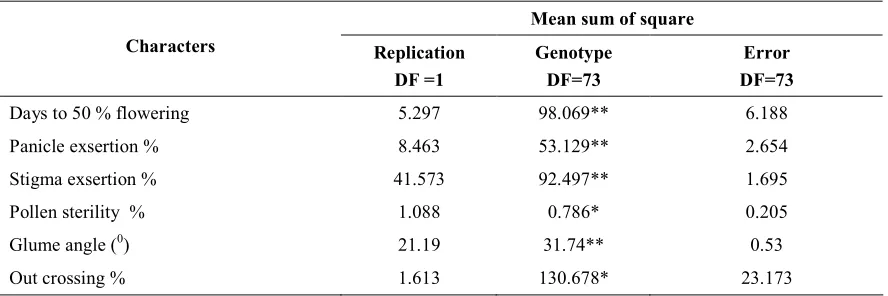
Table 1. Analysis of variance for various traits of 74 CMS linesMean sum of square
Characters Replication
DF =1
Genotype DF=73
Error DF=73
Days to 50 % flowering 5.297 98.069** 6.188
Panicle exsertion % 8.463 53.129** 2.654
Stigma exsertion % 41.573 92.497** 1.695
Pollen sterility % 1.088 0.786* 0.205
Glume angle (0) 21.19 31.74** 0.53
Out crossing % 1.613 130.678* 23.173
191
Table 2. Evaluation of seventy four rice CMS lines for pollen sterility and other floral traits
Sl.no Entries Days to 50
% flowering
Anthesis time (hrs)
Glume angle (O)
Panicle exsertion
%
Stigma exsertion
%
Pollen sterility
%
Spikelet fertility
%
Out crossing
%
Tip colour Awning Stigma
colour
1 COMS 8 88.50 10.45 25.00 79.86 33.69(T.S) 99.98 0.00 27.00 Green - White
2 COMS 9 93.50 10.30 25.00 86.71 31.08(T.S) 99.75 0.51 19.00 Purple - Purple
3 COMS 11 97.00 10.45 20.00 81.12 26.51(T.S) 99.43 0.89 21.50 Green - White
4 COMS 12 95.50 10.30 25.00 81.39 35.98(T.S) 99.39 0.78 19.50 Purple - Purple
5 COMS 13 99.50 10.30 25.00 87.63 41.85(O.S) 100.00 0.00 46.50 Green Small White
6 COMS 14 95.00 10.30 20.00 74.67 38.89(O.S) 99.59 0.68 35.00 Green - White
7 COMS 15 99.00 11.00 30.00 81.25 41.95(O.S) 100.00 0.00 40.00 Green - White
8 COMS 16 96.00 10.40 20.00 75.41 36.96(O.S) 99.99 0.00 30.50 Green - White
9 COMS 18 99.50 10.45 25.00 77.36 30.19(T.S) 98.89 0.74 33.00 Green - White
10 COMS 19 98.00 10.45 20.00 81.61 37.09(O.S) 99.95 0.00 27.00 Green - White
11 IR 66707 95.50 10.45 25.00 71.79 34.09(T.S) 99.93 0.00 21.00 Green small White
12 IR 68229 88.50 10.30 25.00 79.08 42.19(T.S) 98.54 0.93 19.00 Green Small White
13 IR 68275 99.50 10.45 20.00 81.28 31.15(O.S) 100.00 0.00 22.50 Green - White
14 IR 68280 102.00 11.00 20.00 80.95 31.48(O.S) 98.81 1.47 31.00 Green small White
15 IR 68281 107.5 10.45 25.00 89.68 41.09(T.S) 99.94 0.00 44.00 Purple - Purple
16 IR 68285 109.00 11.00 20.00 79.90 41.20(T.S) 99.06 0.94 29.50 Yellow - White
17 IR 68890 102.50 11.15 25.00 83.75 35.20(O.S) 98.28 1.52 22.00 Purple - Purple
18 IR 68892 105.50 10.45 30.00 81.38 37.89(T.S) 99.19 0.68 19.00 Green - White
19 IR 68899 107.50 10.45 20.00 74.25 36.44(O.S) 99.94 0.00 19.50 Green Medium White
20 IR 68902 104.00 10.30 20.00 76.12 37.50(T.S) 99.94 0.00 26.50 Green Medium White
192
Sl.no Entries Days to 50
% flowering
Anthesis time (hrs)
Glume angle (O)
Panicle exsertion
%
Stigma exsertion
%
Pollen sterility
%
Spikelet fertility
%
Out crossing
%
Tip colour Awning Stigma
colour
22 IR 70362 104.00 10.30 20.00 72.16 36.84(O.S) 99.93 0.00 27.50 Green Medium White
23 IR 69626 102.50 11.00 25.00 83.97 41.87(T.S) 99.92 0.00 39.80 Green Medium White
24 DRR 2 109.00 11.00 20.00 79.86 39.09(O.S) 99.04 0.00 29.50 Purple - Purple
25 IR 75596 107.50 11.00 25.00 77.09 41.40(O.S) 99.97 0.00 18.50 Green - White
26 IR 68885 99.00 11.00 20.00 71.46 40.87(O.S) 99.92 0.00 22.00 Green - White
27 IR 80155 109.00 11.00 25.00 77.03 34.29(T.S) 99.24 0.92 18.50 Green Small White
28 IR 70369 96.50 10.00 20.00 78.26 41.38(O.S) 98.89 1.74 15.00 Green Medium White
29 IR 70959 99.00 10.30 15.00 74.25 41.97(O.S) 99.93 0.00 33.00 Purple - Purple
30 IR 71321 107.50 10.15 20.00 88.48 47.06(T.S) 98.64 0.76 27.50 Green Small White
31 IR 73320 102.50 9.30 20.00 74.06 48.65(T.S) 99.28 0.94 14.00 Green - White
32 IR 73321 103.50 10.00 20.00 69.64 38.81(O.S) 98.51 1.02 34.50 Green Medium White
33 IR 73328 109.00 10.00 20.00 75.25 26.82(O.S) 98.53 1.04 19.50 Green - White
34 IR 79156 102.50 10.00 25.00 79.75 37.50(O.S) 99.95 0.51 25.50 Green Medium White
35 IR 80151 99.00 10.00 25.00 76.96 40.37(O.S) 99.98 0.00 19.00 Green - White
36 IR 80154 101.00 10.15 20.00 79.48 36.92(O.S) 99.13 0.74 19.00 Green Small White
37 IR 80156 99.00 10.30 25.00 78.03 41.35(T.S) 98.91 1.47 24.50 Green - White
38 IR 80555 98.50 10.00 20.00 69.23 39.86(T.S) 99.98 0.00 27.00 Green Small White
39 IR 80559 98.50 9.30 25.00 78.09 32.64(T.S) 99.15 1.00 28.00 yellow Small White
40 IR 80186 101.50 10.00 15.00 74.29 35.45(T.S) 100.00 0.00 30.50 Green Medium White
41 DRR 3 96.00 10.00 15.00 83.33 38.42(T.S) 99.93 0.97 29.00 Green - White
42 DRR 4 88.50 10.15 15.00 77.01 22.92(O.S) 98.79 1.23 54.50 Purple - Purple
193
Sl.no Entries Days to 50
% flowering
Anthesis time (hrs)
Glume angle (O)
Panicle exsertion
%
Stigma exsertion
%
Pollen sterility
%
Spikelet fertility
%
Out crossing %
Tip
colour Awning
Stigma colour
44 DRR 6 92.00 9.45 20.00 79.24 22.95(O.S) 99.28 0.91 36.50 Purple - Purple
45 DRR 7 90.00 9.30 25.00 88.81 41.36(T.S) 99.93 0.00 42.00 Purple - Purple
46 DRR 8 95.00 10.00 20.00 80.26 38.51(T.S) 100.00 0.00 29.00 Purple - Purple
47 DRR 10 99.50 10.30 15.00 70.78 38.89(T.S) 99.64 0.56 31.00 Green - White
48 DRR 12 102.50 9.45 20.00 79.10 46.79(O.S) 97.64 2.17 24.50 Green - White
49 RTN 1 96.50 10.00 20.00 80.53 26.09(T.S) 96.30 4.55 35.00 Green - White
50 RTN 2 90.00 9.30 20.00 74.68 37.50(T.S) 99.81 0.85 42.00 Green - White
51 RTN 3 96.50 10.30 25.00 81.92 35.00(T.S) 98.15 2.22 39.00 Green - White
52 RTN 4 112.50 11.00 20.00 70.11 25.68(T.S) 99.92 0.00 26.50 Green Small White
53 RTN 5 105.50 10.30 15.00 73.34 27.94(O.S) 99.90 0.00 29.00 Green - White
54 RTN 6 96.50 10.30 30.00 82.14 42.11(T.S) 99.97 0.00 40.50 Green - White
55 RTN 11 112.50 10.30 30.00 67.66 28.57(O.S) 99.25 0.53 26.75 Green Small White
56 RTN 12 99.00 10.30 25.00 81.84 27.07(T.S) 99.73 0.00 21.00 Green - White
57 RTN 13 111.00 11.00 25.00 81.25 41.59(T.S) 100.00 0.00 41.00 Green Small White
58 RTN 17 114.50 11.00 20.00 79.36 20.69(T.S) 99.74 0.00 29.75 Green Small White
59 RTN 18 92.50 11.00 25.00 71.17 36.56(O.S) 99.92 0.00 27.00 Green Medium White
60 PMS 3 102.50 11.00 25.00 71.74 29.58(T.S) 100.00 0.00 30.25 Green - White
61 PMS 10 106.50 11.00 20.00 74.78 34.68(O.S) 99.19 0.76 25.50 Green - White
62 PMS 17 104.00 11.15 30.00 82.84 45.04(T.S) 99.95 0.00 41.50 Green - White
63 CRMS 45 97.50 11.00 25.00 70.14 20.00(T.S) 99.11 0.78 33.13 Green - White
64 KJT 2 112.50 11.00 20.00 70.13 32.08(O.S) 98.63 1.85 24.00 Green - White
194
Sl.no Entries Days to 50
% flowering
Anthesis time (hrs)
Glume angle (O)
Panicle exsertion
%
Stigma exsertion
%
Pollen sterility
%
Spikelet fertility
%
Out crossing %
Tip
colour Awning
Stigma colour
66 KJT 6 113.50 9.45 20.00 69.75 29.21(O.S) 99.60 0.00 23.50 Green - White
67 APMS 5 99.50 10.00 20.00 79.64 31.76(O.S) 99.52 0.00 27.00 Green Medium White
68 APMS 6 100.50 10.30 20.00 89.21 42.12(T.S) 99.60 0.00 33.75 Green - White
69 DMS 3 86.50 10.00 15.00 79.69 35.54(O.S) 99.73 0.00 27.75 Green - White
70 DMS 4 87.50 11.00 15.00 76.26 32.31(O.S) 99.61 1.59 19.25 Green Small White
71 V 20 96.00 9.45 20.00 77.76 28.33(O.S) 99.26 0.56 17.75 Purple - Purple
72 Zhenshan 97 86.50 9.30 20.00 76.75 10.08(O.S) 98.86 1.02 19.75 Purple - Purple
73 CMS 29 94.00 10.00 20.00 89.90 35.65(T.S) 99.74 0.00 21.50 Green Small White
74 CMS 39 107.50 9.30 20.00 81.95 41.56(T.S) 100.00 0.00 24.00 Green - White
195
Table 3. Estimates of variability and genetic parameters of 74 rice CMS lines for floral traits
Characters Mean Range S.E
difference
S.E of
mean CD CV% GCV % PCV %
Heritability
% GA %
GA % of mean
Days to 50 % flowering 100.28 86.50-113.50 2.49 1.75 3.48 2.48** 6.76 6.98 93.69 13.52 13.48
Panicle exertion % 78.04 67.66-89.90 1.63 1.14 2.28 0.46 6.43 6.60 95.00 10.09 12.93
Stigma exertion% 34.66 10.57-49.55 1.30 0.91 1.82 3.76** 19.44 19.62 98.17 13.75 39.68
Pollen sterility % 99.36 96.30-100.00 0.45 0.32 0.63 0.46 0.54 0.63 73.95 0.95 0.96
Glume angle (o) 22.07 15-30 0.73 - 1.45 3.30** - - - - -