22
Egypt. J. Soil Sci. Vol. 56, No. 3, pp. 385 - 400 (2016)R
Comparative Study between Different Chopping
Rotations and Raw Materials for Composting
Process
I. M. M. Khater and Mona M. El Shazly*
Soil and Water Conservation Department and *Soil Fertility
and Microbiology Department, Desert Research Center, Cairo, Egypt.
ECYCLING of crop residues in agriculture through production of
…… compost brings much needed organic matter to the soil. Composting was studied by using three chopping rotations 1000,1300 and 1500 rpm, three feeding rates of 0.250,0.500 and 0.750 t/h of both rice and corn residues and with application of mixture from different bacterial inocula (cellulose decomposing bacteria cellomonas sp., nitrogen fixing bacteria Azotobacter chroococcum, Phosphate dissolving bacteria Bacillus megatherium and Sacchromyces cervisiae). The performance of chopping machine during cutting rice straw and corn stalks residues in terms of particle size distribution, energy, C/N ratio, P, pH, microbial activities and maturity duration were experimentally investigated as a function of change in chopper drum speed and material feed rate. The results reveal that the farm residues chopping machines were recommended to be used for cutting the crop residues into small pieces to encourage the microbial activities. The best treatment was achieved with chopper drum speed of 1500 rpm and material feed rate of 0.250 t/h with biofertilizers application for both corn stalks and rice straw residues, which produced a compost with maturity period lower than compost without biofertilizers application, narrow C/N ratio, rich with mineral contents like P and K for corn stalks and rice straw, respectively.
Keywords: Chopping rotations, Crop residues, Maturity composting and Microbial activity.
micro-organisms involved in the composting process. These parameters include a drop in compost temperature (Flynn and Wood, 1996), organic matter and nutrient contents (Tiquia, 2003, Baddi et al., 2004 and Grigatti et al. , 2004) and C : N ratio ( Kaushik and Garg, 2004). Proper management of the crop residues by utilizing microorganisms may result into availability of good quality manure as well as protection of environment from pollution (Ulusoy et al., 2009). The main target of chopping farm residues machines is become nowadays more important due to the consequent increase of farm residues all over the world, because of the extensive agriculture and existence of large quantities of farm residues. Rice straw is considered one of the main environmental problems in Egypt. The corn stalks seem to be less as an environmental problem but can be considered one of the main sources for insects and rats. El- Saadany (2003) concluded that the percentage of cutting efficiency increased with increasing the numbers of helical shaft revolution until it reached the maximum cutting efficiency. Jekendra and Singh (1991) reported that the energy requirement of various fodder harvesting machines differ significantly from those of net cutting. Crop acceleration, compaction and conveyance normally consume more than 50 % of total energy while energy consumed in shearing stems is normally less than 3%. Operating at speeds between 25 to 35 m/s gives an optimum cutting energy requirement for forage materials. El-Iraqi and El-Khawaga (2003) found that the maximum percentages in cutting length less than 5cm were 87.80 and 92% obtained for rice straw and corn stalks residues, respectively, at cutting speed of 10.09m/s, feeding rate of 0.771ton/h. The maximum values of power consumption of 4.90 and 4.76kW were obtained at the same feeding rate and cutting speed for cutting rice straw and corn stalks, respectively. Parr et al. (1992) stated that the components of rice straw are mainly cellulose and hemicelluloses encrusted by lignin, in addition to a small amount of protein, which makes it high in C:N ratio. Therefore it is resistant to microbial decomposition compared to straw from other protein-rich grains such as wheat and barley. Misra and Roy (1980) reported that composting is carried out by adding straw, animal dung and green manure crops which often mixed. The pits are filled layer by layer, each layer being 15 cm thick. Usually, the first layer is of a green manure crop or water hyacinth, the second layer is a straw mixture and the third layer is of animal dung.; a water layer of about 4 cm depth is maintained on the surface to create anaerobic conditions which help to reduce losses of nitrogen. Approximate quantities of the different residues in tons per pit are: rice straw 0.15, animal dung 1.0, green manure 0.75 and superphosphate 0.02. Three turnings are given in all, the first one month after filling the pit and, at this time, the superphosphate is added and thoroughly mixed in. Water is added as necessary. The second turning is done after another month and the third two weeks later. The material is allowed to decompose for three months and produces about eight tons of compost per pit.
Examples of cellulose degrading bacteria are found in both filamentous (e.g.,
Streptomyces, Micromonospora) and non-filamentous (e.g., Bacillus, Cellulomonas,
Cytophaga) genera (Lynd et al., 2002).
The use of bacteria, actinomycetes and fungi in the decomposition of organic matter produces good results by taking advantage of their enzymatic activities, favoring the elimination of organic waste and providing beneficial metabolic products to the soil (Tiquia et al. (2002a) and Singh & Sharma, (2003). The enzymatic activities of these microorganisms play an important role in the degradation of complex substrates such as lignin and cellulose (Tiquia et al., 2002b). The aim of the present work is cutting crop residues into pieces (rice straw and corn stalks) in order to minimize their size and volume to facilitate and rapid composting Optimizing some operating parameters (chopper rotating speed, and material feed rate) affecting the performance of crop residues chopping machine and studying the effect of biofertilization in accelerating composting process.
Material and Methods
Two experiments were carried out at a private farm in West Nubaria, the first experiment (rice straw and corn stalks) were prepared for chopping process. This experiment was performed at stationary chopper driven by Universal 650M tractor PTO (power take off) shaft. The chopping machine model A- 210 was locally manufactured by Altec Company. with outer feeding opening width of 40X40 cm and 8 blades, the blades were treated before chopping. All experiments were carried out at different combinations of chopping cylinder peripheral velocity of 33.10; 43.10; and 49.71m/s corresponding to 1000; 1300 and 1500 r.p.m respectively. Material feed rates were; 0.250; 0.500 and 0.750 t/h. All used farm residue materials were air dried. Table(1) showed some crop residues specification before chopping process.
TABLE 1. Some average of crop residues specifications before chopping process 7Kind of residues
Stem diameter (cm)
Stem length (cm)
Moisture content (%)
Rice straw 0.3-0.4 87-115 9.5
Corn stalks 2.5-3.0 189-236 17.8
After each treatment, crop residues were collected from the machine output and their lengths were classified into four categories as follows: the first group of lengths is less than 5 cm; the second is between > 5 to 10 cm; the third is between > 10 to 15 cm, and the fourth is between is over than 15 cm. according to ASAE (2001).
Estimation of the required energy was calculated according to formula of Hunt (1983):
F.C1/3600 PE.LCV.427. thb. m.1/75.1/36
where: F.C= Fuel consumption, (lit/h)
P.E= Fuel density (for solar 0.85 kg/m3) LCV= Calorific value of fuel (11000 k.cal/kg)
thb.
= Thermal efficiency of engine (35% for diesel engine)
m= Mechanical efficiency of the tractor engine (85%)The energy can be determined as follows:
Energy requirement (kW. h/ton) = Required power (kW)/ Effective field capacity (ton/h).
The second experiment was carried out to identify individually plants specifications and compost periods due to residue lengths and their microbial activities, two types of compost were prepared with and without biofertilizer application to investigate effect of biofertilzers in improving compost. The treatments were classified as following (Table 2).
TABLE 2. Classified treatments of chopping residues
Corn(ton/h) Rice (ton/h)
Treatment
C1 with 0.250 t/h R1 with 0.250 t/h
1000 RPM R4 with 0.500 t/h C4 with 0.500 t/h
C7 with 0.750 t/h R7 with 0.750 t/h
C2 with 0.250 t/h R2 with 0.250 t/h
1300 RPM R5 with 0.500 t/h C5 with 0.500 t/h
C8 with 0.750 t/h R8 with 0.750 t/h
C3 with 0.250 t/h R3 with 0.250 t/h
1500 RPM R6 with 0.500 t/h C6 with 0.500 t/h
C9 with 0.750 t/h R9 with 0.750 t/h
During compost preparation, cellulose decomposing bacteria were added to speed organic wastes decomposition where biofertilizers mixture containing N-fixer (Azotobacter chroococcum) , P. solubilizers (Bacillus megatherium) and yeast (Sacchromyces cervisiae) which were added, one liter of biofertilizers mixture beside 1 liter of molasses is added to 98 liter of water to obtain 100 liters of ready to use biofertilizers mixture functioning as accelerator reduces the composting period as well as increases the nutritional value of compost.Nitrogen content was determined by micro-Kjeldahl method (Jackson, 1967). Phosphorus and potassium were determined according to Cottenie et al.
(1982). Phosphorus was photometrically determined using Vanadate method and measured by spectrophotometer, while potassium was extracted by 1N ammonium acetate and pH 8.5 measured by flam photometer.
and Ishac (1968) and aerobic cellulose decomposer on CMC agar medium was done according to Someya (1980).
Results and Discussion
Effect of chopping machine rotation and feeding rate on the p ercentages of cutting lengths
T he percentages of cutting lengths were highl y affected by the different chopping mac hine rotating speed, and feeding rates. Concerning chopper rotating speed on the percen tage of cutting lengths, T able s 3 and 4 sho wed the eff ect of increasing chopper rotating speed and feeding rate for both rice straw and corn stalks. For rice straw, the obtained data showed that increasing rotating speed from 1000 to 1500 rpm, with all constant feed rate increased the percentage of cutting le ngth (<5cm), (>5 10cm) and (>10 -15cm) from 0.00 to 64.37%, while decreased (>-15cm) from 62.78 to 23.71% for all treatments. On other hand , increasing the feeding rate from 0.250 to 0.750 ton/h sho wed different resulted data, but in general, the feeding ra te of 0.250 ton/h achieved more residue length percentage as compared with the other feeding rates specially with rotation speed of 1500 rpm. Relating to corn stalks, data showed that increasing rotating speed from 1000 to 1500 rpm, with all constant feed rate increased the percentage of cutting length (<5cm), (>5 - 10cm) and (>10 -15cm) from 15.00 to 54.72%, while decreased (>15cm) from 12.90 to 0.00% for all treatments. Data collected from corn stalks experiment s ho wed that, the feeding rate of 0.250 ton/h achieved more residue length percentage as compared with the other feeding rates specially w ith rotation speed of 1500 rpm. T he previous data were similar to Lotfy (2003) .
TABLE 3. Effect of chopping machine rotation and feeding rate on the percentages of cutting lengths of rice straw
Feeding Rate ton/h
Chopping rotations and treatments
1000 RPM 1300 RPM 1500 RPM Residue length,(%)
5cm≥ >5-10cm
>10-15cm >15cm 5cm≥ >5-10cm
>10-15cm >15cm 5cm≥ >5-10cm
>10-15cm >15cm
0.250
R1 R2 R3
0.00 2.18 34.95 62.87 2.12 16.82 30.01 51.05 5.20 7.46 52.13 35.21
0.500
R4 R5 R6
0.00 0.86 49.08 50.06 0.22 9.52 42.21 48.05 4.26 28.97 43.06 23.71
0.750
R7 R8 R9
TABLE 4. Effect of chopping machine rotation and feeding rate on the percentages of cutting lengths of corn stalks
Feeding Rate ton/h
Chopping rotations and treatments
1000 RPM 1300 RPM 1500 RPM Residue length cm,(%)
≥5 >5-10
>10-15 >15 ≥5 >5-10
>10-15 >15 ≥ 5 >5-10
>10-15 >15
0.250
C1 C2 C3
22.30 49.11 28.59 0.00 38.55 34.57 22.08 4.80 54.72 26.14 15.00 4.14
0.500
C4 C5 C6
21.47 50.52 28.01 0.00 31.21 38.38 26.74 3.67 47.31 21.10 18.69 12.90
0.750
C7 C8 C9
20.32 51.92 27.76 0.00 26.03 43.70 29.31 0.96 42.80 29.54 21.60 6.06
Effect of chopping machine rotation and feeding rate on energy requirements
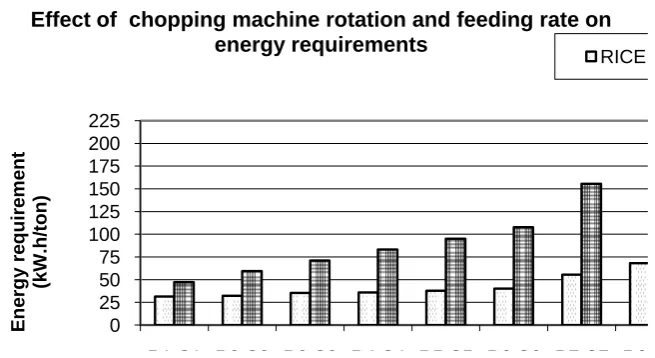
Data in Fig. 1 showed a remarkable increase in energy requirements as the chopper rotating speed increased for the used residues for any feed rate. Concerning rice straw, obtained data showed that increasing rotating speed from 1000 to 1500 rpm, and different feeding rates from of 0.250 to 0.750 ton/h, increased energy requirements from 31.54 to 70.07 kW. h/ton. The same attitude was revealed to corn stalks where data showed that increasing rotating speed from 1000 to 1500 rpm for all feeding rate, increased the energy requirements from 47.31 to 203.32 kW. h/ton . The increasing of energy requirements by increase chopper rotating speed was attributed to more of the cutting blades knocking number per unit time. On the other hand, the increasing of energy requirements by increasing residues feeding rate was attributed to the excessive quantity of the used material on the cutting blades, which increases the load on the machine parts that tends to increase power, then energy requirements (Yore et al., 2005).
Effect of chopping machine rotation and biofertilizers application on C/N ratio, P and K of the matured compost
0 25 50 75 100 125 150 175 200 225
R1,C1 R2,C2 R3,C3 R4,C4 R5,C5 R6,C6 R7,C7 R8,C8 R9,C9
E
ne
rgy
re
qu
ir
e
me
nt
(k
W
.h/
ton
)
Treatments
Effect of chopping machine rotation and feeding rate on
energy requirements
RICE CORN
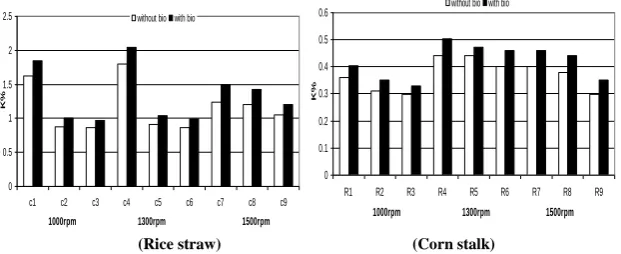
From the obtained results it was clear that chopping machine rotation 1500rpm with feeding rate 0.250 ton/h and biofertilizers application recorded the highest mineral contents of compost followed by the other studied treatments. The lowest mineral contents of compost recorded with 1000 rpm and 0.750 ton/h without biofertilizers application of both corn stalks and rice straw. Each gram of obtained compost contains millions of beneficial microorganisms that synergistically work to break down organic matter, enrich compost with mineral nutrients and eliminate pathogens. Of the microorganisms present, 80 to 90% are bacteria, including actinomycetes and aerobic bacteria. They have an important and effective role in the compost pile, through consuming, digesting and recycling plant residues. These bacteria are also versatile, extracting carbon and nitrogen from virtually any organic substance as a source of energy. They use this energy to create protein and reproduce. Also, microbial activities generate heat, increasing the temperature of the compost pile, which further speeds the decomposition process (Casandra Maier, 2004).
Also, N values might have increased due to the nitrogen-fixing bacterial activity that commonly occurs at the end of composting. The increased amount of N at the end of composting is due to this stored source of N (Bishop and Godfrey, 1983).
The phosphorus (P) content increased with biofertilizers treatment, compared to the treatment without biofertilization, this result is in accordance with the other reports (Sommer, 2001, Iyengar & Bhave, 2005 and Tai & He 2007).
K is known as the element that is easily leached out. However, in this study the K value increased in biofertilization treatments. The use of rice straw as a medium that can absorb moisture and maintain its structural integrity and porosity, might avoid the loss of K in compost (Iyengar and Bhave, 2005). K plays an important role in plant growth where its function is to increase the elongation of the root, control ion balance, improve protein synthesis, encourage enzyme reaction, and improve the photosynthesis process and food development (Sabiani et al., 2004).
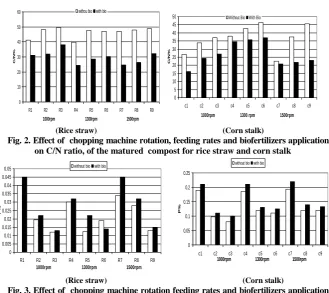
The initial carbon to nitrogen (C/N) ratio is one of the most important factors influencing compost quality Rui Guo et al. (2012). C/N ratio of corn stalk and rice straw before composting is 57.1 and 41.8, respectively. Composting process lowered this wide C/N ratio to 26.37, 22.45, respectively. For compost treatment R3 and \C3 which indicates the important role of composting and microbial activity in accelerating composting process and reach maturity of compost.
0 10 20 30 40 50 60
R1 R2 R3 R4 R5 R6 R7 R8 R9
1000rpm 1300rpm 1500rpm
C
/
N
%
withou bio with bio
0 5 10 15 20 25 30 35 40 45 50
c1 c2 c3 c4 c5 c6 c7 c8 c9
1000rpm 1300 rpm 1500rpm
C
/
N
%
Without Bio With Bio
(Rice straw) (Corn stalk)
Fig. 2. Effect of chopping machine rotation, feeding rates and biofertilizers application on C/N ratio, of the matured compost for rice straw and corn stalk
0 0.05 0.1 0.15 0.2 0.25
c1 c2 c3 c4 c5 c6 c7 c8 c9
1000rpm 1300rpm 1500rpm
P%
without bio with bio
(Rice straw) (Corn stalk)
Fig. 3. Effect of chopping machine rotation feeding rates and biofertilizers application on P%, of the matured compost for rice straw and corn stalk
0 0.005 0.01 0.015 0.02 0.025 0.03 0.035 0.04 0.045 0.05
R1 R2 R3 R4 R5 R6 R7 R8 R9
1000rpm 1300rpm 1500rpm
P%
0 0.5 1 1.5 2 2.5
c1 c2 c3 c4 c5 c6 c7 c8 c9
1000rpm 1300rpm 1500rpm
K%
without bio with bio
0 0.1 0.2 0.3 0.4 0.5 0.6
R1 R2 R3 R4 R5 R6 R7 R8 R9
1000rpm 1300rpm 1500rpm
K%
without bio with bio
(Rice straw) (Corn stalk)
Fig. 4. Effect of chopping machine rotation feeding rates and biofertilizers application on K%, of the matured compost for rice straw and corn stalk
Microorganisms may also immobilize soil nutrients, particularly in soils with residues which have a wide C: N ratio. So, organic residues should be composed to narrow the C: N ratio during humification before being applied to soil as crop amendments. Enriched plant residues with mineral fertilizers results in a product similar in every respect to that obtained from farmyard manure. Sound management of organic residues plays a crucial role in bio-organic farming (Saber, 2001).
As the bacteria in the compost pile consume and digest organic matter, they excrete and free up important minerals and nutrients, including nitrogen, potassium, carbon, ammonia, magnesium, phosphorus and micronutrients. Once the mature compost is added to soil, the plants can absorb these nutrients. Adding compost to nutrient-poor soil may make it able to support plants (Casandra Maier, 2004).
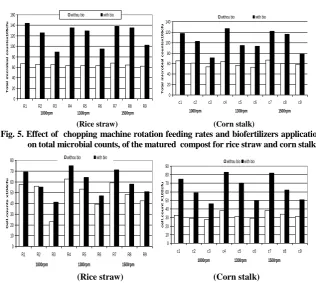
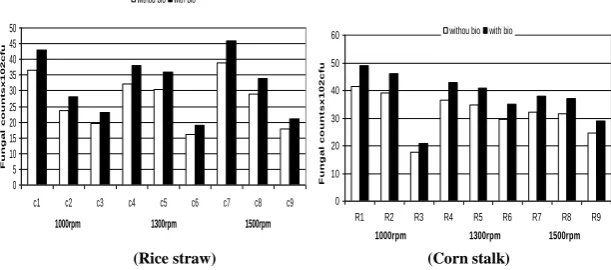
It was observed from Fig. 5-7 that the cellulose decomposing bacteria,
Azotobacter and yeast presented in higher densities especially with biofertilized
compost. Microbiological analysis, however, indicated pronounced differences in the counts of tested microorganisms in both biofertilized or non-biofertilized composts under the different chopping speed and feeding rates. The treatment of corn stalks and rice straw with cellulose decomposer, B. megatherium , Az.
chroococcum and S. cervisiae gave the most desirable characteristics of the final
product with respect to the narrow C/N ratio, high nitrogen content and high denisties of Azotobacter.
substances, production of amino acids, organic acids, vitamins and antimicrobial substances as well, which increase soil fertility, microbial community and plant growth (Russell, 1989). On the other hand, Estefanous, (2003), Tiquia, (2005) and Abd El-Gawad (2008) reported that enrichment of compost materials with A. chroococcum and phosphate solubilizers increased the nitrogen and humus content and decreased the C/N ratio of the produced compost.
The increase of biological activities caused by organic manure might be due to the available carbon sources on which microorganisms live besides conserving soil moisture and maintaining favorable soil temperature (Lou and Sun, 1994). 0 20 40 60 80 100 120 140 160
R1 R2 R3 R4 R5 R6 R7 R8 R9 1000rpm 1300rpm 1500rpm
To t a l m i c r ob i a l c ou nt s x 1 0 5 c f u
withou bio with bio
0 20 40 60 80 100 120 140
c1 c2 c3 c4 c5 c6 c7 c8 c9 1000rpm 1300rpm 1500rpm
To t a l m i c r ob i a l c ou nt s x 1 0 5 c f u
withou bio with bio
(Rice straw) (Corn stalk)
Fig. 5. Effect of chopping machine rotation feeding rates and biofertilizers application on total microbial counts, of the matured compost for rice straw and corn stalk
0 10 20 30 40 50 60 70 80
R1 R2 R3 R4 R5 R6 R7 R8 R9
1000rpm 1300rpm 1500rpm
C e l l . c ou nt s x 1 0 4 c f u
withou bio with bio
0 10 20 30 40 50 60 70 80 90
c1 c2 c3 c4 c5 c6 c7 c8 c9 1000rpm 1300rpm 1500rpm
c e l l . c ou nt X 1 0 2 c f u
withou bio with bio
(Rice straw) (Corn stalk)
0 5 10 15 20 25 30 35 40 45 50
c1 c2 c3 c4 c5 c6 c7 c8 c9
1000rpm 1300rpm 1500rpm
Fu
ng
a
l
c
ou
nt
s
x
1
0
2
c
f
u
withou bio with bio
0 10 20 30 40 50 60
R1 R2 R3 R4 R5 R6 R7 R8 R9
1000rpm 1300rpm 1500rpm
F
u
n
g
a
l
c
o
u
n
t
s
x
1
0
2
c
f
u
withou bio with bio
(Rice straw) (Corn stalk)
Fig 7. Effect of chopping machine rotation feeding rates and biofertilizers application on Fungi counts, of the matured compost for rice straw and corn stalk
Effect of chopping machine rotation, feeding rate and biofertilization on the period of compost maturation
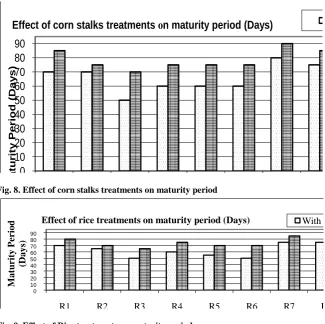
The period for maturity of compost was highly affected by different chopping machine rotating speed, feeding rate and biofertilization. Figures 8 and 9 showed the effect of chopper rotating speed, feeding rate and biofertilization of both rice straw and corn stalks on compost maturation. For corn stalks, the obtained data showed that the rotating speed of 1500 rpm, with 0.250 ton/h feed rate of corn residue achieved the shortest maturity period by 50 and 70 days with biofertilization and without biofertilization, respectively. On the other hand, increasing the feeding rate to 0.750 ton/h with rotation speed of 1000 rpm of the treatment (C7), showed different resulted data, where the maturity period was 80 and 90 days with biofertilization and without biofertilization, respectively. Generally, the feeding rate of 0.250 ton/h achieved short maturity periods as compared with the other feeding rates. Relating to rice straw, data showed that increasing rotating speed from 1000 to 1500 rpm, with all studied feed rates led to decrease maturity periods. The obtained data of treatment (R3) showed that rotating speed of 1500 rpm, with 0.250 ton/h feed rate achieved the shortest maturity period by 50 and 65 days with and without biofertilization, respectively. On other hand, increasing the feeding rate to 0.750 ton/h with rotation speed of 1000 rpm (C7), the maturity period was 75 and 85 days with and without biofertilization, respectively. Generally, the feeding rate of 0.250 ton/h achieved the shortest maturity periods as compared with the other feeding rates. The previous data were similar to Lotfy (2003).
The use of cellulose decomposer, B. megatherium , Az. chroococcum and S.
cervisiae in composting accelerated markedly decomposition process, 90 days
0
10
20
30
40
50
60
70
80
90
C1
C2
C3
C4
C5
C6
C7
C8
C9
M
a
tu
ri
ty
Pe
ri
o
d
(
D
a
y
s
)
Treatments
Effect of corn stalks treatments
o
n maturity period (Days)
With bio
Fig. 8. Effect of corn stalks treatments on maturity period
0 10 20 30 40 50 60 70 80 90
R1 R2 R3 R4 R5 R6 R7 R8 R9
M
at
u
rity
P
er
io
d
(D
ay
s)
Treatments
Effect of rice treatments on maturity period (Days) With bio without
Fig. 9. Effect of Rice treatments on maturity period
References
Abd El-Gawawd, A.M. (2008) Employment of biotechnology in recycling of plant wastes for improving plant production under siwa conditions. Research Journal of Agriculture and Biological Sciences,, 4 (5). 566-574.
Abd El-Hafez, A.M. (1966) Some studies on acid producing microorganisms in soil and rhizosphere with special reference to phosphate dissolvers. PhD. Thesis, Fac. Agric., Ain Shams Univ. Cairo, Egypt.
ASAE (2001) Methods of Determining and Expressing Fineness of Feed Materials by Sieving. American Society of Agricultural Engineering Standards, 45th ed. S 319.3, St. Joseph, Mich.
Baddi, G.A., Hafidi, M., Cegarra, J., Alburquerque, J.A., Gonzalvez, J., Gilard, V. and Revel, J.C. (2004) Characterization of fulvic acids by elemental and spectroscopic (FTIR and C-NMR) analyses during composting of olive mill wastes plus straw. Bioresour. Technol. 93, 285–290.
Bishop, P.L. and Godfrey, C. (1983) Nitrogen transformations during sludge composting. BioCycle , 24, 34-39.
Borken, W., Muhs, A. and Reese, F. (2002) Changes in microbial and soil properties following compost treatment of degraded temperate forest soils. Soil, Biol, Biochem 34, 403–412.
Casandra Maier (2004) Role of Bacteria in Composting, University of Illinois Extension: The Science of Composting, Cornell Composting Science & Engineering: Compost Microorganisms- The Phases of Composting.
Cottenie, A., Verloo, M., Kiekens, L., Velgh, G. and Camerlynck, R. (1982) Chemical Analysis of Plants and Soils. State Univ. Ghent Belgium, pp. 44-45.
El-Iraqi, M. and El-Khawaga, S. (2003) Design and test performance of cutting machine for some crop residues. Misr J. Ag. Eng., 20 (1), 85-101.
El-Saadany, M.A., (2003) Performance of helical mower in cutting maize stalks. Misr J. Ag. Eng., 20 (1), 51-63.
Estafanous, A. N. (2003) Amendment of rice straw with rock phosphate and certain microbial inoculants for production of high quality compost. Egypt. J. Appl. Sci. 18, 441-455.
Feng, C.L., Zeng, G.M., Huang, D.L., Hu, S., Zhao, M.H., Lai, C., Huang, C. and Wei, Z. (2011) Effect of ligninolytic enzymes on lignin degradation and carbon utilization during lignocellulosic waste composting. Process Biochemistry, 46, 1515– 1520.
Flynn, R.P. and Wood, C.W. (1996) Temperature and chemical changes during composting of broiler litter. Compost Sci. Util. 3, 62–70.
Grigatti, M., Civiatta, C. and Gessa, C. (2004) Evolution of organic matter from sewage sludge and garden trimmings during composting. Bioresour Technol. 91, 163–169.
Hoitink, H.A.J. and Grebus, M.E. (1994) Status of biological control of plant disease with composts. Compost Sci. Utilization, 2, 5–12
Iyengar, S.R. and Bhave, PP (2005) In-vessel composting of household wastes. Waste Manag. 26, 1070-1080.
Jackson, M.L. (1967) Soil Chemical Analysis, Prentice Hall of India Ltd. New Delhi. Jekendra, Y. and Singh, P. (1991) Energetics of forage chopping, AMA, 22 (1), 59 –
63.
Kaushik, P. and Garg, V.K. (2004) Dynamics of biological and chemical parameters during vermicomposting of solid textile mill sludge mixed with cow dung and agricultural residues. Bioresour, Technol. 94, 203–209
Lotfy, A. (2003( Development and performance evaluation of a machine for cut and throw agricultural residues. Misr J. Ag. Eng., 20 (3) 724 - 736.
Luo, A. and Sun, X. (1994) Effect of organic manure on the biological activities associated with insoluble phosphorus release in a blue purple paddy soil. Communications in Soil Science and Plant Analysis, Vol. 25, No 13-14, (Available online: Nov 2008), pp.2513– 2522, ISSN: 0010-3624.
Lynd, L.R., Zyl, W.H. and I.S. Pretorious, (2002) Microbial cellulose utilization: Fundamentals and biotechnology.Microbiol. mol. biol. r. 66: 506 – 577. Ministry of Agriculture and Land Reclamation, Economic Affairs Sector, 2012. Study of important indicators of the agricultural statistics, summer and Nili crops.
McMahon,V., Garg, A., Aldred, D., Hobbs, G., Smith, R. and Tothill, I.E. (2009) Composting and bioremediation process evaluation of wood waste materials generated from the construction and demolition industry. Chemosphere, 71 (9), 1617–1628.
Misra, R.V. and Roy, R.N. (1980) A manual of rural composting.FAO/UNDP. Regional Project RAS/75/004 Field Doc. 15.
Nautiyal, C. S. (1999) An efficient microbiological growth medium for screening phosphate solubilizing microorganisms. FEMS Microbiology Letters, 170, 265- 270.
Ouedraogo, E., Mando, A. and Zombre, N.P. (2001) Use of compost to improve soil properties and crop productivity under low input agricultural system in West Africa. Agric Ecosyst Environ. 84, 259–266.
Parr, J.F., Papendick, R.I., Hornick, S.B. and Meyer, R.E. (1992) Soil Quality attributes and relationship to alternative and sustainable agriculture. American J. Altern. Agric., 7–11.
Popkin, R. (1995) Good news for waste watchers: recycling, composting show results for the future. Environ. Prot. Agency J., 21, 188–90
Russell, E.W. (1989) Soil Conditions and Plant Growth, ELBS edition of eleventh edition, reprinted.
Ryckeboer, J., Mergaert, J., Vaes, K., Klammer, S., Clercq, D., Coosemans, J. Insam, H. and Swings, J. (2003) A survey of bacteria and fungi occurring during composting and self-heating processes. Ann. Microbiol. 53, 349–410.
Saber, M.S.M. (2001) Clean biotechnology for sustainable farming. Chem. & Eng. Tech., No. 24. Including Eng. Life Sci. 1(6), 217-223.
Sabiani, M.D., Asaari, N.H. and Kajian, F. (2004) perbandingan kualiti kompos daripada sisa tanaman menggunakan pelbagai kaedah pengkomposan. Pulau Pinang: Universiti Sains Malaysia.
Singh, A. and Sharma, S. (2003) Effect of microbial inocula on mixed solid waste composting, vermicomposting and plant response. Compost Sci. Util., 11, 190-199.
Sommer S.G. (2001) Effect of composting on nutrient loss and nitrogen availability of cattle deep litter. Eur. J. Agron. (2001) 14,123-133.
Someya, M. (1980) Counting Methods of Aerobic Cellulose Decomposers in Paddy Soil. Rep. Inst. Agric Res. Tohoko Univ., 31, 43-58.Nova Scotia: CBA Press.
Tai. H.S. and He, W.H. (2007) A novel composting process for plant wastes in Taiwan military barracks. Resour. Conserv. Recy. 2007, 51, 408-417.
Tiquia, S.M., Wan, J.H.C. and Tam, N.F.Y. (2002a) Microbial population dynamics and enzyme activities during composting. Compost Sci. Util. 10, 150–161.
Tiquia, S.M., Wan, J.H.C. and Tam, N.F.Y. (2002b) Dynamics of yard trimmings composting as determined by dehydrogenase activity, ATP content, arginine ammonification, and nitrification potential. Process Biochem. 37, 1057–1064
Tiquia, S.M. (2003) Evaluation of organic matter and nutrient composition of partially decomposed and composted spent pig litter. Environ. Technol. 24, 97–107.
Tiquia S.M. (2005) Microbiological parameters as indicators of compost. Journal of Applied Microbiology, 99, 816–828
Ulusoy,Y., Ulukardesler, A.H., Unsal, H. and Alibas, K. (2009) Analysis of biogas production in Turkey utilizing there different materials and two scenario. Alex J. Agric . Pres. 4, 996-1003.
Yore, M.W., Jenkins, B.M. and Summers, M.D. (2005) Cutting Properties of Rice Straw. Paper No: 026154 ASAE, Annual Inter. Meeting / CIGR XV th World Congress , Hyatt Regency Chicago, Chicago, Illinois, USA
ىلع تسوبمكلا داومو ةفلتخملا عيطقتلا تاعرس نيب ةنراقم ةسارد
تسوبمكلا صاوخ
و رطاخ رينم محمد ملاسإ
*
ىلذاشلا ىسرم ىنم
مسق ىضارلاا ةنايص هايملاو
و
*
ىضارلاا ايجولويبوركيمو ةبوصخ مسق
-ءارحصلا ثوحب زكرم
ةرهاقلا رصم .
سملا ىضارلاا يف صاخ لكشبو ةبرتلا جاتحت ديمستلا ةيلمع ىلإ اثيدح ةحلصت
ىفو تاتابنلا ومنل ةمزلالا ةيئاذغلا رصانعلا نم اهاوتحم ةدايزو اهدادعلإ كلذو ثلاث مادختساب تسوبمكلا لمع ةسارد مت ثحبلا اذه ةينارود تاعرس عيطقت ةللا تافلخملا ىهو 0111 و 0011 و 0511 ةقل / ةنيكاملا ميقلت تلادعم ثلاثو ةقيقد
ىهو 051 و 511 و 751 نط / ةعاس تافلخم نم لكل شق
و زرلاا ناديع عم ةرذلا
زوليليسلا تلالحم ىهو ةفلتخم ةيبوركيم تلازع نم طولخم مادختسا تافسوفلا تابيذمو مكوكورك رتكابوتوزا نيجورتينلا تاتبثمو سانوموليسلا ميريثاجيم سليساب .
ب عيطقتلا ةلا ءادا رابتخا متو ةينارودلا اهتاعرس
ميقلتلا تلادعمو ةفلتخملا
تافلخمل ةفلتخملا شق
، تائيزجلا مجحو عيزوت ريدقت للاخ نم ةرذلا ناديعو زرلاا
ةقاطلا ةكلهتسملا ةرتف ،ىبوركيملا طاشنلا ،ةضومحلا ،نيجورديهلل نوبركلا ةبسن ،
جضنلا . جئاتنلا ترهظا دقو :
يلقحلا تافلخملا مرفل عيطقتلا تلالاا مادختساب ةيصوتلا ة
ةريغص ءازجا ىلا
هللال عيطقت ةعرسب ةلماعملا تلجسو ىبوركيملا طاشنلا عيجشتل 0511
ةفل / ةقيقد
ميقلت لدعمو 051
نط / ةعاس شق تافلخمل ةبسنلاب ىويحلا ديمستلا مادختسا عم
ريغلا تسوبمكلا نم لقا جضن ةرتفب تسوبمك تجتنا ىتلاو ةرذلا ناديع و زرلاا ىويحلا ديمستلاب لماعم قح ثيح
نم جضن ةرتف ةلماعملا ةذه تق 51
ىلا 71 موي
و ةرذلا تافلخم جضنل 51
و 55 ىويحلا ديمستلا مادختساب زرلاا تافلخمل موي
ىلاوتلا ىلع نودبو ىندعملا ىوتحملاب ىنغ ، نيجورتينلل نوبركلا ةبسن ىف لقا ،
مويساتوبلاو روفسوفلا لثم ةيئاذغلا رصانعلل ناديعل
ا ا ىلع زرلاا شقو ةرذل ىلاوتل