ISSN 1392-2785 ENGINEERING ECONOMICS. 2006. No 5 (50) ECONOMICSOFENGINEERINGDECISIONS
Presumptions for the Development of Labour Market Differences in a
Homogene-ous Group of Countries
Daiva Beržinskien
ė
Šiaulių universitetas
Architektų g.1, LT-78366, Šiauliai
The main differences of labour markets in the Baltic States and the main factors influencing them in the con-text of Euro integration are analysed in this paper. The differences in different regions appear at the beginning of the European Union, but the last period of its develop-ment gave the most challenge for the new members as well as the whole European Union. The factors that influ-enced the changes in the labour markets can be grouped into two periods: influence of transformation processes till the integration into the EU and development of the integration processes of later years. Transformation and integration processes began simultaneously and they have been carried on for different purposes through dif-ferent political conditions and means. The results and development of these processes determined initial Euro integration conditions and different development of la-bour markets in the EU countries. The Baltic States have a few similar features: they all have the similar territorial area, all three states are post soviet countries and their economic development was determined by the similar factors, but they have differences in the changes of their labour market structures. The differences of economic development between new members and the other EU countries are obvious. Gross Domestic Product in some regions differs more than eight times and unemployment rates – even seven times. Though the Baltic States are often presented as one homogeneous group, the trans-formation and integration processes determined the dif-ferent effects in their labour markets. To reduce these social and economic differences in these regions and to stimulate the equal EU development – it is one of the po-litical purposes in the EU countries, so the presumptions influencing the differences of labour markets in homoge-neous group of the countries are analysed in this paper. Keywords: homogeneous group of countries, the Baltic
States, labour market, employment, unemploy-ment, differences in labour market.
Introduction
The political problems of the EU countries are analy-sed in Lithuanian and foreign authors’ works (Štreimi-kienė, 1998; Bagdzevičienė, 2001; Smilga, Čičinskas, 2003; Eamets, Masso, 2002 Boeri, Terrell, 2002; Faggio, Konings, 2001; Iara, Trainstaru, 2004 ir kt.). Some au-thors concentrate their attention on the equal EU devel-opment and social and economic cohesion. The works analysing different models of political management which influence different economic development in the
EU countries are relevant for the research. Though the presumptions and effects forecast and assessment are analysed in some works, the difference of labour markets in the homogeneous group of the countries has not been investigated. Having estimated it, the scientific problem
can be formed like this: how it appeared and what influ-enced the differences of labour markets in the homogene-ous group of the countries.
The aim of the research – to base the presumptions of different labour market development in the Baltic States.
The object – presumptions that influenced the labour markets differences in the Baltic States.
The methods of the research – systematic analysis of scientific literature and statistical data analysis, mathematical statistical methods.
Theoretical background of a homogeneous group in labour market formation
The changes made in the different labour markets can be explained through complicated behaviour of labour market mechanism. Theoretical model of an ideal labour market ignores the strong effect of external conditions for dynamics of labour market structure and points out the features necessary for the ideal labour market:
• labour force supply (labour force quantity in the labour market) is adequate to labour force demand (workplaces in the labour market);
• short time term from the moment when a person begins to look for a job (workplace vacancy) till the labour contact formation. It means that labour contract is made when an opening workplace ap-pears as soon as a person begins to look for a job; • all workers and opening workplaces leave the
la-bour market usefully, as soon as the contract is over.
Fourth, the labour force leaving the labour market does not always match the liquidation of workplaces, and the both side disappearing is not always useful. A worker can leave the labour market when he looses the hope to find a job, and workplaces can be constrainedly liquidated from the labour market. Fifth, different attitudes of employers choosing and employing workers exist (discrimination in labour market). All these and other reasons determine dynamism, indetermination and different development of labour market (Schmid, 1995; Layard, 1991; Jackman, 1991; Nickell, 1991).
Investigating the factors of changes and differences of labour market structure the works analysing the struc-ture of labour market mechanism, its components and function possibilities are relevant (Schmid, 1995; Layard, 1991; Jackman, 1991; Nickell, 1991). The labour market mechanism influenced by different environment condi-tions can be characterised with different dynamics of dif-ferent labour market elements. The research, analysing the features of work efficiency, uncovered that work effi-ciency influenced by large investment and technological possibilities makes a big influence on the changes of la-bour market structure even in the sectors of alternative economic performance (Berggren, 1992; Clawson, 1980; 1990; Williams, 1992; Haslam, 1992). Theoretical labour market studies, where the balance states of supply and demand are analysed, labour force position problems and negotiation related to the differences of work payment are important, because they uncover the reasons which are determined by microeconomic process (Krugman, 1991; Olgaard, 2001; Rotschield, 1994; Rolle, 1997 and others). The problem of labour force migration is relevant nowadays. The research is important investigating the rea-sons and process of migration in the country. The authors (Tedaro, 1969; Molle, 1997; Öberg, 1997; Marsden, 1994)
hade proved that migration appears when there is a grow-ing disproportion between labour market supply and de-mand as well as the differences of work payment in differ-ent regions. Having analysed the problems of social eco-nomic development in the European Union countries, it is noticed that they have common social and economic de-velopment features (Iara, Trainstaru, 2004; Boeri, Terrell, 2002), however the development of institutional, political, juridical and other factors in different countries or their groups influences unequal social economic development. These factors influence the changes of different labour market structures. Though the Baltic States are accepted as one homogeneous group, they are very different in their development process. Integration processes in these coun-tries are found in different development aspects.
Theoretical interpretation (Černina, 1991) of labour market segmentation is necessary to point out the pre-sumptions which determine the segmentation of the ele-ments having the same features in labour market struc-ture. The character and number of segments can vary through the international level, so it is difficult to struc-turalise and explain the presumptions of different territo-rial labour market formation.
In conclusion, labour market can be characterized by complicated morphological structure, however it is influ-enced by internal and external conditions. These condi-tions are not separated from each other and have synergy effect: when external conditions are changing internal condition features are changing respectively, too. This process determines different changes in labour market structure through different territorial regions.
Having evaluated the fact that the labour market is an open system, effective functioning of which is influenced by many factors (interior and exterior). The structure of factors influencing labour market is presented in Figure.
Figure. Factors influencing labour market The synergy effect determines the different social
po-litical tightness, which influences the distribution of labour resource (Boeri, Terrell, 2002). To sum it up, essential pre-sumptions influencing the different dynamics in labour market structure are determined by the external factors: the
difference of economic growth in the countries, the changes of labour resource and work; and the internal fac-tors: different and limited information, intensity of work search, tightness of an employer and a worker in the aspect of placement and working conditions.
Internal factors:
Full information about Intensity of the job
need of the employee search
and the job
REGIONAL LABOUR MARKET
Flexibility of employee Flexibility of worker
in regard in regard to job and
to job and employment employment conditions conditions
Employee’s compatibility External factors
Economic changes: Dynamics of GDP, stage of economic cycle, investment activity
Changes in the labour resource structure:
demographic, make-up, economic activity
Analytical Model of Changes and Differences in Labour Market Structure
To come to a decision to reduce the differences of la-bour market structures the data estimating the changing economic situation in the particular region is essential. To solve this problem it is necessary to choose the right methods to calculate and estimate the data.
To analyse the components of economic rate, data of simple and complex structure is invoked. Data of simple structure is understood as a set of homogeneous elements, whose consistent pattern of dispersion is defined by well known mathematical function. Data of complex structure involves the compound of organically linked simple data elements. Data to describe macro economic and micro economic events in the economic performance is usually comprised of a complex structure. This data can be de-fined as factual, optimal and hypothetical and its ele-ments are economic static criteria or indicators. Eco-nomic statistical identification of the ecoEco-nomic changes (labour market structure) with a ‘structural’ tone is a very difficult goal. To formulate the task of statistical research of structure changes and differences, these concepts should be concretized. The concept of structural changes is more ‘dynamic’. It defines the ‘inside’ structural changes of economic indicator through time, x- role of i-indicator component change through time. The concept of the structural changes is broader and involves dynamic and static aspects. It defines
Σ
y
i changes of the indicatorlevel through time in the hierarchy aspect of the eco-nomic structure (Valkauskas, 2004).
To research the development of territorial changes in the Baltic States the task defining the structural changes and differences should be formulated in this way: take n number of Si indicators, which involve m number of equal
components yij, id est. i indicator is equal to Si = Σyij. In
this case the comparative weight of the component of indicator is equal to:
100 ) /
( Σ ×
= yij ij ij y y
f ; (1)
where: Σfij =100.
This is the procedure of primary data changing to the criterion of comparative structure. When there is n num-ber of indicators,
S
i⎯
⎯→
S
fij→ . Having the factual and
comparative bases of the past period,
S
fij meanings areidentifying and analysing in these goals:
1. To identify factual Si features of the structure
(statics of the index is estimated in the given time period);
2. Features of structure changes are assessed com-paring factual and comparative data (process dy-namics is estimated in the aspect of retrospect). Mathematical models of time rows are used to solve this task, which let define the change of variable x value in the time moments x(t), t1< t2...< tn;
3. The criterions of deflection of factual indicator
components are defined and compared with the base situation (index tendencies are forecasted in the aspect of perspective). Static prediction models of time row are use to solve this task, where forecast error et is counted to validate the
accuracy;
et = xt – ft (2)
where: xt – factual value of the index,
ft – the change of forecasting index value.
4.
S
istructural links are identified and estimated with the help ofK
iindicators (the analysis of correlation regression is done). In this task r in-dexes of link tightness are assessed,y x
y x xy r
σ σ
× −
= ; (3)
Dynamics and differences of labour markets in a homogeneous group of countries
The factors that influenced the changes in the labour markets can be grouped into two periods: influence of transformation processes till the integration into EU and development of the integration processes of late years. Transformation and integration processes began simulta-neously and they have been carried on for different pur-poses through different political conditions and means. The results and development of these processes deter-mined initial Euro integration conditions and different development of labour markets in the EU countries. The Baltic States have a few similar features: they all have the similar territorial area, all three states are post soviet countries and their economic development was deter-mined by the similar factors, but they have differences in the changes of their labour market structures.
Analysing pre-integration period which is determined by the transformation process effects, the Russian crisis is actual because of its influence on the labour markets in the Baltic States. The Baltic States as one homogenous group found out that Russian crisis had dramatically dif-ferent effects in each of the three labour markets. As re-sult of crisis, Estonian outflow from unemployment de-clined and the unemployment pool become more stag-nant. By contrast, in Latvia the unemployment outflow relatively high, but there was an increase in the inflow to inactivity. One explanation for such a situation in Latvia, where unemployment has been substantially higher than in Estonia, is that the macroeconomic shock resulted in widespread worker discouragement (Eamets, Masso, 2002).
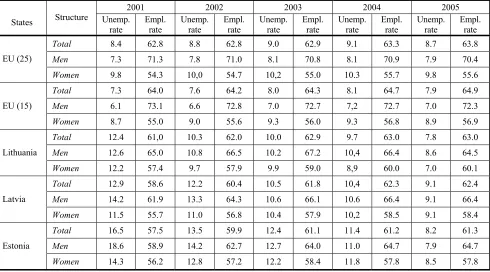
Table 1
Rate changes in labour markets in the EU countries in 2001-2005
2001 2002 2003 2004 2005 States Structure Unemp.
rate Empl. rate Unemp. rate Empl. rate Unemp. rate Empl. rate Unemp. rate Empl. rate Unemp. rate Empl. rate Total 8.4 62.8 8.8 62.8 9.0 62.9 9.1 63.3 8.7 63.8
Men 7.3 71.3 7.8 71.0 8.1 70.8 8.1 70.9 7.9 70.4
EU (25)
Women 9.8 54.3 10,0 54.7 10,2 55.0 10.3 55.7 9.8 55.6 Total 7.3 64.0 7.6 64.2 8.0 64.3 8.1 64.7 7.9 64.9
Men 6.1 73.1 6.6 72.8 7.0 72.7 7,2 72.7 7.0 72.3
EU (15)
Women 8.7 55.0 9.0 55.6 9.3 56.0 9.3 56.8 8.9 56.9 Total 12.4 61,0 10.3 62.0 10.0 62.9 9.7 63.0 7.8 63.0
Men 12.6 65.0 10.8 66.5 10.2 67.2 10,4 66.4 8.6 64.5
Lithuania
Women 12.2 57.4 9.7 57.9 9.9 59.0 8,9 60.0 7.0 60.1 Total 12.9 58.6 12.2 60.4 10.5 61.8 10,4 62.3 9.1 62.4
Men 14.2 61.9 13.3 64.3 10.6 66.1 10.6 66.4 9.1 66.4
Latvia
Women 11.5 55.7 11.0 56.8 10.4 57.9 10,2 58.5 9.1 58.4 Total 16.5 57.5 13.5 59.9 12.4 61.1 11.4 61.2 8.2 61.3
Men 18.6 58.9 14.2 62.7 12.7 64.0 11.0 64.7 7.9 64.7
Estonia
Women 14.3 56.2 12.8 57.2 12.2 58.4 11.8 57.8 8.5 57.8
Source: EUROSTAT
Analysing the changes of unemployment rate among young people during 2001-2005 period, which is divided into pre-integration and post-integration, it was noticed that unemployment among young people during pre-integration period was decreasing very slowly in the whole homogeneous group of the countries, but very differently in each of them. The biggest decrease of youth unemploy-ment was noticed in Lithuania, which was 5.8 per cent until the EU integration, in Latvia it was 5.0 per cent, and in Estonia – 2.8 per cent. After integration the change of youth unemployment was searched in Lithuania again – -7.4 per cent, in Estonia – -5.9 per cent, and in Latvia – -4.4 per cent. This decrease of youth unemployment can be explained by mobility, typical for such group of people. According to the results of the research a lot of young peo-ple after studies prefer to look for a job in a foreign coun-try instead of integrating into the local labour market.
Thought the homogeneous group of the countries su-ccessfully solves the unemployment problems in their regions, the lack of labour force in different economic sectors is observed recently in all these three countries and the reasons are determined by the flow of labour for-ce migration. Usually migration appears as the response to the disproportion of labour force supply and demand as well as the differences of wages among regions. The mig-ration analysis in the Baltic States showed that the inequality of the people who arrived and left the country was negative in Lithuania and Latvia and it was growing up. In the both countries net migration was -7.2 thousand people during the period of 2001-2005. In Estonia situa-tion was different: until 2004 net migrasitua-tion was positive and in 2005 this rate was -0.3 thousand people.
Long-term unemployment usually becomes a difficult
problem because of its strong social factor, but in the Baltic States long-term unemployment was slowly de-creasing during the researched period. In Lithuania this rate decreased 2.2 per cent of the particle, in Latvia – 3.3 per cent and in Estonia only 0.9 per cent. While in Poland long-term unemployment was growing up and during 2001-2005 it increased almost 3.0 per cent. Successfully integrated system of labour market political means had a positive influence for the changes of unemployment in the Baltic States.
To avoid the unemployment growth in Lithuania new mechanisms to establish new work places have been im-plemented, which had the purpose to increase accessibil-ity for the capital for business beginning, to develop business and administration abilities among the people and to promote the investment potential in the working companies. More and more work places have been estab-lished after having improved business conditions in the economy of the country.
Reasons of differences in labour markets in homogeneous group of countries
Having analysed the results of the research assessing the changes of labour market structure it is obvious that the differences in the labour markets are determined by external as well as internal factors, which influence is different in each country.
Taking into account that the economic conditions and development changes were assessed as external factors, possibilities of investments in the Baltic States, dynamics of Gross Domestic Product (GDP) and the changes of wage and work efficiency have been analysed too.
Foreign direct investment (FDI) is necessary condi-tion to create new work places. During the researched period FDI was especially high in Estonia – in 2004 it was 9.4 per cent of GDP. In Latvia it was growing up, but much slower compared with Estonia rates (5.1 per cent of GDP in 2004). In Lithuania FDI was only 3.5 per cent of GDP in the given period. The correlation analysis of FDI and employed people showed that growing investment determines the growth of employment rate. According to the count, it was noticed that adequate to the growing
investment, employed people compounded 63 per cent in Estonia, 62.3 per cent in Latvia and 61.2 per cent in Lithuania. To sum it up, the improving of investment climate in the country is one of the relevant conditions for the positive changes of employment.
In the research of work efficiency change in the EU countries the biggest growth of work efficiency was no-ticed in Poland (5.9 per cent every year). It was nono-ticed that in Poland work efficiency was growing while the employment was decreasing and the unemployment was slowly increasing, so this rate appeared without wage growth. In the Baltic States work efficiency was growing following: in Estonia 5.6 per cent, in Latvia 4.2 per cent and in Lithuania 3.8 per cent per year. However, the wages were growing too while the unemployment was decreasing. The employment growth in Latvia and Lithuania was determined by low value-added taxes. Though the Baltic States were characterized as fast grow-ing productivity countries, they were at the bottom of the list with this rate compared with the other EU countries.
The most important factor influenced the changes in labour market structure and determined migration growth was the differences of the average wages in the countries.
Table2
Average net wage in 2005 (Euro)
CZ EE CY LV LT HU MT PL SI SK EU15 EU25
11056 6067 30245 4407 4890 7794 20908 8505 15075 6136 38701 34288
10733 6540 31915 4659 5045 8421 19442 8044 15757 7625 39909 35395
Source: Eurostat data New Cronos
Having analyzed the data, it is obvious that annual wage in Latvia and Lithuania is the least compared with the other EU countries. It differs more than six times compared with Cyprus and eight times – with EU(25). Migration flows have been determined by global macro economic factors, which are symmetric to the economic proportion of the developed and undeveloped countries. Because of emigration decreased labour force demand in the labour markets influenced on the increase of the wages. Due to it the average wage is approaching to the average EU(25). When in 2001 the difference was 7.1 times between Lithuania and ES25, it has obviously de-creased till 0.5 times during the researched period, in Estonia -1.1 times and in Latvia -1.2 times.
Conclusions
1. The analysis of special literature let it point out and bases the internal and external factors in la-bour market, which are relevant for the changes in labour market structure. The internal factors can be defined as:
• the accessibility of information about vacant work places;
• the intensity of work search;
• the flexibility of employer and employee in the aspect of work place and hire conditions; The external factors are defined as the changes of labour resource structure, economy and work.
2. According to the analysis of literature source, it was estimated that the Baltic States can be con-sidered as one homogeneous group, because they all have the same features: they all are situated in small territorial regions, they all are post-soviet countries and their economic development was determined by the same factors, however they have differences in the changes of labour market structure.
3. The results of the research showed that the Baltic States obtained the best results in decreasing the unemployment rate compared with the other EU countries.
4. It was estimated that FDI growth is one of the relevant conditions increasing the possibilities of employment in the homogeneous group of the countries, because the increasing of this rate in-fluences the growth of new work place estab-lishment.
5. The analysis of statistical data showed that the differences of the wages among the EU countries determine the dynamics of migration flow and this influence the lack of work force in the dif-ferent economic performance sectors.
References
1. Bagdzevičienė, R. Regioninės politikos vykdymo prielaidos //Regionų plėtra. 2001, p. 10-15.
Review. 1994.
3. Berggren, C. Alternatives to Learn Production: Work organization in the Swedish Auto industry, Ithaca NY: ILR Press. 1992.
4. Boeri, T. Regulation and Labour market Performance / T. Boeri, G.Nicoletti, S. Scarpetta//CEPR Discussion Papers No 2420. 2000. 5. Boeri, T.Institutional Determinants of Labour Reallocation in
Transi-tion Economies / T.Boeri, K.Terrell// Journal of Economic Perspec-tives. Feb. Vol. 16, No 2. 2002.
6. Clawson, D. Bureaucracy and the Labour Process: The Transforma-tion of US Industry // New York: Monthly Review Press. 1980. 7. Eamets, R.Labour Market Flexibility and Employment Protection
Regulation in Baltic States / R.Eamets, J.Masso // Working Paper, University of Tartu, mimeo. 2002.
8. Faggio, G. Job Creation, Job Destruction and Employment Growth in Transition Countries in the 90s / G.Faggio, J.Konings// IZA Working Paper No 242. Jan. 2001.
9. Hearley, N. M. The Economics of New Europe. London. 1995, p. 317.
10. Huber, P. Local Labor Market Dynamics in the Czech and Slovak Republics/P.Huber, A.Worgotter. (Paris: OECD). 1997.
11. Iara, A. How Flexible and Wages in EU Accession Countries/ A. Iara, I.Trainstaru// Lab. Ec. 11. 2004, p. 431- 450.
12. Krugman, P. R. Maurice Obstfeld // International Economic: Theory and Policy. 1991.
13. Layard, R. Unemployment: Macroeconomic Performance and the labor Market / R.Layard, S. Nickell, R. Jackman. Oxford University Press, 1991.
14. Marsden, D. The integration of European labour markets in CEC (ed) / European integration and the European labour market. Social Europe, Supplement 1, Commission of the European Communities. Brussels, 1994, p. 1-38.
15. Molle, W. The Economics of European Integration: Theory, Practice, Policy (3rd ed), Ashgate, Aldershot, 1997.
16. Öberg, S. Theories on inter-regional migration: an overview in Blot Vogel, H. and Fielding A. (ed) People, Jobs and Mobility in the New Europe. John Wiley and Sons. Chi Chester, 1997.
17. Olgaard, A. Trends in Demographic Components and Employment, with Special Regard to Industrial Eu-Couuntries // Ekonomika ir vadyba 2000. Konferencijos pranešimų medžiaga. Kaunas, 2000, p. 319 – 321.
18. Paas, T. Labour Market Flexibility and migration in the Baltic States: Macro Evidences / T.Paas, R.Eamets, J. Masso// Faculty of Econom-ics and Business Administration Working Paper No 16. University of Tartu, 2003.
19. Rolle, C. Langzeitarbeitslosigkeit im Ländervergleich; zum Einflub von sozialen Sicherungsszstemen und Tariffindungsszstemen auf die Beschäftigtigung in Deutschland, Schweiz und USA. Berlin: Duncker und Humbolt. 1997, S. 122.
20. Rotschield, K. W. Theorien der Arbeitslosigkeit: Einführung / 2. Aufl. Münchenö Wien: Oldenbourg. 1994, S. 142.
21. Smilga, E. The problems of Lithuanian‘s Integrations into EU and
Global Economy / E. Smilga, J.Čičinskas //Organizacijų vadyba: sis-teminiai tyrimai. 2003.
22. Smith, A. Исследование о природе и причинах богатства народов. Мoсква: Соцэкниз, 1962.
23. Solow, R. M. Unemployment: getting the Question Right // Eco-nomic, 1998, Vol. 53 Supplement. p. 23 – 24.
24. Spycher, S. Auswirkungen von Regelungen des AHV – Rentenal-ters auf die Sozialvericherungen, den Staatshaushalt und die Wirtschaft. Im Auftrag des Bundesamtes für Sozialversicherun-gen. Bern. 1997.
25. Štreimikienė, D. ES regioninės politikos įgyvendinimas Lietuvoje / Regionų plėtra –2002: tarptautinės konferencijos pranešimų
medžiaga. Kaunas, 2002.
26. Williams, K., Haslam C., Williams J. Ford Versus: „Fordism“ The beginning of mass production Work employment and Society 6 (4). 1992, p. 517 – 55.
27. Womack, J.The Machine that Changed the World/ J.Womack, D. Jones, D.Ross. New York: Macmillan. 1990.
Daiva Beržinskienė
Skirtumų homogeninės šalių grupės darbo rinkose susidarymo prielaidos
Santrauka
Europos Sąjungos regioninės politikos problemų klausimais publikuota nemažai šalies ir užsienio autorių darbų (Štreimikienė, 1998; Bagdzevičienė, 2001; Smilga, Čičinskas, 2003; Eamets, Masso, 2002 Boeri, Terrell, 2002; Faggio, Konings, 2001; Iara, Trainstaru, 2004 ir kt.). Dalis autorių dėmesį sutelkia į vientisos ES plėtros gali-mybių didinimą siekiant valstybių socialinės ir ekonominės sanglau-dos. Reikšmingi mokslininkų darbai, analizuojantys įvairių Europos šalių skirtingus regioninės politikos valdymo modelius, kurių rezulta-tai sąlygoja skirtingas ekonominio augimo tendencijas. Nors inte-gracinių procesų prielaidų ir padarinių prognozėms bei vertinimui pastaruoju metu skiriama daug dėmesio, tačiau darbo rinkų skirtumai, besireiškiantys homogeninių valstybių grupėje, iki šiol menkai tyri-nėti. Įvertinus tai, būtų galima iškelti mokslinę problemą: kaip ir kokios prielaidos lėmė skirtumus homogeninių valstybių grupės darbo rinkose.
Skirtumus, susidarančius skirtingose darbo rinkose, pirmiausia galima paaiškinti sudėtingu pačios darbo rinkos mechanizmo funk-cionavimu. Teorinis idealios darbo rinkos modelis ignoruoja stiprų
išorės sąlygų poveikį darbo rinkos struktūros dinamikai ir išskiria požymius, kuriais turi pasižymėti ideali darbo rinka:
• darbo jėgos pasiūla (darbo jėgos kiekis darbo rinkoje) adek-vati darbo jėgos paklausai (darbo vietų skaičiui darbo rin-koje);
• gana trumpu laiko tarpu nuo asmens pasirodymo darbo rin-koje (darbo vietos vakansija) iki darbo sutarties sudarymo. Kitaip tariant, darbo sutartis sudaroma, kai laisvos darbo vie-tos ir asmens pasirodymas darbo rinkoje sutampa;
• visi darbuotojai ir laisvos darbo vietos palieka darbo rinką
rezultatyviai, t. y. pasibaigus darbo sutarties terminui. Vis dėlto, patirtis rodo, kad reali darbo rinka nėra ideali (Berggren, 1992; Clawson, 1980; 1990; Williams, 1992). Pirma. Darbo jėgos pasiūla paprastai neatitinka darbo jėgos paklausos darbo rinkoje. Be kiekybinių nesutapimų, egzistuoja struktūrinis disbalansas (profesinis, kvalifikacinis, geografinis ir pan.). Antra. Įeinantys į
darbo rinką darbo jėgos srautai nelygūs darbo vietų, įeinančiųį darbo rinką, srautams. Trečia. Susidaro gana ilgas laiko tarpas nuo mo-mento, kai asmuo (darbo vieta) patenka į darbo rinką, iki momento, kai sudaroma darbo sutartis (kai kurioms darbo vietoms ir patiems darbuotojams tai ganėtinai reikšmingas laiko tarpas). Ketvirta. Darbo jėgos išėjimas iš darbo rinkos ne visuomet sutampa su darbo vietų
likvidavimu, o ir pats abiejų šalių pasitraukimas ne visuomet yra rezultatyvus. Darbuotojas gali palikti darbo rinką, praradęs viltį į si-darbinti, o darbo vietos gali būti priverstinai išvestos iš darbo rinkos jas likviduojant. Penkta. Darbo rinkoje egzistuoja skirtingos darbdavių nuostatos pasirenkant ir samdant darbuotojus (diskrimi-nacija darbo rinkoje). Visos šios ir kitos priežastys sąlygoja darbo rinkos dinamiškumą, neapibrėžtumą bei skirtingą raišką (Schmid, 1995; Layard, 1991; Jackman, 1991; Nickell, 1991).
Tyrinėjant darbo rinkos struktūros pokyčius ir skirtumus są lygo-jančius veiksnius, reikšmingi darbai, analizuojantys darbo rinkos mechanizmo struktūrą, sudėtį, funkcionavimo galimybes (Schmid, 1995; Layard, 1991; Jackman, 1991; Nickell, 1991). Darbo rinkos funkcionavimo mechanizmas, veikiamas skirtingų aplinkos sąlygų, gali pasižymėti skirtinga darbo rinkos elementų dinamika. Tyrimai, nagrinėjantys darbo našumo ypatybes, atskleidė, kad darbo efekty-vumas sąlygotas investicinių, technologinių galimybių, turi didelę įtaką darbo rinkos struktūros pokyčiams net alternatyviuose ūkinės veiklos sektoriuose (Berggren, 1992; Clawson, 1980; 1990; Williams, 1992; Haslam, 1992). Teorinės darbo rinkos studijos, kuriose anali-zuojamos pasiūlos ir paklausos pusiausvyrų būsenos, darbo jėgos išsidėstymo problemos bei derybos, susijusios su darbo užmokesčio skirtumais, reikšmingos tuo, kad šiuose darbuose atskleidžiamos priežastys, kurias sąlygoja mikroekonominiai procesai (Krugman, 1991; Olgaard, 2001; Rotschield, 1994; Rolle, 1997 ir kt.). Ypač
aktuali pastaruoju metu darbo jėgos migracijos problema. Reikšmingi darbai, kuriuose tyrinėjamos šalių migracijos priežastys ir proce-sai.Tyrėjai (Tedaro, 1969; Molle, 1997; Öberg, 1997; Marsden, 1994)
Reikšminga darbo rinkos segmentuotės teorijos interpretacija (Černina, 1991), atskleidžianti prielaidas, lemiančias darbo rinkos struktūros elementų telkimąsi į atskirus segmentus su jiems būdingais bruožais. Tarptautiniu lygiu segmentų pobūdis ir skaičius gali būti labai įvairus, todėl sunku struktūrizuoti ir paaiškinti teritorinių darbo rinkos skirtumų susidarymo prielaidas.
Gilinantis į Europos Sąjungos šalių socialinio ekonominio vystymosi problemas, pastebėta, kad jos turi bendrų ekonominių ir socialinių vystymosi bruožų (Iara, Trainstaru, 2004; Boeri, Terrell, 2002), tačiau institucinių, politinių, teisinių ir kitų veiksnių raiška skirtingose šalyse ar jų grupėse sąlygoja netolygią socialinę eko-nominę raidą. Šių veiksnių visuma turi įtakos skirtingiems darbo rinkų struktūros pokyčiams. Nors Baltijos valstybės laikomos viena homogenine grupe, tačiau ekonominio vystymosi požiūriu jos labai skirtingos.
Darbo rinkų pokyčius sąlygojusius veiksnius Baltijos šalyse ga-lima skirstyti į du laikotarpius: transformacinių procesų poveikis iki ES integracijos ir integracijos procesų raiška pastaraisiais metais, jau tapus narėmis. Nors transformaciniai ir eurointegraciniai procesai prasidėjo skirtingu metu, juos įgyvendinant siekiama skirtingų tikslų
dažnai skirtingomis politikos priemonėmis; šių procesų raiška ir rezultatai sąlygojo pradines eurointegracijos sąlygas ir iš dalies nulėmė tolimesnį atskirų šalių darbo rinkų vystymąsi. Nors Baltijos valstybės turi bendrų bruožų – tai nedideli teritoriniai regionai, visos trys šalys yra posovietinės valstybės, o šių šalių ekonominę raidą
lėmė panašios priežastys, – tačiau joms būdingi skirtingi darbo rinkų
struktūros pokyčiai.
Analizuojant ikiintegracinį laikotarpį, susijusį su transforma-cinių procesų padarinių raiška, aktuali Rusijos krizės įtaka Baltijos šalių darbo rinkoms. Šie procesai homogeninių šalių grupėje, nors ir sąlygoti tų pačių veiksnių, turėjo skirtingą vystymosi dinamiką.
Po eurointegracijos nedarbo lygis labiausiai mažėjo Estijoje vidutiniškai 4,1 procentinio punkto. Kitose Baltijos valstybėse šis rodiklis taip pat mažėjo: Lietuvoje 2,2 proc. punkto ir Latvijoje – 1,4 proc. punkto. Apibendrinant galima teigti, kad, palyginti su kitomis ES šalimis, Baltijos šalys, mažindamos nedarbo lygį šiuo laikotarpiu pasiekė geriausių rezultatų. Nedarbo lygio augimas po integracijos išliko Kipre 1,1 proc. punkto ir Vengrijoje – išaugo 1 proc. punktu.
Analizuojant jaunimo nedarbo pokyčius 2001-2005 m. laikotar-piu, išskiriant ikiintegracinį ir pointegracinį laikotarpius, pastebėta, kad iki integracijos į ES jaunimo nedarbas mažėjo visoje ho-mogeninėje šalių grupėje, tačiau skirtingai. Labiausiai jaunimo ne-darbas iki ES narystės sumažėjo Lietuvoje – 5,8 proc. punkto, Latvi-joje 5 proc. punkto, o EstiLatvi-joje – 2,8 proc. punkto. Po eurointegracijos didžiausias jaunimo nedarbo rodiklio pokytis išliko Lietuvoje – -7,4 proc. punkto, Estijoje – -5,9 proc. punkto, o Latvijoje – -4,4 proc. punkto. Jaunimo nedarbo mažėjimą iš dalies būtų galima paaiškinti šios amžiaus grupei būdingu mobilumu. Remiantis tyrimų rezultatais, dažnas studijas baigęs jaunuolis mieliau išvyksta nei integruojasi į
vietinę darbo rinką.
Nors teritoriniu požiūriu homogeninė šalių grupė sėkmingai spren-džia nedarbo problemas, tačiau pastaruoju metu visų trijų šaliųį vairiu-ose ekonominės veiklos sektoriuose jaučiamas darbo jėgos stygius, kurio priežastis lemia darbo jėgos migracijos srautai. Paprastai mi-gracija pasireiškia kaip atsakas į darbo jėgos paklausos ir pasiūlos dis-proporcijas, taip pat ir darbo užmokesčio neatitikimus tarp regionų. Migracijos srautų analizė Baltijos šalyse parodė, kad Lietuvoje ir Latvi-joje skirtumas tarp atvykusių ir išvykusių buvo neigiamas ir nuolat augo. Abiejose šalyse migracijos saldo 2001-2005 m. laikotarpiu sudarė
-7,2 tūkst. gyventojų. Estijoje stebėta priešinga situacija: iki 2004 metų
šioje Baltijos valstybėje migracijos saldo buvo teigiamas, o tik 2005 m. šis rodiklis sudarė – 0,3 tūkst. gyventojų.
Įveikti nedarbo augimą Lietuvoje padėjo įdiegti nauji paramos naujoms darbo vietoms kurti mechanizmai, kurių tikslas – didinanti kapitalo verslo pradžiai prieinamumą, ugdyti gyventojų verslumo ir administracinius gebėjimus bei skatinti veikiančiųįmonių investicin-ius pajėgumus. Pagerėjus verslo sąlygoms, šalies ūkyje buvo sukuri-ama vis daugiau darbo vietų. Estijos nedarbo lygio mažėjimui turėjo
įtakos sparti vidaus rinkos plėtra, padidėjusios tiesioginės užsienio investicijos ypač finansų, ryšių, transporto ir sandėliavimo, perdir-bamosios pramonės ir prekybos sektoriuose. Padidėjusi veikiančių įmonių apyvarta padidino ir įmonių pelningumą. Estijos įmonėse ypač padidėjo investicijųį gamybą vertė. Spartus privataus vartojimo ir bendrųjų investicijų augimas skatino įmonėse didinti ir darbo vietų
skaičių. Latvijoje, kaip ir kitose Baltijos šalyse, situacija kito maždaug dėl tų pačių priežasčių. Nedarbas mažėjo dėl augančios šalies ekonomikos, padidėjusių investicijų bei sėkmingai vykdomos nedarbo mažinimo ir užimtumo didinimo politikos.
Tiesioginės užsienio investicijos (TUI) yra viena iš sąlygų kuri-ant naujas darbo vietas. Analizuojamu laikotarpiu TUI ypač išaugo Estijoje – 2004 m. siekė 9,4 proc. BVP. Latvijoje TUI augo, tačiau gerokai mažesniais augimo tempais, palyginti su Estijos rodikliu (5,1 proc. BVP 2004 m.). Lietuvoje TUI BVP sudėtyje šiuo laikotarpiu sudarė tik 3,5 proc. Atlikta TUI ir užimtų gyventojų koreliacinė anal-izė parodė, kad augančios investicijos sąlygoja užimtų gyventojų
skaičiaus augimą. Remiantis apskaičiavimais pastebėta, kad adek-vačiai investicijų augimui Estijoje užimtų gyventojų skaičius sudarė
63 proc., Latvijoje 62,3 proc. ir Lietuvoje – 61,2 proc. Apibendrinant galima teigti, kad investicinio šalies klimato gerinimas yra viena teigiamų užimtumo pokyčių sąlygų.
Tiriant darbo našumo kitimą ES šalyse nustatyta, kad labiausiai darbo našumas išaugo Lenkijoje (kiekvienais metais po 5,9 proc.). Pastebėta, kad Lenkijoje darbo našumas augo mažėjant užimtumui ir nežymiai augant nedarbui, todėl šio rodiklio didėjimas buvo pasiektas nedidinat darbo užmokesčio. Baltijos šalyse darbo našumas taip pat augo: Estijoje 5,6 proc., Latvijoje 4,2 proc. ir Lietuvoje 3,8 proc. per metus. Tačiau šiose šalyse didėjant darbo našumui augo atlyginimai bei mažėjo nedarbas. Užimtumo didėjimui Latvijoje ir Lietuvoje turėjo reikšmės ir tai, kad šiose šalyse vyrauja žemos pridedamosios vertės, materialinėms, energijos ir darbo sąnaudoms imlios veiklos. Nors Baltijos šalys pasižymėjo sparčiais darbo našumo augimo tem-pais, tačiau pagal šį rodiklį užima paskutines vietas tarpe ES šalių.
Bene svarbiausias veiksnys, sąlygojęs darbo rinkų struktūrų po-kyčius ir lėmęs migracijos augimą – vidutinio darbo užmokesčio skirtumai.
Išvados
1. Literatūros šaltinių analizė leido išskirti ir pagrįsti vidinius ir išorinius darbo rinkos veiksnius, kurie lemia darbo rinkos struktūros pokyčius. Vidiniams priskirtini:
• informacijos apie darbo vietas prieinamumas; • darbo paieškos intensyvumas;
• darbuotojo ir darbdavio lankstumas darbo vietos ir sam-dos sąlygų požiūriu.
2. Išoriniams veiksniams priskiriami darbo išteklių struktūros, ekonomikos ir darbo pokyčiai.
3. Remiantis literatūros šaltinių analize nustatyta, kad Baltijos valstybes galima vertinti kaip vieną homogeninę grupę, nes jos turi bendrų bruožų: tai nedideli teritoriniai regionai, visos trys šalys yra posovietinės valstybės, o šių šalių ekonominę
raidą lėmė panašios priežastys, tačiau joms būdingi skirtingi darbo rinkų struktūros pokyčiai.
4. Atlikti tyrimų rezultatai parodė, kad, palyginti su kitomis ES šalimis, Baltijos šalys, mažindamos nedarbo lygį, nagrinė -jamuoju laikotarpiu pasiekė geriausių rezultatų.
5. Nustatyta, kad TUI augimas yra viena iš sąlygų didinant ho-mogeninės šalių grupės užimtumo galimybes, nes šio rodiklio augimas skatina naujų darbo vietų kūrimą.
6. Statistinių duomenų analizė parodė, kad darbo užmokesčio skirtumai tarp ES šalių sąlygoja migracijos srautų dinamiką, o dėl to tirtose šalyse jaučiamas darbo jėgos stygius dauge-lyje ekonominės veiklos sektorių.
Raktažodžiai: homogeninė šalių grupė, Baltijos šalys, darbo rinka, užimtu-mas, nedarbas, skirtumai darbo rinkos.
The article has been reviewed.