Complete Forcing Numbers of Polyphenyl Systems
BINGJIE LIU1, HONG BIAN1 AND HAIZHENG YU2
1
School of Mathematical Sciences, Xinjiang Normal University, Urumqi, Xinjiang 830054, P. R. China
2
College of Mathematics and System Sciences, Xinjiang University, Urumqi 830046, P. R. China
Correspondence should be addressed to [email protected] (H. Bian) Received 25 March 2015; Accepted 10 August 2015
ACADEMIC EDITOR:HASSAN YOUSEFIAZARI
ABSTRACTThe idea of “forcing” has long been used in many research fields, such as colorings, orientations, geodetics and dominating sets in graph theory, as well as Latin squares, block designs and Steiner systems in combinatorics [D. Donovan, E. S. Mahmoodian, C. Ramsay, A. P. Street, Defining sets in combinatorics: A survey, in: C. D. Wensley (Ed.), Surveys in Combinatorics, Cambridge Univ. Press, 2003, pp. 115174]. Recently, the forcing on perfect matchings has been attracting more researchers’ attention. A forcing set of a perfect matching M of a graph G is a subset of M contained in no other perfect matchings of G. A global forcing set of G, introduced by Vukičević et al., is a subset of E(G) on which there are distinct restrictions of any two different perfect matchings of G. Combining the above “forcing” and “global” ideas. Xu et al. in [Complete forcing numbers of catacondensed benzenoid, J. Combin. Optim. 29
(2015) 803814.] introduced a complete forcing set of G defined as a subset of E(G) on which the restriction of any perfect matching M of G is a forcing set of M. The minimum cardinality of complete forcing sets is the complete forcing number of G. In this paper, we give the explicit expressions for the complete forcing number of several classes of polyphenyl systems.
KEYWORDS Complete forcing number • polyphenyl system • global forcing number.
1.
I
NTRODUCTIONA perfect matching M (or Kekulé structure, 1-factor) of a graph G is a set of independent edges such that every vertex of G is incident with exactly one edge in M.
Let G be a graph with edge set E(G) that admits a perfect matching M. A forcing set of M is a subset S of M contained in no other perfect matchings of G. The minimum possible cardinality of forcing set S is called the forcing number of M.
The notions of a forcing edge and the forcing number of a perfect matching first appeared in 1991 in a paper of Harary, Klein and Živković [14]. The root of these concepts can be traced to the works [15, 16] by Randić and Klein in 19851987, where the forcing number was introduced under the name of “innate degree of freedom” of a Kekulé structure, which plays an important role in the resonance theory in chemistry.
Over the past two decades, more and more mathematicians were attracted to the study on forcing sets (including forcing edges and forcing faces, etc) and the forcing numbers of perfect matchings of a graph. The scope of graphs in consideration has been extended from polyhexes to various bipartite graphs and non-bipartite graphs.
Some varied topics such as global (or total) forcing matchings and anti-forcing matching also emerged.
Klein and Randić [15] proposed the degree of freedom of a graph from the global point of view, defined as the sum of forcing numbers over all perfect matchings of a graph, and showed by evidence that the degree of freedom of a chemical graph actually measures graphical characteristics distinct from those measured by a couple of common resonance energy estimators. Because of extensive industrial and medical applications, one class of chemical graph-macrocyclic aromatic hydrocarbons called polyphenyls and their derivatives attracted the attention of chemists for many years [3, 4, 5]. A series of linear and branched polyphenyls and their derivatives were synthesized and some physical properties were discussed [813].
Gutman [17] showed that the values which the Wiener indices of isometric polyphenyls may assume are all congruent modulo 36. Bian and Zhang [18, 19] determined the polyphenyl chain with minimum and maximum Wiener (or edge-Wiener) indices among all the polyphenyl chains with n hexagons. Li and Bian [20] gave the extremal polyphenyl chains concerning k-matchings and k-independent sets. In 2013, Ma and Bian [21] also gave the extremal polyphenyl spiders concerning k-matchings and k -independent sets. A complete forcing set of G, introduced by Xu et al. [2] recently, is a subset of E(G) on which the restriction of any perfect matching is a forcing set of the perfect matching. The minimum possible cardinality of complete forcing sets of G is the complete forcing number of G, denote it by cf(G). Xu et al. gave an expression for the complete forcing number of a hexagonal chain and a recurrence relation for complete forcing number of cata-condensed hexagonal system. In 2014, Xu et al. [22] by the constructive proof, gave an explicit analytical expression for the complete forcing number of a primitive coronoid, a circular single chain consisting of congruent regular hexagons.
2.
P
RELIMINARIESAll graphs in this paper are simple connected and have perfect matchings. For all terms and notations used but not defined here, we refer the reader to the textbooks [23, 24].
Figure 1. A tree-like polyphenyl system and corresponding tree.
A polyphenyl system H is said to be tree-like (see Figure 1), if each vertex of H lies in a hexagon and the graph obtained by contracting every hexagon into a vertex in original molecular graph is a tree.
A hexagon r of a tree-like polyphenyl system may have one, two, three, four, five or six neighboring hexagons. If r has one neighboring hexagon, then it is said to be terminal, and internal otherwise. Also it is branched if it has three or more neighboring hexagons.
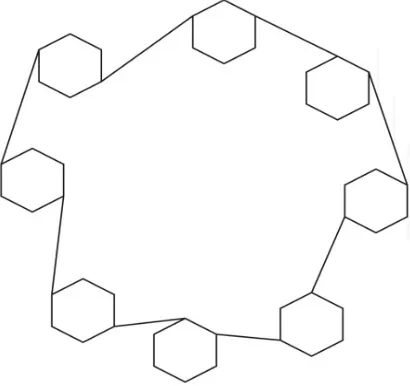
Definition 1. If every hexagon in a polyphenyl system has exactly two neighboring hexagons, then it is called primitive coronoid polyphenyl system. The set of primitive coronoid polyphenyl systems with n hexagons is denoted by CHn (see Figure 2).
Definition 2. A tree-like polyphenyl system without branched hexagons is called a polyphenyl chain. A polyphenyl chain with n hexagons is denoted by Hn (see Figure 3).
Figure 3. A polyphenyl chain with 7 hexagons.
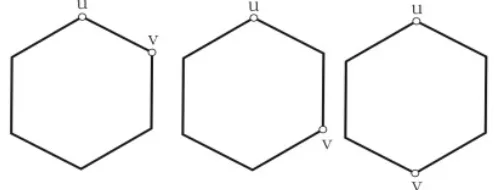
For a hexagon C, two vertices u and v of C are said to be in orthoposition if they are adjacent in C. If two vertices are at distance 2, they are in metaposition. Finally, if u and v are at distance 3, we say that they are in paraposition. Examples of pairs of vertices in ortho, meta, and paraposition are shown in Figure 4.
Figure 4. Orhto, meta, and parapositions of vertices u and v in C.
An internal hexagon C in a polyphenyl chain is called orthohexagon, metahexagon, or parahexagon, if the two vertices of C incident with two edges which connect other two hexagons are in ortho, meta, or paraposition, respectively.
Following Lovász and Plummer [24], an edge of G is said to be allowed if it is contained in some perfect matching of G and forbidden otherwise.
Theorem 1. Let H be a tree-like polyphenyl system with n hexagons. Then we have cf(H) = 2n.
Proof. Suppose that H is a tree-like polyphenyl system with n hexagons.
We can delete all edges incident with terminal hexagons, and obtain the resulting graph, which consists of a small tree-like polyphenyl system and some independent hexagons.
Now we consider the small tree-like polyphneyl system, we also can show that every edge incident with the terminal hexagons of the small polyphenyl system is forbidden edge, then we delete all edges incident with terminal hexagons of the small tree-like polyphenyl system again. By iterating the same proceed, until the resulting graph is an independent hexagon. We can conclude that all edges between the two hexagons are forbidden edges, and the edges lie in every hexagon are allowed edges of H. Moreover, there are two perfect matchings in each hexagon, the union of perfect matching of each hexagon will be a perfect matching of H, and the number of perfect matching of H is 2n.
By definition of complete forcing number, we take any two adjacent edges in every hexagon, the set of these edges will be a complete forcing set of H. Then we have cf(H) = 2n. ■
Since the polyphenyl chain can be viewed as a special tree-like polyphenyl system, as a corollary of Theorem 1, we easily have the following result.
Corollary 2. Let Hn be any polyphenyl chain with n hexagons. Then we have cf(Hn)
=2n.
For a primitive coronoid polyphenyl system CH, the metahexagon in CH will affect the number of perfect matchings of CH, according to whether CH has metahexagons or not, we distinguish the following two cases.
Theorem 3. Let CHn be a primitive coronoid polyphenyl system with n hexagons such
that CHn has no metahexagons. Then we have cf(CHn) = 2n + 1.
Proof. By the assumption, any hexagon C of CHn is either orthohexagon or
parahexagon, so the two vertices of C incident with two edges which connect other two hexagons are in orthoposition or paraposition.
First, we claim that G has a perfect matching M consisting of edges connecting two hexagons with the remainder two independent edges of every hexagon by deleting the two ortho (or para) position vertices of C. Moreover, every hexagon has two perfect matchings, the union of a perfect matching of every hexagon will be a perfect matching of CHn. So the number of perfect matchings of CHn is 2n+ 1.
We can obtain a complete forcing set of CHn by taking any one edge connecting two
hexagons and two adjacent edges of every hexagon in CHn. Hence, the complete forcing
number of CHn is 2n + 1. ■
Theorem 4. Let CHn be any primitive coronoid polyphenyl system with n hexagons such
Proof. According to assumption, CHn has at least one metahexagon C. We claim that
none of the two edges incident with the two meta-position vertices of C is allowed edge. In fact, if one of the two edges is allowed edge, then it must be matched by some perfect matching M of CHn, in this case, the remainder vertices of C besides the vertex incident
with the allowed edge cannot be completely matched by M, which contradicts that M is a perfect matching of CHn.
So, the vertices of every hexagon in CHn must be matched by themselves in M,
namely, any edge connecting two hexagons must be forbidden edge of CHn. The resulting
graph is the set of independent hexagons by deleting all the forbidden edges of CHn. It is
clear that the number of perfect matchings of CHn is 2n, and we can obtain the complete
forcing set of CHn by taking two adjacent edges of every hexagon of CHn. Hence, the
complete forcing number of CHn is 2n. ■
4.
C
ONCLUDINGR
EMARKSIn this section, we discuss the global forcing number of the polyphenyl system. For a simple connected graph G with a perfect matching, let M(G) denote the set of all perfect matchings in G, and f : M(G) → {0, 1}|E(G)|a characteristic function of perfect matchings of G. Any set S ⊆ E(G) such that f|S is an injection is called a global forcing set in G, and the cardinality of smallest such S is called the global forcing number of G. Tomislav Došlić et al. showed that the global forcing number of graph G has lower bound ⌈log2|M(G)|⌉ and upper bound |E(G)| − |V (G)| + 1. We can easily show that the lower and upper bounds of the global forcing number for a tree-like polyphenyl system with n hexagons (in particular a polyphenyl chain with n hexagons) and a primitive coronoid polyphenyl system with n hexagons which has no meta- hexagons are all tight. And the global forcing number of a tree-like polyphenyl system with n hexagons (in particular a polyphenyl chain with n hexagons) is n, the global forcing number of a primitive coronoid polyphenyl system with n hexagons which has no metahexagons is n+1. For a primitive coronoid polyphenyl system with n hexagons which has at least one metahexagon, only the lower bound of the global forcing number for this primitive coronoid polyphenyl system is tight, and the global forcing number of it is n. These results are similar to that of the complete forcing number of the polyphenyl system.
A
CKNOWLEDGEMENTSThe authors thank the referees for their helpful suggestions to improve the exposition. Work supported by NSFC (Grant No.11361062, 11061035), Xinjiang Natural Science Foundation of General Program (2013211A021), Key Program of Xinjiang Higher Education(XJEDU2012I28, XJEDU2013I04).
R
EFERENCESCambridge University Press, 2003, pp. 115174.
2. S.J. Xu, H. Zhang, J. Cai, Complete forcing numbers of catacondensed benzenoid, J. Combin. Optim. 29 (2015) 803814.
3. D. R. Flower, On the properties of bit string-based measures of chemical similarity, J. Chem. Inf. Comput. Sci. 38 (1998) 379386.
4. Q. R. Li, Q. Yang, H. Yin, S. Yang, Analysis of by-products from improved Ullmann reaction using TOFMS and GCTOFMS, J. Univ. Sci. Technol. China 34 (2004) 335341.
5. S. Tepavcevic, A. T. Wroble, M. Bissen, D. J. Wallace, Y. Choi, L. Hanley, Photoemission studies of polythiophene and polyphenyl films produced via surface polymerization by ion-assisted deposition, J. Phys. Chem. B. 109 (2005) 71347140. 6. G. Luthe, J. A. Jacobus, L. W. Robertson, Receptor interactions by polybrominated
diphenyl ethers versus polychlorinated biphenyls: A theoretical structure-activity assessment, Environ. Tox. Pharm. 25 (2008) 202210.
7. M. Bureš, V. Pekárek, T. Ocelka, Thermochemical properties and relative stability of polychlorinated biphenyls, Environ. Tox. Pharm. 25 (2008) 148155.
8. S. Ozasa, N. Hatada, Y. Fujioka, E. Ibuki, Studies of polyphenyls and polyphenylenes. II. The synthesis and physical properties of polphenyls containing para linkage, Bull. Chem. Soc. Jpn. 53 (1980) 26102617.
9. E. Ibuki, S. Ozasa, Y. Fujioka, H. Kitamura, Syntheses and physical properties of several symmetrical sexiphenyls, Chem. Pharm. Bull. 28 (1980) 14681476.
10. S. Ozasa, Y. Fujioka, M. Fujiwara, E. Ibuki, Syntheses and physical properties of several octiphenyls and a septiphenyl, Chem. Pharm. Bull. 28 (1980) 32103222. 11. S. Ozasa, Y. Fujioka, M. Tsukada, E. Ibuki, Syntheses and physical properties of
several octiphenyls containing mixed linkages, Chem. Pharm. Bull. 29 (1980) 344355.
12. S. Ozasa, Y. Fujioka, M. Okada, H. Izumi, E. Ibuki, Syntheses and physical properties of several deuterium-labelled polyphenyls, Chem. Pharm. Bull. 29 (1980) 370378.
13. E. Ibuki, S. Ozasa, Y. Fujioka, M. Okada, Y. Yanagihara, Polyphenyl synthesis by means of the Kharash-type Grignard CrossCcoupling Reaction, Chem. Pharm. Bull. 30 (1982) 23692379.
14. F. Harary, D. J. Klein, T. P. Živković, Graphical properties of polyhexes: Perfect matching vector and forcing, J. Math. Chem. 6 (1991) 295306.
15. D. J. Klein, M. Randić, Innate degree of freedom of a graph, J. Comput. Chem. 8 (1987) 516521.
16. M. Randić, D. J. Klein, in: N. Trinajstić (Ed.), Mathematical and Computational Concepts in Chemistry, Wiley, New York, 1985, pp. 274282.
17. I. Gutman, G. Dömötör, Wiener number of polyphenyls and phenylenes, Z. Naturforsch. 49a (1994) 10401044.
19. H. Bian, F. Zhang, Tree-like polyphenyl systems with extremal Wiener indices, MATCH Commun. Math. Comput. Chem. 61 (2009) 631642.
20. S. Li, H. Bian, F. Zhang, G. Wang, Extremal polyphenyl chains concerning k -matchings and k-independent sets, Ars Combin. 96 (2010) 97103.
21. X. L. Ma, H. Bian, Extremal Polyphenyl Spiders Concerning k-matchings and k -independent Sets, Ars Combin. 113 (2014) 311.
22. S.J. Xu, X. S. Liu, W. H. Chen, H. Zhang, Complete forcing numbers of primitive coronoids, J. Combin. Optim. 2015, DOI: 10.1007/s108780159881y.
23. J. A. Bondy, U. S. R. Murty, Graph Theory with Applications, McMillan, London and Elsevier, New York, 1976.