IJPSR (2013), Vol. 4, Issue 9 (Research Article)
Received on 26 April, 2013; received in revised form, 14 August, 2013; accepted, 28 August, 2013; published 01 September, 2013
FORMULATION AND EVALUATION OF DOMPERIDONE FAST DISSOLVING TABLETS USING PLANTAGO OVATA MUCILAGE
Ravi Subhashini* and D. Ramesh Reddy
Department of Pharmaceutics, Vishwa Bharathi College of Pharmaceutical Sciences, Perecherla (V) (M),Guntur (Dt)-522009, Andhra Pradesh, India
ABSTRACT: The present investigation deals with development of fast dissolving tablets of Domperidone to produce the intended benefits. Domperidone is an antiemetic and a prokinetic medicine. Domperidone is water insoluble drug with problems of variable bioavailability and bio-inequivalence. As precision of dosing and patient’s compliance become important prerequisite for quick relief from emesis, there is a need to develop a formulation for this drug which overcomes problems such as difficulty in swallowing, inconvenience in administration while traveling and better compliance. Hence, the present research work was held to develop a fast dissolving
tablet of domperidone using Plantago ovata mucilage as a natural
super disintegrant. The tablets were prepared by Direct Compression using microcrystalline cellulose as a directly compressible vehicle.
Tablets were evaluated for their physicochemical properties and
In-vitro dissolution study. The evaluation studies were performed such as Weight Variation, Thickness, Hardness, Disintegrating Time, Wetting
Time, and In-vitro Drug release study. The Disintegration time of Fast
Dissolving tablets were increased by the addition of concentration of Super disintegrants.
INTRODUCTION: Oral routes of drug administration have wide acceptance up to 50-60% of total dosage forms. The most popular solid dosage forms are tablets and capsules. Sometimes people experience inconvenience in swallowing conventional dosage forms such as tablet when water is not available, in the case of the motion sickness (kinetosis) and sudden episodes of coughing during the common cold, allergic condition and bronchitis.
QUICK RESPONSE CODE
DOI:
10.13040/IJPSR.0975-8232.4(9).3489-83
Article can be accessed online on: www.ijpsr.com
DOI link: http://dx.doi.org/10.13040/IJPSR.0975-8232.4(9).3489-93
For these reason, tablets that can rapidly dissolve or disintegrate in the oral cavity have attracted a great
deal of attention 1.
Fast disintegrating dosage forms are the drug delivery systems that disintegrate in the patient’s oral cavity within less than a minute without the intake of water. Thus, these tablets are easily
swallowed and have high patient compliance 2.The
fast disintegrating tablets are synonymous with fast dissolving tablets; melt in mouth tablets, rapimelts, Porous tablets, Orodispersible, quick dissolving or rapidly disintegrating tablets.
Domperidone is selected as the model drug which comes under anti-emetic class. Domperidone is optimized suits for preparation of FDT as it has longer half-life and in case of vomiting it required
Keywords:
Domperidone, Direct Compression Method, Fast Disintegrating Tablets
(FDT’s), Super disintegrants and Orodispersible Tablets
Correspondence to Author: Subhashini Ravi
Department of pharmaceutics, Vishwa Bharathi College of pharmaceutical sciences, Perecherla (V) (M), Guntur (Dt)-522009, Andhra Pradesh, India
quick release. This drug is effective in all the
categories i.e. pediatrics, adults, geriatrics.
Domperidone blocks the action of dopamine. It has
strong affinities for the D2 and D3 dopamine
receptors, which are found in the chemoreceptor trigger zone (CTZ) located just outside the blood brain barrier, which regulates nausea and vomiting
3
.
MATERIALS AND METHODS:
Materials: Domperidone was obtained as a gift
sample from Sherrington’s Formulations,
Hyderabad. Mannitol, Lactose, Talc, Magnesium stearate were also obtained from Sherrington’s Formulations, Hyderabad. All the chemicals and solvents were of analytical grade.
Methods:
1. Extraction of Plantago ovata mucilage: The
seeds of Plantago ovata were soaked in
distilled water for 48 hours and then boiled for few minutes so that mucilage was completely
released into water. Then squeeze the mucilage through muslin cloth for filtering and separate out marc. Then equal volume of acetone was added to the filtrate so as to precipitate the mucilage. The separated mucilage was dried in
oven at temperature < 60o c, powdered, sieved
and stored in desiccator until use.
2. Preparation of Domperidone Fast Dissolving Tablets: Different fast dissolving tablet formulations were prepared by direct compression method. All the materials were passed through 80 # screens prior to mixing.
Domperidone, Plantago ovata mucilage,
lactose, Mannitol, talc and magnesium stearate were mixed using a glass mortar and pestle. All the materials were directly compressible so this uniformly mixed blend was compressed into tablets using concave face round tooling on a Rimek- Rotary tablet machine. The
composition of the batches is shown in Table
1.
TABLE 1: FORMULA FOR DOMPERIDONE FAST DISSOLVING TABLETS
Ingredients (mg) F1 (2.5%) F2 (5%) F3 (7.5%) F4 (10%) F5 (12.5%)
Domperidone 10 10 10 10 10
Plantago ovata mucilage 5 15 20 20 25
Mannitol 100 100 100 100 100
Lactose 75 70 65 60 55
Talc 5 5 5 5 5
Mg. stearate 5 5 5 5 5
Evaluation of Domperidone Fast Dissolving Tablets:
Pre-Compression Parameters: Angle of repose,
Bulk density and Tap density, Powder
Compressibility (Carr‘s compressibility index) and Hausner‘s ratio were determined. The results were
[image:2.612.47.562.545.628.2]shown in Table 2.
TABLE 2: PRE-COMPRESSION PARAMETERS OF DOMPERIDONE POWDER BLEND Formulation code Angle of repose (Ɵ) Bulk density
(gm/ml)
Tapped density (gm/ml)
Carr’s index (%)
Hausner’s ratio
F1 19.02 0.65 0.76 14 1.16
F2 19.93 0.64 0.79 18 1.23
F3 19.52 0.64 0.74 13 1.16
F4 18.92 0.63 0.77 18 1.22
F5 18.26 0.63 0.71 11 1.13
Post Compression Parameters:
1. Uniformity of weight: Twenty tablets were taken and their weight was determined individually and collectively on a digital weighing balance. The average weight of the tablet was determined from the collective weight.
TABLE 3: STANDARD PERCENTAGE DEVIATION IN WEIGHT
Average weight of tablets (mg)
Maximum allowable percentage difference
130 or less 10
130-324 7.5
2. Content uniformity: Ten tablets were taken and amount of drug present in each tablet was determined as follows: Tablet was crushed in mortar and transferred to 100 ml flask. The powder was dissolved in pH 3.2.The sample was mixed by using Remi mixer for 5 minutes, after which it was filtered through Whatman filter paper. The filtered solutions after appropriate dilution (1 to 10 ml) with 0.1 N HCl were analyzed by validated UV
spectrophotometric method at ʎmax 284 nm 4.
3. Hardness: The resistance of tablets to capping, abrasion or breakage under conditions of storage, transportation and handling before usage depends on its hardness. It is now designated as either the Monsanto or Stokes hardness tester. The force required to break the tablet is measured in kilograms and a crushing strength of 4Kg is usually considered to be the minimum for satisfactory tablets. Oral tablets normally have a hardness of 4 to 10kg; however, hypodermic and chewable tablets are usually much softer (3 kg) and some sustained
release tablets are much harder (10-20 kg) 5.
4. Friability (F): Friability of the tablet determined using Roche friabilator. This device subjects the tablet to the combined effect of abrasion and shock in a plastic chamber revolving at 25rpm and dropping a tablet at l height of 6 inches in each revolution. Preweighted sample of tablets was placed in the friabilator and were subjected to the 100 revolutions. Tablets were de-dusted using a soft muslin cloth and reweighed. The friability
(F) is given by the formula.5
F = W initial – W final X 100
W final
% Friability of tablets less than 1% is considered acceptable. Thus, it is necessary that this parameter should be evaluated and the results are within bound limits (0.1-0.9%).
5. Tablet thickness: Tablet thickness can be measured using a simple procedure. 5 tablets
were taken and their thickness was measured
using Vernier callipers. The thickness was measured by placing tablet between two arms
[image:3.612.54.556.410.501.2]of theVernier callipers 1.
TABLE 4: RESULT OF EVALUATION PARAMETERS OF DOMPERIDONE FAST DISSOLVING TABLETS Formulation code Weight
variation
Content uniformity (%)
Hardness (kg/cm2)
Friability (%)
Thickness (mm)
F1 pass 98.91 3.9 0.32 4.3
F2 pass 98.28 3.5 0.36 4.5
F3 pass 98.86 3.3 0.39 4.2
F4 pass 99.28 3.4 0.40 4.1
F5 pass 99.85 3.0 0.31 4.1
6. In-vitro Disintegration test: The disintegration time was measured using disintegration test apparatus. One tablet was placed in each tube of the basket. The basket with the bottom surface made of a stainless steel screen (mesh no. 10) was immersed in water bath at 37 ±
20C. The time required for complete
disintegration of the tablet in each tube was determined using a stop watch. To be complied with the Pharmacopoeial standards, dispersible tablets must disintegrate within 3 min when examined by the disintegration test for tablets
1
.
7. Wetting time: The wetting time of the tablets can be measured using a simple procedure. Five circular tissue papers of 10 cm diameter
are placed in a petridish with a 10 cm diameter. Ten millimeters of water-containing Eosin, a water-soluble dye, is added to petridish. A tablet is carefully placed on the surface of the tissue paper. The time required for water to reach upper surface of the tablet is noted as a
wetting time 6.
8. In vitro dispersion time: Tablet was added to
10 ml of 0.1N HCl at 37± 0.5oC. Time required
for complete dispersion of tablet was measured
7
.
9. In-vitro dissolution study: The release rate
Domperidone from fast dissolving tablets was
determined using United State Pharmacopoeia
(paddle method).The dissolution test was performed using 900 ml of 0.1 N HCl
(PH=1.2), at 37± 0.50C and 50 rpm. A sample
(10 ml) of the solution was withdrawn from the dissolution apparatus at 1, 2, 5, 10, 15, 20, 25
and 30min. The samples were replaced with
fresh dissolution medium of same quantity. The samples were filtered through a 0.45µ
membrane filter. Absorbance of these solutions was measured at 284 nm using a Shimadzu
UV-1601 UV/Vis double beam
spectrophotometer. Cumulative percentage of drug release was drug release was calculated using an equation obtained from a standard
curve. 6
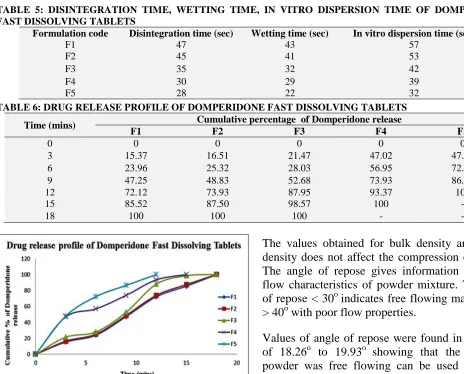
TABLE 5: DISINTEGRATION TIME, WETTING TIME, IN VITRO DISPERSION TIME OF DOMPERIDONE FAST DISSOLVING TABLETS
Formulation code Disintegration time (sec) Wetting time (sec) In vitro dispersion time (sec)
F1 47 43 57
F2 45 41 53
F3 35 32 42
F4 30 29 39
F5 28 22 32
TABLE 6: DRUG RELEASE PROFILE OF DOMPERIDONE FAST DISSOLVING TABLETS Time (mins) Cumulative percentage of Domperidone release
F1 F2 F3 F4 F5
0 0 0 0 0 0
3 15.37 16.51 21.47 47.02 47.93
6 23.96 25.32 28.03 56.95 72.35
9 47.25 48.83 52.68 73.93 86.37
12 72.12 73.93 87.95 93.37 100
15 85.52 87.50 98.57 100 -
18 100 100 100 - -
FIG. 1: DRUG RELEASE STUDY OF DOMPERIDONE FAST DISSOLVING TABLETS OF DIFFERENT BATCHES IN pH6.8 PHOSPHATE BUFFER
RESULTS AND DISCUSSION: The present study was undertaken with an aim to formulate and evaluate Fast Dissolving tablets of Domperidone using direct compression method with the addition of Plantago ovata mucilage as a natural super-disintegranting agent. Tablets each containing 10 mg of domperidone were prepared by employing different proportions of super-disintegrant at five different concentrations of 2.5%, 5%, 7.5%, 10% and 12.5%. The two most important attributes for the direct compression formula are good flow and good compressibility.
The values obtained for bulk density and tapped density does not affect the compression of tablets. The angle of repose gives information about the flow characteristics of powder mixture. The angle
of repose < 30o indicates free flowing material and
> 40o with poor flow properties.
Values of angle of repose were found in the range
of 18.26o to 19.93o showing that the blend of
powder was free flowing can be used for direct compression. The value for Carr’s index was in between 10-15% indicating that all the batches of powder blends were having good compressibility. Thickness was observed between 4.1-4.5 mm, hardness of the tablet was in the range of 3.0-3.9 kg/sq cm, and weight loss in the friability was less than 1% in all the cases.
[image:4.612.52.516.161.535.2]CONCLUSION: Domperidone requires quick action for relieving emesis so it is suitable for fast dissolving tablet. From the study results reveal that F5 (12.5%) exhibits faster disintegration i.e. 28 sec and faster dissolution i.e. for 12 min compared to other formulations, since it was found to be better formulation than F1, F2, F3 and F4.
ACKNOWLEDGEMENT: We are thankful to Sherrington’s Formulations, Hyderabad, for providing gift sample of Domperidone. We are also thankful to respected guide and management of Vishwa Bharathi College of pharmaceutical sciences for their support.
REFERENCES:
1. Ankur Sharma, Abhishek Jain, Anuj Purohit, Rakesh Jatav and R.V.Sheorey: Formulation and evaluation of aceclofenac fast dissolving tablets. International journal of pharmacy and life sciences 2011; 2: 681-686.
2. Shailendra kumar singh, Dina nath mishra, rishab jassal, pankaj soni: Fast disintegrating combination tablets of omeprazole and domperidone. Asian Journal of Pharmaceutical and Clinical Research 2009; 2: 74-82. 3. Bharat Parashar, Abhishek Chauhan: Formulation and
Evaluation of Fast Disintegrating Tablets of Domperidone.
International Journal of Institutional Pharmacy and Life Sciences 2012; 2: 232-238.
4. Sharma Shailesh, Singh Gurjeet and Gupta GD: Formulation design and optimization of mouth dissolving tablets of domperidone using sublimation technique. International Journal of Pharmaceutical Sciences 2010; 1: 128-136.
5. Kapil Chauhan, Bharat Parashar, Abhishek Chandel and Varun Thakur: Formulation and Evaluation of Fast Dissolving Tablets of Telmisartan. International Journal of Pharmaceutical Sciences and Research, 2013; 4:1514-1520.
6. Parmar R.B, Baria A.H, Tank H.M, Faldu S.D: Formulation and Evaluation of Domperidone Fast Dissolving Tablets. International Journal of PharmTech Research 2009; 1:483-487.
7. Bhupendra G.Prajapati, Dipesh V.Patel: Formulation and optimization of domperidone fast dissolving tablet by wet granulation techniques using factorial design.International Journal of PharmTech Research2010; 2:292-299.
8. Bhatt Shailendra and Trivedi Priti: Development of Domperidone: Polyethylene Glycol 6000 Fast Dissolving Tablets from Solid Dispersions Using Effervescent Method. Journal of chemical and pharmaceutical research 2011; 3:889-898.
9. A. Abdul Hasan Sathali, S. Ganesan: Formulation and Evaluation of Fast Dissolving Tablets of Desloratadine. International Journal of Pharma world research 2012; 3:1-31.
10. Honey Goel, Nishant Vora, and Vikas Rana: A Novel Approach to Optimize and Formulate Fast Disintegrating Tablets for Nausea and Vomiting. American Association of Pharmaceutical Scientists, 2008; 9:774-781.
All © 2013 are reserved by International Journal of Pharmaceutical Sciences and Research. This Journal licensed under a Creative Commons Attribution-NonCommercial-ShareAlike 3.0 Unported License.
This article can be downloaded to ANDROID OS based mobile. Scan QR Code using Code/Bar Scanner from your mobile. (Scanners are available on Google Playstore)
How to cite this article: