Application of Intelligent Water Network in
Water Resource Management: Framework And
Case
Qingming Wang
1*, Yong Zhao
1, Jiaqi Zhai
1, Yongnan Zhu
1, Shan Jiang
1,
Fan He
11 China Institute of Water Resources and Hydropower Research (IWHR) Beijing 100038, P.R.China..
Abstract
Water security is a global challenge, and intelligent water network is an important way for some countries and companies to solve regional water problems. Intelligent water network is a comprehensive and systematic water management platform, with river and lake water connected as a physical basis, through the introduction and adoption of new frontier information technology aids and advanced water management concepts to achieve water cycle and its associated process system and efficient Control as the goal. This paper studies the framework of intelligent water network, and presents three main elements of water physical network, water information network and water dispatching network, and discusses the case in Beijing.
1
Introduction
China is facing a severe situation of water resources at present. Flood, water supply and demand contradiction, water pollution and water ecological degradation have become the main bottlenecks restricting sustainable development (Nardo A D, et al., 2013; Smith V L, et al, 2000). All kinds of water problems, regardless of their forms, can be attributed to the imbalance of the evolution and regulation of the water cycle system. The practice of water resources development, management and protection is essentially the regulation and management of the water cycle and its accompanying process. As the carrier of water cycle system, water network is the objective foundation of all water cycle regulation behavior and measures (Boulos P F., 2017). Therefore, whether disaster mitigation, water resources allocation, conservation and protection, or construction of the relevant management system, can be unified into the construction of "natural - society" dualistic water network software and hardware system.
Volume 3, 2018, Pages 2276–2284
The concept of intelligent water network is based on the above background and put forward. Intelligent water network refers to the modern human society, in order to achieve the goals of the benefits of water, disaster reduction and human water harmony, implementing the software and hardware network system which is dependent on the regulation of the "natural - society" dualistic water cycle process. Intelligent water network engineering construction, including water physical network which composed of various types of flow control infrastructure, water informatization network which constructed with intelligent technology trends and water dispatching network which composed of institutional mechanisms and regulation decision-making (Franchini M, et al., 2016). The intelligent water network project will realize the integration of the three basic water conservancy construction components of the physical foundation, the information system and the decision making system, and will realize the coordination of the main functions of water conservancy and water conservation, water supply protection, ecological maintenance, environmental essence and power generation shipping.
The objective of this paper is to discuss the framework of intelligent water network, and their component parts: water physical network, water information network, and water dispatching network, and then take Beijing as an example to introduce the construction work in intelligent water network.
2
Study Area
Since 1999, Beijing has been in a state of continuous drought, the situation of water resources has deteriorated rapidly, and the contradiction between supply and demand of water resources began to focus on the outbreak. In Beijing, the average annual precipitation is only 470mm, with an average annual water resources of 2.09 billion m3, an average annual water entry of 464 million m3, and an average annual outflow of 833 million m3. The total amount of water resources is insufficient, and the per capita water resources is small. The local water resources in Beijing are poor, which belongs to resource type severe water shortage area. In 2014, the total amount of water resources was 2.18 billion m3, and the number of permanent residents released by Beijing Municipal Bureau of statistics in 2014 was 21.5 million, so that the water resources per capita was only 94 m3, which was far lower than the international minimum water shortage per capita 1000 m3. In order to ensure the water supply, Beijing city formed the water supply pattern, including surface water, groundwater, diverted water, reclaimed water and other water supply, and the deployment system is becoming increasingly complex. The construction of Beijing intelligent water network can form a safe and effective engineering system, intelligent perception monitoring system and intelligent management decision-making system. In the process of water management monitoring and forecasting to the whole process of decision-making service system, intelligent water network realizes the integration and promotion of water affairs from data, information, knowledge and wisdom, and improves the management level of modern water affairs. It is an important way to improve the level of social management and public service.
3
Result and discussion
3.1
Analysis of Intelligent Water Network Framework
integration of the physical network, water conservancy and water dispatching network information network system, and is another social basic public network into the intelligent era after the power network and the transportation network, and is the water industry for the future of intelligent public service model forward-looking response.
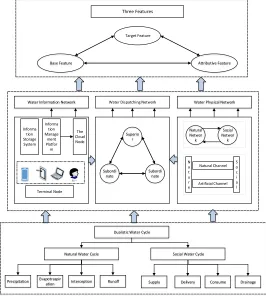
From the macro structure, the intelligent water network is the product of the deep coupling of water physical network, water information network and water dispatching management network, and the above three constitute the basic level system of the intelligent water network. "Natural-society" dualistic physical water network is the material carrier of human flood control practice, and the regulation and feedback effects of human beings on water cycle are carried out on the platform. Water information network is the information technology hardware and software integrated system based on the water physics, on the one hand, it is on the physical network to conduct a comprehensive monitoring and sensing through extensive rainfall, hydrological and engineering layout information collection node, and decision support information in its internal form and its network interface transmission terminal for water supply dispatching management network; on the other hand, it gets the information network released the decision instruction through the operation terminal network, and realizes the decision execution of operations in the IOT technology support and laid in the water conservancy facilities on the automatic control module for interface. Water dispatch network is a system of water management decision-making system, which connects the water information network with the information publishing terminal and the information operation terminal as the interface, obtains the decision support information and releases the regulation instruction, and also can interact with the physical network directly through other ways. The physical network, the information network and the dispatching network have their own network elements, and connect each other through the interface to realize the interaction between the networks, as shown in figure 1.
Figure 1 the intelligent water network framework
Three Features
Target Feature
Base Feature Attributive Feature
Water Information Network
Informa tion Storage System Informa tion Manage ment Platfor m Terminal Node The Cloud Node
Water Dispatching Network
Superio r
Subordi
nate Subordinate
Dualistic Water Cycle
Water Physical Network
Natural Networ k Social Networ k N a t u r e S o c i a l Natural Channel Artificial Channel
Natural Water Cycle Social Water Cycle
Precipitation Evapotraspiration Interception Runoff Supply Delivery Consume Drainage
Analogous to the body system, the water physical network is equivalent to the body skeleton system of the human body, and the water information network is equivalent to the human nervous system, and the water dispatching network is equivalent to the brain central system. Only when the nervous system is timely perceived, the central system is correctly judged, and the body system sensitive response, the three can work together to achieve the desired behavior or to respond effectively to external stimuli. Therefore, a complete water network is a composite network system formed by the coupling of the above three networks.
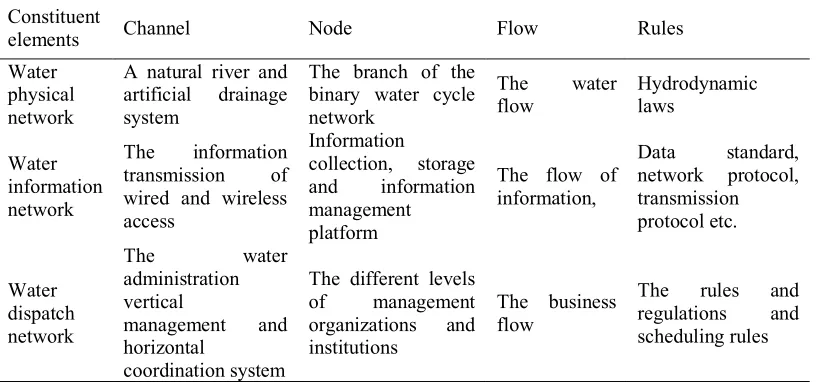
Channels, nodes, flows and rules are four basic elements of a network system. For the water physical network, the "channel" is a natural river and artificial drainage system, the "node" is the branch of the binary water cycle network, the "flow" is the water flow, and control the flow of the basic "rules" is Hydrodynamic laws; For the water information network, the "channel" is the information transmission of wired and wireless access, the "node" is including information collection, storage and information management platform, the "flow" is the flow of information, network operation "rules" include data standard, network protocol, transmission protocol etc.; For the water dispatch network, the "channel" is the water administration vertical management and horizontal coordination system, the "node" is different levels of management organizations and institutions, the "flow" is the business flow, and its "rules" by the rules and regulations and scheduling rules composition.
Constituent
elements Channel Node Flow Rules
Water physical network
A natural river and artificial drainage system
The branch of the binary water cycle network
The water
flow Hydrodynamic laws
Water information network
The information transmission of wired and wireless access
Information
collection, storage and information management platform
The flow of information,
Data standard, network protocol, transmission protocol etc.
Water dispatch network
The water
administration vertical
management and horizontal
coordination system
The different levels of management organizations and institutions
The business flow
The rules and regulations and scheduling rules
Table 1 Network elements for intelligent water networks
3.2
The overall framework design of Beijing intelligent water network
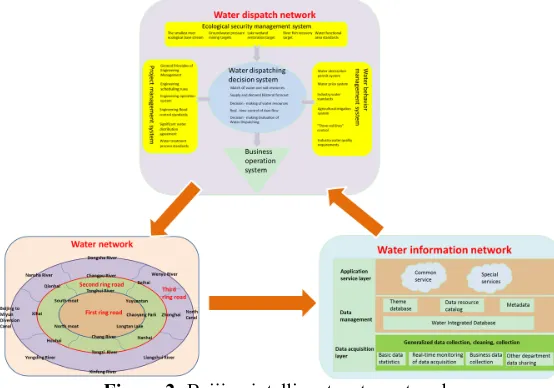
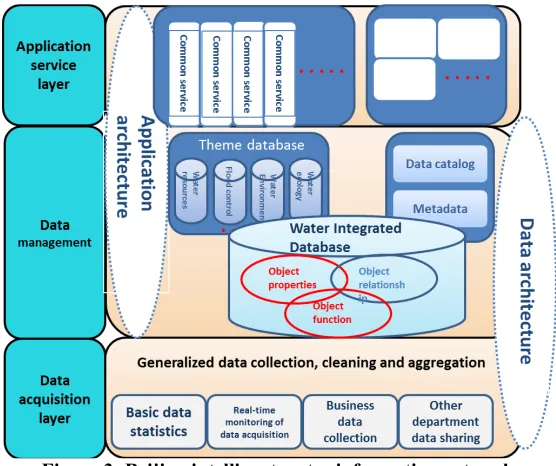
In view of the characteristics of Beijing water physical network, water information network and water dispatching network, we put forward the overall framework of Beijing intelligent water network, as shown in figure 2.Figure 2: Beijing intelligent water network
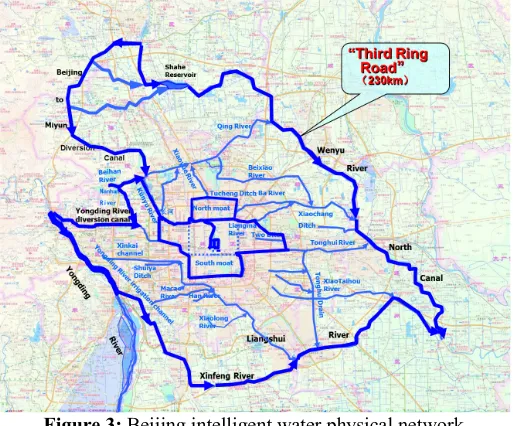
(1) Beijing Intelligent water physical network layout
Figure 3: Beijing intelligent water physical network
(2) Beijing intelligent water information network layout
Figure 3: Beijing intelligent water information network
(3) Beijing intelligent water dispatching network layout
Figure 4: Beijing intelligent water dispatching network
4
Conclusion
ecological maintenance, environmental essence, power generation and other major functions of water conservancy co-ordination. Channel, node, flow and rules are the four basic elements for the water physical network, water information network and water dispatch management network together to constitute a network system. The core feature of intelligent water network is intelligent, with performance of security: target security, strong control , engineering safety; high efficiency: reasonable layout, cost-effective, advanced technology; friendly: eco-friendly, interest related friendly and human-engineering friendly.
On the basis of analyzing and diagnosing the status and problems of water network, water information network and water dispatching network in Beijing, with the urgent need of flood control and disaster mitigation, ecological environment protection and water conservancy project operation in Beijing, Beijing intelligent water network general structure is presented under the basic structure of intelligent water network, aiming for the features of Beijing water physical network, water information network and water dispatching network. The interconnection and circulation of the Beijing-Tianjin-Hebei integrated water network and the "three-ring water system" in Beijing are established. According to the characteristics of the whole county water system, the watershed water system is connected and the regional water circulation project is constructed according to the characteristics of the whole water system. The real data of the water physical network is obtained quickly, efficiently and accurately through the support of the water information network and the support system of the water information network, and the powerful data mining through the water information network decision support system is realized by using the new pattern of regional water recycling and forming the water network of Beijing. The water dispatching network forms the dispatch management instruction under the aid of the decision making support and the high speed transmission capability of water information network. The water physical network receives the instruction of the water dispatching networked and returns to current state to the dispatching network through the monitoring terminal of the water information network, able to assist the formation of the next cycle of dispatching decision.
References
Boulos P F. Smart Water Network Modeling for Sustainable and Resilient Infrastructure. Water Resources Management, 2017, 31:1-12.
Franchini M, Brunone B. Innovative and sustainable methodologies for smart water network management. Civil Engineering & Environmental Systems, 2016, 33(1):1-2.
Nardo A D, Natale M D, Santonastaso G F, et al. An Automated Tool for Smart Water Network Partitioning. Water Resources Management, 2013, 27(13):4493-4508.
Smith V L, Murphy J J, Dinar A, et al. The Design of Smart Water Market Institutions Using Laboratory Experiments, Environmental and Resource Economics. 2000.