IMPLEMENTATION OF HYBRID (INTEGRATED) METHODS
FOR PLANNING PROCESS OPTIMIZATION
Gedas Baranauskas
Mykolas Romeris University, Lithuania [email protected]
Abstract
Purpose. The present article aims to point out and compare key points and practices of the application of Lean principles and selected tools in combination with project management methods and tools for planning process optimization both on academic and practical level.
Design / methodology / approach. For the purpose of a multi-dimensional theory-based narrative review of the subject with several different methods of data collection are used: documental and comparative analysis, review of scientific literature and systemization-synthesis of information, content analysis.An analysis is based on a qualitative paradigm and focus to supply chain management (SCM), Total Quality Management, Change management and Continuous Improvement theories..
Findings. Results of the multi-dimensional evaluation of the subject suggest that principles of the Lean system and Kanban tools can be successfully applicable and compatible in planning process activities and its optimization both separately and as a part of hybrid (integrated) methods.
Research limitations / implications. The research are of a limited scope from a few points of view: first, it is noticed that a limited quantity of research is made within the field of using hybrid (integrated) methods, especially in the case of academic research performed in Lithuania. So, there is no concrete Measurement Model or step by step guides how these methods should be implemented, what are key issues in this process and how results should be evaluated. In addition, there is a limited orientation to such fields as public and non-governmental sectors and organizations, where the need of planning and overall change management is even more significant and missing. Furthermore, this article is based on a narrative type of review towards a scientific literature where findings and theoretical conclusions are outlined from a holistic interpretation contributed by the reviewers’ own experience, mentioned theories and models by using the method of information systemization. In relation to that, case studies and comparative analysis towards a practical implication are not sufficiently elaborated from the point of theoretical overview , therefore, they have not been within the focus of scientific analysis in this paper. The fourth limitation might be the complexity and the dynamics of a planning process as well as the primary orientation of the Lean system and tools directed to the manufacturing and industry sector.
Practical implications. Summarized and underlying research and its findings may serve as a basis for a relevant input to a further scientific discussion regarding the optimization of planning process and adoption of hybrid (integrated) methods in this or related fields. It addition, it might be useful within a practical implementation of new methods of project or process management and planning.
throughout the process and is usually carried out dynamically in parallel with a performed task / job, Lean tools combined together with project management application may serve a very useful and effective way to ensure a more structured and, therefore, successful process handling. Moreover, the selected research object and findings are also valuable in terms of the process improvement in public sector organizations. Since the limitations of Lean tools are their lack of diversity in applicability to an ongoing process, as they are rather applied to a moment and static process phase, and limitations of project management are its unclear structure and abstractness, this particular paper points out and analyzes the possibilities of both Lean tools and project management merging as a proper method.
Keywords: hybrid (integrated) methods; planning process; optimization of planning; Lean; Kanban.
Research type: general review.
Introduction
A dynamic and complex business environment, automation of business processes and Generation Z can be equalized to several factors which are considered quite influential. These factors consist of development and activities of various organizations, changes in the attitude towards process management, and an improvement in application of new methods. Lean principles and tools in combination with project management tools or traditional planning tools are a proper alternative solution for organizations seeking for the business process optimization. It is efficient to use this strategy due to a certain preconditional background which naturally encourages using internal resources, proposes a deeper engagement of employees towards a daily working routine, and accelerates introducing the Continuous Improvement culture. Nevertheless, only about 10% of organizations implement main principles and tools of the Lean system and ensure the continuity in the future practice successfully (Salonitis and Tsinopoulos, 2016). Moreover, when focusing on the case of Lithuania, it is important to notice that a scientific discourse on the Lean application in organizations has not been much elaborated so far and a number of studies in this field are of a limited scope, especially in the case of implementing so called hybrid (integrated) methods (Čiarnienė and Vienažindienė, 2013, 2014). Therefore, in this paper the process of planning is taken into account from a deep theoretical perspective because this process type not only influences activities within organizations but also attributes a quite complex content, a high level of integrity with other process types and employees, and a wide scope of usable methods and tools.
The planning phase is an integral part of each organization's project and process management, necessary for the effective implementation of the organization's goals at both strategic, tactical and operational levels. However, main methods and problem solutions of this phase have been focused mainly to the operational production level for quite a long period. This is grounded by the fact that strategic planning as a separate academic discipline was recognized and started to be used only in the mid of the 20th century (Dole and Cervone, 2014). At this point, it is important to notice that
dynamic environment too (Dole and Cervone, 2014; Zhang and Ge, 2015; Arend, Zhao and Song, 2015). All these listed consequences together with many practical planning tools and methods for planning used in practice indicate the complexity, dynamism and integrity of this phase with other processes in organizations and its wide scope of possible problems. In parallel, the rapidly evolving business environment and globalization requires organizations to increase their competitive advantage, adopt more flexible management systems, and change the attitude towards the content and ways to manage business processes (Serafinas and Ruželė, 2014).The term Lean itself is understood as economical manufacturing or cost saving-effective production in the context of Lithuanian academic research. Accordingly, it has a strong association to the factors mentioned above as well as marks the evolution of organizational management over the past 3 decades (Huxley, 2015). It is recognized that Lean principles and tools are based on the practice of industrial organizations, and, therefore their modifications or combinations should be carefully considered and measured before applying them to service-oriented organizations and similar type of organizations. In addition, it is important to the organization to feature an appropriate level of maturity in terms of both new management process and culture (Urban, 2015). Therefore, the practical situation of Lean validates the argument why only the parts of Kanban's operating principles, updated or hybrid versions (such as Reactive Kanban, Conwip) or even combinations with other project planning tools (such as Scrumban) are applied in practice for the mentioned type of organizations. Key areas of application include planning of information acquisition and transfer processes as well as visual management. So accordingly to the mentioned, this article aims to reveal and compare practices of application in planning process optimization of the following: Lean principles and specific Kanban tools, project management (Agile) methods and tools, and hybrid (integrated) methods. Key objectives are: multidimensional evaluation of a planning process in modern organizations; review of specific and modified hybrid planning techniques or systems used by organizations; and application of Lean principles and hybrid (integrated) methods with planning systems and methods in organizations. To reach these objectives the following type of analysis are used: analysis and synthesis of scientific literature content.
Semantic and content evaluation of planning functions and processes in the context of nowadays organizations
exists in the context of project management outstandingly, where the planning phase relates to specific activities: project timetable and budgeting, project identification and description, etc. All these activities are summarized in several types of plans, using the concepts of guideline plan and detailed planning (Gagliardi et al, 2015). An important aspect for separation of planning values in organizations and project management is the main characteristics of the project: timeliness (certain duration) and uniqueness. All these factors require abandonment of the concept of planning as a continuous process and shift to the specific emphasis on project activities. In summary, planning is among the four major operational projects. At the same time, it is recognized as one of the main reason for poor project management situations which leads to project delays or price increases and overall so called inadequate performance planning (Gardiner, 2005). From a practical point of view, planning process for production is synonymous with several key activities: production planning timeline and scheduling. In a more detailed way, plan as a result and planning as a process consist the same systematic information need to turn raw or semi-finished products into finished products (Mingrang et al., 2015; Jin, Zhang and Shao, 2015).
Moving forward to the question of the planning problem, it was noted that complex planning processes relate to a number of problematic issues and situations that need to be addressed in the elaboration of the levels of management of all plans. Depending on the nature of the effect and the type of expression, the problem factors can be divided into three categories:
1. External environmental factors. They are indirect but important for the overall effectiveness of the planning stage and, the most important, arise irrespective of the organization (for example prices of raw material, production and process quality, environmental requirements, customer needs and demands) (Zhang and Ge, 2015).
2. Internal environmental factors which have a direct and significant effect for the planning phase. On the other hand, an organization typically is capable of managing and eliminating these factors. Possible example includes human resources and technology network, a communication network, and the soft part: coherence and implementation of planning processes (Dole and Cervone, 2014).
3. Planning methodology. It identifies problematic situations associated with using planning measures. It is noted that the current widespread use of advanced planning systems based on the use of information and communication tools is not able to reflect adequately and does not address decisions in a timely manner in relation to such changes as production volume, consumer demand, market competitors' actions. It is also noticed that the planning methodology might be only partially or not integrated at all with the other processes and systems used in organizations (Feng et al., 2011). Additionally, there are examples in practice that so-called traditional planning methods (for example, Gantt chart) used for managing standard projects (for example, construction of buildings) or Network-based scheduling methods are oriented only to the operational level activities but not compatible with Agile type or complex (hybrid) type of projects in strategic level (Kosztyán, 2012; Feng et al., 2011; Wang, Zhang and Fuh, 2012).
tactic or production-operating), information management, time indicators (for example, for management and synchronization activities), relationships with customer (Stefan and Radu, 2016). On the other hand, it is also noticed that not only the management of the above mentioned factors, but also the choice of the appropriate production operations, the order of their execution, the quality of production facilities and the qualified human resources have a great impact on the overall efficiency and effectiveness of the planned activities (Zhang and Ge, 2015). Coming back to the main planning methods used in practice, their possible categorization is presented in the table below.
Table 1. Main types of planning methods and related tools Type of planning methods Type of planning tools Planning methods based on
usage of mathematical calculation or algorithms
Linear programing; Dynamic programing; Transportation tables; Fuzzy logic mathematical programming; SIMPLEX method, etc.
Planning methods based on Computer-aided process planning systems (CAPP)
Manufacturing resource planning (MRPII); Advance planning and scheduling (APS); Supply chain management (SCM); Capacity requirements planning (CRP); Solver from Excel, etc.
Planning methods based on process / project design in future
Ideal state action planning method; The scenario tree based multistage stochastic programming model; The scenario planning methods; Future-based design method (FBD), etc.
Planning methods based on
complexity and integrity Integration of process planning and scheduling (IPPS); Distributed process planning (DPP); Design structure matrix / Dependency structure matrix, (DSM), etc.
Source: Composed by the researcher and based on resources: Zhang and Ge, 2015; Kosztyán, 2012; Mingrang et al, 2015; Feng et al. 2011; Stepchenko and Voronova, 2014, Yang et al, 2015; Stefan and Radu, 2016.
The classification of the above-mentioned planning methods is conditional and assists in distinguishing the general trends and dynamics of the current period in research area. Of course, it should be mentioned too that traditional planning tools as Gantt chart or network planning tools (for example, CPM, PDM, GERT) are still recognized and widespread in practice (Ong, 2016). It has to be noted that in the evaluation period, the concept of planning and the choice of methods in organizations is determined by prevailing tendencies and the application of combined solutions - the use of Lean system and similar hybrid (integrated) methods (for example, Kanban, Scrum, Scrumban, Agile, GT, etc.) (Berlec et al, 2014).
Content, dynamics and hybrid (integrated) methods of processes and project planning activities
determination accordingly to differences in the concept of planning, methods, and problems. On the other hand, planning in scientific literature is often regarded as a separate business process, so in terms of evaluating this phase in the context of process and project management, we characterize a broad (holistic) and limited meaning. Retrospectively, the beginning of the emergence of advanced planning systems is associated with the 20th century. The 1990s and the qualitative changes in the field of information technology at that time subsequently created the conditions for new, interactive and computer systems based on the process of planning and management of methods and systems, and the emergence of combined solutions for the saving of production methods of expression (Burgis, 2014; Lukic et al, 2017). The importance of traditional business management systems, including their inability to tackle planning challenges in the context of global competition, is also crucial. It is identified as one of the main reasons for integrating specialized, intelligent planning systems or their individual modules into existing business management systems. At the same time, we can talk about the need to move from pre-planning to warehouse to real needs assessment and planning (Burgis and Zakarevičius, 2014; Zühlke et al, 2017).
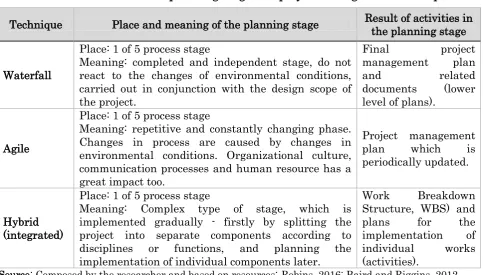
Beginning with a narrow assessment, it is important to discuss the methodology of project management: depending if the project is managed according to the Waterfall, Agile or hybrid project management methodology, the planning phase is differently assessed. The meaning of the planning stage according to the methodology described is given in the table below:
Table 2. Evaluation of the planning stage in 3 project management techniques
Technique Place and meaning of the planning stage Result of activities in the planning stage
Waterfall
Place: 1 of 5 process stage
Meaning: completed and independent stage, do not react to the changes of environmental conditions, carried out in conjunction with the design scope of the project.
Final project
management plan
and related
documents (lower level of plans).
Agile
Place: 1 of 5 process stage
Meaning: repetitive and constantly changing phase. Changes in process are caused by changes in environmental conditions. Organizational culture, communication processes and human resource has a great impact too.
Project management plan which is periodically updated.
Hybrid (integrated)
Place: 1 of 5 process stage
Meaning: Complex type of stage, which is implemented gradually - firstly by splitting the project into separate components according to disciplines or functions, and planning the implementation of individual components later.
Work Breakdown Structure, WBS) and plans for the implementation of individual works (activities).
Source: Composed by the researcher and based on resources: Robins, 2016; Baird and Riggins, 2012.
output as a project management plan and other related documents. A coherent implementation and static plan are an integral part of the results of this technique’s planning phase. The opposite approach to planning can be identified in Agile type and Hybrid-type techniques (Serrador and Pinto, 2015). The planning phase in this case is not completed at the beginning of project, but dynamic, ongoing and responsive, with outputs of a different form, for example, Work Breakdown Structure. It is noted that during the planning phase, using mentioned type of plan and managing the whole project in a hybrid methodology, positive results are obtained in way of high level, detailed implementation plans, shorter development times and faster response to environmental changes (Baird and Riggins, 2012). To sum up, it should be stated that in project management, during the planning phase, elaboration in form of a detailed analysis of the original idea of the project and the assessment of individual aspects is made in priority. In most cases, it is done by using an already mentioned decomposition or a SWOT method, as well as by subdividing all activities into two internal process groups: basic and auxiliary processes. At the same time, one of the main goals of this phase is not only the preparation of a detailed implementation plan (at operational level), but also updating it in a timely manner and making it compatible with the organization's strategy (Project Management Body of Knowledge, 2013).
Moving to a broader assessment of business process planning, it is noticeable that the planning stage or related individual actions can be identified at different hierarchical levels of management, in almost every basic and auxiliary process (Lukic et al, 2017; Bae et al, 2014). It is also noted that planning is recognizable and important not only during the current period in the organization, but also for the modeling future processes in accordance with the concept of Continuous Improvement, so called Kaizen and related methods for the development of Lean principles and system (Čiarnienė and Vienažindienė, 2014; Oropesa-Vento et al, 2015). The planning is found on the basis of this concept, based on the Shewart and Deming ideas and a cycle of control. In practice, in process management activities it is used as one of the stage of Continuous Improvement cycle.
In relation to hybrid (integrated) methods for planning process optimization, combination of the Kanban as one of Lean systems process planning and management tool and the Scrum as one of project managements tool is worth to mention (Ighravwe and Oke, 2017; Kuhrmann et al. 2017). This example of harmonization marks the shift from the traditional Waterfall project management technique to Agile and Lean principles based project management. Although the scope and characteristics of the named methods are different, there is a growing trend or popularity of such hybrid (integrated) methods project management methods such as Scrum-XP Hybrid, Custom Hybrid, or Scrumban (Stoica et al, 2016, 10th Annual State of Agile ™ Report, 2016).
Adaptation and compatibility of Lean principles and methods with planning systems and methods in organizations
behavior and actions of employees and management (Serafinas and Ruželė, 2014; van Assen, 2018).
process, more efficient use of resources and timely delivery of products are reached. In the aspect of historical development, Kanban has long been concerned only to control and optimize processes in supply chain or production chain located in manufacturing or some other industry type organization. However, it is currently widely used in planning both work and time at both on team and individual level and, most important, in organizations of various profiles and sectors. By using interactive digital techniques relevant applications as the transition to electronic Kanban (e-Kanban) version is made (MacKerron et al. 2014; Oh and Shin, 2012). Such versions are currently often used in conjunction with project management and planning methods (for example, with Scrum) or other business planning control systems (for example, ERP). It is added that some Kanban modifications are also found in Advanced Planning and Scheduling systems: Oracle's; JD Edwards and e-Business Suite, IFS AB, Infor ERP LN, SAP ERP, Deltek Costpoint, and Microsoft Dynamics AX. The application of E-Kanban also is confirmed by Toyota's example – it was successfully applied to external processes as working with suppliers (Ordysiński, 2013).
However, it is important to mention that research emphasized that it is still more effectively used in traditional production profile organizations, whose activities are based on separate processes with sufficiently stable, well defined environment and need to provide a limited number of services or products. In todays, especially project-based organizations, not only challenges for financial or human resources, production technologies sides exits, but there are many other factors as extremely dynamic environmental conditions and the need for high level management of information. Here can also be mentioned a shortened product production cycle, constantly changing consumer needs and diversification of activities also are influential (Barba, 2013; Ordysiński, 2013). It is agreed that implementation of mentioned tools, which organizations in practice actively use for optimization and development processes, is still under theoretical consideration and still seems to face similar problems, but both representatives of organizations and researchers confirm that their parallel implementation can reduce the number or impact of such problems. Other possible solutions are the following: the use of process evaluation and Enterprise Resource Planning system or other systems as a coherent process rather than a temporary project, as well as assessing not only the technical nature and indicators but also the social changes and climate in the organization (Chofreh, 2014; Hornstein, 2015).
Discussions
hand, a comparative analysis and research about hybrid (integrated) methods and their application possibilities in different type and sector organizations are missing. Nevertheless, the practical application confirms that individual Lean system tools (for example, Kanban) are successfully used in the combination with project planning and management tools (for example, Scrumban). Accordingly, there is a need to figure out if the practical application of these methods really confirms the theoretical insights and models as follows: specific properties of supplement, high orientation and effective use of existing resources, easy implementation and maintenance, probability of reaching more sustainable andlong-term effects.
References
Aartsengel, A.V; Kurtoglu, S. 2013. Handbook on Continuous Improvement Transformation. Berlin: Springer-Verlag Berlin Heidelberg.
Arend, R.J.; et al. 2015. Strategic planning as a complex and enabling managerial tool. Strategic Management Journal., 38(8):1741–1742.
Assen, M.F. 2018. The moderating effect of management behavior for Lean and process improvement. Operations Management Research., 11: 1–6.
Bae, H.; Lee, S.; Moon, I. 2014. Planning of business process execution in Business Process Management environments. Information Sciences, 268: 357–358.
Baird, A.; Riggins, F.J. 2012. Planning and Sprinting: Use of a Hybrid Project Management Methodology within a CIS Capstone Course. Journal of Information Systems Education., 23(3): 244– 245.
Barba, I. 2013. Constraint-based planning and scheduling techniques for the optimized management of business processes. AI Communications., 26: 251.
Bennett, N.J.; Kadfak, A.; Dearden, P. 2016. Community-based scenario planning: a process for vulnerability analysis and adaptation planning to social–ecological change in coastal communities.
Environment, Development and Sustainability., 18(6): 1771–1774.
Berlec, T.; et al. 2014. A method of production fine layout planning based on self-organising neural network clustering“. International Journal of Production Research., 52(24): 7209.
Burgis, D. 2014. Pažangių planavimo sistemų vaidmuo gerinant regioninį verslo bendradarbiavimą. Regional Formation and Development Studies.,2(13): 6–7; 9.
Burgis, D.; Zakarevičius, P. 2014. Pažangių planavimo sistemų ir taupios gamybos kompleksinio taikymo galimybės. Regional Formation and development studies., 2(13): 116–117.
Chofreh, A.G.; et al. 2014. Sustainable enterprise resource planning: imperatives and research directions. Journal of Cleaner Production., 71: 139–140.
Čiarnienė, R.; Vienažindienė, M. 2013. Lean Manufacturing Implementation: The Main Challenges and Barriers. Management Theory and Studies for Rural Business and Infrastructure Development., 35(1): 2; 4.
Čiarnienė, R.; Vienažindienė, M. 2014. How to Facilitate Implementation of Lean Concept?.
Mediterranean Journal of Social Sciences., 5(13): 177–178.
Dole, W.V.; Cervone, H.F. 2014. Strategic Planning and Assessment. Journal of Library Administration.,54: 156; 159–160.
Feng, P.; et al. 2011. An improved production planning method for process industries.
International Journal of Production Research., 49(14): 4223.
Gagliardi; et al. 2015. Developing a checklist for guideline implementation planning: review and synthesis of guideline development and implementation advice. Implementation Science., 10(19): 1–3.
Gardiner, P.D. 2005. Project Management: A Strategic Planning Approach. London: Palgrave Macmillan.
Hornstein, H.A. 2015. The integration of project management and organizational change management is now a necessity. International Journal of Project Management., 33(2): 291–293.
Huxley, C. 2015. Three Decades of Lean Production: Practice, Ideology, and Resistance.
Ighravwe, D.E.; Oke, S.A. 2017. Sustenance of zero-loss on production lines using Kobetsu Kaizen of TPM with hybrid models. Total Quality Management & Business Excellence., 28: 3–5.
Jin, L.; et al. 2015. An effective hybrid honey bee mating optimization algorithm for integrated process planning and scheduling problems. The International Journal of Advanced Manufacturing Technology.,80(5-8):1253.
Kosztyán, Z.T. 2012. Chalenges of the project planning methods in the 21st century. Problems of management in the 21st century., 5: 46–47.
Kuhrmann, M.; et al. 2017. Hybrid software and system development in practice: waterfall, scrum, and beyond. International Conference on Software and System Process.,30–32.
Lukic, D. 2017. Multi‐ criteria selection of manufacturing processes in the conceptual process planning. Advances in Production Engineering & Management., 12(2): 151–152.
MacKerron, G.; et al. 2014. Supplier replenishment policy using e-Kanban: A framework for successful implementation. Production Planning & Control., 25(2): 162.
Mingrang, T.; et al. 2015. Integration of process planning and scheduling using a hybrid GA/PSO algorithm“. International Journal of Advanced Manufacturing Technology., 78: 583.
Oh, S-C.; Shin, J. 2012. A semantic e-Kanban system for network-centric manufacturing: technology, scale-free convergence, value and cost-sharing considerations. International Journal of Production Research., 50(19): 5294.
Ong, H.Y., Wang., C., Zainon, N. 2016. Integrated Earned Value Gantt Chart (EV-Gantt) Tool for Project Portfolio Planning and Monitoring Optimization. Engineering Management Journal., 28(1):39– 40.
Ordysiński, T. 2013. Kanban Based Information Management In Organization. Polish Association For Knowledge Management: Series: Studies & Proceedings., 63: 77–78.
Project Management Institute-PMI. [interactive]. A Guide to the Project Management Body of
Knowledge (PMBOK® Guide) – Fifth Edition, 2013 [accessed 2018-04-21].
http://dinus.ac.id/repository/docs/ajar/PMBOKGuide_5th_Ed.pdf
Robins, D. [interactive]. Is the Hybrid Methodology the Future of Project Management?, 2016 [accessed 2018-04-21]. https://www.projectmanagement.com/articles/356356/Is-the-Hybrid-Methodology-the-Future-of-Project-Management-
Salonitis, K.; Tsinopoulos, C. 2016. Drivers and Barriers of Lean Implementation in the Greek Manufacturing Sector. Procedia CIRP 57: 189–192.
Serafinas, D.; Ruželė, D. 2014. Lean organizacijų evoliucija. Organizacijų vadyba: sisteminiai tyrimai.,69: 119–121.
Serrador, P.; Pinto, J.K. 2015. Does Agile work? — A quantitative analysis of agile project success. International Journal of Project Management.,33(5): 1040–1042.
Stefan, V., Radu, V. 2016. Alternative Methods for Business Process Planning. Valahian Journal of Economic Studies., 7(2): 87– 90.
Stepchenko, D., Voronova, I. 2014. Scenario Planning Role: The Case Of Baltic Non-Life Insurance Market. Economics and management., 19(1): 37.
Stoica, M.; et al. 2016. Analyzing Agile Development – from Waterfall Style to Scrumban.
Informatica Economica., 20(4): 5; 11.
Versionone. [interactive]. 10th Annual State of Agile ™ Report, 2016 [accessed 2018-04-21]. http://www.agile247.pl/wp-content/uploads/2016/04/VersionOne-10th-Annual-State-of-Agile-Report.pdf
Wang, Y.F., Zhang Y.F. and Fuh, J.Y.H. 2012. A hybrid particle swarm based method based for process planning optimisation. International Journal of Production Research., 50(1): 277.
Wieslaw, U. 2015. The Lean Management Maturity Self-assessment Tool Based on Organizational Culture Diagnosis. Procedia - Social and Behavioral Sciences.,213: 728.
Zhang, Y.; Ge, L. 2015. Method for process planning optimization with energy efficiency consideration. International Journal of Advanced Manufacturing Technology., 77: 2197–2198.
Zühlke, L.J.; et al. 2017. A Comprehensive Needs Assessment Tool for Planning RHD Control Programs in Limited Resource Settings. Glob Heart., 12(1): 25.
This work is licensed under a Creative Commons