B R I E F R E P O R T S
Open Access
DOG-SPOT database for comprehensive
management of dog genetic research data
Julie AS Powell
1, Jeremy Allen
2, Nathan B Sutter
2*Abstract
Research laboratories studying the genetics of companion animals have no database tools specifically designed to aid in the management of the many kinds of data that are generated, stored and analyzed. We have developed a relational database,“DOG-SPOT,”to provide such a tool. Implemented in MS-Access, the database is easy to extend or customize to suit a lab’s particular needs. With DOG-SPOT a lab can manage data relating to dogs, breeds, sam-ples, biomaterials, phenotypes, owners, communications, amplicons, sequences, markers, genotypes and personnel. Such an integrated data structure helps ensure high quality data entry and makes it easy to track physical stocks of biomaterials and oligonucleotides.
Findings
A typical genetics research laboratory is burdened by an information management challenge: to accurately store and make sense of a wide array of data of very different types [1]. A lab working with companion animals such as dogs, cats or horses needs to manage not only oligo-nucleotides, PCR products, markers, genes and DNA samples, but also data particular to companion animal work: owner information, pedigree relationships, regis-tration numbers and breed names [2]. While it may be possible to track these disparate data independently, a database framework that coherently relates them and enforces lab-wide data input rules would allow for both higher overall productivity and fewer data entry errors [3]. Furthermore, such a data model would mean a sin-gle instance of the data can be easily located, backed up and computed upon.
We have developed a relational database “ DOG-SPOT” (Dogs, Owners, Genotypes, Samples, Pedigrees, Oligos and Traits) implemented in Microsoft Access to provide information management for dog genetics research (additional file 1). Within a single database a laboratory can manage all of their data relating to: dogs, their breeds, phenotypes, pedigrees and kennel clubs; owners and communications with them; laboratory per-sonnel and their activities; samples and biomaterials.
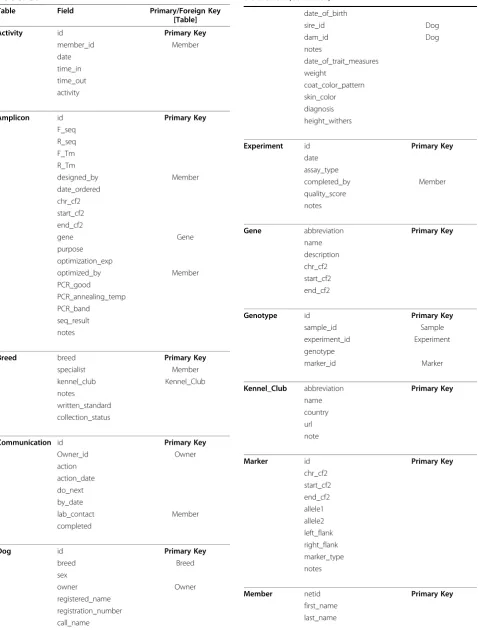
Furthermore, data relating to genetics experiments can be captured, including: gene lists, oligonucleotides, amplicons and capillary sequence trace quality, in addi-tion to genotypes for SNP, microsatellite and indel mar-kers. See Table 1 for a list of the key database tables and fields and additional file 2 for the entity relationship diagram. Users can easily extend and customize DOG-SPOT by writing new forms, queries, macros, tables and relationships. Data quality is partially maintained by enforcing some rules about data types. For example, a dog record is required to have a non-null breed entry and the breed must be an entry in the breed table. As a second example, a dog’s sire must be a dog of known sex“M”while its dam must be of known sex “F”. The solicitation and acquisition of high quality DNA samples, pedigrees and phenotypes from companion ani-mals is a labor-intensive process. Often a lab needs to track a flood of correspondence between laboratory members and dozens or even hundreds of animal own-ers. DOG-SPOT provides an owner record for managing such relationships. Lab personnel can generate multiple communication records and reminders linked to each owner, which are displayed in an owner-centric form along with a list of dogs sampled from that owner (Figure 1). Reminders with past-due dates are filtered to an“alarm”list so they can be prioritized. Owner records can also be marked for inclusion in mailing-label print jobs. These features modularize the work flow and enable solicitation work to be efficiently handled by a team of lab members.
* Correspondence: [email protected]
2
Department of Clinical Sciences, College of Veterinary Medicine, Cornell University, Ithaca, 14853, USA
Full list of author information is available at the end of the article
Table 1 Tables, fields, and primary and foreign keys in DOG-SPOT
Table Field Primary/Foreign Key
[Table]
Activity id Primary Key
member_id Member
date time_in time_out activity
Amplicon id Primary Key
F_seq R_seq F_Tm R_Tm
designed_by Member
date_ordered chr_cf2 start_cf2 end_cf2
gene Gene
purpose optimization_exp
optimized_by Member
PCR_good
PCR_annealing_temp PCR_band
seq_result notes
Breed breed Primary Key
specialist Member
kennel_club Kennel_Club
notes
written_standard collection_status
Communication id Primary Key
Owner_id Owner
action action_date do_next by_date
lab_contact Member
completed
Dog id Primary Key
breed Breed
sex
owner Owner
registered_name registration_number call_name
Table 1 Tables, fields, and primary and foreign keys in DOG-SPOT(Continued)
date_of_birth
sire_id Dog
dam_id Dog
notes
date_of_trait_measures weight
coat_color_pattern skin_color diagnosis height_withers
Experiment id Primary Key
date assay_type
completed_by Member
quality_score notes
Gene abbreviation Primary Key
name description chr_cf2 start_cf2 end_cf2
Genotype id Primary Key
sample_id Sample
experiment_id Experiment
genotype
marker_id Marker
Kennel_Club abbreviation Primary Key
name country url note
Marker id Primary Key
chr_cf2 start_cf2 end_cf2 allele1 allele2 left_flank right_flank marker_type notes
Member netid Primary Key
Within DOG-SPOT owners and dogs have a one to many relationship, as do dogs and the records of sam-ples collected from them. The dog record itself stores registration information, breed, name, date of birth, the dam and sire IDs, as well as values for measured traits (e.g. body weight, coat color, etc.). A sample record links to exactly one dog record and stores the yield and concentration of the extracted nucleic acid, extraction date, and biomaterial type (e.g. blood, gDNA, RNA, etc.). From the dog record a three generation pedigree can be displayed as a quality check.
The ‘amplicons’table stores the sequence of each for-ward and reverse oligonucleotide and each amplicon’s chromosome, start and end position. The ‘sequence’ table stores a record for each sequencing reaction and a true/false value assessing overall read quality so that sequence coverage will not count as“completed” unless it is of sufficient quality. After the user aligns sequences outside the database (e.g. with phred/phrap and consed) and identifies new microsatellite, indel and single nucleotide polymorphisms, they are uploaded in batch to the ‘markers’table. The markers table stores marker position start and end, chromosome, flank sequence and type. When a lab member collects data they write a record to the ‘experiment’table that briefly summarizes the bench work performed. Genotype records are then uploaded from text or excel files with the experiment id, sample id, marker id and the genotype value.
Suppose, for example, that a lab member aims to col-lect sequence data spanning a coding exon of a gene. They design PCR primers spanning the exon and create an amplicon record in DOG-SPOT that contains the sequences of the F and R primer, the Tm of each, and the amplicon’s chromosome, start and end position in the canfam2 assembly of the dog reference sequence. When the primers are synthesized and optimized the lab member would modify the record to indicate the PCR conditions to use. They then would select a set of dogs for sequencing by viewing dogs, pedigrees and DNA samples in the database’s dog form. After wet-lab work and sequence alignment using, for example, phred/phrap and consed, the lab member would write a set of three text files. First, they would record which sequences were high quality. Second, they would describe every marker discovered in the sequence contig by writing the marker’s flank sequences, type, alleles and position. Third, they would genotype each of the sequenced samples for each marker. These three flat files would then be uploaded/appended to the
DOG-SPOT sequence, marker and genotype tables,
respectively.
To leverage the ease with which custom data can be uploaded and viewed in the UC Santa Cruz genome browser, DOG-SPOT stores amplicon and marker
Table 1 Tables, fields, and primary and foreign keys in DOG-SPOT(Continued)
active description
Owner id Primary Key
breed_affiliation Breed
first_name last_name email home_phone street_address city
state zipcode country
lab_contact Member
kennel_name URL date_entered work_phone cell_phone fax notes
is_contact_allowed
referred_by Owner
generate_label date_of_last_mailing number_kits_mailed number_kits_transferred
Sample sid Primary Key
dog_id Dog
date_received biomaterial_received
received_by Member
process_type date_processed
processed_by Member
post_process_vol_ul post_process_conc post_process_OD post_process_biomat notes
source_id Sample
Sequence id Primary Key
name
amplicon_id Amplicon
sample_id Sample
experiment_id Experiment
Figure 1Screen shot of the owner form. Owner information is entered and displayed here, including a log of communications between the lab and the owner. The owner’s sampled dogs are also listed. Shipment of collection kits is tracked as well, and this owner can be marked for inclusion in the next batch of printed mailing labels.
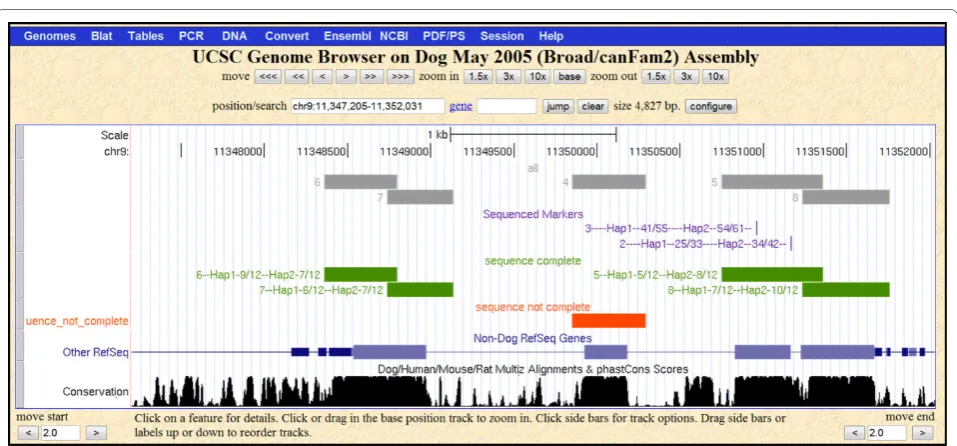
position information in a format compatible with upload: chromosome, start position and end position. To generate data for viewing in the genome browser, the user runs queries that write text files of the ampli-cons, sequence traces and markers. The user then exe-cutes the make_bed.pl perl script to generate a bed formatted file of custom data tracks that can be uploaded directly to the genome browser (see additional files 3 and 4 for the perl script and README, respec-tively). This visual overlay with UCSC tracks is a power-ful tool for assessing the progress of sequencing through a candidate gene, for example, or to verify positioning of newly discovered markers within a gene (see Figure 2). At present, DOG-SPOT is designed to store purebred dog records, breeds, samples and genotypic data. How-ever, a user could readily convert it for use with cat, horse, or another species of interest. We implemented DOG-SPOT in MS-Access to provide an easy interface for lab members, some of whom had no prior database experience. However, because the database is not imple-mented in a more robust system, like MySQL or Post-greSQL, it would likely perform poorly if loaded with very large datasets, such as millions of array-generated genotypes.
To assist in the management of diverse types of lab data we have developed the DOG-SPOT database for the canine genetics research laboratory. By storing all of our laboratory’s dog, owner, sample, amplicon, marker and genotype data in an instance of DOG-SPOT, we have successfully centrally managed these disparate data in a rational and organized way. Finally, by relying on contact management functions and modularization of work within the database, we have been able to effi-ciently utilize undergraduate workers for all aspects of sample solicitation, owner communication, sample data entry and biomaterial banking.
Additional material
Additional file 1: DOG-SPOT.mdb. The DOG-SPOT database implemented in MS Access.
Additional file 2: Figure S1. The entity relationship diagram for DOG-SPOT
Additional file 3: Make_Bed.pl. A perl script to generate BED files. See the README for details.
Additional file 4: README for BED file creation from the DOG-SPOT database. Description: A protocol for generating BED files from the database.
Acknowledgements
The authors thank Andrew Arieter and other lab members for testing the database prototype and providing helpful feedback. Support was provided by internal funds of the College of Veterinary Medicine, Cornell University.
Author details
1Office of Educational Development, College of Veterinary Medicine, Cornell
University, Ithaca, 14853, USA.2Department of Clinical Sciences, College of Veterinary Medicine, Cornell University, Ithaca, 14853, USA.
Authors’contributions
JP wrote most of the visual basic code, contributed to the overall database design and reviewed the manuscript. JA extensively tested the database, contributed to design discussions and edited the manuscript. NS designed the database and wrote the manuscript. All authors read and approved the final manuscript.
Competing interests
The authors declare that they have no competing interests.
Received: 22 June 2010 Accepted: 15 December 2010 Published: 15 December 2010
References
1. Maier CW, Long JG, Hemminger BM, Giddings MC:Ultra-structure database design methodology for managing systems biology data and analyses.BMC Bioinformatics2009,10:254.
2. Dziuk E:CHIC-The Canine Health Information Center.Theriogenology2007,
68:375-377.
3. Sundberg JP, Sundberg BA, Schofield P:Integrating mouse anatomy and pathology ontologies into a phenotyping database: tools for data capture and training.Mamm Genome2008,19:266-267.
doi:10.1186/1751-0473-5-10
Cite this article as:Powellet al.:DOG-SPOT database for comprehensive management of dog genetic research data.Source Code for Biology and Medicine20105:10.
Submit your next manuscript to BioMed Central and take full advantage of:
• Convenient online submission
• Thorough peer review
• No space constraints or color figure charges
• Immediate publication on acceptance
• Inclusion in PubMed, CAS, Scopus and Google Scholar
• Research which is freely available for redistribution