R E S E A R C H
Open Access
Systematic comparison of single-chain Fv
antibody-fusion toxin constructs containing
Pseudomonas Exotoxin A or saporin produced in
different microbial expression systems
Pietro Della Cristina
1†, Monica Castagna
1†, Alessio Lombardi
2†, Erika Barison
1, Giovanni Tagliabue
2, Aldo Ceriotti
2,
Ilias Koutris
3, Luana Di Leandro
3, Francesco Giansanti
3, Riccardo Vago
3, Rodolfo Ippoliti
3, Sopsamorn U Flavell
4,
David J Flavell
4*, Marco Colombatti
1*and Maria Serena Fabbrini
2,5*Abstract
Background:Antibodies raised against selected antigens over-expressed at the cell surface of malignant cells have been chemically conjugated to protein toxin domains to obtain immunotoxins (ITs) able to selectively kill cancer cells. Since latest generation immunotoxins are composed of a toxic domain genetically fused to antibody fragment(s) which confer on the IT target selective specificity, we rescued from the hydridoma 4KB128, a recombinant single-chain variable fragment (scFv) targeting CD22, a marker antigen expressed by B-lineage leukaemias and lymphomas. We constructed several ITs using two enzymatic toxins both able to block protein translation, one of bacterial origin (a truncated version ofPseudomonasexotoxin A, PE40) endowed with EF-2 ADP-ribosylation activity, the other being the plant ribosome-inactivating protein saporin, able to specifically depurinate 23/26/28S ribosomal RNA. PE40 was selected because it has been widely used for the construction of recombinant ITs that have already undergone evaluation in clinical trials. Saporin has also been evaluated clinically and has recently been expressed successfully at high levels in a Pichia pastorisexpression system. The aim of the present study was to evaluate optimal microbial expression of various IT formats.
Results:An anti-CD22 scFv termed 4KB was obtained which showed the expected binding activity which was also internalized by CD22+target cells and was also competed for by the parental monoclonal CD22 antibody. Several fusion constructs were designed and expressed either inE. colior inPichia pastorisand the resulting fusion proteins affinity-purified. Protein synthesis inhibition assays were performed on CD22+human Daudi cells and showed that the selected ITs were active, having IC50values (concentration inhibiting protein synthesis by 50% relative to controls) in the nanomolar range.
(Continued on next page)
* Correspondence:[email protected];[email protected]; [email protected]
†Equal contributors
4The Simon Flavell Leukaemia Research Laboratory, (Leukaemia Busters),
Southampton General Hospital, Southampton, UK
1Department of Pathology and Diagnostics, University of Verona, Verona,
Italy
2Istituto Biologia e Biotecnologia Agraria, CNR, Milan, Italy
Full list of author information is available at the end of the article
Over a century ago Paul Ehrlich formulated a new idea in medicine, the“magic bullet”concept, in which a drug would be selectively directed against a pathogen/cellular target and which would therefore be innocuous to the surrounding healthy tissues. This concept was later real-ized by the discovery of monoclonal antibodies, provid-ing us with molecules endowed with antigen-specific binding capability [1] thus opening the way for the first generation of immunotoxins (ITs) constructed with whole antibodies conjugated to chemically modified toxic do-mains. These first generation ITs were created by cross-linking monoclonal antibodies directed against marker antigens overexpressed on the tumor cell surface to toxin protein domains of choice, derived either from plants like saporin or ricin A chain or as Diphtheria and Pseudo-monastoxin domains, from bacteria. However, these type of ITs possessed several weaknesses as follows: 1) hetero-geneity among different batch preparations, 2) high im-munogenicity and 3) safety issues and high costs for their production under GMP conditions [2].
This led to the development of a new generation of re-combinant chimeric molecules (for a review see [3-5]) which are not only easier to manipulate but which also yield ITs endowed with consistent physico-chemical properties. In particular, toxic enzymatic sequences can be directly genetically fused to sequences encoding the selected targeting domains (e.g. hormones, growth fac-tors, antibody portions, including single-chain variable fragments (scFv)). Additionally, toxin molecules can be engineered to delete unwanted native cell-binding do-mains while retaining those dodo-mains involved in cell membrane translocating activity. Targeting domains might also be further modified to enhance their cellular specificity, binding affinity, etc.
Neoplastic B-cells arising in hematopoietic malignan-cies frequently express at their surface the CD19 and CD22 differentiation antigens. CD22 is not expressed by any other normal tissue being restricted to only normal and malignant B-cells making this a good candidate target molecule for antibody-targeted therapies. A combination of anti-CD19,−CD22, and -CD38-saporin ITs (3BIT cock-tail) has been shown previously to cure severe combined
lymphoma cell line Ramos, resulting in 100% disease-free survivors at 300 days [6]. Several first generation anti-CD22 ITs have been described in the past some chemically conjugated to plant deglycosylated ricin A-chain [7] and others to Pseudomonas Exotoxin A (PEA) that have yielded encouraging resultsin vivoin animal models and in clinical trials in humans [8]. However, due to some of the above-mentioned limitations, development of fully re-combinant anti-CD22 ITs is highly desirable for thera-peutic use in humans. BL22 is a fusion protein derived from the parental anti-CD22 RFB4 monoclonal antibody formed between an CD22 disulfide-stabilized anti-body fragment (dsFv) and a shorter version of bacterial PEA termed PE38. In 2001 results were reported of complete remissions in a phase I trial for hairy cell leukemia [9]. A next generation IT (High affinity BL22) molecule, HA22 [3,10], incorporated a three amino acid change in the antibody fragment to increase the binding affinity for the target CD22 molecule and is currently under clinical evaluation by NIH.
domain, firstly allowing the immunological response against the toxic moiety to be reduced and secondly to provide the opportunity to swap in a different toxin do-main whilst retaining the same target antigen specificity.
In the present study, we compared different constructs containing the same recombinant anti-CD22 scFv fused to two different toxin domains: PE40, a truncated ver-sion ofPseudomonas exotoxin A, or saporin. Both were expressed either in prokaryotic (i.e. E. coli, already de-scribed for PE40-based IT [17]) or eukaryotic (i.e.Pichia pastoris, already described for saporin [16]) microbial hosts, in order to set-up the most appropriate conditions for the rapid development of new anti-CD22 recombin-ant ITs.
We made fusion proteins between an scFV derived from a previously described anti-CD22 murine IgG1
antibody (4KB128, [18]) which formerly demonstrated excellent targeting properties as a carrier of native seed-derived saporin against a human B-cell lymphoma cell line [6] and full length saporin or PE40 as the toxin moiety.
Overall our results demonstrate that IT containing a toxin moiety of bacterial origin are better expressed in the E. coli host, while saporin-based ITs are best ex-pressed in the P. pastoris system. The potency of the resulting IT molecules obtained was comparable, with the PE40-based IT showing a 5-fold higher cytotoxic ac-tivity in some experiments.
Results and discussion
Rationale for the design of experiments
To date, bacterial and yeast host cells have been used to produce RIPs or RIP-based ITs [19,20]. One common problem faced during the production of recombinant RIPs resides in their intrinsic toxicity toward the host ri-bosomes. Toxin expression can be rapidly achieved in bacteria and tightly regulated by employing specific E. coli strains, to obtain satisfactory yields [21,22], but in some cases the protein may accumulate inside the cell as an insoluble fraction from which fully active RIP is not easily recoverable. Endotoxin contamination to-gether with inefficient folding of certain secretory target-ing domains appear to be the main disadvantages of the bacterial expression systems and this has prompted the more recent development of eukaryotic expression sys-tems. The methylotrophic yeastPichia pastorishas been demonstrated to be a suitable platform for the expression of recombinant proteins, allowing protein post-translation modifications and a several-fold yield improvement in product [23]. Recombinant DT-based IT fusions has been successfully expressed in P. pastoris, in the GS115 strain that was found to be particularly tolerant to this bacterial toxin [24]. Toxicity was most likely prevented through rapid and efficient secretion of the toxin into the culture
medium, allowing for easier downstream purification and production scale up. On the other hand, yeast expression systems for the production of toxins takes longer than for bacterial expression systems and concomitantly secreted or membrane-bound enzymes can proteolytically cleave the expressed recombinant proteins. In this regard the two toxic domains we used in the production of fusion ITs match some of the requirements, since Pseudomonas exo-toxin A has been successfully used to construct recombin-ant ITs expressed in E. coli [17] in the truncated PE38 version, easily recovered from inclusion bodies, while saporin has been expressed as both free toxin or fusion IT [16] by our group inPichia pastorisand is easily purified from the culture medium. In the latter case we noticed a strong influence of the antibody moiety on the stability and intracellular processing of the recombinant IT in the eukaryotic system. Taking these aspects into consideration we decided to systematically compare anti-CD22 based scFV fused with the two toxins in the prokaryotic (E. coli) and eukaryotic (Pichia pastoris) expression systems.
Selection of the anti-CD22 single chain variable regions and characterization of 4KB scFv constructs expressed in
E. coli
A set of primers (forward and reverse, see Additional file 1: Table S1) was used to amplify the heavy (VH) and light
(VL) variable antibody domains from hybridoma cells on
reverse transcribed anti-CD22 hybridoma mRNA. We ob-tained the two selected variable domains that were subse-quently assembled, as described in the Methods section (see below), inserting a (G4S)3(one letter amino acid code)
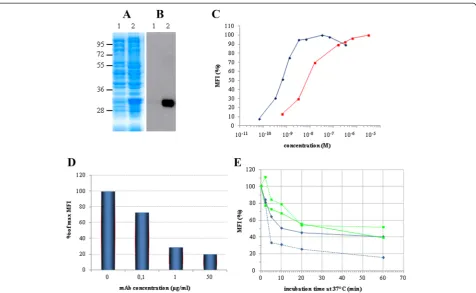
peptide linker joining the two polypeptides. This first DNA construct was subcloned, sequenced and then ex-pressed inE. coliBL21(DE3)pLysS cells with a C-terminal hexahistidine tag to allow easy nickel-affinity purification. The level of scFv expression in BL21(DE3)pLysS was first assessed in small-scale cultures. Following IPTG induc-tion, an overexpressed band with an expected size of approximately 30 kDa was detected in Coomassie blue-stained SDS-PAGE gels (Figure 1A, lane 2) which was also specifically recognized by an anti-histidine antibody in Western blotting (Figure 1B, lane 2).
Characterization of the binding of the parental anti-CD22 monoclonal antibody and derived scFv
Before generation of anti-CD22 ITs, the binding proper-ties of the parental IgG1 mAb and the derived scFv to the native cellular antigen were confirmed by flow cy-tometry on CD22+ lymphoid cell lines. As shown in Figure 1C, a Mean Fluorescence Intensity (MFI) curve was obtained following staining CD22 expressing cells with increasing concentrations of mAb (blue line) or scFv (red line). The expected sigmoid shaped curve was obtained on Daudi cells (CD22+) but as expected binding was not seen on two CD22 negative T-lymphoblastoid cell lines (H9 and HSB-2) as negative controls (data not shown). On CD22+ Daudi cells the MFI-plateau above 3 nM of mAb, whilst 4KB scFv showed a 10-fold reduced af-finity to the same cellular target in comparison to the na-tive bivalent mAb.
The specificity of the molecular target recognized by the anti-CD22 scFv was also confirmed by analyzing
4KB scFv binding on CD22-expressing cells, in a compe-tition assay with increasing concentrations of the paren-tal mAb. The scFv-associated fluorescence decreased in a dose-dependent manner as the amount of anti-CD22 mAb used to pre-stain cells was increased (Figure 1D).
Finally, the avidity of the specific binding of 4KB scFv to the recombinant extracellular domain of CD22 was determined using Biacore. The dissociation constant (Kd)
of the interaction between 4KB scFv and recombinant CD22 target antigen was assessed using Surface Plasmon Resonance technology. The resulting Kd (koff/kon)
evalu-ated was 5.1 × 10⁻⁸M for the scFv (data not shown), a value consistent with aKdof 2.5 × 10⁻⁹ M previously
de-termined for the parental 4KB128 monoclonal antibody (our unpublished observations), supporting the likely suit-ability of 4KB scFv for IT constructions.
To ensure that our scFv represented a suitable delivery vehicle for the design of an immunotoxin, the internal-ization capability of the antibody fragment was also
investigated by flow cytometry, following binding to CD22 expressed on the surface of target Daudi and Ramos cells. By plotting the fluorescence associated with residual surface-bound scFv against incubation time at 37°C, a rapid fall in extracellular staining was observed, indicating rapid endocytosis of bound antibody, particu-larly in Ramos cells (Figure 1E). It is apparent that the endocytosis trend almost overlaps with the native bi-valent mAb and unibi-valent 4KB scFv, indicating that the targeted site(s), rather than the valency of the binding antibody, is the critical factor in determining the effi-ciency of uptake. Both antibodies preserved their binding capability (binding at 4°C) of the two target cell lines even after a prolonged pre-incubation at 37°C (data not shown), ruling out the possibility that decrease in MFI may have been due to intrinsic antibody instability, deg-radation, dissociation or antigen shedding following in-cubation at 37°C.
Production and characterization of the 4KB derived fusion constructs expressed inE. coli
The nucleotide sequence coding for the PE40 truncated version ofPseudomonasexotoxin A was fused to the 3’ -end of the 4KB scFv, generating a chimeric immuno-toxin encoded within the pET20b(+) vector (Figure 2B). The C-terminal hexahistidine tag was exploited for puri-fication and analytical purposes. The small-scale expres-sion of the recombinant IT (rIT) in BL21(DE3)pLysSE. coliyielded an induced protein of approximately 70 kDa,
consistent with the expected size for a fusion between the scFv (30 kDa) and PE40 (40 kDa) (Figure 3A and B).
This preliminary induction assay showed that, unlike the scFv, the derived rIT could be expressed as a single molecular species, possibly retaining the N-terminal sig-nal peptide for periplasmic sorting. Although its level of synthesis seemed to be appropriately lower than that of the scFv alone, this did not prevent accumulation of the chimeric protein exclusively in inclusion bodies, as no detectable rIT could be recovered in soluble form(s) ei-ther in the cytoplasmic or in the periplasmic compart-ments (data not shown), indicating a certain propensity of the fusion toxin to aggregate, presumably due to the presence of the anti-CD22 recombinant scFv domain.
A larger culture was thereafter grown, induced and processed to extract the chimeric protein from inclusion bodies which was then purified and refolded, as described in Methods. This procedure allowed us to recover ap-proximately 3 mg/L of rIT from induced bacterial cul-ture, a yield consistent with those previously reported for other recombinant ITs that include truncated ver-sions of PEA [25]. A distinguishing feature of our rIT, as compared to the scFv polypeptide alone, was a negli-gible loss of the rIT during the renaturation step. We calculated that approximately 80% of the denatured re-combinant protein eluted by IMAC was recoverable after the refolding procedure.
4KB-PE40 has a good binding capacity as demonstrated by flow cytometry on Daudi cells (Figure 3C). Furthermore,
to assess the biological activity of our first fusion construct we performed protein synthesis dose–response assays which demonstrated a cytotoxic activity of 4KB-PE40 on Daudi cells with an IC50 of approximately 0.3 nM
(Figure 4). The cytotoxicity observed was dependent on the presence of the anti-CD22 scFv domain fused to PE40 since the toxin alone or the scFv alone were sub-stantially less effective against Daudi cells, while in turn the cytotoxicity of the rIT towards CD22 negative cell lines was, as expected, significantly less (Table 1). Add-itional evidence of the immunospecificity of our rIT for CD22 as the target antigen is further supported by the observation that co-incubation with an excess of whole
monoclonal parental antibody abolished the cytotoxicity of rIT, indicating displacement of the rIT by the com-peting whole antibody (Figure 4).
The sequence coding for PE40 was also sub-cloned at the C-terminus of a different 4KB scFv format in which the VHand the VLdomains were joined through the 218
linker (Figure 2C), a more flexible and hydrophilic se-quence [26].
The purified 4KB(218)-PE40 fusion protein showed chemical and physical properties similar to that of 4KB-PE40. The recombinant IT had a molecular mass of ap-proximately 70 kDa and was recognized by the anti-His antibody in Western blotting (Figure 3A-B, lane 2). Additionally, the levels of synthesis and the final yields of the latter fusion protein were also comparable to those of the first rIT made with the (G4S)3linker.
In parallel experiments, we utilized the latter anti-CD22 scFv to deliver the 30 kDa plant-derived toxin RIP saporin. Since a more flexible and hydrophilic linker may be advantageous for the construction of a rITs, we decided to link the sequence coding for a plant saporin isoform [27] to the 4KB(218) scFv version and the latter rIT was also expressed in bacteria and purified, as
Figure 3Characterization of recombinant ITs expressed inE. colipurified by IMAC. (A)Coomassie staining and(B)Western blot with anti-His antibody of purified 4KB-PE40 inlane 1, 4KB(218)-PE40 inlane 2and 4KB(218)-SAP inlane 3.(C)Comparison of the binding characteristics of 4KB-PE40 (blue diamonds), 4KB(218)-PE40 (green circles) and 4KB(218)-SAP (red triangles) analyzed by flow-cytometry using Daudi cells incubated at 4°C with increasing concentrations of each IT.
Figure 4Characterization of 4KB-PE40 IT immunospecificity for CD22 expressed on Daudi cells.The cytotoxic assay was performed incubating Daudi cells for 72 hours with increasing concentrations of 4KB-PE40 in the presence (pink squares) or absence (blue diamonds) of a fixed concentration of the corresponding parental 4KB128 monoclonal antibody. Inhibition of protein synthesis is expressed as percentage of [14C]-leucine incorporation compared to the control samples (untreated cells).
Table 1 Comparison of concentrations of the 4KB-PE40 IT, PE or the scFv alone inhibiting protein synthesis by 50% of control values (IC50)
Daudi Ramos HSB-2 H9
IC50
IT 7 nM 4 nM >300 nM >300 nM
PE 200-300 nM >750 nM 60 nM >750 nM
scFV >3200 nM >3200 nM >3200 nM >3200 nM
CD22+
described for the PEA-based recombinant proteins (see Methods). However, in the case of rIT containing a sa-porin domain we observed a lower level of rIT synthesis than that observed for PE40 containing rIT inE. coli fol-lowing IPTG induction. This phenomenon was apparently not dependent on possible host auto-intoxication effects observed during saporin expression in several hosts [28], since theE. coligrowth curve of the bacterial transformant strain was not influenced by the expression of the fusion protein (data not shown).
Nevertheless, around 4 mg/L of this saporin fusion protein could be extracted from inclusion bodies but more than 90% was lost during the renaturation process due to aggregation and concomitant precipitation caused by what we presume must be due to the instability of this particular IT construct. Indeed it has been shown previously that saporin and fusion proteins incorporating this RIP have a low propensity to refold after urea denatur-ation procedures (D. Lappi, personal communicdenatur-ation).
The binding characteristics of the different recombinant ITs produced by the bacterial expression system were compared by flow cytometry as described in Methods. As shown in Figure 3C the data demonstrate overlapping binding curves on Daudi cells.
Next, rITs produced in bacteria were tested in a pro-tein synthesis inhibition assay on Daudi cells (Figure 5). 4KB-PE40 (green) and 4KB(218)-PE40 (blue) showed very similar cytotoxic activities with an IC50 of
approxi-mately 0.1 nM, while unexpectedly, the 4KB(218)-SAP produced inE. coli(violet) failed to show any cytototoxi-city, we presume due to IT instability problems, as al-luded to above. We did not assay the 4KB(G4S)3-SAP
construct, since parallel experiments performed inP. pas-toris demonstrated that this construct was incapable of giving rise to inducible clones in theP. pastorisexpression system (see Figure 6).
Overall, these data confirm that rITs formed by PE40 fused to the anti-CD22 scFv joined by different linker peptides can be successfully produced and purified inE. coli and, most importantly, are biologically active. In contrast, a similar construct based on a saporin toxin domain was not properly expressed in bacteria and the renatured purified rIT molecules therefore failed to in-toxicate CD22+target cells.
Selection of the 4KB derived, best-suited fusion constructs expressed inP. pastoris
Saporin and a number of recombinant fusion proteins have been previously expressed with some success inE. coli [4]. However, eukaryotic hosts would seem much more suitable for expression of saporin chimaeras [29], as we recently demonstrated by exploiting the microbial eukaryotic hostPichia pastorisas an expression platform [30]. Having observed the production of aggregation-prone product(s) during expression of our anti-CD22 PE40 IT inE. coli, and having obtained low, non- func-tional amounts of this saporin-based IT in bacteria, we decided to compare the expression of companion saporin-based ITs inP. pastoris.
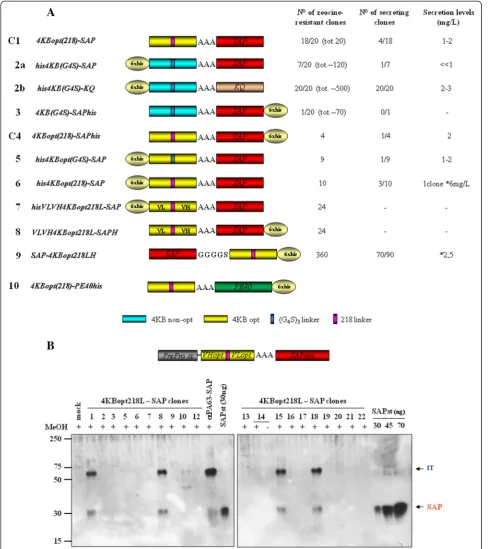
With this aim, we prepared a panel of constructs (see, Figure 6A) fusing the sequences coding for the anti-CD22 VH and VL domains alternatively connected by
using (G4S)3or 218 linkers, as described for 4KB-PE40,
to a saporin yeast-optimized sequence [30] either carry-ing an N- or C-terminal hexahistidine tag.
The first attempts to replate zeocine-resistant trans-formed clones and induce fusion protein expression were unsuccessful as we obtained only a very low num-ber of transformants, in some instances as few as only one or two transformant zeocine-resistant clones, which were incapable of expression induction (Figure 6A, for examples see schemes for constructs 2a and 3).
As a control, Pichia cells transformed with an enzy-matically inactive saporin mutant construct termed 4KB-SAPKQ (named KQ because a Lysine K and a Glu-tamine Q residue were introduced at the saporin cata-lytic site) yielded plates with the expected number of several hundred viable growing colonies (Figure 6A, see scheme for construct 2b) all of which were zeocine-resistant and all of which could be induced to express, on a small-scale, up to 2 mg/L of the fusion protein con-taining inactive mutant KQ saporin. This observation suggests that one likely reason for the unsuccessful ex-pressions of IT was the high toxicity of the enzymatically fully active saporin domain towards host Pichia cells. Similar effects have also been previously reported during
Figure 5Cytotoxicity of 4KB128-derived rITs for CD22+Daudi
the expression of wild type saporin or chimaeras con-taining saporin fused with the Amino-Terminal Frag-ment of human urokinase (ATF-saporin) in different host cells, includingP. pastoris[28].
Expression of the 4KB scFv construct alone yielded the expected number of secreting clones, and these clones were further analyzed following a medium scale induc-tion (see Addiinduc-tional file 2: Figure S1) which all gave a
good secretory yield, further supporting the notion that the low number of transformants we obtained for rIT constructs was in all likelihood due to intoxication of the host by fully active saporin.
Codon-optimization has already been shown to mark-edly decrease the toxicity issues associated with saporin expression in P. pastoris and also found to be essential for obtaining clones that expressed high levels of active saporin [30]. For these reasons, we decided to design a yeast codon-optimised anti-CD22 sequence for fusion to the N-terminus of mature saporin through a trialanine linker, which has previously been successfully used for recombinant ATF-saporin constructs [29] (Figure 6A).
A synthetic optimized gene was therefore assembled as described in the Methods section in which a yeast codon-optimized sequence coding for saporin [30] fused with dif-ferent versions of the scFv with either a (G4S)3linker, not
sequence optimized (colour coded turquoise in Figure 6A) or the 218 linker (colour coded purple) joining the VHand
VLcodon-optimized variable chains (colour coded yellow
in Figure 6A) for expression inP. pastoris. Among all the constructs obtained, constructs termed C1 and C4 were then analyzed further as described below.
Codon-optimization of the scFv domain appears to be important to enable an increase in the potential number of secreting clones that are capable of achieving a minimum of 1–2 mg/L of fusion protein production. In the supple-mentary figures we show some additional data for con-structs 6 and 9 that gave rise to expresser clones in medium scale inductions that reached values as high as 5– 10 mg/L. However, neither of these had any demonstrable saporin catalytic activity even when they were selected among a much larger number of transformants, directly on plates (see Additional files 3, 4, 5 and 6: Figures S2-S5). Indeed, Construct 9 which has the saporin C-terminus blocked by a G4S linker peptide that joins the toxin to the
scFv domain, showed the largest number of transformant (360 clones) but no enzymatic activity was detectable when the purified fusion protein was assayed (data not shown).
Appending extensions at the C-terminus has previ-ously been reported to cause inactivation of saporin (Sap-VSAV, single letter aminoacid code) assayed by an
in vitro cell-free inhibition assay, but enzymatic activity was “activated” once this molecule was used against whole viable cells [21] suggesting that a proteolytic acti-vation step takes place either extra- or intracellularly.
Finally, constructs 5 and 6 expressed with an hexahisti-dine tag appended at the N-terminus of the scFv were not recognized by an anti-his polyclonal antibody (Additional file 6: Figure S5), suggesting that proteolytic removal of this tag may have taken place, as shown for the PEA fusion as described below.
Since it is known that a gelonin-based IT (having a VL domain connected to the VH antibody domain via the
18-amino acid 218-flexible linker GSTSGSGKPGSGEGSTKG, amino acid one letter code) shows enhanced resistance to proteolysis and reduced aggregation properties of scFvs when expressed in bacterial systems [26,19], we decided to make two constructs (constructs 7 and 8 in Figure 6A) that were designed with a reversed VL-VH configuration, in contrast to all the other constructs.
Among alternate construct configurations that we also explored, the hexahistidine tag appended at N-terminus in the IT (Figure 6A, contructs 5 and 6) or the saporin domain cloned at N-terminus of the scFv (Figure 6A, construct 9) gave rise to fusion polypeptide produced in medium scale with considerable yields (see Additional files 3, 4 and 5: Figures S2-S4), but when they were puri-fied and tested on Daudi cells, no cytotoxic activity was detected (data not shown). Finally, when VH-VL orienta-tion constructs were prepared (Figure 6A, constructs 7 and 8) in the hope of increasing the scFv stability/flexi-bility or its affinity towards the target antigen, as pre-viously demonstrated by others [31], no expression was obtained. (see Additional files 3, 4 and 5: Figures S2-S4).
Overall, we may draw the following conclusions from the data we obtained with the VH-VL configurations examined so far. Our results indicate that 4KB scFv behaves as a poor secretory domain, prone to aggrega-tion (found in inclusion bodies in bacteria) and under-goes misfolding which may explain why transformation of fusion constructs containing an active saporin domain resulted in a very few transformants: if the misfolded polypetides were retro-translocated to the cytosol for degradation by the ER-associated degradation pathways, saporin would escape segregation in the endoplasmic reticulum being active against cytosolic ribosomes. Con-sistently, secretion levels of the KQ control fusion pro-tein (contruct 2b, Figure 6) were also extremely low, at least 10 times lower than when saporin KQ is expressed alone in GS115(his4) [30]. This would suggest that when this scFv domain is fused even to a good secretory protein it has direct detrimental effects on the overall expression/secretion levels.
An example of saporin-based CD22 immunotoxin expressed inPichia pastoris
icity was compared to that of unconjugated seed-extracted saporin (Figure 7A) in a protein synthesis inhibition assay. The recombinant saporin-based scFv fusion showed an IC50of 7 nM, being approximately two orders of
magni-tude higher than free saporin (Figure 7B) but lower than the conventional (chemical cross-linked) IgG (anti-CD22, 4KB128-SAPORIN) conjugate, reported to be in the order of tens of picomolar [6]. In order to confirm that the C1 activity was mediated via the CD22 target molecule, a com-petitive inhibition assay was performed by co-incubating Daudi cells for 72 hours with a fixed amount of C1 scFv saporin fusion protein together with increasing concentra-tions of 4KB128 monoclonal antibody (Figure 7B). An excess of free 4KB128 native antibody competed with the IT for the target antigen and completely abolished C1 cytotoxicity.
As C1 was active and expressed in sufficient amounts, a similar construct termed Construct 4 (C4) was pre-pared in which a hexahistidine tag was appended to the C-terminus of saporin (Figure 6A, compare C1 and C4) to allow for IMAC affinity purification of the IT.
change chromatography.
Subsequently, the activity of purified C4 construct was assessed on Daudi cells, and was found to be active in the nanomolar range (Figure 9), similar to the cytotox-icity observed for 4KB-PE40 produced inE. coli, This in-dicates that the codon optimization of the scFv and the insertion of the 218 L linker were critical to allow for proper folding, expression and activity of the IT in
Pichia cells while the His tag did not interfere with its activity contrary to the observations we made with con-struct 9. The protein synthesis inhibitory activity of the re-combinant PE-based scFv fusion was observed to have an IC50of 0.36 nM slightly lower than the 1 nM observed for
the C4 anti-CD22 scFv fusion to saporin. We also com-pared the activity of the above mentioned ITs to that of unconjugated seed-extracted saporin or to recombinant saporin expressed in P. pastoris. Notably the latter two displayed identical activity in Daudi cells with an IC50of
approximately 0.6μM. Thus, 4KB218Lopt-SAPHis (C4) is the scFv anti-CD22 fusion to saporin that in our hands performs the best with respect to expression levels and
Figure 7Cytotoxicity of 4KB128-SAP (C1) produced inP. pastorisfor CD22+Daudi cells.Daudi cells were exposed for 72 hours to
ease and efficiency of purification, with similar cytotoxic activity to construct 1. The activity of the histidine-tagged C4 construct was directly comparable to the untagged C1 construct containing the 218 linker.
Is bacterial PE efficiently expressed as a fusion with 4KBscFv inPichia pastoris?
Finally, since fusions between antibodies and bacterial toxins have been successfully expressed inP. pastoris,as demonstrated by Neville and coworkers for diphtheria toxin [24], we explored the feasibility of expressing PE40 chimeras using this host, in which antibody or other secretory targeting domains might undergo better fold-ing and quality control in the oxidizfold-ing environment of the ER lumen. We transformed the eukaryotic host
Pichia pastoris with the fusion construct 4KB218Lopt-PE40 (Figure 6A) containing the yeast codon-optimized sequences for both the anti-CD22 scFv and the toxin do-mains. An initial screening of the transformed colonies by Western blot analysis (shown in Figure 10) revealed that no intact polypeptide was secreted into the P. pas-torismedium and indeed, no band was detectable at the expected molecular mass (70 kDa). A pattern of three
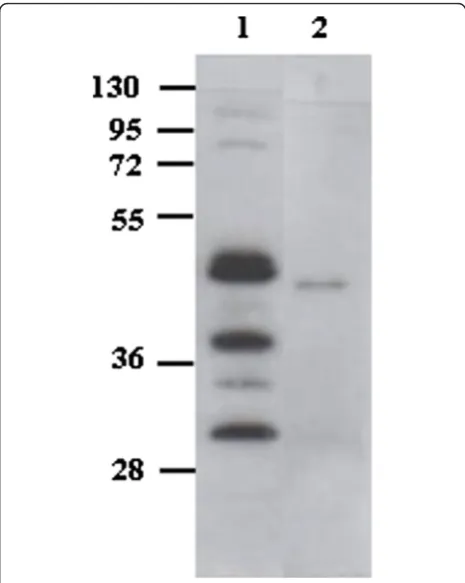
Figure 8Characterization of 4KB128-SAP (C4) produced in P. pastorisand purified by IMAC.Silver staining of purified 4KB128-SAP (C4). MW markers are shown in the far right lane.
Figure 9Protein synthesis inhibition in Daudi cells exposed for 72 hours to increasing concentrations of 4KB-PE40 produced in E. coli(green circles), C4 (4KBopt218L-SAPHis6) (red triangles), rSAP (open blue squares), seed SAP (solid blue squares). Inhibition of protein synthesis is expressed as percentage of [3H]-leucine incorporation compared to untreated control cells. Error bars represent standard deviations from mean of triplicate samples.
Figure 10Expression of 4KB218Lopt-PE40 inP. pastoris.A sample from a 72-hour medium scale induction of a GS115 clone expressing 4KB218Lopt-PE40 was analyzed by Western blotting with anti-PE serum. Concentrated medium of the induced culture was loaded inlane 1; 20 ng of recombinant PE40 expressed inE. coli
lowing secretome analysis of P. pastoris after methanol induction [32]. To confirm whether this hypothesis is correct, we conducted a study to test if native PE was cleaved by culture medium obtained fromP. pastoris ex-pressing the recombinant IT following induction by methanol. Native PE was incubated 1 h with: 1) PBS alone as a control, 2)Pichia induction 48 h medium, 3) GS115-mock transformed induction medium after a 48 h induction (pPiczαA empty vector) or 4) induction medium containing 1 mM of the serine protease inhibitor PMSF after a 48 h induction. As shown in Figure 11A, na-tive PE incubated with non-inoculated medium remained intact, showing the expected size of PE in the control lane. We can therefore exclude the possibility that proteolytic activity intrinsic to the culture medium was responsible for cleaving the 4KB218Lopt-PE40 recombinant protein. However, when samples of PE were incubated with medium after methanol induction ofP. pastoris transfec-tants, four degradation products were observed; these were less intense in the presence of proteases inhibitors. This finding strongly implies thatP. pastorissecretes pro-teases into the culture medium that proteolytically cleaves native PE and that the amount of degradation observed was decreased by the addition of protease inhibitors. An
in silicostudy of the native PE sequence revealed five pu-tative cleavage sites (Figure 11B): the predicted C-terminal PE fragments have molecular masses similar to those
PE-based IT could be expressed that retains intact catalytic activityin vivo.
Conclusions
In the present work we compared a prokaryotic and a eukaryotic expression system used for the production of recombinant immunotoxin molecules based on PE or saporin toxin domains (a flow chart comparing the two expression systems is reported in Additional file 7: Figure S6). Immunotoxins are promising therapeutics for the targeted therapy of leukemia, lymphoma and other malignancies. Targeting CD22 expressed on B-cell tumours with the 4KBscFv fused to eitherPseudomonas
exotoxin A or to the plant toxin saporin would theoret-ically allow for multiple administrations by switching to a different IT carrying the alternative toxin domain but with the same targeting domain This would be a particu-larly attractive strategy if a patient develops an antibody response against one of the toxin domain(s) during treatment.
Overall our data demonstrate that we may use a com-mon targeting moiety to deliver toxins of plant or bac-terial origin and that the resulting fusion molecules show similar potencies in terms of their protein inhib-ition capabilities. However, the molecules containing the bacterial toxin are better expressed in the E. colisystem, whilst the yeast P. pastoris is confirmed to be a better
host for saporin-based chimaeras in terms of recovery of active products once codon-usage optimization of both the toxin and the targeting scFv domains has been undertaken.
Saporin is a eukaryotic secretory protein and despite its lack of disulphide bonds or N-glycosylation sites, it is a polypeptide that would appear to be better expressed in the environment provided by the endoplasmic reticulum. When saporin is fused to a “non conven-tional”unfavorable domain, as with the “synthetic”scFv, misfolding may occur and result in greater host toxicity issues, thus reducing expression levels. The reason why codon-usage optimization at least in part, counteracts such an effect by the scFv domain expressed in Pichia
requires further investigation. The advantage of both the microbial expression platforms used here is that they can both be easily scaled up for industrial production for such therapeutic proteins. Finally, we were able to deter-mine that P. pastoris is not a suitable host for the ex-pression of PE-derived fusion proteins because of the potential cleavage sites present in native PE that are rec-ognized by furin-like enzymes secreted by P. pastoris
into the culture medium.
Methods
Materials
All the Materials were of analytical grade.
Recombinant CD22 was purchased from SBH SCIENCES. 4KB128 hybridoma cells were kindly provided by Profes-sor Karen Pulford, University of Oxford and anti-saporin rabbit antiserum was provided by one of our laboratories (DJF/SUF).
The synthetic genes coding for optimized scFv or opti-mized PE-40 sequence were assembled by Genscript (Piscataway, NJ, USA), based on the available P. pastoris
coding sequences (CDS) in Biomed Central (64,359 co-dons with corresponding triplet frequencies, choosing those most frequently represented in highly expressedP. pastoris proteins for the construction of the synthetic genes that were subcloned in pUC57 recipient vector, as for the codon-optimized saporin sequence [30] obtaining the pUC57-PE40optconstruct and 4KB218scFvopt.
The pPICZalpha series of vectors from Invitrogen were used for subcloning the DNA constructs to obtain recipient vectors for expression in GS115 (his4) Pichia pastorisstrain.
Plasmid construction for the expressions inE. coli
The 4KB128 hybridoma secreting murine IgG directed against human CD22 were cultured under the same con-ditions used for other cell lines (see below).
Total RNA was extracted using the SV Total RNA Isola-tion System (Promega, Madison, WI, USA) according to the manufacturer’s instructions. Reverse transcription was
performed using M-MLV retrotranscriptase from Invitro-gen and a mix of random primers (InvitroInvitro-gen) to obtain cDNA according to the manufacturer’s instructions.
The sequences coding for the variable domains of heavy (VH) and light (VL) immunoglobulin chains were
amplified by PCR reactions on 1μg cDNA using a panel of 25 forward and 4 reverse oligonucleotides for each variable domain (25 VH forward primers and 4 JH
re-verse primers; 25 VL forward primers and 4 JL reverse
primers, (see Additional file 1: Table S1). Forward primers were designed based on highly conserved se-quences at the 5’-end of DNA fragments for VH and VL
domains from several families of murine immunoglobu-lins; reverse primers were instead inferred from the J re-gions located at the 3’-end of VH and VL DNA regions.
Each forward primer was tested in a PCR reaction that included a mix of the four reverse primers. Once the best forward primer had been thus selected, it was used in four individual PCR reactions, each with a single re-verse primer.
The PCR products generated by each of the putative primer pairs were sequenced and compared with se-quences present in the Genbank database of variable do-mains deriving from murine immunoglobulins.
The primer pairs that allowed for a correct amplifica-tion of VHand VLgenes were then re-designed as
modi-fied versions by inserting the suitable restriction sites for the cloning into the recipient vector: NcoI and XhoI
were inserted into the primer for the amplification of the VHchain andPstIandNotIfor the VLchain.
The VHand VLchains were therefore further amplified
using the latter pairs of primers, i.e. 4HF, 4HR in the case of amplification of the VHdomain and 4KF, 4KR in
the case of the VL (Additional file 1: Table S1). The
resulting PCR fragments were inserted into a pHEN1 vector derived from a clone obtained from the ETH-2-Gold library and containing a (Gly4Ser)3 linker between the two previously encoded VHand VLregions. The final
construct, named 4KBscFv, was amplified with primers 4HF and 4KR (Additional file 1: Table S1) then sub-cloned into the pET20b(+) expression vector which pro-vided a carboxy-terminal hexahistidine tag for nickel affinity protein purification, in this way we obtained a first construct which we named pET20b(+)4KBscFv(XP). Two point mutations were then inserted into the plas-mid pET20b(+)4KBscFv(XP) using the QuickChange Site-Directed Mutagenesis Kit (Stratagene, La Jolla, CA, USA) in order to remove the restriction sites for PstI
andXhoIby respectively using the primer pairs PSTmut1/ PSTmut2 and XHOmut1/XHOmut2 (Additional file 1: Table S1). The resulting vector was called pET20b(+)4KB (G4S) scFv (Figure 2A).
of the variable domains are joined through the 218 linker, two 218 F and 218R oligonucleotides were syn-thesized (Additional file 1: Table S1). Briefly, the oligo-nucleotides were mixed with a reaction buffer (100 mM TrisHCl pH 7.5, 200 mM NaCl, 60 mM MgCl2),
incu-bated for 2 minutes at 80°C to enable primer annealing and then cooled to room temperature. The primer ex-tension was performed using Klenow fragment (Fermen-tas) according to the manufacturer’s protocol. The double-stranded fragment was digested with PstI/XhoI and cloned into the pET20b(+)4KBscFv vector to obtain the final construct pET20b(+)4KB(218)scFv.
The sequence of PE40, amplified as described above, was inserted into pET20b(+)4KB(218)scFv at the C-terminus of the scFv sequence to obtain the immunotoxin construct 4KB(218)-PE40his (Figure 2C).
The same cloning strategy was used for construction of the pET20b(+)4KB(218)-SAPhis vector (Figure 2D) amplifying the saporin native sequence from a saporin expression plasmid, as previously described [30] by using the primers SAPF and SAPR (Additional file 1: Table S1).
DH5α-competent bacteria were used for DNA trans-formation and large-scale preparation, and the putative positive clones were confirmed by sequencing using T7 promoter and T7 terminator primers for pET20b(+) de-rived constructs. All our DNA sequence analyses were performed by BMR Genomics (Padua, Italy) and primers for DNA amplifications were synthesized by Eurofins MWG Operon.
The E. coli strain BL21(DE3)pLysS was transformed with 50 ng of the plasmids described above and grown at 37°C in Luria-Bertani broth containing 100 μg/mL ampicillin. To induce protein expression, 1 mM isopropyl-1-thio-ß-D-galactopyranoside (IPTG) was added to the culture and the induction was carried out for 3 hours at 30°C after which the cell culture was harvested by centri-fugation (10000 x g, 10 min).
Protein purification from bacterial cultures
The bacterial cell pellet was resuspended in 100 ml resus-pension buffer (50 mM Na2HPO4, 0,5 M NaCl pH 7.5).
25μg/mL DNase, 0,1 mg/mL lysozyme, 1% Triton X-100,
bodies was attained by multi-step dialysis in refolding buffer (50 mM TrisHCl, 0.5 M NaCl, 0.4 M L-Arg, pH 7.5) that gradually decreased the concentration of denaturant. The final dialysis step was carried out in PBS (pH 7.2) for 12 hours.
Rationale for thePichiaexpression constructs, selection of
pichiags115(his4) trasformants
A SfiI-NotI fragment of a pHEN1 construct containing the 4KB antibody single-chain variable fragment (scFv) was purified and inserted into theSfiI-NotI-cut pPICZal-phaB recipient vector while a second construct in which the amino acid sequence of this first scFv version was fused to the N-terminus of a saporin yeast codon opti-mized sequence [30] via an alanine tripeptide linker (encoded within the NotI sequence) was also obtained and clone integrity confirmed by DNA sequencing by BMR Genomics (Padua, Italy), that custom performed all the DNA sequence analyses of constructs described herein. A codon-optimized DNA sequence encoding the anti-CD22 scFv was custom synthesized by Genscript company as described previously for the saporin se-quence optimization [30] was also used to obtain some of the fusion constructs, following the same cloning strategy.
to appear after 3–4 days incubation at 30°C, and ran-domly selected colonies were restreaked onto YPDS-zeocin plates. In the case of non optimised scFv fusion constructs only few colonies could be selected and al-most no induction or very little expression of the fusion construct could be observed in one or two clones.
At least 10 different fusion constructs have been de-signed, produced and separately introduced into Pichia
GS115(his 4) cells, using as a starting point the yeast codon optimised saporin (SAPopt) sequence which has been fused to alternate versions of the anti-CD22 single chain variable fragments that were collectively termed 4KB. For further details please refer to Figure 6A in which clone identifying numbers refer to the (best) refer-ence clone(s) obtained and further analyzed for each transformation set. AAA in aminoacid one letter code refers to the encoded Alanine linker joining the two variable single chain domains to the toxin domain. Basic fusion construct configuration generally included the Preproalpha factor domain which was always used as a common yeast secretory domain, in all our constructs (not shown in Figure 6) optimized saporin followed by AAA linker, except for constructs labeled 7, 8 that started with the heavy chain variable (VH) antibody
main immediately following the Preproalpha factor do-main and construct 9 which has saporin dodo-main connected via a G4S linker to the scFv optimized 4KB
domain.
We also introduced and investigated the effects of a change in linker sequence between VH and VL, leading
to what we term“218 L derived constructs”. Two alter-nate construction options were explored, by inserting instead of the classic (G4S)3linker between the VH and
VL antibody domains, a longer and more hydrophilic
218 linker. We also checked for the expression of fusions with an hexahistidine tag placed either at the C-terminus of the fusion toxin or at its N-C-terminus, in the latter case the 6xHistag was placed just beyond an endo-protease Kex-2 like site that should be recognised allow-ing for removal of the transient alpha factor secretory domain within the Golgi complex. Overall, only two construct(s) gave us a successful clones, construct 1 and construct 4 that are quite similar, because they both contain the 218 linker between VHand VLof the codon
yeast optimized 4KBopt sequence, differing only for the presence of an histidine tag at the saporin C terminus in clone 4.
After obtaining the pUC57-PE40opt construct from Genscript, the PE40 optimized sequence, including the C-terminal hexahistidine tag, was amplified by PCR on pUC57-PE40opt with optPE40 and optPE6his primers (Additional file 1: Table S1) and ligated in the NotI-XbaI-cut pPicZalphaB-4KBopt218L; the final construct was named 4KBopt(218)-PE40his (Figure 6A).
Pichiaexpression screening procedures and large scale induction conditions
Screening conditions were either small-scale inductions ofPichiaindependent clones after being restreaked onto YPDS-zeocin plates. Single colonies were picked into 5– 10 mL broth and at 2OD/mL these were either non-induced or non-induced for 48 h with 0.5% Methanol in BMMY. Equivalent samples of non-induced (NI) or methanol-induced (I) media were loaded, subjected to a SDS-PAGE and Western-blot analysis using anti-saporin serum, as shown in Figure 6B.
As negative control, an induced mock-transformant clone was also loaded in same amounts, to confirm no reactivity was present, whereas as a positive control of a small-scale induction of the model IT antiPA63-SAP [30] was also loaded, to confirm the expected size and to roughly compare expression levels of the fusion polypep-tides under small-scale induction conditions, which were also compared to standard seed saporin for protein quantitation’s.
Among the 20 clones picked and induced, we then se-lected a “best expresser” clone showing almost no im-munoreactivity in the NI-condition but when induced showing an immune-reactive band of the expected size for a saporin-scFv fusion (around 55 KDa) co-migrating with the model control scFv fusion. In some experiments we noticed the presence of faint reactive bands migrat-ing at the size of saporin in some of the induced media.
Larger scale inductions in 400 mL of the best ex-presser clones were performed as previously described (See Additional file 2: Figure S1). In some cases when several hundred clones were obtained afterPichia trans-formation, inductions of colony lifts were performed as described in detail in [30] and shown here in Additional files 3 and 4: Figures S2-S3.
Protein purifications fromP. pastorisculture
SDS-Cell lines
The biological assays were performed on two human lines of B lymphocytes derived from Burkitt’s lymphoma and expressing CD22 antigen (Daudi or Ramos cell line) and two CD22-negative T-lymphoblastoid cell lines (HSB-2 and H9). Cells were cultured in RPMI 1640 medium (with 40 mg/L folic acid, 2 g/L NaHCO3) (Bio-chromag) supplemented with 10% FCS, 2 mM L-Glutam-ine and antibiotics (100 U/mL penicillL-Glutam-ine and 100μg/mL streptomycine-sulphate). Daudi cells were grown in flasks at 37°C in a 5% CO2humidified atmosphere.
Binding properties of the fusion proteins to CD22 antigen
The binding characteristics of 4KB128 monoclonal anti-body and of the 4KB128-derived scFv and rITs for CD22 antigen was assessed using the CD22-positive cell line Daudi by incubating 3 × 10⁵ cells with increasing con-centration of purified mAb 4KB128 or scFv (ranging from 10−11M to 10−5M) or rITs (from 10−9M to 10−5M). Cells were analyzed for fluorescence on a FACS Caliber flow-cytometer after a staining with anti-His antibody and a second incubation with a goat anti mouse-FITC antibody (Beckman Coulter).
In the competition assay 3 × 10⁵Daudi cells were pre-incubated on ice for 20 minutes with increasing amounts of the purified anti-CD22 mAb 4KB128. Five μg of the scFv (100 μl) was then added and incubation continued for one hour on ice. Cells were then stained with anti-His6-FITC (Miltenyibiotec) and analyzed as described above. The inhibition of scFv binding was evaluated by reference to the maximal MFI without competing 4KB128 antibody.
Stability and internalization in target cells
The stability of the anti-CD22 mAb and of the derived scFv was evaluated by incubation of the antibodies at 37°C for the same times as in the internalization experiment (see below). The two antibodies were diluted at concentra-tions of 0.5μg/mL (mAb) and 10μg/mL (scFv) and incu-bated for up to 60 minutes at 37°C in a water bath. At each time point the corresponding tube was transferred in ice and analysed by flow cytometry as described above.
were added to 2.5 × 10⁴cells seeded in 96-well plate and maintained in leucine-free RPMI-1640 medium with 2% fetal calf serum (FCS). After incubation for 48 hours at 37°C, 0.2 μCi of [14C]-leucine or 0.5μCi of [3H]-leucine were added. Incorporated radioactive leucine was mea-sured on a beta counter.
The specific inhibition of 4KB-PE40 IT activity was de-termined in a competition assay in which Daudi cells were seeded 2.5 × 10⁴in a 96-well plate, and incubated with increasing concentrations of 4KB-PE40 in the pres-ence or abspres-ence of a fixed concentration of the CD22 mAb 4KB128 (10−6 M). After an incubation period of 48 hours at 37°C, [14C]-leucine was added and the incor-porated radioactivity was measured as described above.
Additional files
Additional file 1: Table S1.Oligonucleotide sequences used to generate expression plasmids.
Additional file 2: Figure S1.Example of medium and small scale induction procedures.
Additional file 3: Figure S2.Screening for constructs 7, 8 on plate.
Additional file 4: Figure S3.Screening for construct 9-induced clones on plate.
Additional file 5: Figure S4.Comparison of secretion yields ofPichia pastorisclones deriving from constructs 6–9.
Additional file 6: Figure S5.N-terminal histidine tagged fusions (construct C6, see also Figure 6) were not recognized be the anti-tag antibody.
Additional file 7: Figure S6.Flow chart representation comparing the two expression systems tested.
Abbreviations
IT:Immunotoxin; MFI: Mean fluorescence intensity; PEA: Pseudomonas exotoxin A; PE40: Truncated version of Pseudomonas exotoxin A; scFv: Single-chain variable fragment.
Competing interests
The authors declare that they have no competing interests.
Authors’contributions
coordinating the project; DJF, MCo, MSF and RV drafted the manuscript. All authors read and approved the final manuscript.
Acknowledgements
The authors wish to thank Professor Karen Pulford (University of Oxford) for her generous gift of the 4KB128 hybridoma and Dr A. Pini (Dept. of Molecular Biology, University of Siena, Italy) for the preliminary Biacore data. Some of the experiments were performed in L'Aquila at the Center for Molecular Diagnostics and Advanced Therapies, funded by the Abruzzo Earthquake Relief Fund (Toronto Canada). This work received major funding from the UK based children’s leukaemia research charity Leukaemia Busters under the Recombinant Immunotoxin Collaborative Group (RICG) project, with additional funding from the Italian Ministry for Economics Development (MiSE)/Institute for Foreign Commercial Affairs (I.C.E.) and AIRC-Regione Veneto.
Author details
1Department of Pathology and Diagnostics, University of Verona, Verona,
Italy.2Istituto Biologia e Biotecnologia Agraria, CNR, Milan, Italy.3Department of Life, Health and Environmental Sciences, University of L’Aquila, L’Aquila, Italy.4The Simon Flavell Leukaemia Research Laboratory, (Leukaemia Busters), Southampton General Hospital, Southampton, UK.5Istituto Nazionale di Genetica Molecolare-INGM, Milan, Italy.
Received: 21 October 2014 Accepted: 27 January 2015
References
1. Strebhardt K, Ullrich A. Paul Ehrlich’s magic bullet concept: 100 years of progress. Nat Rev Cancer. 2008;8:473–80.
2. Vago R, Ippoliti R; Fabbrini, M. S. Current status & Biomedical applications of Ribosome-inactivating proteins. In Antitumor Potential and other Emerging Medicinal Properties of Natural Compounds. Edited by Ng EFFTB: Springer; 2013: 145–179.
3. Kreitman RJ. Recombinant immunotoxins containing truncated bacterial toxins for the treatment of hematologic malignancies. BioDrugs. 2009;23:1–13.
4. de Virgilio M, Lombardi A, Caliandro R, Fabbrini MS. Ribosome-inactivating proteins: from plant defense to tumor attack. Toxins (Basel). 2010;2:2699–737. 5. Fracasso G, Stirpe F, Colombatti M. Plant toxic proteins, ribosome - inactivating
protein - containing conjugates for therapeutic use. Toxic Plant Proteins, Plant Cell Monographs. 2010;18:225–63.
6. Flavell DJ, Noss A, Pulford KA, Ling N, Flavell SU. Systemic therapy with 3BIT, a triple combination cocktail of anti-CD19,−CD22, and -CD38-saporin immunotoxins, is curative of human B-cell lymphoma in severe combined immunodeficient mice. Cancer Res. 1997;57:4824–9.
7. Amlot PL, Stone MJ, Cunningham D, Fay J, Newman J, Collins R, et al. A phase I study of an anti-CD22-deglycosylated ricin A chain immunotoxin in the treatment of B-cell lymphomas resistant to conventional therapy. Blood. 1993;82:2624–33.
8. Kreitman RJ, Squires DR, Stetler-Stevenson M, Noel P, FitzGerald DJ, Wilson WH, et al. Phase I trial of recombinant immunotoxin RFB4(dsFv)-PE38 (BL22) in patients with B-cell malignancies. J Clin Oncol. 2005;23:6719–29. 9. Kreitman RJ, Wilson WH, Bergeron K, Raggio M, Stetler-Stevenson M,
FitzGerald DJ, et al. Efficacy of the anti-CD22 recombinant immunotoxin BL22 in chemotherapy-resistant hairy-cell leukemia. N Engl J Med. 2001;345:241–7.
10. Bera TK, Onda M, Kreitman RJ, Pastan I. An improved recombinant Fab-immunotoxin targeting CD22 expressing malignancies. Leuk Res. 2014;38:1224–9.
11. Krauss J, Arndt MA, Martin AC, Liu H, Rybak SM. Specificity grafting of human antibody frameworks selected from a phage display library: generation of a highly stable humanized anti-CD22 single-chain Fv fragment. Protein Eng. 2003;16:753–9.
12. Onda M, Beers R, Xiang L, Lee B, Weldon JE, Kreitman RJ, et al. Recombinant immunotoxin against B-cell malignancies with no immunogenicity in mice by removal of B-cell epitopes. Proc Natl Acad Sci U S A. 2011;108:5742–7. 13. Mazor R, Vassall AN, Eberle JA, Beers R, Weldon JE, Venzon DJ, et al.
Identification and elimination of an immunodominant T-cell epitope in recombinant immunotoxins based on Pseudomonas exotoxin A. Proc Natl Acad Sci U S A. 2012;109:E3597–603.
14. Mazor R, Eberle JA, Hu X, Vassall AN, Onda M, Beers R, et al. Recombinant immunotoxin for cancer treatment with low immunogenicity by identification and silencing of human T-cell epitopes. Proc Natl Acad Sci U S A. 2014;111:8571–6.
15. French RR, Bell AJ, Hamblin TJ, Tutt AL, Glennie MJ. Response of B-cell lymphoma to a combination of bispecific antibodies and saporin. Leuk Res. 1996;20:607–17.
16. Fabbrini MSF, Flavell DJ, Ippoliti R. Plant protein toxins: structure, function and biotechnological applications. In: Ascenzi PP F, Visca P, editors. Bacterial, Plant and Animal Toxins. Kerala, India: Research Signpost; 2003. p. 66–9. 17. Buchner J, Pastan I, Brinkmann U. A method for increasing the yield of
properly folded recombinant fusion proteins: single-chain immunotoxins from renaturation of bacterial inclusion bodies. Anal Biochem. 1992;205:263–70.
18. Mason DY, Stein H, Gerdes J, Pulford KA, Ralfkiaer E, Falini B, et al. Value of monoclonal anti-CD22 (p135) antibodies for the detection of normal and neoplastic B lymphoid cells. Blood. 1987;69:836–40.
19. Rosenblum MG, Cheung LH, Liu Y, Marks 3rd JW. Design, expression, purification, and characterization,in vitroandin vivo, of an antimelanoma single-chain Fv antibody fused to the toxin gelonin. Cancer Res. 2003;63:3995–4002.
20. Vallera DA, Oh S, Chen H, Shu Y, Frankel AE. Bioengineering a unique deimmunized bispecific targeted toxin that simultaneously recognizes human CD22 and CD19 receptors in a mouse model of B-cell metastases. Mol Cancer Ther. 2010;9:1872–83.
21. Giansanti F, Di Leandro L, Koutris I, Pitari G, Fabbrini MS, Lombardi A, et al. Engineering a switchable toxin: the potential use of PDZ domains in the expression, targeting and activation of modified saporin variants. Protein Eng, Des Sel. 2010;23:61–8.
22. Heisler I, Keller J, Tauber R, Sutherland M, Fuchs H. A cleavable adapter to reduce nonspecific cytotoxicity of recombinant immunotoxins. Int J Cancer. 2003;103:277–82.
23. Cereghino JL, Cregg JM. Heterologous protein expression in the methylotrophic yeast Pichia pastoris. FEMS Microbiol Rev. 2000;24:45–66. 24. Woo JH, Liu YY, Mathias A, Stavrou S, Wang Z, Thompson J, et al. Gene
optimization is necessary to express a bivalent anti-human anti-T cell immunotoxin in Pichia pastoris. Protein Expr Purif. 2002;25:270–82. 25. Barth S, Huhn M, Matthey B, Klimka A, Galinski EA, Engert A.
Compatible-solute-supported periplasmic expression of functional recombinant proteins under stress conditions. Appl Environ Microbiol. 2000;66:1572–9.
26. Whitlow M, Bell BA, Feng SL, Filpula D, Hardman KD, Hubert SL, et al. An improved linker for single-chain Fv with reduced aggregation and enhanced proteolytic stability. Protein Eng. 1993;6:989–95.
27. Marshall RS, D’Avila F, Di Cola A, Traini R, Spano L, Fabbrini MS, et al. Signal peptide-regulated toxicity of a plant ribosome-inactivating protein during cell stress. Plant J. 2011;65:218–29.
28. Lombardi AM RS, Savino C, Fabbrini MS, Ceriotti A. Toxic plant proteins, plant cell monographs. Berlin/Heidelberg, Germany: Springer; 2010. 29. Fabbrini MS, Carpani D, Soria MR, Ceriotti A. Cytosolic immunization allows
the expression of preATF-saporin chimeric toxin in eukaryotic cells. FASEB J. 2000;14:391–8.
30. Lombardi A, Bursomanno S, Lopardo T, Traini R, Colombatti M, Ippoliti R, et al. Pichia pastoris as a host for secretion of toxic saporin chimeras. FASEB J. 2010;24:253–65.
31. Power BE, Doughty L, Shapira DR, Burns JE, Bayly AM, Caine JM, et al. Noncovalent scFv multimers of tumor-targeting anti-Lewis(y) hu3S193 humanized antibody. Protein Sci. 2003;12:734–47.


![Figure 6A) fusing the sequences coding for the anti-With this aim, we prepared a panel of constructs (see,CD22 VH and VL domains alternatively connected byusing (G4S)3 or 218 linkers, as described for 4KB-PE40,to a saporin yeast-optimized sequence [30] either carry-ing an N- or C-terminal hexahistidine tag.](https://thumb-us.123doks.com/thumbv2/123dok_us/9155237.1910602/7.595.58.291.490.656/sequences-constructs-alternatively-connected-described-optimized-terminal-hexahistidine.webp)