The Thirty-Third AAAI Conference on Artificial Intelligence (AAAI-19)
Deep Short Text Classification with Knowledge Powered Attention
Jindong Chen,
1,2Yizhou Hu,
1Jingping Liu,
1Yanghua Xiao,
1,3,4,5*Haiyun Jiang
11Shanghai Key Laboratory of Data Science, School of Computer Science, Fudan University, China
2CETC Big Data Research Institute Co.,Ltd., Guizhou, China 3Shanghai Institute of Intelligent Electronics & Systems, Shanghai, China
4Shuyan Technology, Shanghai, China 5Alibaba Group, Zhejiang, China
{chenjd16, huyz15, jpliu17, shawyh, jianghy16}@fudan.edu.cn
Abstract
Short text classification is one of important tasks in Natu-ral Language Processing (NLP). Unlike paragraphs or doc-uments, short texts are more ambiguous since they have not enough contextual information, which poses a great chal-lenge for classification. In this paper, we retrieve knowledge from external knowledge source to enhance the semantic rep-resentation of short texts. We take conceptual information as a kind of knowledge and incorporate it into deep neural networks. For the purpose of measuring the importance of knowledge, we introduce attention mechanisms and propose deep Short Text Classification with Knowledge powered At-tention (STCKA). We utilize Concept towards Short Text (C-ST) attention and Concept towards Concept Set (C-CS) at-tention to acquire the weight of concepts from two aspects. And we classify a short text with the help of conceptual in-formation. Unlike traditional approaches, our model acts like a human being who has intrinsic ability to make decisions based on observation (i.e., training data for machines) and pays more attention to important knowledge. We also con-duct extensive experiments on four public datasets for differ-ent tasks. The experimdiffer-ental results and case studies show that our model outperforms the state-of-the-art methods, justify-ing the effectiveness of knowledge powered attention.
Introduction
Short text classification is one of important ways to un-derstand short texts and is useful in a wide range of ap-plications including sentiment analysis (Wang et al. 2014), dialog system (Lee and Dernoncourt 2016) and user in-tent understanding (Hu et al. 2009). Compared with para-graphs or documents, short texts are moreambiguoussince they have not enough contextual information, which poses a great challenge for short text classification. Existing meth-ods (Gabrilovich and Markovitch 2007; Wang et al. 2014; 2014) for short text classification can be mainly divided into two categories:explicit representationandimplicit represen-tation(Wang and Wang 2016).
For explicit representation, a short text is represented as a sparse vector where each dimension is an explicit feature, corresponding to syntactic information of the short text in-cluding n-gram, POS tagging and syntactic parsing (Pang,
Copyright c2019, Association for the Advancement of Artificial Intelligence (www.aaai.org). All rights reserved.
Lee, and Vaithyanathan 2002). Researchers develop effec-tive features from many different aspects such as knowl-edge base and the results of dependency parsing. The ex-plicit model is interpretable and easy to understand for hu-man beings. However, the explicit representation usually ig-nores the context of short text and cannot capture deep se-mantic information.
In terms of implicit representation, a short text is usually mapped to an implicit space and represented as a dense vec-tor (Mikolov et al. 2013). The implicit model is good at cap-turing syntax and semantic information in short text based on deep neural networks. However, it ignores important se-mantic relations such as isAandisPropertyOf that exist in Knowledge Bases (KBs). Such information is helpful for the understanding of short texts, especially when dealing with previously unseen words. For example, given a short text S1: “Jay grew up in Taiwan”, the implicit model may treatJay as a new word and cannot capture that Jayis asinger which is beneficial to classify the short text into the class
entertainment.
In this paper, we integrate explicit and implicit representa-tion of short texts into a unified deep neural network model. We enrich the semantic representation of short texts with the help of explicit KBs such as YAGO (Suchanek, Kasneci, and Weikum 2008) and Freebase (Bollacker et al. 2008). This allows the model to retrieve knowledge from an external knowledge source that is not explicitly stated in the short text but relevant for classification. As the example shown in S1, the conceptual information as a kind of knowledge is helpful for classification. Therefore, we utilizeisA rela-tion and associate each short text with its relevant concepts in KB by conceptualization1. Afterwards we incorporate the
conceptual informationasprior knowledgeinto deep neural networks.
Although it may seem intuitive to simply integrate con-ceptual information into a deep neural network, there are still two major problems. First, when conceptualizing the short text, some improper concepts are easily introduced due to the ambiguity of entities or the noise in KBs. For exam-ple, in the short text S2: “Alice has been using Apple for more than 10 years”, we acquire the concepts fruitand
1
mobile phoneofapplefrom KB. Obviously,fruit is not an appropriate concept here which is caused by the ambiguity of apple. Second, it is necessary to take into account the granularity of concepts and the relative impor-tance of the concepts. For insimpor-tance, in the short text S3: “Bill Gates is one of the co-founders of Microsoft”, we re-trieve the conceptspersonandentrepreneurofBill Gatesfrom KB. Although they are both correct concepts, entrepreneuris more specific thanpersonand should be assigned a larger weight in such a scenario. Prior work (Gabrilovich and Markovitch 2007; Wang et al. 2017) ex-ploited web-scale KBs for enriching the short text represen-tation, but without carefully addressing these two problems. To solve the two problems, we introduceattention mech-anisms and propose deep Short Text Classification with Knowledge PoweredAttention (STCKA). Attention mech-anism has been widely used to acquire the weight of vec-tors in many NLP applications including machine transla-tion (Bahdanau, Cho, and Bengio 2015), abstractive sum-marization (Zeng et al. 2016) and question answering (Hao et al. 2017). For the first problem, we useConcept towards Short Text (C-ST) attentionto measure the semantic simi-larity between a short text and its corresponding concepts. Our model assigns a larger weight to the conceptmobile phone in S2 since it is more semantically similar to the short text than the conceptfruit. For the second problem, we use Concept towards Concept Set (C-CS) attention to explore the importance of each concept with respect to the whole concept set. Our model assigns a larger weight to the conceptentrepreneurin S3 which is more discrimina-tive for a specific classification task.
We introduce a soft switch to combine two attention weights into one and produce the final attention weight of each concept, which is adaptively learned by our model on different datasets. Then we calculate a weighted sum of the concept vectors to produce the concept representation. Be-sides, we make full use of both character and word level features of short texts and employ self-attention to generate the short text representation. Finally, we classify a short text based on the representation of short text and its concepts. The main contributions of this paper are summarized as fol-lows:
• We propose deep Short Text Classification with Knowl-edge Powered Attention. As far as we know, this is the first attention model which combines prior knowledge in KBs to enrich the semantic information of the short text.
• We introduce two attention mechanisms (i.e., C-ST and C-CS attention) to measure the importance of each con-cept from two aspects and combine them by a soft switch to acquire the weight of concept adaptively.
• We conduct extensive experiments on four datasets for different tasks. The results show that our model outper-forms the state-of-the-art methods.
Our Model
Our model STCKA is a knowledge-enhanced deep neural network shown in Figure 1. We provide a brief overview of
our model before detailing it. The input of the network is a short texts, which is a sequence of words. The output of the network is the probability distribution of class labels. We use p(y|s, φ)to denote the probability of a short text being class y, whereφis the parameters in the network. Our model con-tains four modules. Knowledge Retrieval module retrieves conceptual information relevant to the short text from KBs.
Input Embedding module utilizes the character and word level features of the short text to produce the representa-tion of words and concepts. Short Text Encoding module encodes the short text by self-attention and produces short text representationq.Knowledge Encodingmodule applies two attention mechanisms on concept vectors to obtain the concept representation p. Next, we concatenatepandqto fuse the short text and conceptual information, which is fed into a fully connected layer. Finally, we use an output layer to acquire the probability of each class label.
Knowledge Retrieval
The goal of this module is to retrieve relevant knowledge from KBs. This paper takesisArelation as an example, and other semantic relations such as isPropertyOf can also be applied in a similar way. Specifically, given a short texts, we hope to find a concept setC relevant to it. We achieve this goal by two major steps:entity linkingand conceptualiza-tion. Entity linking is an important task in NLP and is used to identify the entities mentioned in the short text (Moro, Raganato, and Navigli 2014). We acquire an entity setE of a short text by leveraging the existing entity linking solu-tions (Chen et al. 2018). Then, for each entitye∈ E, we ac-quire its conceptual information from an existing KB, such as YAGO (Suchanek, Kasneci, and Weikum 2008), Probase (Wu et al. 2012) and CN-Probase (Shuyan 2018) by concep-tualization. For instance, given a short text “Jay and Jolin are born in Taiwan”, we obtain the entity set E = {Jay Chou,Jolin Tsai}by entity linking. Then, we concep-tualize the entityJay Chouand acquire its concept setC ={person,singer,actor,musician,director} from CN-Probase.
Input Embedding
The input consists of two parts: short textsof lengthnand concept setCof sizem. We use three kinds of embeddings in this module including character embedding, word embed-ding, and concept embedding. Character embedding layer
Short Text Encoding
KB
Entity Linking Conceptualization
………..…..
Short Text Concepts
⨂
C-ST Attention
"# "$ "% "& "'
C-CS Attention (# ($ (% (& ('
)# )$ )% )& )'
Attention Module
⊕
Knowledge Encoding
BiLSTM Self-attention
Word/Char Embedding Concept/Char Embedding
Knowledge Retrieval
⨁
Concatenate
⨂
Weighted
Attention Module “history”
Probability Distribution
Figure 1: Model architecture. The input short text ison the creation of Chinese historical plays. The concepts includehistory, country, etc. The class label ishistory.
word/concept embedding vectors to obtain d-dimensional word/concept representation.
Short Text Encoding
The goal of this module is to produce the short text rep-resentation q for a given short text of length n which is represented as the sequence ofd-dimensional word vectors
(x1, x2, ..., xn). Self-attention is a special case of attention
mechanism that only requires a single sequence to compute its representation (Vaswani et al. 2017). Before using self-attention, we add a recurrent neural network (RNN) to trans-form the inputs from the bottom layers. The reason is ex-plained as follows. Attention mechanism uses weighted sum to generate output vectors, thus its representational power is limited. Meanwhile, RNN is good at capturing the contex-tual information of sequence, which can further increase the expressive power of attentional network.
In this paper, we employ bidirectional LSTM (BiLSTM) as (Hao et al. 2017) does, which consists of both forward and backward networks to process the short text:
− → ht=
−−−−→ LST M(xt,
−−→
ht−1) (1) ←−
ht=
←−−−− LST M(xt,
←−−
ht+1) (2) We concatenate each−→htand
←−
htto obtain a hidden stateht.
Let the hidden unit number for each unidirectional LSTM be u. For simplicity, we denote all thehts asH∈Rn×2u:
H = (h1, h2, ...hn) (3)
Then, we use the scaled dot-product attention, which is a variant of dot-product (multiplicative) attention (Luong, Pham, and Manning 2015). The purpose is to learn the word
dependence within the sentence and capture the internal structure of the sentence. Given a matrix ofnquery vectors Q∈Rn×2u, keysK ∈Rn×2uand valuesV ∈Rn×2u, the
scaled dot-product attention computes the attention scores based on the following equation:
A=Attention(Q, K, V) =sof tmax(QK
T
√
2u)V (4)
HereQ, K, V are the same matrix and equal toH, √1 2u is
the scaling factor. The output of attention layer is a matrix denoted as A ∈ Rn×2u. Next, we use max-pooling layer
overAto acquire the short text representationq∈R2u. The
idea is to choose the highest value on each dimension of vector to capture the most important feature.
Knowledge Encoding
The prior knowledge obtained from external resources such as knowledge bases provides richer information to help de-cide the class label given a short text. We take conceptual information as an example to illustrate knowledge encoding, and other prior knowledge can also be used in a similar way. Given a concept setCof sizemdenoted as(c1, c2, ..., cm)
where ci is the i-th concept vector, we aim at producing
its vector representationp. We first introduce two attention mechanisms to pay more attention to important concepts.
follow-ing formula to calculate the C-ST attention:
αi=sof tmax(w1Tf(W1[ci;q] +b1)) (5)
Hereαi denotes the weight of attention fromi-th concept
towards the short text. A largerαimeans that thei-th
con-cept is more semantically similar to the short text. f(·) is a non-linear activation function such as hyperbolic tangent transformation andsof tmaxis used to normalize attention weight of each concept.W1 ∈Rda×(2u+d)is a weight
ma-trix andw1 ∈ Rda is a weight vector whered
a is a
hyper-parameter, andb1is the offset.
Besides, in order to take the relative importance of the concepts into consideration, we propose Concept towards Concept Set (C-CS) attention based onsource2token self-attention(Lin et al. 2017) to measure the importance of each concept with respect to the whole concept set. We define the C-CS attention of each concept as follows:
βi =sof tmax(wT2f(W2ci) +b2) (6)
Hereβi denotes the weight of attention from thei-th
con-cept towards whole concon-cept set.W2 ∈ Rdb×d is a weight
matrix andw2∈Rdbis a weight vector wheredbis a
hyper-parameter, andb2is the offset. The effect of C-CS attention is similar to that offeature selection. It is a “soft” feature selection which assigns a larger weight to a vital concept, and a small weight (close to zero) to a trivial concept. More details are given in the experimental Section “Knowledge Attention”.
We combineαiandβiby the following formula to obtain
the final attention weight of each concept:
ai=sof tmax(γαi+ (1−γ)βi)
= P exp(γαi+ (1−γ)βi)
k∈[1,m]exp(γαk+ (1−γ)βk)
(7)
Hereaidenotes the final attention weight from thei-th
con-cept towards the short text,γ∈[0,1]is asoft switchto adjust the importance of two attention weightsαiandβi. There are
various ways to set the parameterγ. The simplest one is to treatγ as a hyper-parameter and manually adjust to obtain the best performance. Alternatively,γ can also be learned by a neural network automatically. We choose the latter ap-proach since it adaptively assigns different values to γ on different datasets and achieves better experimental results. We calculateγby the following formula:
γ=σ(wT[α;β] +b) (8)
where vectorswand scalar bare learnable parameters and σ is the sigmoid function. In the end, the final attention weights are employed to calculate a weighted sum of the concept vectors, resulting in a semantic vector that repre-sents the concepts:
p=
m
X
i=1
aici (9)
Training
To train the model, we denote all the parameters to be trained as a setφ. The training target of the network is used to max-imize the log-likelihood with respect toφ:
φ7−→X
s∈S
log p(y|s, φ) (10)
whereSis the training short text set andyis the correct class of short texts.
Experiment
Dataset
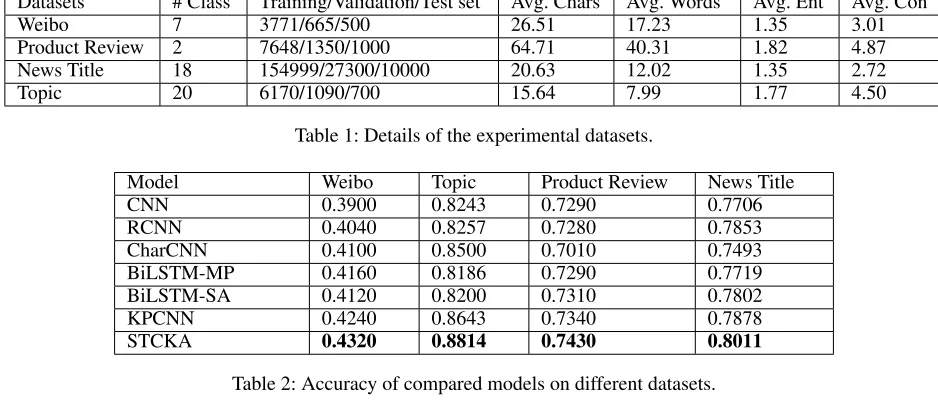
We conduct experiments on four datasets, as shown in Ta-ble 1. The first one is a Chinese Weibo emotion analysis2 dataset from NLPCC2013 (Zhou et al. 2017). There are 7 kinds of emotions in these weibos, such as anger, disgust, fear and etc. The second one isproduct review3dataset from NLPCC2014 (Zhou, Xu, and Gui 2017). The polarity of each review is binary, either positive or negative. The third one is theChinese news title4 dataset with 18 classes (e.g., entertainment, game, food) from NLPCC2017 (Qiu, Gong, and Huang 2017).
The average word length of the above-mentioned three datasets is over 12. To test whether our model works on much shorter texts, we build theTopicdataset whose average word length is 7.99. The Topic dataset is collected from So-gou news (Fu et al. 2015) where each news contains a title, document and topic (e.g., military, politics). We acquire the title as short text and topic as label. Besides, we also report the average number of entities and concepts for each dataset in Table 1. All four datasets are tokenized through the jieba tool5.
Compared Methods
We compare our proposed model STCKA with the following methods:
• CNN (Kim 2014): This model is a classic baseline for text classification. It uses CNN based on the pre-trained word embedding.
• RCNN (Lai et al. 2015): This method uses a recurrent convolutional neural network for text classification. It ap-plies RNN to capture contextual information and CNN to capture the key components in texts.
• CharCNN (Zhang, Zhao, and LeCun 2015). This method uses CNN with only character level features as the input.
• BiLSTM-MP (Lee and Dernoncourt 2016): This model is proposed for sequential short text classification. It uses a LSTM in each direction, and use max-pooling across all LSTM hidden states to get the sentence representation, then use a multi-layer perceptron to output the classifica-tion result.
2
http://tcci.ccf.org.cn/conference/2013/pages/page04 sam.html
3http://tcci.ccf.org.cn/conference/2014/pages/page04 sam.html
4
http://tcci.ccf.org.cn/conference/2017/taskdata.php
5
Datasets # Class Training/Validation/Test set Avg. Chars Avg. Words Avg. Ent Avg. Con
Weibo 7 3771/665/500 26.51 17.23 1.35 3.01
Product Review 2 7648/1350/1000 64.71 40.31 1.82 4.87 News Title 18 154999/27300/10000 20.63 12.02 1.35 2.72
Topic 20 6170/1090/700 15.64 7.99 1.77 4.50
Table 1: Details of the experimental datasets.
Model Weibo Topic Product Review News Title
CNN 0.3900 0.8243 0.7290 0.7706
RCNN 0.4040 0.8257 0.7280 0.7853
CharCNN 0.4100 0.8500 0.7010 0.7493 BiLSTM-MP 0.4160 0.8186 0.7290 0.7719 BiLSTM-SA 0.4120 0.8200 0.7310 0.7802
KPCNN 0.4240 0.8643 0.7340 0.7878
STCKA 0.4320 0.8814 0.7430 0.8011
Table 2: Accuracy of compared models on different datasets.
• BiLSTM-SA (Lin et al. 2017): This method uses BiLSTM and source2token self-attention to encode a sentence into a fixed size representation which is used for classification.
• KPCNN (Wang et al. 2017): This model is the state-of-the-art method for short text classification. It utilizes CNN to perform classification based on word and charac-ter level information of short text and concepts.
Settings and Metrics
Forall models, we use Adam (Kingma and Ba 2014) for learning, with a learning rate of 0.01. The batch size is set to 64. The training epochs are set to 20. We use 50-dimension skip-gram character and word embedding (Mikolov et al. 2013) pre-trained on Sogou News corpus6. If a word is un-known, we will randomly initialize its embedding. We also use 50-dimension concept embedding which is randomly initialized. All character embedding, word embedding and concept embedding are trainable and fine-tuned in the train-ing stage, since we hope to learn task-oriented representa-tion. We use 1D CNN with filters of width [2,3,4] of size 50 for a total of 150.
For our model, the following hyper-parameters are es-timated based on the validation set and used in the final test set: u = 64, da = 70, db = 35. And γ is
automat-ically learned by the neural network, because this method achieves better classification results than using a fixed hyper-parameter. The evaluation metric is accuracy, which is widely used in text classification tasks (Lee and Dernoncourt 2016; Wang et al. 2017).
Results
We compare our model STCKA with six strong baselines and the results are shown in Table 2. Our model outperforms traditional Deep Neural Networks (DNNs), including CNN, RCNN, CharCNN, BiLSTM-MP and BiLSTM-SA, without
6
http://www.sogou.com/labs/resource/list news.php
using any knowledge. The main reason is that our model en-riches the information of short texts with the help of KBs. Specifically, we incorporate prior knowledge in KBs into DNNs as explicit features which have a great contribution to short text classification. Compared with traditional DNNs, our model is more like a human being who has intrinsic abil-ity to make decisions based on observation (i.e., training data for machines) as well as existing knowledge. In addition, our model also performs better than KPCNN since our model is able to pay more attention to important knowledge due to the attention mechanism. We use C-ST and C-CS attention to measure the importance of knowledge from two aspects and adaptively assign a proper weight to each knowledge of different short texts.
Knowledge Attention
Model Weibo Topic Product Review News Title STCKA(λ= 0.00) 0.4280 0.8600 0.7390 0.7972 STCKA(λ= 0.25) 0.4320 0.8700 0.7430 0.8007 STCKA(λ= 0.50) 0.4260 0.8786 0.7380 0.8002 STCKA(λ= 0.75) 0.4220 0.8643 0.7380 0.7959 STCKA(λ= 1.00) 0.4160 0.8557 0.7360 0.7965
Table 3: The setting of hyper-parameterλon our model
interpretable. Given a short text and its corresponding con-cepts, our model tells us the contribution of each concept for classification by attention mechanism. Second, it is robust
to the noisy concepts. For example, as shown in Figure 2a, when conceptualizing the short text, we acquire some im-proper concepts such as industrial product which are not helpful for classification. Our model assigns a small attention weight to these concepts since they are irrelevant to the short text and have little similarity to the short text. Third, the effect of C-CS attention is similar to that of fea-ture selection. To some extent, C-CS attention is a “soft” fea-ture selection assigning a small weight (nearly to zero) to ir-relevant concepts. Therefore, the solution (attention weight) produced by C-CS attention is sparse, which is similar toL1 Norm Regularization(Park and Hastie 2007).
case2
short text 赵丽颖马思纯竟然都穿厚底鞋,舒适又不累脚!Zhao Liying and Ma Sichun actually wear pantshoes, comfortable and not tired!
concepts 人物
person 演员 actor
娱乐人物 entertainer
歌手 singer
工业产品 industrial product C-ST AW
C-CS AW final weight
(a) The lable of the short text isfashion.
case1
short text 12-13Which one should I choose if I have 120-130 thousand budget for cars,万的裸车预算,速腾、卡罗拉、科鲁兹、福克斯选谁好?
Sagitar, Corolla, Chevrolet Cruze or Ford Focus?
concepts 汽车零部件Auto parts brands品牌 location地点 城镇city Auto types汽车型号
C-ST AW C-CS AW final weight
(b) The lable of the short text iscar.
Figure 2: Knowledge attention visualization. Attention Weight (AW) is used as the color-coding.
Power of Knowledge
We use conceptual information as prior knowledge to en-rich the representation of short text and improve the perfor-mance of classification. The average number of entities and concepts of each dataset are shown in Table 1. To verify the power of knowledge in our model, we pick some testing ex-amples from Topic dataset and illustrate them in Figure 3. These short texts are correctly classified by our model but misclassified by traditional DNNs that do not use any knowl-edge. In general, the conceptual information plays a crucial role in short text classification, especially when the context of short texts is not enough. As the first example shown in Figure 3,Revolution of 1911is a rare word, i.e.,
oc-curs less frequently in the training set, and thus is difficult to learn a good representation, resulting in poor performance of traditional DNNs. However, our model solves therare and unknown word problem(Gulcehre et al. 2016) in some de-gree by introducing knowledge from KB. The concepts such ashistoryandhistorical eventused in our model are helpful for classifying the short text into the correct class
history.
Short text:
Did the Revolution of 1911 make a mistake of “radicalism” ? Concepts:
history historical event history book Short text:
Nanning Railway Branch creates a new safety record. Concepts:
transportation term organization city
Figure 3: Two examples for power of knowledge. Under-lined phrases are the entities, and the class labels of these two short texts arehistoryandtransportrespectively.
Embedding Tunning
We totally use three embeddings in our model. Concept em-beddings are randomly initialized and fine-tuned in the train-ing stage. As for character and word embeddtrain-ing, we try three embedding tuning strategies:
• STCKA-rand: The embedding is randomly initialized and then modified in the training stage.
• STCKA-static: Using pre-trained embedding which is kept static in the training.
• STCKA-non-static: Using pre-trained embedding ini-tially, and tuning it in the training stage.
above-Model Weibo Topic Product Review News Title STCKA-rand 0.3780 0.8414 0.7290 0.7930 STCKA-static 0.4240 0.8600 0.7350 0.7889 STCKA-non-static 0.4320 0.8814 0.7430 0.8011
Table 4: The impact of different embedding tunning methods on our model
mentioned reasons and enables STCKA-rand to learn task-oriented embeddings which are better for different classifi-cation tasks.
Error Analysis
We analyze the bad cases induced by our proposed model on News Title dataset. Most of the bad cases can be gen-eralized into two categories. First, long-tailed entities lack discriminative knowledge in KB due to the incompleteness of KB. For example, in short text “what does a radio mean to sentry in the cold night alone”, the entitysentryis a long-tailed entity without useful concepts in KB. Thus, the short text cannot be classified into the correct classmilitary. Second, some short texts are too short and lack contextual information. Even worse, there are no entities mentioned in these short texts which leads to the failure of conceptualiza-tion. Therefore, it is difficult to classify the short text “don’t pay money, it’s all routines” into the classfashion.
Related Works
Short Text Classification Existing methods for text clas-sification can be divided into two categories: explicit rep-resentation and implicit reprep-resentation. The explicit model depends on human-designed features and represents a short text as a sparse vector. (Cavnar, Trenkle, and others 1994) made full use of simple n-gram features for text classifica-tion. (Pang, Lee, and Vaithyanathan 2002; Post and Bergsma 2013) exploited more complex features such as POS tag-ging and dependency parsing to improve the performance of classification. Some researches introduced knowledge from KBs to enrich the information of short texts. (Gabrilovich and Markovitch 2007) utilized the Wikipedia information to enrich the text representation. (Wang et al. 2014) conceptu-alized a short text to a set of relevant concepts which are used for classification by leveraging Probase. The explicit model is interpretable and easily understood by human beings, but neglects the context of short texts and cannot capture deep semantic information.
Recently, implicit models are widely used in text classi-fication due to the development of deep learning. The im-plicit model maps a short text to an imim-plicit space and rep-resents it as a dense vector. (Kim 2014) used CNN with pre-trained word vectors for sentence classification. (Lai et al. 2015) presented a model based on RNN and CNN for short text classification. (Zhang, Zhao, and LeCun 2015) of-fered an empirical exploration on the use of character-level CNN for text classification. (Lee and Dernoncourt 2016) proposed a RNN model for sequential short text classifica-tion. It used BiLSTM and max-pooling across all LSTM hid-den states to produce the representation of short text. (Lin et
al. 2017) classified the texts by relying on BiLSTM and self-attention. The implicit model is good at capturing syntax and semantic information in short text, but ignores the impor-tant prior knowledge that can be acquired from KBs. (Wang et al. 2017) introduced knowledge from Probase into deep neural networks to enrich the representation of short text. However, Wang et al.’s work has two limitations: 1) fail-ing to consider the semantic similarity between short texts and knowledge; 2) ignoring the relative importance of each knowledge.
Attention Mechanism has been successfully used in many NLP tasks. According to the attention target, it can be divided into vanilla attention and self-attention. (Bahdanau, Cho, and Bengio 2015) first used vanilla attention to com-pute the attention score between a query and each input to-ken in machine translation task. (Hao et al. 2017) employed vanilla attention to measure the similarity between ques-tion and answer in quesques-tion answering task. Self-attenques-tion can be divided into two categories including token2token self-attention and source2token self-attention. (Vaswani et al. 2017) applied token2token self-attention to neural ma-chine translation and achieved the state-of-the-art perfor-mance. (Lin et al. 2017) used source2token self-attention to explore the importance of each token to the entire sentences in sentence representation task. Inspired by these work, we employ two attention mechanisms from two aspects to mea-sure the importance of knowledge.
Conclusion and Future work
In this paper, we propose deep Short Text Classification with Knowledge Powered Attention. We integrate the conceptual information in KBs to enhance the representation of short text. To measure the importance of each concept, we ap-ply two attention mechanisms to automatically acquire the weight of concepts that is used for generating the concept representation. We classify a short text based on the text and its relevant concepts. Finally, we demonstrate the effec-tiveness of our model on four datasets for different tasks, and the results show that it outperforms the state-of-the-art methods.
References
Bahdanau, D.; Cho, K.; and Bengio, Y. 2015. Neural ma-chine translation by jointly learning to align and translate.
Computer Science.
Bollacker, K.; Evans, C.; Paritosh, P.; Sturge, T.; and Taylor, J. 2008. Freebase: a collaboratively created graph database for structuring human knowledge. In Proceedings of the 2008 ACM SIGMOD international conference on Manage-ment of data, 1247–1250. AcM.
Cavnar, W. B.; Trenkle, J. M.; et al. 1994. N-gram-based text categorization.Ann arbor mi48113(2):161–175. Chen, L.; Liang, J.; Xie, C.; and Xiao, Y. 2018. Short text entity linking with fine-grained topics. InProceedings of the 27th ACM International Conference on Information and Knowledge Management, 457–466. ACM.
Fu, J.; Qiu, J.; Wang, J.; and Li, L. 2015. Name disambigua-tion using semi-supervised topic model. In International Conference on Intelligent Computing, 471–480. Springer. Gabrilovich, E., and Markovitch, S. 2007. Computing se-mantic relatedness using wikipedia-based explicit sese-mantic analysis.
Gulcehre, C.; Ahn, S.; Nallapati, R.; Zhou, B.; and Ben-gio, Y. 2016. Pointing the unknown words. arXiv preprint arXiv:1603.08148.
Hao, Y.; Zhang, Y.; Liu, K.; He, S.; Liu, Z.; Wu, H.; Zhao, J.; Hao, Y.; Zhang, Y.; and Liu, K. 2017. An end-to-end model for question answering over knowledge base with cross-attention combining global knowledge. InMeeting of the Association for Computational Linguistics, 221–231. Hu, J.; Wang, G.; Lochovsky, F.; Sun, J.-t.; and Chen, Z. 2009. Understanding user’s query intent with wikipedia. In
Proceedings of the 18th international conference on World wide web, 471–480. ACM.
Kim, Y. 2014. Convolutional neural networks for sentence classification.Eprint Arxiv.
Kingma, D. P., and Ba, J. 2014. Adam: A method for stochastic optimization.arXiv preprint arXiv:1412.6980. Lai, S.; Xu, L.; Liu, K.; and Zhao, J. 2015. Recurrent con-volutional neural networks for text classification. InAAAI, volume 333, 2267–2273.
Lee, J. Y., and Dernoncourt, F. 2016. Sequential short-text classification with recurrent and convolutional neural net-works. 515–520.
Lin, Z.; Feng, M.; Santos, C. N. D.; Yu, M.; Xiang, B.; Zhou, B.; and Bengio, Y. 2017. A structured self-attentive sentence embedding.
Luong, M.-T.; Pham, H.; and Manning, C. D. 2015. Effec-tive approaches to attention-based neural machine transla-tion.arXiv preprint arXiv:1508.04025.
Mikolov, T.; Chen, K.; Corrado, G.; and Dean, J. 2013. Ef-ficient estimation of word representations in vector space.
Computer Science.
Moro, A.; Raganato, A.; and Navigli, R. 2014. Entity link-ing meets word sense disambiguation: a unified approach.
Transactions of the Association for Computational Linguis-tics2:231–244.
Pang, B.; Lee, L.; and Vaithyanathan, S. 2002. Thumbs up?: sentiment classification using machine learning techniques.
Proceedings of Emnlp79–86.
Park, M. Y., and Hastie, T. 2007. L1-regularization path algorithm for generalized linear models. Journal of the Royal Statistical Society: Series B (Statistical Methodology)
69(4):659–677.
Post, M., and Bergsma, S. 2013. Explicit and implicit syn-tactic features for text classification. 866–872.
Qiu, X.; Gong, J.; and Huang, X. 2017. Overview of the nlpcc 2017 shared task: Chinese news headline categoriza-tion. In National CCF Conference on Natural Language Processing and Chinese Computing, 948–953. Springer. Shuyan, T. 2018. Cn-probase concept api. Accessed May 22, 2018. http://shuyantech.com/api/cnprobase/concept. Suchanek, F. M.; Kasneci, G.; and Weikum, G. 2008. Yago a large ontology from wikipedia and wordnet. Web Seman-tics Science Services and Agents on the World Wide Web
6(3):203–217.
Vaswani, A.; Shazeer, N.; Parmar, N.; Uszkoreit, J.; Jones, L.; Gomez, A. N.; Kaiser, L.; and Polosukhin, I. 2017. At-tention is all you need.
Wang, Z., and Wang, H. 2016. Understanding short texts. In
the Association for Computational Linguistics (ACL) (Tuto-rial).
Wang, F.; Wang, Z.; Li, Z.; and Wen, J. R. 2014. Concept-based short text classification and ranking. In ACM In-ternational Conference on Conference on Information and Knowledge Management, 1069–1078.
Wang, J.; Wang, Z.; Zhang, D.; and Yan, J. 2017. Combin-ing knowledge with deep convolutional neural networks for short text classification. InTwenty-Sixth International Joint Conference on Artificial Intelligence, 2915–2921.
Wu; Wentao; Li; Hongsong; Wang; Haixun; Zhu; and Kenny, Q. 2012. Probase: a probabilistic taxonomy for text understanding. 481–492.
Zeng, W.; Luo, W.; Fidler, S.; and Urtasun, R. 2016. Effi-cient summarization with read-again and copy mechanism. Zhang, X.; Zhao, J.; and LeCun, Y. 2015. Character-level convolutional networks for text classification. InAdvances in neural information processing systems, 649–657. Zhou, H.; Huang, M.; Zhang, T.; Zhu, X.; and Liu, B. 2017. Emotional chatting machine: Emotional conversation gener-ation with internal and external memory.