CREDIT SCORING PROCESS
AVOIDING THE EXCESSIVE RISK
Alban Burazeri1, Orfea Dhuci1, Andromahi Kufo1*
1Alpha Bank - Albania, Albania
Abstract
There are many ways that credit risk can be managed. The first line of defense is the use of credit scoring or credit analysis to avoid extending credit to parties that entail excessive credit risk. Credit scoring technologies have sharply reduced the cost of credit evaluation and improved the consistency, speed, and accuracy of credit decisions. Creditors must decide whether to use a customized or generic scoring system or a combination of both. This paper provides a framework for the evaluation of alternatives by comparing generic with customized credit scoring models. Customized credit models are developed for the use of a single creditor. Generic scoring models are sold in the marketplace for use by multiple creditors. Creditors must decide whether to use customized scoring, generic scoring, or a combination of both. The creditor will also have to choose among competing scoring models being those generic or customized. Proper evaluation should consider among other factors, the credit product and type of decisions, the creditor’s capabilities, the environment, the target market, and the characteristics and costs of the models available. The primary purpose of this paper is to provide a framework for these evaluations. We’ll try to compare generic with customized credit scoring models in terms of feasibility, development, implementation, economic, and management issues. Each approach has advantages and disadvantages and, furthermore, the scoring model should be integrated with an overall evaluation system.
Keywords
Application processing system; Credit score; Customized credit scoring system; Judgmental credit evaluation; Scorecard.
INTRODUCTION
In assessing credit risk from a single counterparty, an institution must consider three issues:
o Default probability: What is the likelihood that the counterparty will default on its obligation either over the life of the obligation or over some specified horizon, such as a year?
o Credit exposure: In the event of a default, how large will the outstanding obligation be when the default occurs?
o Recovery rate: In the event of a default, what fraction of the exposure may be recovered through bankruptcy proceedings or some other form of settlement?
Under the revised framework on International Convergence of Capital measurement and Capital Standards of the Basel Committee on Banking Supervision, known also as Basel II agreement, the above are named as risk components (Basel Committee on Banking Supervision, 2004). The risk components include measures of probability of default (PD), loss given default (LGD), the exposure at default (EAD), and effective maturity (M). When we speak of credit quality of an obligation, this refers generally to the counterparty's ability to perform on that obligation. This encompasses both the obligation's default probability and anticipated recovery rate. To place credit exposure and credit quality in perspective, recall that every risk comprise two elements: exposure and uncertainty. For credit risk, credit exposure represents theormer, and credit quality represents the latter.
For loans to individuals or small businesses, credit quality is typically assessed through a process of credit scoring (Mays, 2004). Prior to extending credit, a bank or other lender will obtain information about the party requesting a loan. In the case of a bank issuing credit cards, this might include the party's annual income, existing debts, whether they rent or own a home, etc. A standard formula is applied to the information to produce a number, which is called a credit score. A credit score is a numerical expression based on a statistical analysis of a person's credit files, to represent the creditworthiness of that person, which is the perceived likelihood that the person will pay debts in a timely manner. Based upon the credit score, the lending institution will decide whether or not to extend credit. The process is formulaic and highly standardized.
may also assess the exact nature of an obligation. For example, senior debt generally has higher credit quality than does subordinated debt of the same issuer. Based upon this analysis, the credit analysts assign the counterparty (or the specific obligation) a credit rating, which can be used for making credit decisions.
Many banks, investment managers and insurance companies hire their own credit analysts who prepare credit ratings for internal use. Other firms (including Standard & Poor's, Moody's and Fitch) are in the business of developing credit ratings for use by investors or other third parties. Institutions that have publicly traded debt hire one or more of them to prepare credit ratings for their debt. Those credit ratings are then distributed for little or no charge to investors. Some regulators also develop credit ratings.
Credit risk modeling is a concept that broadly encompasses any algorithm-based methods of assessing credit risk. The term encompasses credit scoring, but it is more frequently used to describe the use of asset value models and intensity models in several contexts. There are many ways that credit risk can be managed or mitigated. The first line of defense is the use of credit scoring or credit analysis to avoid extending credit to parties that entail excessive credit risk. Credit risk limits are widely used. These generally specify the maximum exposure a firm is willing to take to a counterparty. Industry limits or country limits may also be established to limit the sum credit exposure a firm is willing to take to counterparties in a particular industry or country. Calculation of exposure under such limits requires some form of credit risk modeling. Transactions may be structured to include collateralization or various credit enhancements. Credit risks can be hedged with credit derivatives. Finally, firms can hold, and they are required from the regulators to do so, capital against outstanding credit exposures.
GENERIC vs. CUSTOMIZED CREDIT SCORING MODELS
To go back to credit scoring one may note some benefits of such a process. First of all, credit scoring promotes great efficiencies and time-savings in the loan approval process. Secondly, credit scoring reduces subjectivity in the loan approval process ensuring that the same standards are applied to all applicants. It is widely accepted nowadays that credit scoring technologies have sharply reduced the cost of credit evaluation and improved the consistency, speed, and accuracy of credit decisions.
There are two models of credit scoring: generic and customized. Customized credit models are developed for the use of a single creditor. Generic scoring models are sold in the marketplace for use by multiple creditors. Typically, a customized model is based on data from a creditor’s past lending experience while a generic model is based on data from the past lending experience of a number of creditors. Creditors must decide whether to use customized scoring, generic scoring, or a combination of both. The creditor will also have to choose among competing scoring models being those generic or customized. Proper evaluation should consider among other factors, the credit product and type of decisions, the creditor’s capabilities, the environment, the target market, and the characteristics and costs of the models available. The primary purpose of this paper is to provide a framework for these evaluations.
We will try to compare generic with customized credit scoring models in terms of feasibility, development, implementation, economic, and management issues. Each approach has advantages and disadvantages and, furthermore, the scoring model should be integrated with an overall evaluation system. Conceptually, a customized credit scoring system should be more accurate than a generic one. The customized system is tailor-made from the creditor’s own past experience to fit the creditor’s lending environment and objectives. However, there are situations in which the development and implementation of a customized scoring system are either nit feasible or not the most appropriate alternative.
Three important issues in the decision are: (i) feasibility; (ii) development; and (iii) implementation. We will focus the discussion primarily on new applicant scoring models, but similar points could be made for other types of models.
i. Feasibility. Few credit situations are absolutely perfect for modeling. Therefore, tradeoffs between what would be ideal and what can be done must be considered in deciding between customized and generic systems.
a. Historical lending experience. No historical data equals no customized scoring system. Usually the question is, what data are available and how close are they to what is really needed? Ideally, the scoring model should be used for the same product, market area, and economic environment that generated the historical experience. Experience in auto car loans, for instance, may not be relevant to a scoring system for credit cards.
c. Know outcomes of past decisions. The outcomes of past decisions must be available in a quantifiable form. Account payment histories can be used to classify outcomes as good or bad loans.
d. Age of decision. The decisions must have aged enough to allow appropriate measurement and classification of the outcomes. For example, bankcard accounts approved three months previously are not old enough to be accurately classified as good or bad risk outcomes, whereas accounts approved two years ago probably are. At the other extreme, bankcard accounts approved 10 years ago are too old, since the relationship between their historical credit applications and credit bureau reports and their outcomes would not likely reflect current relationships. Model developers will specify a sample time frame in which decisions must have occurred if they are to be included in the development.
e. Sample size. The number of credit decisions made must have been large enough to allow an appropriate sample size. Credit scoring developers often ask for a sample of at least 4,500 applicants, whereas: 1,500 goods; 1,500 bads; and 1,500 rejected, in order to develop a customized new applicant scoring model.
f. Economic factors. The costs and benefits of a customized model must be compared to those of a generic scoring model. Costs are included in developing, implementing, and managing the system. Both systems, generic and customized could be purchased as a package or on a transaction basis.
ii. Model development issues. During the development of any credit scoring model, decisions are made that will affect its performance and implementation.
a. Objective of the model. In development of a customized scoring model, a creditor selects the objective of the model and the target population. Objectives may be general, like reduction in credit losses from new accounts, or specific, reduction in bankruptcy filings by new accounts within a six-month window after approval. The objective will influence decisions ranging from outcome definitions to implementation.
loans (decisions will be made judgmentally), data on student loans can be eliminated from the development sample.
c. Data/sample development. The development of any scoring system requires that the data be in computer-readable form.
d. Dependent variable definitions. The dependent variable is the outcome. The most traditional dependent variable for a new applicant model is whether payment performance is good or bad. One creditor might require that an account be 60 days or more past due before it is considered a bad account whilst another might specify 90 days or more. Customized scoring can accommodate either.
e. Independent variable definitions. Independent variables are the characteristics that determine the value of the credit score. In a customized model for new applicant scoring, the independent variables are typically taken from the application form and the credit bureau report.
f. Model development procedures. A creditor can select different scoring development techniques by choosing a development firm that uses those techniques or allows creditors to select from alternative techniques in creating a customized model.
g. Rejected applicants. There is payment history only for applicants who have been extended credit and have used it. Lack of information about the performance of the rejected population creates a statistical and practical problem. Model developers attempt to compensate for this with reject inference procedures.
h. Development time. It can take from three to twelve months to develop a customized scoring model. Implementation adds more time, ranging from a month to years. Generic scoring systems already on the market are available for use on relatively short notice. Sometimes a creditor’s need is so immediate that the general models are the only feasible alternative.
iii. Implementation issues. Implementation can be as important as the predictive accuracy of the system. Implementation issues include information interpretation and entry, computer automation, forecasts of performance, validation and monitoring, adverse action reasons, shred experience and advice, security, and management.
applicants, the amount of information entered, and the amount of information required. Accurate and consistent interpretation of some information can be quite difficult, as with classification of employment information into occupational categories.
b. Computer automation. Nearly all credit scoring systems use computers for implementation. Although customized implementations will differ, in general information is entered, edit checks are performed, exclusions and policy rules are implemented, scores are calculated, additional information is requested as needed, actions are recommended, and adverse action reasons determined. Software to implement the customized model can be developed internally or purchased.
c. Forecasts of performance. It is relatively simple to develop performance forecasts for customized scoring models. Typically, the developer calculates the scores for a sample of known outcome applicants from the creditor’s files, which may be the development sample, a holdout or validation sample, a sample from a specified time frame or geographical region, or a sample for a product entirely different from that used in model development.
d. Validation/monitoring. The predictive power of the model will change as the relationship between variables and outcome change. It is important to monitor changes and react. In addition, proper monitoring of a scoring system provides a wealth of information about customers, marketing efforts, and the overall credit evaluation system. In order to validate or monitor the performance of any scoring model, the actual score at the time of the credit decision must be retained.
e. Adverse action reasons. Creditors must inform declined applicants either of the specific reasons why they received adverse action or of their right to receive specific reasons which must comply with the regulatory intent that they be accurate, educational, and informative.
f. Share experience and advice. Since every customized scoring model is unique, creditors cannot discuss their experience with others while, on the other hand, creditors using exactly the same generic bureau scoring models can and sometimes do share experiences in order to learn from each other.
scoring system, software and implementation procedures must guard against manipulation.
h. Management. The management of any credit scoring system is the critical element for successful implementation. Management must address each of the issues presented in this section during implementation and provide ongoing active management of the scoring system and the overall evaluation system.
The final factor in choosing between a customized and a generic scoring system (or a combination of both) is the type of credit decisions being made and the generic models available, along with their strength and weaknesses and their inherent advantages and disadvantages.
i. Type of decisions and models available. There are many types of credit decisions, among them targeting a preapproved offer, approving “take one” applicants or young college student applicants, increasing or decreasing credit limits, amount of loan, and collection prioritization. The type of credit decision being made has a direct impact on the choice between a generic and a customized model. With regard to the availability nowadays this is not an issue any more. You can find a wide variety of generic models and at the same time you can create a customized one in a relatively short time selecting among a lot of industry professionals.
ii. Portfolio valuation and rating agencies. Generic credit score models play a central role in the valuation of credit portfolios. They create a standard measurement for portfolio risk by which different portfolios can be compared that is usually simple, fast, accurate, and relatively inexpensive.
iii. Creditor strengths and weaknesses. Creditors should consider their own strengths and weaknesses when choosing between generic and customized models. In general, creditors with extensive experience in the use and management of scoring systems will select customized scoring models when feasible, to use either alone or in conjunction with generic models. Such creditors can derive maximum benefit from customized systems due to their input into development, their knowledge of how to integrate policy rules with the scoring models, their experience in implementing scoring systems, and their expertise in monitoring and management. Creditors with limited staff will often opt for generic scoring, as will those who are new to scoring, in order to gain experience before attempting to develop customized models.
iv. Inherent advantages and disadvantages
a. Advantages of generic systems:
Not limited by the creditor’s historical experience with population groups, credit products, and geographic areas;
Available immediately, without development time or cost;
Less reliant on the user’s knowledge of and experience in using scoring;
Easy to implement – often the scores are generated by others;
Less expensive for small numbers of decisions;
Detailed in their treatment of credit bureau information;
Very economical in their use of credit bureau information;
Better able to predict certain outcomes, such as bankruptcies;
Supported by a network of advice; and
Secure, because they are usually protected from credit bureaus or other industry professionals.
b. Disadvantages of generic systems:
Potentially less accurate because they are not based on the creditor’s own experience, products, and customers;
Available to competitors;
More expensive to high-volume users paying on a transaction basis;
Proprietary - details of the scoring system are often confidential;
Harder to use in forecasting system and monitoring performance; and
Rigid in their definition of adverse action codes and selection procedures.
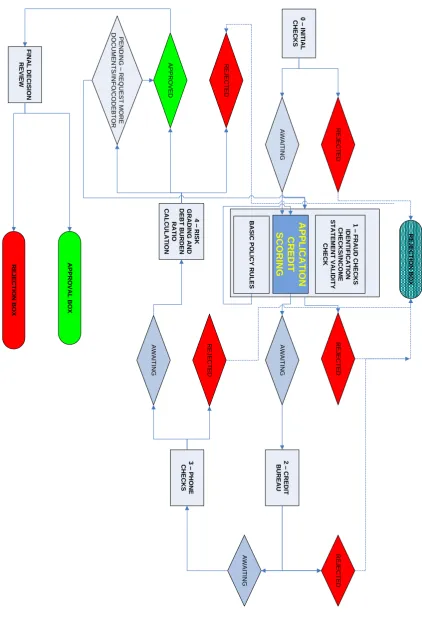
B A S IC P O L IC Y R U L E S 0 – IN IT IA L C H E C K S R E J E C T E D A W A IT IN G R E J E C T IO N B O X 1 – F R A U D C H E C K S ID E N T IF IC A T IO N C H E C K S /IN C O M E S T A T E M E N T V A L ID IT Y C H E C K R E J E C T E D A W A IT IN G A W A IT IN G 2 – C R E D IT B U R E A U R E J E C T E D 3 – P H O N E C H E C K S R E J E C T E D A W A IT IN G 4 – R IS K G R A D IN G A N D D E B T B U R D E N R A T IO C A L C U L A T IO N R E J E C T E D A P P R O V E D P E N D IN G – R E Q U E S T M O R E D O C U M E N T S /IN F O /C O D E B T O R F IN A L D E C IS IO N R E V IE W A P P R O V A L B O X R E J E C T IO N B O X A P P L IC A T IO N C R E D IT S C O R IN G B A S IC P O L IC Y R U L E S
CONCLUSIONS
Creditors must decide whether to use a customized or generic scoring system or a combination of both. This paper provides a framework for the evaluation of alternative by comparing generic with customized credit scoring models. One may argue that the main conclusions of this research are:
First, there are two basic processes for credit evaluation: judgmental and credit scoring. The judgmental evaluation is the most subjective one, cannot capture without bias the credit risk, and therefore is not capable to avoid the excessive risk. Credit scoring technologies have sharply reduced the cost of credit evaluation and improved the consistency, speed, and accuracy of credit decisions. In our region, a lot of banks and other lenders have moved towards credit scoring technologies but still there are players in the market that should move urgently in the same direction. These becomes more important considering the recent movements of several big financial groups present in the region from wholesale versus retail banking activities.
Second, generic scoring systems have taken a major role in credit evaluation. They can level the playing field between smaller and larger creditors. Generic credit bureau credit scoring systems (if available, which is not always the case in small countries coming out from controlled economical environments) allow the use of credit bureau information for managing existing accounts economically and efficiently. They provide a potential standard measurement that can be used to evaluate and price portfolios. The overall credit environment will often determine whether to use customized or generic scoring systems or both. Many creditors will use both customized and generic systems - weighted and integrated properly in the credit environment - in order to minimize credit risk. Any component of an evaluation system, including scoring systems, policy and exception rules, and even judgmental analysis, must be designed and implemented to fit within the overall evaluation system. Coordination of the components is critical. It is also critical that the overall evaluation system and its components be closely monitored in order to properly manage the system. The solution should be based in best practices and should account for future scalability, flexibility, and migration.
should pay attention, among others, to the integration of generic scoring with other systems in a first place and to the continuous fine-tuning of the overall system in a second place. Considering that you have (or you intend to):
(i) an application processing system supposed to manage the application workflow from the applicant’s entry in the point of sale until approval or rejection;
(ii) a generic scorecard with a certain number of characteristics, interpretation rules for missing data, and a numerical output;
(iii) some basic policy rules and credit bureau report interpretation guidelines; and
(iv) clear definition of willingness to pay and ability to pay including here well-known ratio like debt burden etc.
In this line, we recommend the following:
(a) Encompass and encrypt the scorecard (Rockford, 1997) in a object - a DLL
(Microsoft Developers Network, http://msdn.microsoft.com ) could work just fine - by creating so a black box that receives as input the scorecard characteristics as gives as an output a score;
(b) Encompass and encrypt everything else in separate objects (small black boxes) and pack them in a library including here basic policy rules (for instance, no applicants less than 18 years old etc.), credit bureau interpretation guidelines (for instance, more than 90 days past due etc.), ability to pay and credit limit definition rules (for instance, debt burden ration less than 45% etc.) and all the rest of the components involved in the credit assessment process; and
(c) Deliver the objects to the application processing system by integrating everything within a normalized relational database management system (Date, 2004) and, at the same time, securing and protecting your business logic (ANSI/ISO/IEC 9075:1999, SQL, http://webstore.ansi.org).
Of course, such an approach is difficult due to the lack of integrated regional databases and we would kindly recommend to regional governments to facilitate such a process by removing or lessening to the most possible extent the legal boundaries for the cross-country information exchange.
REFERENCES
ANSI/ISO/IEC 9075:1999, SQL - http://webstore.ansi.org
Basel Committee on Banking Supervision, International Convergence of Capital Measurement and Capital Standards - A revised framework, The Bank for International Settlements, 2004.
Jorion, P. (2005). Financial risk manager handbook, 3rd ed., Wiley.
Mays, E. (2004). Credit scoring for risk managers - The handbook for lenders, Thomson South Western.
Microsoft Developers Network - http://msdn.microsoft.com