Volume 2, Issue 6, June 2013
Page 314
ABSTRACT
The Ad hoc On-Demand Distance Vector (AODV) routing protocol is intended for use by mobile nodes in an ad hoc network. It offers quick adaptation to dynamic link conditions and low processing. The end-to-end delay is more, there increase the chances for loss of information while transaction between the source node and destination node. So the efforts are required to be taken regarding the reduction of packet loss and end-to-end delay in implementation of AODV routing protocol. The related work in the field of AODV routing protocol really creates the motivating impact on the mind for further research. The implementation of the AODV routing protocol with all features such as less end-to-end delay, maintenance of network Load (PDF) and Packet loss is really a challenging one. The proposed work mainly concentrates on implementation of all above parameters. This implementation will really prove advantageous for the networking technology.
Keywords: AODV Routing Protocol, ns-2.35, End2End delay, PDF, Packet loss, Trace graph.
1.
INTRODUCTION
Mobile Ad Hoc Networks (MANETs) are an emerging technology that allows establishing instant communication infrastructures for civilian and military applications [1]. MANET is a network architecture that can be rapidly deployed without relying on pre-existing fixed network infrastructure. The nodes in a MANET can dynamically join and leave the network, frequently, often without warning, and possibly without disruption to other nodes’ communication. The nodes in the network can be highly mobile, thus the network topology is rapidly changing. MANETs are distinguished from other ad-hoc networks by rapidly changing network topologies, influenced by the network size and node mobility. Such networks typically have a large span and contain hundreds to thousands of nodes.
2.
ROUTING
PROTOCOL
Mobile Ad-hoc networks are self-organizing and self-configuring multi-hop wireless networks, where the structure of the network changes dynamically [2]. This is mainly due to the mobility of the nodes. Nodes in these networks utilize the same random access wireless channel, cooperating in an intimate manner to engaging themselves in multi-hop forwarding. The node in the network not only acts as hosts but also as routers that route data to/from other nodes in network.
The early protocols that were proposed for routing in ad hoc networks were proactive Distance Vector protocols based on the Distributed Bellman-Ford (DBF) algorithm [3]. To address the problems of the DBF algorithm - convergence and excessive control traffic, which are especially an issue in resource-poor ad hoc networks - modifications were considered. Another approach taken to address the convergence problem is the application of the Link State protocols to the ad hoc environment. An example of the latter is the Optimized Link State Routing protocol (OLSR) [4]. On the other "end of the spectrum" are the reactive routing protocols, which are based on some type of "query-reply" dialog. Reactive protocols do not attempt to continuously maintain the up-to-date topology of the network. Rather, when the need arises, a reactive protocol invokes a procedure to find a route to the destination; such a procedure involves some sort of flooding the network with the route query. As such, such protocols are often also referred to as on demand. Examples of reactive protocols include the Temporally Ordered Routing Algorithm (TORA) [4], the Dynamic Source Routing (DSR), and Ad hoc On Demand Distance Vector (AODV) Routing Algorithms, both of the routing "extremes," the proactive and the reactive schemes, may not perform best in a highly dynamic networking environment, such as in ad hoc networks. The Zone Routing Protocol (ZRP) is an example of the hybrid approach. In ZRP, each node proactively maintains the topology of its close neighborhood only, thus reducing the amount of control traffic relative to
The Efficient AODV routing protocol in
MANET
Rama Soni1, Amit Saxena2 and Ajit Shrivasta3
1
M.Tech Student,
Truba Institute of Eng. and Info. Technology, Bhopal (MP)
2
H.O.D. of C.S.E. Department
Truba Institute of Eng. and Info. Technology, Bhopal (MP)
3
Professor of C.S.E. Department
Volume 2, Issue 6, June 2013
Page 315
the proactive approach. To discover routes outside its neighborhood, the node reactively invokes a generalized form of controlled flooding, which reduces the route discovery delay, as compared with purely reactive schemes. The size of the neighborhood is a single parameter that allows optimizing the behavior of the protocol based on the degree of nodal mobility and the degree of network activity.Fig.2.1 [4]
3.
AD-HOC
ON
DEMAND
ROUTING
PROTOCOL
(AODV)
The Ad hoc On Demand Distance Vector (AODV) routing algorithm is a popular reactive routing protocol [5]. AODV is capable of both unicast and multicast routing [6]. It is an on demand algorithm, for finding routes, meaning that it builds routes between nodes only as desired by source nodes for transmitted data packets. Routes are maintained till the communication is completed by the node. Sequence numbers are used in AODV routing protocol to maintain the freshness of routes. Advantages of AODV include loop free operation and scalability to a large number of terminals. AODV has two phases Route discovery and Maintenance
A.ROUTEDISCOVERY
When a source node intends to send packets, it checks its routing table to see whether it has a valid route to that destination. If so, it could begin to send packet to the next hop towards the destination. Or else, it does not have the information about a route to the destination, a Route Request (RREQ) packet is sent as a broadcast message. The Route Request (RREQ) message includes Source Identifier, the Destination Identifier, and the Source Sequence Number, the Destination Sequence Number, the Broadcast Identifier and the value of Time to Live (TTL). RREQ is broadcasted to all neighbors of the node. Neighbors are those who have sent Hello message during the last Hello interval. If an intermediate or neighbors node receives a Route Request (RREQ) packet, it checks if it is the destination node. If not, it checks if it has seen this Route Request (RREQ) before by checking the request ID and source node If an intermediate or neighbours node receives a Route Request (RREQ) packet, it checks wethers it is the destination node. If not, it checks if has seen this Route request (RREQ) before by checking the requesting ID and source node ID. The intermediate node in turn forward the request to their neighbours until the RREQ message reaches the destination or an intermediate node that has an up-to-date route to the destination. If this is the case the node just drops the packet and does not forward the Route Request (RREQ) any further. In AODV, each node maintains its own sequence number, as well as a broadcast ID. Each RREQ message contains the sequence numbers of the source and destination nodes and is uniquely identified by the source node’s address and a broadcast ID. Destination sequence number is used to ensure loop free routing and use of up-to-date route information. Intermediate nodes can reply to the RREQ message only if they have a route to the destination whose destination sequence number is greater or equal to that contained in the RREQ message. During the process of forwarding the RREQ messages, an intermediate node automatically records the address of the neighbor from which it received the first copy of the RREQ message, thereby establishing a reverse path. If a Route Request is received multiple times, which is indicated by the Bcast ID-SrcID pair, the duplicate copies of the same RREQ message are discarded. All intermediate nodes having valid routes to the destination, or the destination node itself, are allowed to send Rout Reply packets to the source. Every intermediate node, while forwarding a Route Request, enters the previous node address and it’s Bcast ID. A timer is used to delete this entry in case a route reply is not received before the time expires. Once the RREQ message reaches the destination or an intermediate node with a fresh route, the destination or the intermediate node responds by sending a route reply (RREP) packet back to the neighbor from which it first received the RREQ message. As the RREP message is routed back along the reverse path, nodes along this path set up forward path entries in their routing cache [2].
B.ROUTEMAINTENANCE
Volume 2, Issue 6, June 2013
Page 316
it can either stop sending the data or reinitiate the route discovery mechanism by sending a new RREQ message if the route is still required.Fig 3.1 [5]
4.
MODIFIED
AD
HOC
ON
DEMAND
DISTANCE
VECTOR
(MAODV)
The Modified Ad hoc On Demand Distance Vector (MAODV) routing algorithm is a routing protocol designed for ad hoc mobile networks.
1.MAODV builds routes using a route request / route reply query cycle. When a source node desires a route to a destination for which it does not already have a route, it broadcasts a route request (RREQ) packet across the network. 2.Nodes receiving this packet update their information for the source node and set up backwards pointers to the source node in the route tables.
3.In addition to the source node's IP address, current sequence number, and broadcast ID, the RREQ also contains the most recent sequence number for the destination of which the source node is aware.
4.IF rt_req_cnt is the no. of times we did network-wide broadcast and RREQ_RETRIES is the maximum number we will allow before. Going to a long timeout.
5.A node receiving the RREQ may send a route reply (RREP) if it is either the destination or if it has a route to the destination with corresponding sequence number greater than or equal to that contained in the RREQ.
Timeout = current time + half the max rreq timeout
6.If this is the case, it unicasts a RREP back to the source. Otherwise, it rebroadcasts the RREQ.
7. Nodes keep track of the RREQ's source IP address and broadcast ID. If they receive a RREQ which they have already processed, they discard the RREQ and do not forward it.
8.As the RREP propagates back to the source, nodes set up forward pointers to the destination. 9.Once the source node receives the RREP, it may begin to forward data packets to the destination.
10. If the source later receives a RREP containing a greater sequence number or contains the same sequence number with a smaller hop count, it may update its routing information for that destination and begin using the better route. 11. As long as the route remains active, it will continue to be maintained. A route is considered active as long as there are data packets periodically travelling from the source to the destination along that path.
12. Once the source stops sending data packets, the links will time out and eventually be deleted from the intermediate node routing tables.
13. If a link break occurs while the route is active, the node upstream of the break propagates a route error (RERR) message to the source node to inform it of the now unreachable destination(s). After receiving the RERR, if the source node still desires the route, it can reinitiate route discovery.
The modified Ad hoc On-Demand Distance Vector (MAODV) routing protocol is intended for use by mobile nodes in an ad hoc network. It offers low end-to-end delay, maximum PDF, minimum packet loss is, there decrease the chances for loss of information while transaction between the source node and destination node. The implementation of the AODV routing protocol with all features such as less end-to-end delay, maximum PDF and minimum Packet loss is really a challenging one. The proposed work mainly concentrates on implementation of all above parameters. This implementation will really prove advantageous for the networking technology.
5.
NS-2.35
SIMULATION
NS is a discrete event simulator targeted at networking research. Ns provides substantial support for simulation of TCP, routing, and multicast protocols over wired and wireless (local and satellite) networks.
Volume 2, Issue 6, June 2013
Page 317
in collaboration with other researchers including ACIRI. Ns have always included substantial contributions from other researchers, including wireless code from the UCB Daedelus and CMU Monarch projects and Sun Microsystems.6.
SIMULATION
ENVIRONMENT
PARAMETERS VALUES
Number of Nodes 100,120,140,160,180,200
Node Placement Random
Terrain 500m*500m
Packet Size 128 bytes
Simulation Time 200 sec
Bandwidth 2Mbps
Mobility Model Random way point
Max Speed 20 m/sec
Volume 2, Issue 6, June 2013
Page 318
7.
RESULTS:
Fig 7.1, shows comparison between the routing protocols AODV and MAODV on the basis of packet delivery fraction (PDF) using different number of Nodes. It describes the loss rate as seen by the transport layer. It reflects the completeness and accuracy of the routing protocol. According to the graphs, it is clear that PDF increase with increase in node. Comparison between AODV and MAODV, MAODV gives better performance than the AODV it is clear from the graph.
Fig 7.1
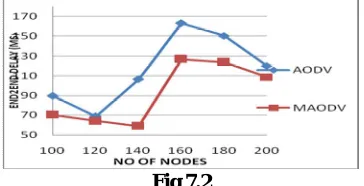
Fig. 7.2, shows the graphs for end-to-end delay Vs no. of nodes. From these graphs we see that the average packet delay increase for increase in number of nodes waiting in the interface queue while routing protocols try to find valid route to the destination. Besides the actual delivery of data packets, the delay time is also affected by route discovery. Comparison between AODV and MAODV, MAODV end to end delay is less than from the AODV. It is clear MAODV gives better performance than the AODV.
Fig 7.2
Fig. 7.3, shows the graphs for No. of dropped data (packets) Vs no. of nodes. From these graphs we see that the no of drop packets increase with increase in number of nodes .but Compare between AODV and MAODV, MAODV have packet droop less than from the AODV. It is clear MAODV gives better performance than the AODV.
Fig 7.3
Fig. 7.4, shows the graphs for packet loss Vs no. of nodes. From these graphs we see that the no of drop packets increase with increase in number of nodes .but Compare between AODV and MAODV, MAODV have packet droop less than from the AODV. It is clear MAODV gives better performance than the AODV.
Volume 2, Issue 6, June 2013
Page 319
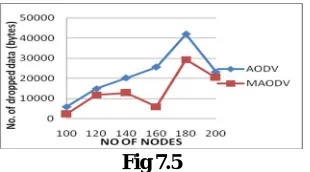
Fig. 7.5, shows the graphs for No. of dropped data (bytes) Vs no. of nodes. From these graphs we see that the no of drop packets increase with increase in number of nodes .but Compare between AODV and MAODV, MAODV have packet droop less than from the AODV. It is clear MAODV gives better performance than the AODV.Fig 7.5
8.
CONCLUSION
The modified Ad hoc On-Demand Distance Vector (MAODV) routing protocol is intended for use by mobile nodes in an ad hoc network. It offers low end-to-end delay, maximum PDF, minimum packet loss is, there decrease the chances for loss of information while transaction between the source node and destination node. The implementation of the AODV routing protocol with all features such as less end-to-end delay, maximum PDF and minimum Packet loss is really a challenging one. The proposed work mainly concentrates on implementation of all above parameters. This implementation will really prove advantageous for the networking technology.
REFERENCES:
[1] Zygmunt J. Haas, et al, Wireless Ad Hoc Networks,Encyclopedia of Telecommunications, John Proakis, editor, John Wiley, 2002.
[2] C.E. Perkins, Ad Hoc Network, Addison-Wesley,2001
[3] C.E. Perkins, et, al, Performance Comparison of Two OnDemand Routing Protocols for Ad Hoc Networks, IEEE Personal Communications • February 2001,pp16-28
[4] Ram Bamanathan and Jason Redi, A Brief Overview of Ad Hoc Network: Chanllenges and Directions,IEEE Communications Magazine, 50th Anniversary Commemorative Issue, May 2002
[5] Cesar A. Santivanez, et al, “On the Scalability of Ad Hoc Routing Protocols”, IEEE INFOCOM 2002,(1688sant_scalability.pdf)
[6] Cesar A. Santivanez, et al, Hazy Sighted Link State Routing: A Scale Link State Algorithm,( BNNTech-memo-1301.pdf)
[7] Jinyang Li, et al,A Scalable Location Service for Geographic Ad Hoc Routing, MOBICOM 2000 Boston MA USA ( p120_li.pdf)
[8] Yajian Zhou, Study on Wireless Multiple Access Control and Multicast Routing Protocols in Ad hoc Networks, Ph. D Thesis, Xidian University.
[9] Samir R. Das, Charles E. Perkins, Elizabeth M. Royer and Mahesh K. Marina."Performance Comparison of Two On-demand Routing Protocols for Ad hoc Networks." IEEE Personal Communications Magazine special issue on Ad hoc networking, February 2001, p. 16-28.
[10] S.Corson and I. Mocker, “Mobile Ad-hoc Networking (MANET) Routing Protocol Performance issues and Evaluation Considerations”, pp.78-90, Jan 1999.
[11] C.K.Toh, “Long-Lived Ad-hoc Routing Based on the Concept of Associativity”, Draft-ietf-manet-longlived-adhoc-routing-00.txt, pp.1-30, Mar 1999.
[12] E.Royer and C.K.Toh, “A Review of Current Routing Protocols for Adhoc Mobile Wireless Networks”, Vol.6, No.2, PP.46-55, Apr 1999.
[13] S.R.Das, R.Castanrda, J.Yan, R.Sengupra, “Comparative Performance Evolution of Routing Protocols for Mobile Ad-hoc Networks”, 7’Th International Conf. on Computer Communications and Networks (lCCCN), Pages l53-161, Aug I999.
[14] Lee. M.Gerla and C.K.Toh, “A simulation Study of Table-Driven and On-demand Routing Protocols for Mobile Ad-hoc Networks”, PP.48-54, Aug1999.
[15] S.R.Das, C.E.Perkins and E.M.Ruyer, “Performance Comparison of two on demand routing protocols for Ad-hoc networks”, INFOCOM 2000, Tel Aviv, Israel, pp.56-67, Mar 2000.
[16] C.E.Perkins and E.M.Royer, “Ad hoc On-demand Distance Vector (AODV) Routing”, internet Draft, Draft-ietf-manet-aodv-O9.txt, pp.1-33, Jan 2002.
Volume 2, Issue 6, June 2013
Page 320
[18] H. Yang, H. Luo, F. Ye, S. Lu and L. Zhang, “Security in Mobile Ad Hoc Networks: Challenges and Solutions,”IEEE Wireless Communications, Vol. 11, No. 1, 2004, pp. 38-47 .
![Fig 3.1 [5]](https://thumb-us.123doks.com/thumbv2/123dok_us/9740770.1958261/3.595.197.404.112.262/fig.webp)