143
Volume-4, Issue-4, August-2014, ISSN No.: 2250-0758
International Journal of Engineering and Management Research
Available at:
www.ijemr.net
Page Number: 143-146
Detection of Defects in Printed Circuit Boards using Fuzzy Logic and
Correlation Coefficient
Neha Koul1, Dr. Gurmeet Kaur2, Beant Kaur3
1M.Tech student in Department of Electronics and Communication Engineering, Punjabi University, Patiala, INDIA 2Professor in Department of Electronics and Communication Engineering, Punjabi University, Patiala, INDIA 3
Assistant Professor in Department of Electronics and Communication Engineering, Punjabi University, Patiala, INDIA
ABSTRACT
A Printed Circuit Board (PCB) is a card made
specifically for attaching electronic components on it.
Inspection of PCB is necessary in order to reduce the defects otherwise it can lead to complete circuit failures. In this paper we have presented a PCB Inspection System which involves the use of correlation coefficient and fuzzy logic in order to detect the defects and the inspection system is applied at the time of manufacturing, i.e., the making of bare PCB. The inspection system also gives the degree of defectiveness present in the PCB. Typical defects that can be detected are over etchings (opens), under-etchings (shorts), holes etc. Keywords- correlation coefficient, fuzzy logic, fuzzy image processing, membership functions.
I.
INTRODUCTION
During the manufacturing of PCB there are some defects commonly found on PCB. These defects are broadly divided into two categories, potential and fatal defects. Short-circuit and open-circuit defects are examples of fatal defects category. Breakout, under etch, missing hole, and wrong size hole fall in potential defects category. Fatal defects are those defects in which the PCB does not meet the objective for which it is designed, while the potential defects are those which compromise the PCB performance during utilization [1].
The detection of these defects at an early stage in the production process is beneficial and avoids multiplication of cost due to delayed detection of defects. Thus, it is important to work out a reliable method to detect the defects in the PCBs. There are many types of defects which plague printed circuit boards (PCBs). The reason for this is the immense complexity and miniaturization of chips which are mass produced in the millions [2]. Each chip contains thousands of individual systems all working harmoniously to produce a certain output.
Some
defects are caused by impure materials. Another defect is where thereare physical problems with the material [6]. Voids, fractures, and de-lamination can all combine to reduce or corrupt PCB performance .In this study correlation coefficient is used to find whether the PCB is defective or not and if PCB is found to be defective then its degree of defectiveness is calculated using correlation coefficient.
II.
METHODOLOGY
For the inspection of the printed circuit boards we first need to have a reference image of a PCB which is absolutely defect free i.e. defect less. Then the correlation of the PCB image which is to be inspected is found with respect to the reference image. If correlation is found to be zero then PCB is not defective otherwise PCB is defective.
144
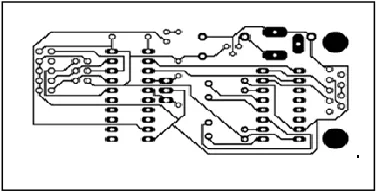
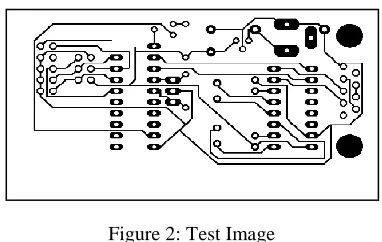
Figure 2: Test ImageFig. 1 and 2 show the examples of reference PCB image and test PCB image. The defective image has a missing joint which is now to be detected [5].
A. Inspection Flow Chart
In our inspection system, we will first find correlation between the image which is to be inspected with the reference image. Then the value of the correlation coefficient will be given to the fuzzy system whose output will tell the degree of defectiveness in the PCB.
Fig 3: Inspection Flow Chart
B. Correlation Coefficient
Correlation is a measure of the strength and direction of the linear relationship between two variables that is defined as the (sample) covariance of the variables divided by the product of their (sample)
standard deviations. The next step in the inspection system will be the calculation of the correlation coefficient. The value of the correlation coefficient will give the amount of similarity between the inspected image and the standard image [3]. This value of correlation will be given input to the fuzzy system on the basis of which we will calculate the degree of extent of defectiveness. In the case of above test PCB image correlation was found to be 0.96. This value is then fed to the fuzzy tool box which calculates the degree of defectiveness present in the PCB.
C. Design And Development Of Fuzzy Expert System
Fuzzy comprises the process of transforming crisp values into grades of membership functions for linguistic terms of fuzzy sets. Steps in fuzzy logic are fuzzification, evaluation of rules and finally defuzzification. To design the system, the FIS tool in MATLAB R2013a is used [4].
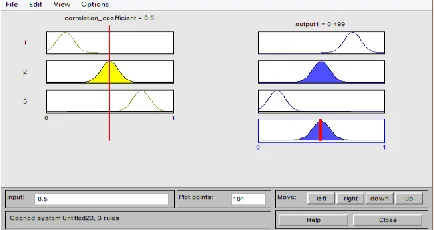
Fuzzy Image Processing is the collection of all approaches that understand, represent and process images, their segments and features as fuzzy sets .The representation and processing depend on the selected fuzzy technique and on the problem to be solved [7]. First, the linguistic values and corresponding membership functions of input and output have been determined. Samples of values and corresponding membership functions for the correlation coefficient are shown in Figure 4. Fig 5 shows the membership function and linguistic variables for the output PCB defect.
Fig 4: Linguistic variable and membership function of Correlation Coefficient
Select the reference image
Calculation of correlation of
correlation coefficient
Fuzzy Reasoning
Buffer the image to be
inspected
145
Fig 5: Linguistic variable and membership functionof PCB defect
The membership function for correlation coefficient is low, medium and high. All are represented in Gaussian waveforms. The range of values for low is taken from 0 to 0.3, for medium it is taken from 0.4 to 0.7 and for high it has sample values from 0.7 to 1.Then the output variable and its corresponding membership functions have been determined. Samples of values and corresponding membership functions for output are shown in Figure 5 above. The membership function for output is low, medium and high [8]. All are represented in Gaussian waveforms. The range of values for low is taken from 0 to 0.3, for medium it is taken from 0.4 to 0.7 and for high it has sample values from 0.7 to 1. Gaussian waveforms are generally used in fuzzy because the input is not exact so the range of input can be easily shown using Gaussian waveform [9].
D. MATLAB 2013
Correlation coefficient is first calculated of the test image with respect to the reference image and then this value is fed to the fuzzy system whose output will give the extent of defectiveness present in the PCB based on the fuzzy rule base.
III.
RESULTS
Fuzzy expert system is used to determine degree of defectiveness present in the PCB. This design consists of 1input and 1 output. The inputs consist of correlation coefficient while the output is the extent of defectiveness present in the PCB. The variables are used like low, medium and high for input and low, medium and high for output. The outline of our proposed fuzzy expert system can be shown in Fig.6. Mamdani method is used for fuzzification.
Fig 6: Fuzzy Expert System
Rule base is shown in figure 7. Three rules are used in this system. The rules have been developed using if-thenmethod. The rules have been made on the basis of the FAM table given below. Table 1 : Fuzzy Associative Memory Table
Correlation Defect
Low Highly defective
Medium Medium defective High Less defective
One Not defective
Fig 7: Rule Base
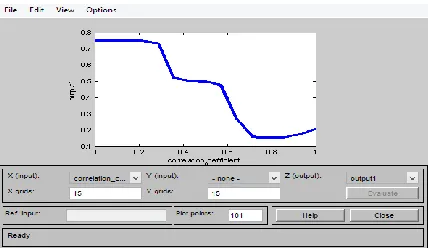
Using these rules, the result risk in term of percentage (%) has been computed. Figure 8 shows the ruler view of the graph obtained between defectiveness of the PCB against correlation coefficient. Surface view of the resultant graph is shown in figure 9.
146
Fig 9: Surface view of fuzzy expert systemIt is clear from the graphs that as the correlation coefficient increase the defect in Printed Circuit Board decreases. As soon as the correlation coefficient becomes zero the defect also reduces to zero. The PCB above was found to be 20% defective.
IV.
CONCLUSION
The PCB is analyzed and the defects of PCB are calculated. Due to the use of correlation coefficient the accuracy of the system is very high. By the use of the above inspection method we come to know that whether the PCB is defective or not and if the PCB is found to be defective its degree of defectiveness is calculated.
V.
FUTURE WORK
The proposed method can also be extended to detection of defects in fabric; wood etc. The reference image and the image to be tested should have same alignment. So this alignment problem also has to be worked upon
REFERENCES
[1] M. Moganti, F. Ercal, C. H. Dagli and S. Tsunekawa, “Automatic PCB Inspection Algorithms: A Survey”, Computer Vision and Image Understanding journal, vol.63,1996.
[2]
J. F Canny, “A computational approach to edge detection”, IEEE Transaction on Pattern Analysis and Machine Intelligence, vol. 8, pp 679-698, 1997.[3] W.Y. Wu, M.J. Wang and C.M. Liu, “Automated Inspection of Printed Circuit Boards through Machine Vision”, Computers in Industry, vol.28, no.2, pp.103-111,1998.
[4] Jan Hanca, Adrian Munteanu and Peter Schelkens, “Segmentation-based Intra Coding Of Depth Maps Using Texture Information”, proceedings of IEEE conference on Compression of depth information for 3D rendering , 2013.
[5] G. Rafiee, S.S. Dlay, and W.L. Woo, “Unsupervised Segmentation of Focused Regions in Images with Low Depth of Field”, International Journal of Computer Vision, vol. 70, pp. 109-131, 2013.
[6] I. Ibrahim, S.A.R Abu-Bakar, M.M. Mokji et al. “Performance measurement of thresholding algorithms in printed circuit board inspection system”, proceedings of 3rd International Conference on Computational Intelligence, Modeling and Simulation,2012.
[7] I. Ibrahim, S. Rahman and Syed, “A Printed Circuit Board Inspection System with Defect Classification Capability”, International Journal of Innovative Management, Information & Production, Vol. 3, March 2012.
[8] D. Perng, C.Liu, Y. Chen, and C. Chou, “Advanced PCB Vision Inspection Machine Development”, Department of Industrial Engineering and Management National Chiao-Tung University, 15th IPPR Conference on Computer Vision, Graphics and Image Processing, 2002.
[9] Z.Ye , Prasad, S.Wei Li , “Classification Based on 3-D DWT and Decision Fusion for Hyperspectral Image Analysis Geoscience and Remote Sensing Letters”, proceedings of IEEE conference , 2014.