The Thirty-Third AAAI Conference on Artificial Intelligence (AAAI-19)
Distributed PageRank Computation: An Improved Theoretical Study
Siqiang Luo
The University of Hong KongPokfulam, Hong Kong [email protected]
Abstract
PageRank is a classic measure that effectively evaluates the node importance in large graphs, and has been applied in numerous applications ranging from data mining, Web al-gorithms, recommendation systems, load balancing, search, and identifying connectivity structures. Computing PageR-ank for large graphs is challenging and this has motivated the studies of distributed algorithms to compute PageRank. Previously, little works have been spent on the distributed PageRank algorithms with provably desired complexity and accuracy. Given a graph withnnodes and if we model the distributed computation model as the well-known congested clique model, the state-of-the-art algorithm takesO(√logn)
communication rounds to approximate the PageRank value of each node in G, with a probability at least 1− 1
n. In
this paper, we present improved distributed algorithms for computing PageRank. Particularly, our algorithm performs
O(log logn) rounds (a significant improvement compared withO(√logn)rounds) to approximate the PageRank val-ues with a probability at least 1− 1
n. Moreover, under a
reasonable assumption, our algorithm also reduces the edge bandwidth (i.e., the maximum communication message size that can be exchanged through an edge during a commu-nication round) by a O(logn) factor compared with the state-of-the-art algorithm. Finally, we show that our algo-rithm can be adapted to efficiently compute another variant of PageRank, i.e., the batch one-hop Personalized PageRanks, in
O(log logn)communication rounds.
Introduction
Given a graphGofnnodes, and a probabilityα ∈ (0,1), the PageRank vector of a graph is the stationary distribution
π of the following specific type of random walk (Sarma, Gollapudi, and Panigrahy 2011): at each step, with proba-bilityαthe walk restarts from a node chosen uniformly at random; with the remaining probability1−α, the walker jumps to a randomly chosen neighborvof the current node. PageRank has emerged as a very powerful measure of rel-ative importance of nodes in a network. It was first pro-posed as the pioneering idea for Google’s search engine for document ranking. Since then, PageRank has been ap-plied in extensive applications, such as data mining, dis-tributed networks, Web algorithms, and recommendation Copyright c2019, Association for the Advancement of Artificial Intelligence (www.aaai.org). All rights reserved.
systems (Sarma et al. 2015; Florescu and Caragea 2017; Fujiwara et al. 2013; Ahmadi, Kersting, and Sanner 2011; Neumann, Ahmadi, and Kersting 2011; Ponzetto and Strube 2007).
There have been a number of works on distributed PageR-ank algorithms (Guo et al. 2017; Sarma et al. 2015; Zhu, Ye, and Li 2005). Among them, the algorithm presented in (Sarma et al. 2015) has the best complexity under a fully-distributed model which is a kind of congested clique model. It models the graphGwithnindependent nodes such that each node communicates with each other over a complete network (i.e., the clique on the nnodes) in order to com-pute some function of their inputs. Each pair of nodes can communicate at most b bits (which is also known as the edge bandwidth). The computation is performed in syn-chronous rounds. The algorithm in (Sarma et al. 2015) fin-ishes computing PageRank of an undirected n-node graph
GinO(√logn)rounds with a probability at least1− 1
n,
whereas the edge bandwidth isb=O(log3n)bits.
The congested clique model (definitions may be slightly different in different papers) has received tremendous in-terest in recently years, and has been studied extensively on many important problems (e.g., (Jurdzi´nski and Now-icki 2018; Drucker, Kuhn, and Oshman 2014; Hegeman et al. 2015; Ghaffari and Parter 2016; Hegeman, Pemmaraju, and Sardeshmukh 2014; Lenzen 2013)). One attractiveness of the congested clique model is that the model is funda-mental to other distributed models. In particular, an effi-cient algorithm based on the congested clique model can be translated into an efficient algorithm on other distributed models such as the k-machine model (Klauck et al. 2015; Luo et al. 2014) and MapReduce model (Hegeman and Pem-maraju 2015; Dean and Ghemawat 2008; Luo et al. 2012).
Our Contributions.In this paper, we present improved distributed PageRank algorithms based on the congested clique model1. Particularly, given an undirected connected graphGofnnodes, we show that with a probability at least
1−1
n, our algorithm finishes computing approximate
PageR-ank vector inO(log logn)rounds and the edge bandwidth is O(log2n)bits (under a reasonable degree assumption). This significantly improves over the algorithm presented
1
in (Sarma et al. 2015), which costsO(√logn)rounds, en-tailing an edge bandwidth ofO(log3n)bits.
We show that our algorithm can be adapted to compute another variant of the PageRank, i.e., batch one-hop per-sonalized PageRanks (BPPR) (Luo et al. 2019) (The def-inition can be referred to Section “Extensions to BPPR”). With at least1−1
nprobability, our algorithm handles BPPR
inO(log logn)rounds and the edge bandwidth isO(log2n)
bits (under a reasonable degree assumption). To the best of our knowledge, this is the first distributed algorithm that handles the BPPR ino(logn)rounds.
Preliminaries
PageRank based on α-Decay Random Walk. Given a graphG(V, E), a reset probabilityα∈(0,1), the PageRank (PR) value of a nodev, denoted byπ(v), is the stationary probability of the followingα-decay random walk: a random walk is chosen from a node ofGuniformly at random, such that at each step of the traversal, it terminates with proba-bilityαand, with the other1−αprobability, moves to a randomly selected out-neighbor of the current node. For any nodev, the PageRank ofvis denoted byπ(v). In this paper, we focus on undirected graphGofnnodes.
Congested Clique Model. The congested clique model is one of the most well-known models in distributed graph computation. Given a connected n-node undirected graph
G(V, E), a congested clique model models the nodes inG
as independent nodes who communicate with each other via message passings. A nodeucan send a message to a node
vifuknows the identity (ID) ofv. The computation is per-formed in synchronous rounds, such that the messages that have been sent in roundiwould be received at the beginning of the roundi+ 1. It defines a bandwidthb. At each round, each pair of nodes(u, v)can exchange at most messages of
bbits. In this paper, we assume initially each node knows the IDs of its neighbors inG.
There are several measures for the efficiency of a dis-tributed algorithm based on the congested clique model. Following existing works (e.g., (Hegeman and Pemmaraju 2015; Sarma et al. 2015)), we focus on two measures of an algorithm in this paper: 1) the round complexity, or the number of rounds (asymptotically) that the algorithm takes to finish; 2) the edge bandwidthb. Based on these measures, AlgorithmAis considered to be better than algorithmB, if
Ahas a smaller round complexity as well as an edge band-width. Note that, typically the local computation within each node is for free, following the assumptions of the standard congested clique model.
Monte Carlo (MC). The Monte Carlo method gener-ates a number,Θ(logn), of random walks from every node, and π(v) is estimated by the probability of a walk ends at nodev. To implement the idea in the congested clique model, initially, each node generatesΘ(logn)random walk tokens. A node forwards each token with probability1−α
and terminates the token with probabilityα. From Lemma 2.2 of (Das Sarma, Nanongkai, and Pandurangan 2009) we know that these steps can be implemented in O(log2n)
rounds in the congested clique model with a probability at
least1− 1
n. It can be also shown that it consumes an edge
bandwidth ofO(log2n)bits.
Length-LRandom Walk.The length-Lrandom walk is a random walkwithout decay, but with a fixed lengthL.
Related Works
In this section we review the closest existing works on dis-tributed computation under the congested clique model. Dis-tributed PageRank computation is studied in (Sarma et al. 2015) and it is the closest literature to this paper. The algo-rithm presented in (Sarma et al. 2015) improves the round complexity for PageRank computation in undirected graphs over a naive baseline approach. The main idea is to first gen-erate a number of short walks of length O(√logn) from each node. Then, these generated short walks are stitched together, by at mostO(√logn)steps, to compose random walks of lengthO(logn). It can be shown that the algorithm takes O(√logn) rounds to finish with high probability 2, and the edge bandwidth is O(log3n)bits. To the best of our knowledge, this is the current best theoretical result for PageRank computation in congested clique model.
There are a number of existing algorithms about round complexity of computing a length-L random walk, and fruitful results have been presented for this problem. In (Das Sarma, Nanongkai, and Pandurangan 2009), the au-thors give a round complexity of O˜(L23D
1
3)(where D is the diameter of the network) for computing a single random walk of lengthL, which is among the first algorithms that improve over the baseline linear round complexity O(L). This round complexity is further improved in (Das Sarma et al. 2010) to achieveO˜(√LD)rounds, In this algorithm, the total number of messages passed is Ω(m√L), where
m is the number of edges in the graph. Later, the authors of (Sarma, Molla, and Pandurangan 2012) improve the re-quired number of messages toO(L), with the same round complexity guarantee asO˜(√LD). While the results on the distributed computation of a single random walk is closely related to the distributed PageRank algorithms, it is not clear whether the same round complexity (with reasonable bandwidth) can be achieved, as computing PageRank re-quires multiple random walks to be conducted simultane-ously. There can be pressing challenges in extending the algorithm for computing a single random walk to compute multiple random walks in the congested clique model. The reason is that, when multiple random walks are processed at the same time, the message complexity (or bandwidth) can be significantly enlarged, resulting in an unacceptable band-width.
To conclude, little works have been done in distributed PageRank algorithms based on the congested clique model besides the works (Sarma et al. 2015). While there are other relevant literatures that address distributed random walks, they can not be easily adapted to an efficient distributed PageRank algorithm based on the congested clique model.
2
“With high probability” means with a probability at least1− 1
Our Solution
In this section we present our improved algorithm. We first present an algorithm called the Radar-Push (RP) algorithm, that improves MC in terms of the edge bandwidth. We then present a further improved algorithm by recursively using the RP algorithm, called the Multiple-round RP (MRP) al-gorithm. MRP improves the round complexity significantly. Finally, we show how the MRP algorithm can be employed to compute PageRanks.
Basic Idea of Radar Push
The MC algorithm has an edge bandwidth as high as
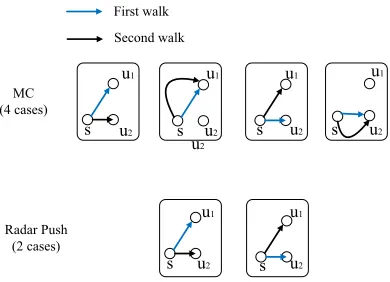
O(log2n)bits3. The high edge bandwidth of MC is due to the randomness of the random walk. Particularly, given that a random walk would extend the walk to a randomly chosen neighboring node of the current node, there is a probabil-ity that certain nodes be visited by many walks at the same time. These nodes therefore become the hubs of the walks and the hubs have to communicate with their neighbors fre-quently, resulting in a high edge bandwidth. To address this issue, we need to avoid such hubs and make the generation of the random walks more controllable. Based on this idea, we propose the Radar-Push (RP in short) algorithm such that, instead of randomly extending a walk to a neighboring node, it conducts a deterministic push to all the neighboring nodes. For ease of presentation, let us consider a unit task as follows:
Unit Task:Generate for each nodev∈V a numberd(v)of length-Lrandom walks4, whered(v)is the degree of node
vinG.
Note that, the purpose of introducing the unit task is two-fold: 1) It is much easier to present our idea of RP if to han-dle the unit task. 2) Computing the unit task can be closely related to computing the PageRank (as will be introduced in the following sections). We will explain the Radar-Push al-gorithm based on this simple task, and also introduce how the computation of PageRank reduces to this simple task.
Let(s, t, i)be awalk label to describe the computation state of a length-iwalk that starts from nodesand currently resides at nodet. The main idea of the RP algorithm is that, when a certain random walk (residing at nodev) is extended one step further, we do not select a neighbor node ofv uni-formly at random to extend the walk. Instead, we collect all the random walks which currently reside atv, andmanually assign their next nodes as evenly as possible. Interestingly, this will not hurt the ending node distribution of a random walk (i.e., the probability of a node becoming the ending node of a walk), and hence the correctness of computing PageRank is guaranteed. The detailed procedure can be re-ferred to the following algorithm.
Algorithm 1.
• Round 0. For any nodev and each neighbor uof v,v
initializes a random walk with the label(v, u,1), and node
vsends the label as a message to nodeu.
3
It can be simply derived based on Lemma 4.1 of (Sarma et al. 2015)
4
Precisely, we are only interested in the ending node of a walk. We call a walk is generated if we know its ending node.
• Roundi (1 ≤ i ≤ L−1).At the beginning of Round
i each node v receives k = d(v) walk labels (will ex-plain shortly why such number of walk labels received) which are {(s1, v, i),(s2, v, i), . . . ,(sk, v, i)}. We
shuf-fle the labels and increase their lengths by1, forming a new label list represented as {(s∗1, v, i+ 1),(s∗2, v, i+ 1), . . . ,(s∗k, v, i+ 1)}. Note that {s∗1, . . . , s∗k} is a per-mutation of{s1, . . . , sk}. We change the second element
in each of the labels to one of v0sneighbors, such that each neighbor appears exactly once (this can be done be-cause we have exactly d(v)labels). For example, if v0s
neighbors are {u1, u2, . . . , ud(v)}. Then the labels be-come{(s∗
1, u1, i+ 1),(s∗2, u2, i+ 1), . . . ,(s∗k, uk, i+ 1)}.
Node v sends the labels to the nodes indicated by their corresponding second elements in the labels, respectively.
• Round L. Each label (s, v, L) that is received corre-sponds to a generation of a length-Lrandom walk from
stov.
• Backtrack (optional).In some cases, we require nodes
to collect the random walks that are sourced at nodes. This can be simply done by sending the walk label back to the source node of the walk.
The above algorithm can be understood as a propagate algorithm that for each node v, there are d(v)walks start at v, and walks are propagated to immediate neighboring nodes, as evenly as possible. There are several interesting designs of the algorithm.
First, we show that the estimator based on RP is not looser than directly using Monte-Carlo (MC), which samplesd(v)
random walks from nodev. There is a crucial difference be-tween RP and MC: in MC, suppose we need to extend p
walks from nodev tov0s neighbors, we selectptimes for
pneighbors uniformly at random and extend the walks to the neighbors respectively. In RP, the walks are extended to
v0sneighbor evenly. This results in the fact that each node
v will receive exactlyd(v)walks (under the condition that
Gis undirected). To explain, at each round there is exactly one message sent through an edge and therefore exactly one message received through the edge. The difference made here is crucial to an improved bandwidth. It means that, at each round each edge conveys at mostO(1)labels (and thereforeO(logn)bits as an integer in[1, n]costsO(logn)
bits). Whereas in MC, the message received by each node can be much worse. Consider that in the worst case, all the neighbors ofvmay send all their messages tov, resulting in a message bottleneck. This results in an unsatisfactory edge bandwidth in MC.
bot-First walk
Second walk
MC (4 cases)
Radar Push (2 cases)
u1 u1 u1 u1
u1 u1
u2 u2 u2 u2
u2 u2
s s
u2
s s
s s
Figure 1: Differences between MC and Radar Push (RP) when extending a random walk.
tom) each with a probability1/2. The side-effect of the walk dependency is that, it invalidates the analysis that is used in MC. Therefore we need new analysis to show that the RP gives an unbiased estimator and the estimate does not be-come looser. To give a formal analysis, we definePr(˜ s, v, L)
as the RP’s estimator of Pr(s, v, L), the probability that a walk which starts at nodeswill reach nodevat theL-th step, andPr˜mc(s, v, L)is that given by MC. We give the
follow-ing lemmas to complete the correctness proofs of PR. Partic-ularly, Lemma 1 tells that using RP will not affect the end-ing node distribution of a random walk, whereas Lemma 2 shows that using RP can even gain a smaller variance for its estimator, compared with that of the MC method.
Lemma 1. The Pr(˜ s, v, L) is an unbiased estimator of
Pr(s, v, L).
Proof. We prove by mathematical induction on walk length
L. When L = 1. Based on Radar-Push, for each neigh-bor v of s, we have E[ ˜Pr(s, v,1)] = d(1s) = Pr(s, v,1). Lemma holds. Assume that the lemma holds whenL = i, we consider the case whenL =i+ 1. Consider any fixed nodev, given the randomness of the shuffle, for any neigh-boring nodeu there is d(1u) probability that a walk is ex-tended to v. Therefore, for any s and v, E[ ˜Pr(s, v, i +
1)] =E[P
u∈N(v)Pr(˜ s, u, i)· 1
d(u)] =
P
u∈N(v)Pr(s, u, i)· 1
d(u)= Pr(s, v, i+1). The lemma also holds whenL=i+1. By induction, the lemma holds for allL≥1.
Lemma 2. Var[ ˜P r(s, v, L)]≤Var[ ˜P rmc(s, v, L)].
Proof. Letx(s, v, i)be the number of random walks froms
that ends at nodev at stepifor the RP algorithm, whereas
xmc(s, v, i) be that for the MC algorithm. Our goal is to
show that
Var[x(s, v, L)]≤Var[xmc(s, v, L)]
Let the neighbors of v be {u1, . . . , ud(v)}. Conditioned onx(s, ui, L−1)for alli, the probability thatvreceives a
random walk fromuiisx(s, ui, L−1)/d(ui). Thus x(s, v, L) = X
1≤i≤d(v) yi
whereyi = 1with probability x(s, ui, L−1)/d(ui), and yi= 0otherwise.
It is easy to show that the conditional variance
Var[x(s, v, L)|x(s, u1, L−1), . . . , x(s, ud(v), L−1)]
= X
1≤i≤d(v)
Var[yi]
= X
1≤i≤d(v)
E[y2i]−(E[yi])2
= X
1≤i≤d(v)
x(s, ui, L−1) d(ui)
−x(s, ui, L−1)
2
(d(ui))2
(1)
Taking over the expectation of the variablesx(s, ui, L−1)
for alli, we have
Var[x(s, v, L)]
= X
1≤i≤d(v)
E[x(s, ui, L−1)] d(ui)
−E[x(s, ui, L−1)
2]
(d(ui))2
(2)
On the other hand, conditioned onxmc(s, ui, L−1), for
alli= 1,2, . . . , d(v), we can express
xmc(s, v, L) = X
1≤i≤d(v)
X
1≤j≤xmc(s,ui,L−1)
zij
wherezij = 1with probability1/d(ui)andzij = 0
other-wise. Given thatVar[zij] = 1/d(ui)−1/(d(ui))2, and that
the variables zij are independent, we have the conditional
variance
Var[xmc(s, v, L)|{xmc(s, ui, L−1)}i≤d(v)]
= X
1≤i≤d(v)
xmc(s, ui, L−1) d(ui)
−xmc(s, ui, L−1)
(d(ui))2
(3)
Taking over expectation ofxmc(s, ui, L−1), for alli, we
have
Var[xmc(s, v, L)]
= X
1≤i≤d(v)
E[xmc(s, ui, L−1)] d(ui)
−E[xmc(s, ui, L−1)]
(d(ui))2
= X
1≤i≤d(v)
E[x(s, ui, L−1)] d(ui)
−E[x(s, ui, L−1)]
(d(ui))2
≥ X
1≤i≤d(v)
E[x(s, ui, L−1)] d(ui)
−E[x(s, ui, L−1)
2]
(d(ui))2
To conclude, the RP algorithm handles the unit task by
O(L)rounds, entailing an edge bandwidth ofO(logn)bits per round (note that in each round each edge only conveys
O(1)integers as messages, and thereforeO(logn)bits edge bandwidth.). This improves over the MC algorithm, which has the same round complexity but withO(log2n)bits edge bandwidth.
Multi-Round Radar Push (MRP)
When L = 2r (for integer r ≥ 1), we show that recur-sively using the RP algorithm effectively reduces the round complexity toO(logL). The idea is to first compute enough walks of length2, and then stitch two such walks to gener-ate a longer walk of length4 = 2·2. Recursively, finally the walks of length2r can be stitched by two walks of length
2r−1. To implement this procedure, we consider the follow-ing r batches of computation in the congested cliques. In Batch1 we first generate2r−1·d(v)length-2 walks from nodev, forv ∈ V, by using the RP algorithm2r−1 times. Thei-th invocation correspondingly generates the length-2 sub-walks, which can be regarded as the sub-walks (of the final length-Lwalks) containing thei-th jump andi+ 1-th jump for i = 1,3, . . . ,2r−1. We usestep-{a,b} walkto
refer to the sub-walks from thea-th jump to theb-th jump. In Batch2 (ifL ≥ 4) we stitch the short walks generated in Batch 1, such that the step-{i, i+ 1} walks and
step-{i+ 2, i+ 3}walks are stitched, fori = 1,5, . . . ,2r−3.
This generates length-4 walks, which are denoted by
step-{i, i+3}walks. Note that, such walk concatenations are pos-sible because the RP algorithm done by the previous batch guarantees that each nodev hasd(v)step-{i, i+ 1}walks that end atv, andd(v)step-{i+ 2, i+ 3}walks that start at
v(and this property similarly applies to later batches). The stitches of the walks at each node are similar in spirit to the Radar Push in that the incoming walks of nodevare stitched to a random permutation of the outgoing walks. Recursively, in Batchi(1 ≤ i ≤ r) we generate length-2i walks, and
usingr(= O(logL))batches we generate all the length-L
walks. Algorithm 2.
• Batch1.Generate2r−1·d(v)length-2walks from node
v, forv ∈V, by using the RP algorithm for2r−1 times. Thei-th invocation correspondingly generates thei-th and
i+ 1-th steps (i.e., thei-th andi+ 1-th jumps) in each of the random walks, for1≤i≤2r−1. We call them
step-{i, i+ 1}walks, fori= 1,3, . . . ,2r−1.
• Batch i (2 ≤ i ≤ r). In the previous batch we have generated length-2i−1walks, which are the step-{1,2i−1} walks, step-{2i−1+ 1,2i}walks, . . . , step-{2r−2i−1+
1,2r}walks. We stitch two length-2i−1walks together to generate length-2ishort walks, which are the step-{1,2i}
walks, step-{2i+1,2i+1}walks, . . . , step-{2r−2i+1,2r}
walks.
Remarks.The above MRP algorithm can be understood as recursively connecting two shorter walks to longer walks. Consider that a walkW2is connected to a walkW1, we call the ending node of theW1(which is also the starting node ofW2) theconnector.
Complexity. Each batch costs O(1) rounds. In total there are O(logL) batches and therefore the algorithm takesO(logL)rounds. As for bandwidth, we use a lemma in (Lenzen 2013) for the analysis.
Lemma 3. (Lenzen 2013) Assume that each node of the con-gested clique is given a set ofO(n)messages (each of size
O(logn)bits) with fixed destination nodes. Moreover, each node is the destination ofO(n)messages from other nodes. Then, it is possible to deliver all messages inO(1)rounds of the congested clique with edge bandwidth ofO(logn)bits.
Lemma 3 tells that, Batch 1 in Algorithm 2 can be per-formed in O(1) rounds with an edge bandwidth ofO(L·
logn)bits, as each nodevreceives or sends at mostO(L· d(v)) = O(L·n)messages in each round. Note that later batches do not have a per-edge message communication cost higher than Batch 1. Therefore, Algorithm 2 runs in
O(logL)rounds with edge bandwidth ofO(L·logn)bits.
MRP for
2
r-Bounded Unit Task
In PageRank computation it requires that every node gen-erates a random walk, with its length independently drawn from a geometric distribution Geom(α). Therefore, we need to further consider the following task for the preparation of computing PageRank.
2r-Bounded Unit Task: Given L = 2r for an integer r >0, each nodevgeneratesd(v)random walks of lengths
Lv
1, . . . Lvd(v), such thatL
v
i ≤Lfor1≤i≤d(v).
Note that, the aforementioned Algorithm 2 is efficient in generating fixed length random walks from each node. Fur-ther extending this algorithm to handle the2r-Bounded Unit
Task would give us a challenge: how to modify the MRP al-gorithm so that we can extract the ending node of a
length-L∗walk (L∗≤L) inO(logL)rounds?
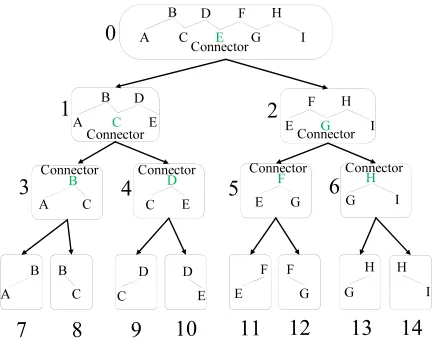
To address the challenge, our main idea is to conduct a bi-section search to locate the ending node of a length-L∗walk. To see this, observe that each walk generated by MRP can be organized by the hierarchy illustrated by Figure 2. From Figure 2 we see that the walk is recursively divided by the connector and two walks. Note that it is simple to include the connector into the walk label, such that we have four elements in a walk label, respectively indicating the start-ing node, endstart-ing node, the connector as well as the walk length. For a walk labelW, we respectively use W.start,
W.end,W.connectandW.lento refer to its four elements. With such an expanded walk label, we can conduct a binary search on the hierarchy from tree-note 0to locate the tree node that contains the sub-walk containing the desired end-ing node. For example, suppose we would like to extract the sub-walk of length5for the walk in tree-node 0 in Figure 2. Based on the binary search, the search first goes from tree-node0to tree-node2, as5 is larger than half length of the current random walk. When the search goes to tree-node2, the current walk length is updated to8/2 = 4and the cur-rent searching length is updated to5−8/2 = 1, meaning we would like to search a sub-walk of length1from the current random walk. Similarly, the search further goes to tree-node
Figure 2: The hierarchical structure of a walk in MRP (con-nector in green).
the current random walk length to be4/2 = 2and current searching length remains to be1. The search goes on and fi-nally it goes to tree-node11, which correctly identifies node
Fas the ending node of the length-5sub-walk. Each drilling down of the hierarchy would cost one round in the congested clique model, and therefore it requires onlyO(logL)rounds (as the height of the hierarchy isO(logL)) in total to retrieve a lengthL∗-walk whereL∗≤L. The algorithm is described as follows.
Algorithm 3.
• Use Algorithm 2 to generated(v)length-Lrandom walks that are started atv,∀v∈V. We denote the walks sourced atvbyW1, . . . , Wd(v).
• We subtract the walkWi (1 ≤i ≤ d(v))a sub-walk of
lengthLv
i (with the same source node) by the following
method:
• Round 0. Consider each walk Wi = (v, u, c, L),
which is a length-Lwalk from nodevto nodeuwith con-nectorc. The current walk lengthcur walk len=L, and the current searching lengthcur search len=Lv
i. Node u, the holder of Wi, would either send messages to the
connectorcor itself or nodev, depending on the follow-ing three conditions (in a way similar to the binary search in the hierarchy of the current random walk.)
[Case 1.] If cur search len < cur walk len/2, then nodeusends asub-walk message, which is a mes-sage that facilitates the sub-walk search, to the connec-tor c, such that the sub-walk message is represented by(v, u, v, c, cur walk len/2, Lv
i). Essentially, this
sub-walk message tells nodecthat we need to get a sub-walk of length Lv
i (the last element in the message), and the
current walk length should be updated tocur walk len/2
(the fifth element in the message). The other elements in the sub-walk message have the following meaning: the first two elements record the start/end node of the orig-inal walk of lengthL; the next two elements record the start/end node of the current sub-walk.
[Case 2.] If cur search len > cur walk len/2, then node u sends a sub-walk message to node
u itself, with the sub-walk message represented as
(v, u, c, u, cur walk len/2, Lv
i −cur walk len/2).
[Case 3.] If cur search len = cur walk len/2, send a message to nodev saying that a walk ending at nodecis generated.
•Round j(0 < j ≤ r).For each received sub-walk message (s1, t1, s2, t2, cur walk len, cur search len) from roundj−1, we do the following two steps.
[Step 1 of Roundj.] In this step we aim to identify the current sub-walk from s2 to t2. This can be done by searching the walk labels and the connection infor-mation5 holding at nodes2. The identified sub-walkW must satisfy: 1) W.start = s2; 2) W.end = t2; 3) W.len=cur walk len.
[Step 2 of Roundj.] In this step we conduct the same binary search as that in Round0based on the iden-tified walkW.
Edge Bandwidth.Note that the additional sub-walk ex-traction steps included in Algorithm 3 does not affect the edge bandwidth. To see this, observe that during each round the connector would not receive more sub-walk messages than the walks (of the same lengths) it has stitched. That means, during the sub-walk extraction, each connector will send/receive at most the number of messages that it has sent/received in Algorithm 2. Therefore, the edge bandwidth remains the same as Algorithm 2, which isO(Llogn)bits for the unit task.
Computing PageRank using MRP
In this section we show that the MRP algorithm (Algorithm 3) can be used to efficiently compute PageRank. We first give the number of random walks that need to be sampled using MC (see Lemma 5).
Lemma 4(Chernoff Bound). LetX=Pm
i=1Xibe the sum
of m independent random variables, whereXi = 1 with
probabilitypiandXi= 0with probability1−pi. Letµ=
E[X]. Then for all1> δ >0,
Pr[|X−µ| ≥δµ]≤2e−δ 2µ 3
Letπ(u)be the PageRank of nodeu. Fix an error bound
∈ (0,1), and a failure probabilitypf, we show that with
probability at least1−pf, we can estimate the PageRank of
each node with a multiplicative error.
Suppose we initiate k ·d(s) random walks from each node swith RP, wherek is an integer, and estimate π(u)
byˆπ(u) = 1nP s∈V
c(s)
k·d(s), wherec(s)is the number of ran-dom walks that start atsand end atu. By Lemma 1,πˆ(u)is an unbiased estimator ofπ(u), i.e.,E[ˆπ(u)] =π(u).
5
We assume that each node stores the walk labels of incoming walks and outgoing walks, as well as how they are connected to generate longer walks. Since each node conductsO(L)walk con-nections and the information for each connection costs a storage ofO(d(v) logn)bits for a nodev, it requires each nodevto store
Lemma 5. Fork= 3 log(2/pf)
2α , we have
Pr[|πˆ(u)−π(u)|> ·π(u)]≤pf.
Proof. Observe that thek·d(s)random walks initiated from nodescan be grouped intoksets, each of sized(s). We only require that the random walks within the same group are sent to different neighbors ofs. Hence initiatingk·d(s)random walks from nodesis equivalent to repeatingkindependent MRP, in which each nodesinitiatesd(s)random walks.
Letni be the number of random walks that end at node v, in thei-th run of MRP. In Lemma 1, we have shown that
ni
n is an unbiased estimator ofπ(v); in Lemma 2, we have
shown that the variable has a better concentration than the estimator given by the MC model. Letn˜i be the estimator
given under the MC model, which is the summation of n
random variablesxj, each withE[xj] =π(v). Then we have
Prh
1
k Pk
i=1
ni
n −π(v)
> π(v) i
≤Prh
1
k Pk
i=1 ˜
ni
n −π(v)
> π(v) i
= Prh
Pkn
i=1xi−kn·π(v)
> kn·π(v) i
≤2·exp(32 ·kn·π(v))
≤2·exp(
2α
3 ·k) =pf. (due toπ(v)≥
α n)
In Lemma 5, letpf = n1, thenk = 3 log(22αn). Therefore, one can sampleO(log2αn ·d(u))walks from each nodeuto achieve the approximation guarantee given by Equation 5.
As pointed out in (Sarma et al. 2015), sampling α -decay random walks is equivalent to generating a random walk of length L where L follows a geometric distribu-tion Geom(α). That means, to compute the PageRank, we can perform O(d(v)· log2αn) = O(d(v) logn) times ran-dom walks from each nodev, where the length of the walks are respectively drawn from Geom(α)independently. Note that, the length of the random walk with a length larger than4 log 1
1−αn ==
4 logn
log 1 1−α
= O(logn) has probability
(1−α)4 log1−1α
n
= n14.
In total we need to perform O(P
v∈V d(v)·
logn 2α) = O(n2logn)random walks. Hence, by union bound, the case that there are at least one random walks with length larger than4 lognwould happen with probability at most
O
1
n4 ·n 2logn
< 1 n
whennis enough large.
Therefore, with a probability at least1− 1
n, every
ran-dom walk has a length at most4 log 1
1−αn= O(logn). To
compute the PageRank, therefore, we can invokeO(log2αn)
runs of MRP (Algorithm 3), each runs with walk lengthL=
O(logn)to generated(v)random walks from each nodev. As such, there areO(log2αn)instances of MRP and that they
are merged together for concurrently processing in the same
rounds. This ensures that it only requires O(log logn) 6
rounds to finish with a probability at least1−1
n. Since MRP
entails a O(L·logn) = O(log2n) bits edge bandwidth, invokingO(log2αn)MRP algorithms at the same time will re-sult in an edge bandwidth ofO(log3n)bits. Next, we show that this edge bandwidth can be improved toO(log2n), if we assume that the maximum degreedmis at most lognn.
To explain, ifdm ≤ lognn, then in the current processing
of theO(log2αn)instances of MRP algorithm, in each round each node v sends/receivesO(log2αn ·d(v)L) = O(
logn 2α · n
lognL) =O(nL)messages, i.e.,O(nlogn)messages with
high probability. By Lemma 3, with high probability, the op-erations can be guaranteed to be finished in O(1) rounds, with an edge bandwidth ofO(log2n)bits. To conclude, with a probability at least1−1
n, the MRP algorithm computes the
PageRank inO(log logn)rounds with an edge bandwidth of
O(log2n)bits in the congested clique model. This algorithm is summarized as follows.
Algorithm 4 (Compute PageRank).
• Invoking O(log2αn) instances of Algorithm 3 simultane-ously. All together, each nodevgeneratesNv =O(log2αn· d(v))random walks.
• Estimateπ(v)by |V1|·P
walk fromstov
1
Ns.
Extensions to BPPR
Very recently, there is another variant of PageRank, called BPPR, that finds interesting applications in recommendation systems (Luo et al. 2019). BPPR is defined based on the Personalized PageRank (PPR), which is defined as follows. Definition 1 (PPR). Given a pair of nodes(s, t), the PPR value of nodetwith respect tos, denoted byπ(s, t), is de-fined as the probability that anα-decay random walk froms
would terminate att.
BPPR (Batch One-Hop Personalized PageRanks) is de-fined as follows.
Definition 2(BPPR). Given a thresholdδ, an error bound, and a failure probabilitypf, an approximate batch one-hop
PPR query returns an estimated PPRπˆ(s, v)for every node pair(s, v)such thats ∈ V andv is an out-neighbor ofs, such that for allπ(s, v)≥δ,
|π(s, v)−πˆ(s, v)| ≤·π(s, v) (5) holds with a probability at least1−pf.
We show that our algorithm can be applied to compute BPPR very naturally and efficiently. To explain, in (Luo et al. 2019) there is a lemma (summarized as Lemma 6) says that it can effectively approximate the BPPR by letting each nodevgenerateO(d(v) logn)α-decay random walks. Lemma 6. Let nodesgenerateω =O(αd·((1s) log−α)n2)random walks. If there arec(v)random walks end at a neighboring
6
Careful readers may notice that we omit the factors aboutand
nodev ofs, thenπ˜(s, v) = c(ωv) is an unbiased estimator ofπ(s, v), such that Equation 5 holds with a probability at least1−1
n, forδ= 0.
Lemma 6 interestingly points out that, to compute BPPR, the number of random walks started at nodevshould be pro-portional tod(v). Precisely, the number of walks started at nodev isO(d(v) logn). This naturally suits the unit tasks performed by MRP, and it is easy to see that computing BPPR requires the same complexities as those of computing the PageRank, which is, with a probability at least1−1
n, the
algorithm finishes inO(log logn)rounds with an edge band-width ofO(log2n)under the condition thatdm≤ lognn. The
algorithm is described as follows. Algorithm 5 (Compute BPPR).
• Invoking O(2αlog(1−nα)) runs of Algorithm 3 simulta-neously. All together, each node v generates Nv = O(2αlog(1−nα)·d(v))random walks.
• Estimateπ(s, v)byP
walk fromstov
1
Ns.
Conclusion
In this paper we present improved distributed PageRank al-gorithms based on a kind of congested clique model. Partic-ularly, given an undirected connected graphGofnnodes, we propose an algorithm, called MRP, that finishes com-puting approximate PageRank vector inO(log logn)rounds with a probability at least1−1
n. This significantly improves
over the state-of-the-art approaches. We also present solu-tions to optimize the edge bandwidth as well as to extend the techniques for computing the BPPR, which is another variant of batch Personalized PageRanks that has found ap-plications in practice.
Acknowledgements
I sincerely thank Dr. Xiaowei Wu for his contributions on Lemma 2 and Lemma 5, and his comments that greatly im-proved the manuscript.
References
Ahmadi, B.; Kersting, K.; and Sanner, S. 2011. Multi-evidence lifted message passing, with application to pager-ank and the kalman filter. InIJCAI, 1152–1158.
Das Sarma, A.; Nanongkai, D.; Pandurangan, G.; and Tetali, P. 2010. Efficient distributed random walks with applica-tions. InPODC, 201–210.
Das Sarma, A.; Nanongkai, D.; and Pandurangan, G. 2009. Fast distributed random walks. InPODS, 161–170.
Dean, J., and Ghemawat, S. 2008. Mapreduce: simplified data processing on large clusters. Communications of the ACM51(1):107–113.
Drucker, A.; Kuhn, F.; and Oshman, R. 2014. On the power of the congested clique model. InPODC, 367–376. Florescu, C., and Caragea, C. 2017. A position-biased pagerank algorithm for keyphrase extraction. In AAAI, 4923–4924.
Fujiwara, Y.; Nakatsuji, M.; Shiokawa, H.; Mishima, T.; and Onizuka, M. 2013. Fast and exact top-k algorithm for pager-ank. InAAAI, 1106–1112.
Ghaffari, M., and Parter, M. 2016. MST in log-star rounds of congested clique. InPODC, 19–28.
Guo, T.; Cao, X.; Cong, G.; Lu, J.; and Lin, X. 2017. Dis-tributed algorithms on exact personalized pagerank. In SIG-MOD, 479–494.
Hegeman, J. W., and Pemmaraju, S. V. 2015. Lessons from the congested clique applied to mapreduce. Theoret-ical Computer Science608:268–281.
Hegeman, J. W.; Pandurangan, G.; Pemmaraju, S. V.; Sardeshmukh, V. B.; and Scquizzato, M. 2015. Toward opti-mal bounds in the congested clique: Graph connectivity and MST. InPODC, 91–100.
Hegeman, J. W.; Pemmaraju, S. V.; and Sardeshmukh, V. B. 2014. Near-constant-time distributed algorithms on a con-gested clique. InDISC, 514–530.
Jurdzi´nski, T., and Nowicki, K. 2018. MST in O(1) rounds of congested clique. InSODA, 2620–2632.
Klauck, H.; Nanongkai, D.; Pandurangan, G.; and Robinson, P. 2015. Distributed computation of large-scale graph prob-lems. InSODA, 391–410.
Lenzen, C. 2013. Optimal deterministic routing and sorting on the congested clique. InPODC, 42–50.
Luo, S.; Luo, Y.; Zhou, S.; Cong, G.; and Guan, J. 2012. Disks: a system for distributed spatial group keyword search on road networks. PVLDB5(12):1966–1969.
Luo, S.; Luo, Y.; Zhou, S.; Cong, G.; Guan, J.; and Yong, Z. 2014. Distributed spatial keyword querying on road net-works. InEDBT, 235–246.
Luo, S.; Xiao, X.; Lin, W.; and Kao, B. 2019. Efficient batch one-hop personalized pageranks. InICDE.
Neumann, M.; Ahmadi, B.; and Kersting, K. 2011. Markov logic sets: Towards lifted information retrieval using pager-ank and label propagation. InAAAI, 447–452.
Ponzetto, S. P., and Strube, M. 2007. Deriving a large scale taxonomy from wikipedia. InAAAI, volume 7, 1440–1445. Sarma, A. D.; Molla, A. R.; Pandurangan, G.; and Upfal, E. 2015. Fast distributed pagerank computation. Theoretical Computer Science561:113–121.
Sarma, A. D.; Gollapudi, S.; and Panigrahy, R. 2011. Es-timating pagerank on graph streams. Journal of the ACM 58(3):13:1–13:19.
Sarma, A. D.; Molla, A. R.; and Pandurangan, G. 2012. Near-optimal random walk sampling in distributed net-works. arXiv preprint arXiv:1201.1363.