Subcarrier Resource Allocation Based
Cooperative OFDMA Systems with QPSK
Modulation
Ansu Elizabeth Baby
1, Blessy J
2, Dr. Sreeja Mole S S
3P.G. Student, Department of Electronics and Communication, Narayanaguru College of engineering, Manjalumoodu,
Tamilnadu, India1
Assistant Professor, Department of ECE, Narayanaguru College of engineering, Manjalumoodu, Tamilnadu, India 2
Head of the Department ECE, Narayanaguru College of engineering, Manjalumoodu,Tamilnadu,
India
3ABSTRACT:This project proposes the cooperative multiuser OFDMA systems with subcarrier resource allocation technique. A particular subcarrier resource allocation approach about which this paper proposes is a method, based on nodes that transmit and receive on adjacent OFDM subcarriers simultaneously. I propose a transceiver structure to reduce the interference between transmitting subcarriers and receiving subcarriers. The transceiver structure includes QPSK (Quadrature Phase Shift Keying).In this two sets of signals would be mixed; the required 90o of phase separation between the carriers allows the sidebands to be separated by the receiver using phase discrimination. Its performance in terms of signal to interference and noise ratio (SINR) is evaluated by simulation and is incorporated into a recently proposed cooperation strategy for OFDMA systems to examine its performance under the realistic structure.It is shown that SINR increased when QPSK modulation used.
KEYWORDS:Cooperative communication, OFDM, OFDMA, Subcarrier based duplexing
I. INTRODUCTION
Cooperation is the process of working together, opposite of working separately in competition. Recently, such a concept has been adopted from social sciences and economics to constitute a major research area in wireless communication networks. When cooperative communication is incorporated in OFDMA systems, overall performance enhanced further. Potential benefits of cooperation are improved channel reliability, improved system throughput, seamless service provision, and operation cost reduction. Improved channel reliability includes mitigating channel impairments and interference reduction. The wireless communication channel suffers from several phenomena that decrease its reliability. These phenomena include path loss, shadowing and fading. An improved system throughput can be a direct benefit from enhanced wireless channel reliability through employing cooperative transmissions at the physical layer. Seamless service provision is needed because mobile users are more sensitive to call dropping than call blocking.
II. LITERATUREREVIEW
1) RESOURCE ALLOCATION BASED ON OFDM SYMBOL BASED RELAY SELECTION
1 1
2 2
3 3
4 4
5 5
Hop 1 Hop 2
Figure 2.1: OFDM symbol based relay selection.
A common selection strategy is to choose the relay with the best equivalent end to end channel gain. End to end equivalent channel gain is calculated as the minimum number of channel gains of the first and second hops under the decode and forward protocol or the harmonic mean of both channel gains under the amplify and forward protocol. This can be extended to OFDM systems. Here one relay is selected based on the channel condition of the whole OFDM symbol. Such a symbol based relay selection may not be efficient since the differences of channel conditions among different subcarriers are not fully utilized.
2) RESOURCE ALLOCATION BASED ON SUBCARRIER BASED RELAY SELECTION
Subcarrier based relay selection resource allocation selects one best relay for each subcarrier. This exploits both node diversity and frequency diversity. Such a scheme can be called as subcarrier to relay assignment. This subcarrier to relay assignment assumes that signals received over one subcarrier (say i) is amplified (or decoded) and forwarded by the relay also over subcarrier i in the next hop. This doesn‟t exhibit optimal system performance.
3) RESOURCE ALLOCATION BASED ON SUBCARRIER PAIR BASED RELAY SELECTION
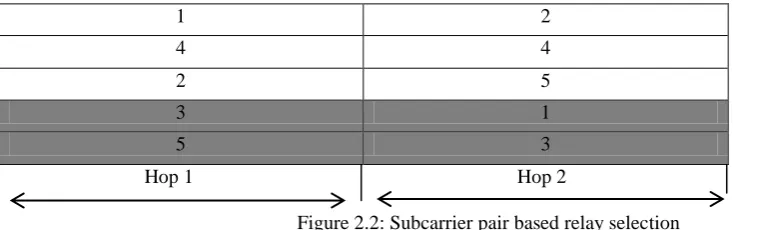
System performance can be improved if the subcarriers in the first and second hops are paired according to the channel conditions. This is called subcarrier based relay selection. Ordered subcarrier pairing is optimal for AF protocol.
1 2
4 4
2 5
3 1
5 3
Hop 1 Hop 2
Figure 2.2: Subcarrier pair based relay selection
Such subcarrier-by-subcarrier based pairing is not sufficient for DF protocol, where the information from one set of subcarriers in the first hop can be decoded and re-encoded jointly and then transmitted over a different set of subcarriers in the next hop. By using the dual method, the mixed integer programming problems are solved with polynomial complexity. To reduce the complexity of the problem with power constraints, two suboptimal approaches
Relay 1
are introduced. The suboptimal algorithm which decouples the power allocation with the subcarrier pairing and relay assignment performs close to optimality with less complexity.
III.PREVIOUS WORK
A particular subcarrier resource allocation scheme based on nodes that transmit and receive on adjacent OFDM subcarriers simultaneously is proposed. This is referred to as “subcarrier based duplexing”. Using of decode and forward strategy for cooperation helps to achieve near upper-bound performance. Subcarriers when allowed to be concurrently allocated to multiple links can improve system throughput. Although subcarrier based duplexing appears possible in ideal OFDM systems, the orthogonality between different subcarriers is lost in realistic communication system. This is due to the non-ideal characteristics of different subsystems. Subsystem imperfections include frequency offset of local oscillator, nonlinearity of power amplifiers, quantization errors, I/Q imbalance, time jitter of ADC/DAC, time synchronization.
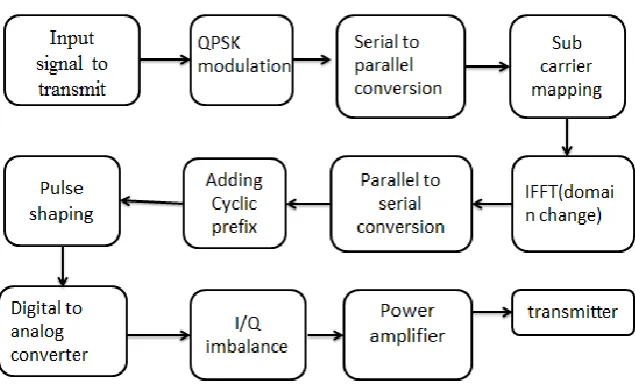
A transceiver structure is proposed to reduce the interference between transmitting and receiving subcarriers and also care has to be taken to avoid the above mentioned subsystem imperfections. This structure utilizes baseband echo cancellation to suppress interference between transmitting and receiving subcarriers. It is possible to achieve subcarrier based duplexing in short range low transmit power communication systems by this transceiver structure. By incorporating this with cooperation strategy performance under realistic conditions can be derived. Although the performance of the cooperative networks degraded due to the residual interference imposed on the receiving subcarriers by the transmitting subcarriers, it still outperforms conventional cooperation schemes. Optimal decode and forward has power consumption less than that of AF&DF cooperation scheme. This is a major advantage of optimal DF scheme.
Quadrature Amplitude Modulation is used for modulation.It conveys two analog message signals, or two digital bit streams, by changing (modulating) the amplitudes of two carrier waves, using the amplitude-shift keying (ASK) digital modulation scheme or amplitude modulation (AM) analog modulation scheme. The two carrier waves, usually sinusoids, are out of phase with each other by 90° and are thus called quadrature carriers or quadrature components — hence the name of the scheme. The modulated waves are summed, and the resulting waveform is a combination of both phase-shift keying (PSK) and amplitude-shift keying (ASK), or (in the analog case) of phase modulation (PM) and amplitude modulation.
IV.PROPOSED WORK
Fig. 4.1 Block diagram of proposed transceiver structure.
Quadrature Phase Shift Keying (QPSK)-It is a form of Phase ShiftKeying in which two bits are modulated at once, selecting oneof four possible carrier phase shifts (0, 90, 180, or 270 degrees).QPSK allows the signal to carry twice as much informationas ordinary PSK using the same bandwidth.
Cyclic Prefix method-It is a copy of last part of OFDM symbol to the beginning of the symbol and is removed at the receiver before demodulation. It should be at least as long as significant part of impulse response experienced by the transmitted signal.
I/Q imbalance- The In-phase (I) and the Quadrature (Q) channels are necessary for any angle modulated signals because the two sidebands of the RF spectrum contain different information and may result in irreversible corruption if they overlap each other without being separated into two phases.
V. EXPERIMENTAL RESULTS
Computer simulation is done to evaluate the performance of the proposed transceiver and these are also compared to the analytical results developed in the previous section. We target a system with parameters similar or related to those specified by the IEEE 802.11a/g standard. The transmit messages on each subcarrier are modulated by QPSK. The FFT size and CP length are 64 and 16, respectively and the total number of subcarriers utilized is 52. The pulse shaping filter is a Hanning windowed sinc function, with oversampling factor RTx=16. For simplicity no convolution coding or data scrambling is applied. Both the near-end and far-end channels are modeled as multipath Rayleigh fading, with the path loss model and power delay profile (PDP) given by standard IEEE 802.11 WLAN channel model.
Figure 5.1 Performance of the proposed transceiver with interleaved subcarrier allocation
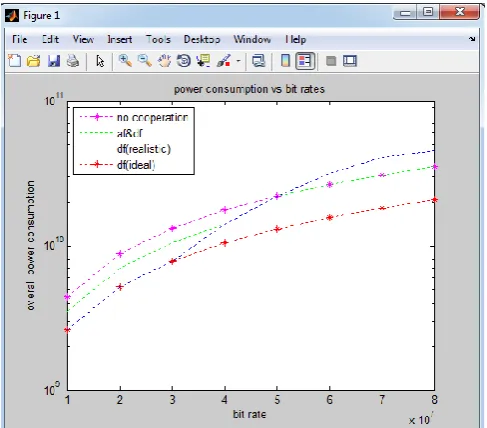
Fig. 5.2 shows the results when the data rate of user 1 and user 2 varies while d10 is fixed to be 50m. It can be seen that the difference between the power consumption of DF cooperation in the ideal case and that in the realistic case increases with the data rate. The reason is that the transmit power of user 1 increases with the data rate, therefore more interference is generated to the data streams from user 2 to user 1, and user 2 needs to scale up its transmit power in order to compensate for the SINR loss. As the data rate increases, the extra transmit power required by user 2 also increases, thus the total power consumption of optimal DF cooperation will finally exceed that of AF&DF cooperation and that of no cooperation. However, it can be seen from Fig. 5.2 that optimal DF cooperation is advantageous in most of the data rate region. This remains a power consuming method.
REFERENCES
[1] Xin Wang and Georgios B.Giannakis, “Resource allocation for wireless multiuser OFDM networks”, IEEE Transaction on Information theory,vol.57,No.7,July 2011.
[2] Shunqing Zhang and Vincent K.N Lau, “Resource allocation for OFDMA system with orthogonal relay using rateless code”, IEEE Transaction on Wireless Communication,vol.7,No.11,November 2008.
[3] Wenbing Dang,Meixia Tao,Hua Mu and Jianwei Huang, “Subcarrier Pair Based Resource Allocation for cooperative Multi-Relay OFDM systems”, IEEE Transaction on Wireless Communication,vol.9,No.5,May 2010.
[4] B.Gui,L.Dai and L.J.C.Jr.‟ “Selective relaying in cooperative OFDM systems:two hop random network”, Proc.IEEE WCNC‟07.
[5] Shenghong Li and Ross D.Murch, “Realizing cooperative Multiuser OFDMA systems with Subcarrier Resource Allocation”, IEEE Transaction on Wireless Communication, vol.12, No.4,April 2013.
[6] F.Sjoberg, M.Isaksson, R.Nilsson, P.Odling, S.K.Wilson and P.O.Borjesson, “Zipper:a duplex method for VDSL based on DMT”, IEEE Transaction Communication,vol.47, No.8, August 1999.
[7] D.Falconer, “Adaptive reference echo cancellation”, IEEE Transaction Communication, vol.30, No.9, Sep.1982.
[8] E.Costa and S.Pupolin, “M-QAM-OFDM system performance in the presence of a nonlinear amplifier and phase noise”, IEEE Transaction Communication, vol.50, No.3,March 2002.
[9] G.Kramer, M.Gastpar and P.Gupta, “Cooperative strategies and capacity theorems for relay networks”, IEEE Transaction Inf. Theory, vol.51, No.9, Sep.2005.
[10] J.Tubbax, B.Come, L.V.der Perre, S.Donnay, M.Engels, H.DeMan and M.Moonen “Compensation of IQ imbalance and phase noise in OFDM systems”, IEEE Transaction on Wireless Communication, vol.4, No.13,May 2005.
[11] S.Bakim AND O.Kaya, “Cooperative strategies and achievable rates for two user OFDMA channels”, IEEE Transaction on Wireless Communication, vol.10, No.12,Dec 2011.