The Thirty-Third AAAI Conference on Artificial Intelligence (AAAI-19)
Reverse-Engineering Satire, or “Paper on
Computational Humor Accepted despite Making Serious Advances”
Robert West
* EPFL [email protected]Eric Horvitz
Microsoft Research [email protected]Abstract
Humor is an essential human trait. Efforts to understand hu-mor have called out links between huhu-mor and the foundations of cognition, as well as the importance of humor in social en-gagement. As such, it is a promising and important subject of study, with relevance for artificial intelligence and human– computer interaction. Previous computational work on hu-mor has mostly operated at a coarse level of granularity, e.g., predicting whether an entire sentence, paragraph, document, etc., is humorous. As a step toward deep understanding of humor, we seek fine-grained models of attributes that make a given text humorous. Starting from the observation that satir-ical news headlines tend to resemble serious news headlines, we build and analyze a corpus of satirical headlines paired with nearly identical but serious headlines. The corpus is con-structed viaUnfun.me, an online game that incentivizes play-ers to make minimal edits to satirical headlines with the goal of making other players believe the results are serious head-lines. The edit operations used to successfully remove humor pinpoint the words and concepts that play a key role in mak-ing the original, satirical headline funny. Our analysis reveals that the humor tends to reside toward the end of headlines, and primarily in noun phrases, and that most satirical head-lines follow a certain logical pattern, which we termfalse analogy. Overall, this paper deepens our understanding of the syntactic and semantic structure of satirical news headlines and provides insights for building humor-producing systems.
1
Introduction
Humor is a uniquely human trait that plays an essential role in our everyday lives and interactions. Psychologists have pointed out the role of humor in human cognition, includ-ing its link to the identification of surprisinclud-ing connections in learning and problem solving, as well as the importance of humor in social engagement (Martin 2010). Humor is a promising area for studies of intelligence and its automa-tion: it is hard to imagine a computer passing a rich Turing test without being able to understand and produce humor. As computers increasingly take on conversational tasks (e.g., in chat bots and personal assistants), the ability to interact with users naturally is gaining importance, but human–computer interactions will never be truly natural without giving users
*Research done partly at Microsoft Research.
Copyright © 2019, Association for the Advancement of Artificial Intelligence (www.aaai.org). All rights reserved.
g h
h′ h′
Task 1:
Unfun the headline!
Task 2:
Real or not?
RA(h,h′) RB(g)
A
B
Satirical headlines
Real headlines
Modified satirical 1
2
3 3
God diagnosed with bipolar disorder
Words changed: 2
real serious
real serious
Obama elected president
Figure 1:Unfun.me, a game for building a corpus of pairs
(h,h0)of satirical and similar-but-serious-looking headlines. Numbers: order of steps. Screenshots: running example (h=
God diagnosed with bipolar disorder; h0=Bob Dylan
diag-nosed with bipolar disorder; g=Obama elected president).
the option to say something funny and have it understood that way; e.g., recent work has shown that misunderstanding of playful quips can be the source of failures in conversa-tional dialog in open-world interaction (Andrist et al. 2016). Given how tied humor is to the human condition, the phenomenon has challenged some of the greatest thinkers throughout history and has been the subject of much aca-demic research across over 20 disciplines (Raskin 2008), in-cluding computer science (Binsted et al. 2006), where re-searchers have developed algorithms for detecting, analyz-ing, and generating humorous utterances (cf. Sec. 6).
headline is funny in and of itself is the rest of the story writ-ten (Glass 2008). This is markedly different from real news stories and means thatsatirical news headlinescan be stud-ied in isolation from the full stories, whose essence they con-vey in a concise form with minimal narrative structure.
An additional advantage of satirical headlines is that they mimic the formulaic style of serious news headlines, which limits their syntactic variability and allows us to better con-trol for syntax and focus on semantics. Moreover, satirical headlines are similar to serious news headlines not only in style but also in content: changing a single word often suf-fices to make a satirical headline sound like serious news.
Running example.For instance, changingGodtoBob Dy-lan turns the satirical headlineGod diagnosed with
bipo-lar disorder,which was published in the satirical newspaper
The Onion, intoBob Dylan diagnosed with bipolar
disor-der,which could appearverbatimin a serious newspaper. A large corpus of such pairs of satirical and similar-but-serious-looking headlines would open up exciting opportu-nities for humor research. For instance, it would allow us to understand why a satirical text is funny at a finer granular-ity than previously possible, by identifying the exact words that make the difference between serious and funny. This is a striking difference from most previous research, where usually theaveragesatirical headline is compared to the
av-erageserious one (Mihalcea and Pulman 2007). Moreover,
while the principal goal of this research has been to achieve new insights about humor, we also imagine new applica-tions. For example, if we attained a grasp on the precise dif-ferences between satirical and serious headlines, we might be able to create procedures for transforming real news headlines into satirical headlines with minimal changes.
To create an aligned corpus, a first idea would be to au-tomatically pair satirical with serious news headlines: start with a satirical headline and find the most similar serious headline written around the same time. It is hard to imagine, though, that this process would yield many pairs of high lex-ical and syntactic similarity. An alternative idea would be to use crowdsourcing: show serious headlines to humans and ask them to turn them into satirical headlines via minimal edits. Unfortunately, this task requires a level of creative tal-ent that few people have. Even atThe Onion,America’s most prominent satirical newspaper, only 16 of 600 headlines gen-erated each week (less than 3%) are accepted (Glass 2008).
The crucial observation is that the task is much easier in the reverse direction: it is typically straightforward to re-move the humorfrom a satirical headline by applying small edits that turn the headline into one that looks serious and could conceivably be published in a real news outlet. In other words, reversing the creative effort that others have already invested in crafting a humorous headline requires much less creativity than crafting the headline in the first place. We thus adopt this reverse-crowdsourcing approach, by design-ing agame with a purpose(von Ahn and Dabbish 2008).
The game is called Unfun.meand is described graphi-cally in Fig. 1. A playerAof the game is given a satirical news headlinehand asked to modify it in order to fool other players into believing that the resulth0is a real headline from
a serious news outlet. The rewardRA(h,h0)received by the playerAwho modified the satirical headline increases with the fraction of other players rating the modified headlineh0
as serious and decreases with the number of words changed in the original headlineh.
Contributions. Our main contributions are twofold. First, we presentUnfun.me, an online game for collecting a cor-pus of pairs of satirical news headlines aligned to similar-but-serious-looking headlines (Sec. 2). Second, our analy-sis of these pairs (Sec. 3–5) reveals key properties of satiri-cal headlines at a much finer level of granularity than prior work (Sec. 6). Syntactically (Sec. 4), we conclude that the humor tends to reside in noun phrases, and with increased likelihood toward the end of headlines, giving rise to what we term “micro-punchlines”. Semantically (Sec. 5), we ob-serve that original and modified headlines are usually op-posed to each other along certain dimensions crucial to the human condition (e.g.,high vs. low stature, life vs. death), and that satirical headlines are overwhelmingly constructed according to a false-analogypattern. We conclude the pa-per by discussing our findings in the context of established theories of humor (Sec. 7).
2
Game description:
Unfun.me
Here we introduceUnfun.me, our game for collecting pairs of satirical and similar-but-serious-looking headlines. The game, available online at http://unfun.me and visually de-picted in Fig. 1, challenges players in two tasks.
Task 1:Unfun the headline!This is the core task where the reverse-engineering of satire happens (left panel in Fig. 1). A player,A, is given a satirical headlinehand is asked to turn it into a headlineh0 that could conceivably have been pub-lished by a serious news outlet, by changing as few words as possible.
Task 2:Real or not?Whether on purpose or not, playerA
may have done a bad job in task 1, andh0 may still be hu-morous. Detecting and filtering such cases is the purpose of task 2 (right panel in Fig. 1), whereh0 is shown to another player,B, who is asked to indicate her belief pB(h0)thath0 comes from a serious news outlet using a slider bar ranging from 0% to 100%. We shall refer to pB(h0)asB’s serious-ness ratingofh0. For reasons that will become clear below, playerBalso indicates her beliefpB(g)for a second, unmod-ified headlineg(unrelated toh) that originates from either a serious or a satirical news outlet. The two headlinesh0andg
are presented in random order, in order to avoid biases. For the purpose of incentivizing players to make high-quality contributions, we reward them as follows.
Reward for task 1. As player A is supposed to remove
the humor from h via a minimal modification, his reward
RA(h,h0)increases (1) with the average ratingr(h0)that the modified headlineh0 receives from all nplayersB1, . . . ,Bn who rate it and (2) with the similaritys(h,h0)ofhandh0:
RA(h,h0) =
p
r(h0)s(h,h0), (1)
where r(h0) =1
n
n X
i=1
pBi(h
0),
s(h,h0) =1− d(h,h
0)
where, in turn, |x| is the number of tokens (i.e., words) in a string x, and d(h,h0), the token-based edit distance
(Navarro 2001) betweenh andh0, i.e., the minimum num-ber of insertions, deletions, and substitutions by whichhcan be transformed into h0, considering as the basic units of a string its tokens, rather than its characters. The geometric mean was chosen in Eq. 1 because it is zero whenever one of the two factors is zero (which is not true for the more standard arithmetic mean): a modified headline that seems very serious, but has nothing to do with the original, should not receive any points, nor should a headline that is nearly identical to the original, but retains all its humor.
Reward for task 2. Since player B’s very purpose is to determine whether h0 is without humor, we do not have a ground-truth rating forh0. In order to still be able to reward playerBfor participating in task 2, and to incentivize her to indicate her true opinion abouth0, we also ask her for her be-liefpB(g)regarding a headlinegfor which we do have the ground truth of “serious” vs. “satirical”. The rewardRB(g) that playerBreceives for rating headlinegis then
RB(g) =
log(pB(g)) ifgis serious, log(1−pB(g)) ifgis satirical.
(2)
Note that this is aproper scoring rule(Gneiting and Raftery 2007), i.e., playerBmaximizes her expected reward by in-dicating her true belief. This would not be true for the more straightforward scoring formula without logarithms, which would drive players to report beliefs of 0 or 1 instead of their true beliefs. Also, ash0andgare shown in random order,B
does not know which is which, and her optimal strategy is to indicate her true belief on both.
Overall game flow.Whenever a user wants to play, we gen-erate a type-1 task with probabilityα=1/3 and a type-2 task with probability 1−α=2/3, such that we can collect two ratings per modified headline. As mentioned, ratings from task 2 can serve as a filter, and we can increase its precision at will by decreasingα. To make rewards more intuitive and give more weight to the core task 1, we translate and scale rewards such that RA(·,·)∈[0,1000] andRB(·)∈[0,200]. We also implemented additional incentive mechanisms such as badges, high-score tables, and immediate rewards for par-ticipating, but we omit the details for space reasons.
Satirical and serious headlines.The game requires corpora of satirical as well as serious news headlines as input. Our satirical corpus consists of 9,159 headlines published by the well-known satirical newspaperThe Onion;our serious cor-pus, of 9,000 headlines drawn from 9 major news websites.
Data and code.We make the data collected viaUnfun.me, as well as our code for analyzing it, publicly available online (West and Horvitz 2019).
3
Analysis of game dynamics
ViaUnfun.me, we have collected 2,801 modified versionsh0
for 1,191 distinct satirical headlinesh(2.4 pairs per satirical headline). All but 7 modified headlines have received at least one rating, and 1,806 (64%), at least two (mean/median: 2
ratings per modified headline). The modified headlines (rat-ings) came from 582 (546) unique user ids (mean/median: 4.8/2 modified headlines per user; 10/4 ratings per user).
We start by analyzing the edit operations players perform in task 1 and the seriousness ratings they provide in task 2. The main objects of study are pairs(h,h0)consisting of an original satirical headlinehand a modified versionh0, which we shall simply callpairsin what follows.
Edit distance. The first interesting question is how much players tend to modify original satirical headlineshin order to expunge the humor from them. We quantify this notion via the token-based edit distanced(h,h0)between the satir-ical headlinehand the modified versionh0(cf. Sec. 2). Fig. 2(a), which plots the distribution of edit distance, shows that very small edits are most common, as incentivized by the re-ward structure of the game (Eq. 1). In particular, 33% of all pairs have the smallest possible edit distance of 1, and 57% (69%) have a distance up to 2 (3).
Tradeoff of edit distance vs. seriousness rating. The re-ward structure of the game (Eq. 1) does not, however, ex-clusively encourage small edits. Rather, there is a tradeoff: larger edits (bad) make it easier to remove the humor (good), while smaller edits (good) run the risk of not fully removing the humor (bad). Fig. 2(b), which plots the mean average se-riousness ratingr(h0)of modified headlinesh0as a function of the edit distanced(h,h0), shows how this tradeoff plays out in practice. For edit distances between 1 and 5 (83% of all pairs, cf. Fig. 2(a)), seriousness ratings correlate pos-itively with edit distance. In particular, it seems harder to remove the humor by changing one word than by changing two words, whereas the marginal effect is negligible when allowing for even larger edits. The positive correlation does not hold for the much smaller number (17%) of pairs with an edit distance above 5. Inspecting the data, we find that this is caused by headlines so inherently absurd that even large edits cannot manage to remove the humor from them.
Seriousness ratings.Recall that, in task 2, players attribute seriousness ratings to modified headlines h0, as well as to unmodified serious or satirical headlinesg. We find that, in all three cases, the distribution of seriousness ratings is bi-modal, with extreme values close to 0 or 1 being most com-mon. Hence, we binarize ratings into two levels, “satirical” (rating below 0.5) and “serious” (rating above 0.5).
In order to see how people rate serious, satirical, and mod-ified headlines, respectively, Table 1 aggregates ratings by headline (considering only the 1,806 headlines with at least two ratings) and splits the headlines into three groups: “con-sensus serious” (over 50% “serious” ratings), “no consen-sus” (exactly 50%), and “consensus satirical” (under 50%).
We make two observations. First, modified headlines h0
subse-1 3 5 7 9 11 13
Token−based edit distance
0
200
600
Number of pairs
0.0
0.4
0.8
Cum
ulativ
e rel. frequency
(a)
0.30
0.40
0.50
0.60
1 2 3 4 5 6 7 8 9 10 Token−based edit distance
Mean a
vg. ser
iousness r
ating
(b)
Insertion Deletion Substit.
0.0
0.2
0.4
0.6
0.8
Relativ
e frequency
All pairs Pairs with edit dist. 1
(c)
1 3 5 7
Chunk−based edit distance
0
50
150
250
Number of pairs
0.0
0.4
0.8
Cum
ulativ
e rel. frequency
(d)
Figure 2:(a)Distribution of token-based edit distance in headline pairs collected viaUnfun.me.(b)Tradeoff of edit distance vs. seriousness rating (only pairs with at least 2 ratings; with bootstrapped 95% confidence intervals).(c)Distribution of token-based edit operations (successful pairs only, cf. Sec. 3).(d)Distribution of chunk-based edit distance (successful pairs only).
Table 1: Rating distributions for pairs with at least 2 ratings. “No consensus” large as most pairs have exactly 2 ratings.
Aggregate rating Serious Satirical Modified Consensus serious 777 (57%) 105 (8%) 654 (36%) No consensus 447 (33%) 368 (27%) 570 (32%) Consensus satirical 133 (10%) 871 (65%) 582 (32%)
quent analyses to the corresponding 654successful pairs.1
Second, the ratings are heavily skewed toward the ground truth for unmodified serious (column 1) and satirical (col-umn 2) headlines; i.e., players can typically well distinguish serious from satirical headlines (but cf. discussion in Sec. 7).
Insertions, deletions, substitutions.When computing the edit distanced(h,h0)using dynamic programming, we can also keep track of an optimal sequence of edit operations (insertions, deletions, substitutions) for transforminghinto
h0 (Navarro 2001). In Fig. 2(c), we plot the distribution of edit operations, macro-averaged over all pairs. We see that substitutions clearly dominate (61%), followed by deletions (34%), with insertions being very rare (5%).
Pairs with edit distance 1 are particularly interesting, as they are the most similar, as well as the most frequent (Fig. 2(a), footnote 1). Also, the optimal edit sequence may not be unique in general, but for edit distance 1 it is. Hence, Fig. 2(c) also displays the distribution over edit operations for pairs with edit distance 1 only. Here, substitutions dominate even more (77%), and insertions are even rarer (2%).
Reversing the direction of the editing process, we hence conclude that writers of satirical headlines tend to work overwhelmingly by substituting words in (hypothetical) sim-ilar-but-serious headlines, and to a certain degree by adding words, but very rarely by deleting words.
4
Syntactic analysis of aligned corpus
Next, we go one level deeper and ask: what parts of a satir-ical headline should be modified in order to remove the hu-mor from it, or conversely, what parts of a serious headline should be modified in order to add humor? We first tackle
1As a sanity check, we computed the edit-distance distribution
for successful pairs only, finding no big differences from Fig. 2(a).
this question from a syntactic perspective, before moving to a deeper, semantic perspective in Sec. 5.
From tokens to chunks.We analyze syntax at an interme-diate level of abstraction between simple sequences of part-of-speech (POS) tags and complex parse trees, by relying on
achunker(also calledshallow parser). We use OpenNLP’s
maximum entropy chunker (Berger, Pietra, and Pietra 1996), after retraining it to better handle pithy, headline-style text. The chunker takes POS-tagged text as input and groups sub-sequent tokens into meaningful phrases (chunks)without inferring the recursive structure of parse trees; e.g., our run-ning example (Sec. 1) is chunked as [NPBob Dylan] [VP
diagnosed] [PP with] [NP bipolar disorder] (chunk labels
expanded in Table 2). Chunks are handy because they ab-stract away low-level details; e.g., changingGodtoBob Dy-lanrequires a token-based edit distance of 2, but a chunk-based distance of only 1, where the latter is more desirable because it more closely captures the conceptual modification of one entity being replaced by another entity.
Chunking all 9,159 original headlines from ourThe Onion
corpus, we find the most frequent chunk pattern to be NP VP NP PP NP (4.8%; e.g., H2 in Fig. 4(a)), followed by NP VP NP (4.3%; e.g., H4) and NP VP PP NP (3.3%; e.g., H9).
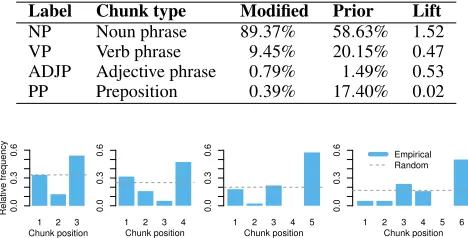
To control for syntactic effects, it is useful to study a large number of pairs(h,h0)where all original headlineshfollow a fixed syntactic pattern. We therefore gave priority to head-lines of the most frequent pattern (NP VP NP PP NP) for a certain time period when sampling satirical headlines as in-put to task 1, such that, out of all 2,801(h,h0)pairs collected in task 1,hfollows that pattern in 21% of all cases.
Table 2: Distribution of syntactic chunk types in single-sub-stitution pairs (only showing types modified at least once).
Label Chunk type Modified Prior Lift NP Noun phrase 89.37% 58.63% 1.52 VP Verb phrase 9.45% 20.15% 0.47 ADJP Adjective phrase 0.79% 1.49% 0.53 PP Preposition 0.39% 17.40% 0.02
1 2 3
0.0
0.3
0.6
Chunk position
Relativ
e frequency
1 2 3 4
0.0
0.3
0.6
Chunk position
1 2 3 4 5
0.0
0.3
0.6
Chunk position
1 2 3 4 5 6
0.0
0.3
0.6
Chunk position Empirical Random
Figure 3: Distributions of modified chunk positions in sin-gle-substitution pairs, for original headlines containing 3 to 6 chunks (number of pairs for each length: 24, 38, 123, 38).
accounts for about half of all successful pairs (after discard-ing pairs that were problematic for the chunker).
Dominance of noun phrases. We now ask which
syntac-tic chunk types (noun phrases, verb phrases, etc.) are mod-ified to remove humor. In doing so, we need to be careful, as some chunk types are more commona priorithan oth-ers; e.g., 59% of all chunks in original satirical headlines are noun phrases, 20%, verb phrases, etc. We therefore com-pare the empirical distribution of modified chunks with this prior distribution, via the ratio of the two (termedlift). Ta-ble 2 shows that noun phrases constitute 89% of the modi-fied chunks (lift 1.52), whereas all other chunk types are less frequent than under the prior. We conclude that the humor of satirical news headlines tends to reside in noun phrases.
Micro-punchlines.We now ask where in terms of location within a headline the humor tends to reside. To answer this question, we compute the position of the modified chunk in each headline’s chunk sequence and plot the distribution of modified positions in Fig. 3. We see that, regardless of head-line length, modifications to the last chunk are particularly overrepresented.2This is an important finding: we have pre-viously (Sec. 1) argued that satirical headlines consist of a punchline only, with minimal narrative structure, and indeed it was this very intuition that led us to investigate headlines in isolation. Given Fig. 3, we need to revise this statement slightly: although satirical headlines consist of a single sen-tence, they are often structured—at a micro-level—akin to more narrative jokes, where the humorous effect also comes with the very last words. Put differently, the final words of satirical headlines often serve as a “micro-punchline”.3
2We ascertained that the effect is not due to trailing chunks
po-tentially being (1) longer and (2) more likely to be noun phrases.
3Strictly speaking, the findings of Sec. 4 only pertain to satirical
headlines that are already similar to hypothetical serious headlines, due to selection bias (we only study headlines that players of Un-fun.mechose to modify) and due to our focus on single-substitution pairs (about 50% of successful pairs).
5
Semantic analysis of aligned corpus
After characterizing aligned pairs syntactically, we now move to the semantic level. We first analyze the aligned pairs obtained fromUnfun.meand later discuss our findings in the broader context of established theories of humor (Sec. 7).Example. Before a more general analysis, let us first con-sider again our running example (Sec. 1), God diagnosed
with bipolar disorder. This satirical headline works by
blending two realms that are fundamentally opposed—the human and the divine—by talking about God as a human. Although the literally described situation is impossible (God is perfect and cannot possibly have a disease), the line still makes sense by expressing a crucial commonality between bipolar humans and God, namely that both may act unpre-dictably. But for humans, being unpredictable (due to bipo-larity) is a sign of imperfection, whereas for God it is a sign of perfection (“The Lord moves in mysterious ways”), and it is this opposition that makes the line humorous.
The main advantage of our aligned corpus is that it lets us generalize thisad-hocanalysis of a particular example to a large and representative set of satirical headlines by pin-pointing the essential, humor-carrying words in every head-line: if the humor has been successfully removed from a headlinehby altering certain words, then we know that these very words are key to makinghfunny.
This is especially true for single-substitution pairs; e.g., in the running example,Godwas replaced byBob Dylan(a particular human), giving rise to the serious-soundingBob
Dylan diagnosed with bipolar disorder. The automatically
extracted chunk pair {God,Bob Dylan} surfaces both the crucial commonality in the context of the headline (unpre-dictability) and the crucial opposition (God vs. human; un-predictability as a good vs. bad trait).
While the semantic analysis of original vs. substituted chunks may be difficult to automate, having access to ex-plicit chunk pairs tremendously facilitates a large-scale hu-man analysis. Conducting such an analysis revealed that the above pattern of a crucial commonality combined with a cru-cial opposition occurs in a large fraction of satirical head-lines, and particularly in nearly all single-substitution pairs.
Script opposition.The crucial opposition has been called
script opposition by humor theorists (cf. Sec. 7), and we
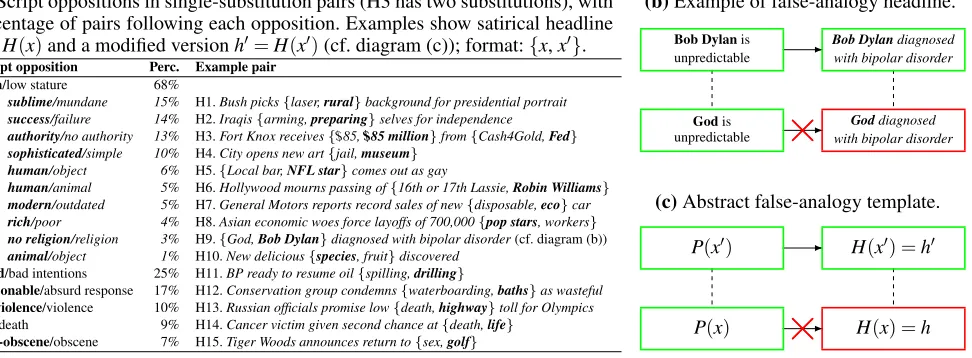
henceforth adopt the same term. Inspecting all 254 sin-gle-substitution pairs, we found each pair to be in at least one of 6 oppositions, all representing “good”-vs.-“bad” di-chotomies that are essential to the human condition, such as
high/low stature,life/death, ornon-obscene/obscene.All 6
oppositions, alongside examples, are listed in Fig. 4(a). We manually labeled all pairs with their (sometimes mul-tiple) oppositions and observe that most pairs (68%) feature an opposition of high/low stature(as in the running exam-ple), and surprisingly few pairs (7%), one ofnon-obscene/
obscene. Due to its dominance, Fig. 4(a) further splits the
high/low statureopposition into 10 subtypes.
exam-(a)Script oppositions in single-substitution pairs (H3 has two substitutions), with percentage of pairs following each opposition. Examples show satirical headline
h=H(x)and a modified versionh0=H(x0)(cf. diagram (c)); format:{x,x0}. Script opposition Perc. Example pair
high/low stature 68%
sublime/mundane 15% H1.Bush picks{laser,rural}background for presidential portrait success/failure 14% H2.Iraqis{arming,preparing}selves for independence authority/no authority 13% H3.Fort Knox receives{$85,$85 million}from{Cash4Gold,Fed}
sophisticated/simple 10% H4.City opens new art{jail,museum}
human/object 6% H5.{Local bar,NFL star}comes out as gay
human/animal 5% H6.Hollywood mourns passing of{16th or 17th Lassie,Robin Williams}
modern/outdated 5% H7.General Motors reports record sales of new{disposable,eco}car rich/poor 4% H8.Asian economic woes force layoffs of 700,000{pop stars, workers}
no religion/religion 3% H9.{God,Bob Dylan}diagnosed with bipolar disorder(cf. diagram (b)) animal/object 1% H10.New delicious{species, fruit}discovered
good/bad intentions 25% H11.BP ready to resume oil{spilling,drilling}
reasonable/absurd response 17% H12.Conservation group condemns{waterboarding,baths}as wasteful no violence/violence 10% H13.Russian officials promise low{death,highway}toll for Olympics
life/death 9% H14.Cancer victim given second chance at{death,life}
non-obscene/obscene 7% H15.Tiger Woods announces return to{sex,golf}
(b)Example of false-analogy headline.
-Bob Dylanis unpredictable
Godis unpredictable
Goddiagnosed with bipolar disorder Bob Dylandiagnosed with bipolar disorder
@ @
(c)Abstract false-analogy template.
-P(x0)
P(x) H(x) =h H(x0) =h0
@ @
Figure 4:(a)Script oppositions and examples.(b)Example of false-analogy headline.(c)Abstract false-analogy template.
ple and depicts the generic template it implements, which may be verbalized as follows. The pair involves two enti-ties,x(God) andx0(Bob Dylan), who share a crucial com-mon property P (unpredictability), but whereas statement
P(x0)(“Bob Dylan is unpredictable”) could potentially entail the serious headlineH(x0) =h0(Bob Dylan diagnosed with
bipolar disorder), the analogous statementP(x)(“God is
un-predictable”) cannot entail the analogous headlineH(x) =h
(God diagnosed with bipolar disorder), forxandx0are
cru-cially opposed via one of the script oppositions of Fig. 4(a)
(religion/no religion;or,God,for whom unpredictability is
a sign of perfection, vs.humans,for whom it is a sign of im-perfection). Hence, we call this mechanismfalse analogy.
As the examples of Fig. 4(a) show, the analogy is never marked lexically via words such aslike;rather, it is evoked implicitly, e.g., by blending the two realms of human psychi-atry and biblical lore into a single headline. Only the satirical headlineH(x)itself (red box in Fig. 4(c)) is explicit to the reader, whereasx0andP(and thus all the other 3 boxes) need to be inferred. A main advantage of our method is that it also makesx0explicit and thereby facilitates inferringPand thus the semantic structure that induces humor (as in Fig. 4(b)).
We emphasize that the script opposition that invalidates the logical step fromP(x)toH(x)is not arbitrary, but must be along certain dimensions essential to human existence and contrasting “good” vs. “bad” (Fig. 4(a)). Interestingly, in typical jokes, the “good” side is explicit and the “bad” side must be inferred, whereas in satirical headlines, either the “good” or the “bad” side may be explicit. And indeed, as shown by the examples of Fig. 4(a) (where the “good” side is marked in bold), satirical headlines differ from typical jokes in that they tend to make the “bad” side explicit.
Single vs. multiple edit operations.A large fraction of all headlines fromThe Onion—and an overwhelming fraction of those in single-substitution pairs—can be analyzed with the false-analogy template (and we indeed encourage the reader to apply it to the examples of Fig. 4(a)). Addition-ally, many of the pairs with two substitutions also follow
this template. H3 in Fig. 4(a), which plays on the opposi-tion of the Federal Reserve being a serious instituopposi-tion vs. Cash4Gold being a dubious enterprise exploiting its cus-tomers, exemplifies how, whenever multiple substitutions are applied, they all need to follow the same opposition (e.g., Fed : Cash4Gold = $85 million : $85 = serious : dubious).
6
Related work
The most widely accepted theory of verbal humor is the so-calledGeneral Theory of Verbal Humorby Attardo and Raskin (1991), an extension of Raskin’s (1985)
Semantic-Script Theory of Humor, which we summarize when
dis-cussing our findings in its context in Sec. 7.
Much follow-up work has built on these theories; see the excellent primer edited by Raskin (2008). Here, we focus on contributions from computer science, where most work has been on thedetection of humorin various forms, e.g., irony (Reyes, Rosso, and Veale 2013; Wallace, Choe, and Char-niak 2015), sarcasm (Davidov, Tsur, and Rappoport 2010; Gonz´alez-Ib´anez, Muresan, and Wacholder 2011), and satire (Burfoot and Baldwin 2009; Goldwasser and Zhang 2016), sometimes with the goal of deciding which of two texts is funnier (Shahaf, Horvitz, and Mankoff 2015). These works use documents or sentences as the smallest unit of analysis, whereas we operate at a finer granularity, analyzing the very words causing the switch from serious to funny.
Another cluster of work has considered thegeneration of humor,mostly via fixed templates such as acronyms (Stock and Strapparava 2006), puns (Binsted and Ritchie 1997; Ritchie et al. 2007), two-liners (Labutov and Lipson 2012), or cross-reference ambiguity (Tinholt and Nijholt 2007).
7
Discussion and future work
Summary of findings. Comparing satirical to similar-but-serious-looking headlines within the pairs collected via
Un-fun.me reveals that the humor tends to reside in the
fi-nal words of satirical headlines, and particularly in noun phrases. In order to remove the humor, players overwhelm-ingly replace one phrase with another; rarely do they delete phrases, and nearly never introduce new phrases. Reversing the direction of the editing process, this implies that the most straightforward way of producing satire from a serious head-line is to replace a trailing noun phrase with another noun phrase.
One may, however, not just replace any noun phrase with any other noun phrase; rather, the corresponding scripts need to be opposed along one of a few dimensions essential to the human condition and typically pitting “good” vs. “bad”. Also, the two opposing scripts need to be connected via cer-tain subtle mechanisms, and we pointed out false analogy as one prominent mechanism. These findings echo the pre-dictions made by the prevailing theory of humor. We now summarize this theory and discuss our results in its context.
Relation to Semantic-Script Theory of Humor.As men-tioned (Sec. 6), the most influential theory of verbal humor has been Raskin’s (1985)Semantic-Script Theory of Humor,
which posits a twofold necessary condition for humorous text: (1) the text must be compatible with two different
se-mantic scripts (simply put, a semantic script is a concept
together with its commonsense links to other concepts); and (2) the two scripts must be opposed to each other along one of a small number of dimensions.
The second criterion is key: the mere existence of two par-allel compatible scripts is insufficient for humor, since this is also the case in plain, non-humorous ambiguity. Rather, one of the two scripts must be possible, the other, impos-sible; one, normal, the other, abnormal; or one, actual, the other, non-actual. These oppositions are abstract, and Raskin (1985, p. 127) gives several more concrete classes of op-position, which closely mirror the dimensions we empiri-cally find in our aligned pairs (Fig. 4(a)). Our results thus confirm the theory empirically. But the advantages of our methodology go beyond, by letting us quantify the preva-lence of each opposition. In addition to the concrete opposi-tions of Fig. 4(a), we also counted how pairs distribute over the above 3 abstract oppositions, finding that most satirical headlines are of type possible/impossible(64%), followed
by normal/abnormal (28%), and finally actual/non-actual
(8%).
In typical jokes, one of the two scripts (the so-calledbona fideinterpretation) seems more likely given the text, so it is in the foreground of attention. But in the punchline it becomes clear that the bona fide interpretation cannot be true, causing initial confusion in the audience, followed by a search for a more appropriate interpretation, and finally surprise or relief when the actually intended, non–bona fide
script is discovered. To enable this process on the recipient side, the theory posits that the two scripts be connected in specific ways, via the so-calledlogical mechanism,which resolves the tension between the two opposed scripts.
Attardo (2001, p. 27) gives a comprehensive list of 27 logical mechanisms. While our analysis (Sec. 5) revealed that one mechanism—false analogy—dominates in satirical headlines, several others also occur: e.g., in figure–ground
reversal,the real problem (the “figure”) is left implicit, while
an unimportant side effect (the “ground”) moves into the focus of attention (e.g., H12 in Fig. 4(a): waterboarding, like baths, does waste water, but the real problem is ethical, not ecological). Another common mechanism—cratylism— plays with the assumption prevalent in puns that phonetic implies semantic similarity (e.g., H11 in Fig. 4(a)).
Satire is a form of art, and the examples just cited high-light that it is often the creative combination of several mechanisms that makes a headline truly funny. Beyond the bare mechanism, the precise wording matters, too: e.g.,
ei-ther16th Lassieor17th Lassiewould suffice to make H6 in
Fig. 4(a) funny, but the combination16th or 17th Lassieis wittier, as it implies not only that Lassie has been played by many dogs, but also that people do not care about them, thus reinforcing thehuman/animalopposition.
We conclude that, while satirical headlines—as opposed to typical jokes—offer little space for complex narratives, they still behave according to theories of humor. Our con-tributions, however, go beyond validating these theories: the aligned corpus lets us quantify the prevalence of syntactic and semantic effects at play and reveals that the dominant logical mechanism in satirical headlines is false analogy.
Satirical-headline generation.This points to a way of gen-erating satirical headlines by implementing the false-anal-ogy template of Fig. 4(c): pick an entityx(e.g., Pepsi) and a central propertyP(x)ofx(e.g., “Pepsi is a popular drink”); then pick another entity x0 for which P(x0)also holds, but which is opposed to xalong one of the axes of Fig. 4(a) (e.g., Bordeaux wine, which is in ahigh/low stature[
sub-lime/mundane] opposition to Pepsi); and finally generate a
headlineH(x0)based onP(x0)(e.g.,2018 Bordeaux vintage
benefits from outstanding grape harvest) which cannot be
seriously formulated forxinsteadx0, due to the opposition, yielding the satiricalH(x)(e.g.,2018 Pepsi vintage benefits
from outstanding high-fructose corn harvest,where we
anal-ogously replacedgrapewithhigh-fructose corn,cf. Sec. 5). The subtitle of the present paper was also generated this way. Most humans are unaware of the logical templates un-derlying satire, while machines have difficulties finding en-tity pairs opposed in specific ways and formulating pithy headline text. We hence see promise in a hybrid system for coupling the respective strengths of humans and machines, where the machine guides the human through the template instantiation process while relying on the human for opera-tions such as finding appropriate entities for substitution etc.
Human perception of satirical vs. serious news. Recall that in task 2 (Sec. 2), players also rate unmodified satiri-cal and serious headlinesgwith respect to how likely they consider them to be serious. Table 1 shows that, although players are generally good at distinguishing satire from real news, they do make mistakes: 10% of serious headlines are consistently misclassified as satirical (e.g.,Schlitz returns,
as serious (e.g.,Baltimore looking for safer city to host
Su-per Bowl parade). Studying these misunderstood headlines
can yield interesting insights into how readers process news, especially in an age where “fake news” is becoming a ubiq-uitous scourge. We leave this analysis for future work.
Beyond humor. The mechanism underlyingUnfun.me
de-fines a general procedure for identifying the essential por-tion of a text that causes the text to have a certain property. In our case, this property is humor, but when asking players instead to remove the rudeness, sexism, euphemism, hyper-bole, etc., from a given piece of text, we obtain a scalable way of collecting fine-grained supervised examples for bet-ter understanding these ways of speaking linguistically.
8
Conclusion
Humor is key to human cognition and holds questions and promise for advancing artificial intelligence. We focus on the humorous genre of satirical news headlines and present
Unfun.me, an online game for collecting pairs of satirical
and similar-but-serious-looking headlines, which precisely reveal the humor-carrying words and the semantic structure in satirical news headlines. We hope that future work will build on these initial results, as well as on the dataset that we publish with this paper (West and Horvitz 2019), in order to make further progress on understanding satire and, more generally, the role of humor in intelligence.
References
Andrist, S.; Bohus, D.; Yu, Z.; and Horvitz, E. 2016. Are you messing with me? Querying about the sincerity of interactions in the open world. InProc. ACM/IEEE International Conference on Human–Robot Interaction (HRI).
Attardo, S., and Raskin, V. 1991. Script theory revis(it)ed: Joke similarity and joke representation model. HUMOR: International Journal of Humor Research4(3/4):293–348.
Attardo, S. 2001. Humorous Texts: A Semantic and Pragmatic Analysis. Walter de Gruyter.
Berger, A. L.; Pietra, V. J. D.; and Pietra, S. A. D. 1996. A maxi-mum entropy approach to natural language processing. Computa-tional Linguistics22(1):39–71.
Binsted, K., and Ritchie, G. 1997. Computational rules for gener-ating punning riddles. HUMOR: International Journal of Humor Research10(1):25–76.
Binsted, K.; Nijholt, A.; Stock, O.; Strapparava, C.; Ritchie, G.; Manurung, R.; Pain, H.; Waller, A.; and O’Mara, D. 2006. Com-putational humor.IEEE Intelligent Systems21(2):59–69.
Burfoot, C., and Baldwin, T. 2009. Automatic satire detection: Are you having a laugh? InProc. Annual Meeting of the Association for Computational Linguistics and International Joint Conference on Natural Language Processing (ACL–IJCNLP).
Davidov, D.; Tsur, O.; and Rappoport, A. 2010. Semi-supervised recognition of sarcastic sentences in Twitter and Amazon. In Proc. Conference on Computational Natural Language Learning (CoNLL).
Filatova, E. 2012. Irony and sarcasm: Corpus generation and anal-ysis using crowdsourcing. InProc. Language Resources and Eval-uation Conference (LREC).
Glass, I. 2008. Tough room. Act one: Make ’em laff.This Amer-ican Life348. https://www.thisamericanlife.org/348/tough-room/ act-one.
Gneiting, T., and Raftery, A. E. 2007. Strictly proper scoring rules, prediction, and estimation. Journal of the American Statistical As-sociation102(477):359–378.
Goldwasser, D., and Zhang, X. 2016. Understanding satirical arti-cles using common-sense.Transactions of the Association of Com-putational Linguistics4(1):537–549.
Gonz´alez-Ib´anez, R.; Muresan, S.; and Wacholder, N. 2011. Identi-fying sarcasm in Twitter: A closer look. InProc. Annual Meeting of the Association for Computational Linguistics: Human Language Technologies (ACL–HLT).
Khodak, M.; Saunshi, N.; and Vodrahalli, K. 2018. A large self-annotated corpus for sarcasm. InProc. Language Resources and Evaluation Conference (LREC).
Labutov, I., and Lipson, H. 2012. Humor as circuits in semantic networks. InProc. Annual Meeting of the Association for Compu-tational Linguistics (ACL).
Martin, R. A. 2010. The psychology of humor: An integrative approach. Elsevier.
Mihalcea, R., and Pulman, S. 2007. Characterizing humour: An exploration of features in humorous texts. InProc. International Conference on Intelligent Text Processing and Computational Lin-guistics (CICLing).
Navarro, G. 2001. A guided tour to approximate string matching. ACM Computing Surveys33(1):31–88.
Raskin, V. 1985.Semantic Mechanisms of Humor. Reidel. Raskin, V., ed. 2008. The Primer of Humor Research. Mouton de Gruyter.
Reyes, A.; Rosso, P.; and Veale, T. 2013. A multidimensional approach for detecting irony in Twitter. Language Resources and Evaluation47(1):239–268.
Ritchie, G.; Manurung, R.; Pain, H.; Waller, A.; Black, R.; and O’Mara, D. 2007. A practical application of computational hu-mour. InProc. International Joint Conference on Computational Creativity (ICCC).
Shahaf, D.; Horvitz, E.; and Mankoff, R. 2015. Inside jokes: Iden-tifying humorous cartoon captions. In Proc. ACM SIGKDD In-ternational Conference on Knowledge Discovery and Data Mining (KDD).
Stock, O., and Strapparava, C. 2006. Laughing with HA-HAcronym, a computational humor system. InProc. National Con-ference on Artificial Intelligence (AAAI).
Tinholt, H. W., and Nijholt, A. 2007. Computational humour: Uti-lizing cross-reference ambiguity for conversational jokes. InProc. International Workshop on Fuzzy Logic and Applications (WILF). von Ahn, L., and Dabbish, L. 2008. Designing games with a pur-pose.Communications of the ACM51(8):58–67.
Wallace, B. C.; Choe, D. K.; and Charniak, E. 2015. Sparse, contextually informed models for irony detection: Exploiting user communities, entities and sentiment. In Proc. Annual Meeting of the Association for Computational Linguistics and Interna-tional Joint Conference on Natural Language Processing (ACL– IJCNLP).