A
rticle
Original Article
A Comparison of Event Analysis and
Multilinear Events Sequencing Techniques for
Reconstructing Unique Phenomena
A
rticle
Ross M. Gardner, MA, CSCSA
Copyright: © 2009 Ross M. Gardner. Copyright for this article is retained by the author, with publication rights granted to the Association for Crime Scene Reconstruction. This is an Open Access article distributed under the terms of the Creative Commons Attribution-Noncommercial-No Derivatives License (http://creativecommons.org/licenses/by-nc-nd/3.0/) which permits unrestricted noncommercial use, distribution, and reproduction, provided the original work is properly cited and not changed in any way.
Crimes represent singularly unique events. No two crimes have the exact same data set leading to their development, they occur in different environments and of course all crimes are temporally disassoci-ated. Granted, analysts can study trends in crimes using tools like the Crime Classifica-tion Manual [1], but the distincClassifica-tions evident in trends, such as the differences noted be-tween a domestic homicide as compared to a sexual homicide, does little to explain the actions of a specific criminal event. Once properly trained and experienced, the crime scene analyst is tasked with a responsibil-ity to evaluate, study and reconstruct these unique incidents. They do this within the constraints of what is often referred to as the “archeologists dilemma” [2][3]. This dilemma is the recognition that the analyst is dealing with a historical incident and has only a small number of artifacts on which
to base their conclusions about the incident. Like an archeologist, no one has all the pieces of the investigative puzzle; thus no one will ever have a complete picture of the incident. Operating within this environ-ment, the crime scene analyst is expected to proceed in an objective fashion and provide a clear factual work product that can aid the judicial system in establishing guilt or in-nocence.
While immersed in the “archeologists dilemma”, the analyst must also contend with the antagonistic nature of the judicial system. Lawyers from both sides of the ta-ble consistently attack any information that fails to meet their particular view of what the “truth” is. Although intended as mea-sures to prevent “junk science” from enter-ing the court, the various legal challenges such as Daubert, Shreck, or Frye are used as
Received: 10.30.2009 Revised: 12.17.2009 Accepted: 12.18.2009
Citation: Gardner, Ross M. “A Comparison of Event Analysis and Multilinear Events Sequencing Techniques for Reconstructing Unique Phenomena.” Journal of the Association for Crime Scene Reconstruction, Volume 16, Issue 1, Winter 2010: pages 1-9.
Abstract: Event Analysis is a specific crime scene analysis method in use today. Its purpose is to objectively define what happened in alleged criminal events and in what order it happened. This article compares Event Analysis methodology to the analysis method known as Multilinear Events Sequenc-ing (MES). MES is an established methodology used by safety specialists, failure analysts, and other scientists to evaluate unique and rare events. This comparison will effectively demonstrate that the two methods are one and the same in theory, process, and purpose.
Keywords: crime scene analysis, crime scene reconstruction, Event Analysis, Multilinear Events Sequencing, Daubert
Original Article
methods to effectively filter valid informa-tion from jurors. Unfortunately, the judges ruling on these concerns appear to be as much in the dark on the concepts of foren-sic science as the lawyers, which routinely leads to less-than-factual claims by lawyers being given credence. Of course these same lawyers use the reality of the “archeologists dilemma” as a bludgeon against the analyst, pointing out that what we know is often less than what we want to know. The bottom line for the forensic analyst is that no mat-ter what the discipline, it will be attacked. It is not enough that the analyst can perform a forensic analysis; the analyst must be able to effectively defend their discipline.
This is the environment and situation that the crime scene analyst faces. In the face of this reality, this paper will compare two reconstruction methodologies. The in-tent is to show their similarities in an effort to aid the crime scene analyst in surviving any courtroom claim that the reconstruc-tion resulting from a crime scene analysis is “unscientific”.
The first method being considered is known as Event Analysis (EA). It was pub-lished as a technique in 1997 by the author and Tom Bevel [4]. Event Analysis was de-signed as a forensic technique to evaluate unique incidents believed to be crimes. The underlying themes that drive Event Analy-sis can be found in various criminal investi-gation references dating back as far as 1898, when Han Gross wrote the first true scien-tific investigative reference [5].
The second method of concern is known as Multilinear Events Sequencing (MES). MES was initially proposed by Ludwig Benner Jr. at the National Bureau of Stan-dards in 1976 to evaluate unique and rare phenomena [6]. Since its publication, it has become an integral part of “failure analysis” studies and other similar reconstruction investigations. These include operations
conducted by the National Transportation Safety Board (NTSB) and the Federal Avia-tion AdministraAvia-tion (FAA). Subsequent to its initial description, MES technique has become an integral part of scientific inves-tigations. It is currently described or refer-enced in numerous texts on system safety, failure analysis or accident investigation. More notable among these texts are Ferry’s, Stephenson’s and Hendrick’s efforts [7][8] [9]. Additionally, similar techniques have developed out of the MES process; this includes a technique known as Events and Causal Factor Analysis (ECFA) [10].
A Comparison of Theories
In 2007 the author and Tom Bevel wrote a paper outlining the theoretical basis of crime scene analysis as well as describing the Event Analysis process [11]. This theo-ry, which had previously been described in a number of references, was simply: “Noth-ing just happens”. A criminal incident is no different than any other historical incident. Every moment in history has a series of causal actions that lead to it and every mo-ment in history has some series of actions that will follow it. By studying the debris of a crime and the context in which that debris is found, some of the actions as-sociated with the incident and their order become evident. The noted physicist and crime scene analyst Edward Oscar Hein-rich was the first author to effectively ar-ticulate this theory. In his biography The Wizard of Berkeley, he described his theory in a slightly more eloquent way, saying that when presented with crime:
Event analysis is a crime scene analysis process, a technique utilized by the crime scene analyst to accomplish objective analy-sis. Thus the theoretical basis and underly-ing principles of crime scene analysis apply directly to Event Analysis.
In 1975 and 1976 Ludwig Benner Jr. pub-lished his theory of Multilinear Events Se-quencing (MES) in two papers in the Jour-nal of Safety Research [13][14]. MES was proposed as a process for accident investi-gation and rare event research that would remove both the hit and miss aspects of the typical investigative effort and provide a more effective technique for hypothesis generation. In describing the underlying theory Benner wrote:
“My hypothesis generation method is based on the premise that the func-tioning of our universe and its con-stituent parts reflects a continuum of interacting events. Events, in this con-text, are used in the sense that some-one or something does something (actor + action = event.) Each event influences one or more events, which follow that event in time. It is the pre-cede follow logic of the related events that provides the key to the hypothesis generation method.” [15]
Based on these descriptions it should be evident that EA and MES share the same underlying belief, actions are linked caus-ally and temporcaus-ally. A unique series of re-lated actions lead to some ultimate act (e.g., a murder or a plane crash). Through de-tailed and organized study of these unique phenomena, some of these actions and their interrelationships will be identified. These techniques can never fully describe all aspects of the incident being studied, but proper application of this theory leads to a more effective understanding of what happened and the order in which it hap-pened. In the case of safety research, this
knowledge may prevent subsequent similar events. In the case of both safety research and crime scene analysis this information will ultimately aid those responsible for as-signing blame for the act.
A Comparison of the Objectives of
EA and MES
There is a simple objective in pursuing Event Analysis as a process. Crime investi-gations can be subjective by their very na-ture. This subjectivity exists for no reason other than human beings pursue the pro-cess. The nature of the subjectivity may be extreme, as in the case of confirmation bias or the interjection of personal prejudices in support of the investigative conclusions. Or it may be minor in form. A minor sub-jective example might be interjecting what the analyst considers to be a logical action into the analysis, to fill some gap, but for which, insufficient foundation in the form of physical evidence exists. Compounding this issue is the ever-present “archeolo-gists dilemma” which always impacts the outcome of any analysis. To remove the potential subjectivity that humans bring to any situation, science defines methods and techniques grounded in the scientific meth-od that guide the analyst. Event Analysis is such a technique; it focuses effort, refines the analyst’s context and helps prevent the introduction of bad information, inappro-priate assumptions, and or bias.
fashion as the data allows. At its core EA involves graphic representation of the crime using the Event Analysis flowchart. Lastly, the conclusions resulting from the analysis and flow chart provide everyone involved with an objective mechanism to evalu-ate more subjective investigative products. This is particularly true of testimonial evi-dence offered in the investigation and the various “theories” presented by suspects, police and lawyers to explain the criminal event.
The stated objective of Multilinear Events Sequencing is to ensure valid, effec-tive investigaeffec-tive work products. It assures the quality of the investigation by focus-ing the efforts of the investigator, puttfocus-ing the collected data into a standard format, preventing the introduction of assump-tions and presenting the conclusions in an objective and understandable format. MES also utilizes a graphic representation of the event, called the MES Tree or Matrix. Like Event Analysis, a stated objective of MES is “determining the quality of non-MES based work products. “ MES in action is used to evaluate the more subjective aspects of any safety investigation or failure analy-sis.
In terms of ultimate objective, EA and MES share the same basic purpose. They provide a path to objective analysis and present the conclusions in an easily under-stood graphical format. Each of these tech-niques was designed to provide the analyst with an objective work product that can be used to check more subjective aspects of the investigation.
The Basic Investigative Unit for
EA and MES
Both Event Analysis and Multilinear Events Sequencing operate around a basic investigative unit. Each seeks to identify as many of these investigative units as feasible,
which in effect provides the detail of the analysis.
In Event Analysis the analyst ultimately defines the incident in question by identify-ing macro components known as “Events”. Think of events as chapters in a book. Each “event” however is made up of discrete ac-tions known as “event segments”. The event segment is the true basic unit of EA. Think of an event segment as a snapshot from the incident, it defines an action that occurred during the incident. All effort is directed at defining these event segments. The more event segments defined, the more detail is known about the events. The more detail known about the events, the more the ana-lyst knows about the overall incident. Event segments are always based on physical evi-dence and described as an action by some entity. This may be a human entity (e.g. Mary touched the wall after injury) or it may be some inanimate object undergoing change (e.g., the chair was knocked over). A temporal association of each event seg-ment to the incident in question is an inte-gral aspect of its definition. This temporal association means establishing the event segment’s sequential and or specific time orientation to the incident.
MES operates on a nearly identical unit called an “Event Block”. In MES the event block (EB) is defined as an actor plus an action and a time sequence. Actors include both human entities and or objects under-going change. Note however that in MES a “time sequence” is not always a literal time (e.g., 10:02:02). Like Event Analysis, time sequence is a temporal association. It may be an estimated time, an actual observed time or a relative time (a sequential order).
A Comparison of EA and MES
Process
achiev-ing EA and MES hold significant similar-ity. This shouldn’t be surprising, since both operate on the basic principle of scientific method.
As with all scientific method, the EA process begins with data collection. Using the data available, the analyst identifies as many discrete actions (the event segments) as possible. When an event segment is rec-ognized, the supporting data is document-ed so it can be found and verifidocument-ed at a later point. The analyst then looks for related event segments. Once relationships are established between segments, the analyst attempts to order the event segments us-ing both absolute chronology (the concept of a specific time) and relative chronology (the concept of sequential order). This lat-ter chronology aspect is accomplished us-ing three sequential tests. Every event segment is evaluated to define whether it: precedes, follows or is near simultaneous to some other segment. Although not ever action can be sequenced, as the sequencing of various segments is accomplished, the analyst begins to map out the incident. This involves literally drawing these sequential relationships. This map will become the Event Analysis Flowchart. It graphically depicts both the actions and the order asso-ciated with those actions. No analysis how-ever presents itself as a complete or absolute picture of the incident; therefore, the fifth step of EA is to try and resolve any appar-ent contradictions that may appear within the data or flow chart. Depending upon the level of data available in a specific situation, resolution of contradictions may or may not be possible. Ordering of the event segments leads to crossover event segments, actions that correlate one event to another. Using this information the sixth step of the EA process is to revisit the events and validate their general order. The final step of EA is to validate the final Event Analysis Flow-chart.
MES also starts with data collection. From the data the analyst identifies the event blocks (identifying an action and the actor). As each EB is identified, the analyst records the data source and then begins to organize the EBs. This is accomplished by applying both sequential tests and seeking cause and effect relationships between EBs. As these relationships are recognized the EBs are organized into a graphical format known as the MES Tree.
Of interest to both EA and MES tech-niques is the predicative value of each pro-cess. The resulting analysis is never a com-plete picture. As event segments or event blocks are identified, logical gaps in the graphic representation will become evi-dent to the analyst. These gaps often re-sult in the generation of new hypotheses whose purpose is to fill the gaps and link the known actions. Consideration of these hypotheses directs the analyst to revisit as-pects of the available data for something that may have been overlooked and or to seek out new data in an attempt to locate evidence that might support or refute the hypothesis in question. This effort may or may not resolve the hypothesis; but if it is possible to resolve, then a more complete analysis results.
Data Sources Used in EA and
MES
or artifact of interest, then such informa-tion is utilized as data.
MES identifies the Event Blocks through a process known as change track-ing method (CTM). A specific actor is tracked and changes in condition, position etc. are documented. As defined by Ben-ner “CTM requires concrete observations of, or data from, any person, document or animate or inanimate source, including the description of things remaining after the occurrence.” [16]
The only difference between data sources used in the two techniques lies in testimonial evidence. EA is based on the recognition that people can lie, fill in blanks in their memory or simply perceive things incorrectly when involved in crimi-nal events. This concern was first articulat-ed in 1898, when Hans Gross commentarticulat-ed that if investigator’s heap testimony upon testimony, they will “almost always be led astray and found wandering from the goal (the truth) [17]. MES on the other hand is designed around system failures that rou-tinely involve human beings. To
function-ally understand why a system failed (e.g. a plane crash or industrial plant explosion) the analyst must consider how the various people involved acted or failed to act based on their perceptions of what was occurring around them. For that reason testimonial evidence is a necessary element of the MES process. Beyond this distinction both sys-tems use the same basic data sources.
EA and MES Output
The most significant work product re-sulting from either Event Analysis or Mul-tilinear Events Sequencing is the graphical flow chart each technique produces. These work products allow the viewer to more effectively grasp the nature and sequence of the actions involved. It also allows for more effective logic testing of this order and helps the analyst recognize where gaps exist in the analysis.
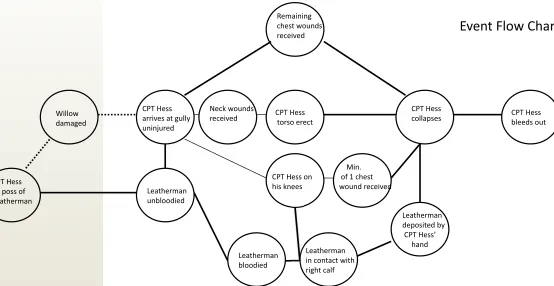
In EA the analyst produces a flow chart of event segments. The event segments are sequentially ordered and depicted based on any known relationships. Figure 1 is an example of an Event Analysis Flowchart.
Figure 1: The Event Analy-sis Flow Chart is a graphi-cal representation of the convoluted actions defined by the analysis. Actions are represented left to right in sequential order. Known sequential relationships are shown with the connecting lines. The final flow chart is ef-fectively the sum total of the analysis, defining what happened and in what order it happened.
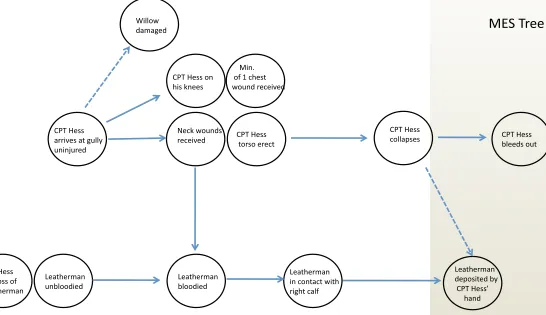
Figure 2: The Multilinear Events Sequencing Tree is also a graphical represen-tation of the analysis in a slightly different format. Each tier tracks a particu-lar actor, with actions list-ed in appropriate sequen-tial order left to right in the tier. Each tier’s actions are oriented sequentially with other tiers. This tier format, although effec-tive, is not conducive to crime scene analysis. The lack of specific sequence and causal information al-ways produces a convolut-ed representation. In an MES tree the connecting arrows between tiers rep-resent causal connections, not sequence. These lines may have to cross several tiers to show the causal connection.
The actions are generally ordered in a left to right orientation and arranged across the page based on both causal and temporal as-sociations.
In MES the analyst produces a flow chart called the MES Tree or Matrix. Event blocks are arranged in tiers within this flow chart. Each tier, in effect tracks a particu-lar actor. All of the event blocks associated with that actor are arranged in linear orien-tation, left to right and in sequential order. The MES tree then depicts causal relation-ships between different actors (different tiers) by interjecting arrows from the ap-propriate location in one tier to some point in another tier. See Figure 2.
These graphical work products are significant in accomplishing both tech-niques. The graphical output is not just an end product; it is an integral part of each analysis. Significant logical reasoning as well as a search for data to support the se-quential order presented in the flow chart are necessary to produce these charts. Each
flow chart is analyzed and scrutinized from its inception for logical errors by the ana-lyst.
Practical Utilization of the
Result-ing Work Product
considered as distinct hypotheses. These claims become theories that are compared to the analysis. If the theory matches up to the analysis, that theory is possible and remains a viable explanation. If the theory contradicts the analysis, it is refuted. As re-quired of all scientific effort, once refuted a theory must either be revised to resolve the contradiction or abandoned as a viable explanation.
Summary
Crime scene analysts are asked to evuate both the scene and the debris of al-leged crimes in an effort to describe what happened and in what order it happened. Whatever method they use to pursue this purpose must be objective, at least if their effort is to have value to and meet the sci-entific standards expected by the judicial system. Event Analysis is a specific crime scene analysis technique designed around this objective. Event Analysis is based on themes found in the long history of crime scene analysis and criminal investigations, but it also mirrors a technique that devel-oped in the framework of modern scientific scrutiny. This newer technique, Multilinear Events Sequencing, is an established pro-cess utilized by engineers, scientists, and accident investigators to explain unique events in their individual areas of study.
To effectively survive a Daubert or Frye style challenge in court, the crime scene an-alyst must describe the underlying theory, principles and methodology associated with Event Analysis. This technique must stand on its own merit. But when the question is posed: To what degree has Event Analysis technique and theory been generally accept-ed by the scientific community? The ana-lyst can respond in a strong and very spe-cific fashion. These two techniques, Event Analysis and Multilinear Events Sequenc-ing, match each other in process and form from inception to end. The only differences
noted between these systems of analysis are minor. Each produces a flow chart made up of the same basic building blocks presented in a sequential format, but one chooses to do so linearly while the other does not. The second difference lies in the data used in forming the conclusions. EA reduces the analyst’s reliance on subjective testimonial evidence, whereas MES must incorporate such information. Beyond these differences they are effectively one and the same tech-nique.
If considered scientific in one discipline, a technique cannot logically become un-scientific when used in another. Any claim that Event Analysis is unscientific, is in fact a statement that the MES technique em-ployed by scientists, structural engineers and failure analysts is also unscientific. Granted some lawyer will eventually have the gall to make this preposterous claim, but if a judge gives credence to and ac-cepts it, then simply put science itself has no chance and that community has bigger things to worry about than the guilt or in-nocence of one person.
References
[1] Douglas, John, E., Burgess, Ann, W., Burgess, Allen, A. and Ressler, Robert, K. Crime Classification Manual. Lexington Books, NY, NY, 1992
[2] Bevel, T., Gardner R.M. Bloodstain Pattern Analysis With An Introduction to Crime Scene Analysis. 1st Edition, CRC Press, Boca Raton, Fl, 1997, Chapter 2, pg. 2.
[3] Gardner R.M., Bevel, T. Practical Crime Scene Analysis and Reconstruction. CRC Press, Boca Raton, Fl, 2008, Chapter 2, pg. 15.
[5] Gross, Hans. System der Kriminalistic translated in Criminal Investigation: a Practical Textbook. Adam, J.C. Ed., Sweet Maxwell, Ltd., London, England.
[6] Benner, Ludwig Jr. “Rare Event/Acci-dent Research Methodolog y Proceedings of a Work-shop held at the Institute of Applied Technolog y.” National Bureau of Standards, Gaithers-burg, MD, May 26-28 1976, National Bu-reau of Standards, Special Publication 482, 1998.
[7] Ferry, Ted, S. Modern Accident Investiga-tion and Analysis. John Wiley and Sons, Inc., Chickchester, UK, 1988, pg. 183.
[8] Stephenson, Jon. System Safety 2000: A Practical Guide for Planning, Managing and Con-ducting System Safety Programs.John Wiley and Sons, Chickchester, UK, 1991, pg. 256
[9] Hendrick, Kingsley, Benner, Ludwig, Jr. Investigating Accidents With Step. Marcell Dekker, Inc. NY, NY, 1987.
[10] Buys, J.R., Clark, J.L., Kingston-Howell, J., Nelson, H.K., “Events and Causal Factors Analysis.” Technical Research and Science Center, SCIENTECH, Inc., Idaho Falls, ID, Aug 1995.
[11] Gardner, R.M., Bevel, T. “Theoretical and Practical Considerations in Crime Scene Anal-ysis.” JFI 57, 6, 2007, pp. 891-910.
[12] Block, E. Wizard of Berkeley. Coward-McCann Inc, NY., NY. pg. 44.
[13] Benner, Ludwig Jr. “Accident Investi-gations: Multilinear Events Sequencing Methods.” Journal of Safety Research, WA, DC, Vol. 7, 1975.
[14] Benner, Ludwig Jr. “Generating Hy-potheses to Explain Accidents and Other Rare Events.” Journal of Safety Research, WA, DC, Vol. 10, 1976.
[15] Benner, Ludwig Jr. “Rare Event/Acci-dent Research Methodolog y Proceedings of a Work-shop held at the Institute of Applied Technolog y.” National Bureau of Standards, Gaithers-burg, MD, May 26-28 1976, National Bu-reau of Standards, Special Publication 482, 1998.
[16] Benner, Ludwig, Jr. “Multilinear Events Sequencing Technolog y Guide.” Chap-ter 4, pg. 3., Starlines www.starlines.com/ product/guides/MESGuid04.html.