PRECEDE model on the regular physical activity
among elderly people
Parinaz Doshmangir1, Shayesteh Shirzadi1,
Mohamad Hossein Tagdisi2, Leila Doshmangir3
Abstract
PRECEDE model is the most appropriate model for planning in health education and promotion. The aim of this study is the effect of educational intervention based on PRECEDE model on the regular physical activity among elderly people. In this study, 80 elderly people were selected based on inclusion criteria and randomly assigned in experimental and control groups. Educational program for regular physical activity was designed with considering predisposing, enabling, reinforcing factors that are effective for regular physical activity in elderly people. Before educational intervention, questionnaires completed by the participants and then experimental group received the educational intervention. After one month of intervention the questionnaires were filled again and collected data was analyzed with SPSS-21, t-test and Chi-Square and ANOVA. Mean score for predisposing factor (knowledge of 11.37 to 15.07, attitude of 24.1 to 25, self- efficacy of 9.62 to 13.97), reinforcing factor (6.22 to 8.32) and enabling factor (8.37 to 16.67) in experimental group in signiticant level. Education was effective on predisposing, enabling and reinforcing factors that are effective for regular physical activity in elderly people. By using Educational diagnosis phase of PRECEDE model we can plan various educational programs for encouraging elderly people for doing regular physical activity.
Keywords: Elderly, Physical Activity, PRECEDE model
Journal of Research & Health Social Development & Health Promotion
Research Center Vol.5, No.2, Summer 2015
Pages: 172-177
Original Article
1. PhD Student in Health Education and Promotion, Department of Health Education, School of Public Health, Tabriz University of Medical Sciences, Tabriz, Iran 2. Professor of Health Education, Department of Health Education and Promotion, School of Public Health, Iran University of Medical Sciences, Tehran, Iran
3. Correspondence to: Assistant Professor of Health Policy, Department of Health Services Management and Iranian Center of Excellence in Health Management, School of Management and Medical Informatics, Tabriz University of Medical Sciences, Tabriz, Iran
Tel/Fax: +98 41 33380457 Email: [email protected]
Received: 25 Mar 2013 Accepted: 5 May 2014
How to cite this article: Doshmangir P, Shirzadi Sh, Tagdisi MH, Doshmangir L. The effect of educational intervention according to PRECEDE model on the regular physical activity among elderly people; J Research Health2015; 5(2): 172-177.
Introduction
In recent years, medical care and health have always complemented each other [1]. Combining the two has increased life expectancy, and in demographic transition, has led to increased population of those over 60 years old. As defined by the World Health Organization, this group of people is called the elderly. Currently,
The old age, according to normal human development, is a natural period with physical, physiological and social changes. Yet, some physiological changes can be altered or delayed through healthy lifestyle choices [4]. The World Health Organization defines ideal health for the elderly as enjoying functional independence. According to this definition, 5% of the elderly are debilitated, 20% are weak, and 75% are dependent [5]. Regular physical activity plays a significant role in prevention and control of chronic diseases in old age [1]. Other benefits of regular physical activity in this period include: reduced blood pressure, prevention and control of diabetes, reduced cognitive and neuronal disorders and osteoarthritis, and reduced mortality rate and age-related diseases [6].
According to CDC report, 23.1% of people aged 65-74 years and 35.9% of over 75s are inactive. This means that they did not take part in household chores or in coming and goings. Thus, improving regular physical activity among the elderly is considered a national health priority [7]. Studies conducted in America show, despite many benefits of exercise in this age group, more than 75% of American elderly do not regularly perform physical activities [8].
Health education, with emphasis on health and prevention plays an important role in enhancing health behaviors [9], and achieving this objective is impossible, without attention to planning in educational programs [10]. Application of theories and models, by creating conditions to identify people’s characteristics, supportive environments, and other influential factors, increases the possibility of success of educational programs [11].
An intervention to achieve this is PRECEDE model, which is part of PRECEDE-PROCEED model and part of planning models in health education and health promotion [12]. By utilizing this model, the most appropriate strategies and interventions may be identified and implemented. PRECEDE has a set of stages that deals with examination and grouping of predisposing, reinforcing, and enabling factors in educational recognition [13].
We have used this model because of its
comprehensiveness and applicability to different populations [11]. Effective application of this model in several studies has been proven, for instance: Afkari studied the effect of training according to PRECEDE model, and revealed improved quality of elderly life [14]. Salinero also confirmed the efficacy of this model in his study [15].
The present study was conducted given the importance of regular physical activity in old age and in absence of PRECEDE-based educational program about physical activity of the elderly, with the aim to use educational recognition phase of PRECEDE model as educational intervention framework to examine predisposing, enabling, and reinforcing factors of physical activity in old age and the effect of training on these factors.
Method
This quasi-experimental study was conducted with the aim to determine the effect of educational intervention on predisposing, enabling, and reinforcing factors in regular physical activity in old age. Participant size was estimated according to 1-β=80%, zβ=84%, σ1=3.8, σ2=2.5, and d=1.8. Minimum participant size for trial and control group was found 40. The elderly frequently presenting to the health center entered the study if they qualified and were willing to, and were placed in either control or trial group. Study inclusion criteria were age 60 years and older, personal consent, elderly file at the health center, and no particular diseases that would prevent their activity. The educational recognition phase of PRECEDE model was utilized to design framework of study to teach regular physical activity to participating elderly. Knowledge, attitude, and self-efficacy were considered as predisposing factors for elderly regular physical activity, holding training sessions and presenting educational subjects as enabling factors, and pleasant feeling due to regular exercise, encouragements by family and physician as reinforcing factors.
demographic details (age, gender, education level), knowledge (20 items, with score ranging from 0 to 20), with “yes” or “no” answers, aiming to assess participants’ knowledge about benefits of exercise in old-age, points to be considered before and after exercise, and variety of old-age exercises, attitude (6 items, with score ranging from 6 to 36), enabling factors (7 items, score ranging from 7 to 28), reinforcing factors(3 items, score ranging from 3 to 12), and Physical Exercise Self-Efficacy questionnaire [16]. Questionnaires were completed using interviews, so that items were read out to the elderly, and the interviewer completed questionnaires according to their response. Qualitative content validity method was used to determine validity of the researcher-made questionnaire. To that end, the questionnaire was sent to 10 professors in health education, and modifications were made according to their comments. Reliability of the questionnaire was assessed using internal consistency (Cronbach’s alpha) and test-retest methods, and values obtained for each construct were (0.74, 0.69) for knowledge, (0.79, 0.72) for attitude, (0.87, 0.85) for enabling factors,
and (0.93, 0.88) for reinforcing factors. According to questionnaire results obtained, 3 educational sessions of regular physical exercise were held for the trial group elderly at the health center with the presence of physician and PE expert. Each session lasted 45-60 minutes, and to improve knowledge, attitude, and self-efficacy, short educational speech, small and large group discussion, questions and answers, and practical display methods were used. Approaches to improve knowledge, attitude and self-efficacy were used in combination and in all three sessions. To maintain educational behaviors, participating elderly were provided with educational flip-chart on old-age physical exercise at the end of the third session. Comments from research team and two physical exercise experts were usedto prepare the flip-chart. By the end of intervention in the trial group, both groups completed relevant questionnaires once again, one month after intervention. Table 1 presents approaches adopted in educational recognition according to PRECEDE model to overcome barriers to performing old-age Table 1 Approaches adopted based on educational recognition to overcome barriers to performing old-age physical activity
Row Barriers Approach
1 Knowledge Explaining important points aboutchart to the elderly as a reminder, both pictorially and in writing exercise, making available pictorial educational
flip-2 Attitude Necessary explanations about benefits of regular exercise in old-age, enjoyment from exercises and strategies for
3 Self-efficacy Simple exercises by the elderly, frequent encouragement to perform exercises, askingparticipants to explain their exercising experiences to others 4 Enabling Providing pictorial educational flip-chart, teaching exercise skills
5 Reinforcing group exercises for greater enjoyment, exercising in the class for enjoyment of the elderly, Providing families with a pamphlet to encourage the elderly to exercise, encouraging holding a meeting with health workers to encourage the elderly to exercise regular physical activities.
Data collected were analyzed using SPSS-21 (IBM SPSS, In, IL, Chicago. USA). Student test was used to determine any significant differences between before and after intervention in scores of predisposing, enabling, and reinforcing factors in the two groups. To determine differences in mean age of the two groups, independent t-test, and for significant difference between two groups in terms of demographic parameters, chi-square and ANOVA tests were used. P<0.05 was considered significant.
Results
included predisposing (knowledge, attitude, and self-efficacy), enabling, and reinforcing factors effective in performing regular physical activities in old-age, and the difference between the two groups in all these variables before intervention was insignificant. However, after educational
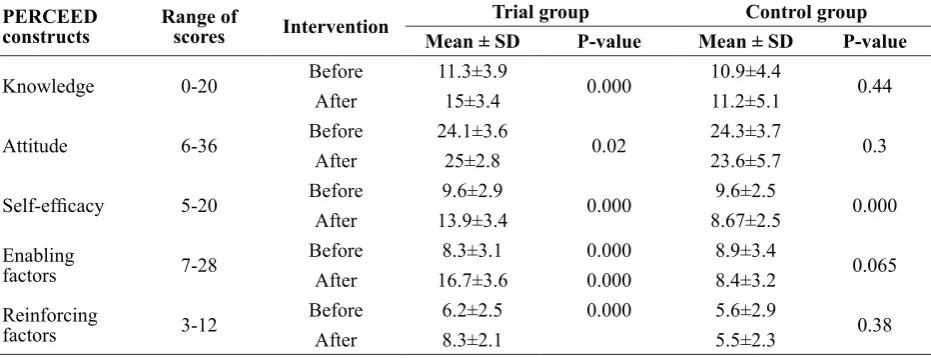
intervention, mean scores in the trial group were significantly different from those inthe control group in all constructs (P<0.05). Table 3 shows mean and standard deviation and significant levels in knowledge, attitude, enabling, and reinforcing factors in both groups.
Table 2 Frequency distribution of age, gender, and education in trial and control groups
Group/demographic variables
Frequency Frequency % Frequency Frequency % Trial group Control group P-value
Gender Male 18 45 18 45 0.589
Female 22 55 22 55
Age 60-74 33 82.5 31 77.5 0.573
75-90 7 17.5 9 22.5
Education level
Illiterate 13 32.5 16 40
0.748
Primary school 13 32.5 13 32.5
High school 4 10 3 5
Diploma and above 10 25 9 22.5
Table 3 Knowledge, attitude, self-efficacy, enabling factors (regular physical activity), and reinforcing factors in trial
and control groups
PERCEED
constructs Range ofscores Intervention Mean ± SD Trial groupP-value Mean ± SD Control group P-value
Knowledge 0-20 Before 11.3±3.9 0.000 10.9±4.4 0.44
After 15±3.4 11.2±5.1
Attitude 6-36 Before 24.1±3.6 0.02 24.3±3.7 0.3
After 25±2.8 23.6±5.7
Self-efficacy 5-20 Before 9.6±2.9 0.000 9.6±2.5 0.000
After 13.9±3.4 8.67±2.5
Enabling
factors 7-28 BeforeAfter 16.7±3.68.3±3.1 0.0000.000 8.9±3.48.4±3.2 0.065 Reinforcing
factors 3-12 BeforeAfter 6.2±2.58.3±2.1 0.000 5.6±2.95.5±2.3 0.38
Discussion
PRECEDE is an appropriate model for studying and identifying causes of a behavior in people. According to educational recognition phase of this model, behavior is explained by predisposing, enabling, and reinforcing factors [17]. In this study, PRECEDE was used as a framework for educational program to determine effects of predisposing, enabling, and reinforcing factors on regular physical activity of the elderly.
Knowledge, attitude, and self-efficacy were considered as predisposing factors. Affected by educational intervention, mean scores of knowledge and attitude showed a significant
increase in the trial group compared to the control (P<0.05). Results obtained for knowledge and attitude as predisposing factors were in line with Hezavehee et al. study in increasing mothers’ knowledge of iron deficiency anemia in children aged 1-5 years [18] and Afkari study on improving quality of life of the elderly according to PRECEDE model [14]. In these studies, knowledge was considered as a predisposing factor according to PRECEDE model.
study, results of self-efficacy as a predisposing factor in physical activity significantly increased in the trial group compared to the control, which is similar to results obtained in a study by Dehdari on self-efficacy according to PRECEDE-PROCEDE model in enhancing quality of life of patients after coronaryartery bypass surgery [20]. A study by Sung showed that self-efficacy-enhancing program significantly affects level of self-efficacy [21].
According to the stage of educational evaluation of PRECEDE model, reinforcing factors, including encouragement by health workers and recommendations by others, increase possibility of adopting and maintaining behaviors recommended [22]. In the present study, encouragements by family and health workers were considered as reinforcing factors in performing physical activity. Analysis showed an increase in mean scores of these factors in trial group after intervention. But, the difference was insignificant in the control group. Similar results were found in a study by Sun on American students dietary behavior change in relation to reinforcing factors in educational recognition stage of PRECEDE model [23]. In this study, educational resources were used as enabling factors (educational classes and flip-chart) in teaching skills required for performing regular physical activity in old-age. Mean scores in this area in the trial group showed a significant increase after intervention compared to the control group.Thus, it can be argued that such interventions can facilitate enabling factors for performing physical activity in old-age. Studies by Lesan [24] and Salinero [25] have shown the effect of educational programs on facilitating enabling factors.
The present study results showed that design and implementation of educational program can make a significant difference in predisposing, enabling, and reinforcing factors in regular physical activity in old-age, which indicates the need for development of planned educational interventions according to causes of incidence of a behavior.
Study limitations:
Considering that there were no similar studies
about educational intervention according to PRECEDE model on performing regular physical activity by the elderly, comparison of this and other studies was impossible. Since this study was conducted in a geographical region with its own particular cultural and social characteristics, generalizability of results to other regions is unlikely.
Conclusion
The results showed that educational program had been effective in enhancing predisposing, enabling, and reinforcing factors in regular physical activity in the elderly, and accordingly, given the positive results obtained, various educational programs can be devised to enhance health of the elderly.
Acknowledgements
This article was derived from a research project (Registered as 90-03-27-15103 in School of Health, Tehran University of Medical Sciences. Authors wish to express their special thanks to participants and Shabestar city health center for their cooperation in this study.
contributions:
Contributions
Study design: PP, ShSh, MHT, LP
Data collection and analysis: LP, MHT, PD Manuscript preparation: PD, MHT, LD
Conflict of interest
"The authors declare that they have no competing interests."
Refrences
1- Sheykhi MT. The elderly and family change in Asia with a focus in Iran: a sociological assessment. J Comp Fam Stud2006;37(4):583-8.
2- Naidoo N, Abdullah S, Bawah A, et al. Ageing and adult health status in eight lower-income countries: the INDEPTH WHO-SAGE collaboration. Glob Health Action2010:11. http://www.who.int/healthinfo/Vol3_ Suppl2_GHA2010.pdf
perceptions and lifestyles of the elderly. Res Nurs Health2007;12(2):93-100.
5- Tanaka H. Health Promotion in Elderly People. International Journal of Sport and Health Science2006;4(2):303.
6- Nied RJ, Franklin B. Promoting and prescribing exercisefor the elderly. Am Fam Physician 2002;65(3):419-30.
7- Alessandra C, Filho WJ. Effect ofan exercise program on functional performance of institutionalized elderly. J Rehabil Res Dev2004;41:659-68.
8- Nied RJ, Franklin B. Promoting and prescribing exercise for the elderly. Am Fam Physician2002;65(3): 419-30. 9- Park C, Kang C. Does education induce healthy lifestyle?.J Health Econ2008;27(6):1516-31.
10- Bartholomew LK, Parcel GS, Kok G, Gottlieb NH, Fernandez ME. Planning health promotion programs: an intervention mapping approach: Jossey-Bass; 2011. 11- Jackson C. Behavioral science theory and principles for practice in health education. Health Educ Res1997;12(1):143-50.
12- Mirtz TA, Thompson MA, Greene L, Wyatt LA, Akagi CG. Adolescent idiopathic scoliosis screening for school, community, and clinical health promotion practice utilizing the PRECEDE-PROCEED model. 2005;13(1):25.
13- Naderi Z, Zighimat F, A. E. Study the use of Preced-proceed model on quality of life of patients with epilepcy in tehran's Baghatallah Hospital. Daneshvar2009(82):1-8. 14- Afkari M, Solhi M, Matin H, Hoseini F, Mansoorian M. The efficiency of educational intervention based on PRECEDE educational method in the promotion of life quality of the aged under the coverage of Tehran Cultural House of Aged People. Salmand2011;5(18):37-45. [In Persian]
15- Salinero-Fort MA, Pau EC, Arrieta-Blanco FJ, Abanades-Herranz JC, Martín-Madrazo C, Rodés-Soldevila B, et al. Effectiveness of PRECEDE model for health education on changes and level of control of HbA1c, blood pressure, lipids, and body mass index in patients with type 2 diabetes mellitus. BMC public health2011;11(1):267.
16- Schwarzer R, Renner B. Social-cognitive predictors of health behavior: Action efficacy and coping self-efficacy. Health Psychol2000; 19:487- 495.
17- Green LW, Kreuter MW: Health Program Planning: An Educational and Ecological Approach. 4th ed. McGraw-Hill:New York; 2005,P, 46-56.
18- Hazavehei M, Jalili Z, Heydarnia AR, Faghihzadeh S. Application of the PRECEDE Model for controlling
iron-deficiency anemia among children aged 1-5Kerman, Iran. IUPH-Promotion and Education2006; 3(13): 173-7. [In Persian]
19- Jancey JM, Clarke A, Howat PA, Lee AH, Shilton T, Fisher J. A physical activity program to mobilize older people: A practical and sustainable approach. Gerontologist2008;48(2):251-7.
20- Dehdari T, Heidarnia AR, Ramezankhani A, Sadeghian S, Ghofranipour F. Planning and evaluation of an educational intervention programme to improve life quality in patients after coronary artery bypass graft-surgery according to PRECEDE-PROCEED model. Journal of Birjand University of Medical Sciences2009; 4(15): 27-37. [In Persian]
21- Song KJ. The effects of self efficacy promoting cardiac rehabilitation program on self efficacy, health behavior and quality of life. Taehan Kanho Hakhoe Chi2003; 33 (4):510-518.
22- Glanz KA, Rimer BA, Viswanath K. Health Behavior and health education theory. research and practice. 4 ed. San Francisco:Jossey-bass Publisher2008;408.
23- Sun W, Sangwein B, Chen J. Effects of a community- based nutrition education program on the dietary behavior of Chinese- American college students, Health Promot Int. 1999; 14(3): 241-251.
24- Lesan SH, Ghofranipour FA, Faghihzadeh S, Birashk B.Application of the precede model for increasing coping behaviors ageing anxiety in Tehran's' firemen. Payesh2009; 8: 81-90. [In Persian]