ON TWO-ECHELON MULTI-SERVER QUEUE WITH
BALKING AND LIMITED INTERMEDIATE BUFFER
M. Jain
School of Mathematical Science, Institute of Basic Scince Khandari, Agra - 282002, India, [email protected]
I. Dhyani
Department of Mathematics, D.A.V. (P.G.) College Dehradun - 248001, India
(Received: Aug. 29, 1997 - Accepted in Final Form: August 2, 2000)
In this paper we stu dy two echelon mu lti-server tandom queu eing systems where
Abstract
customers arrive according to a poisson process with two different rates. The service rates at both echelons are independent of each other. The service times of customers is assumed to be completed in two stages. The service times at each stage are exponentially distribu ted. At the first stage, the customers may balk (i.e. reject to join the waiting line) when all servers are busy. The higher echelon has a limited buffer space. The steady state queue size distribution has been obt ained for both stages. We inve stiga te the pr operties of a H e ssenb erg mat rix which is required for the complete specification of the generating function for ready use.
Tandem Queue, Balking, Multi-Server. Finite Buffer, Hessenberg Matrix, Queue
Key Words
Size Distribution
R°B T« fo¯ °j BM ¬Bwn±Q é½p±U L oM ¬B½oTz« ³ »d w °j S«ki æ ©Tv¼w ³§B « ½A nj
²k¼ña
³M u½°ow /j±M k®µA±i ©µ pA ¥ Tv« c w °j oµ nj »µj u½°ow Sîow /jo¼£»« nAo o ¯ Øk« ,k¯±{»« jnA° ¨BªÇU ³Ç »TÇ ° /SwA »½Bª¯ é½p±U ºAnAj ³¦eo« oµ nj »µj u½°ow ¬B«p /j±{»« ¥«B ³¦eo« °j nj ¬B½oTz« oU¿BM c w /k¯pn° B®T«A æ ³M Tw±¼Q pA ¬B½oTz« SwA ñª« ¤°A ³¦eo« nj ,k®{BM ¤± z« ¬B£k®µj u½°ow /j±{»Ç« ³LwBdÇ« ³¦ÇeoÇ« °j oµ ºAoM nAk½BQ S§Be nj æ ¤± é½p±U /SwA ºj°kd« ºB ºAnAj u½°ow An k§±« éMBU |A±i ³ SwA ¨p¿ o ¯ ¬C pA u½oUB« ½A ³í§B « /jo¼£»« nAo »wnoM jn±« òoL®vµ u½oUB« |A±i /k® »« ¥«B ¬C pA é½ow ºnAjoM ²o´M ºAoM
INTRODUCTION
The problem of tandem queue with finite buffer has received the attention from the early stages of queueing theory. The earliest study made by Avi-Itzhak and Yadin [4] dealt with two single se rver stat ions without inte rme diat e que ue wh e r e cu st o m e r s fo llo we d t h e p o isso n dist r ibu t io n a n d t h e se r vice t im e s we r e arbit rarily dist ribute d in bot h st ations. This study was extende d to a se quence of se rvice stations with arbitrary input and regular service time by Avi-Itzhak [3] to derive waiting time distribution. A two stage single server network with finite intermediate buffer and blocking was
at t e mpt e d by Ne ut s [16]. H e a ssume d t h at service times had a ge neral distribution at the first stage and an exponential distribution at the second stage.
serve r queues in serie s having finit e wait ing room and blocking under the assumption that se rvice time follows phase -t ype dist ribut ion. Langaris [13] developed the finite set of balance equations for a two stage service system having single server at each stage, finite waiting space in both stages and blocking. Gun and Makowski [10] provided a matrix geometric solution for a two node tandem queueing system with phase type servers subject to blocking and failure.
Chao and Pinedo [7] obtained an expression for expected waiting time in the system for two sin gle se r ve r st a t io n s in t a n de m wit h o u t intermediate buffer where customers arrive in groups and arbitrary service is provided at both st at ions. G re e n [9] analysize d mult i-se rve r system with two types of servers (primary and auxiliary) and two types of customers. The first type of customers are t hose who are satisfied with a se rvice re nde re d by a primary se rve r whe reas se cond type custome rs re que st for co mbine d se r vice of p rimary a nd a uxilia ry t oge t he r. R e ce nt ly, Z ut a a nd ye chia li [18] studied a two echelon multi-server Markovian queueing syst em with a limit ed inte rmediate buffer. Abou-El-Ata and Showky [2] studied the single server for longer queues. Furthermore, Abou-El-Ata and Kotb [1] derived the solution of the st at e de pe ndent queue M/M/1/N with ge n e r a l ba lk fun ct io n, r e fle ct in g ba r rie r , re ne ging and an addit ional serve r for longer queues. Recently, Mohanty et al. [15] analysed a multi-server queueing system with balking and reneging.
We consider a two stage multi-server queue in tandem with a limited intermediate buffer in which an arriving customer who finds all servers busy may balk or reject to join the queue. There are Sk servers at stage k (k = 1, 2). The service times of customers are exponentially distributed wit h mean rat e mk ( k = 1, 2) at st age k. We fu rt he r a ssume t hat t he re e xist s unlimit e d
waiting capacity at the first stage but a finite buffer of size M-S2is provide d at the se cond stage . At t he first stage a custome r is serve d separately at each queue and leaves the system wit h the probabilit y of q while at the se cond stage a customer is forced to leave the system with the probability of 1 if the buffer is full.
T h e t wo dim e n sio n a l co n t in u o u s t ime Markov chain model has been developed. The co-ordinates of the system state (i, j) represent the numbe r of customers waiting and being served at the corresponding stage respectively. The technique developed by Levy and Yechiali [14] and by Bocharov and Al Bores [6] has been employed to solve the problem.
W e o bt a in e xp r e ssio n s fo r t h e p a r t ia l
generating functions to
d e t e r m in e t h e st e a d y st a t e q u e u e size distribution Pi,j(i= 0, 1, 2, ...; j= 1, 2, ..., M). M being the maximum total number of customers at the second stage. To dete rmine the part ial
generating function we apply
H e sse nbu rg matr ix appr oach which ca n be o b t a in e d fr o m a se t o f lin e a r e qu a t io n s [A(z)p(z) = b(z)] in the unknown generating functions. To investigate the properties of the H e ssenburg matrix, we use M+ 1 roots of t he determinant of A(z) lying in interval (0, 1) and the remaining M+1 in (1, È).
THE MODEL
Assume a t wo echelon multi-server queue ing system, where customers arrive to the first lower echelon according to a poisson process with the arrival rate given by
(1)
t im e s a r e e xp o n e n t ia lly dist r ibu t e d wit h parameterm1. After being served first at lower echelon, a customer leaves the system with the probabilit y q or move s on and re qu e st s for additional service at the second higher echelon with the probability of p = 1-q and are served by S2 ide ntical serve rs. The se rvice t ime s of customers at second echelon are exponentially distributed with parameter m2.
The inte rmediate buffer bet we en t he t wo stage s is limit ed to M -S2. If a cust ome r who requests for service at the higher echelon and finds that t he buffer is full, leave s t he syst em with the probability 1. We formulate the system as a t wo dimensional birt h and deat h process. Le t Pi ,j ( i = 1, 2, ...; j = 1, 2, ..., M ) be t he probability that there are i(j) customers at the first (second) echelon.
THE BALANCE EQUATIONS GOVERNING THE MODEL
For j = 0 :
(2a)
(2b)
(2c)
(2d)
For
:
(2e)
(2f)
(2g)
(2h)
For
:
(2i)
(2j)
(2k)
(2l)
For j = M :
(2n)
(2o)
(2p)
T he solu t io n o f
The Generating Functions
t h e se t o f E qu a t io n s 2 de p e n ds o n t h e kno wle dge o f t h e va lue s o f t he bo un dar y probabilit ie s {Pi, j}. To obtain t he boundary probabilities, we shall use the following partial generating function:
which is the marginal generating function of the number of customers at stage 1, when there are j customers at stage 2 for . Thus
gives the marginal probability of j customers at the second stage.
First we consider j= 0. On multiplying 2a-2d by zi and summing for all i, we get
(3a)
where
(3b)
For , using 2c-2h, in similar manner, we get
(3c)
where
(3d)
Similarly for , we obtain
(3e)
where
Finally, for j= M,
(3g)
where
(3h)
There are S1(M+ 1) "boundary"probabilities {Pi,j} (i = i, 2, ..., S1-1; j = 0, 1, ..., M) which are to be determined in order to get the expressions for bj(z). Once these probabilities are obtained, we have (M+ 1) unknown generating functions
pj(z)( ). The solution of these (M+1) u n kn o wn e qu a t io n s give s t h e r e su lt fo r
pj(z)( ) which provides the entire probability distribution {Pi,j}( ). T o co n st r u ct S1( M + 1) e qu a t io n s wit h S1(M+ 1) unknown, we use the se t of balance equatins 2a, 2e, 2i and 2m where i= 0;
a n d E qu a t io n s 2, 2f, 2j a n d 2n , wh e r e ; which provide a set of (S1-1)(M + 1) linear equations with S1(M+ 1) unknown. We also ne e d addition al ( M + 1) equations in the above unknown probabilities {Pi, j}.
Equations 3a, 3c, 3e and 3g can be written in matrix form as
(4)
where p(z) is a vector of the (M+1) generating function pj(z), ; A(z) is an (M+1) dimensional square matrix and b(z) is an (M+1) dime nsion al ve ctor who se comp one nt s are defined by Equations 3b, 3d, 3f and 3h.
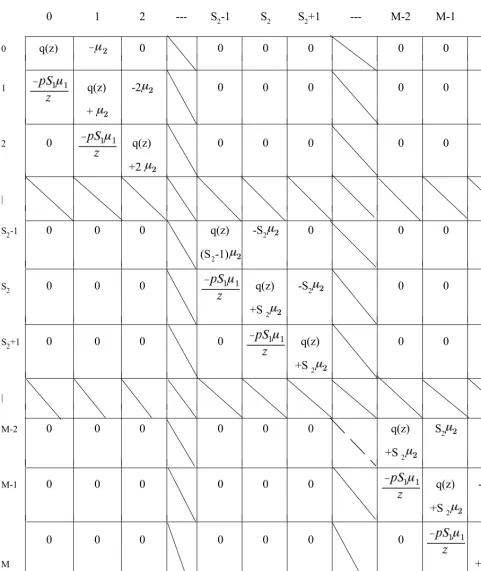
T h e coe fficie n t s o f t he ma t r ix A( z) in Equation 4 are represented in Figure 1, where
. The column or rows numbe re d from 0 to M re pr e se nt the number of customers.
Applying Cramer's rule, for each value of z such that A(z) is non-singular, we obtain
(5)
where the matrix Aj(z) is derived from A(z) by replacing the ith column of the matrix by b(z).
For eve ryàzà À1, the syst em A( z) p(z)= b(z) always yie lds a solution. It follows t hat whenever A(z) is singular, and therefore, Aj(z) and E quation 5 hold good in this case as we ll for any root of A(z)= 0 and for each j. Hence we can write = 0 which is a linear equat ion in the unknown probabilit ies {Pi, j} (0<i<S 1-1; 0<j<M).
N o w we s o l ve u n k n o wn
The Solution
probabilities {Pi, j} as follows:
A set of (S1-1)(M+1) independent equations in the above S1(M+ 1) "boundary" probabilities a r e a lr e a dy d e r ive d . W e will in ve st iga t e additional (M+ 1) equations by considering the equation in àA(z)à = 0 and will show that the polynomial in z,àA(z)à= 0 has (M+1) distinct roots in ( 0,1). Le t us de note t hese roots by zk(M+1), k = 1, 2, ..., M+1 where zM+1(M+1) = 1. Note that each root zk = zk(M+1) results
Equation 5 in , in
M M-1
M-2
---S2+1 S2
S2-1
---2 1
0
q(z)
0 0 0 0 0 0 0 0
1 q(z) -2 0 0 0 0 0 0
+
0
2 q(z) 0 0 0 0 0 0
+2
|
q(z) 0
0 0
S2-1 -S2 0 0 0 0
(S2-1)
0 0
0
S2 q(z) -S2 0 0 0
+S2
0 0
0 0
S2+1 q(z) 0 0 0
+S2
|
q(z) 0
0 0
0 0
0
M-2 S2 0
+S2
0 0
0 0
0 0
M-1 q(z) -S2
+S2
0 0
0 0
0 0
0 q(z)
M +S2
Figure 1. The coefficient matrix A(z)
T h e e qu a t io n o b t a in e d fr o m t h e r o o t zM + 1( M + 1) = 1 is r e du nda nt. This can be
ve ct or b(z). Indee d, for z = 1, the sum of all terms in each column of A(z) is zero. Also the sum of the elements of b(1) is zero. Therefore is the zero polynomial, so that the equation isredundant. Thus we nee d an additional equation in order to find solution for the required {Pi, j}.
Th e first e che lon ca n con side r classical queue where one-dimensional probabilities for i customers, are the marginal probabilities of our
two dimensional system, that is ,
. From Equations 2a to 2p, for , we have
. and
The well known result for classical M/M/S1 queue with balking (H iller and Liberman [11]) gives
(4a)
since , therefore Equation 4a with
on the left hand side completes
the set of S1(M+ 1) equations in the S1(M+ 1) boundary probabilities {Pi,j}.
A ft e r calculat ing "bo un da r y" {Pi ,j} an d
expressions for we can determine
the mean total number of customers L1 and L2 at the two echelons as:
(4b)
where and
and P0 is given by Equation 4a and
(4c)
Illustration: Set S1 = 3, S2= 2, M = 2. In this case there are six "boundary" probabilities {Pi, j} {i = 0,1,2; j = 0,1,2}. Also Equations 2a, 2b, 2m and 2n reduce to
(4d)
(4e)
(4f)
(4g) Equation 4a get the form
(4h)
Also
Putting z = z0 in b(z), we obtain
(4i)
(4j)
(4k)
where
R e placing the third column of A( z0) by b( z0) yie l d s t h e m a t r ix A1( z) . T h e e q u a t io n
provides
(4l)
E quations 4d, 4e , 4f, 4g, 4h and 4i give t he solution of desired "boundary" probabilities for this case.
W e t r a n sfo r m t h e
The Interlacing Theorem:
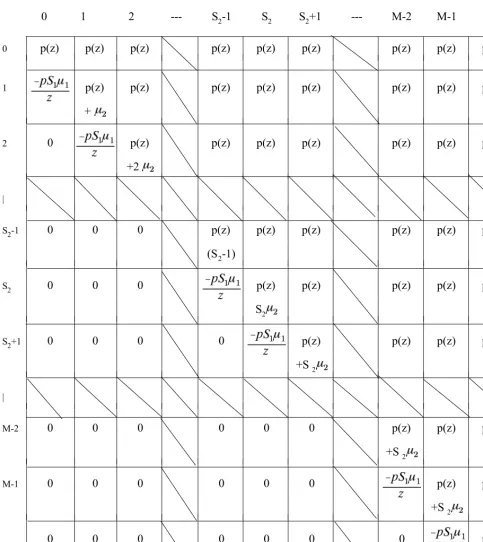
basic A(z) into an equivalent matrix H(z) called H essenberg form (Wilkinson [11]). To obtain H e s s e n b e r g m a t r ix H ( z ) , we p e r f o r m elementary operations on the rows of the matrix A( z) as follows: We add t he mth row t o t he (m-1)strow, the n we add t he m-1strow to t he (m-2)n dand so on up t o the first row, t hus we obtain its ithrow as the sum of the rows from i to M in the original mat rix A( z). The resulting matrix is characterized by the fact that the elements below the secondary diagonal are all zero. This type of matrix is called an upper H e sse n be r g ma t r ix se e F igu r e 2. A ll t h e e le me nt s of t h e 0t h r ow of t he H e sse nbe rg matrix obtained from A(z) are the same, and equal to
Le t us denote the de te rminant of the square sub-matrix of H (z) to comprise its first n rows and n columns (i = 0, 1, ..., n-1 and j = 0, 1, ..., n-1) by B(z). Let Gn(z) denote the determinant of the above n-dimensional sub-matrix with the exception that the lower right element is P(z) instead of where kn= min(n, S2). Now we have
(5b)
Using 5a and 5b, we get
(5c)
and
(5d)
Putting the value of Cn-1(z) in Equation 5a, we have
(5e)
Rewriting Equation 5e as
(5f) where
(5g)
(5h)
By factorizing P(z), we write
where Dn( z) is the determinant of the matrix determining Bn(z) with all elements of the first row e qual t o 1. Thus dividing E quation 5f by Pn(z), we can obt ain a recursion formula for Dn(z) given by
(5i)
Our aim is to prove that
has M + 1 re al root s in t he int e rval ( 0,1). It indicat es t hat P( z) has a single root in ( 0,1).
It is not ed t hat P (z) has two root s z1= 1 and
since z1>1; therefore P(z) has a single
root in (0, 1], so that DM+1(z) has M real roots in ( 0, 1]. This shows that BM + 1(z) has (M+ 1) real roots in that interval.
Th e re for e , we will p ro ve t h at fo r e ve ry , Dn(z) provides n-1 real roots in (0, 1] and will indicate that all n roots are different. Dn(z) is a rational function with zn -1 as its denominator and a polynomial of degree 2n-2 as its numerator, such that
it will be proved that Dn(z) has its (n-1) roots in the ope n inte rval ( 0, 1) while the remaining (n-1) roots are in (1-È).
Theorem: , where all
di( z) a r e o f t h e sa me sign a n d n o n ze r o . F u r t h e r m o r e , fo r a n y t wo s u c c e ss i ve
polynomials of and , the
coefficients do(n-1) and do(n) will have opposite signs.
Proof:Since B1(z) = P(z), we have . Also B2(z) = P(z) f1(z), so that we have
M M-1
M-2
---S2+1 S2
S2-1
---2 1
0
p(z) p(z)
p(z) p(z)
p(z) p(z)
p(z) p(z)
p(z)
0
1 p(z) p(z) p(z) p(z) p(z) p(z) p(z) p(z)
+
0
2 p(z) p(z) p(z) p(z) p(z) p(z) p(z)
+2
|
p(z) p(z)
p(z) p(z)
p(z) p(z)
0 0
0
S2-1
(S2-1)
0 0
0
S2 p(z) p(z) p(z) p(z) p(z)
S2
0 0
0 0
S2+1 p(z) p(z) p(z) p(z)
+S2
|
p(z) p(z)
p(z) 0
0 0
0 0
0
M-2
+S2
0 0
0 0
0 0
M-1 p(z) p(z)
+S2
0 0
0 0
0 0
0 p(z)
M +S2
Figure 2. The Hessenberg matrix H(z)
zero coefficients, and has an
opposite sign to that of do(1) = 1.
Now E quation 5g can be rewritten for f1(z)
as
proved by induction principle on the same line as done by Zuta and Yachiali [18].
CONCLUSION
In this study, two echelon multi-server tandom q u e u in g syst e m wh e r e cu st o me r s a r r ive a cco r din g t o a p o isso n fa sh io n wit h t wo diffe re nt rat es, is develope d. The analysis is done by exploiting the properties of Hessenberg mat rix whose determinant s yield polynomials with inte rest ing inte rlacing prope rtie s. The se r vice o f cu st o me r s a r e a ssu me d t o be completed in two stages. At the first stage the customers may balk when all se rvers are busy while the second stage has a finite buffer. Such type of situation may occur in communication and computer systems wherein jobs need service of two kinds by primary and secondary auxiliary servers with a provision of intermediate limited buffe r. The incorporat ion of balking at first stage of service make our model more feasible in realistic situations.
ACKNOWLEDGMENT
This st udy is supporte d by U G C, India vide grant F. No. F.8-5/98 (SR-I).
REFERENCES
Abou El-Ata, M. O. and Kotb, K. A. M., "A Linearly 1.
D e p e ndent Se r vice R at e for t he Q u e u e : M /M /1/N , R e n e gin g a n d a n A d d it io n a l Se r ve r fo r L o n ge r Queue", Microelectron.Reliab., Vol. 32, No. 12, (1992), 1693-1698.
A b o u E l-A t a , M . O . a n d Sh o wky, A . I ., "T h e 2.
Single-Server Markovian Overflow Queue with Balking, R e n e gin g a n d a n A d d it io n a l Se r ve r fo r L o n ge r Q u e u es", Microelectron. Reliab., V ol. 32, No . 10, (1991), 1389-1394.
Avi I t zhak B., "A Se qu ence of Se r vice St a t ions wit h 3.
A r b it r a r y I n p u t a n d R e gu la r Se r vice T im e s",
Management Science, Vol. 11, (1965), 565-571. Avi I t zhak, B. an d Y adin, M ., "A Se qu ence of T wo 4.
Servers with No Intermediate Q u eu e",Management Science, Vol. 11, (1965), 553-564.
Alt iok, T ., "Ap pr oxim a t e An a lysis o f Q u e u e s in Se r ie s 5.
wit h P h a se -T yp e -Se r vice T im e s a n d Blo ck in g",
Operations Research, Vol. 37, (1989), 601-610. Bocharov, P. P. and Al. Bores, F. K., "O n Two Stage 6.
Exponential Queueing Systems with Internal Losses or Blocking",Problems of Control and Information Theory, Vol. 9, (1980), 365-379.
Chao, X . and P i n e d o , M., "Batch Arrivals to a Tandem 7.
Q u eu e with ou t an In ter me dia te Bu ffe r",Commun Statist-Stochastic Models, Vol. 6, (1990), 735-748. Gershwin, S. B., "An Efficient Decomposition Method 8.
for the Approximate Evalu ation of Tandem Q u eu es with Finite Storage Space and Blocking",Operations Research, Vol. 35, (1987), 291-305.
Green, L., "A Queueing System with Auxiliary Servers", 9.
Management Science, Vol. 30, (1984), 1207-1216. G u n, L. an d M akowski, A. M ., "M a t r ix-G eom e t r ic 10.
Solution for Two Node Tandem Queueing System with Plasa-Type Servers Subject to Blocking and Failure",
Commun Statis Stochastic Models, Vo l. 95, (1989), 431-457.
H ille r , F . H . a n d L ib e r m a n , G . J ., "O p e r a t io n s 11.
Research", Holden-Day, San Francisco, (1974). Konheim, A. G . and R eiser, M., "A Qu eu eing Model 12.
with Finite Waiting Room and Blocking",J. Association for ComputingMachinery, Vol.23, (1976), 328-341. La n ga r is, C., "O n a T wo -St a ge Bir t h a n d D e a t h 13.
Q u eu eing Pro ce ss",Operations Research, V ol. 37, (1989), 488-497.
L e vy, Y . a n d Y e c h ia li, V ., "A n M /M /S Q u e u e wit h 14.
Servers Vacations", Infor, Vol. 14, (1976), 153-163. Mohanty, S. G., Montazer H. and Trueblood, R., "On 15.
the Transient Behavior of a Finite Birth-Death Process with an Application",Computer Ops-Res, Vol. 20, No. 3, (1993), 239-248.
Ne u ts, M. F ., "T wo Q u e u es in Ser ies with a F inite 16.
Intermediate Waiting R oom",J. Applied Probability, Vol. 5, (1968), 123-142.
W i lk in s o n , J . H . , "T h e A lg e b r a ic E ig e n V a l u e 17.
Problem", Oxford University Press, (1965).
Z u t a , S . a n d Y e c h ia li, U . , " A T w o - E c h e l o n 18.