Please cite this article as: R. Tang, X. Zhou, D. Wang, Improved Adaptive Median Filter Algorithm for Removing Impulse Noise from Grayscale Images, International Journal of Engineering (IJE), TRANSACTIONS A: Basics Vol. 30, No. 10, (October 2017) 1503-1509
International Journal of Engineering
J o u r n a l H o m e p a g e : w w w . i j e . i rImproved Adaptive Median Filter Algorithm for Removing Impulse Noise from
Grayscale Images
R. Tang, X. Zhou*, D. Wang
School of Mechanical, Electrical and Information Engineering, Shandong University, Weihai, China
P A P E R I N F O Paper history:
Received 17 February 2017 Received in revised form 19 June 2017 Accepted 07 July 2017
Keywords: Image Denoising Impulse Noise Removal Salt and Pepper Noise Adaptive Median Filter
A B S T R A C T
Digital image is often degraded by many kinds of noise during the process of acquisition and transmission. To make subsequent processing more convenient, it is necessary to decrease the effect of noise. There are many kinds of noises in image, which mainly include salt and pepper noise and Gaussian noise. This paper focuses on median filters to remove the salt and pepper noise. After summarizing the main disadvantages of the conventional median filters, this paper proposes a new kind of median filter algorithm based on the detection of impulse noise points. The performance of the proposed algorithm is compared with the conventional standard median filter (SMF), extremum median filter (EMF), and adaptive median filter (AMF). Experimental results under various noise intensities show that the proposed method has better denoising performance and detail preservation compared with the other denoising methods.
doi: 10.5829/ije.2017.30.10a.11
1. INTRODUCTION1
In essence, image denoising methods are all low-pass filtering. However, the low-pass filter is a double-edged sword. It will eliminate part of useful high-frequency information when eliminates image noise at the same time. Therefore, the research on image denoising methods actually is a trade-off between noise reduction and high-frequency information preservation.
There are many different median filtering methods [1]: standard median filter (SMF), extremum median filter (EMF), and adaptive median filter (AMF). Hwang and Haddad [2] proposed two new algorithms for AMF based on two image models corrupted by impulse noise. They are the ranked-order based adaptive median filter (RAMF) and the impulse size based adaptive median filter (SAMF). Simulations on standard images confirm that these two algorithms are superior to SMF. To reduce computational complexity, a switching based adaptive median filtering scheme was proposed for impulse noise detection by Juneja and Mohana [3]. In their method, the noise whose neighborhood pixels are not labeled as noisy is attenuated by estimating the
*Corresponding Author’s Email: [email protected] (X. Zhou)
median-based filter for impulse noise removal from extremely corrupted images. To identify pixels corrupted by noise, an analysis for local intensity extrema is applied. Atulkar et al. [8] presented a fuzzy logic based noise removal method with detail restoration. The local statistic is used to determine local weighted mean in filter window. The pixels that are detected as noisy pixels are filtered, and others are kept unchanged.
In this paper, we propose an improved adaptive median filter algorithm based on the detection of impulse noise points. A threshold is first adopted in the proposed method to measure the degree of pollution. Then, according to the degree of noise pollution, an appropriate filter window is selected to filter the noise. By comparison with other three conventional median filtering methods, the proposed method achieves better filtering effect both subjectively and objectively.
The rest of this paper is organized as follows. Section 2 introduces the basic principles of conventional median filtering methods. Section 3 gives the improved AMF algorithm. Experimental results and performance analysis between the improved AMF and conventional median filtering methods are presented in Section 4. Conclusions and suggestions for future work are given finally in Section 5.
2. CONVENTIONAL MEDIAN FILTERING METHODS
Median filtering algorithm was first put forward by Tukey in 1971 [9]. The principle of this algorithm is as follows: First, a local region, mostly a square one is delineated. Then, the gray values of each pixel in the neighborhood are sorted and the median is considered as the new value of center pixel. By using median filtering algorithm, it can greatly smooth the image. The output pixel value of median filter is determined by the value which is the median of image gray values in the neighborhood. Because median filter to limit pixel (the pixel which has the great difference compared with surrounding pixel values) is less sensitive to mean value, so isolated noise points are eliminated.
2. 1. Standard Median Filter (SMF) Standard median filter means that each pixel value of a digital image or a digital sequence is replaced by the median in its neighborhood. The definition of median is that a group of numbers x x1, 2, ,xn is sorted by its value. After sorting, we have xi1xi2 xin. Then, the
median of sequence x x1, 2, ,xn, y is obtained by Equation (1):
(( 1)/ 2) 1 2
( / 2) ( / 2 1)
,
{ , , , } 1
[ ].
2 i n
n
i n i n
x y Med x x x
x x
(1)
The concept of standard median filter can be easily extended to two dimensions. In this way, two-dimensional window can be adopted to filter the noise. Supposing that {xi j, , ( , )i j I2} is gray value of each
point in a digital image, the two-dimensional median filter with filter window A is defined as:
2
, { ( ),( ), ( , ) ( , ) }
i j i r j s
y Median x r s A i j I . (2)
Due to its simplicity and good filtering effect at low noise, standard median filter has been widely used to remove impulse noise. However, median filter filtering effect is not satisfactory in high noise pollution, and image details such as some threads and sharp corners can be easily destroyed, which leads to image distortion. Furthermore, standard median filter uses the predefined fixed filter window and all the pixels are filtered by the same size window. So, it is hard to get good filtering effect when the image has been seriously polluted by noise.
2. 2. Extremum Median Filter (EMF) As for standard median filter, the filter efficiency of median filter algorithm will rapidly decline with the increased intensity of the noise. To solve this problem, extremum median filter was proposed. Given a group of data, the extremum median can be expressed as:
' ' '
1 2
{
, ,
, }
nyMedian x x x . (3)
Supposing that the maximum value of x x1
,
2,
,
xn ismax
I and the minimum value is Imin, then ' ' ' 1
, ,
2,
n x x xin Equation (3) is the data x x1
,
2,
,
xn with Imax andmin
I screened out.
This method has a good effect on filtering salt and pepper noise. With regard to a flat region or an edge region, there are little differences between pixel value and partial median, so extremum median filter can effectively restore its original gray value. Nevertheless, in thread region, there are great differences between original gray value and partial median. In this case, the extremum median filter would bring adverse effects. It will make great difference between the substitute value and original value, which leads to the blur lines in image.
The detailed steps of adaptive median filter are as follows, where
x
min is the minimum gray value in the filter window;x
max is the maximum value in the filterwindow;
x
med is the median in the filter window; xi j, isthe gray value in ( , )i j ; and
S
max is the maximum that is specified.Step 1. Calculate
z
1
x
med
x
min and z2 xmedxmax.Step 2. If z10 and z2 0, go to Step 3; otherwise,
we extend the window Si j, . If Si j, Smax, repeat Step 1
and Step 2. If not, output xi j, directly.
Step 3. Calculate
k
1
x
i j,
x
min andk
2
x
i j,
x
max.Step 4. If k1 0 and k20, output xi j, directly.
Otherwise, we regard
x
med as the output value.The feature of this algorithm is that it can filter impulse noise and smooth non-impulse noise. Besides, it can reduce image distortion and protect image details at the same time.
3. IMPROVED AMF BASED ON DETECTION OF IMPULSE NOISE POINTS
To improve the filtering effect of median filter, many improved methods have been proposed. However, conventional improvement methods use the median of the surrounding pixels to replace the noise point. It will lead to the loss of image details and edge information because of underutilizing local feature of the image.
3. 1.Detection of Impulse Noise Impulse noise is some contaminated points with small gray value or large gray value in the image due to some reasons. Gray values of these points generally have great differences with the gray value of signal point around the neighborhood, and they are the mostly extreme points in the neighborhood. According to these two features of impulse noise, a simple salt and pepper noise filtering algorithm was put forward by Dong and Zhang [10]. This algorithm proposed an analyzing method. Taking a 3×3 square window for example, a threshold value
is set firstly. Assuming that the range of pepper point noise’s gray value is [0, ]
, then the range of gray value in salt point noise is [255
, 255]. If the gray value of the center pixel falls within the range, the pixel point is regarded as noise point. If the gray value of the center pixel is not in the scope, this point is regarded as a signal point. Liu and Fei [11] called this analyzing method as bipolar threshold detection method.However, not all the extreme points are impulse noise points. The smooth region without noise points or the boundary region also have extreme points, so it is
not enough to explain the nature of the pixels by only the bipolar threshold detection. Based on references [12, 13], we can use neighborhood information in 5×5 window to further distinguish impulse noise points, smooth region points, and strong edge points. The detailed steps include two steps:
(1) Bipolar threshold detection. As we can see, if current point xi j, does not fall into the range which
determines the noise point in the detection window, it is regarded as a signal point S ; if it is an extreme point, it is regarded as quasi-noise point N, which needs a further test.
(2) The detection to the border and smooth transition area. When pixel point xi j, is judged as noise
point in the previous step, the neighborhood information of xi j, is used for further test. In the window with xi j,
as the center (except center point), the gray differences between xi j, and other pixels in horizontal, vertical, diagonal primary, and secondary diagonal directions are calculated. Then, the differences are summed and recorded as d1, d2, d3, and d4 , respectively, which are given in Equation (4):
1 , 2, 1, 1, 2,
2 , , 2 , 1 , 1 , 2
3 , 2, 2 1, 1 1, 1 2, 2
4 , 2, 2 1, 1 1, 1 2, 2
4 ,
4 ,
4 ,
4 .
i j i j i j i j i j
i j i j i j i j i j
i j i j i j i j i j
i j i j i j i j i j
d x x x x x
d x x x x x
d x x x x x
d x x x x x
(4)
Supposing that m is the minimum among the absolute values d1, d2, d3, and d4, it can be expressed as :
1 2 3 4
min( , , , )
m d d d d . (5)
Then, the pixel xi j, is determined whether it is the
impulse noise point based on the value of m. The criterions for judgment are as follows:
(1) If the current pixel is an isolated impulse noise point, the point would have greater difference with all the gray values in neighborhood. So, the value of m will take the larger one.
(2) If the current pixel is a flat area without noise pollution, the differences of neighborhood pixels in 4 directions are close to 0. So, the value of m will take a smaller one.
(3) If the current pixel is an edge point including thread, there will be at least one difference whose value is smaller than other differences in the 4 directions. So, the value of m will take a smaller one.
If the pixels satisfy the above two conditions, this point is determined as noise point N. So, we can use a flag binary matrix [fi j, ] to represent the distribution of
image noise. If the pixel of the image is a noise point, the corresponding fi j, is set to 1. If the pixel of the
image is a signal point, fi j, is labeled as 0.
3. 2.Removal of Impulse Noise Standard median filter and its improvements mainly have the following problems:
(1) Although the filter with small filter window can maintain good image details and edges, it cannot filter all the noise. On the other hand, a bigger filter window would have a good effect on noise filtering, but it cannot preserve image details and edges, which would lead to fuzz and distortion in image.
(2) The selection of filter window size depends on the noise intensity, which needs a prior knowledge of the image.
(3) For each pixel, it will be sorted many times by using adaptive filtering method with the filter window from small to large, which would highly increase computational complexity.
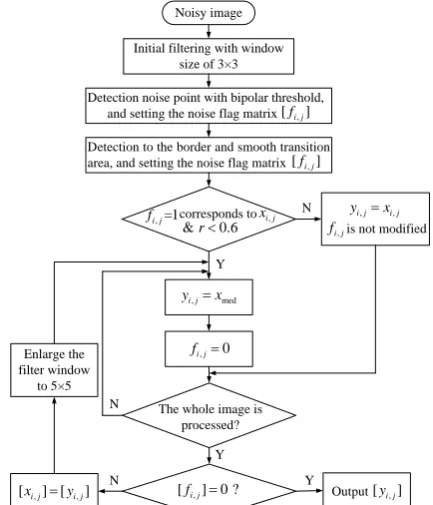
To solve these problems, we introduce a hypothesis that the filtering effect will be better if we can judge the pollution degree in different regions of the image at first. Then, we select an appropriate size for the filter window according to the pollution degree. In this paper, adaptive method is used to filter impulse noise. According to different pollution degree of impulse noise in different regions of the image, the filter window size is changed adaptively. First of all, an initial filter window is selected. In this paper, we use 3×3 filter window. Then, a noise flag matrix [fi j, ] is obtained for
each element. If fi j, 0, it is output directly without
filtering; if fi j, 1, it indicates that the point is a noise
point. Supposing that the size of filter window A is n n and there are p noise points in the window, the contamination degree of the filter window is expressed as:
p r
n n
. (6)
Assuming that the threshold is T1, if the contamination
degree of this window rT1, the point is regarded as the center and the median in the filter window is calculated. In addition, this median calculation only includes the value of the image points.
First of all, the points with fi j, 0 in noise flag matrix are recorded and sorted. If the number of points marked as 0 is odd, the grayscale of the center point is replaced by the median; if the number of points marked
as 0 is even, the grayscale of the center point is replaced by the mean value of two points in the middle. After that, the value of fi j, is set to 0, and this point can be seen as a signal point.
If the contamination degree of this window rT1, it indicates that the noise causes serious pollution in the window and the window size should be expanded. So the noise points in this window as well as fi j, in image
noise flag matrix are kept untouched.
After initial filtering, we obtain [yi j, ]. Then, it is
judged that whether it is equal to 1 in the binary noise flag matrix fi j, . If it is, the image [yi j, ] is regarded as
the original input image, and the filter window is expanded to 5×5. At last, repeat the above processes until there is no digital type 1 in binary noise identification matrix fi j, . The output image [yi j, ] is
considered as the filter results of the proposed algorithm.
The flow chart of the proposed method for impulse noise removal is shown in Figure 1.
4. EXPERIMENTAL RESULTS AND PERFORMANCE ANALYSIS
Simulation experiment was conducted with MATLAB software, using function “imnoise” to add impulse noise with different intensities.
Detection to the border and smooth transition area, and setting the noise flag matrix Detection noise point with bipolar threshold, and setting the noise flag matrix
Initial filtering with window size of 3×3
N Noisy image
,
[fi j]
,
[fi j]
corresponds to
,=1
i j
f xi j,
& r0.6
, med
i j
y x
Y
, ,
i j i j
y x
,
i j
f is not modified
, 0
i j
f
The whole image is processed? N
Y
,
[fi j]0 ? Y
N
Output[yi j,]
, ,
[xi j] [ yi j]
Enlarge the filter window
to 5×5
Figure 1. Flow chart of the proposed method for impulse
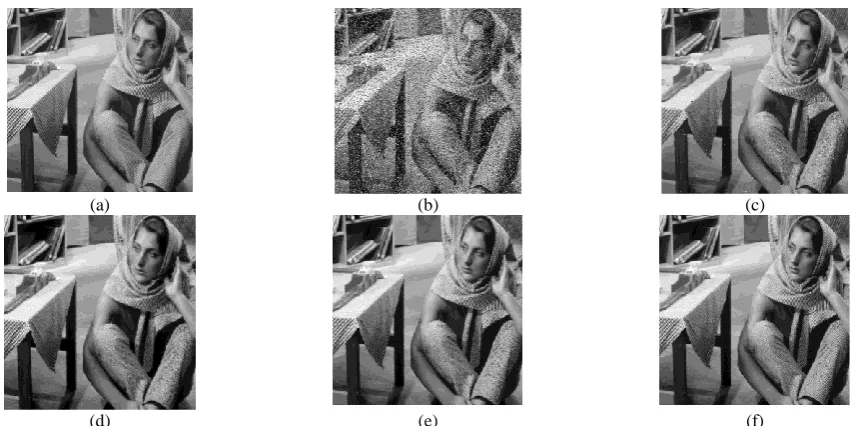
Two typical images Lena and Barbara with size of 512×512 are used to test the performance of the proposed method. The image Lena has more smooth region, while image Barbara has more detailed texture. Both Lena and Barbara images are corrupted by salt and pepper noise with different intensities. In addition, the comparisons between the proposed method and the other three conventional methods (SMF, EMF, and AMF) are also made in the experiment. The peak signal-to-noise ratio (PSNR) is adopted in this paper to evaluate the image quality after filtering.
In the experiments, several important thresholds are set as follows: 5, T 35, and T10.6. In addition, equivalence extension is used in the image boundary to facilitate image filtering.
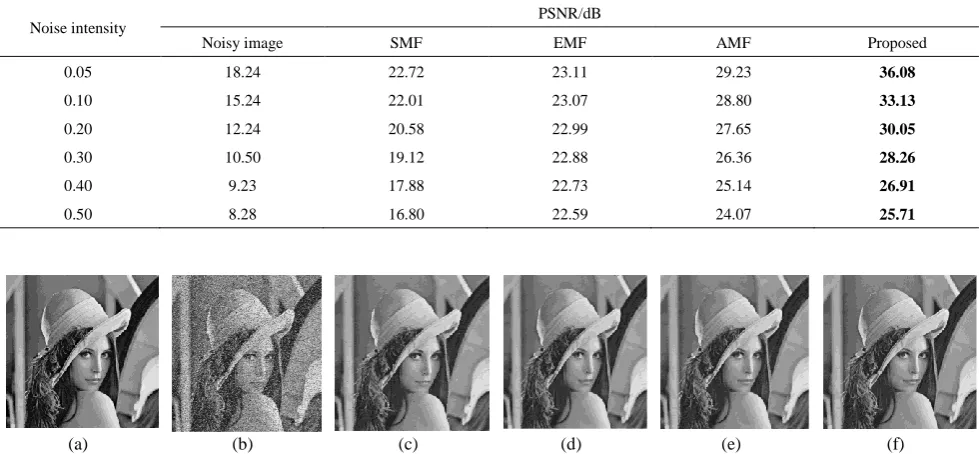
Tables 1 and 2 show the PSNR of Lena image and Barbara image filtered by various filter algorithms, respectively. It can be seen from these tables that with
the increase of noise density, the PSNR is declining. Among various filtering algorithms, standard median filtering has the worst performance, and with the increase of noise density, the value of PSNR is decreased rapidly. The filtering effect of extremum median filter is better than standard median filter in high noise density. By comparison, the adaptive median filter is better than above two methods, but it is not good enough under the high noise density. The filter effect of the proposed algorithm achieves better filtering performance than other three methods. It has at least 2 dB improvements in PSNR.
To evaluate the subjective effects of the proposed method, the salt and pepper noise with noise intensity of 0.2 is added to Lena image and Barbara image. Figures 2 and 3 show the comparisons of subjective effects between the proposed method and other methods.
TABLE 1. PSNR comparison of image Lena obtained by various median filtering methods
Noise intensity PSNR/dB
Noisy image SMF EMF AMF Proposed
0.05 18.41 27.39 31.13 38.95 41.84
0.10 15.44 25.66 31.08 37.97 38.79
0.20 12.43 23.02 30.74 35.84 35.61
0.30 10.68 21.11 30.47 33.77 33.80
0.40 9.41 19.41 30.04 32.06 33.63
0.50 8.46 18.01 29.55 30.14 31.01
TABLE 2. PSNR comparison of image Barbara obtained by various median filtering methods
Noise intensity PSNR/dB
Noisy image SMF EMF AMF Proposed
0.05 18.24 22.72 23.11 29.23 36.08
0.10 15.24 22.01 23.07 28.80 33.13
0.20 12.24 20.58 22.99 27.65 30.05
0.30 10.50 19.12 22.88 26.36 28.26
0.40 9.23 17.88 22.73 25.14 26.91
0.50 8.28 16.80 22.59 24.07 25.71
(a) (b) (c) (d) (e) (f)
Figure 2. Lena images obtained by different median filtering methods: (a) original image, (b) noisy image added by salt and pepper
(a) (b) (c)
(d) (e) (f)
Figure 3. Barbara images obtained by different median filtering methods: (a) original image, (b) noisy image added by salt and
pepper noise with density 0.2, (c) SMF, (d) EMF, (e) AMF, and (f) the proposed method
From Figures 2 and 3, we can see that the improved median filtering method has better visual effect than the other three conventional methods. The distortion in image details is much smaller than the previous methods. Besides, it has better clarity, which is particularly obvious in the Barbara denoising image. Finally, we would like to point out that the proposed algorithm is also applied to other test images, and similar results can be obtained.
5. CONCLUSION
This paper proposes an improved adaptive median filter algorithm based on the detection of impulse noise points. In the scheme, a threshold is first used in the proposed method to measure the degree of pollution. Then, according to the pollution degree, an appropriate filter window is selected adaptively to filter the noise. Experimental results show that the proposed algorithm is effective in denoising. Compared with other three conventional median filtering methods, the proposed method not only has better filtering effect, but also achieves good performance in preserving the image details and edges. For the future work, we would further improve the filtering performance under higher noise intensity.
6. ACKNOWLEDGEMENTS
This work was supported by the 7th undergraduate research apprentice program (URAP) and the 11th
student research training program (SRTP) at Shandong University, Weihai, China, and the Natural Science Foundation of Shandong Province, China (No. ZR2015PF004). Dongyan Wang thanks the image processing and computer vision (IPCV) research group at Shandong University (Weihai) for giving her the opportunity to do some research in her college years.
7. REFERENCES
1. Teoh, S.H. and Ibrahim, H., "Median filtering frameworks for reducing impulse noise from grayscale digital images: A literature survey", International Journal of Future Computer and Communication, Vol. 1, No. 4, (2012), 323-330.
2. Hwang, H. and Haddad, R.A., "Adaptive median filters: New algorithms and results", IEEE Transactions on Image Processing, Vol. 4, No. 4, (1995), 499-502.
3. Juneja, M. and Mohana, R., "An improved adaptive median filtering method for impulse noise detection", International Journal of Recent Trends in Engineering, Vol. 1, No. 1, (2009), 274-278.
4. Singh, K.K., Mehrotra, A., Nigam, M.J. and Pal, K., "A novel edge preserving filter for impulse noise removal", in Multimedia, Signal Processing and Communication Technologies (IMPACT), 2011 International Conference on, IEEE., (2011), 103-106.
5. Wu, J. and Tang, C., "PDE-based random-valued impulse noise removal based on new class of controlling functions", IEEE Transactions on Image Processing, Vol. 20, No. 9, (2011), 2428-2438.
6. Tian, H., Cai, H. and Lai, J., "A novel diffusion system for impulse noise removal based on a robust diffusion tensor",
Neurocomputing, Vol. 133, (2014), 222-230.
corrupted images", IET Image Processing, Vol. 5, No. 5, (2011), 472-480.
8. Atulkar, M., Zadgaonkar, A.S. and Kumar, S., "Impulse noise removal technique based on fuzzy logic for contrast enhancement", Transactions on Machine Learning and Artificial Intelligence, Vol. 2, No. 6, (2014), 99-105.
9. Tukey, J.W., "Exploratory data analysis", Journal of the American Statistical Association, Vol. 26, No. 2, (1977), 163-182.
10. Dong, J. and Zhang, J., "A simple algorithm for removing salt and pepper noise from gray-scale image", Computer Engineering and Applications, Vol. 20, (2003), 27-29.
11. Liu, J.-Y. and Fei, R.-C., "An improved median filtering algorithm for salt and pepper noise", Journal of Liaoning Institute of Science and Technology, Vol. 10, No. 4, (2008), 24-26.
12. Xing, C.-J., Wang, S.-J., Deng, H.-J. and Luo, Y.-J., "A new filtering algorithm based on extremum and median value",
Journal of Image and Graphics, Vol. 6, No. 6, (2001), 533-536.
13. Wang, J.-Y., Zhou, X.-G. and Liao, Q.-Z., "A mixed noise filter based on median-fuzzy technology", Journal of Electronics and Information Technology, Vol. 28, No. 5, (2006), 901-904.
Improved Adaptive Median Filter Algorithm for Removing Impulse Noise from
Grayscale Images
R. Tang, X. Zhou, D. Wang
School of Mechanical, Electrical and Information Engineering, Shandong University, Weihai, China
P A P E R I N F O Paper history:
Received 17 February 2017 Received in revised form 19 June 2017 Accepted 07 July 2017
Keywords: Image Denoising Impulse Noise Removal Salt and Pepper Noise Adaptive Median Filter
هديكچ
یتحار یارب .دبای یم شهاک هفون فلتخم عاونا طسوت بلغا لاتیجید ریوصت تیفیک ،لاقتنا و تفایرد دنیآرف لوط رد کمن هفون لماش ًاتدمع هک دراد دوجو ریوصت رد هفون فلتخم عاونا .دوش هداد شهاک هفون رثا هک تسا مزلا ،یدعب شزادرپ یف یور رب هلاقم نیا .تسا یسواگ هفون و لفلف و هنایم یاهرتل
یارب فذح هفون کمن و لفلف زکرمت دراد . سپ زا هصلاخ
ندرک بیاعم یلصا یاهرتلیف هنایم ،یلومعم نیا ،هلاقم کی عون دیدج زا متیروگلا رتلیف هنایم ار رب ساسا صیخشت طاقن
هفون نابرض هئارا
یم دهد . درکلمع متیروگلا داهنشیپ هدش اب رتلیف ( یلومعم درادناتسا هنایم
SMF
هنایم رتلیف ،) یمومرتسکا
(
EMF
( یقیبطت هنایم رتلیف و )
AMF
هفون تحت یبرجت جیاتن .تسا هدش هسیاقم ) هک دهد یم ناشن فلتخم تدش اب یاه
شور رب تایئزج ظفح و هفون فذح ظاحل زا رتهب یداهنشیپ شور .دراد یرترب رگید یاه