An Improvement of Remote Control Panel for Numerous
Electrical Devices in Smart Homes Using RF and Wifi
https://doi.org/10.3991/ijoe.v15i15.11668
Trung Dang Ngoc (*), Linh Le Thi Huyen
Thai Nguyen University of Technology, Thai Nguyen, Vietnam [email protected]
Abstract—This study aims to improve a remote control panel for numerous electrical devices in smart homes using radio frequency (RF) and wifi. In this study, RF315MHz transceiver module and Arduino Ethernet Shield wifi module are combined by a programmed algorithm to transmit control signals from a central processor to the electrical devices in the smart house. The RF315 MHz transceiver with hard coding is modified to be a soft coding module in which each control channel can switch on/off 256 electrical devices. Then, a remote control panel is developed to control numerous electrical devices based on the requirements of the number of control buttons and the technology in the smart house. Moreover, this proposed method allow to control the electrical devices in the house by various panels. An experimental model with two separate trans-mission channels using two soft-coded RF315MHz modules has been done to verify the applicability of the proposed method.
Keywords—Remote control panel, smart home, RF transmitter, RF transceiver, wifi.
1
Introduction
Nowadays, with a quick development of information technology and electronic en-gineering, smart electrical devices have been become more and more popular in smart homes. These electrical devices are commonly controlled by the remote control panels in which the control signals from the central processor to the smart devices can be transmitted by many channels such as Bluetooth waves, RF waves, wifi, Zigbee, etc. [1, 2]. Since each control signal line has different frequencies and transmission dis-tances, the remote control panel should be designed to adapt the requirements of each specific smart home [4, 11].
convenience to users when choosing or replacing any electrical device at a low cost [3, 5].
However, the remote control panels with the same RF waves of different electron-ics brands have been designed with hard coding for the transceiver and the integrated control buttons in each panel are limited [6, 9]. Therefore, when the number of elec-trical devices and users increase, it may require a lot of remote control devices. That means that the number of RF transmitter modules must be increased together with inconvenience and high expenditure for users. In order to increase the flexibility of remote control panels and reduce the number of RF transmitter modules, this paper has developed a method that integrates the RF transceiver module with the Arduino Ethernet Shield wifi module [7, 12]. This solution allows the members in the smart house to control electric devices at the same time by many control devices such as smart phone, personal computer, tablet, laptop, HMI, etc [8, 10]. Since each original RF transceiver module is coded with 8-bit hard coding by the manufacturers, the number of communication codes are limited. To improve this problem, the hard cod-ing RF transceiver has been transferred to the soft codcod-ing module by Arduino Uno controller card. Thus, the number of communication codes between the transmitter module and the receiver module can be increased up to 28(256) sets of codes. That
means that each transmitter module can send up to 256 communication codes for 256 receiver modules. In other word, if one control panel has n push buttons, the number of controllable devices is 256 * n.
In order to verify the proposed method, an experimental module with two separate transmission channels using two soft RF315MHz encoders has been designed for testing.
2
Structure of Remote Control Panel
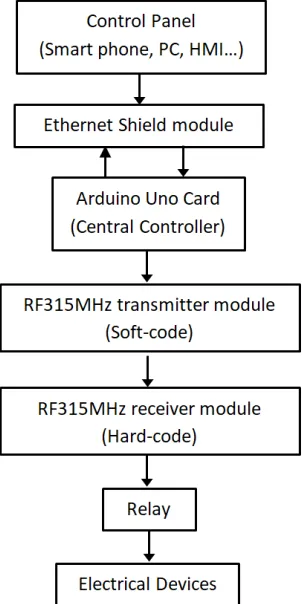
The proposed structure of the remote control panel is presented in Fig. 1 in which the RF communication is implemented by via RF315MHz – FS1000A transmitter module and RF315MHz – IC PT2272 receiver module [3].
The communication code on Din root of the RF315MHz transmitter module that is received the soft coding from the Arduino Uno is continuously sent to the receiver modules. Depending on the received code on each receiver module via RF waves, the relays on the corresponding electric device switch on or off.
By using this proposed method, users can easily and conveniently control many electrical devices in the smart home by various peripheral devices connected via the local wifi network.
Fig. 1. The proposed control structure of remote control panel using RF 315MHz modules and wifi Ethernet Shield modules
3
The Experimental Model
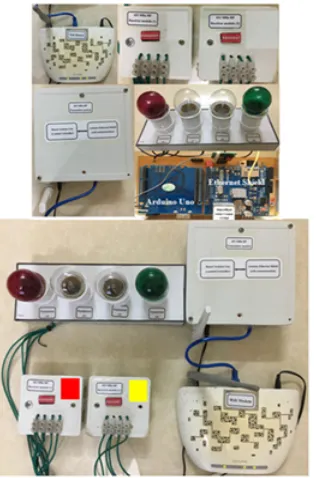
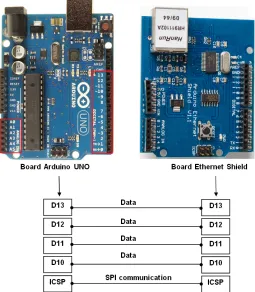
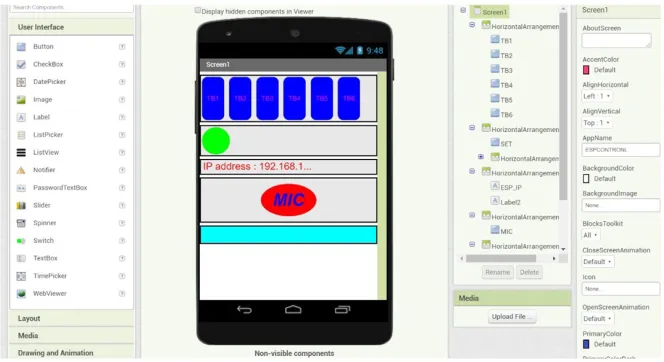
The experimental model has used 2 transmission channels including RF315 mod-ule and wifi Shield Shield modmod-ule to control switching on and off 4 lights as shown in Fig. 2. The connection diagrams of the system components including Arduino Uno card, Ethernet Shield module, RF transmitter module, RF315MHz receiver module and relays are presented from Fig. 3 to Fig. 5. The control panel interface with the control buttons is designed on the App Inventor on the peripheral devices as shown in Fig. 6.
Fig. 2. The experimental model using two channels including RF315 module and wifi Shield Shield module
Fig. 4. Diagram of data communication between Arduino Uno card and Ethernet Shield mod-ule
Fig. 6. Control panel interface on the App Inventor
4
Results and Discussion
After testing the experimental model, the control signal is obtained good quality and high accuracy. The use of the control buttons and the IP address of the local wifi designed on the App Inventor interface allows users to expand the number of the controlled electrical devices via Ethernet Shield module. In addition, as mentioned above, by using the RF315MHz receiver module with 4 addresses for each module, the maximum number of the controlled devices for this model is up to 4x28 or 1024
devices.
5
Conclusion
6
References
[1]Shantanu K. Nath, Sayera Aznabi, Nabila T. Islam, Annan Faridi, Wayesh Qarony (2017). Investigation and Performance Analysis of Some Implemented Features of the ZigBee Pro-tocol and IEEE 802.15.4 Mac Specification: iJOE ‒ Vol. 13, No. 1, https://doi.org/10.39 91/ijoe.v13i01.5984
[2]Hilary I. Okagbue, Muminu O. Adamu, Timothy A. Anake (2019). Differential Evolution in Wireless Communications -A Review: iJOE ‒ Vol. 15, No. 11, pp 29-52 https://doi.org/ 10.3991/ijoe.v15i11.10651
[3]Michael P. Gaynor (2007), System-in-Package RF Design and Applications, Artech House, Inc.
[4]Juan Carlos Augusto, Chris D. Nugent (2006). Designing Smart Homes. Springer-Verlag Berlin Heidelberg
[5]Qing Wan, Ming-Jiang Weng, Song Liu (2019). Optimization of Wireless Sensor Net-works based on Differential Evolution Algorithm: iJOE ‒ Vol. 15, No. 1, https://doi.org/ 10.3991/ijoe.v15i01.9786
[6]Cheng Huang, Yongbo Lv. (2018). An Internet of Things System Based on Device-to-Device Communication Technology and Radio-Frequency Identification: iJOE ‒ Vol. 14, No. 10, pp 210-218. https://doi.org/10.3991/ijoe.v14i10.9302
[7]V. M. Cvjetkovic, U. Stankovic (2017). Arduino Based Physics and Engineering Remote Laboratory: iJOE ‒ Vol. 13, No. 1, pp 87-105. https://doi.org/10.3991/ijoe.v13i01.6375
[8]Hazim Shakhatreh (2019). Optimal Placement of a UAV to Prolong the Lifetime of Indoor Wireless Devices: Universal Journal of Electrical and Electronic Engineering 6(3): 108-114. https://doi.org/10.13189/ujeee.2019.060304
[9]Chunmei Liu, Bin Li, Guohong Shi (2017). Design of Electronic Remote Control System Based on Wireless Sensor: iJOE ‒ Vol. 13, No. 5, pp 146-159 https://doi.org/10.3991/ ijoe.v13i05.7057
[10]Fangzhou He (2019). Exploration of Distributed Image Compression and Transmission Algorithms for Wireless Sensor Networks: iJOE ‒ Vol. 15, No. 1, https://doi.org/10.3991/ ijoe.v15i01.9782
[11]Jordán Pascual Espada (2014). Mobile Web-Based System for Remote-Controlled Eletronic Devices and Smart Objects: Mobile Networks and Applications, Volume 19, Is-sue 3, pp 435–447, https://doi.org/10.1007/s11036-014-0510-2
[12]Yang Wang (2017). Design and Implementation of a Wireless Sensor Network Node Based on Arduino: iJOE‒Vol. 13, No. 11, pp 128-135, https://doi.org/10.3991/ijoe.v13i11. 7749
7
Authors
Trung Dang Ngoc is working in Electrical Engineering Department, Thai Nguyen
University of Technology, Thai Nguyen, Vietnam.(E mail: [email protected])
Linh Le Thi Huyen is working inElectrical Engineering Department, Thai
Ngu-yen University of Technology, Thai NguNgu-yen, Vietnam.