A Practical Evaluation of ML Algorithms for a
Tag-Based BLE Indoor Positioning System
https://doi.org/10.3991/ijoe.v16i08.14795
Ashraf Tahat ()
Princess Sumaya University for Technology, Amman, Jordan
Mohammed N. Smadi, Mohammad Syouf PenguinIN, Irvine, USA
Abstract—In this paper, we evaluate the performance of machine learning (ML) algorithms employed in a commercial Bluetooth Low Energy (BLE) Indoor Positioning (IP) solution relying on practical measurements in a commercial of-fice space setting. The BLE IP system utilizing tags presents an ideal economic approach for large facilities with a limited number of tracking elements (gate-ways). In this investigation, data collection campaigns were conducted in an in-door facility fitted with BLE gateways to aggregate Received Signal Strength Indicator (RSSI) fingerprints. Performance of a collection of well-known ML algorithms in terms of accuracy of positioning of the desired objects, in addition to training complexity and online tracking speed were evaluated. ML algorithms of increased accuracy and efficiency were identified and tabulated in both of the offline and online phases. It is also envisaged that as part of this practical study, the results will serve to identify proper economical topologies and configuration in real-life installations for tag-based BLE IP systems.
Keywords—Bluetooth low energy, positioning, tracking, localization, machine learning, fingerprinting, RSSI.
1
Introduction
platform to identify the locale of asset or personnel geographically utilizing a deployed wireless technology, such as Bluetooth low energy (BLE) [7], WiFi [8], Radio Fre-quency Identification (RFID) [9] or similar ones. As a result, end-users can be provided with solutions that include fast access to precision positioning, asset tracking, location analytics, mapping, wayfinding, and a plethora of other applications. In addition, in-door location-based services, in conjunction with asset and personnel tracking, are ex-pected to facilitate proximity marketing and to optimize workflows. Furthermore, the widespread adoption of BLE tags/beacons accompanied by a surge in deployment of Internet of Things (IoT) [10] in indoor settings are among the factors that are envisioned to further drive the acceleration of deployment of such systems. These solutions will serve shopping malls, hotels, airports, warehouses, hospitals, and university/school buildings, museums [11] among the representative numerous venues of other areas that will benefit from such systems. Smart homes [10] offering intelligent features will implement enhanced systems that rely on indoor positioning, and will represent an ad-ditional prominent segment of these settings.
Wireless signal fingerprinting [12] is the most emerging among the techniques des-ignated for indoor positioning [5], [13], because of the widespread deployment of wire-less networks. Moreover, positioning methods based on Received Signal Strength Indi-cator (RSSI) [14] fingerprinting are attractive for their accuracy and independence of radio propagation models [13], [15].
Within the broad domain of indoor positioning, BLE at the present is a comprehen-sively utilized technology in pervasive computing in addition to the numerous IoT ap-plications. Lately, the Bluetooth 5 protocol was introduced by the Bluetooth Special Interest Group (BSIG), which comes just 14 years subsequent to its initial introduction. This new protocol provides for four times extension in range, twice the speed, in addi-tion to eight times the capacity of broadcasted messages.
BLE technology presents several attractive features within indoor positioning (IP) when deployed in conjunction with fingerprinting. These include the common support of smartphones and mobile devices to BLE; the portability of lightweight transmitters (such as tags), ease of installations, RSSI measurements can be gathered in a rather simple manner that is reflected in greater accuracy and high precision [16], in addition to the most prominent feature of low-energy consumption.
fingerprinting, which employed the kNN and support vector machine (SVM) ML algo-rithms. They suggested some key performance parameters of the IP system to make it more effective. In [21], a collection of effectiveness bounds were theoretically estab-lished on the essential beacons count for resolvable positioning of users. The authors of [22] have alleviated the fast fading effects on BLE signals by employing channel diver-sity, which has also mitigated interference within the recorded RSSI data in their pre-sented BLE IP System.
Our BLE IP system described in this work is a tag-based implementation for a com-mercial proof-of-concept prototype incorporating the fingerprinting approach. It will be shown experimentally that this BLE IP system attains practical high accuracy in combination with a collection of candidate group of machine learning (ML) algorithms. In our investigation, data collection campaigns were conducted in an indoor facility fitted with BLE gateways to allow the aggregation of the signal-specific measurements of the BLE tagged items at known locations (fingerprints). Performance of the existing basic algorithms was evaluated and the accuracy of tracking locations of the desired objects was found to meet the industrial grade requirements. The rest of the paper is organized as follows: In Section 2, we describe the system architecture, topologies and methodologies, experimental testing at various phases in addition to working principles. Obtained results are presented in greater details in Section 3. Finally, we conclude the paper in Section 4 by highlighting our findings in this research.
2
System Architecture and Methodology
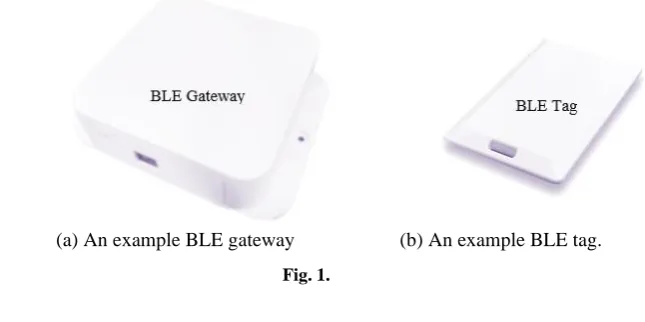
In order to conduct micro-positioning relying on BLE tags based on the fingerprint technique, the definition of a radio signal map is necessary in the form of a combined geographical coordinates (2-Dimension Cartesian Space) and RSSI values received by the BLE gateways, as shown in Fig.1-(a), that are transmitted by the BLE Tag(s), as shown in Fig.1-(b) [23]. The location of a BLE tag is a key point, because it must be chosen in such a way that, at any time, the tag is within the radio range of at least one BLE gateway. The generic RSSI vector received by a server is denoted as r = (r1, r2, rj, …, rN), where rj, (j = 1 ,…, N) denotes the RSSI value from the jth BLE gateway, and N is the number of BLE gateways in the area of interest. However, the RSSI-based scheme is susceptible in general to large signal fluctuations and fading due to the mul-tipath the signals [22]. Hence, to treat these imperfections in signal propagation in the indoor environments, it is necessary to turn to advanced techniques in signal processing and machine learning algorithms.
(a) An example BLE gateway (b) An example BLE tag.
Fig. 1.
2.1 Fingerprinting (offline phase)
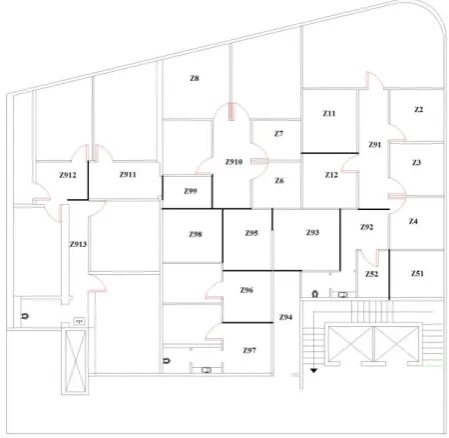
A set of nine BLE gateways, as the one shown in Fig. 1-a, were conveniently in-stalled in spatially diverse rooms, and their locations within each room were chosen to enable best visibility for a designated BLE gateway inside any room, in addition to achieving expected spatial paths diversity. The nine different rooms with BLE gate-ways were installed are depicted in Fig. 2. The black dots mark the positions of the gateways, where each was given a label as Z1 through Z9. Note that Zone (Z9), which represents the hallway, does not have a designated BLE gateway installed as was done for other zones.
Fig. 2. An illustration of the nine zones and BLE gateways locations.
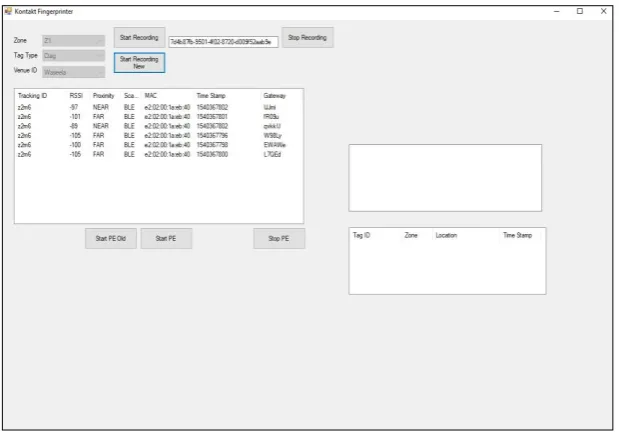
A fingerprinting software, with a graphical user interface (GUI) as shown in Fig. 4, was used to query and fetch from the server the Radio Signal Strength Indicators (RSSI) for each of the nine BLE gateways every one second. The measurement data ( finger-prints) for each zone was stored and saved in a separate file. Note that the average time the server takes to update the RSSI reading of a given gateway is 15 seconds on average.
Fig. 4. The GUI of the utilized fingerprinting software.
2.2 Dataset creation
The measurement data was stored for each sub-zone individually. There was approx-imately 1100 points for each sub-zone distributed in 21 separate files of CSV file for-mat. Time-domain averaging, filtering, was performed on the data points of each sub-zone to eliminate radio signal fluctuations due to fast fading effects [22]. It was deter-mined empirically that a 5 second widow yielded acceptable performance for this par-ticular location, considering that the server takes about 15 seconds, on average, to up-date the BLE gateway RSSI measurements.
2.3 ML algorithm training and evaluation
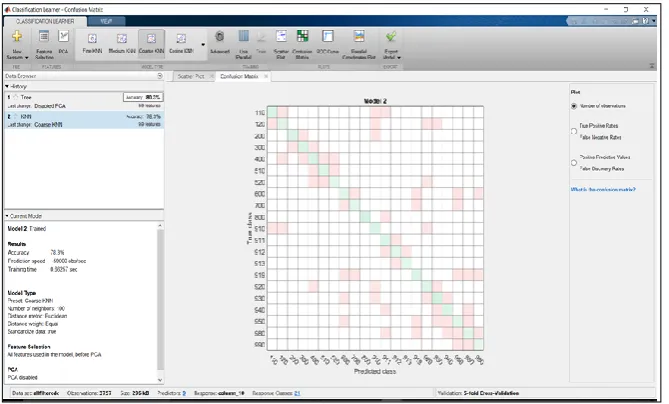
The fingerprints dataset was first imported into the Classification Learner application within the Matlab® software package [24], and was used to evaluate and investigate the performance of our BTL IP system. We started by evaluating two basic ML algorithms, namely the generic kNN [25] and classification Tree [26] ML algorithms, that are com-monly employed for this task of IP applications. Our goal was to obtain baseline per-formance benchmarks using a 5-fold validation approach. In Fig. 5, we illustrate this step and the obtained results. As presented in Table 1, the basic kNN classification algorithm had an accuracy of 78.3%, and the basic classification Trees algorithm had and accuracy of 80.3%. This relatively low performance was attributed to the sub-zones of the Hallways, where there were no BLE gateways installed. This accuracy measure represents the percentage of falsely classified sub-zones (locations) over the total num-ber of observations that were included in the classification process.
Fig. 5. Evaluating the performance of the BLT IP system using Classification Learner Applica-tion.
Table 1. Performnace of the basic kNN and Classification Trees ML Algorithms.
Algorithm Accuracy (%) Prediction Speed (obs/sec) Training Time (sec.) off-line
kNN 78.3 59,000 0.6626
Tree 80.3 110,000 1.213
2.4 Investigation of advanced ML algorithms
BLE Tag (beacon). Among the investigated algorithms, the ones that resulted-in best performance in terms of accuracy were Ensemble Learners (Subspace KNN [27] and Bagged Tees [28]), Weighted KNN [29], Fine KNN, Cubic SVM, and Fine Gaussian SVM [30]. That was accomplished and verified utilizing Matlab as was stated earlier and performance is presented in Table 2.
Table 2. Performnace Summary of Advanced ML Algorithms.
Algorithm Accuracy (%) Prediction Speed (obs/sec) Training Time (sec.) off-line
Subspace KNN 97.5 12000 3.425
Bagged Trees 95.5 24000 3.193
Weighted KNN 95.8 100,000 0.43717
Fine KNN 96.6 210,000 0.3714
Cubic SVM 95.7 6200 10.805
Fine Gaussian SVM 93.8 4000 11.873
2.5 ML algorithm online performance investigation
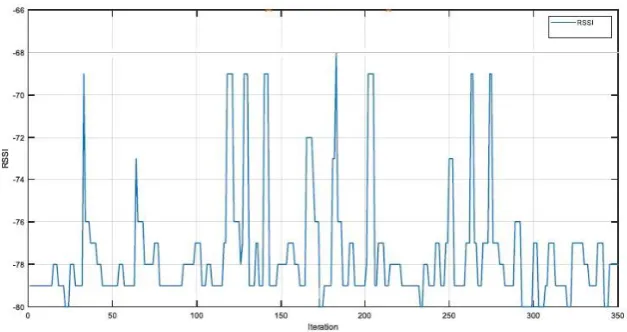
In order to test the real-life performance of the top-performers of the collection of ML algorithms identified in the previous Section (2.4), the same BLE Tag that was previously used to collect fingerprinting data, was placed in arbitrarily selected loca-tions, where subsequently the RSSI fingerprints at the nine gateways were pooled from the server. In Fig. 6, we have plotted the observed RSSI that was recorded over time at one of the gateways for the stand-still BLE Tag.
Fig. 6. A Plot of Random Fluctuations of the Observed RSSI Versus Time at a BLE gateway.
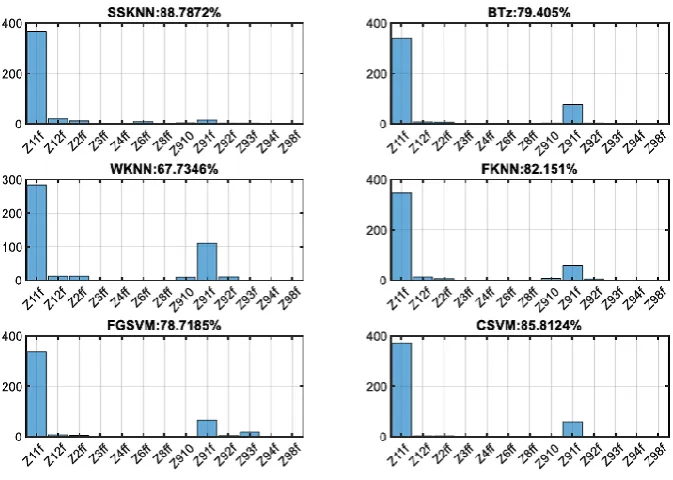
corresponding sub-zone (e.g., Z11). Subsequently, it was fed to each of the set of ML trained classifiers from the previous section to independently predict the corresponding location sub-zone. The obtained results are illustrated in Fig. 8 for each of the top six performers of the ML algorithms presented in Section 2.4. The figure depicts histo-grams for zone prediction when the BLE Tag was placed in zone Z11. It can be seen that the online accuracies and performance do not compare well with those obtained using offline data.
Fig. 7. Spectrum for Wi-Fi Channel 1 versus BLE Beacon Advertisements Channels [31].
2.6 Effects of reducing the number of deployed BLE gateways
We investigated the possibility of using fewer number of BLE gateways in the IP system without sacrificing significant performance (accuracy) in positioning. To this end, we empirically tested the gradual elimination of BLE gateways in a systematic manner, while observing the resulting prediction accuracy in each scenario.
Fig. 8. Prediction Results in Zone Z11 (online).
accuracy (or performance). It was then validated using online data that produced similar results.
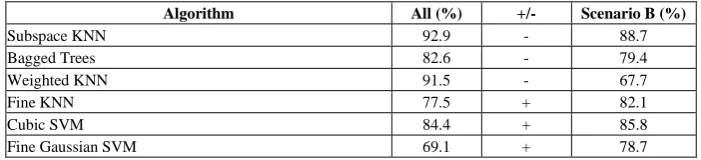
Scenario B: Here, one corner and three center gateways were kept (gateways 1, 3, 7, and 9). As illustrated in Fig. 9, the accuracy of the kNN family of algorithms was significantly degraded. This was especially manifested in the subspace kNN, that had relatively superior performance. On the other hand, the accuracy of the other classifiers has only changed a little around what it was, with all gateways in online prediction mode.
2.7 Evaluation of the ML algorithms in online real-time tracking
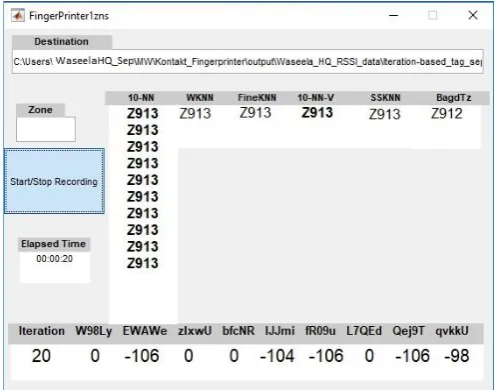
It is desired to evaluate and demonstrate the online real-time performance ( on-the-fly predictions) to replicate an actual deployment of the selected trained ML algorithms when incorporated in a commercial software application solution. For this purpose, an application software (proprietary tool) was created using Matlab®. It obtains, in real-time, from the server the most recently available RSSI measurements from the IP sys-tem BLE gateways, and subsequently feeds this set of RSSI values as features to a collection of previously trained ML algorithms (of primary interest) to obtain predic-tions of location (sub-zone numbers) based on these values. The application interface is shown in Fig. 10 displaying the measured RSSI values (dBm) at the nine gateways, in addition to the predicted location (zone number, i.e., Z913).
Fig. 10. Application Software Interface of Online Real-Time Tracking.
this application is as follows: basic kNN with 10 Nearest Neighbors (10-NN), Weighted kNN (WKNN); Fine KNN (FKNN); Subspace kNN (SSKNN); 10-NN with Voting (10-NN-V), and Bagged Trees (BagdTrz). Considering the superior performance of the var-iants of the kNN-family of algorithms for this application, it was selected to be incor-porated in this real-time application and compared to the second best performer (Bagged-Tree). We note here the wrongly reported location (Z912) by the Bagged-tree (BagdTz).
3
Discussion of Results
Most of the obtained results were presented directly within the methodology section. Nevertheless, we re-present some of the results for the purpose of comparisons and discussion. As was shown in Table 1, the basic classification Trees algorithm had a little better accuracy than that of the basic kNN algorithm, although this was not of sufficient performance level. Also, Table 1. depicts that the classification Trees ML algorithm has superior performance in terms of prediction speed once it has been trained. The subspace kNN classification algorithm was shown, in Table 2, to have the highest accuracy with good prediction speed and intermediate training time. The bagged Tree algorithm has a relatively lower accuracy than that the subspace kNN, but with double the prediction speed. The SVM ML algorithms family has much faster prediction speed with accuracy close to that of the Bagged Tree algorithm.
A look at the sub-zone prediction accuracy using the online data of Section 2.5 indi-cates that prediction accuracy was significantly reduced, when compared with the ac-curacy obtained in the offline phase of Section 2.4. This can be attributed to a form of overfitting in the application of the ML algorithms, although the employed 5-fold cross-validation helps in reducing its effect. In addition, the resolution and quality of the measurement data acquired from the utilized servers could not be verified. Moreover, fluctuations of the recorded RSSI data rendered repeatability and uniqueness of the fin-gerprints at the same location to be a discrepancy.
Table 3. Performnace Summary of Advanced ML Algorithms in Online Phase.
Algorithm Accuracy (%) Prediction Speed (obs/sec) Training Time (sec.) off-line
Subspace KNN 92.9 12000 3.425
Bagged Trees 82.6 24000 3.193
Weighted KNN 91.5 100,000 0.43717
Fine KNN 77.5 210,000 0.3714
Cubic SVM 69.1 6200 10.805
Fine Gaussian SVM 84.4 4000 11.873
accuracy, while others had suffered major degradation in accuracy such as the WKNN. On the other hand, an increase in accuracy was observed for the group of algorithms that had less favorable accuracy in the online mode.
Table 4. Results of scenario B with only four BLE gateways
Algorithm All (%) +/- Scenario B (%)
Subspace KNN 92.9 - 88.7
Bagged Trees 82.6 - 79.4
Weighted KNN 91.5 - 67.7
Fine KNN 77.5 + 82.1
Cubic SVM 84.4 + 85.8
Fine Gaussian SVM 69.1 + 78.7
Finally, the real-time investigation of selected algorithms that allowed movement and on-the-fly reporting of predicted location (sub-zone label) demonstrated the viabil-ity of employed ML algorithms. Moreover, it allowed the discovery of most error prone areas near sub-zone borders, and in zones where there were no BLE gateways installed.
4
Conclusion
5
Acknowledgement
This work was performed within the framework of the Faculty-for-Factory (FFF) program, and we thank its administrators for their support. We highly value the great interactions with PenguinIN/Waseela ICT Solutions and its great employees, where this research and the measurement campaigns had been conducted.
6
References
[1]T. Logsdon, The Navstar Global Positioning System, Switzerland: Springer, 1992, pp 17-32. https://doi.org/10.1007/978-1-4615-3104-3_2
[2]V. A. Bartenev, V. V. Malyshev, M. N. Krasilshikov, "Current GLONASS status upgrades and prospective", Air Space Eur., vol. 1 (2), 1999, pp. 56-62. https://doi.org/10.1016/ s1290-0958(99)80015-x
[3]H. L. Trautenberg, T. Weber, C. Schäfer, "GALILEO system overview", Acta Astronautica, vol. 55(3), 2004, pp. 643-647.https://doi.org/10.1016/j.actaastro.2004.05.046
[4]S. Hongwei, L. Zhigang, P. Feng, "Development of satellite navigation in China", Proc. IEEE Int. Freq. Control Symp. Joint 21st Eur. Freq. Time Forum, 2007, pp. 297-300.
https://doi.org/10.1109/freq.2007.4319084
[5]Yanying Gu, Anthony Lo, and Ignas Niemegeers, "A Survey of Indoor Positioning Systems for Wireless Personal Networks," IEEE Communications Surveys & Tutorials, 11(1), 2009, pp.13–32. https://doi.org/10.1109/surv.2009.090103
[6]Maximize Market Research. 2019 Global Indoor Positioning and Indoor Navigation Mar-ket–Industry Analysis and Forecast (2020-2027). Available online: https://www.max- imizemarketresearch.com/market-report/global-indoor-positioning-and-indoor-navigation-market/25418 (Accessed on 8 March 2020) https://doi.org/10.1109/ipin.2010.5646748
[7]S. Memon et. al., “Smart indoor positioning using BLE technology,” 4th IEEE International Conference on Engineering Technology and Applied Sciences, 2017, https://doi.org/10. 1109/icetas.2017.8277872
[8]A. Yoddumnern, R. Chaisricharoen, T. Yooyativong, "Cloud based WiFi multi-sensor net-work," International Journal of On-Line Engineering, 14(8), 2018, pp. 35-51.
https://doi.org/10.3991/ijoe.v14i08.8536
[9]M. Du, L. Shang, "A low-cost RFID/GPS location sensing algorithm for urban infrastruc-ture," International Journal of On-line Engineering, 11(4), 2015, pp.1-7.
https://doi.org/10.3991/ijoe.v11i4.4319
[10]T. Adiono, B. Tandiawan, S. Fuada, "Device protocol design for security on Internet of Things based smart home," Int Journal of On-Line Engineering, 14(7), 2018, pp. 161-170.
https://doi.org/10.3991/ijoe.v14i07.7306
[11] P. Spachos and K. N. Plataniotis, "BLE Beacons for Indoor Positioning at an Interactive IoT-Based Smart Museum," in IEEE Systems Journal, 2020, pp. 1-11.
https://doi.org/10.1109/jsyst.2020.2969088
[12]S. He, S. Chan, "Wi-Fi fingerprint-based indoor positioning: Recent advances and compar-isons," IEEE Communications Surveys & Tutorials, 18(1), 2016, pp. 466-490.https://doi.org/10.1109/comst.2015.2464084
[14]J. Yang, Z. Feng, X. Ma, X. Zhang, "Indoor positioning method based on wireless signal," International Journal of Online Engineering, 14(10), 2018, pp.53-67.https://doi.org/10. 3991/ijoe.v14i10.9303
[15]S. Li, C. Zhang, J. Qu, "Location optimization of wireless sensor network in intelligent workshop based on the three-dimensional adaptive fruit fly optimization algorithm," Inter-national Journal of Engineering, 14(11), 2018, pp. 202-211. https://doi.org/10.3991/ ijoe.v14i11.9544
[16]R. Faragher and R. Harle, “Location fingerprinting with Bluetooth low energy beacons,” IEEE J. Sel. Areas Commun., vol. 33(11), pp. 2418-2428, 2015. https://doi.org/10. 1109/jsac.2015.2430281
[17]R. Faragher and R. Harle, “An analysis of the accuracy of Bluetooth low energy for indoor positioning applications,” in Proc. ION GNSS, Tampa, FL, USA, 2014, pp. 201-210. [18]S. Kajioka, T. Mori, T. Uchiya, I. Takumi, and H. Matsuo, “Experiment of indoor position
presumption based on RSSI of Bluetooth LE beacon,” in Proc. IEEE GCCE, Tokyo, Japan, Oct. 2014, pp. 337-339. https://doi.org/10.1109/gcce.2014.7031308
[19]Y. Peng, W. Fan, X. Dong, and X. Zhang, “An iterative weighted KNN (IWKNN) based indoor localization method in Bluetooth low energy (BLE) environment,” in Proc. IEEE IEEE UIC/ATC/ScalCom/CBDCom/IoP/ SmartWorld, 2016, pp. 794-800.
https://doi.org/10.1109/uic-atc-scalcom-cbdcom-iop-smartworld.2016.0127
[20]M. Castillo-Cara, J. Lovón-Melgarejo, G. Bravo-Rocca, L. Orozco-Barbosa, and I. García-Varea, “An analysis of multiple criteria and setups for Bluetooth smartphone-based indoor localization mechanism,” J. Sensors, vol. 2017, Sep. 2017, Art. no. 1928578, Accessed: Jan. 2018, https://doi.org/10.1155/2017/1928578
[21]W. He, P.-H. Ho, and J. Tapolcai, “Beacon deployment for unambiguous positioning,” IEEE Internet Things J., vol. 4(5), 2017, pp. 1370-1379. https://doi.org/10.1109/ jiot.2017.2708719
[22]V. C. Paterna, A. C. Augé, J. P. Aspas, and M. A. P. Bullones, “A Bluetooth low energy indoor positioning system with channel diversity, weighted trilateration and Kalman filter-ing,” Sensors, vol. 17 (12), pp. 2927, 2017. https://doi.org/10.3390/s17122927
[23] http://www.pinguinIN.com/. Accessed: 25 April 2020.
[24] https://www.mathworks.com/help/stats/classificationlearner-app.html/. Accessed: 8 April 2020.
[25]Cover, T.; Hart, P. Nearest neighbor pattern classification. IEEE Trans. Inf. Theory 1967, 13, pp. 21–27. https://doi.org/10.1109/tit.1967.1053964
[26]Quinlan, J.R. C4.5: Programs for Machine Learning; Morgan Kaufmann Publishers Inc.: San Francisco, CA, USA, 1993. https://doi.org/10.1007%2Fbf00993309
[27] T.K. Ho "Nearest neighbors in random subspaces," in Advances in Pattern Recognition. SSPR /SPR 1998. LNC, vol. 1451. Springer, Berlin, Heidelberg, pp. 640-648.
https://doi.org/10.1007/bfb0033288
[28]E. Bauer, R. Kohavi, “An empirical comparison of voting classification algorithms: Bag-ging, boosting, and variants,” Machine Learning, vol. 36, 1999, pp. 105–139.
https://doi.org/10.1007%2F3-540-28084-7_16
[29] K. Hechenbichler, K. Schliep, "Weighted k-Nearest-Neighbor Techniques and Ordinal Classification," Collaborative Research Center 386, Discussion Paper 399, 2004, pp. 1-16. DOI: https://doi.org/10.5282/ubm/epub.1769
[30] Burges, C.J. A tutorial on support vector machines for pattern recognition. Data Min. Knowl. Discov. 1998. 2, pp. 121–167. https://doi.org/10.1023/A:1009715923555
7
Authors
Ashraf Tahat is an Associate Professor in the Department of Communications En-gineering at Princess Sumaya University for Technology (PSUT) and the Vice-Chair-man of IEEE Jordan Section. Dr. Tahat earned his B.Sc. and M.Sc. degrees in Electrical Engineering from the Illinois Institute of Technology (IllinoisTech), Chicago, USA, where he also received a Ph.D. in 2002, with a focus on communications and signal processing. Dr. Tahat joined PSUT in 2005 and served as the Head of the department of Communications Eng. from 2010 to 2012. He was also a Visiting Professor with McGill University, Montreal, Canada, in the Department of ECE, conducting research on modern communications systems (2012-2013). From 2002 to 2003, he was an Ad-junct Professor at IllinoisTech, Chicago, USA. Email: [email protected]
Mohammed N. Smadi is the Director of Research and Development at PenguinIN, Irvine, CA, USA. He received the BSc, MSc, and PhD in ECE from McMaster Univer-sity in Ontario, Canada. Dr. Smadi has been an adjunct Assistant Professor with depart-ment of ECE at McMaster university since 2012. He was also senior and principal re-searcher with Blackberry from 2008 to 2015. Email: [email protected]
Mohammad Syouf is a presale engineer with PenguinIN in Irvine, CA, USA. He received a BSc and an MSc degree in Electrical and Electronics Engineering form Jor-dan University for Science and Technology in 2018, where he was a teaching and re-search assistant. Email: [email protected]
![Fig. 7. Spectrum for Wi-Fi Channel 1 versus BLE Beacon Advertisements Channels [31].](https://thumb-us.123doks.com/thumbv2/123dok_us/551538.2054702/9.595.150.450.250.488/fig-spectrum-channel-versus-ble-beacon-advertisements-channels.webp)