Volume 3 • Issue 2 • April 2017
ISSN 2206-4451
www.ajbssit.net.au
The Impact of Technology on Minors: A Survey-based Study
Mona Telmesani1, Waqar Ahmad2 and Tareq M. Telmesani3
1Department of Arts and Design, Limkokwing University of Creative Technology, Selangor, Malaysia, 2Department
of Industrial Engineering, King Abdul Aziz University, Jeddah 21589, Saudi Arabia, 3Department of Administration,
Jeddah International College, Jeddah, Saudi Arabia
1. Introduction
Technology is the present world; almost every individual is using technology nowadays. It’s certainly affecting peoples’ daily lives because it’s playing a major role in facilitating our everyday life whether we are talking about transportation, communication, security, banking, or healthcare; they all rely on technology in one way or another. The argument on the technology concept is always crucial for understanding because it is difficult to define the nature of technology. The old studies are very clearly stating that it is very difficult to define technology (Reddy and Zhoa, 1990). To overcome this difficulty technology is studied from different approaches. Many researchers even from different disciplines, i.e., political science, marketing, organizational behavior and management are studying international and local technological transfer (Cusumano and Elenkov, 1994; Zhao and Reisman, 1992).
Technology provides us with knowledge, experience, and entertainment; indeed a list of its benefits would be very long. However, these advantages made people ignore its dark side and serious impact on everybody, especially children.
This paper is describing about what is technology? And how it is effecting our children’ socially, mentally, and physically. Author will also highlight the damage it’s causing to their health, social skills and academic performances. Two questionnaires are used in this paper, one distributed to mothers and other to their teachers to collect reliable data. An analysis is also provided to lead to the final conclusion, which will decide whether technology should be allowed for children, or not.
Abstract
The current era is a technological era. In every field of life, technology is playing a key role. Even in education, from school to universities everywhere technology is an essential element. Researchers are always focusing on the benefits of technology and very few researches are conducted on its negative impact. This study is examining the negative impact of technology on children. The recent question whether technology has a dark impact besides its bright side or not is focused in this study. Should our younger ones use technology, this frequent with no limits is also investigated. Questionnaire method is used to collect data to investigate the answer of these questions. Two different questionnaires were designed for mothers and teachers. Questionnaires were distributed to schools and results were analyzed using software. The results clearly indicate that there is a negative impact of technology on the physical and mental health of children for the excessive use of gadgets. Although a fair use with precautionary measure can improve the productivity of the children. At the end, researcher also provides few guidelines for mothers and children on fair use technology.
2. Literature Review
2.1. What is technology?
The researcher’s in the past has defined and viewed “technology” term in different perspectives, which influenced the results and research design and also affected government policies in general (Reddy and Zhoa, 1990).
According to Lane (2005), technology concerns itself with understanding how knowledge is creatively applied to organized tasks involving people and machines that meet sustainable goals.
According to Kumar et al. (1999), technology is based on two important components: The first one belongs to tools and equipment as physical components and second as informational components such as marketing, management, skilled labor, reliability, and practical areas. The Sahal (1981) defines technology as observing and configuration of technology based on a subjectively determined but specifiable set of processes and products. Dunning (1994) said that the transfer of technology has linked technology directly with knowledge and provide more consideration to the method of development and research.
Technology also gives us various products, which can be used for good or ill or where the benefits are disputed.
2.2. How children between the age of 3 and 16-year-old are exposed to technology
The technology was invented in the first place to facilitate life and make complicated procedures much easier. For example, machines were made to save effort and time. But when speaking about children, the case is different. Children use technology mainly for two purposes: Entertainment and knowledge. The children of elementary school age use technology 8 h/day as an average and 65% of the children have a personal television in their bedrooms and almost 50% North American houses whole day use television (Rideout, 2003; Active Healthy Kids Canada, 2008).
Special programs and channels are created to entertain or teach children in different ways. It is very clear that children are not attracted to physical games anymore; technology plays a huge role in this. Instead of playing soccer with friends, decorating cupcakes, raising pets and playing with dolls, you’ll find that children would hold an iPad, an iPod, an iPhone, a video game or a computer and sit in one place for hours.
Many entertainment applications are creatively created especially for children to use and those programs are really satisfying the little ones’ imagination to an extreme level. Moreover, internet has become an essential matter to all ages including children. A child would go online to find his favorite program, animation, game or movie clips, also a child in the age of 8 years and older would communicate with family, friends and society through social network programs.
To some children technology in its many shapes has helped in improving skills, knowledge, and imagination, to others it has caused addiction, changed habits, damaged personalities, relationships and social lives or hurt physical health. However, the question is as follows: “Are we aware of the impact of technology on our children?”
2.3. Physical impacts of technology
2.3.1. Eyes problems
Computer vision syndrome (CVS) is a common disease for technology users. It causes burning and irritation. According to Dr. Matthew Gardiner (an ophthalmologist at Mass Eye and Ear Infirmary in Boston), people focus intently on the screen and they forget to blink. That can lead to dry eyes, which causes the irritation.
The American Optometric Association defines CVS as “the combination of eye and vision problems associated with the use of computers. These symptoms result from the individual having insufficient visual capabilities to perform the computer task comfortably.”
age ranging between 8 and 18 years discovered that average day kids devote around 4.5 h watching television, 7.5 h using entertainment media, 1.5 h on a computer and over an hour playing video games. Many researchers studied the effect of computer and other technology on the children and find out the children’s are equally effected with CVS because of excess use of technology (Barar et al., 2007; Bali et al., 2007; Izquierdo et al., 2004; Jacobs and Baker, 2002).
2.3.2. Ears problems
Dr. Jennifer Smullen also works at Mass Eye and Ear says: “An ear bud doesn’t block out background sound so people tend to turn the volume up louder,” she said. Over time, that can cause hearing loss or tinnitus, which is an annoying ringing in the ear.
A research study by Small and Vorgan (2009) indicates that technology heavily impact on the visual and auditory systems of the kids. Vorgan said that “while the vestibular, proprioceptive, tactile, and attachment systems are under stimulated, the visual and auditory sensory systems are in “overload.” This sensual disproportion generates enormous problems in the neurological development, as the brain’s anatomy, pathways and chemistry can be permanently changed and impaired.
2.3.3. Obesity
As per the report of addressing childhood obesity by Canadian Institutes of Health. (2004), one of each six kids is obese. There are three very important and critical factors for the psychological and physical development of a kid, (1) Connection to other humans, (2) touch, and (3) movement. A study concluded that when these three elements are deprived, shocking consequences happen (Montagu, 1972; Korkman, 2001; Ratey and Hagerman, 2008).
The more time people are spending engrossed in technology they are spending less time being active or exercising. Furthermore, the likelihood of mindlessly eating unhealthy food increases, as people are hypnotized while watching. According to the report of National Association for Sport and Physical Education (2002), the young children require 3-4 h/day physical, rough and active play to attain satisfactory sensory stimulation to their vestibular, proprioceptive and tactile systems for normal development (Braswell and Rine, 2006). Hence, the physical movement of the kids is very important for healthy development.
2.3.4. Poor sleep habits
Getting sucked into online activities that keep us up too late and the constant stream of information can make it difficult to turn off our brains. Furthermore, the ambient glow from screens can affect the release of melatonin, the sleep chemical.
Paavonen et al. (2006) in his study interviewed parents of 321 children’s and found that most of the children are suffering with sleep disorder because of excess use of technology.
2.4. Mental impact of technology
Researches have proved that technology has a dangerous impact on mental health such as neurosis and shortened attention span. As per the study of Hamilton (2006), one kid from six is diagnosed with developmental disability. Waddell et al. (2007) identified that 14.3% of kids are diagnosed with psychiatric disorder.
Many researchers proved that autism, diagnoses of attention deficit hyperactivity disorder, coordination disorder, anxiety, depression, sensory processing disorder, and sleep disorders are normally associated to overuse of technology and the also increasing at an alarming rate (Christakis et al., 2004; Hancox et al., 2005; Jennings, 2005; National Dissemination Center for Children with Disabilities, 2005; Paavonen et al., 2006; Robinson and Martin, 2008 Rowan, 2013). It is highly required that parents should be informed about the problems their child can face by excess use of technology.
2.5. Social impact of technology
lack of empathy, lack of boundaries, lack of privacy, and warped sense of reality. “Television gives children a distorted image of the world, as children have difficulty in discriminating reality from fantasy on television” (Sprafkin et al., 1986).
Ozmert et al. (2002) in his study concluded that “As evaluated by the Child Behavior Checklist (CBCL), television viewing time is positively associated with social problems, delinquent behavior, aggressive behavior, externalization, and total problem scores. Older age, male gender, and decreasing social subscale and increasing attention problem subscale scores on the CBCL increases the risk of watching television for more than 2 h.” Social problems (Ozmert et al., 2002).
3. Research Methodology
Two surveys were created and distributed to women with different occupations, nationalities, and ages. One page survey was given to 50 Saudi mothers of children from different genders between the ages of 3 and 16 years, the questionnaire included questions about their children’s use of technology, age, gender, personalities, health problems, and academic performances to know the impact of using technology on the child’s habits, personality and health. Out of 50 participants, 32 mothers answered the questions. As for the other survey, it was one page also and was distributed to 50 teachers to get information about technology impact on students’ health, personalities, and performances in school. Some general questions about the child gender and age were asked in the survey too. Out of 50, 48 questionnaires were collected.
4. Questionnaires Analysis and Discussion
Results from the survey have showed that all 32 mothers agreed that their children are technology users (Figure 1).
About 60% of the mothers described their child’s personality as social, while 31% answered active, and the rest 9% were described as quiet children, which means that 40% of the children lack social skills and their energy level is affected; it’s either increased or decreased (Figure 2).
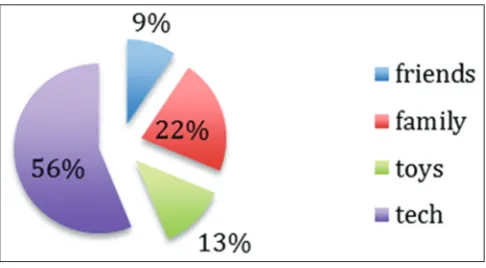
Mothers were asked to identify the age group which their children belong to, 53% has answered that their children were in the age group of 3-5 years old, while 25% falls in the age group of 6-8 years old, 16% belonged to the age group of 9-12 years old and only 6% were between 13 and 16 years old (Figure 3). 56% of the mothers agreed that their children spend most of their free time at home on technology, while 22% answered that their children spend more time with family, 13% said their children prefer to play with toys, and the 9% left spend most of their time with friends (Figure 4).
When it came to health problems, charts has confirmed that 50% of the children are having health problems such as eyes problems, sleeping and eating disorders and other health issues such as asthma and eczema (Figure 5a and b).
Each mother has specified how many hours her child spends on technology per day, the answers varied between 1, 2-3, 4-5 h and more (Figure 6).
4.1. Technology and health problems
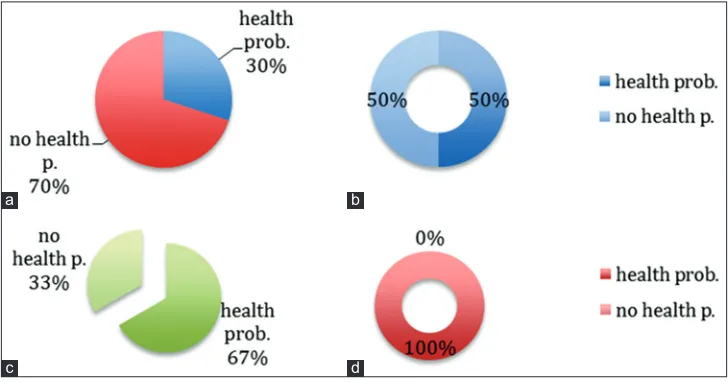
After relating hours spent on technology with health problems, charts have proved that the more time the child spends on technology the higher the risk of having health issues (Figure 7a-d).
Figure 2: Personality description
Figure 3: Age of the child
4.2. Females, males and technology
According to charts both males and females spend many hours on technology, but results have indicated that females tend to spend more time on technology than males (Figure 8a and b). This makes sense because in Saudi Arabia males get to practice more activities outdoors like playing soccer and other games. While girls tend to stay at home longer. Moreover, males tend to play with building blocks, cars, and wrestling. These games to them cannot be replaced with electronic application; as physical contact and sound effects are more interesting in reality than behind the screen. In the other hand, females
Figure 6: Technology hours
Figure 5: (a) Health problems, (b) What kind of health problems?
a b
Figure 7: (a) Health problems (1 h), (b) health problems (2 h), (c) health problems (3 h), (d) health problems (4 h)
a
c
b
are interested in styling dolls, raising pets, cooking and these games are all available in electronic applications with more facilities and options which justify the long time they spend on technology.
Despite that, charts showed that males’ personality and academic performances were more affected than females (Figure 9a-d). While their health was equally affected (Figure 10a and b). That can be explained; when males play video games, or watch TV or engage in any technological activities they tend to give their 100% attention, full focus and become isolated from reality, which make them easily affected, and more exposed to personal damage, which make them less social, more hyper and active, in some cases quite, and distracted all the time. And since females spend more time it’s more likely for them to suffer from health problems.
4.3. Technology and age groups
Focusing on age groups, charts proved that the older the child is the more he/she tends to use technology more frequently (Figure 11a-d). And according to personality charts results, the older the child is, he/ she is more likely to become less active and more quite (Figure 12a-d).
As children grow older their learning abilities and skills are much improved, so they start using more forms of technology like internet, video games, mobiles; which means more time spent on technology which off course leads to more damage.
When it comes to academic performances, papers has shown that the age group of 13-16 years old were mostly affected, after them were the age group of 3-5 years old children, then 9-12 years old
Figure 8: (a) Females at home, (b) males at home
a b
Figure 9: (a) Females’ personality, (b) male’s personality, (c) females’ academic performances, (d) male’s academic
performances
a
c
b
Figure 10: (a) Females’ health, (b) males’ health
a b
Figure 11: (a) Children 3-5 (time at house), (b) children 6-8 (time at house), (c) children 3-5 (time at house),
(d) children 6-8 (time at house)
a
c
b
d
Figure 12: (a) Children 3-5 (personality), (b) children 6-8 (personality), (c) children 9-12 (personality), (d) children 13-16 (personality)
a
c
b
children, and finally, the least affected group is the 6-8 years old children. As discussed earlier, the group of 13-16 years old children use technology the most of all groups then the younger groups and that can explain their academic performance. Although, it does not explain why 3-5 years old children are the second to be impacted. It’s known that 3-5 years old children does not have serious studies or exams but the fact that teachers have noticed 41% of the students is below average this means that there’s a serious impact on their performances which could not be ignored. The only explanation to this is their young age, they are more influenced and affected by external factors than any group, and cannot control their abilities or emotions, which interpret the results (Figure 13a-d).
4.4. Teacher’s questionnaire…
Teachers were asked to determine the children who tend to use technology during school time and the results showed that 23% of the students would want to extend their use of technology to school time (Figure 14). The study was made on this group to know the impact of technology on their personalities, behavior in class and academic performances. 73% of them were females, which matches the results of mothers’ questionnaire that females are more frequent technology users than males (Figure 15).
Again the study has proved that males’ personalities, behavior in class, and academic performances get more affected by technology than female users (Figure 16a-f).
Figure 14: Children’s preferences during free time
Figure 13: (a) Children 3-5 (academic performances), (b) children 6-8 (academic performances), (c) children 9-12
(academic performances), (d) children 13-16 (academic performances)
a
c
b
Except in health, according to health charts females had more health issues, which is expected (Figure 17a and b).
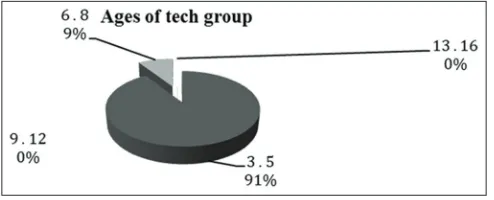
Around 91% of them were 3-5 years old children and the rest were at the age of 6-8 years old, which shows that kids at these young ages cannot control their addiction or usage of technology while older ones can and know their limits (Figure 18).
These children were clearly affected by their addiction to technology; it’s showing in their personalities, performances in class, and academic performances charts, what you can notice is that the group of 6-8 years old children are more impacted than the younger ones, as it’s proved earlier that the older the child gets the more frequent he or she uses technology and the more impacted he or she becomes (Figure 19a-f).
Finally, all women (both mothers and teachers) were asked if technology has an impact on children or not to see how aware they were of the negative impact and the dark side of technology, 45% of them though that technology has no significant impact or can cause no harm to children, on the other hand,
Figure 15: Children’s tendency to use tech in school
Figure 16: (a) Females’ personalities in school, (b) males’ personalities in school, (c) females’ behavior in class,
(d) females’ behavior in class, (e) females’ academic performances, (f) females’ academic performances
a
d
b
e
c
f
Figure 17: (a) Females’ health, (b) males’ health
21% has answered that technology also is harmless but has a good impact on children’s imagination, knowledge, and entertainment. Only 34% were aware of the dark side of technology and believed that technology causes serious and negative impact to children’s health, personalities, attitudes, academic performances, and social communications (Figure 20).
5. Conclusion
There’s no doubt that technology has many advantages and is a key to a bright future but we should be careful when it comes to our children. Many studies have proved that technology has a dark side besides its great beneficial side, and this paper specifically is an indication of how dangerous technology can be to children, the more frequent the child uses technology the more negatively impacted his health,
Figure 18: Ages of tech group
Figure 20: Does technology affect children?
Figure 19: (a) Tech children 3-5 (behavior in class), (b) tech children 6-8 (behavior in class), (c) tech children 3-5
(personalities), (d) tech children 6-8 (personalities), (e) tech children 3-5 (academic performances), (f) tech children 6-8 (academic performances)
a
d
b
e
c
personality, and academic performances get. Technology can slowly damage our new generation physically, mentally and socially; that’s why it’s important to be aware of these negative impacts of technology and take them seriously. Parents should take control of how much time their children spend on its different forms to maintain balance between technology’s advantages and disadvantages.
References
Active Healthy Kids Canada. (2008). Available from: http://www.activehealthykids.ca/Ophea/ActiveHealthyKids_ v2/upload/AHKC-Short-FormEN.pdf. [Last accessed on 2015 March 12].
Bali, J., Navin, N., Thakur, B.R. (2007), Computer vision syndrome: A study of the knowledge, attitudes and prac-tices in Indian ophthalmologists. Indian Journal of Ophthalmology, 55(4), 289-294.
Barar, A., Apatachioaie, I.D., Apatachioaie, C., Marceanu-Brasov, L. (2007), Ophthalmologist and computer vision syndrome. Oftalmologia, 51(3), 104-109.
Braswell, J., Rine, R. (2006), Evidence that vestibular hypo function affects reading acuity in children. International Journal of Pediatric Otorhinolaryngology, 70(11), 1957-1965.
Canadian Institutes of Health. (2004), Addressing childhood obesity: The evidence for action. Available from: http:// www.cihrirsc.gc.ca/e/23293.html.
Christakis, D.A., Zimmerman, F.J., DiGiuseppe, D.L., McCarty, C.A. (2004), Early television exposure and subse-quent attentional problems in children. Pediatrics, 113(4), 708-713.
Cusumano, M.A., Elenkov, D. (1994), Linking international technology transfer with strategy and management: A literary commentary. Research Policy, 23(2), 195-215.
Dunning, J.H. (1994), Multinational enterprises and the global of innovatory capacity. Research Policy, 23, 67-88. Hamilton, S. (2006), Screening for developmental delay: Reliable, easy-to-use tools. Journal of Family Practice,
55(5), 416-422.
Hancox, R.J., Milne, B.J., Poulton, R. (2005), Association of television during childhood with poor educational achievement. Archives of Pediatric and Adolescent Medicine, 159(7), 614-618.
Izquierdo, J.C., Garcia, M., Buxo, C., Izquierdo, N. (2004), Factors leading to the computer vision syndrome: An issue at the contemporary workplace. Boletin de la Asociacion Medica de Puerto Rico, 99(1), 21-28. Jacobs, K., Baker, N.A. (2002), The association between children’s computer use and musculoskeletal discomfort.
Work, 18(3), 221-226.
Jennings, J.T. (2005), Conveying the message about optimal infant positions. Physical and Occupational Therapy in Pediatrics, 25(3), 3-18.
Korkman, M. (2001), Introduction to the special issue on normal neuropsychological development in the school-age years. Developmental Neuropsychology, 20(1), 325-330.
Kumar, V., Kumar, U., Persaud, A. (1999), Building technological capability through importing technology: The case of Indonesian manufacturing industry. Journal of Technology Transfer, 24(1), 81-96.
Lane, A. (2005), What is technology? Available from: http://www.open.edu/openlearn/science-maths-technology/ engineering-and-technology/technology/what-technology. [Last accessed on 2016 Jan 15].
Montagu, A. (1972), Touching: The Human Significance of the Skin. 2nd ed. New York: Harper and Row.
National Association for Sport and Physical Education. (2002), NASPE Releases First Ever Physical Activity Guidelines for Infants and Toddlers. Available from: http://www.aahperd.org/naspe/template. cfm?template=toddlers.html. [Last accessed on 2016 Jan 18].
National Dissemination Center for Children with Disabilities, 26th Annual Report to Congress, US Department of
Education. Available from: http://www.nichcy.org/pubs/factshe/fs7txt.htm. [Last accessed on 2016 Feb 10]. Ozmert, E., Toyran, M., Yurdakok, K. (2002), Behavioral correlates of television viewing in primary school children
evaluated by the child behavior checklist. Archives of Pediatrics and Adolescent Medicine, 156(9), 910-914. Paavonen, E.J., Pennonen, M., Roine, M., Valkonen, S., Lahikainen, A.R. (2006), TV exposure associated with sleep
disturbances in 5- to 6-year-old children. Journal of Sleep Research, 15(2), 154-161.
Ratey, J.J., Hagerman, E. (2008), Spark: The Revolutionary New Science of Exercise and the Brain. New York: Little, Brown and Company.
Reddy, N.M., Zhao, L. (1990), International technology transfer: A review. Research Policy, 19(4), 285-307. Rideout, V.J., Foehr, U.G., Roberts, D.F. (2010), Generation M2. Media in the Lives of 8- to 18-year olds. A Kaiser
Family Foundation Study. Menlo Park, CA: The Henry J. Kaiser Family Foundation. Available from: http:// www.eric.ed.gov/?id=ED527859. [Last accessed on 2016 Jan 10].
Robinson, J.P., Martin, S. (2008), What do happy people do? Journal of Social Indicators Research, 89, 565-571. Rowan, C. (2013), The Impact of Technology on the Developing Child. Available from: http://www.huffingtonpost.
com/cris-rowan/technology-children-negative-impact_b_3343245.html. [Last accessed on 2016 Feb 15]. Sahal, D. (1981), Alternative conceptions of technology. Research Policy, 10, 2-24.
Small, G., Vorgan, G. (2009), iBrain: Surviving the Technological Alteration of the Modern Mind. New York: Harper Collins Publishing.
Sprafkin, J., Gadow, K.D., Dussault, M. (1986), Reality perceptions of television: A preliminary comparison of emotionally disturbed and nonhandicapped children. American Journal of Orthopsychiatry, 56(1), 147-152. Waddell, C., Hua, J.M., Garland, O., Peters, R.D.V., McEwan, K. (2007), Preventing mental disorders in children:
A systematic review to inform policy-making. Canadian Journal of Public Health, 98(3), 166-173.