Security of Intelligent Building Network
Based on Wireless Sensor Network
https://doi.org/10.3991/ijoe.v14i06.8705
Shuang Xu!!", Tong Zhou
Zhengzhou Institute of Technology, Zhengzhou, China
Abstract—In order to study the intelligent buildings, the intelligent building network security of wireless sensor was explored. Because of its advantages of low cost, easy installation, low maintenance and update cost, wireless sensor network system was applied to intelligent building. In view of the characteris-tics of various influencing factors on the wireless sensor network working envi-ronment, node hardware cost and location accuracy, a secure localization algo-rithm based on DV-Hop was put forward. The security analysis results showed that the algorithm resisted external attacks and guaranteed the accuracy of loca-tion results. Based on the above findings, it is concluded that the algorithm can be used to protect the safety of wireless sensor network in building.
Keywords—Intelligent building, wireless sensor network, security positioning, DV-Hop
1
Introduction
medi-cal, intelligent building, environmental monitoring, traffic management, disaster relief and other fields. Because wireless sensor network technology has the advantages of convenient and rapid deployment, as well as low cost of wiring and network mainte-nance, wireless sensor network is especially suitable for application in intelligent building control system. Especially in recent years, with the development of wireless communication technology ZigBee, the BACnet protocol widely used in intelligent building control system can also be transmitted on the ZigBee wireless link, and the sensor nodes supporting BACnet protocol also start to appear. At present, wireless sensor network technology has begun to penetrate into the monitoring of intelligent building and become a hot topic in this field.
2
State of the art
First of all, on the basis of analyzing topology of wireless wireless sensor network, a topology of wireless sensor network suitable for intelligent building is given. And then, the characteristics of wireless sensor networks safety in intelligent buildings are analyzed. At last, some reasonable assumptions are made according to the actual situ-ation of wireless sensor network in intelligent building.
2.1 Topology structure of wireless sensor network in intelligent building Because of the large number of sensor nodes and the larger scale of the sensor network in the intelligent building, it is not suitable to adopt a planar topology. But using the hierarchical topology directly in the wireless sensor network of intelligent building, there are the following problems:
In order to communicate between the cluster head nodes, the cluster head nodes need to communicate with high power. Although it is easier to select some resource sufficient nodes as cluster head nodes in intelligent buildings, it will exacerbate the interference between nodes, reduce communication efficiency, cause the waste of node energy and reduce the life cycle of nodes. More importantly, there are many factors affecting the spread of indoor wireless signal, and the wireless signal long distance transmission not only has great consumption, but also causes signal loss.
Nowadays, the area of intelligent building is large, while the communication abil-ity of cluster head nodes is limited. There is no direct communication between cluster head nodes and Sink nodes, which needs to transfer through other cluster head nodes. Thus, when the sensor node transfers the collected signal to the Sink node through cluster head node, it needs to transfer through multiple cluster head nodes. It not only increases the possibility of transmitted data packet loss, but also increases the time delay of data packet transmission. In intelligent buildings, many data collected by sensor nodes are very timeliness. In intelligent building wireless sensor networks, it is unnecessary to have many hops from sensor nodes to Sink nodes.
affected by environment and data transmission has higher reliability, in the control system of intelligent building, the wireless network cannot completely replace the wired network. Suryadevara, N. K. et al. [1] studied intelligent sensors and actuators based on wireless sensor networks in smart power management buildings. When deploying wireless sensor networks in the intelligent building, we can use the network system with wired and wireless combination. Chen, M. et al. [2] studied cloud based wireless networks: virtualization, reconfiguration, intelligent wireless networks, and 5G technology. Li, J. Q. et al. [3] put forward an intelligent wireless sensor network system for multi-server communication. The sensor nodes are grouped according to the geographic location of sensor nodes, such as floors, rooms and so on. Each group sensor node consists of a sensor sub network, and the sub network is communicated through the wired network. Batalla, J. M. et al. [4] proposed a low-cost and highly scalable wireless sensor network solution, which can provide intelligent LED lighting control for green buildings.
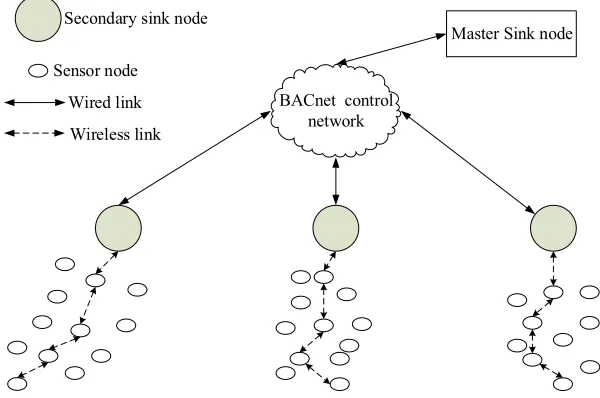
Because the BACnet control network has begun to occupy a dominant position in the intelligent building, and gateway products interconnecting wireless sensor works and wired BACnet network has also emerged, here we take wired control net-work based on BACnet in intelligent building as the backbone netnet-work. BACnet gateway is regarded as the sub Sink node of each sensor network, to show the topolo-gy of wireless sensor network in intelligent building, as shown in figure 1. In the whole network, the main Sink node does communicate directly with sensor nodes, just controlling the operation of sub Sink node. Magno, M. et al. [5] pointed out that between the main Sink node and sub Sink node, the network communication is con-trolled through the wired BACnet. The sub Sink nodes directly control the wireless sensor network operation and process the data sent by the sensor nodes. The sensor node uses the transfer of sub Sink node to send the collected to the main Sink node.
BACnet control network
Master Sink node Secondary sink node
Sensor node Wired link Wireless link
The topology structure of wireless sensor network in intelligent building in figure 1 is actually a two-layer network structure. It includes a main Sink node and multiple sub networks (equivalent to "cluster" in the hierarchical structure), where each sub network comprises a sub Sink node (equivalent to "cluster head" in the hierarchical structure, which is shouldered by the BACnet gateway) and some sensor nodes. Be-tween the upper nodes and beBe-tween the upper node and the Sink node, we use the wired network communication; between the lower nodes, and between the lower nodes and the upper nodes, we use wireless communication. Al-Sakran, H. O. [6] studied the intelligent traffic information system based on the integration of the Inter-net of things and Agent technology. The sensor node transfers the collected data to the sub Sink node through the wireless channel firstly. Then, the sub Sink node converts the data into the BACnet protocol format, and transmits to the main Sink node through the wired BACnet network. Similarly, when the main Sink node issues que-ries and so on commands to the sensor nodes, the command and other information are transmitted to the sub Sink nodes through the wired BACnet network. Then, each sub Sink node transfers the command information to the sensor nodes in each sub network through the wireless channel. This network topology makes full use of the advantages of the reliable transmission of the wired network and the convenient deployment of the wireless network.
2.2 Security analysis of wireless sensor network in intelligent building
Based on wireless sensor networks and power line communications, Li, M. and Lin, H. J. [7] designed a smart home control system. The security problem of wireless sensor network in the application of intelligent building is a necessity in the first con-sideration. Peng, C. et al. [8] studied the design and application of the VOC monitor-ing system based on ZigBee wireless sensor network. If the security system of the network is destroyed, it will not only bring economic losses and sometimes threatens the safety of people's life. Based on wireless sensor networks, Zhou, P. et al. [9] stud-ied large indoor space monitoring systems, including data processing and gas distribu-tion optimizadistribu-tion. For example, in the event of a fire, if the sensor network is dam-aged, then the detected data may not be transferred to the fire control center.
Rawat, P. et al. [10] investigated the recent development and potential synergy of wireless sensor networks. In intelligent building, security problems in wireless sensor networks and those in other sensor networks are similar. Rashid, B. and Rehmani, M. H. [11] pointed out that the wireless sensor network in intelligent building has its own characteristics, making the security problems and solutions of sensor network in intel-ligent buildings different. Because intelintel-ligent building is an open environment, the deployed sensor nodes are easy to be physically captured by attackers. Therefore, when dealing with the safety of wireless sensor network (WSN) in intelligent build-ings, we need to pay special attention to attacks from inside. In addition, the lifetime of sensor networks in intelligent building is very long. In the design of security scheme, it is necessary to guarantee a long time to provide security.
influ-encing factors on the wireless sensor network working environment, node hardware cost and location accuracy, a secure localization algorithm based on DV-Hop was put forward. The security analysis results showed that the algorithm resisted external attacks and guaranteed the accuracy of location results. Therefore, the algorithm pro-posed in this paper can be used to protect the safety of wireless sensor network in building.
3
Security of wireless sensor network in intelligent building
Many applications of wireless sensor networks in intelligent buildings depend on location information of sensor nodes. For example, when fire occurs, we need to know the location of fire, and when someone invades, we need to know where the intruders are. Though nodes are deployed manually in intelligent building wireless sensor networks, due to the large number of sensor nodes, it is not practical to set positions for each node manually. It is not possible for each node to configure a glob-al positioning system GPS because of the limitations of cost and the use of environ-ment. Because of the effects of building environment complexity and the resource constraints of sensor nodes, many traditional wireless location algorithms cannot be directly applied to sensor node localization in buildings. In addition, the wireless sensor network in the building is working in an open environment, so the location of sensor nodes in the building is vulnerable to attack. This chapter first of all analyzes the location mechanism and location security problem in wireless sensor network. And then, it designs a secure localization algorithm suitable for wireless sensor works in intelligent buildings according to the characteristics of wireless sensor net-works in intelligent buildings.
3.1 Node location of wireless sensor network
In the localization technology of wireless sensor network, according to whether the node knows its location, sensor nodes can be divided into beacon nodes and unknown nodes. Beacon nodes occupy very small proportion in the network, and can get their exact location by carrying GPS devices or other means. In the process of sensor node localization, when unknown nodes get the distance from adjacent beacon nodes or get the relative angle between adjacent beacon nodes and unknown nodes, their positions can be calculated according to the following methods.
The algorithm of triangulation is as follows: it is known that the coordinates of the three nodes A, B and C are (xa, ya), (xb, yb), and (xc, yc), respectively, the distance from them to the unknown node D is da, db, and dc, respectively, and it is assumed that the coordinate of node D is (x, y), then there is the following formulas (1) and (2):
The coordinate of the node D can be obtained by (1).
(2)
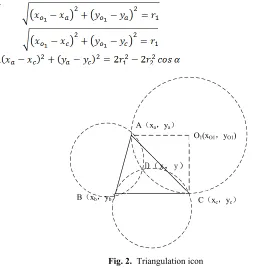
Triangulation as shown in Figure 2, it is known that the coordinates of the three nodes A, B and C are A (xa, ya), B (xb, yb), and C(xc, yc), respectively, the angles of the unknown node D relative to the nodes A, B, and C are �ADB, �ADC, and �BDC, and it is assumed that the coordinate of node D is (x, y). For nodes A and C and the angle �ADC, if the arc AC is in �ABC, it can only determine a circle. The center of circle is set to O1 (xO1, yO1) and the radius is r1, then !=�AO1
C=(2"-2�ADC), and expressed by (3):
(3)
Axaya
O1(xO1yO1)
Cxcyc
Bxbyb
Fig. 2. Triangulation icon
The algorithm of Maximum Likelihood Estimation is: it is known that the coordi-nates of n node are (x1, y1), (x2, y2),…, (xn, yn), the distances from the unknown node D to them are d1, d2,…,dn, and assuming that the coordinate of node D is (x,y), then, there is the following formula:
The last equation is subtracted from the first equation, and (5) is obtained.
(5)
The linear equation of (5) can be expressed by (6): AX=b
(6)
The coordinates of the node D can be obtained by using the standard minimum
mean square method as !
3.2 Security analysis of node location in wireless sensor network
The attack on node location can be divided into external attack and internal attack. External attack refers to that the attacker does not get the system authentication and authorization, unable to access the network. But the internal attack refers to that the attacker becomes the attack issued by the system recognized "legitimate nodes" to the network. An attacker can be captured sensor nodes, or sensor nodes forged according to the legitimate nodes information obtained (including the key information, code, data and so on). Obviously, the internal attack is more difficult to detect and prevent than the external attack, and it is more dangerous. Now, in most of the location algo-rithms design, the security problems are not fully considered. Therefore, there are many kinds of attack methods for these algorithms, and the common attacks are as follows:
False positioning information: By cheating and tampering the location information, the attacker can deceive the location node to generate the wrong location information. Replay the attack. This is the easiest and most common way of attack. Attackers can delay the intercepted location information for a period of time, replay it, or relo-cate information from this location to other locations to replay. As a result, the loca-tion node can calculate the wrong localoca-tion based on the replay informaloca-tion. In hops-based location algorithms, the attacker can use replaying message to make the loca-tion node get the error value of the minimum hops from the beacon node.
Sybil attack: A malicious node forges it to be a false image of multiple nodes, al-lowing the location node to receive the location information of multiple reference nodes from one node.
Wormhole attack: In Wormhole attack, two malicious nodes collude together to re-ceive messages in partial network through a very small delay link, transmit by tunnel, and replay these messages in different parts of the network. Because the localization algorithm based on ranging positions according to the physical information of meas-urement reference node signal, and the localization algorithm free from range posi-tions by referring to node signal content, compared with the localization algorithm based on ranging, range free localization algorithm is more vulnerable to Wormhole attack.
An attack on a false beacon node: This is the most serious attack mode of attack. The attackers disguise as beacon node to send false location information to the posi-tioning node. Most location algorithms locate and calculate based on the information of all beacon nodes. In these algorithms, the attacker can make false localization in-formation by impersonating a beacon node so that all the location nodes can locate errors.
3.3 Safety positioning method of sensor nodes in intelligent building
The basic idea of this algorithm is to use the key chain for the certification of bea-con node identity. The mean value is replaced by median in the DV-Hop algorithm, and each beacon node is assigned a weight value. In this algorithm, the communica-tion between all beacon nodes and Sink nodes is authenticated by the key shared be-tween the beacon node and the Sink node. The broadcast message mechanism of the Sink node is based on the broadcast authentication mechanism proposed. The locali-zation process of the algorithm is divided into four stages:
The first phase is authentication key preposition: Each beacon node selects a ran-dom number R0 as the initial key of its identity authentication, and conducts multiple Hash operations for R0. It generates an authentication key: R0, R1,...,RN, where Ri=Hi(R0), N is the maximum hops between nodes in the network, and H () is a Hash function. The last authentication key RN generated by each beacon node is preposi-tioned or stored in each node through a secure channel. Each node sets the number of hops from all the beacon nodes to N.
The second phase calculates the minimum hop number of the unknown node and each beacon node. Initiated by each beacon node, each node i broadcasts a location request information to its neighbor node: Si>*:{ID(A), P(A), hi(A), Idi, Ri(A)}. ID(A) is an identifier of beacon node A, P(A) refers to location information of beacon node A, hi(A) means the hop of node i to beacon node A, and Ri(A) indicates the authentication key of beacon node A stored on the node i. When the node itself is the beacon node A, hi(A)=0. Ri(A) suggests the initial key R0(A) authenticated by beacon node A.
that there are n beacon nodes in the system. First of all, the beacon node i calculates the corresponding hop distance based on (7) according to the location information and the hop count of each beacon node.
(7)
In (7), (xi, yi) and (xj, yj) are the coordinates of the beacon nodes i and j, respective-ly. hij suggests the hop number between the beacon node i and j(j#i).
In this way, the beacon node i calculates a series of each hop distance as HopLi,1, HopLi,2,…,HopLi,j,…,HopLi,n-1, (j#i). The beacon node i takes the median of these values as each hop distance HopLi calculated by the beacon node i. Then, the beacon node i calculates the weight value of the beacon node j according to (8).
(8)
Here, the minimum of Wj is zero, namely when Wj<0, Wj=0; r refers to the com-munication distance of sensor nodes.
The fourth stage is the calculation of the unknown node location: When the unk-nown node receives the location information sent by the Sink node, the weight-based likelihood estimation method can be used to calculate the coordinates according to the following formula.
(9)
4
Simulation results of security positioning algorithm for sensor
nodes in intelligent building
We simulate and analyze the calculation performance and security performance of the proposed algorithm, respectively. In simulation operation, 200 sensor nodes are randomly deployed in the square area of 100m * 100m. The communication distance of each sensor node is 15m, and the proportion of beacon nodes is 20% when conduc-ting security analysis and simulation experiments.
The sensor nodes of wireless sensor network in intelligent building are made of ar-tificial deployment, and it can guarantee that all the sensor nodes are connected. Therefore, in this paper, in the positioning algorithm and DV-Hop localization algo-rithm, all the unknown nodes can position. That is to say, the positioning coverage of the two localization algorithms is 100% in the intelligent building of sensor network, so the positioning accuracy of the algorithm is only analyzed. Here, the location ac-curacy is represented by the ratio of the value of node location calculation to the communication range between the node true value distance.
Fig. 3. The proportion and location accuracy of beacon nodes
Figure 3 shows the positioning accuracy of two location algorithms in the case of different proportions of the beacon nodes. It is obvious from the diagram that the positioning accuracy of this algorithm is better than that of the DV-Hop algorithm. This is mainly because in this algorithm, the median is calculated instead of the average method in DV-Hop when calculating the average hop distance of each hop. The median is not sensitive to the abnormal data compared with the mean value. The error of every hop distance has little influence on the algorithm. In addition, according to the error between each hop distance of beacon node and each hop distance of other nodes, each beacon node is assigned with different weights. In the calculation of node location, the beacon nodes with large weights contribute more, which can also impro-ve the accuracy to a certain extent.
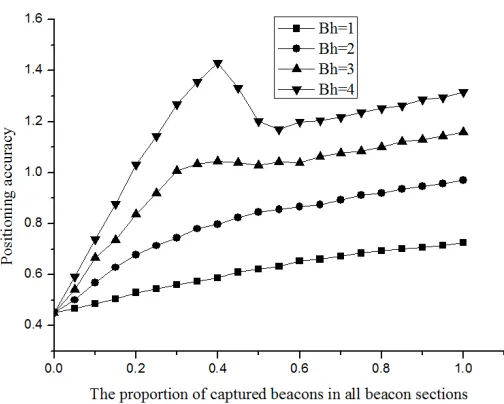
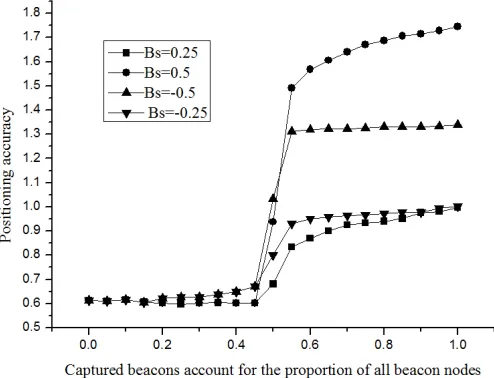
But in Figure 5, the positioning accuracy begins to become bad as the proportion of captured beacon nodes increases. When the number of captured nodes is 40% or so, the destroy degree of changing the beacon node hop number is stronger. When the number of the captured nodes increases, the destroy degree of attack is weakened, and then it is strengthened with the further increase of captured beacon node number. Figure 4~7 also shows that, no matter what kind of attack is, the effect of the attack is enhanced with the increase of the attack intensity.
Fig. 4. Attack based on beacon node location
Fig. 6. Attack based on distance per hop
Fig. 7. Attack based on beacon node weight value
5
Conclusion
Based on the analysis of the characteristics of wireless sensor network in intelligent building, a wireless sensor network topology suitable for intelligent building is given. Specifically, the main contents and contributions of this paper are as follows:
network. This network topology makes full use of the advantages of the reliable transmission of the wired network and the convenient deployment of the wireless network.
(2) A secure location algorithm for wireless sensor network nodes in intelligent building is proposed. The algorithm is based on the DV-Hop algorithm, using the key chain for the certification of beacon node identity. The mean value is replaced by median in DV-Hop location algorithm, and each beacon node is assigned a weight value. The insensitivity of median to abnormal data and weights of beacon nodes are used to reduce the effects of malicious nodes on the positioning accuracy. The per-formance analysis shows that the computation and communication amount of the algorithm are not large, and it is suitable for application in wireless sensor networks.
6
References
[1]Suryadevara, N. K., Mukhopadhyay, S. C., Kelly, S. D. T., & Gill, S. P. S. WSN-based smart sensors and actuator for power management in intelligent buildings. IEEE/ASME transactions on mechatronics, 2015, vol. 20, pp. 564-571. https://doi.org/10.1109/ TMECH.2014.2301716
[2]Chen, M., Zhang, Y., Hu, L., Taleb, T., & Sheng, Z. Cloud-based wireless network: Virtu-alized, reconfigurable, smart wireless network to enable 5G technologies. Mobile Net-works and Applications, 2015, vol. 20.(6), pp. 704-712. https://doi.org/10.1007/s11036-015-0590-7
[3]Li, J. Q., He, S. Q., Ming, Z., & Cai, S. An intelligent wireless sensor networks system with multiple servers communication. International Journal of Distributed Sensor Net-works, 2015, vol. 11(8), pp. 960173. https://doi.org/10.1155/2015/960173
[4]Batalla, J. M., Mastorakis, G., Mavromoustakis, C. X., & Zurek, J. On cohabitating net-working technologies with common wireless access for home automation system purposes. IEEE Wireless Communications, 2016, vol. 23(5), pp. 76-83. https://doi.org/10.1109/ MWC.2016.7721745
[5]Magno, M., Polonelli, T., Benini, L., & Popovici, E. A low cost, highly scalable wireless sensor network solution to achieve smart LED light control for green buildings. IEEE Sen-sors Journal, 2015, vol. 15(5), pp. 2963-2973. https://doi.org/10.1109/JSEN.2014.2383996 [6]Al-Sakran, H. O. Intelligent traffic information system based on integration of Internet of
Things and Agent technology. International Journal of Advanced Computer Science and Applications (IJACSA), 2015, vol. 6, pp. 37-43.
[7]Li, M., & Lin, H. J. Design and implementation of smart home control systems based on wireless sensor networks and power line communications. IEEE Transactions on Industrial Electronics, 2015, vol. 62(7), pp. 4430-4442. https://doi.org/10.1109/TIE.2014.2379586 [8]Peng, C., Qian, K., & Wang, C. Design and application of a VOC-monitoring system
based on a ZigBee wireless sensor network. IEEE Sensors Journal, 2015, vol. 15(4), pp. 2255-2268. https://doi.org/10.1109/JSEN.2014.2374156
[10]Rawat, P., Singh, K. D., Chaouchi, H., & Bonnin, J. M. Wireless sensor networks: a sur-vey on recent developments and potential synergies. The Journal of supercomputing, 2014, vol. 68(1), pp. 1-48. https://doi.org/10.1007/s11227-013-1021-9
[11]Rashid, B., & Rehmani, M. H. Applications of wireless sensor networks for urban areas: A survey. Journal of Network and Computer Applications, 2016, vol. 60, pp. 192-219. https://doi.org/10.1016/j.jnca.2015.09.008
7
Authors
Shuang Xu and Tong Zhou are with Zhengzhou Institute of Technology, Zheng-zhou, China.