T
HE
R
EBOUND
P
ROGRAM
D
E
K
ALB
C
OUNTY
(GA) J
UVENILE
D
RUG
COURT
A
SUMMATIVE
EVALUATION
2004-2011
Submitted to:
The DeKalb County (GA) Juvenile Drug Court
Submitted by:
S
PECIAL
A
CKNOWLEDGEMENTS
-2-
S
PECIAL
A
CKNOWLEDGEMENTS
TEAM-MOE would like to thank all of the Rebound Program collaborators for assisting
directly or indirectly with this summative evaluation. A very special thanks is extended to
the following partners who went above and beyond in providing access to data and
documents that contributed to this report:
Walter Carmack
, Assistant District Attorney Paralegal, DeKalb County
Government & President and Founder, Georgia Community Resource Center
Shunda Dean
, Probation Supervisor, DeKalb County Juvenile Court
Theodore Gordon
, Probation Officer, DeKalb County Juvenile Court
Bayyinah Shaheed
, Counselor, Be Smart Don’t Start
We would also like to thank the
Judge Linda Haynes
for her support of the evaluation
process.
T
ABLE OF
C
ONTENTS
Special Acknowledgements 2
Table of Contents 3
Executive Summary 4
I.
OVERVIEW OF THE REBOUND PROGRAM
7
Overview 8
Collaborating Partners 9
Rebound Program Framework 11
The Rebound Program Structure and Process 13
II. EVALUATION FRAMEWORK
16
Overview of Evaluation Design 17
The Logic Model 18
The Evaluation Inquiry & Analysis Methods 26 The Evaluation Data Sources 27 Data Management and Analysis Procedures 29
Program Indicators 30
III. REBOUND PROGRAM FINDINGS
33
Findings Overview 35 Year 1 Results 38 Year 2 Results 44 Year 3 Results 50 Year 4 Results 59 Year 5 Results 66 Year 6 Results 74 Year 7 Results 81
IV. CONCLUSIONS
86
Overall Conclusions
87Recommendations
95The overall purpose of this summative evaluation report is to highlight the findings from seven (7) years of program implementation for DeKalb County’s Juvenile Drug Court’s Rebound Program. The Rebound Program is designed to help adolescent participants learn to live drug-free and crime-drug-free through early, continuous, and intense judicially supervised treatment, mandatory periodic drug testing, and the use of appropriate sanctions and other rehabilitation services. This summative evaluation embodies aspects from formative, process, and outcomes evaluation frameworks, including cohort analyses and case studies to learn more about the diversity among participating young people. In the end, the summative evaluation data can be used to justify additional funding for effective programmatic components, request supplemental funds to fill gaps in services, as well as to inform program improvements at the staff and collaborative levels.
U
NDERSTANDING THEN
EED FOR AJ
UVENILED
RUGC
OURTIND
EK
ALBC
OUNTY.
The DeKalb County’s Juvenile Drug Court is one of 457 fully operational juvenile drug courts in the United States. The pressing need for such a court in DeKalb County is substantiated in the Juvenile Probation Department’s estimate that at least 70% of all DeKalb County’s juvenile offenders have used alcohol and other drugs. Moreover, drug use is a key factor to other juvenile criminal offenses, including theft and burglary. Based on these determinants of poor outcomes for youth with substance disorders who commit crimes, the Bureau of Justice Assistance (BJA) awarded DeKalb County’s Juvenile Court a Drug Court Planning Grant to convene and train a multi-disciplinary team comprised of the Juvenile Court, the Public Defender’s Office, the District Attorney’s Office, the DeKalb County School System, and the DeKalb Community Service Board (CSB).A G
LIMPSE OF THEP
ROGRAMS’ P
RIORITYP
OPULATION.
In terms of populations served, according to the State of Georgia Department of Juvenile Justice Descriptive Statistics for Fiscal Year (FY) 2009, 87.5% of DeKalb County juvenile offenders are African American, 78.8% are male, and 99% are 13 years of age and up. In comparison, the mean age of the 153 juvenile offenders served by the Rebound Program is 15, with ages ranging from 13 to 17. Ninety-five percent of the juvenile offenders in the program are African American males from lower to middle economic backgrounds.-4-
E
XECUTIVE
S
UMMARY
T
HEP
ROGRAMMATICD
ESIGN AT AG
LANCE.
The Rebound Program blends best practices in clinical intervention and court compliance to deter youth offenders from deviant criminal and social behaviors. The program begins with an orientation, bio-physiological assessment, psychological evaluation, and weekly court appearances. Individual treatment plans are developed based on the assessment results. At the same time, young people are required to meet curfew, maintain satisfactory conduct at home, school, and in the community, maintain a “B” grade point average in school, attend school regularly, and have negative drug screens. Youth not enrolled in school must enroll in a GED or vocational program and/or employment with no unexcused absences. Finally, participating youth must engage in pro-social activities and perform community service. Additional programmatic strategies include journaling, oral presentations, and relapse planning and prevention.EFFORTS
TO EVALUATE PROGRAM RESULTS FROM 2004 – 2011. In the Spring of 2011, The DeKalb County Juvenile Court commissioned Messages of Empowerment Productions, LLC. (TEAM-MOE) to evaluate the Rebound Program. This report presents the results from a summative evaluation of the effectiveness of the DeKalb County Juvenile Drug Court Rebound Program. The program’s process and outcomes are judged based on the effectiveness of the program in reducing recidivism and substance use in juveniles and ultimately developing productive citizens in the community. A customized database was developed to manage data for 153 Rebound Program participants, including demographic and program information extracted from client case files. DeKalb County juvenile history was collected and the data from the adult system was accessed via the DeKalb County Online Judicial System. Program data was analyzed to determine the extent to which young people in the Rebound Program experienced reductions in recidivism and substance abuse, improvements in school performance, increased program retention and phase promotion, as well as an increase in family engagement and involvement in the youths’ lives.S
UMMATIVEE
VALUATIONF
INDINGS.
The Rebound Program serviced 153 young people over a seven year period. Of the 153 participants in the program, 111 (79%) were retained with 57 (38%) graduated from the program. Of these 57 graduates, 26 (46%) remained drug free and have not reoffended since completing the program.-6-
E
XECUTIVE
S
UMMARY
S
UMMATIVEE
VALUATIONR
ESULTSAT AG
LANCECOHORT YEARS TOTAL NO. GRADUATED SCHOOL/ WORK LEVELOF FAMILY ENGAGEMENT (COURT, ACTIVITIES, HOME, SCHOOL) RECIDIVISM LAST DRUG SCREEN POSITIVE RETENTION Aggregate 153 57 (38%) 1 Not documented 97 (88%) 15 Not documented 28 NA 52 (47%) 38 Not documented 3 NA 64 (47%) 11 Not documented 6 NA 73 (62%) 24 Not documented 12 NA 111 (79%) 1 Not documented 11 NA 2010-2011 21 8 (38%) 9 (82%) 4 Not documented 6 NA 12 (86%) 7 Not documented 7 (37%) 2 Not documented 14 (78%) 3 Not documented 14 (93%) 6 NA 2009-2010 30 15 (50%) 21 (91%) 7 Not documented 11 (58%) 11 Not documented 14 (54%) 4 Not documented 18 (78%) 7 Not documented 23 (77%) 2008-2009 25 8 (32%) 19 (83%) 1 Not documented 1 NA 5 (31%) 9 Not documented 10 (43%) 1 Not documented 1 NA 12 (52%) 1 Not documented 1 NA 21 (91%) 2 NA 2007-2008 24 7 (29%) 15 (94%) 8 NA 4 (22%) 3 Not documented 3 NA 6 (32%) 2 Not documented 3 NA 13 (62%) 2 Not documented 1 NA 15 (68%) 2 NA 2006-2007 28 7 (25%) 16 (94%) 3 Not documented 8 NA 6 (30%) 8 Not documented 9 (38%) 2 Not documented 2 NA 12 (75%) 10 Not documented 2 NA 20 (74%) 1 NA 2005-2006 15 7 (47%) 9 (82%) 4 NA 9 (64%) 1 NA 9 (64 %) 1 NA 0 (0%) 7 NA 8 (57%) 1 Not documented 2004-2005 10 5 (50%) 8 (89%) 1 Not documented 5 (50%) 9 (90%) 5 (56%) 1 Not documented 10 (100%)
B
ACKGROUND OF THER
EBOUNDP
ROGRAM.
The DeKalb County Juvenile Court (DCJC) launched the Rebound Program in 2003 with grant funding from the Bureau of Justice Assistance (BJA). Since its inception, the Rebound Program continues to focus on early intervention as a way to deter youthful offenders from further delinquent activities that bring harm to themselves and to the communities they live in. Over time, the Rebound Program has emerged as intensive behavior modification program serving primarily low-to-middle income African American males between the ages of 14 and 16 with substance abuse issues.The DCJC established and trained a multi-disciplinary team to serve as the core Rebound Program Team. The team’s original members included representation from the DeKalb County Juvenile Court, the Public Defender’s Office, the District Attorney’s Office, the DeKalb County School System and the DeKalb Community Service Board (CSB). Although these represented organizations have remained part of the Rebound Program’s collaborative partnership, there has been staff turnover throughout the eight (8) years of program implementation. It is important to note that the CSB was replaced as the treatment provider with representation from ProActive Management Counseling (PMC), Attachment & Bonding Center of Atlanta (ABC), and The Potter’s House.
C
OREM
ISSION ANDP
ROGRAMMATICS
TRATEGY.
The mission of the DeKalb County Juvenile Drug Court Rebound Program is to utilize judicial and community-based interventions to provide an effective response to juvenile offenders and their families, and to create safer communities by strengthening families, reducing crime, and developing productive citizens. The Rebound Program is an intensive behavior modification program that is divided into a five (5) phase program design, in which participants must successfully complete each phase before transitioning to the next phase. The participant must submit a written request to be promoted and the Drug Court Team makes recommendations on whether the participant should be promoted to next phase. As a requirement during the initial phase of the program, the juveniles are mandated to attend treatment five days each week and to be present in court every Wednesday. As they matriculate throughout the phases, they are not required to report as often. In all, the program requires accountability and responsibility, education or employment and productivity, rehabilitation and recovery, community service, random drug screens, and home visits.O
VERVIEW
OF THE
R
EBOUND
P
ROGRAM
TABLE NO. 1
THE REBOUND PROGRAM’S STEERING COMMITTEE
(OPERATIONS TEAM1)
TEAM MEMBER ROLE(S) AND RESPONSIBILITY
1Presiding Judge of the Drug Court
Program Maintain judicial and policy oversight of the program. Preside at status hearings and staffing and team meetings. 1Drug Court Coordinator Reports directly to Director of Court Services. Attends weekly staffing and charged with oversight of the project,
including overall implementation, evaluation, and reporting.
1Assistant District Attorney of DeKalb County
Attends weekly staffing and status hearings. Acts as “gatekeeper” for eligibility screening – investigates charges and criminal history, represents victims and recommends restitution.
Assistant Public Defender of DeKalb County
Attends weekly staffing and status hearings. Identifies/screens candidates. Provides legal counsel, information on program and legal impact to ensure that participants’ families make informed decisions.
1Treatment Providers
Community Board Service 2004-2006 Odyssey Family Counseling 2006-2010 Peachford Hospital 2006-2007
Attachment & Bonding Center of Atlanta 2008-2011
ProActive Management Counseling 2008-2011
The Potter’s House 2010-2011
Oversees the implementation of the treatment services for participants, and effective interfacing between all treatment agencies. Ensures treatment team performs all mandated functions, including weekly staffings and status hearings.
Supervises the implementation of the treatment services for Drug Court participants, coordinates all treatment activities. Provides weekly updates and treatment reports to the Drug Court Team. Responsible for ensuring timely and competent clinical assessments, patient matching, outpatient treatment, weekly treatment reports, urine drug screen, clinical case management, and relapse prevention. Attends weekly staffing and status hearing
1Probation Officer of DeKalb County
Juvenile Court Attends weekly staffing and status hearings. One of three designated Drug Court Case Manager/Probation Officer. Chief Probation Officer of DeKalb County
Juvenile Court
Ensures proper interface of Probation Department and Drug Court. Provides guidance and technical assistance to Drug Court officers. Refers and screens participants.
Evaluation Consultant from James,
Andrews & Associates 2005, 2008 In charge of evaluation, designs; instrument development or acquisition; data collection, analysis and reporting. Director of Student Relations, DeKalb
County School System
Liaison from the school system with Drug Court. Sets up and maintains school-based services. Provides reports and technical assistance regarding Individual Service Plan and other student developments. Provides support for parents for school-based activities.
Director of Court Services, DeKalb Juvenile Court
Chief administrator of juvenile court and has oversight responsibility of all the Juvenile Court programs out of the Probation Department.
Parent Coordinator Coordinates activities with participants and families.
Community Coordinator Coordinates activities and program with participants in the community.
Licensed Clinician Assessment Licenses Professional Counselor, Master Addiction Counselor to provide immediate assessment to judges for
appropriate treatment referrals for both mental health and substance abuse services and specifically the Juvenile Drug Court.
Program Director Responsible for the organization and coordination of the Rebound Program, development of syllabus, staff
assignments, responsible for the Drug Court site, participates in staffing and status hearings.
Group Leader and Treatment Case Manager
Responsible for leading group, individual, and family sessions, and team meetings. Attends weekly staffings and status hearings
C
OLLABORATIVE
P
ARTNERS: CORE COURT PARTNERS
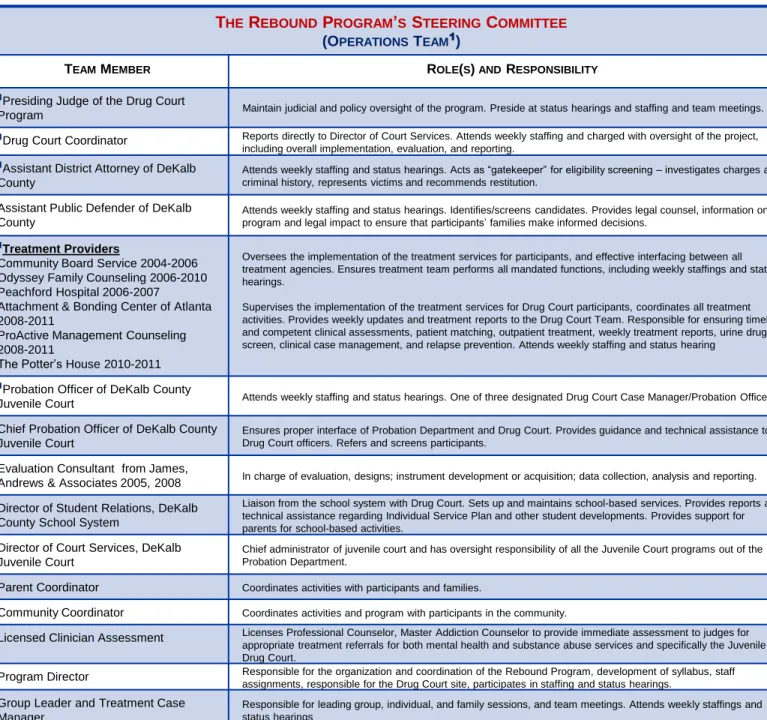
The Rebound Program’s collaborative partnerships function on two distinct levels. First, there is a steering committee that provides programmatic and policy oversight. Additionally, there is an operations team that is responsible for programmatic implementations and reporting on youth progress. Table No. 1 provides a snapshot of the collaborative partners and their roles and responsibilities. Operations team members are also delineated.
TABLE NO. 2
ANCILLARY/SUPPORT SERVICES
PROGRAM/ORGANIZATION SERVICE
Youth Achievement Program (YAP) A juvenile reentry program created by Juvenile Court with education/job/career focus, jointly funded by the County, State, and Federal governments
Georgia Community Support &
Solution (GCSS) Support for individuals and families through crisis-integration, advocacy, and counseling Georgia Counseling Network Crisis intervention and counseling services (individual/group/family therapy and counseling) GPS Monitoring Program Allows for house arrest
Family Values Crisis intervention through home-based counseling and other practices Gender Specific Anger
Management Program 10-week group program to find healthy solutions for anger/rage Georgia Parent Support Network Provides support and resources utilization for families
Capes Drug education based at the Juvenile Court , a joint program with Community Service Board
SUPER (Substance Use Prevention
and Education Resource) For tobacco and AOD Attachment and Bonding Center of
Atlanta/Alliance for Change Support for individuals and families through crisis-integration, advocacy, and counseling ProActive Management Counseling Support for individuals and families through crisis-integration, advocacy, and counseling Odyssey Family Counseling Support for individuals and families through crisis-integration, advocacy, and counseling
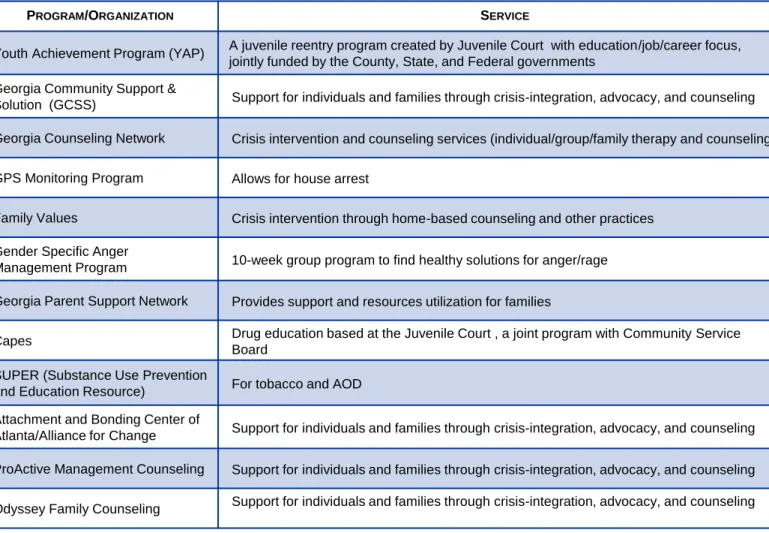
-10- The Rebound Program has community partners that work in collaboration with the DeKalb County Juvenile Court to provide additional wrap-around services using an extensive network of organizations and services with expertise in serving high-risk youth. Table No. 2 details these public and community-based agencies that participate in the Rebound Program through the provision of mental health and auxiliary services to the individual youth and families.
T
HE
R
EBOUND
P
ROGRAM’S
F
RAMEWORK
Probation Judges Defender Public Schools
Community Referral of eligible youth
Graduation
Aftercare
Orientation
Court
Assessment
Intake
Treatment
Probation
Education
Phase V
Phase I Phase II Phase III Phase IV
Parents PO, DA, PD, & TX Collection of all court, education, medical, etc. District Attorney
The programmatic framework below provides a shared visual that depicts core components and process flows associated with the Rebound Program. This framework is followed by a narrative explanation of the programmatic flow.
PARTICIPANT REFERRAL AND ELIGIBILITY REVIEW PROCESS. The Rebound Program’s programmatic flow begins when the District Attorney’s (DA) Office Drug Court reviews current and past charges to determine participant eligibility based on strict Federal Drug Court eligibility criteria. Specific criteria include: the young person must be a post adjudicated resident of DeKalb County between the ages of 14 and 16, have no significant pattern of violence and prior sex offenses, and admits to alcohol and drug (AOD) involvement. Referred participants are excluded if the young person has prior adjudication of violent felony offenses, requires sex offender management, has committed one or more of the deadly sins as outlined in Georgia Senate Bill 440 (SB 440), prior commitment to the Department of Juvenile Justice (DJJ), and/or has an adjudicated felony within 3 years. Moreover, the DA verifies the degree to which victims are involved and if restitution and/or victim protection procedures are necessary.
ASSESSMENT AND INTAKE. Youth who clear the legal screening proceed to complete an AOD needs assessment and take part in a home visit where Rebound Team members assess the youth’s living environment to determine if the home is safe and is free of drugs and alcohol. Young people deemed to be residing in “unsafe” environments are assisted with locating alternative living accommodations prior to enrollment. The home visit also serves as an orientation, at which time a Rebound Team member walks the youth and guardian through the program’s rules and requirements. In addition, required forms are completed, including the Juvenile Automates Substance Abuse Assessment (JASAA). If deemed “clinically appropriate” the youth will be contacted to schedule an intake appointment where the youth and guardian meet with treatment providers to complete paperwork. Tuberculosis and Syphilis records within the last six months are also collected. If not “clinically appropriate” the Rebound Team attempts to make alternative treatment recommendations.
FINAL APPROVAL. Cases are brought before the Operations Team, which reviews each case
assessment for admission during the recruitment phase. Once the Rebound Team approves the youth’s admission into the program, he attends court session and observe until all required documentation has been submitted to court and the clinical assessment has been received by the court. Also, of note, the judge is specific about behavior and appearance, especially in the courtroom. Anyone entering the courtroom must be dressed appropriately and address everyone with respect.
A
N
ARRATIVE OF THE
P
ROGRAMMATIC
F
RAMEWORK
INITIATION AND IMPLEMENTATION. Upon enrollment, the individual will begin treatment services
within 24 hours. A comprehensive bio-psycho-social assessment, titled The Global Appraisal of Individual Needs – Initial Assessment (GAIN-I), is conducted and treatment modality begins. In the initial phase of the program, the youth are mandated to attend treatment five days each week and present in court every Wednesday. Prior to court sessions on Wednesdays, the team holds weekly team meetings to monitor and discuss the progression, strengths, and challenges of each participant and future steps. The presiding judge chairs these staffing meetings and conducts them in a round table forum. Each team member reports on specific aspects of the participant’s behavior at home, school performance and attendance, treatment performance and attendance, and drug test result(s). The drug court team then determines sanctions and incentives for the immediate status hearing, reviews each participant’s case plan, addresses any other significant issues, and schedules caucuses for those individuals or families that need individualized level of intervention.
INTENSE MONITORING, SOCIAL, AND COMMUNITY INVOLVEMENT. Also during Phase I, the DeKalb
County School System representative ensures that each participant’s school record is submitted to the team for review. A team member calls to monitor whether the participants are maintaining court ordered curfews and reports are also given by the parents. The youth are required to participate in community service and pro-social activities as a way to give back to the community. Pro-social activities include physical activity, organized sports and non-sport activities, volunteering and religious affiliation activities. These events are held on Saturdays. The judge and team emphasize the need to keep the youth in school, and to have activities and/or sanctions on the weekend or when school is out. If participants are in night school they receive excused absences from these programs and sessions.
TREATMENT INITIATION AND IMPLEMENTATION. As part of the treatment criteria, the participants are required to maintain a journal and obtain a psychological evaluation. An individual treatment plan is developed for each participant by their treatment provider which includes drug testing and screening. The participant is expected to work the treatment plan as designed. Drug tests in Phase I start with three or more tests per week and can increase or decrease based on test results. When the youth seems ready to move to the next phase, they will submit a letter
requesting to advance to the next phase. The drug court team deliberates and assesses the participant’s case and progression and decides on whether he should be promoted to the next phase.
GENERAL CONCEPT OF PHASES. The first and subsequent phases are all similar in that they
require common general and treatment criteria that are monitored. These criteria include maintaining a “B” grade point average, attending an educational program or school and/or work everyday with constant review of school credits, maintaining satisfactory conduct in home, school and the community, maintaining court ordered curfew, attending and participating in pro-social activities, maintaining a journal, cooperating with drug testing and screenings, and submitting a request to advance to next phase. Throughout the program, the team tries to hold a caucus with each participant and their family for a more individualized approach at reaching resolutions and mediating issues in the home life that may contribute to some of the youth’s actions.
UNDERSTANDING DISTINCT REQUIREMENTS TO PHASE UP. The main difference in the phases, as the participant continues to transition from phase to phase, is that required reporting lessens. So in Phase II, instead of attending court hearings and meetings with the Drug Court Officer every week, they will report every two weeks. Phase II also requires participants to submit a paper on their “Personal History and Pattern of Drug Use” and to undergo a Psychological Evaluation by treatment provider. Phase III differs from Phase II in that it requires that participants have no positive drug screening for 30 consecutive days and report to court hearings and meetings with the Drug Court Officer once a month. The difference in Phase IV in comparison to the preceding phase is that participants are only required to report to court hearings and meet with Drug Court Officer as directed. A relapse prevention plan must be developed during treatment, participants are to have no positive drug screenings for 60 consecutive days, and they present their “Life Story” and an oral presentation to the court to advance to graduation. Phase V is the continuing care plan which builds on Phase IV to require participants to have no positive screens for 75 consecutive days and a graduation presentation. Upon successful completion of the Rebound Program and satisfaction of all other court requirements, participants will participate in the graduation exercise and will be eligible to have their charges dismissed. The graduation is a momentous occasion where community partners assist in preparing the young men for graduation by providing haircuts and suits from D & K for the ceremony, if needed. Family
T
HE
R
EBOUND
P
ROGRAM’S
S
TRUCTURE AND
P
ROCESS
members are invited to the ceremony to recognize the participant’s personal achievements and successful completion of the Rebound Program. The Rebound Team may terminate participants from the program if their continued participation is deemed detrimental to the remaining participants.
O
VERVIEW OF THE
E
VALUATION
D
ESIGN
The DeKalb County Juvenile Drug Court commissioned Messages of Empowerment Productions, LLC (TEAM-MOE) to conduct a secondary analysis of program data and documentation in an effort to glean program effectiveness and lessons learned using summative evaluation model. TEAM-MOE utilizes the Centers for Disease Control and Prevention’s six steps for program evaluation. These steps were applied to the Rebound Program’s evaluation approach as follows:
STEP 1: ENGAGETHE STAKEHOLDER:
TEAM-MOE met with key stakeholders from the Juvenile Drug Court to learn more about the Rebound Program and to determine a strategy for evaluation. Throughout the evaluation, the lead evaluator attended team meetings, court sessions, a graduation ceremony, and a team retreat to observe the program practices and to become a fully integrated member of the program team.
STEP 2: DESCRIBE THE PROGRAM
The lead evaluator developed and modified comprehensive logic models based on program documents. Additionally, a program service flow visual was adapted to better describe how the program’s implementation evolved over time. The lead evaluator also constructed a program narrative to be sure TEAM-MOE understood the core program for evaluation purposes.
STEP 3: FOCUSTHE EVALUATION DESIGN
The comprehensive logic models provided a framework for determining whether measurement of key activities was feasible to track and define as program indicators. The outcome indicators for the Rebound Program include: (1) retention, (2) recidivism, (3) drug use, (4) education/employment, (5) phase promotion, and (6) family engagement. Once the indicators were identified, TEAM-MOE developed a customized Microsoft ACCESS database to include process and outcome data, as well as a corresponding data dictionary to define indicators and data sources.
STEP 4: GATHER CREDIBLE EVIDENCE
Secondary data were retrieved from key Rebound Program partners. Data were sorted and entered into the database to determine the extent to which each client's baseline, process, and outcome data were complete enough for the evaluation process.
STEP 5: JUSTIFY EVALUATION FINDINGS
The lead evaluator conducted process and outcome analyses, as well as a case study analysis for each cohort and for each youth within a cohort. After completing the data analysis, TEAM-MOE identified program successes, challenges, unintended outcomes, and ineffective program components.
STEP 6: ENSURE DATA UTILITY
The final step in the evaluation process was to produce a summative evaluation report that includes programmatic successes and lessons learned.
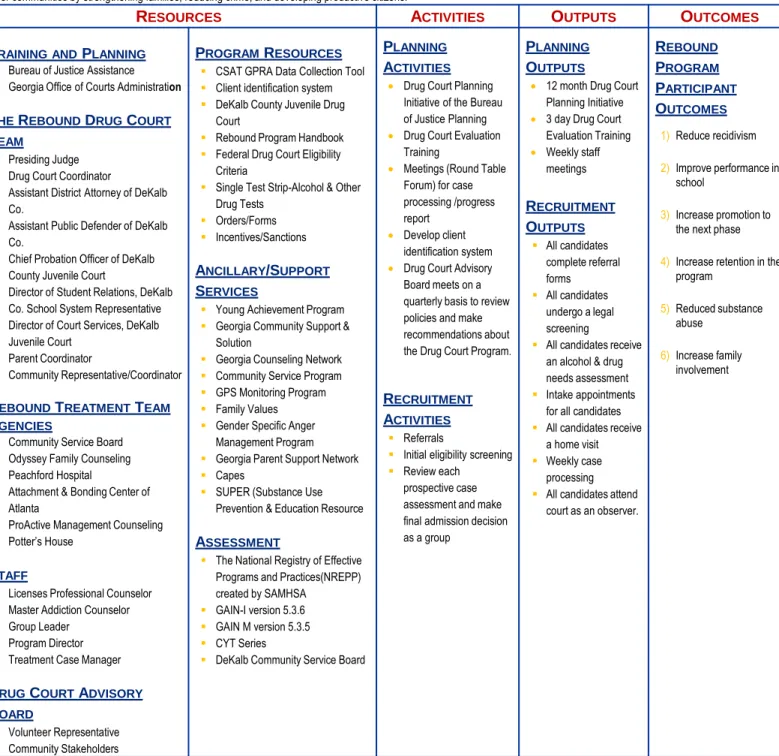
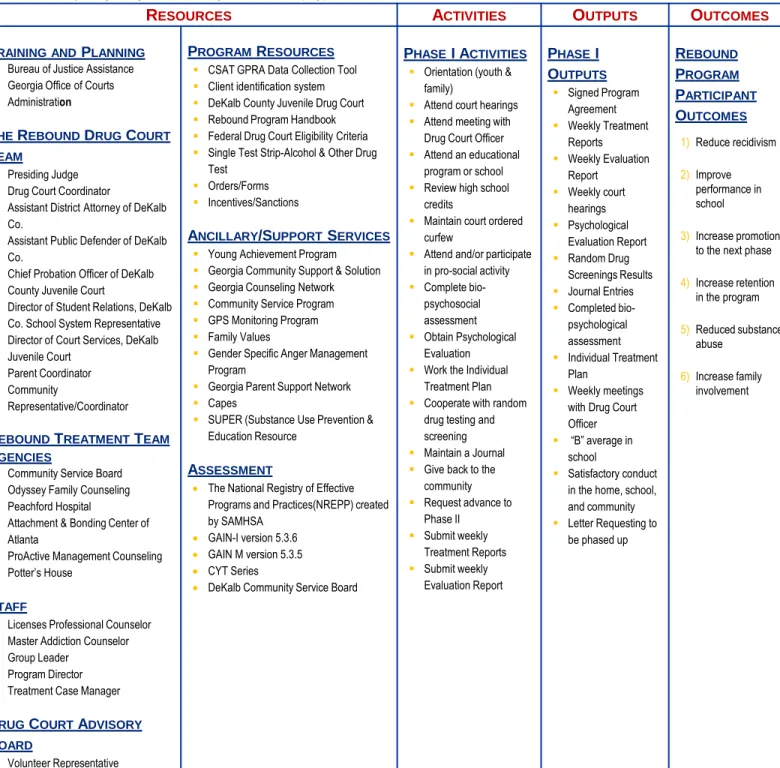
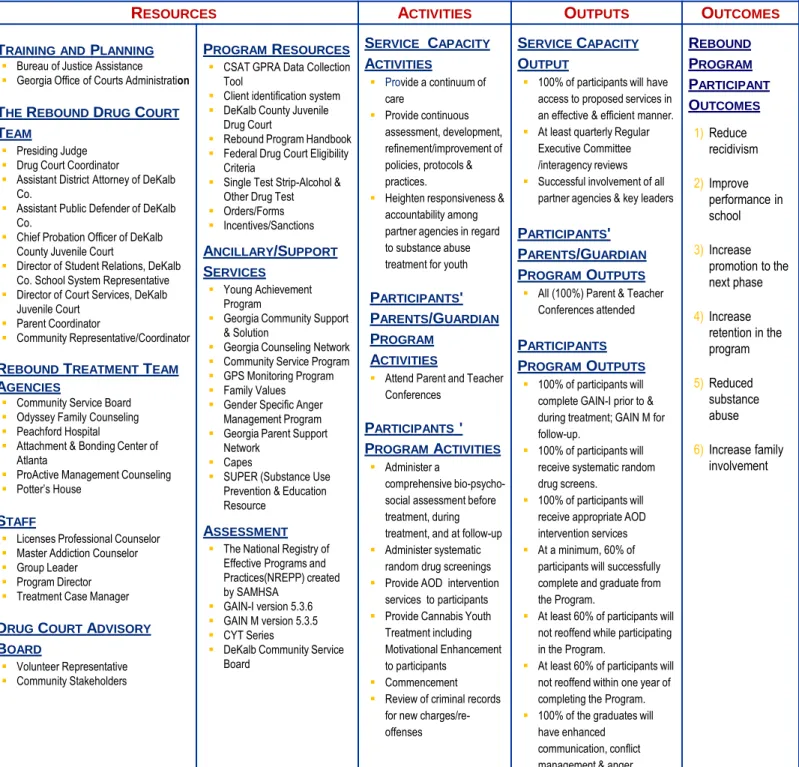
THE LOGIC MODEL FRAMEWORK. A logic model is a tool that describes and illustrates the logical or causal relationships among program elements and the problem to be solved, thus defining measurements of success. The logic model is utilized as a guide to help focus the evaluation design, to determine the extent to which desired changes occur or do not occur and for whom, to determine what is working and what is not working, and to determine whether or not the program is making a difference. It also shows contributions from each partner and how the impact depends on all contributors. A logic model is also utilized as a guide to help staff and the funder(s) visualize the program’s purpose, resources, processes, and ultimate goals.
As the Rebound Program is a 9-12 month intensive behavior modification intervention program divided into five phases, the logic model has been divided into the phases. The evaluation team felt that the logic models would best be understood through the activities in each phase. This methodology reflects the evaluator’s understanding of the phased process and assisted the team in determining what documents would be needed to measure success. To be clear, the resources and outcomes remain the same across phased activities; however, the activities are matched to specific outputs for the participants. So, in essence, the logic models that are found on pages 19 - 25 of this report all have the same resources and outcomes, but different activities and outputs that are catered to the specific phase of the program.
T
HE
L
OGIC
M
ODEL AS AN
E
VALUATION
T
OOL
L
OGIC
M
ODEL
A:
P
LANNING
AND
R
ECRUITMENT
A
CTIVITIES
TABLE NO. 3
T
HER
EBOUNDP
ROGRAML
OGICM
ODELA: P
LANNINGANDR
ECRUITINGA
CTIVITIESISSUE: The Juvenile Probation Department suspects that at least 70% of the juvenile offenders in DeKalb County have been involved with illegal alcohol and other drug use, and
that alcohol and other drug use is a key contributing factor to other criminal offenses (i.e., theft and burglary).
PROGRAM OBJECTIVES: To utilize judicial and community based interventions to provide an effective response to youthful offenders and their families and to create safer communities by strengthening families, reducing crime, and developing productive citizens.
RESOURCES ACTIVITIES OUTPUTS OUTCOMES
TRAININGAND PLANNING
Bureau of Justice Assistance
Georgia Office of Courts Administration
THE REBOUND DRUG COURT
TEAM
Presiding Judge
Drug Court Coordinator
Assistant District Attorney of DeKalb Co.
Assistant Public Defender of DeKalb Co.
Chief Probation Officer of DeKalb County Juvenile Court
Director of Student Relations, DeKalb Co. School System Representative
Director of Court Services, DeKalb Juvenile Court
Parent Coordinator
Community Representative/Coordinator
REBOUND TREATMENT TEAM
AGENCIES
Community Service Board
Odyssey Family Counseling
Peachford Hospital
Attachment & Bonding Center of Atlanta
ProActive Management Counseling
Potter’s House
STAFF
Licenses Professional Counselor
Master Addiction Counselor
Group Leader
Program Director
Treatment Case Manager
DRUG COURT ADVISORY
BOARD
Volunteer Representative
Community Stakeholders
PROGRAM RESOURCES
CSAT GPRA Data Collection Tool
Client identification system
DeKalb County Juvenile Drug Court
Rebound Program Handbook
Federal Drug Court Eligibility Criteria
Single Test Strip-Alcohol & Other Drug Tests Orders/Forms Incentives/Sanctions ANCILLARY/SUPPORT SERVICES
Young Achievement Program
Georgia Community Support & Solution
Georgia Counseling Network
Community Service Program
GPS Monitoring Program
Family Values
Gender Specific Anger Management Program
Georgia Parent Support Network
Capes
SUPER (Substance Use Prevention & Education Resource
ASSESSMENT
The National Registry of Effective Programs and Practices(NREPP) created by SAMHSA
GAIN-I version 5.3.6
GAIN M version 5.3.5
CYT Series
DeKalb Community Service Board
PLANNING
ACTIVITIES
Drug Court Planning Initiative of the Bureau of Justice Planning
Drug Court Evaluation Training
Meetings (Round Table Forum) for case processing /progress report
Develop client identification system
Drug Court Advisory Board meets on a quarterly basis to review policies and make recommendations about the Drug Court Program.
RECRUITMENT
ACTIVITIES
Referrals
Initial eligibility screening
Review each prospective case assessment and make final admission decision as a group
PLANNING
OUTPUTS
12 month Drug Court Planning Initiative
3 day Drug Court Evaluation Training Weekly staff meetings RECRUITMENT OUTPUTS All candidates complete referral forms All candidates undergo a legal screening
All candidates receive an alcohol & drug needs assessment
Intake appointments for all candidates
All candidates receive a home visit
Weekly case processing
All candidates attend court as an observer. REBOUND PROGRAM PARTICIPANT OUTCOMES 1) Reduce recidivism 2) Improve performance in school 3) Increase promotion to the next phase
4) Increase retention in the program
5) Reduced substance abuse
6) Increase family involvement
IMPACT: To reduce or eliminate substance abuse and its associated problems primarily in African American males, age 14 to 16, from lower to middle economic backgrounds in DeKalb County
-20-
L
OGIC
M
ODEL
B:
REBOUND
PROGRAM
PHASE
ONE
(1)
ACTIVITIES
TABLE NO. 4
T
HER
EBOUNDP
ROGRAML
OGICM
ODELB: P
HASEI A
CTIVITIESISSUE: The Juvenile Probation Department suspects that at least 70% of the juvenile offenders in DeKalb County have been involved with illegal alcohol and other drug use, and
that alcohol and other drug use is a key contributing factor to other criminal offenses (i.e., theft and burglary).
PROGRAM OBJECTIVES: To utilize judicial and community based interventions to provide an effective response to youthful offenders and their families and to create safer communities by strengthening families, reducing crime, and developing productive citizens.
RESOURCES ACTIVITIES OUTPUTS OUTCOMES
TRAININGAND PLANNING
Bureau of Justice Assistance
Georgia Office of Courts Administration
THE REBOUND DRUG COURT
TEAM
Presiding Judge
Drug Court Coordinator
Assistant District Attorney of DeKalb Co.
Assistant Public Defender of DeKalb Co.
Chief Probation Officer of DeKalb County Juvenile Court
Director of Student Relations, DeKalb Co. School System Representative
Director of Court Services, DeKalb Juvenile Court
Parent Coordinator
Community
Representative/Coordinator
REBOUND TREATMENT TEAM AGENCIES
Community Service Board
Odyssey Family Counseling
Peachford Hospital
Attachment & Bonding Center of Atlanta
ProActive Management Counseling
Potter’s House
STAFF
Licenses Professional Counselor
Master Addiction Counselor
Group Leader
Program Director
Treatment Case Manager
DRUG COURT ADVISORY
BOARD
Volunteer Representative
Community Stakeholders
PROGRAM RESOURCES
CSAT GPRA Data Collection Tool
Client identification system
DeKalb County Juvenile Drug Court
Rebound Program Handbook
Federal Drug Court Eligibility Criteria
Single Test Strip-Alcohol & Other Drug Test
Orders/Forms
Incentives/Sanctions
ANCILLARY/SUPPORT SERVICES
Young Achievement Program
Georgia Community Support & Solution
Georgia Counseling Network
Community Service Program
GPS Monitoring Program
Family Values
Gender Specific Anger Management Program
Georgia Parent Support Network
Capes
SUPER (Substance Use Prevention & Education Resource
ASSESSMENT
The National Registry of Effective Programs and Practices(NREPP) created by SAMHSA
GAIN-I version 5.3.6
GAIN M version 5.3.5
CYT Series
DeKalb Community Service Board
PHASE I ACTIVITIES
Orientation (youth & family)
Attend court hearings
Attend meeting with Drug Court Officer
Attend an educational program or school
Review high school credits
Maintain court ordered curfew
Attend and/or participate in pro-social activity Complete bio-psychosocial assessment Obtain Psychological Evaluation
Work the Individual Treatment Plan
Cooperate with random drug testing and screening
Maintain a Journal
Give back to the community Request advance to Phase II Submit weekly Treatment Reports Submit weekly Evaluation Report PHASE I OUTPUTS Signed Program Agreement Weekly Treatment Reports Weekly Evaluation Report Weekly court hearings Psychological Evaluation Report Random Drug Screenings Results Journal Entries Completed bio-psychological assessment Individual Treatment Plan Weekly meetings with Drug Court Officer
“B” average in school
Satisfactory conduct in the home, school, and community Letter Requesting to be phased up REBOUND PROGRAM PARTICIPANT OUTCOMES 1) Reduce recidivism 2) Improve performance in school 3) Increase promotion to the next phase
4) Increase retention in the program 5) Reduced substance abuse 6) Increase family involvement
IMPACT: To reduce or eliminate substance abuse and its associated problems primarily in African American males, age 14 to 16, from lower to middle
L
OGIC
M
ODEL
C:
REBOUND
PROGRAM
PHASE
TWO
(2)
ACTIVITIES
TABLE NO. 5
T
HER
EBOUNDP
ROGRAML
OGICM
ODELC: P
HASEII A
CTIVITIESISSUE: The Juvenile Probation Department suspects that at least 70% of the juvenile offenders in DeKalb County have been involved with illegal alcohol and other drug use, and that alcohol and other drug use is a key contributing factor to other criminal offenses (i.e., theft and burglary).
PROGRAM OBJECTIVES: To utilize judicial and community based interventions to provide an effective response to youthful offenders and their families and to create safer communities by strengthening families, reducing crime, and developing productive citizens.
RESOURCES ACTIVITIES OUTPUTS OUTCOMES
TRAININGAND PLANNING
Bureau of Justice Assistance
Georgia Office of Courts Administration
THE REBOUND DRUG COURT
TEAM
Presiding Judge
Drug Court Coordinator
Assistant District Attorney of DeKalb Co.
Assistant Public Defender of DeKalb Co.
Chief Probation Officer of DeKalb County Juvenile Court
Director of Student Relations, DeKalb Co. School System Representative
Director of Court Services, DeKalb Juvenile Court
Parent Coordinator
Community
Representative/Coordinator
REBOUND TREATMENT TEAM AGENCIES
Community Service Board
Odyssey Family Counseling
Peachford Hospital
Attachment & Bonding Center of Atlanta
ProActive Management Counseling
Potter’s House
STAFF
Licenses Professional Counselor
Master Addiction Counselor
Group Leader
Program Director
Treatment Case Manager
DRUG COURT ADVISORY
BOARD
Volunteer Representative
Community Stakeholders
PROGRAM RESOURCES
CSAT GPRA Data Collection Tool
Client identification system
DeKalb County Juvenile Drug Court
Rebound Program Handbook
Federal Drug Court Eligibility Criteria
Single Test Strip-Alcohol & Other Drug Test
Orders/Forms
Incentives/Sanctions
ANCILLARY/SUPPORT SERVICES
Young Achievement Program
Georgia Community Support & Solution
Georgia Counseling Network
Community Service Program
GPS Monitoring Program
Family Values
Gender Specific Anger Management Program
Georgia Parent Support Network
Capes
SUPER (Substance Use Prevention & Education Resource
ASSESSMENT
The National Registry of Effective Programs and Practices(NREPP) created by SAMHSA
GAIN-I version 5.3.6
GAIN M version 5.3.5
CYT Series
DeKalb Community Service Board
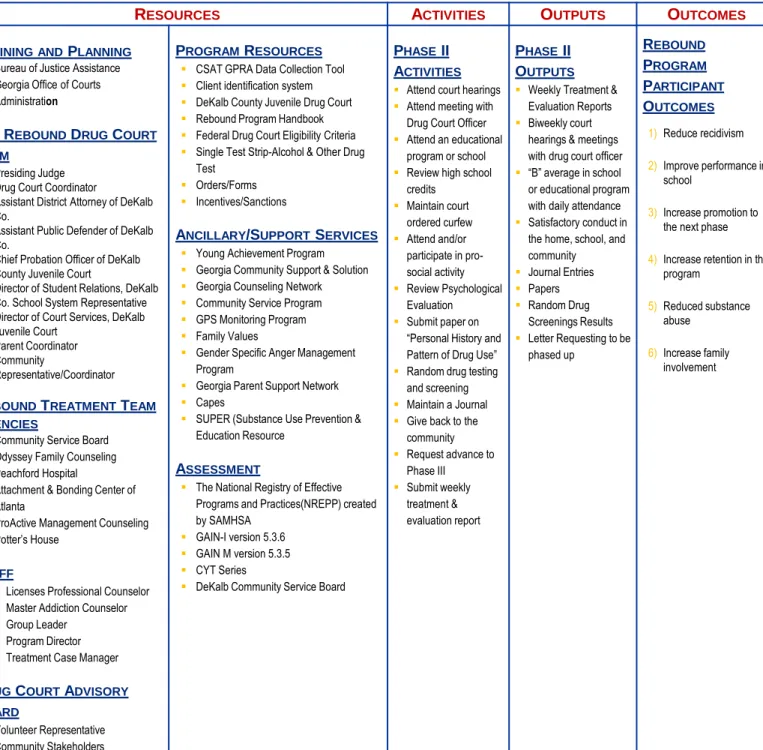
PHASE II ACTIVITIES
Attend court hearings
Attend meeting with Drug Court Officer
Attend an educational program or school
Review high school credits Maintain court ordered curfew Attend and/or participate in pro-social activity Review Psychological Evaluation Submit paper on “Personal History and Pattern of Drug Use”
Random drug testing and screening
Maintain a Journal
Give back to the community Request advance to Phase III Submit weekly treatment & evaluation report PHASE II OUTPUTS
Weekly Treatment & Evaluation Reports
Biweekly court hearings & meetings with drug court officer
“B” average in school or educational program with daily attendance
Satisfactory conduct in the home, school, and community Journal Entries Papers Random Drug Screenings Results Letter Requesting to be phased up REBOUND PROGRAM PARTICIPANT OUTCOMES 1) Reduce recidivism 2) Improve performance in school 3) Increase promotion to the next phase
4) Increase retention in the program 5) Reduced substance abuse 6) Increase family involvement
IMPACT: To reduce or eliminate substance abuse and its associated problems primarily in African American males, age 14 to 16, from lower to middle
-22-
L
OGIC
M
ODEL
D:
REBOUND
PROGRAM
PHASE
THREE
(3)
ACTIVITIES
TABLE NO. 6
T
HER
EBOUNDP
ROGRAML
OGICM
ODELD: P
HASEIII A
CTIVITIESISSUE: The Juvenile Probation Department suspects that at least 70% of the juvenile offenders in DeKalb County have been involved with illegal alcohol and other drug use, and
that alcohol and other drug use is a key contributing factor to other criminal offenses (i.e., theft and burglary).
PROGRAM OBJECTIVES: To utilize judicial and community based interventions to provide an effective response to youthful offenders and their families and to create safer communities by strengthening families, reducing crime, and developing productive citizens.
RESOURCES ACTIVITIES OUTPUTS OUTCOMES
TRAININGAND PLANNING
Bureau of Justice Assistance
Georgia Office of Courts Administration
THE REBOUND DRUG COURT
TEAM
Presiding Judge
Drug Court Coordinator
Assistant District Attorney of DeKalb Co.
Assistant Public Defender of DeKalb Co.
Chief Probation Officer of DeKalb County Juvenile Court
Director of Student Relations, DeKalb Co. School System Representative
Director of Court Services, DeKalb Juvenile Court
Parent Coordinator
Community Representative/Coordinator
REBOUND TREATMENT TEAM
AGENCIES
Community Service Board
Odyssey Family Counseling
Peachford Hospital
Attachment & Bonding Center of Atlanta
ProActive Management Counseling
Potter’s House
STAFF
Licenses Professional Counselor
Master Addiction Counselor
Group Leader
Program Director
Treatment Case Manager
DRUG COURT ADVISORY
BOARD
Volunteer Representative
Community Stakeholders
PROGRAM RESOURCES
CSAT GPRA Data Collection Tool
Client identification system
DeKalb County Juvenile Drug Court
Rebound Program Handbook
Federal Drug Court Eligibility Criteria
Single Test Strip-Alcohol & Other Drug Test Orders/Forms Incentives/Sanctions ANCILLARY/SUPPORT SERVICES
Young Achievement Program
Georgia Community Support & Solution
Georgia Counseling Network
Community Service Program
GPS Monitoring Program
Family Values
Gender Specific Anger Management Program
Georgia Parent Support Network
Capes
SUPER (Substance Use Prevention & Education Resource
ASSESSMENT
The National Registry of Effective Programs and Practices(NREPP) created by SAMHSA
GAIN-I version 5.3.6
GAIN M version 5.3.5
CYT Series
DeKalb Community Service Board
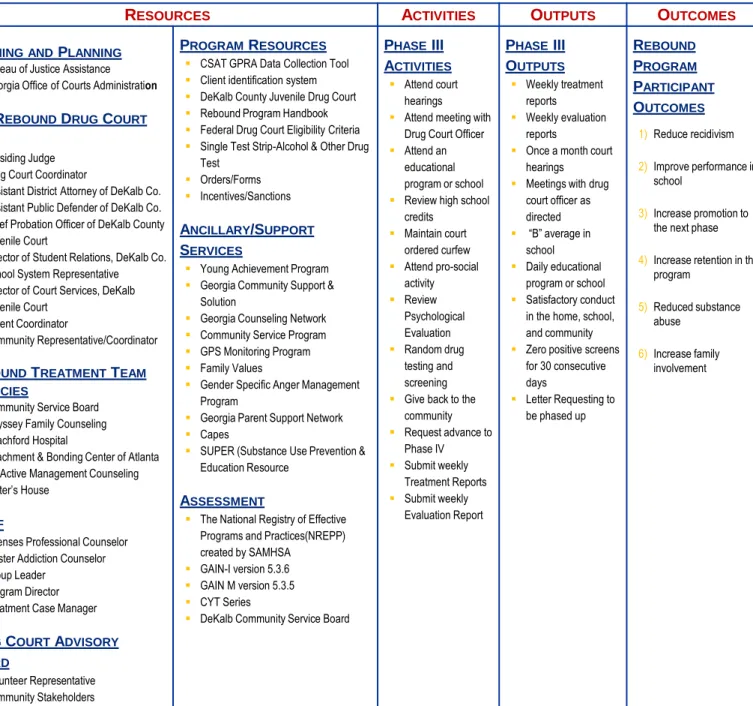
PHASE III ACTIVITIES
Attend court hearings
Attend meeting with Drug Court Officer
Attend an educational program or school
Review high school credits Maintain court ordered curfew Attend pro-social activity Review Psychological Evaluation Random drug testing and screening
Give back to the community Request advance to Phase IV Submit weekly Treatment Reports Submit weekly Evaluation Report PHASE III OUTPUTS Weekly treatment reports Weekly evaluation reports
Once a month court hearings
Meetings with drug court officer as directed “B” average in school Daily educational program or school Satisfactory conduct in the home, school, and community
Zero positive screens for 30 consecutive days Letter Requesting to be phased up REBOUND PROGRAM PARTICIPANT OUTCOMES 1) Reduce recidivism 2) Improve performance in school 3) Increase promotion to the next phase
4) Increase retention in the program 5) Reduced substance abuse 6) Increase family involvement
IMPACT: To reduce or eliminate substance abuse and its associated problems primarily in African American males, age 14 to 16, from lower to middle economic backgrounds in DeKalb County
L
OGIC
M
ODEL
E:
REBOUND
PROGRAM
PHASE
FOUR
(4)
ACTIVITIES
TABLE NO. 7
T
HER
EBOUNDP
ROGRAML
OGICM
ODELE: P
HASEIV A
CTIVITIESISSUE: The Juvenile Probation Department suspects that at least 70% of the juvenile offenders in DeKalb County have been involved with illegal alcohol and other drug use, and
that alcohol and other drug use is a key contributing factor to other criminal offenses (i.e., theft and burglary).
PROGRAM OBJECTIVES: To utilize judicial and community based interventions to provide an effective response to youthful offenders and their families and to create safer communities by strengthening families, reducing crime, and developing productive citizens.
RESOURCES ACTIVITIES OUTPUTS OUTCOMES
TRAININGAND PLANNING
Bureau of Justice Assistance
Georgia Office of Courts Administration
THE REBOUND DRUG COURT
TEAM
Presiding Judge
Drug Court Coordinator
Assistant District Attorney of DeKalb Co.
Assistant Public Defender of DeKalb Co.
Chief Probation Officer of DeKalb County Juvenile Court
Director of Student Relations, DeKalb Co. School System Representative
Director of Court Services, DeKalb Juvenile Court
Parent Coordinator
Community Representative/Coordinator
REBOUND TREATMENT TEAM AGENCIES
Community Service Board
Odyssey Family Counseling
Peachford Hospital
Attachment & Bonding Center of Atlanta
ProActive Management Counseling
Potter’s House
STAFF
Licenses Professional Counselor
Master Addiction Counselor
Group Leader
Program Director
Treatment Case Manager
DRUG COURT ADVISORY
BOARD
Volunteer Representative
Community Stakeholders
PROGRAM RESOURCES
CSAT GPRA Data Collection Tool
Client identification system
DeKalb County Juvenile Drug Court
Rebound Program Handbook
Federal Drug Court Eligibility Criteria
Single Test Strip-Alcohol & Other Drug Test Orders/Forms Incentives/Sanctions ANCILLARY/SUPPORT SERVICES
Young Achievement Program
Georgia Community Support & Solution
Georgia Counseling Network
Community Service Program
GPS Monitoring Program
Family Values
Gender Specific Anger Management Program
Georgia Parent Support Network
Capes
SUPER (Substance Use Prevention & Education Resource
ASSESSMENT
The National Registry of Effective Programs and Practices(NREPP) created by SAMHSA
GAIN-I version 5.3.6
GAIN M version 5.3.5
CYT Series
DeKalb Community Service Board
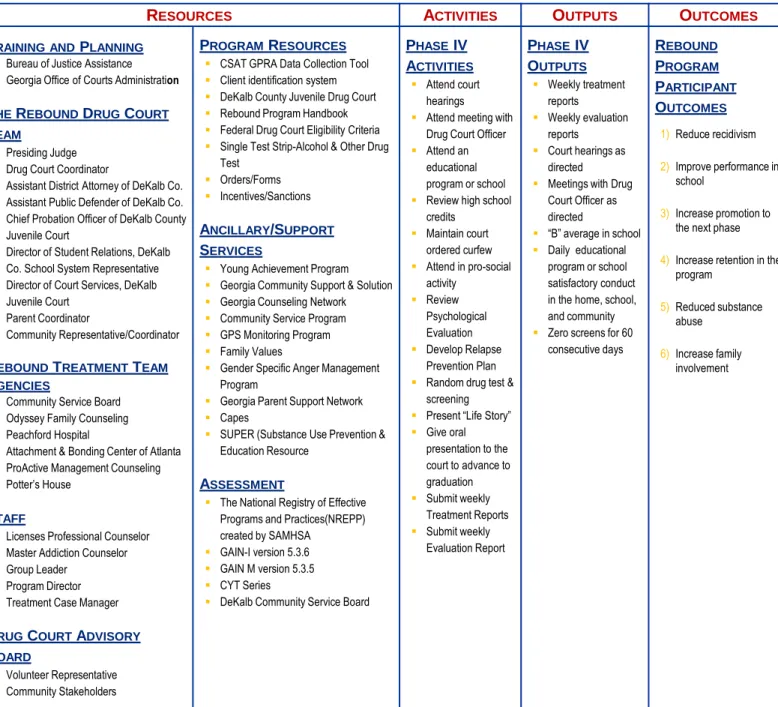
PHASE IV ACTIVITIES
Attend court hearings
Attend meeting with Drug Court Officer
Attend an educational program or school
Review high school credits Maintain court ordered curfew Attend in pro-social activity Review Psychological Evaluation Develop Relapse Prevention Plan
Random drug test & screening
Present “Life Story”
Give oral presentation to the court to advance to graduation Submit weekly Treatment Reports Submit weekly Evaluation Report PHASE IV OUTPUTS Weekly treatment reports Weekly evaluation reports Court hearings as directed
Meetings with Drug Court Officer as directed “B” average in school Daily educational program or school satisfactory conduct in the home, school, and community
Zero screens for 60 consecutive days REBOUND PROGRAM PARTICIPANT OUTCOMES 1) Reduce recidivism 2) Improve performance in school 3) Increase promotion to the next phase
4) Increase retention in the program 5) Reduced substance abuse 6) Increase family involvement
IMPACT: To reduce or eliminate substance abuse and its associated problems primarily in African American males, age 14 to 16, from lower to middle economic backgrounds in DeKalb County
-24-
L
OGIC
M
ODEL
F:
REBOUND
PROGRAM
PHASE
FIVE
(5)
ACTIVITIES
TABLE NO. 8
T
HER
EBOUNDP
ROGRAML
OGICM
ODELF: P
HASEV A
CTIVITIESISSUE: The Juvenile Probation Department suspects that at least 70% of the juvenile offenders in DeKalb County have been involved with illegal alcohol and other drug use, and
that alcohol and other drug use is a key contributing factor to other criminal offenses (i.e., theft and burglary).
PROGRAM OBJECTIVES: To utilize judicial and community based interventions to provide an effective response to youthful offenders and their families and to create safer communities by strengthening families, reducing crime, and developing productive citizens.
RESOURCES ACTIVITIES OUTPUTS OUTCOMES
TRAININGAND PLANNING
Bureau of Justice Assistance
Georgia Office of Courts Administration
THE REBOUND DRUG COURT
TEAM
Presiding Judge
Drug Court Coordinator
Assistant District Attorney of DeKalb Co.
Assistant Public Defender of DeKalb Co.
Chief Probation Officer of DeKalb County Juvenile Court
Director of Student Relations, DeKalb Co. School System Representative
Director of Court Services, DeKalb Juvenile Court
Parent Coordinator
Community Representative/Coordinator
REBOUND TREATMENT TEAM AGENCIES
Community Service Board
Odyssey Family Counseling
Peachford Hospital
Attachment & Bonding Center of Atlanta
ProActive Management Counseling
Potter’s House
STAFF
Licenses Professional Counselor
Master Addiction Counselor
Group Leader
Program Director
Treatment Case Manager
DRUG COURT ADVISORY
BOARD
Volunteer Representative
Community Stakeholders
PROGRAM RESOURCES
CSAT GPRA Data Collection Tool
Client identification system
DeKalb County Juvenile Drug Court
Rebound Program Handbook
Federal Drug Court Eligibility Criteria
Single Test Strip-Alcohol & Other Drug Test Orders/Forms Incentives/Sanctions ANCILLARY/SUPPORT SERVICES
Young Achievement Program
Georgia Community Support & Solution
Georgia Counseling Network
Community Service Program
GPS Monitoring Program
Family Values
Gender Specific Anger Management Program
Georgia Parent Support Network
Capes
SUPER (Substance Use Prevention & Education Resource
ASSESSMENT
The National Registry of Effective Programs and Practices(NREPP) created by SAMHSA
GAIN-I version 5.3.6
GAIN M version 5.3.5
CYT Series
DeKalb Community Service Board
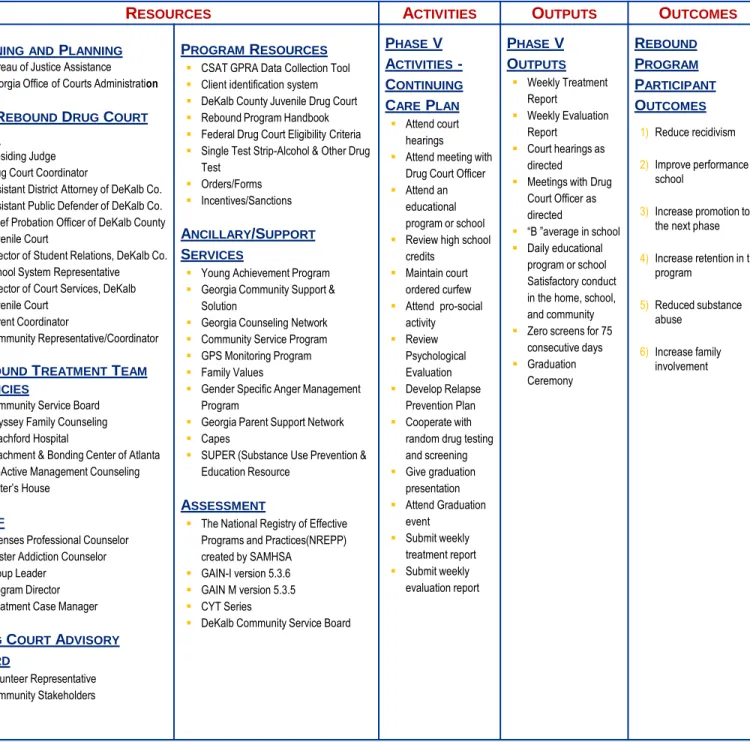
PHASE V ACTIVITIES -CONTINUING CARE PLAN Attend court hearings
Attend meeting with Drug Court Officer
Attend an educational program or school
Review high school credits Maintain court ordered curfew Attend pro-social activity Review Psychological Evaluation Develop Relapse Prevention Plan Cooperate with random drug testing and screening Give graduation presentation Attend Graduation event Submit weekly treatment report Submit weekly evaluation report PHASE V OUTPUTS Weekly Treatment Report Weekly Evaluation Report Court hearings as directed
Meetings with Drug Court Officer as directed “B ”average in school Daily educational program or school Satisfactory conduct in the home, school, and community
Zero screens for 75 consecutive days Graduation Ceremony REBOUND PROGRAM PARTICIPANT OUTCOMES 1) Reduce recidivism 2) Improve performance in school 3) Increase promotion to the next phase
4) Increase retention in the program 5) Reduced substance abuse 6) Increase family involvement
IMPACT: To reduce or eliminate substance abuse and its associated problems primarily in African American males, age 14 to 16, from lower to middle economic backgrounds in DeKalb County
L
OGIC
M
ODEL
G:
REBOUND
PROGRAM
S
ERVICE
C
APACITY
TABLE NO. 9
T
HER
EBOUNDP
ROGRAML
OGICM
ODELG: S
ERVICEC
APACITYB
UILDINGISSUE: The Juvenile Probation Department suspects that at least 70% of the juvenile offenders in DeKalb County have been involved with illegal alcohol and other drug use, and
that alcohol and other drug use is a key contributing factor to other criminal offenses (i.e., theft and burglary).
PROGRAM OBJECTIVES: To utilize judicial and community based interventions to provide an effective response to youthful offenders and their families and to create safer communities by strengthening families, reducing crime, and developing productive citizens.
RESOURCES ACTIVITIES OUTPUTS OUTCOMES
TRAININGAND PLANNING
Bureau of Justice Assistance
Georgia Office of Courts Administration
THE REBOUND DRUG COURT
TEAM
Presiding Judge
Drug Court Coordinator
Assistant District Attorney of DeKalb Co.
Assistant Public Defender of DeKalb Co.
Chief Probation Officer of DeKalb County Juvenile Court
Director of Student Relations, DeKalb Co. School System Representative
Director of Court Services, DeKalb Juvenile Court
Parent Coordinator
Community Representative/Coordinator
REBOUND TREATMENT TEAM AGENCIES
Community Service Board
Odyssey Family Counseling
Peachford Hospital
Attachment & Bonding Center of Atlanta
ProActive Management Counseling
Potter’s House
STAFF
Licenses Professional Counselor
Master Addiction Counselor
Group Leader
Program Director
Treatment Case Manager
DRUG COURT ADVISORY
BOARD
Volunteer Representative
Community Stakeholders
PROGRAM RESOURCES
CSAT GPRA Data Collection Tool
Client identification system
DeKalb County Juvenile Drug Court
Rebound Program Handbook
Federal Drug Court Eligibility Criteria
Single Test Strip-Alcohol & Other Drug Test
Orders/Forms Incentives/Sanctions ANCILLARY/SUPPORT SERVICES Young Achievement Program
Georgia Community Support & Solution
Georgia Counseling Network
Community Service Program
GPS Monitoring Program
Family Values
Gender Specific Anger Management Program
Georgia Parent Support Network
Capes
SUPER (Substance Use Prevention & Education Resource
ASSESSMENT
The National Registry of Effective Programs and Practices(NREPP) created by SAMHSA
GAIN-I version 5.3.6
GAIN M version 5.3.5
CYT Series
DeKalb Community Service Board
SERVICE CAPACITY
ACTIVITIES
Provide a continuum of care
Provide continuous assessment, development, refinement/improvement of policies, protocols & practices.
Heighten responsiveness & accountability among partner agencies in regard to substance abuse treatment for youth
PARTICIPANTS' PARENTS/GUARDIAN PROGRAM
ACTIVITIES
Attend Parent and Teacher Conferences
PARTICIPANTS ' PROGRAM ACTIVITIES
Administer a
comprehensive bio-psycho-social assessment before treatment, during treatment, and at follow-up
Administer systematic random drug screenings
Provide AOD intervention services to participants
Provide Cannabis Youth Treatment including Motivational Enhancement to participants
Commencement
Review of criminal records for new charges/re-offenses
SERVICE CAPACITY
OUTPUT
100% of participants will have access to proposed services in an effective & efficient manner.
At least quarterly Regular Executive Committee /interagency reviews
Successful involvement of all partner agencies & key leaders
PARTICIPANTS' PARENTS/GUARDIAN PROGRAM OUTPUTS
All (100%) Parent & Teacher Conferences attended
PARTICIPANTS
PROGRAM OUTPUTS
100% of participants will complete GAIN-I prior to & during treatment; GAIN M for follow-up.
100% of participants will receive systematic random drug screens.
100% of participants will receive appropriate AOD intervention services
At a minimum, 60% of participants will successfully complete and graduate from the Program.
At least 60% of participants will not reoffend while participating in the Program.
At least 60% of participants will not reoffend within one year of completing the Program.
100% of the graduates will have enhanced communication, conflict management & anger
REBOUND PROGRAM PARTICIPANT OUTCOMES 1)Reduce recidivism 2)Improve performance in school 3)Increase promotion to the next phase 4)Increase retention in the program 5)Reduced substance abuse 6)Increase family involvement
IMPACT: To reduce or eliminate substance abuse and its associated problems primarily in African American males, age 14 to 16, from lower to middle economic backgrounds in DeKalb County
EVALUATION QUESTIONS. The evaluation questions are used as a guide in the evaluation design.
The evaluation questions that shaped this summative evaluation are listed below.
To what extent is there evidence that the Rebound Program: (a) reduce recidivism (b)
improved performance in school, (c) increased promotion to the next phase, (d) increased retention in the program, (e) reduced substance abuse, and (f) increased family engagement and involvement?
To what extent were planned programmatic activities actually implemented?
(Resource accountability and partner performance)
What activities were not implemented as planned and why?
(Lessons learned and project challenges)
What aspects of the Rebound Program were implemented exceptionally well, and what
factors led to such excellence in execution?
(Best practices and program achievements)
What was the overall impact of the various strategies aimed at reducing substance abuse and its associated primary problems?
(Degree of program effect size)
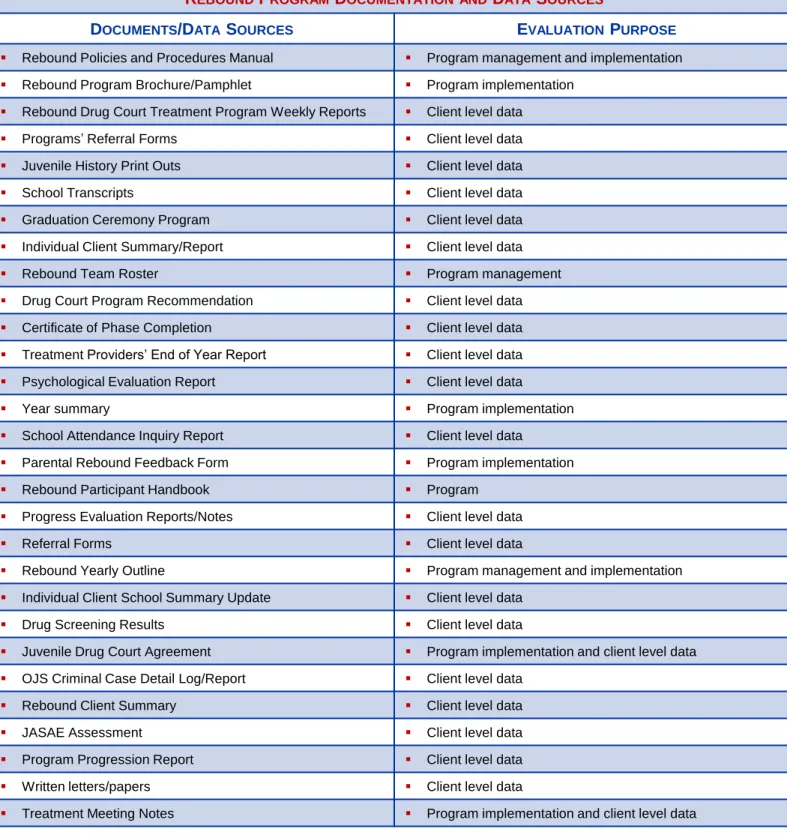
Once the program’s logic models were finalized, an evaluability assessment was conducted, and indicators selected, secondary data sources were identified based on the program’s resources, activities, and outputs from the logic models. A data collection checklist was created listing all types of secondary data sources and distributed to the Rebound Team to review and gain a sense of the data needed to conduct this summative evaluation. Upon retrieval of the data, a new list was composed outlining all data retrieved. The data were then assessed for relevancy to the indicators selected. The secondary data retrieved were program management data produced by the program team members for accountability purposes. Table number 10 lists some examples of the data sources. A mixed methods approach was taken since data retrieved were both quantitative and qualitative. Of the secondary data collected, there was a total of 76 participants who had evidential data to measure both the baseline assessment and outcome indicators. In using baseline data we are able to track the change over the entire program’s timeframe and, using outcome indicators, we are able to measure the program’s effectiveness in reaching it’s target outcomes.
-26-
T
HE
E
VALUATION
I
NQUIRY AND
A
NALYSIS
M
ETHODS
A list of the Rebound Program documents utilized in this summative evaluation are presented in Table 10.
E
VALUATION
D
ATA
S
OURCES
TABLE NO. 10
REBOUND PROGRAM DOCUMENTATION AND DATA SOURCES
DOCUMENTS/DATA SOURCES EVALUATION PURPOSE Rebound Policies and Procedures Manual Program management and implementation
Rebound Program Brochure/Pamphlet Program implementation
Rebound Drug Court Treatment Program Weekly Reports Client level data
Programs’ Referral Forms Client level data
Juvenile History Print Outs Client level data
School Transcripts Client level data
Graduation Ceremony Program Client level data
Individual Client Summary/Report Client level data
Rebound Team Roster Program management
Drug Court Program Recommendation Client level data
Certificate of Phase Completion Client level data
Treatment Providers’ End of Year Report Client level data
Psychological Evaluation Report Client level data
Year summary Program implementation
School Attendance Inquiry Report Client level data
Parental Rebound Feedback Form Program implementation
Rebound Participant Handbook Program
Progress Evaluation Reports/Notes Client level data
Referral Forms Client level data
Rebound Yearly Outline Program management and implementation
Individual Client School Summary Update Client level data
Drug Screening Results Client level data
Juvenile Drug Court Agreement Program implementation and client level data
OJS Criminal Case Detail Log/Report Client level data
Rebound Client Summary Client level data
JASAE Assessment Client level data
Program Progression Report Client level data
Written letters/papers Client level data
•
E
VALUATION
D
ATA
S
OURCES
-28- The sole source of data for this evaluation is secondary data which was retrieved from the Probation Supervisor. The Probation Supervisor collects and composes all data that is used throughout the program. Data collection sources are the school system, probation officer, court sessions and hearings, treatment sessions and groups, events and activities, and counselors. Over the years of the Rebound Program, forms and methods changed; however the weekly treatment