Evaluation of Physical Education Multimedia Teaching
for Data Assimilation
https://doi.org/10.3991/ijoe.v14i04.8366
Lifu Xing
Ningbo Dahongying University, Ningbo, Zhejiang, China [email protected]
Abstract—The evaluation of physical education (PE) multimedia teaching refers to the prediction of physical education multimedia teaching quality in the absence of initial multimedia teaching information. Therefore, the evaluation method of PE multimedia teaching based on unsupervised feature learning has achieved good performance. But, its quality prediction accuracy decreases sig-nificantly with the reduction of the feature dimension. In order to overcome this defect, the author combines the active learning strategy with the unsupervised feature learning and proposes a kind of data assimilation framework to improve the discriminability of the representation of teaching features. The results show that the proposed method can enhance the accuracy of teaching quality predic-tion by 8%. Experiments show that, when feature dimension is relatively low, the proposed method can improve the teaching quality prediction accuracy by 8% compared with the method based on unsupervised feature learning. At the same time, the performance of the proposed method is superior to that of the other physical education multimedia teaching evaluation methods at present.
Keywords—active learning; dictionary learning; feature learning; teaching presentation; teaching quality evaluation
1
Introduction
With the popularization of teaching acquisition equipment such as mobile phones and cameras and the rapid development of social networks, teaching plays an increas-ingly important role in our daily life. However, due to the limitation of the perfor-mance of the teaching processing system, various kinds of distortion will be intro-duced in the process of teaching access, transmission and processing. The introduc-tion of distorintroduc-tion will reduce the aesthetics of teaching, which, at the same time, will impeding people from obtaining information from the teaching. Therefore, it is neces-sary to study the teaching quality evaluation methods, so as to apply them to the mon-itoring of the teaching acquisition equipment performance, the optimal selection of teaching processing system and the optimization of teaching methods.
inte-grated into the teaching processing system. Therefore, the design of objective teach-ing quality evaluation method [2], so that the quality of teachteach-ing can be evaluated by computer automatically and accurately is of great significance in the field of teaching processing.
The existing objective teaching quality evaluation methods can be divided into two categories: the reference teaching quality evaluation method [2-3] and the physical education multimedia teaching evaluation method [4]. Between them, the former requires all or part of the initial teaching information to evaluate and test the teaching quality by comparing the difference between the test teaching and the initial teaching information. On the other hand, the evaluation of the multimedia teaching of the phys-ical education is to predict the teaching quality of teaching without the initial teaching information. In the actual application, as the initial teaching information is usually not available, the study of physical education multimedia teaching evaluation will be conducive to the promotion of the teaching quality evaluation method in the practical application.
As the research on the subjective perception mechanism is not sufficiently in-depth, how to extract the teaching features that are highly related to the quality of teaching has become an important challenge for the evaluation of multimedia teaching in physical education. There are two kinds of teaching feature extraction methods in the existing physical education multimedia teaching evaluation: (1) Extraction of features based on the statistical characteristics of the natural scene [5-6]; (2) Unsuper-vised feature learning [7-8]. In the first method, it is assumed that the natural teaching has certain statistical characteristics. The distortion can affect these statistical teristics, making the teaching seem "unnatural." Thus, based on the statistical charac-teristics of natural teaching, the features can be extracted, which in turn can be used to predict the quality of teaching. In literature [9], the statistical characteristics of the natural scene were first introduced into the evaluation of physical education multime-dia teaching. Subsequently, the corresponding teaching statistical characteristics were extracted based on the statistical law of teaching in the pixel domain and teaching cosine transform coefficient, wavelet transform coefficient and Gabor transform coef-ficient to carry out the quality prediction.
improve the accuracy of teaching quality by 8% compared with the method based on unsupervised feature learning. At the same time, the proposed method is also superior to the existing PE multimedia teaching evaluation methods.
2
Data assimilation
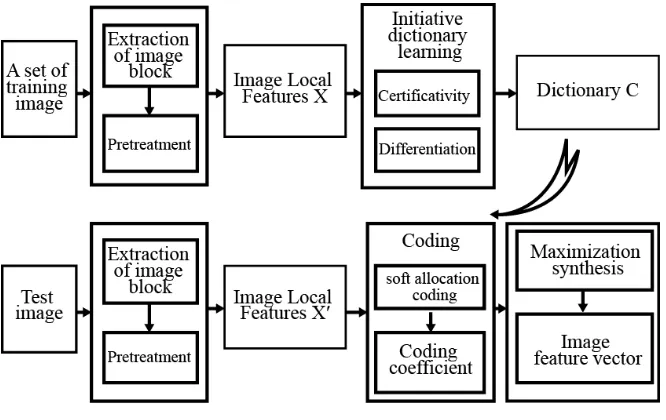
In this paper, in view of the problems existing in the unsupervised feature learning, its dictionary learning process is improved and a kind of data assimilation framework is put forward. The process of data assimilation framework is similar to that of unsu-pervised feature learning. However, in the dictionary learning stage, we introduce the active learning strategy. In combination with the characterization of the samples themselves and the difference between samples, the teaching blocks with maximum information volume is selected through iteration as the atoms of the dictionary so as to obtain a more complete dictionary and further learn to obtain better representation of the teaching features. The detailed flow of data assimilation framework is shown in Figure 1. Next, we will introduce the specific steps as the following.
Fig. 1. Data Assimilation Framework
For a set of unlabeled teaching, we randomly select
M
teaching blocks ofb b
!
from these teaching and convert each teaching block into a vector form. We will ex-tract the set of teaching blocks as follows:{
1 2 M}
P
=
p , p , , p
!
,
(
1
)
i
the teaching is the color teaching, it is
d b b
=
! !
3
. We can pre-process the extract-ed teaching block.2.1 Pretreatment
In the pre-treatment phase, we firstly normalize the extracted teaching blocks, and the normalization method can be expressed as
!
p
i=
p
i!
m
i!
i,i
=
1
,
!
,M
.
i
m
and!
iare the mean and standard deviation of the pixel valuesp
i.p
!
i is thenormalized teaching block. The normalized set of teaching blocks is expressed as
!
P
=
{
p
!
1,
p
!
2,
!
,
p
!
M}
.
Later, we used zero component analysis (Zero Components Analysis, ZCA) to whiten it, and the mathematical expression is as follows:
x
i=
W
ZCAp
!
i,i
=
1,
!
,M ;
W
ZCA=
1
M
p
!
ip
!
iT i=1M
!
"
#
$$
%
&
''
(1 2
.
i
x
stands for a whitened vector ofp
!
i,
W
ZCA is the transform matrix of ZCA , and{
1 2 M}
X
=
x ,x , ,x
!
is a set of teaching blocks after whitening.2.2 Active dictionary learning
We think that the amount of information in the teaching block from
X
should con-tain two aspects: (1) the characterization of the teaching block-the choice of the ing block should be the same as possible with the teaching block. Many of the teach-ing blocks are similar, so that we only choose a small number of samples, which can represent the entire set of teaching blocks; (2) the difference between teaching blocks - the newly selected teaching blocks should have a large difference from the selected teaching blocks. The dictionaries we construct can characterize a wider range of teaching distortions. In the section, we describe the process of characterization and difference, as well as the process of active dictionary learning.corresponding neighborhood samples. In this paper, we use the formula (1) to esti-mate characterization of teaching blocks:
R x
( )
i=
1
M
exp
!
x
i!
x
j 2 22
!
R2"
#
$
%
&
'
xj(X ,j)i*
(1)
( )
iR x
is the characterization of the teaching blockx
i. 22 i j
x x
!
is for the Eu-clidean distance betweenx
i andx
j.!
R is the distance for the radial basis function. In this paper, we choose the formula (2) for!
R2:!
R2=
!
median
xi,xj!X ,i"j
x
i#
x
j 2 2$
%
&
'
(
)
(2)
Median is the median value,
!
is the scalar to adjust the!
R2dimension. Experi-mental results show that when we take any value!
between 0.01 and 1, the method can achieve better performance. In this paper, we choose!
= 0.1.Diversity. We use
S
to show the set of teaching blocks (i.e. dictionary). It has been chosen to represent the set of unselected teaching blocksU
. For the samplex
i!
U
, we calculate the differencex
i based on the minimum angle betweenx
i andS
of allthe teaching blocks.
D x
( )
i=
min
xj!S
1
!
cos
"1
x
ii
x
jx
ix
j#
$
%
%
&
'
(
(
(3)
i jx x
!
shows the inner product betweenx
i andx
j,cos
!1represents the cosinefunction, and
!
represents the modulus of the vector.Active sample selection. As the teaching blocks have the largest amount of infor-mation, both the characterization and the difference shall be met. We use the weighted average of the characterization and difference measure as the measure of the amount of information in the teaching block. Then, we select the teaching block containing the largest amount of information as the new. The criteria for sample selection can be expressed as
arg max
[ ]
0 1
,
!
"
is the weighting factor used to weigh the impact of sample characteri-zation and discrepancy on dictionary construction.It is very difficult to choose all the teaching blocks from the information in
U
. Therefore, in the active dictionary learning, we adopt the method of stepwise itera-tion: in each iteration, the comprehensive characterization and difference selection include the most information teaching blocks to join the dictionaryS
. It can update the collectionU
as well as the difference measure ofx U
i!
. This is followed by a sufficient number of teaching blocks inS
. It is important to note that the representa-tion of all the samplesX
does not change. There is no need for recalculation of the representational measurex U
i!
in the iterative process. The procedure is described in Procedure 1.Process 1. Active dictionary learning.
1. Initialization: for sample set
X
, the sizeK
of the dictionary is built. The number0
k
=
has the selected samples and the dictionaryS
=
!
, and the sample set is se-lected;2. The formula (1) is estimated the representation of the sample
U
;3. Select one of the most representative samples in
U
as the initial dictionary to remove it:( )
1
i
i x U
c arg max R x
!=
,
1 1
1
S S c ,U U c ,k k
=
!
=
"
= +
;
4. Use equation (3) to calculate the difference between
x U
i!
andS
;5. Select the sample with the largest amount of information to join the dictionary
S
and remove itU
:( ) (
) ( )
(
)
1
1
i
k i i
x U
c
+arg max R x
!
!
D x
"
=
+ #
,
1 1
1
k k
S S c ,U U c ,k k
=
!
+=
"
+= +
;
6. If it isk K
<
, return to 4;7. Output the dictionary
S
.use the
c
ias thei
-th dictionary atomic normalizationc
!
i
=
c
i/ c
i ,i , ,K
=
1
!
,with the length of each vector 1. Normalized dictionary is expressed as
!
C
=
!"
c
!
1,
c
!
2,
!
,
c
"
K#$
d%K
.
For simplicity, we refer to the normalized dictionary atom with "dictionary atom" below. Figure 2 shows some of the dictionaries of this paper based on active diction-ary learning. It can be seen that the dummy atoms can represent edges, noise, and textures. In the local structure, the atoms have a greater difference, which makes the characteristics of the school, with the strong ability to distinguish.
2.3 Local feature coding
For a test teaching, we firstly extracted m teaching blocks and pre-process them to get their local feature set:
{
1 2}
t t t t
M
X
=
x ,x , ,x
!
,
t i
x
stands for thei
-th local feature vector,i , , ,M
=
1 2
!
.We will have the soft allocation coding in the dictionary
C
!
forx
ti!
X
t. Thecod-ing coefficient
x
ti!
X
tis expressedz
i=
!"
z
i ,1,
!
,z
i ,K,z
i ,K+1,
!
,z
i ,2K#$
T,
z
i ,j=
max x
(
ti!
c
!
j,
0
)
,
z
i ,j+k=
max
(
!
x
ti"
c
!
j,
0
)
, j
=
1
,
!
,K
;
x
ti
!
c
!
jshows the inner product of the ti
x
andj
dictionary atomsc
!
j. We will test
the corresponding code to teaching in all the expression as a matrix form
[
1 2 m K m]
22.4 Local feature synthesis
Furthermore, we adopt the max-pooling strategy to synthesize the coding coeffi-cients of all teaching blocks to obtain a fixed dimension of the teaching feature vector
f
( )
[
]
21 2 2
T k
max K
f
=
!
Z
=
f , f , , f
!
"
R
,
max
!
shows the maximum value of each row in each line ofZ
, and thej
-th el-ement that represents off
can be expressed as{
1 2}
1
2
j ,j ,j m,j
f
=
max z ,z , ,z
!
, j , , K
=
!
;
max
is taken for the maximal operation.3
Evaluation of physical education in multimedia teaching
quality
Because the support vector regression (SVR) has better generalization ability. We use SVR to construct the numerical mapping between teaching features and teaching quality. We realize the blind prediction of teaching quality. The method includes training and testing two processes:
1.In the training process, we first use the data assimilation method to extract the ei-genvector of the training set. Then, we input the characteristics of the training set and the subjective quality score into the SVR model to train the optimal model pa-rameters.
2.In the test process, for any given test teaching, we first use the data assimilation method to extract its eigenvector. Then, we input it into the trained SVR model. We can estimate the quality of the test teaching scores.
In this paper, we use the
v
-SVR model and the linear kernel function. We adopt the LIBSVM toolbox to implement the method.4
Experimental results and analysis
4.1 Data set
CSIQ database contains six kinds of distortions: JPEG compression, JPEG2000 com-pression, additive pinkGaussian noise, Gaussian Blur, global contrast decrements and white noise. In addition, we generated some new types of distortion teaching: speckle noise, Poisson noise, and salt-peppernoise. In this paper, we used the brightness com-ponents of the teaching. We randomly selected 105 gray scale teaching blocks with of 8!8 from these unlabeled teaching. It can estimate the ZCA transform matrix and construct the dictionary.
In order to verify the performance of this method, we experimented with the LIVE standard data�. The LIVE database contains 29 original teaching methods and 5 class distortion teaching methods (total of 808), which is generated by the 29 original teaching ways. JPEG2000 compression, JPEG compression, Gaussian noise, WN, Gaussian blurring, Gblur, and Fast fading in Raylia Channel (FF) are given in the database (DMANS). The lower the DMOS value of teaching, the better the quality of teaching.
We used the teaching quality evaluation to calculate the Spearman Rank-order Correlation Coefficient (SRCC) and the Pearson's Linear Correlation Coefficient (PLCC) between the predicted mass fraction and the teaching DMOS value. As an indicator of method performance, the higher the SRCC and PLCC values, the better the performance of the method. We used the median of PLCC and SRCC as the esti-mation of the method performance in 100 experiments. In each experiment, we ran-domly selected 23 original teaching from the LIVE database. Its corresponding distor-tion teaching is viewed as a training set in the remaining teaching on the test. We estimated the parameters of the
v
-SVR model by cross-validation on the training set. In sections 5.2 and 5.3, the weighting factor in the active dictionary learning is!
=0.5 for the results. In section 5.4, we analyze different!
to the impact on perfor-mance.4.2 Validity of data assimilation
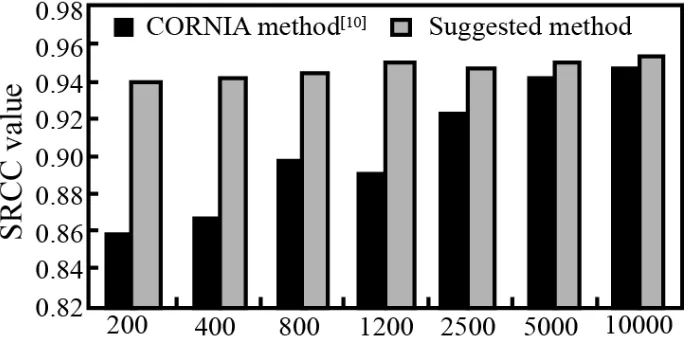
In order to verify the validity of the data assimilation framework, we compared this method with the feature learning based on
K
mean clustering (CORNIA method [10]). In the quality prediction, we usev
-SVR model and the linear kernel function. We tested the performance of the multimedia teaching evaluation method in the dic-tionaryK
at 200, 400, 800, 1200, 2500, 5000 and 10,000. Figure 2 shows the SRCC values of the two methods on the entire test set. The number of atoms changes in the dictionary.data assimilation, we consider the characterization of the sample and the difference between the samples. When the dictionary size is small, the obtained teaching features still have high discriminative ability, which can effectively overcome this defect. Therefore, data assimilation can greatly reduce the consumption of computer storage and computing resources while maintaining better performance. With the mobile phone, Tablet PC and other electronic equipment storage and computing power are limited. The data assimilation of teaching quality evaluation of the promotion and application is of great importance.
Fig. 2. SRCC values with the
K
number of atoms in the dictionary histogram4.3 Consistent experiment
In this section, we compare the methods proposed in this paper with the existing methods of evaluation of multimedia multimedia teaching. There are BLIINDS-II [5], BRISQUE-L [6], NSS-TS [8], and CORNIA [10]. For BLIINDS-II, we use the sup-port vector regression for quality prediction. CORNIA and the results of this method corresponding to the dictionary size are 10000.
Table 1. SRCC values for different methods on the LIVE database
Method JP2k JPEG WN Gblur FF Total BLIINDS-II 0.934 0.900 0.946 0.941 0.907 0.922 BRISQUE-L 0.928 0.913 0.979 0.961 0.921 0.936 NSS-TS 0.931 0.915 0.971 0.939 0.935 0.930 CORNIA 0.924 0.939 0.969 0.959 0.920 0.946 Suggested
method 0.931 0.948 0.959 0.964 0.923 0.951
Table 2. The PLCC values for different methods on the LIVE database
Method JP2k JPEG WN Gblur FF Total BLIINDS-II 0.934 0.920 0.936 0.927 0.900 0.909 BRISQUE-L 0.932 0.935 0.966 0.945 0.924 0.926 NSS-TS 0.947 0.933 0.963 0.950 0.942 0.926 CORNIA 0.949 0.964 0.977 0.954 0.940 0.948 Suggested
method 0.956 0.970 0.971 0.961 0.944 0.952
4.4 Effect of data assimilation parameters on performance
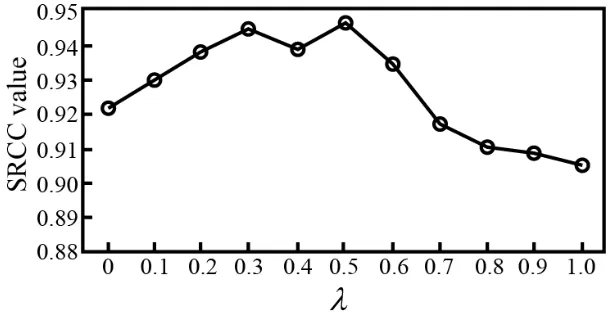
In order to prove the effect of the weighting factor
!
"
[ ]
0 1
,
on the final perfor-mance, in the process of data assimilation, we selected different learning characteris-tics and made quality prediction. Figure 3 shows that the SRCC index!
of the meth-od on the whole LIVE database. The weighting factor " changes in the other diction-ary size. There are similar experimental phenomena. At the same time, PLCC shows a similar change.It can be seen that the best performance can be obtained when it is
!
=0.5. Its per-formance is generally decreasing when it is close to 0 or close to 1. Among them, when!
is close to 1, the performance decreases rapidly. At this point, the decrease in the weight loss in the active dictionary learning indicates that the difference is more important than the data assimilation. It is consistent with the analysis in section 5.2. The introduction of differences makes the data assimilation framework. This paper further validates the rationality of active dictionary learning, by considering the repre-sentativeness and difference of the sample comprehensively.5
Conclusion
In this paper, the author introduces the strategy of active learning into unsupervised feature learning. This paper puts forward a data assimilation framework and applies it to the evaluation of physical education multimedia teaching. The experimental results show that the evaluation method of multimedia teaching in physical education is high-ly consistent with human eye perception. But, it also verifies that data assimilation is superior to the traditional unsupervised feature in learning methods. Because data assimilation can maintain a better performance, a significant reduction can be reduced in the computer storage and computing resources consumption. It is related to the promotion and application of learning of great significance. In the next work, we believe that the following issues are needed to be further studied and explored: (1) research data assimilation framework, different initialization methods, different cod-ing methods and integrated approach to the impact of performance; (2) we study the data assimilation framework based on batch, to select multiple samples in each itera-tion. It is to improve the efficiency of active dictionary learning; (3) we can extend the data assimilation framework to target classification and can verify its effectiveness and exploit its possible improvement.
6
References
[1]Miksch S, Aigner W. A matter of time: Applying a data–users–tasks design triangle to vis-ual analytics of time-oriented data[J]. Computers & Graphics, 2014, 38(1):286-290. https://doi.org/10.1016/j.cag.2013.11.002
[2]Rind A, Lammarsch T, Aigner W, et al. TimeBench: a data model and software library for visual analytics of time-oriented data.[J]. IEEE Transactions on Visualization & Computer Graphics, 2013, 19(12):2247. https://doi.org/10.1109/TVCG.2013.206
[3]Tiede D. A new geospatial overlay method for the analysis and visualization of spatial change patterns using object-oriented data modeling concepts[J]. Cartography & Geo-graphic Information Science, 2014, 41(3):227. https://doi.org/10.1080/15230406.2014.9 01900
[5]Gschwandtner T, Aigner W, Miksch S, et al. TimeCleanser:a visual analytics approach for data cleansing of time-oriented data[J] Driven Business. ACM, 2014:1-8.
[6]Chen Q. Research for influence of physical education multimedia teaching on physical ed-ucation motivation of students[J]. Advances in Information Sciences & Service Sciences, 2012, 9(6):1241-1255.
[7]Xu J. A Study of Extension Strategies of Multimedia Online Teaching Platform in Physi-cal education Teaching of Universities[J]. Journal of Computational & TheoretiPhysi-cal Nano-science, 2017, 20(1):421-430.
[8]Lin X Y. Research of Information Physical education Teaching System based on Multime-dia CAI[J]. International Journal of Advancements in Computing Technology, 2013, 12(6):429-435(7).
[9]Che Y. Multimedia application in physical education teaching drawbacks[J]. Electronic Test, 2013, 30(1):147-152.
[10]Zhang T, Wen H, Hu S. The impact of using the visual multimedia presentation platform on the teaching effectiveness of public physical education[J]. International Journal of In-formation Technology & Management, 2014, 13(1):64-71. https://doi.org/10.1504/ IJITM.2014.059150
7
Author
Lifu Xing is with Ningbo Dahongying University, Ningbo, Zhejiang, China ([email protected]).