Volume 12, Number 2, pp. 227–238. http://www.scpe.org c 2011 SCPE
PARALLELIZATION OF COMPUTE INTENSIVE APPLICATIONS INTO WORKFLOWS BASED ON SERVICES IN BEESYCLUSTER
PAWEL CZARNUL∗
Abstract. The paper presents an approach for modeling, optimization and execution of workflow applications based on services that incorporates both service selection and partitioning of input data for parallel processing by parallel workflow paths. A compute-intensive workflow application for parallel integration is presented. An impact of the input data partitioning on the scalability is presented. The paper shows a comparison of the theoretical model of workflow execution and real execution times. The execution of this distributed workflow is compared to a highly parallel approach using MPI. Finally, results for an integrated workflow/MPI approach are shown.
Key words: workflow management, service selection, data partitioning, parallel computing, numerical integration
1. Introduction. Parallel and distributed processing is now possible thanks to a variety of architectures, application models and technologies. First, these are available for both shared memory and distributed memory processing within HPC clusters [30]. Secondly, approaches such as grid, sky and cloud computing [5] allow integration of services at a high level.
Several models and frameworks have been proposed for complex distributed applications. Quality of Service (QoS) needs to be considered where resources are usually shared among various users requesting their own jobs [13, 29, 35]. Such approaches need to offer enough flexibility in constructing a distributed application and provide the ability to process input data in parallel. Ideally, the user should not be involved in low level details such as selection of services for particular tasks or selection of resources to execute the code. The user should define functional and QoS goals and rely on automatic selection to meet the goals.
2. Related Work. Parallel processing is currently being implemented at various levels within: 1. computing nodes using GPU programming [2], programming many processor cores,
2. local systems such as HPC clusters in which computing nodes are interconnected with a reasonably fast interconnect such as Infiniband, Gigabit Ethernet etc. [6, 30],
3. at a distributed level using e.g. grid [17], cloud computing [5].
One of practical approaches for modeling complex distributed processing based on services is done using workflow applications. A workflow application is modeled as an acyclic graph in which vertexes denote tasks to be executed while directed edges dependencies between the tasks. Forscheduling in utility grids [34]/workflow scheduling in grids[31] for each tasktithere is a set of servicesSiout of which one service is selected to execute
ti. Other attributes such as service costs are considered [33]. As proposed by [34, 35] the goal is to find the best assignment of ti →(sk, tstik) where sk is a service able to execute task ti and tstik is the starting time of execution of tasktiusing servicesk. Execution oftiandtj on oneskmust not overlap. The workflow execution time should be minimized while keeping the cost of selected services below a predefined minimum [7, 8]. In the context of typical business interactions, many more quality attributes are considered such as execution time, cost, availability [7, 27, 36], accessibility [27], fidelity [9] or conformance [27], security [27], reputation [36] is minimized. Usually no dependencies between or overlapping of services executing different tasks are considered in these applications.
From the infrastructure point of view, several MPI [26] implementations have been traditionally used for parallel programming. OpenMPI supports threads and MPI simultaneously. Additionally, several tools can be used for parallel programming within nodes such as CUDA [2], OpenCL, Pthreads [30] etc.
For the distributed workflow model, there are several workflow management systems for grid computing. Paper [32] provides a review and comparison of Gridbus, Kepler [23], Pegasus [16], Triana [25], P-GRADE [22], Directed Acyclic Graph Manager (DAGMan), ICENI, GridFlow, GrADS, Askalon, UNICORE, Taverna, GridAnt. These grid-oriented systems rely mainly on middlewares such as Globus Toolkit, Grid Application Toolkit or other resource management systems for starting and management jobs. Business oriented systems such as Meteor-S [3] incorporate support for BPEL for modeling workflows and use semantic service discovery and composition. As suggested by [24], BPEL can also be used for grid environments. Input data can often be
∗Faculty of Electronics, Telecommunications and Informatics, Gdansk University of Technology, Poland,
([email protected]) http://fox.eti.pg.gda.pl/∼pczarnul.
defined as values, files or data streams [19], as in Gridbus. Input data can drive workflows as in Kepler [1]. The input data from one or several preceding workflow tasks can be treated and processed in several ways [18].
3. Motivations. While this paper builds on the model presented in [14], the contribution of this paper is as follows:
1. assessment of the impact of input data partitioning of input data on the scalability for a workflow with parallel paths,
2. comparison of the theoretical model of processing in a workflow and real results,
3. assessment of the overhead of the parallelization using workflows with distributed services and a highly parallel solution using MPI,
4. integration of parallel processing by parallel workflow paths and parallelization within services using MPI.
4. Model of the Workflow Scheduling with Data Distribution. The model proposed by the author is based on the workflow model with service selection [13, 35] and is extended to consider data distribution for parallel paths of the workflow.
A directed graph G(V, E) represents a workflow in which nodes V correspond to tasks while edges E
represent task dependencies. At least one starting node with initial data and one termination node which terminates computations are distinguished. The starting nodes do not have predecessors. Each node should have a successor apart from the termination node. The model allows to define:
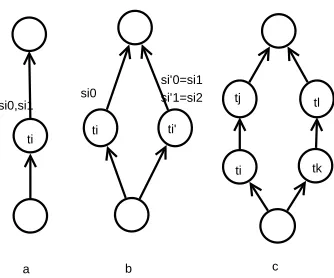
1. a sequence – a service assigned to the second task in a sequence successor is executed only after the service selected for the predecessor has completed (Figure 4.1a),
2. fork – services assigned to the tasks following the forked task are executed in parallel provided these were installed on separate processors (Figure 4.1b),
3. join – the service selected for the task to which other tasks are connected are executed only after each of the predecessors has finished (Figure 4.1b).
The following parameters are distinguished following [14]:
• Si={si0, si1, ..., si(|Si|−1)}– a set of services out of which one is selected to execute taskti, • cij – the cost of processing a unit of data by servicesij,
• Nij – the node on which servicesij was installed, • spn – the speed of noden,
• Pij – the provider of servicesij, • din
ij anddoutij denote the sizes of the input and output data accepted and produced by servicesij. These are linked with formula dout
ij =fti(d
in
ij) where fti defines the size of output data for task ti based on
the input data size.
• di denotes the size of data processed by taskti.
• dijkldenotes the size of data to be sent from servicesijto serviceskl. doutij can be sent and/or partitioned into input files of successors. In particular, all the data can be sent to all the successors or it can be partitioned into non-overlapping parts that will be distributed for parallel processing by the following tasks.
• texec
ij (dinij) – the execution time of servicesij, • ttr
ijkl– additional time for data conversion between output/input formats if connected services are offered by various providers,
• tst
i :i∈ |V|– the time at which servicesijchosen to executetistarts processing it, we have∀i,k:(vi,vk)∈E tst
k ≥tsti + P
jtexecij + P
j,ltcommijkl + P
j,lttrijkl. texecij will be larger than 0 only for onej. Similarly, for the giveniandk tcomm
ijkl andt tr
ijkl will be larger than 0 only for one pair oflandksince only one service per nodeiand one per nodekwill be selected.
• tworkf low – the workflow execution time i.e.
tworkf low=t
termination not∃q(vtermination, vq)∈E.
Traditionally, several optimization goals can be considered such as minimization oftworkf low with a bound on the total cost of selected services i.e. P
din
ijcij < B where B is the budget (problem MIN T C BOUND) and tworkf low is the time when the last service finishes. Problem MIN TC is minimization of v
M IN T C =
αtworkf low+P
din
ijcij. α >0.
team in [15].
ti
a b c
ti ti’
si0,si1 si0
si’0=si1 si’1=si2
ti tk
tj tl
Fig. 4.1: Selection and Parallelization in the Model
4.1. Selection of Solutions and Data Parallelization. The proposed formulation allows to model several issues typical of workflows composed of independent services offered and managed by various users:
1. selection of alternative solutions (services)si0, ..., si(|Si|−1)to particular taskti. This is possible thanks to the well known service selection concept i.e. selecting only one service out of the ones defined for the given task (one of several services is selected for taskti in Figure 4.1a).
2. data parallelism – partitioning of input data for parallelization of computations on this data. This can be achieved in the model in several configurations, depending on the needs:
(a) parallelization of tasktiwhere input data is divided and possibly processed by servicessi0andsi1 orsi0 andsi2 in parallel. Note thatsi1 andsi2 are modeled as exclusive services which combines selection with parallelization. Task ti is split into ti and t′i which are functionally equivalent (Figure 4.1b) and initial services are assigned to these two tasks.
(b) parallelization of a complex task (composed of more than one task) by possibly execution of various sub-solutions in parallel. Input data is divided into flows so thatti→tj andtk→tlare executed in parallel. It can be thatti6=tk and tj6=tl (Figure 4.1c).
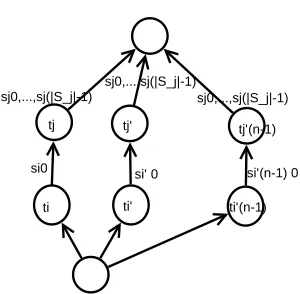
Assuming the user has access to servicessi0, ..., si(|Si|−1) for task ti, parallelization where the algorithm determines partitioning of data between possibly all services, can be modeled as splitting services for many tasks (in fact functionally equivalent) as in Figure 4.2 where∀i,ks′n
i0 =sin.
4.2. Real and Integer Data Sizes. Additional constraints on partitioning of data could be set e.g.
di ∈Z dijkl ∈Z for integer values suitable for partitioning of a set of e.g. pictures of same size for processing in parallel. This makes the problem harder to solve but the algorithms proposed and discussed by the author in Section 5 can handle this case.
4.3. Synchronization. In Figure 4.2 all services are synchronized on the following tasktj which means that even afters′2
i0has finished processing its portion of data,tj will not start until alls
′n
i0 have finished. If there are taskstiandtj which need to process the input data subsequently, the proposed model can allow pushing a portion of data to the following task even if the previous steps on the other portions of data have not completed yet. This can be accomplished as in Figure 4.3. Namely, as soon ast′
i has finished processing its portion of data, it can send results for processing byt′
j without waiting for completion of processing by e.g. ti.
The question arises into how many virtual tasks processing of the given task should be split. This should cover the number of services which can process the given task. In such a case, potentially all services for the original taskti andtj could participate in parallel execution of the corresponding task with the possibility of pushing parts of data from taskti to tasktj even when execution of other parts ofti’s data is still in progress. Furthermore, this could be set up to the potential number of partitions the initial data could be divided into to allow pushing smaller portions of data sooner.
ti ti’ si0
si’ 0
ti’(n-1) si’(n-1) 0 tj
Fig. 4.2: Data Parallelization
ti ti’
si0 si’ 0
ti’(n-1) si’(n-1) 0
tj tj’ tj’(n-1)
sj0,...,sj(|S_j|-1)
sj0,...,sj(|S_j|-1)
sj0,...,sj(|S_j|-1)
Fig. 4.3: Data Parallelization without Synchronization between Tasks
when there is a task to be executed on a portion of the input data where it is not possible to split data among services or it would be too costly compared to the execution by one service (e.g. a conversion of an image to another format). Data partitioning can be used when it is possible and beneficial to split the data and there are enough services to execute in parallel.
5. Algorithms. If the graph contains only tasks with one service for each, the problem becomes how to distribute data with possibly cost constraints. In this case and assuming that data can be divided into chunks of any size, fast linear programming [28] can be used where variables denote the sizes of data processed by particular services. This also assumes that the execution times for the serviceare linear functions of input data size which does not have to be the case. For service selection, the literature suggests introducing integer variables [3, 4, 36] that denote which service is selected for the particular task.
The author has proposed and implemented three different algorithms to solve the problem [14]:
1. genetic algorithm (GA) – in this case a solution is represented by a chromosome. It encodes both selection of particular services for the tasks and also order of execution for pairs of parallel tasks in the graph for which the order is not determined by the workflow graph.
2. mixed genetic algorithm and linear programming (MGALP) – in this case services are assigned to the tasks by a genetic algorithm and data distribution for the given schedule is determined by linear programming [28],
3. mixed integer linear programming (MILP) – similarly to the known approaches [36, 3, 4], integer variables mean which service is selected for a particular task. Additionally though, real or integer variables denote sizes of data flowing from task to task.
6. Management, Optimization and Execution of Workflow Applications in BeesyCluster. The author has created a workflow management environment for modeling, scheduling and execution of workflow applications, both for the proposed model [14] and also for dynamic selection of services at runtime [13].
The environment uses BeesyCluster as a middleware to access distributed services and is available at https://lab527.eti.pg.gda.pl:10030/ek/Main at Faculty of Electronics, Telecommunications and Infor-matics, Gdansk University of Technology, Poland.
BeesyCluster allows its users to access accounts on distributed resources through SSH and compile and run applications, among others (Figure 6.1). Furthermore, such applications can be published as BeesyCluster services to which access may be granted to other users. In particular, costs of running services can be defined. BeesyCluster users have virtual purses from which can pay for services published by others. Similarly, users may earn from others running their own services.
BeesyCluster server cluster BeesyCluster server server database ssh ssh ssh company server WWW/Web services cluster clients A B Sun Sun Sun Sun 0000 0000 0000 0000 1111 1111 1111 1111 0000 0000 1111 1111 000 111 0 0 0 0 0 0 0 0 0 0 0 0 1 1 1 1 1 1 1 1 1 1 1 1 0 0 0 0 0 0 0 0 0 0 0 0 1 1 1 1 1 1 1 1 1 1 1 1
Fig. 6.1: BeesyCluster Architecture
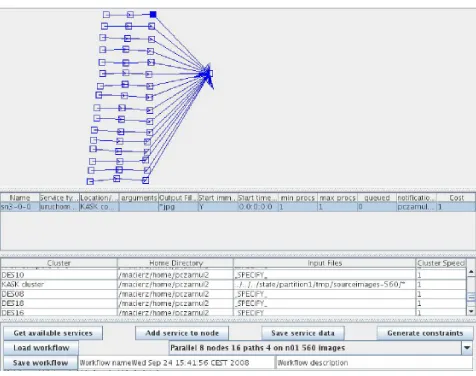
Fig. 6.2: Workflow Editor in BeesyCluster
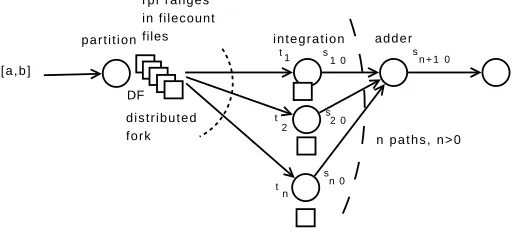
6.1. Compute Intensive Scientific Workflow: Adaptive Quadrature Distributed Integration.
As an example for demonstration of the goals defined in Section 3 a compute intensive application was imple-mented by the author and analyzed. This application computes a numerical integrate of a given function on the given range with a certain accuracy using the adaptive quadrature integration algorithm presented in [30].
6.1.1. Testbed Environment and Services. The testbed environment consists of 16 nodes installed at the Faculty of Electronics, Telecommunications and Informatics, Gdansk University of Technology. Each node along with services installed on them was accessed by BeesyCluster using SSH. The relative speeds of 8 nodes were 1 while the speeds of the other nodes were 0.575 for the application. Each node uses its local disks to store input and output data. As an example functionf(x) =sin(x)cos(sin(x)) +x12 was integrated on given ranges.
The following services were developed:
partition a b rpf filecount – partitions range [a, b] recursively into the given number of files filecount and subranges per filerpf so that the execution time per subrange is approximately similar. At the given step, for each subrange [a,b] 10 points c0, ..., c9 are selected so thata < ci < b. Then the maximum of areas of the triangles formed by (a, f(a)),(ci, f(ci)),(b, f(b)) is selected for each subrange [a, b]. Out of all available subranges the one with the largest area is selected and partitioned into two subranges [a,a+b
2 ], [ a+b
2 , b]. The procedure is repeated until the desired number of subranges is generated. integration – an application written in C that integrates all subranges from input files in its directory and
al-gorithm divides the given subrange recursively like described above until the maximum area of triangles is smaller than 0.000000001 in which case the integrate is approximated by a sum of rectangles.
adder – adds the values supplied in files withoutextension supplied in its directory
Figure 6.3 presents the workflow in which the initial range [a, b] is partitioned into f ilecount files each of which containsrpf subranges. Then the initial files with subranges are sent to separate nodes for parallel processing. It is important to note that filecount must be sufficiently large to distribute files with input subranges among parallel tasks for integration especially if services assigned to them run on nodes of different speeds. Similarly,rpf can be set larger than 1 to further improve load balance since it increases the number of initial subranges and makes their computation times more even. The model assumes that the processing time of each input file is the same.
p a r t i t i o n
[ a , b ]
i n t e g r a t i o n a d d e r rpf ranges
in filecount files
1 0
2 0
n 0
n + 1 0 1
2
n
n p a t h s , n > 0 DF
d i s t r i b u t e d fork
t
t
t s
s
s
s
Fig. 6.3: A Parallel Integration Workflow
6.1.2. Workflow Configurations and Results. The algorithm is able to adapt data distribution to various speeds of processing nodes and also does it under budget constraints. The following configurations were tested (optimization goals are noted):
MIN TC: granularity test (Figure 6.3) – for up to 8 nodes it is best to select 1 file per node as the nodes have same speeds but vary the number of subranges. On the other hand, for 12 and 16 processors we must increase the number of files to let the algorithm balance work between processors of different speeds. Figure 6.4 presents execution times for these settings for range [1,1000]. Setting the number of files or subranges too large causes too much overhead related to opening files, loop overhead with no further gain in load balance. Finally, best settings were selected for following tests.
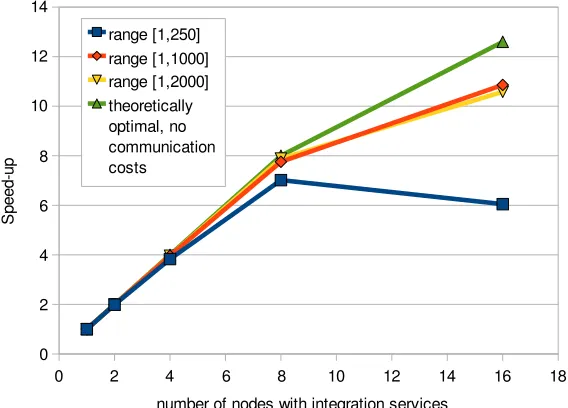
MIN TC:parallel (Figure 6.3) – execution times and corresponding speed-ups are shown in Figures 6.5 and 6.7 for three different ranges of [1,250], [1,1000] and [1,2000]. It can be seen that the algorithm achieves very good speed-ups for larger ranges even though there are various node speeds. For a small run the overhead of the solution including preparation of directories on the nodes, copying of data take their toll. In fact the speed-up for range [1,1000] is slightly better than for range [1,2000] presumably because of some temporary load on one of the nodes during the runs. It also suggests that this is the upper limit on the speed-up for this configuration as increasing the size does not increase the speed-up.
MIN T C BOUND: parallel under budget constraints (Figure 6.6) – we define the costs of services de-pending on the clusters they are installed on and the time of day according to Table 6.1. Three logical clusters are distinguished with 8, 4 and 4 nodes (with different costs) respectively. Figures 6.8 and 6.9 show the impact of decreasing the budget on the execution time of the workflow for two configurations: clusters 1 and 2 (total of 12 nodes), clusters 1, 2 and 3 (total of 16 nodes) for day and night. Cluster costs are the same as for the digital photography workflow since the same clusters were used. However, for this particular integration code clusters 2 and 3 (the speed of each node is 0.575) are slower than cluster 1 (the speed of each node is 1). The budget is varied from the minimum budget allowing full parallelization, then 0.9 and 0.8 of this value. Clearly tightening the budget increases execution times as the algorithm does not allow to pass input data to more expensive services causing the use of a smaller number of cheaper but slower paths.
Fig. 6.4: Adaptive Integration on range [1,1000]: Execution Times [s] vs Number of Subranges per File (1-8 nodes) or Files Per Node (16 nodes)
Fig. 6.5: Adaptive Integration: Execution Times [s]
cost per second Cluster services node count day night 1 s1 0tos24 0 8 20 10
2 s25 0tos36 0 4 10 20
3 s37 0tos48 0 4 15 15
Table 6.1: Services and Cost per Processor Second for Testbed Clusters
p a r t i t i o n [ a , b ]
i n t e g r a t i o n a d d e r rpf ranges
in filecount files
1 0
2 0
n 0
n + 1 0 1
2
n
n p a t h s , n > 0 if the budget is limited
for day simulations: services from cluster1 will be omitted first as too expensive
for night simulations: services from cluster2 will be omitted first as too expensive
cost of each service depends on the cluster it is installed on cluster1: services s to s cluster2: services s to s cluster3: services s to s DF
d i s t r i b u t e d fork
t
t
t s
s s
s
1 0 8 0 9 0 12 0 13 0 16 0
Fig. 6.6: A Parallel Integration Workflow with Budget Constraints
Fig. 6.7: Adaptive Integration: Speed-up
including web album generation as the last workflow task is as follows: execution time = a+ d
p(c+e) +df where d is the number of initial images, p the number of paths, a is an accumulated constant from startup times, overhead for preparation of directories for each workflow node, eandc correspond to computation and communication times anddf corresponds to the execution time of Web album generation.
The execution times are known as are data sizesd. The execution times of the Web generation phase were read from the system logs and thus it was possible to determinef. The execution time of web album generation is always the same as requires the same number of images. Then linear regression was used to determineaand
c+e.
The simulation results are very close to the model (Figure 6.10) being slightly too optimistic regarding performance. The source node is a bottleneck in copying data to several following nodes.
Fig. 6.8: Adaptive Integration: Execution Time [s] under Cost Constraints: Day
Fig. 6.9: Adaptive Integration: Execution Time [s] under Cost Constraints: Night
Fig. 6.10: Comparison of Theoretical Model and Simulation Results
standard MPI nor grid-enabled versions such as MPICH-G2 [20], PACX-MPI [21] or BC-MPI [11] offer easy integration of services with performance and cost aware optimization.
Distributed integration was used as an example in the following configurations:
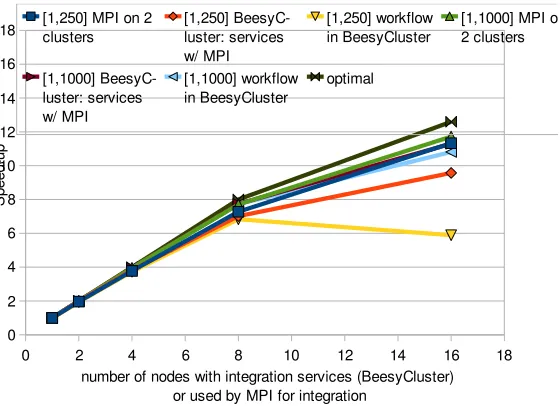
MPI on 2 clusters. Two MPI environments each with 8 nodes were configured. The partitioning application divides the initial range into a predefined number of subranges and saves them to the number of files equal to the number of distinct MPI environments used (1 up to 8 nodes, 2 for 16 nodes in this case) considering relative speeds of the latter. Subsequently, MPI applications launched on the clusters divide the ranges between processes using MPI and compute results for their parts.
workflow in BeesyCluster with services using MPI. Two services were used each of which was imple-mented as a parallel C+MPI application. For 1-8 nodes one service impleimple-mented by one MPI applica-tion using from 1 to 8 nodes was used. For 16 nodes, two BeesyCluster services each of which ran an MPI application on 8 nodes just like in the previous example. It allows to assess the overhead of the BeesyCluster layer. Initial data was prepared as in the previous example.
workflow in BeesyCluster. The configuration considered in Paragraph 6.1 was used where the number of services is equal to the number of nodes. Each service is a sequential application.
Fig. 6.11: Performance Comparison of BeesyCluster Workflow and MPI: Speed-up
processor.
It can be seen that the MPI implementation is not far below the theoretical best result while the BeesyCluster based implementations introduce slightly more overhead. It is not significant for the [1,1000] range but is visible for short runs for range [1,250] and 16 nodes. This is because the overhead introduced by the Java EE implementation is significant compared to the short execution time in this case. Nevertheless, for longer runs the performance of the workflow solution is very good. Secondly, as expected the overhead of the workflow with MPI-based services is much smaller than for a larger number of sequential services. The overhead of the workflow with MPI-based services compared to an MPI-only implementation on 16 nodes for range [1,1000] was 13 seconds. This encourages to use workflows with MPI-based services as it allows very easy integration of services with scheduling and data partitioning incorporating performance and costs which is not available in MPI implementations.
7. Summary. The paper formulated a problem on service selection and scheduling with data distribution encountered in the integration of distributed services offered by various providers. Both the model and the algorithm were implemented in BeesyCluster allowing to consume distributed services from various providers. Additionally, an easy-to-use workflow editor and an execution engine were implemented. As an example, a distributed numerical integration was constructed as a workflow application were prepared and executed a distributed service-based environment. The solution achieves good speed-ups. It is able to minimize the execution time and keep the total cost of selected services below a threshold. The paper demonstrates the impact of input data partitioning on the scalability of the approach. Secondly, simulation results are compared to the theoretical model which confirms its correctness. Finally, the overhead of the implementation is analyzed compared to a pure parallel MPI implementation. Results for an integrated workflow/MPI solution are also presented.
Acknowledgment. Research partially sponsored by research grant N N516 383534 “Strategies for management of information services in distributed environments”.
REFERENCES
[1] Kepler user manual, May 2008.
[2] CUDA Programming Guide 3.1.http://developer.download.nvidia.com/compute/cuda/3 1/toolkit/
docs/NVIDIA CUDA C ProgrammingGuide 3.1.pdf, June 2010.
[4] R. Aggarwal, K. Verma, J. Miller, and W. Milnor,Dynamic web service composition in meteor-s, technical report, LSDIS Lab, Computer Science Dept., UGA, May 2004.
[5] S. A. Ahson and M. Ilyas, eds.,Cloud Computing and Software Services: Theory and Techniques, CRC Press, 2011. ISBN 978-1-4398-0315-8.
[6] R. Buyya, ed.,High Performance Cluster Computing, Programming and Applications, Prentice Hall, 1999.
[7] G. Canfora, M. D. Penta, R. Esposito, and M. Villani,A Lightweight Approach for QoS-Aware Service Composition. ICSOC 2004 forum paper, IBM Technical Report Draft.
[8] ,Qos-aware replanning of composite web services, in Procs. of 2005 IEEE International Conference on Web Services, vol. 1, Res. Centre on Software Technol., Sannio Univ., Italy, July 2005, pp. 121–129.
[9] J. Cardoso, A. Sheth, and J. Miller,Workflow quality of service, tech. report, LSDIS Lab, Department of Computer Science, University of Georgia, Athens, GA 30602, USA, March 2002.
[10] P. Czarnul,Integration of compute-intensive tasks into scientific workflows in beesycluster, in Computational Science – ICCS 2006, vol. 3993 of LNCS, Springer, 2006, pp. 944–947.
[11] ,Bc-mpi: Running an mpi application on multiple clusters with beesycluster connectivity, in Proceedings of Parallel Processing and Applied Mathematics 2007 Conference,, Springer Verlag, May 2008. Lecture Notes in Computer Science, LNCS 4967.
[12] ,A JEE-based Modelling and Execution Environment for Workflow Applications with Just-in-time Service Selection, in proceedings of Grid and Pervasive Computing, Geneva, Switzerland, May 2009.
[13] P. Czarnul, Modeling, run-time optimization and execution of distributed workflow applications in the JEE-based BeesyCluster environment, The Journal of Supercomputing, (2010), pp. 1–26. 10.1007/s11227-010-0499-7, http://dx.doi.org/10.1007/s11227-010-0499-7.
[14] P. Czarnul,Modelling, optimization and execution of workflow applications with data distribution, service selection and budget constraints in beesycluster, in Proceedings of 6th Workshop on Large Scale Computations on Grids and 1st Work-shop on Scalable Computing in Distributed Systems, International Multiconference on Computer Science and Information Technology, 2010, pp. 629–636. Wisla, Poland.
[15] P. Czarnul, M. Matuszek, M. Wjcik, and K. Zalewski,BeesyBees — agent-based, adaptive & learning workflow execution module for BeesyCluster, in Faculty of ETI Annals, Information Technologies vol. 18, Gdansk, Poland, 2010.
[16] E. Deelman, J. Blythe, Y. Gil, C. Kesselman, G. Mehta, S. Patil, M.-H. Su, K. Vahi, and M. Livny,Pegasus : Mapping Scientific Workflows onto the Grid, in Across Grids Conference, Nicosia, Cyprus, 2004. http://pegasus.isi.edu. [17] I. Foster, C. Kesselman, J. Nick, and S. Tuecke, The Physiology of the Grid: An Open Grid Services Architecture
for Distributed Systems Integration, in Open Grid Service Infrastructure WG, June 22 2002. Global Grid Forum,
http://www.globus.org/research/papers/ogsa.pdf.
[18] T. Glatard, J. Montagnat, D. Lingrand, and X. Pennec,Flexible and Efficient Workflow Deployment of Data-Intensive Applications On Grids With MOTEUR, International Journal of High Performance Computing Applications, 22 (2008), pp. 347–360.
[19] Gridbus Project,Workflow language (xwfl2.0). gridbus.cs.mu.oz.au/workflow/2.0beta/ docs/xwfl2.pdf.
[20] N. Karonis and B. Toonen, Mpich-g2 – a grid-enabled implementation of the mpi v1.1 standard.
http://www.hpclab.niu.edu/mpi/, Department of Computer Science at Northern Illinois University and
Mathe-matics and Computer Science Division (MCS) at Argonne National Laboratory.
[21] R. Keller and M. Mller, The Grid-Computing library PACX-MPI: Extending MPI for Computational Grids.
www.hlrs.de/organization/amt/projects/pacx-mpi/.
[22] Laboratory of Parallel and Distributed Systems, MTA SZTAKI, Hungary,Parallel Grid Runtime and Application Development Environment, User’s Manual, ver. 8.4.2.
[23] B. Ludascher, I. Altintas, C. Berkley, D. Higgins, E. Jaeger-Frank, M. Jones, E. Lee, J. Tao, and Y. Zhao,Scientific Workflow Management and the Kepler System, Concurrency and Computation: Practice & Experience, Special Issue on Scientific Workflows, (2005).
[24] R.-Y. Ma, Y.-W. Wu, X.-X. Meng, S.-J. Liu, and L. Pan,Grid-enabled workflow management system based on bpel, Int. J. High Perform. Comput. Appl., 22 (2008), pp. 238–249.
[25] S. Majithia, M. S. Shields, I. J. Taylor, , and I. Wang,Triana: A Graphical Web Service Composition and Execution Toolkit, in IEEE International Conference on Web Services (ICWS’04), IEEE Computer Society, 2004, pp. 512–524. [26] Message Passing Interface Forum,MPI-2: Extensions to the Message-Passing Interface Standard, July 1997.
[27] C. Patel, K. Supekar, and Y. Lee,A QoS Oriented Framework for Adaptive Management of Web Service based Workflows, in Proceedings of the 14th International Database and Expert Systems Applications Conference (DEXA 2003), LNCS, Prague, Czech Republic, September 2003, pp. 826–835.
[28] M. M. Syslo, N. Deo, and J. S. Kowalik,Discrete Optimization Algorithms, Prentice-Hall, 1983.
[29] M. Wieczorek, A. Hoheisel, and R. Prodan,Towards a general model of the multi-criteria workflow scheduling on the grid, Future Generation Comp. Syst., 25 (2009), pp. 237–256.
[30] B. Wilkinson and M. Allen, Parallel Programming: Techniques and Applications Using Networked Workstations and Parallel Computers, Prentice Hall, 1999.
[31] Yingchun, X. Li, and C. Sun,Cost-effective heuristics for workflow scheduling in grid computing economy, in GCC ’07: Proceedings of the Sixth International Conference on Grid and Cooperative Computing, Washington, DC, USA, 2007, IEEE Computer Society, pp. 322–329.
[32] J. Yu and R. Buyya,A taxonomy of workflow management systems for grid computing, Journal of Grid Computing, 3 (2005), pp. 171–200.
[33] J. Yu and R. Buyya,A budget constrained scheduling of workflow applications on utility grids using genetic algorithms, in Workshop on Workflows in Support of Large-Scale Science, Proceedings of the 15th IEEE International Symposium on High Performance Distributed Computing (HPDC 2006), Paris, France, June 2006.
Programming Journal, (2006). IOS Press, Amsterdam.
[35] J. Yu, R. Buyya, and C.-K. Tham,Cost-based scheduling of workflow applications on utility grids, in Proceedings of the 1st IEEE International Conference on e-Science and Grid Computing (e-Science 2005), IEEE CS Press, Melbourne, Australia, December 2005.
[36] L. Zeng, B. Benatallah, M. Dumas, J. Kalagnanam, and Q. Sheng,Quality driven web services composition, in Pro-ceedings of WWW 2003, Budapest, Hungary, May 2003.
Edited by: Dana Petcu and Marcin Paprzycki
Received: May 1, 2011
![Fig. 6.5: Adaptive Integration: Execution Times [s]](https://thumb-us.123doks.com/thumbv2/123dok_us/8748995.1748030/7.595.141.425.371.577/fig-adaptive-integration-execution-times-s.webp)
![Fig. 6.8: Adaptive Integration: Execution Time [s]under Cost Constraints: Day](https://thumb-us.123doks.com/thumbv2/123dok_us/8748995.1748030/9.595.64.264.121.247/fig-adaptive-integration-execution-time-cost-constraints-day.webp)