Scalable Computing: Practice and Experience
Volume 17, Number 4, pp. 369–391. http://www.scpe.org
ISSN 1895-1767 c
⃝2016 SCPE
AQSORT: SCALABLE MULTI-ARRAY IN-PLACE SORTING WITH OPENMP
DANIEL LANGR, PAVEL TVRD´IK AND IVAN ˇSIME ˇCEK ∗
Abstract. A new multi-threaded variant of the quicksort algorithm called AQsort and its C++/OpenMP implementation are presented. AQsort operates in place and was primarily designed for high-performance computing (HPC) runtime environments. It can work with multiple arrays at once; such a functionality is frequently required in HPC and cannot be accomplished with standard C pointer-based or C++ iterator-based approach. An extensive study is provided that evaluates AQsort experimentally and compares its performance with modern multi-threaded implementations of in-place and out-of-place sorting algorithms based on OpenMP, Cilk Plus, and Intel TBB. The measurements were conducted on several leading-edge HPC architectures, namely Cray XE6 nodes with AMD Bulldozer CPUs, Cray XC40 nodes with Intel Hasswell CPUs, IBM BlueGene/Q nodes, and Intel Xeon Phi coprocessors. The obtained results show that AQsort provides good scalability and sorting performance generally comparable to its competitors. In particular cases, the performance of AQsort may be slightly lower, which is the price for its universality and ability to work with substantially larger amounts of data.
Key words: C++, high performance computing, in-place sorting, many-core, multi-array sorting, multi-core, multi-threaded algorithm, OpenMP, parallel partitioning, parallel sorting
AMS subject classifications. 68P10, 68W10
1. Introduction. The demand for sorting multiple arrays at once emerges not only in high-performance computing (HPC) codes. Such codes are mostly written in C/C++ and Fortran, however, common imple-mentations of sorting algorithms in these languages do not support multi-array sorting. Pointer-based sorting routines—such asqsortfrom the C standard library [10,§7.20.5.2]—and their iterator-based generalizations— such as std::sort from the C++ standard library [11, §25.4.1.1]—can operate on a single array only. The Boost library [28] has introduced so-called zip iterators that can work with multiple arrays at once; however, Boost zip iterators are read-only iterators and therefore do not provide a solution for multi-array sorting. Gen-erally, it is not feasible to create a portable standard-compliant implementation of zip iterators that can modify underlying arrays.1
The multi-array sorting problem has been frequently addressed by developers; numerous threads of C/C++ mailing lists and web forums have been devoted to this topic.2 The suggested solution is practically always the same—to transform thestructure of arrays (SoA) into a singlearray of structures (AoS), then perform sorting, and finally copy data back from AoS to SoA. Such a solution has the following drawbacks:
1. There must be enough free memory to perform the SoA-to-AoS transformation. Namely, the amount of free memory must be at least the same as the amount of memory occupied by the data that need to be sorted. Such a constraint might be inconvenient especially in HPC, where not the computational power but the amount of memory often limits the sizes of problems being solved. Users of HPC programs thus might in practice need to work with multi-array data structures that occupy more than the half of available memory, e.g., with representations of sparse matrices or meshes for spatial discretization of PDEs. Sorting/reordering of these data structures via SoA-to-AoS transformation would be not possible under such conditions.
2. The SoA-to-AoS and back AoS-to-SoA transformations imposes into programs a runtime overhead. Sorting algorithms can be classified as being either in-place or out-of-place. We define an out-of-place/not-in-place sorting algorithm as an algorithm that requires Ω(n) extra space for auxiliary data structures, where n denotes the number of sorted elements; for a multi-array sorting problem, n denotes the number of sorted elements of each of the arrays. On the contrary, we define anin-place sorting algorithm as an algorithm that needso(n) extra space. Out-of-place sorting algorithms, such as mergesort, have typically the same amortized memory requirements as the SoA-to-AoS transformation. That is, the amount of free memory must be at
∗Department of Computer Systems, Faculty of Information Technology, Czech Technical University in Prague, Th´akurova 9, 160 00, Praha, Czech Republic ([email protected]).
1The problem stems from the fact that it is not possible to create a pointer or a C++ reference to multiple data entities. For example, the following code is perfectly valid for an implementation of a sorting algorithm in C++:auto& next elem = *(iter + 1); next elem = std::move(...);. But in case of multiple arrays, there does not exist any entity thatnext elemcould reference. A detailed discussion about this problem is beyond the scope of this text.
2Look, e.g., for posts regarding multiple arrays/vectors sorting in C/C++ on the Stack Overflow community developer site (http://stackoverflow.com).
least the same as is occupied by the sorted data. Within this article, we primarily address multi-array sorting problems where such an amount of free memory is not available. Therefore, for the solution of these problems, neither the SoA-to-AoS transformation nor the out-of-place sorting can be used.
Growing capacities of shared memories of computer hardware architectures and growing numbers of their computational cores have raised the demand for parallel/multi-threaded algorithms; we do not consider distribu-ted-memory parallelism in this text, therefore, we use the termsparallel and multi-threaded as synonyms. In HPC, the utilization of shared memories via hybrid parallel paradigms, such as the combination of MPI and OpenMP, often outperforms distributed-memory implementations (pure MPI). However, the amount of data that fit shared memories might become so large that their sequential sorting would introduce into applications significant hotspots. For illustration, sorting of an array of 6.4 billions of integers, which fit 64 GB of memory, with sequentialstd::sorttook in our measurements over 18 minutes on a contemporary CPU-based system. Using parallel in-place sorting algorithms, we were able to reduce the sorting time to less than 2.5 minutes (speedup 7.5) utilizing all 16 system cores. Similarly, we observed the reduction of runtime from 12 minutes to less than 24 seconds (speedup over 30) when sorting 1.6 billions of integers on an Intel Xeon Phi many-core coprocessor.
Available parallel C/C++ implementations of sorting algorithms usually adopt the pointer-/iterator-based approach of their sequential counterparts. Consequently, they are not able to work with multiple arrays at once. In this article, we present a new parallel variant of the in-place quicksort algorithm called AQsort that does not impose such a constraint. Instead of pointers/iterators, AQsort works with user-provided routines for comparing and swapping sorted data. The drawback of this approach is that it hinders some possibilities to optimize and tune resulting programs by developers and compilers (see Sect. 6 for details). One of the purpose of the presented experimental study is therefore to evaluate the effects of such a restriction.
The structure of this article is as follows. Section 2 introduces the state-of-the-art implementations of parallel sorting algorithms. Sections 3 and 4 describe the AQsort algorithm itself and its C++/OpenMP implementation, respectively. Section 5 presents a study that evaluates AQsort experimentally on modern HPC architectures and compares its performance with its not-multi-array competitors. Section 6 discusses the problem of choosing the most suitable sorting solution according to user’s needs and constraints. Finally, Section 7 summarizes our work and concludes the article.
1.1. Motivation. Our research is tightly connected to sparse-matrix computations, mainly to sparse ma-trix storage formats. These formats determine the way how mama-trix nonzero elements are stored in computer memory. The simplest format is so-called coordinate storage format (COO) [1, 27] that consists of three ar-rays containing row indexes, column indexes, and values of matrix nonzero elements. COO does not prescribe any order of the elements in these arrays and it is the most suitable format for assembling sparse matrices— generated nonzero elements are simply to the arrays appended. However, COO has high memory requirements; it is therefore not a suitable format for sparse-matrix computations, which are generally bound in performance by memory bandwidth [14, 35].
In practice, likely the most commonly-used format for sparse matrix computations is thecompressed sparse row format (CSR, CRS), together with its compressed sparse column (CSC, CCS) counterpart [1, 27]. The conversion of sparse matrices from COO to CSR consists of two steps: First, the nonzero elements in COO arrays are sorted lexicographically, which represents a multi-array sorting problem. Then, the array of row indexes is substituted by an (hopefully much smaller) array that indicates how many nonzero elements are in each row and where their column indexes and values can be found.
Numerous other formats have been developed in the past that were shown to provide high performance of sparse matrix computations on modern multi-core and many-core architectures, typically in comparison with CSR. Generally, these formats have two common features: (1) they store matrix nonzero elements in memory in some particular order, and (2) they are more or less parametrized. Finding (pseudo)optimal parameters for a given matrix and transforming this matrix into a given format typically involves multiple sorting of the COO arrays. For example, uniformly-blocking formats are parametrized by the block size [13]. To find an optimal block size, matrix nonzero elements need to be sorted repeatedly with respect to different tested block sizes [12, 29].
problems, we need this algorithm to be in-place. Finally, to allow developers to integrate such an algorithm into their codes, we need its efficient portable OpenMP implementation, since the OpenMP threading paradigm [5] prevails in sparse matrix-related and HPC codes in general. All of these requirements AQsort fulfils.
2. Related Work. Many C/C++ implementations of parallel sorting algorithms have been developed in the past. To our best knowledge, we have not found any one capable of generic multi-array in-place sorting. To evaluate AQsort, we therefore compared its performance with the performance of iterator-based sorting functions from forefront libraries provided by GNU, Nvidia, and Intel.
GNU implements parallel sorting algorithms in the scope of its parallel version of the C++ Standard Library, namely the GNU Libstdc++ Parallel Mode [30]. It provides functions for both in-place and out-of-place sorting; the former implements the parallel quicksort algorithm proposed by Tsigas and Zhang [34], the latter implements a parallel multi-way mergesort. Moreover, the parallel quicksort exists in the library in a balanced and an unbalanced variant, which differ in the way of assigning threads to partitions of unequal sizes. The library uses the OpenMP threading paradigm and was originally developed as a standalone software project called the Multi-Core Standard Template Library (MCSTL) [31]. At the time of writing this article, the GNU Libstdc++ Parallel Mode was referred to as “an experimental parallel implementation of many C++ Standard Library algorithms”.
Nvidia provides parallel sorting functions in the scope of its library called Thrust. The documentation does not discuss the implementation in detail, but according to the source code, the functions seemingly implement an out-of-place parallel mergesort. Thrust was primarily designed for GPGPU programming, but it also supports OpenMP as an underlying threading paradigm [3].
Intel provides parallel sorting functions for their own threading paradigms/frameworks Cilk Plus [26] and Thread Building Blocks (TBB) [24]. Cilkpub—a library of community-contributed Cilk Plus code—contains functions that implement both a parallel in-place quicksort and a parallel out-of-place samplesort. Intel TBB contains an implementation of an in-place parallel quicksort. Some details of these functions are provided by McCool et al. [18].
We have chosen the above mentioned (iterator-based) implementations since, thanks to their providers, we presumed highly efficient and optimized codes targeting modern hardware architectures. However, note that there are numerous other parallel implementations of sorting algorithms as well, available either in the form of standalone codes or within some more generic libraries/frameworks. These include, e.g., Intel PSS [25], OMPTL [2], Parallel STL [19], ParallelSort [21], psort [16], STAPL [33], and STXXL [7].
2.1. Parallel Quicksort. Current implementations of generic in-place sorting algorithms are mostly based on quicksort [8, 9]. Quicksort partitions sorted data according to a so-called pivot element and then recursively calls itself for both resulting parts. In multi-threaded environments, the recursive calls are natural candidates for task parallelism, which is available, e.g., in OpenMP since version 3.0, Intel TBB, and Intel Cilk Plus. However, partitioning needs to be parallelized as well; sequential partitioning at top levels of recursion would significantly hinder the scalability of parallel quicksort.
Tsigas and Zhang [34] proposed a parallel quicksort with efficient parallel partitioning that is widely used in practice and frequently mentioned in literature. Alternative solutions and their comparison has been presented by Pasetto and Akhriev [22, 23]. Within they work, they also proposed a new approach to parallel partitioning, however, they defined it only by words and did not provide a corresponding algorithm [23, Section 2.4].
Another parallel quicksort have been proposed by Mahafzah [15], however, he does not provide experimental comparison with other solutions. Moreover, he presents results only for small data up to 80 MB of memory footprint and small number of threads up to 8. S¨us and Leopold [32] compared several parallel implementations of quicksort based on OpenMP and POSIX threads (Pthreads).
3. Algorithm Design. Available iterator-based C++ sorting functions—both sequential and parallel— typically adhere to the following declaration pattern:
template <class RandomAccessIterator, class Compare>
void sort(RandomAccessIterator first, RandomAccessIterator last, Compare comp);
The first and last parameters represent random-access iterators that determine data to be sorted. The comp binary function decides whether its first argument should appear before the second in the sorted data. Unfortunately, there is no portable way how to construct writable random-access iterators for multiple arrays. To solve the in-place multi-array sorting problem, we thus need to give up the iterator-based approach.
Let us introduce some terminology used in the text below. Up to now, we have spoken about multi-array sorting, i.e., sorting of multiple arrays at once. However, by the term array, we generally mean any sequence of data, i.e., any data structure that contains multiple elements accessible via indexes; in C++, such data structures can be represented, e.g., by the std::vectorand std::array STL containers, or ordinary C-style one-dimensional arrays. We assume that all the arrays haven elements indexed from 0 ton−1. We refer to the elements with the same index in all these arrays as to amultielement.
In a multi-array sorting problem, we thus want to sort n multielements according to some order given by sorting keys that can be derived from multielements data. We say that a multielement Mi is less than another multielementMj ifMishould take place beforeMj in the sorted arrays, according to their sorting keys. Otherwise, we say thatMi isgreater than or equal to Mj.
Let us consider reordering of sparse matrix nonzero elements; a multielement is then represented by a single matrix nonzero element, i.e., by its row index, column index, and value. If we want to sort matrix nonzero elements, e.g., lexicographically (such as for conversion to CSR), we might define sorting keys for the ith multielement as
std::size_t key(std::size_t i) { return rows[i] * n_cols + cols[i]; }
wheren colsequals the number of matrix columns and the arrays rows/cols contain row/column indexes of matrix nonzero elements.
The AQsort implementation declares sorting functions as follows: template <typename Comp, typename Swap>
void sort(std::size_t length, Comp* const comp, Swap* const swap);
The parameterlengthrepresents the number of multielements that need to be sorted, i.e.,n. The parameter compis a pointer to a binary function that takes two arguments and returnstrueif the multielement indexed by the first argument is less than the multielement indexed by the second argument; otherwise, it returnsfalse. Finally, the parameterswapis a pointer to a function that takes two arguments and swaps multielements indexed by these arguments.
Thanks to this approach, AQsort has no information about data being sorted. The algorithm does not know how many arrays are sorted at once, it cannot recognize the types of the elements in these arrays, and there is no way how it could access these elements. It also does not work with sorting keys, only indirectly through thecompfunction. This function needs to derive sorting keys for both indexed multielements, compare them, and return the appropriate binary value. It is up to AQsort users to provide the expected functionality of compandswap over the sorted arrays.
Let us now present the AQsort algorithm itself. Parallel quicksort is carried out by theParallelQuickSort procedure presented by Algorithm 1. Its input consists of the following parameters:
1. n: total number of sorted multielements, 2. numthreads: total number of threads,
3. start: index of the first multielement to be sorted by this call, 4. count: number of multielements to be sorted by this call,
5. Comp: reference to a binary function that compares multielements with two different indexes and returns true if the first multielement is less than the second one; otherwise returns false,
6. Swap: reference to a procedure that swaps multielements with two different indexes, 7. level: auxiliary parameter for preventing quicksort worst case complexityO(n2). Initially,ParallelQuickSortis called from a single thread with the following arguments:
start = 0, count =n, level = 2·⌊log2(n) ⌋
Algorithm 1Main recursive procedure of AQsort
1: procedureParallelQuickSort(n,numthreads,start,count, Comp,Swap, level)
2: whiletruedo
3: if level = 0then
4: SequentialSort(start, count,Comp,Swap,level)
5: return
6: end if
7: level ←level−1
8: T ← ⌊numthreads×count/n⌋ 9: end while
10: if T <2then
11: SequentialSort(start,count,Comp,Swap,level)
12: return
13: end if
14: pivot←SelectPivotMoM(start,count,Comp)
15: Swap(pivot,start+count−1)
16: pivot←start+count−1
17: lessthan←ParallelPartition(start,count,pivot,Comp, Swap,T)
18: Swap(start+lessthan, pivot)
19: greaterthan←count−lessthan−1
20: whilegreaterthan>0andComp(start+lessthan,start+count−greaterthan)= falseandComp(start+ count−greaterthan,start+lessthan)= false do
21: greaterthan←greaterthan−1
22: end while
23: if lessthan>greaterthan then
24: runParallelQuickSort(n,numthreads,start+count−greaterthan,greaterthan,Comp,Swap,level) in a new parallel task
25: count ←lessthan
26: else
27: runParallelQuickSort(n,numthreads,start,lessthan,Comp,Swap,level)in a new parallel task
28: start ←start+count−greaterthan
29: count ←greaterthan
30: end if
31: end procedure
andnumthreads set to the number of threads that a user wants to use for parallel sorting. TheParallelQuickSort procedure works as follows:
1. If the maximum allowable depth of recursion is reached, SequentialSort is called, which further immediately proceeds to heapsort.
2. The number of threads that proportionally falls on the number of multielements processed by this call (count) is calculated and stored in T; the total number of threads as well as the total number of multielements therefore need to be passed toParallelQuickSort as arguments. WhenT drops below 2, the processed multielements are sorted sequentially by calling theSequentialSortprocedure. 3. Otherwise, a pivot multielement is selected and the processed multielements are partitioned with respect
to this pivot usingT threads by calling theParallelPartition function.
4. InParallelQuickSort, the pivot is chosen using themedian of medians (MoM) strategy referred also to asninther, which is usually recommended for large arrays; see, e.g., [4]. The MoM pivot selection is represented by theSelectPivotMoMfunction.
5. After parallel partitioning, multielements that lays behind the pivot and are equal to it are excluded from further processing, since they are already at their final positions. This might considerably improve the algorithm efficiency in cases when sorted arrays contain only few unique sorting keys.
Algorithm 2Parallel partitioning—Part 1
1: functionParallelPartition(start,count,pivot,Comp,Swap,T)
2: m← ⌊count/PBS⌋
3: tleft[]←integer array of sizeT
4: tstart[]←integer array of sizeT+ 1
5: fort= 0 toT−1do
6: tstart[t]←start+PBS× ⌊t×m/T⌋
7: end for
8: tstart[T]←start+PBS×m 9: forT threads do in parallel
10: t←actual thread number
11: left ←tstart[t]
12: right ←tstart[t+ 1]−1
13: tleft[t]←left+SequentialPartition(left, right−left+ 1,pivot,Comp,Swap)
14: perform parallel barrier synchronization
15: end for
16: i←0
17: j←T−1
18: whilei < j do
19: imod ←(tleft[i]−start) modPBS
20: jmod ←(tleft[j]−start) mod PBS
21: if imod = 0then
22: i←i+ 1
23: continue
24: end if
25: if jmod = 0then
26: j ←j−1
27: continue
28: end if
29: ilast ←tleft[i]−imod+PBS−1
30: jfirst ←tleft[j]−jmod
31: whiletleft[i]≤ilast andtleft[j]−1≥jfirst do
32: Swap(tleft[i],tleft[j]−1)
33: tleft[i]←tleft[i] + 1
34: tleft[j]←tleft[j]−1
35: end while
36: end while
process the second partition. The recursive call is always performed for the smaller partition.
The key for the good scalability of AQsort is efficient parallel partitioning at the high levels of the quicksort’s recursive process accomplished by theParallelPartitionfunction. Its functionality stems from the solution described by Pasetto and Akhriev that was introduced in Section 2.1. We elaborated their concept into an fully-defined efficient blocking-based algorithm that is introduced by Algorithm 1.
TheParallelPartition function takes the following arguments: 1. start: index of the first multielement to be partitioned, 2. count: number of multielements to be partitioned, 3. pivot: index of a pivot multielement,
4. Comp,Swap: see Algorithm 1,
5. T: number of threads to be used for partitioning,
Algorithm 3Parallel partitioning—Part 2
37: lessthan←0
38: fork←0to T−1do
39: lessthan←lessthan+tleft[k]−tstart[k]
40: end for
41: temp←(tleft[i]−start) modPBS
42: if temp̸= 0and (start+lessthan<tleft[i]−temp orstart+lessthan≥tleft[i]−temp+PBS)then
43: if Comp(start+lessthan,pivot)then
44: q←PBS−temp
45: while q >0do
46: Swap(tleft[i],start+lessthan+q−1) 47: tleft[i]←tleft[i] + 1
48: q←q−1
49: end while
50: else
51: q←temp
52: while q >0do
53: Swap(tleft[i]−1,start+lessthan−q)
54: tleft[i]←tleft[i]−1
55: q←q−1
56: end while
57: end if
58: end if
59: lthread ←0
60: rthread←T−1
61: gleft←tleft[0] 62: gright←tleft[T−1]
15), which represents a standard sequential partitioning algorithm. For efficiency, multielements are processed in blocks, and the size of blocks represents a global AQsort parameter called PBS; such a blocking approach is inevitable for multi-core and many-core environments to avoid cache contention. The size of split parts is chosen to be an exact multiple of the block size.
We further distinguish 3 different types of blocks. A block is calledblack if all its multielements are less than the pivot. A block is calledwhite if all its multielements are greater than or equal to the pivot. A block is calledgrey if it contains multielements of both types and the multielements less than the pivot are placed on its left side, thus have lower indexes, than the multielements greater than or equal to the pivot. After performing SequentialPartitionby each thread, the corresponding part of multielements contains at most one grey block; the other blocks are either black or white. The next step is to “neutralize” these at most T grey blocks by swapping their multielements such that as a result, either only one or no grey block exists (lines 16–36). If it does, it is placed to its final position, which is already known (lines 37–58). The neutralization of grey blocks is performed sequentially; this step is very fast and there would be only little or no benefit from its parallelization. After neutralization of the grey blocks—up to at most the single one—all black and white blocks are swapped in parallel so that all black blocks are finally placed left from white blocks (lines 59–105). Thought the most of the pseudocode of this step consists of a critical section, the most runtime is spent outside of it (lines 100–102). In the end,ParallelPartition needs to process multielements that did not fit the blocking scheme. This consists of placing the remaining not-yet-processed multielements that are less than the pivot to the left side of the position where the pivot finally belongs (lines 106–111). This last step is performed sequentially (again, it is very fast and there would be only little or no benefit from its parallelization).
Algorithm 4Parallel partitioning—Part 3
63: forT threads do in parallel
64: done←false
65: whiletruedo
66: enter critical section
67: if gleft ≥gright orgleft ≥start+lessthan orgleft−PBS <start+lessthan then
68: done←true
69: break
70: end if
71: whilegleft ≥tstart[lthread+ 1]do
72: lthread ←lthread + 1
73: if lthread ≥T then
74: done←true
75: break
76: end if
77: gleft ←tleft[lthread]
78: end while
79: myleft←gleft
80: gleft←gleft+PBS
81: whilegright >PBS andgright−PBS <tstart[rthread]do
82: if rthread= 0 then
83: done←true
84: break
85: end if
86: rthread ←rthread−1
87: gright ←tleft[rthread]
88: end while
89: if gright ≤PBS then
90: done←true
91: break
92: end if
93: myright←gright−PBS
94: gright←gright−PBS
95: exit critical section
96: if done= truethen
97: break
98: end if
99: if myleft<myright then
100: fork←0to PBS−1do
101: Swap(myleft+k,myright+k)
102: end for
103: end if
104: end while
105: end for
quicksort. Then, insertion sort is executed to finally sort multielements not sorted by quicksort. TheSequentialQuickSort procedure works as follows:
1. If the maximum allowable depth of recursion is reached, the quicksort is abandoned and the processed multielements are sorted with theHeapSortprocedure.
2. Otherwise, a pivot multielement is selected and the processed multielements are partitioned with respect to this pivot by calling theSequentialPartitionfunction.
3. The pivot is chosen using so-calledmedian of three (Mo3) strategy, which is faster than MoM.
Algorithm 5Parallel partitioning—Part 4
106: fork←tstart[T]tostart+count do
107: if Comp(k,pivot)then
108: Swap(k,start+lessthan)
109: lessthan←lessthan+ 1
110: end if
111: end for
112: returnlessthan
113: end function
from further processing.
5. As inParallelQuickSort, thetail call elimination is applied to reduce the required call stack space. 6. Quicksort is performed only for partitions with sizes greater thanIST. Smaller partitions are left to
be sorted by insertion sort.
4. Implementation. We provide an AQsort implementation in the form of an open-source GitHub project3. It is written in C++ and uses OpenMP as a threading paradigm; OpenMP version 3.0 or higher is required because of task parallelism. Its usage consists of:
1. including the main AQsort header fileaqsort.h,
2. defining functions for comparing and swapping multielements, 3. calling one of the provided sorting functions.
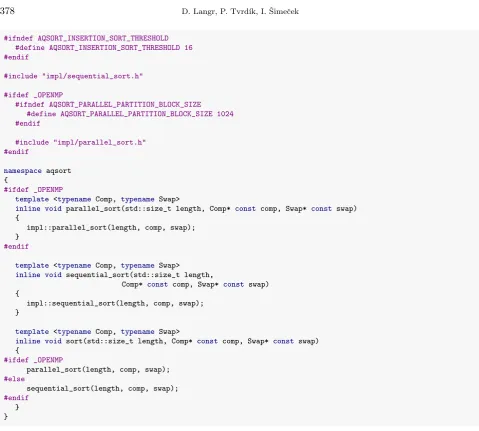
The contents of aqsort.his shown in Figure 4.1.
There are three sorting functions defined, all within the aqsort namespace. The first function called parallel sort performs sorting in parallel by using OpenMP. The second function called sequential sort performs sequential sorting. The third function calledsortis a simple “switch” that proceeds toparallel sort if OpenMP is available and tosequential sort otherwise. Note that parallel sortis accessible only if the OPENMPpreprocessor macro is defined. This macro is typically provided automatically by compilers in case that OpenMP threading is activated (as, e.g., when the-fopenmp command line argument is passed to the GNU C/C++ compilers).
Thesequential sort function can be employed in codes where OpenMP threading is not available, such as sequential programs. In HPC, these may also be pure MPI-based programs; their MPI processes are typically mapped to all available system cores and, consequently, there is no room for shared-memory parallelism.
Both parallel sort and sequential sort functions are only simple wrappers. The implementation of sorting algorithms defined in Section 3 is hidden in theaqsort::implnamespace and the corresponding codes are stored in theimplsubdirectory. There is no need for building and linking the AQsort library; its functionality is provided purely in the form of C++ header files.
In Section 3, we introduced two AQsort global algorithm parameters, namely PBS and IST. These pa-rameters are represented within the implementation by preprocessor macros calledAQSORT PARALLEL PARTI-TION BLOCK SIZE andAQSORT INSERTION SORT THRESHOLD, respectively. If users want to change their default values for their codes, they need to define these macros before theaqsort.hheader file is included.
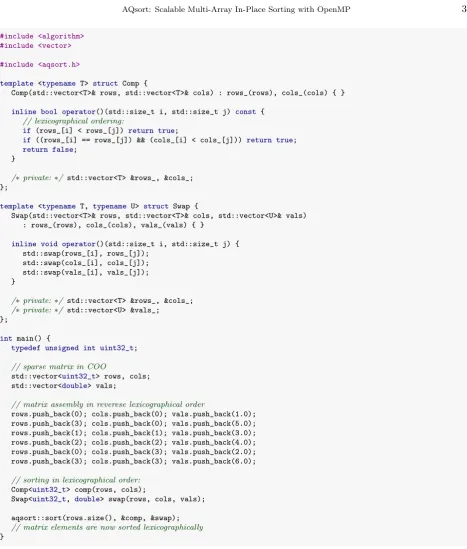
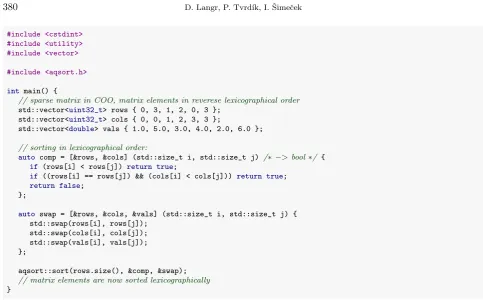
Let us now show how to define comparison and swapping functions for AQsort. Primarily, we can define them either asfunction objects, or aslambda functions, which were introduced by the C++11 standard. Both options are illustrated by Figures 4.2 and 4.3, respectively; note that the latter is considerably clearer and more concise. These example codes show how to sort nonzero elements of a sparse matrixA, where:
A=
1 0 0 2
0 3 0 0
0 0 4 0
5 0 0 6
and n= 6. (4.1)
Note that it would have no sense to perform such sorting in parallel; multi-threaded functionality of AQsort was designed for very large arrays. The reasonable condition for efficient parallel sorting with AQsort is
n≫PBS×numthreads, (4.2)
#ifndef AQSORT_INSERTION_SORT_THRESHOLD #define AQSORT_INSERTION_SORT_THRESHOLD 16 #endif
#include "impl/sequential_sort.h"
#ifdef _OPENMP
#ifndef AQSORT_PARALLEL_PARTITION_BLOCK_SIZE #define AQSORT_PARALLEL_PARTITION_BLOCK_SIZE 1024 #endif
#include "impl/parallel_sort.h" #endif
namespace aqsort {
#ifdef _OPENMP
template <typename Comp, typename Swap>
inline void parallel_sort(std::size_t length, Comp* const comp, Swap* const swap) {
impl::parallel_sort(length, comp, swap); }
#endif
template <typename Comp, typename Swap> inline void sequential_sort(std::size_t length,
Comp* const comp, Swap* const swap) {
impl::sequential_sort(length, comp, swap); }
template <typename Comp, typename Swap>
inline void sort(std::size_t length, Comp* const comp, Swap* const swap) {
#ifdef _OPENMP
parallel_sort(length, comp, swap); #else
sequential_sort(length, comp, swap); #endif
} }
Fig. 4.1: Contents of the AQsort main header fileaqsort.h. Comments and some unimportant preprocessor directives are omitted.
wherenumthreads denotes the number of utilized OpenMP threads.
5. Experiments. We have conducted an extensive experimental study to evaluate the performance and scalability of AQsort and to compare it with existing forefront implementations of parallel sorting algorithms. Measurements were run on modern HPC hardware architectures, namely 3 types of multi-core computational nodes of large-scale HPC systems and a many-core Intel Xeon Phi coprocessor/accelerator; see Table 5.1 for details.
The utilized Intel Xeon processors of the Cray XC40 system supported hyper-threading, i.e., running two threads per a single physical core. However, within preliminary test measurements, hyper-threading brought
4Formerly known as Hornet (the system was renamed/upgraded during our work).
5High Performance Computing Center Stuttgart, University of Stuttgart, Stuttgart, Germany. 6National Center for Supercomputing Applications, University of Illinois, Urbana-Champaign, USA. 7Faculty of Information Technology, Czech Technical University in Prague, Prague, Czech Republic. 8J¨ulich Supercomputing Centre, Institute for Advanced Simulation, J¨ulich, Germany.
#include <algorithm> #include <vector>
#include <aqsort.h>
template <typename T> struct Comp {
Comp(std::vector<T>& rows, std::vector<T>& cols) : rows_(rows), cols_(cols) { }
inline bool operator()(std::size_t i, std::size_t j) const { // lexicographical ordering:
if (rows_[i] < rows_[j]) return true;
if ((rows_[i] == rows_[j]) && (cols_[i] < cols_[j])) return true; return false;
}
/∗private:∗/ std::vector<T> &rows_, &cols_; };
template <typename T, typename U> struct Swap {
Swap(std::vector<T>& rows, std::vector<T>& cols, std::vector<U>& vals) : rows_(rows), cols_(cols), vals_(vals) { }
inline void operator()(std::size_t i, std::size_t j) { std::swap(rows_[i], rows_[j]);
std::swap(cols_[i], cols_[j]); std::swap(vals_[i], vals_[j]); }
/∗private:∗/ std::vector<T> &rows_, &cols_; /∗private:∗/ std::vector<U> &vals_;
};
int main() {
typedef unsigned int uint32_t;
// sparse matrix in COO
std::vector<uint32_t> rows, cols; std::vector<double> vals;
// matrix assembly in reverese lexicographical order
rows.push_back(0); cols.push_back(0); vals.push_back(1.0); rows.push_back(3); cols.push_back(0); vals.push_back(5.0); rows.push_back(1); cols.push_back(1); vals.push_back(3.0); rows.push_back(2); cols.push_back(2); vals.push_back(4.0); rows.push_back(0); cols.push_back(3); vals.push_back(2.0); rows.push_back(3); cols.push_back(3); vals.push_back(6.0);
// sorting in lexicographical order: Comp<uint32_t> comp(rows, cols);
Swap<uint32_t, double> swap(rows, cols, vals);
aqsort::sort(rows.size(), &comp, &swap); // matrix elements are now sorted lexicographically }
Fig. 4.2: Custom reordering of sparse matrix nonzero elements with AQsort using function objects.
#include <cstdint> #include <utility> #include <vector>
#include <aqsort.h>
int main() {
// sparse matrix in COO, matrix elements in reverese lexicographical order std::vector<uint32_t> rows { 0, 3, 1, 2, 0, 3 };
std::vector<uint32_t> cols { 0, 0, 1, 2, 3, 3 };
std::vector<double> vals { 1.0, 5.0, 3.0, 4.0, 2.0, 6.0 };
// sorting in lexicographical order:
auto comp = [&rows, &cols] (std::size_t i, std::size_t j) /∗ −>bool∗/ { if (rows[i] < rows[j]) return true;
if ((rows[i] == rows[j]) && (cols[i] < cols[j])) return true; return false;
};
auto swap = [&rows, &cols, &vals] (std::size_t i, std::size_t j) { std::swap(rows[i], rows[j]);
std::swap(cols[i], cols[j]); std::swap(vals[i], vals[j]); };
aqsort::sort(rows.size(), &comp, &swap); // matrix elements are now sorted lexicographically }
Fig. 4.3: Custom reordering of sparse matrix nonzero elements with AQsort in C++11 using lambda functions.
Table 5.1: Configurations of HPC systems and their run-time environments used for experiments.
Architecture: Cray XC40 Cray XE6 Intel Xeon Phi IBM BlueGene/Q
System: Hazel Hen4 Blue Waters Star Juqueen
Provider: HLRS5 NCSA6 CTU7 JSC8
Processor: Intel Xeon E5-2680 v3 AMD Opteron 6276 Xeon Phi 7120P IBM PowerPC A2
Frequency: 2.5 GHz 2.3 GHz 1.238 GHz 1.6 GHz
Cores per node: 24 16 61 16
Node memory: 128 GB 64 GB 16 GB 16 GB
Memory access: NUMA9 NUMA SMP10 SMP
Used compilers: GNU g++ 4.9.2 GNU g++ 4.8.2 Intel icpc 15.0.2 GNU g++ 4.8.1 Intel icpc 15.0.2 Intel icpc 15.0.3
per core, therefore, we present measurements for up to 64 and 244 threads for these architectures, respectively. All the measurements on Intel Xeon Phi were performed in the native mode, i.e., test programs were run directly on the coprocessor.
Please note that we do not provide results of all the measurements for IBM BG/Q, since the Juqueen’s runtime environment was not intended for such types of experiments. There was neither a possibility to obtain an interactive access to computational nodes nor a possibility to use a single node only. The smallest allocation unit for a job consisted of 32 nodes and such an allocation had wall clock time limited to 30 minutes. We therefore performed only selected experiments on IBM BG/Q.
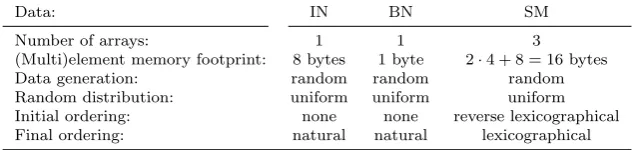
Within measurements, we used 3 types of data sets for sorting:
1. integer numbers(IN) represented with the 64-bit unsigned integer data type, 2. binary numbers (BN) represented with the 8-bit unsigned integer data type,
3. sparse matrix nonzero elements (SM) in the COO format represented with the 32-bit unsigned integer indexes and double-precision 64-bit values.
Table 5.2: Characteristics of data sets and experiments performed with them.
Data: IN BN SM
Number of arrays: 1 1 3
(Multi)element memory footprint: 8 bytes 1 byte 2·4 + 8 = 16 bytes Data generation: random random random Random distribution: uniform uniform uniform Initial ordering: none none reverse lexicographical Final ordering: natural natural lexicographical
AQsort is primarily intended for multi-array sorting, we chose the IN and BN single-array sorting problems for this study since it allowed us to directly compare AQsort with its iterator-based competitors. In case of the SM data sets, such a comparison had to be performed indirectly by running the SoA-to-AoS and back AoS-to-SoA transformations.
For sake of readability, we generally refer to the elements of IN and BN arrays as to multielements, even though they are in fact “single elements” only. For all types of data sets, multielements were generated randomly; we used the implementation of the Mersene Twister pseudorandom number generator [17] provided by C++11 and Boost. In the IN and BN cases, data were sorted directly, which corresponded to sorting of randomly shuffled integer/binary numbers. The matrix nonzero elements (SM) were first sorted in the reverse lexicographical order and the measurements were performed while sorting them in the lexicographical order.
Each particular measurement within this study can be characterized by the followinginput parameters: 1. the algorithm/its implementation used for sorting,
2. the utilized hardware architecture, 3. the type of sorted data (IN, BN, SM), 4. the number of sorted multielements (n), 5. the number of utilized threads.
Due to the randomness in the input data, sorting times generally differ for the same input parameters across different algorithm runs. Let algorithm’sperformance stability denote a degree of its ability to sort data with the same input parameters in the same runtime; we call itstability only if the context is clear. (We could quantify stability, e.g., as an inverse of the standard deviation of the sorting time from multiple algorithm runs. Note that the defined stability has nothing to do with sorting algorithms being either stable or unstable in the sense of preserving the order of elements with equal keys. Quicksort, and therefore AQsort as well, in inherently unstable in this sense.) The reported results represent average sorting times from multiple measurements. Typically, we used between 6 and 12 measurements for the same input parameters, depending mostly on the algorithm’s stability and required computational resources.
The multielements of the IN, BN, and SM data sets have different memory footprints. Their different counts thus fit memories of the architectures presented by Table 5.1. For instance, 230≈1.07·109 SM elements can be stored in a memory of an Intel Xeon Phi coprocessor or an IBM BG/Q node. However, we could not work with such large data sets, since even in-place variants of quicksort require some call stack space to perform the recursion. Moreover, there has to be some amount of memory reserved for system processes. We therefore decided to work within our measurements with data sets of sizes n = 2k·108, where k ∈ Z. Such a choice allowed us to cover a wide range of data set sizes and also guaranteed enough memory for system processes and the call stack. On Intel Xeon Phi coprocessors and IBM BG/Q nodes, we thus sorted at most 8·108 SM multielements. However, AQsort was the only implementation that was able to sort such an amount. If the SoA-to-AoS transformation and/or out-of-place sorting was performed, the maximum number of sorted SM multielements was only 4·108.
All the presented results were obtained for default values of the AQsort parameters, i.e., IST = 16 and PBS = 1024 (see Figure 4.1), if not specified otherwise.
Table 5.3: Maximum measured speedup of parallel AQsort with respect to std::sort (left) and sequential AQsort (right).
Speedup with respect to
std::sort sequential AQsort
Architecture IN BN SM IN BN SM
Cray XC40 8.8 20.4 8.8 9.9 6.5 8.8 Cray XE6 5.2 17.6 4.6 6.9 3.8 5.2 Intel Xeon Phi 30.7 16.5 28.1 41.8 4.1 41.3 IBM BG/Q 11.8 36.9 14.3 15.6 5.6 16.2
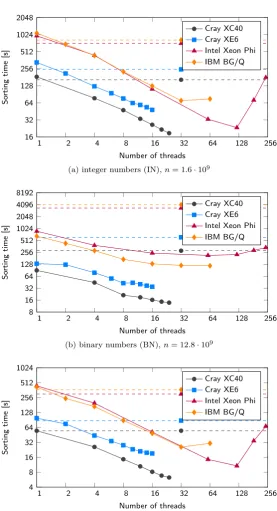
To illustrate the benefits of parallel sorting, Figure 5.1 also shows sorting times for the sequentialstd::sort function from the C++ Standard Library. Clearly, AQsort reduced these sorting times in all cases considerably. The maximum obtained speedup with respect tostd::sort, and also with respect to the sequential version of AQsort, are shown in Table 5.3.
The results for the IN and SM data sets are similar—the maximum obtained speedup with respect to std::sortfalls between about 1/4 and 1/3 of the number of threads. The BN case is specific—the total memory footprint of the data being sorted was the same as in the IN case, but the number of sorted multielements was 8 times higher, which caused much longer sorting times of std::sort. On the contrary, sorting times of the sequential version of AQsort were actually lower in the BN case than in the IN case. The speedup of parallel AQsort with respect to sequential AQsort was relatively low in the BN case, especially on Intel Xeon Phi and IBM BG/Q. We attribute this effect to the saturation of the memory subsystems; on all utilized architectures, the number of memory controllers/channels was much lower than the number of their computational cores.
Note that for AMD and Intel CPU-based nodes, the lowest sorting times were always obtained when the number of OpenMP threads equaled the number of node cores (one-thread-per-core configuration). For Intel Xeon Phi and IBM BlueGene/Q, the lowest sorting times mostly occurred for the two-threads-per-core config-uration, and, even if not, the differences were minimal. We can thus generally recommend these configurations for AQsort maximum speedup on given architectures.
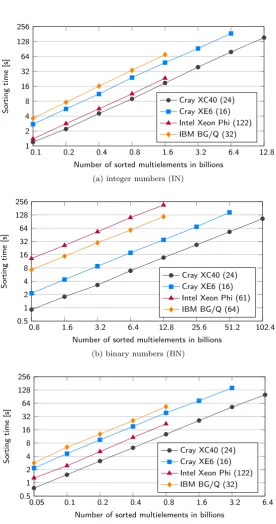
Second, we measured the relation between AQsort sorting times and the number of sorted multielementsn; results are shown in Figure 5.2. On all architectures, we performed experiments up to the maximum number of multielements that fitted the available memory. The number of threads was always set to a value that provided highest speedup within the strong scalability results. The results show that the sorting time grew linearly with nand that the rate of this growth was close to 1 in all cases. Such a growth clearly does not correspond to a quicksort complexityO(n·logn). In auxiliary measurements, we have observed similar linear growth with all the considered implementations of sorting algorithms, includingstd::sort.
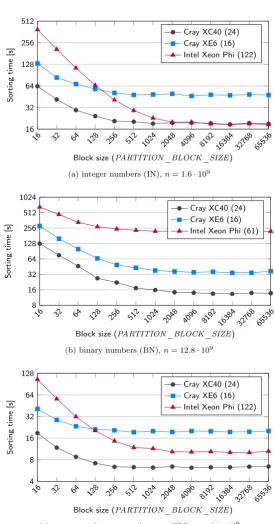
The third experiment evaluated the dependence of AQsort sorting time on the algorithm global parameter PBS; results are presented in Figure 5.3. They show that, as might have been expected, small block sizes provided low algorithm performance. As the block size grew, the sorting time decreased accordingly. At some point sorting time established and no longer improved with higher block sizes; small variances in sorting times were caused by the instability of the algorithm. Generally, setting a higher block size is seemingly preferable. However, users need to be sure that there is enough data to be sorted efficiently according to condition (4.2).
The fourth experiment evaluated the dependence of AQsort sorting time on the second algorithm global parameterIST; results are presented in Figure 5.4 (for space reasons, we show the measurements for the IN data sets only). According to these results, users should not set too high values of the threshold for insertion sort; again, small variances in sorting times were caused by the instability of the algorithm.
The last experiment evaluated the stability of AQsort. We performed 200 runs of the algorithm with each particular set of input parameters and processed the results statistically, see Table 5.4. For easier comparison, we showrelative sorting timesthat are sorting times in percents normalized by the their average values. Obviously, the sorting times can vary significantly in practice, especially for the BN data sets. However, standard deviations reveal that typical sorting times might be expected much closer to the average than the measured extrema.
1 2 4 8 16 32 64 128 256 16
32 64 128 256 512 1024 2048
Number of threads
So
rting
time
[s]
Cray XC40 Cray XE6 Intel Xeon Phi IBM BG/Q
(a) integer numbers (IN),n= 1.6·109
1 2 4 8 16 32 64 128 256
8 16 32 64 128 256 512 1024 2048 4096 8192
Number of threads
So
rting
time
[s]
Cray XC40 Cray XE6 Intel Xeon Phi IBM BG/Q
(b) binary numbers (BN),n= 12.8·109
1 2 4 8 16 32 64 128 256
4 8 16 32 64 128 256 512 1024
Number of threads
So
rting
time
[s]
Cray XC40 Cray XE6 Intel Xeon Phi IBM BG/Q
(c) sparse matrix nonzero elements (SM),n= 0.4·109
0.1 0.2 0.4 0.8 1.6 3.2 6.4 12.8 1
2 4 8 16 32 64 128 256
Number of sorted multielements in billions
So
rtin
g
time
[s]
Cray XC40 (24) Cray XE6 (16) Intel Xeon Phi (122) IBM BG/Q (32)
(a) integer numbers (IN)
0.8 1.6 3.2 6.4 12.8 25.6 51.2 102.4
0.5 1 2 4 8 16 32 64 128 256
Number of sorted multielements in billions
So
rting
time
[s]
Cray XC40 (24) Cray XE6 (16) Intel Xeon Phi (61) IBM BG/Q (64)
(b) binary numbers (BN)
0.05 0.1 0.2 0.4 0.8 1.6 3.2 6.4
0.5 1 2 4 8 16 32 64 128 256
Number of sorted multielements in billions
So
rting
time
[s]
Cray XC40 (24) Cray XE6 (16) Intel Xeon Phi (122) IBM BG/Q (32)
(c) sparse matrix nonzero elements (SM)
16 32 64 128 256 512 10 24 20 48 40 96 81 92 16 38 4 32 76 8 65 53 6 16 32 64 128 256 512
Block size (PARTITION_BLOCK_SIZE)
So
rting
time
[s]
Cray XC40 (24) Cray XE6 (16) Intel Xeon Phi (122)
(a) integer numbers (IN),n= 1.6·109
16 32 64
12 8 25 6 51 2 10 24 20 48 40 96 81 92 16 38 4 32 76 8 65 53 6 8 16 32 64 128 256 512 1024
Block size (PARTITION_BLOCK_SIZE)
So
rtin
g
time
[s]
Cray XC40 (24) Cray XE6 (16) Intel Xeon Phi (61)
(b) binary numbers (BN),n= 12.8·109
16 32 64 128 256 512
10 24 20 48 40 96 81 92 16 38 4 32 76 8 65 53 6 4 8 16 32 64 128
Block size (PARTITION_BLOCK_SIZE)
So
rtin
g
time
[s]
Cray XC40 (24) Cray XE6 (16) Intel Xeon Phi (122)
(c) sparse matrix nonzero elements (SM),n= 0.4·109
2 4 8 16 32 64 128 256 512 16
32 64 128
Insertion sort threshold (IN SERTION_SORT_THRESHOLD)
So
rting
time
[s]
Cray XC40 (24) Cray XE6 (16) Intel Xeon Phi (122)
Fig. 5.4: AQsort runtimes for different values of the insertion sort threshold (parameterIST) measured with the IN data sets on different architectures. Numbers in parentheses in the legend denote the number of utilized OpenMP threads.
Table 5.4: Statistical values for 200 sorting times of parallel AQsort in percents normalized by their average values. The number in parentheses denote the number of utilized OpenMP threads.
Cray XC40 (24) Cray XE6 (16) Intel Xeon Phi (122)
Statistics IN BN SM IN BN SM IN BN SM
Minimum 87.0 77.6 90.9 87.8 80.9 88.2 94.0 93.1 92.1 Average 100.0 100.0 100.0 100.0 100.0 100.0 100.0 100.0 100.0 Maximum 108.4 135.7 108.9 110.6 129.9 112.6 109.6 110.0 116.7
Stddev 4.7 6.6 3.8 4.7 7.9 5.2 2.6 4.8 3.5
5.2. Comparison of AQsort with Modern Implementations of Sorting Algorithms. In this sec-tion, we show the results of experiments that were designed to compare the performance of AQsort and modern implementations of sorting algorithms introduced in Section 2. Namely, we considered the following parallel solutions:
1. in-place std:: parallel::sort(..., quicksort tag()) function from GNU Libstdc++ Parallel Mode (further referred to as GNU-QS),
2. in-placestd:: parallel::sort(..., balanced quicksort tag()) function from GNU Libstdc++ Parallel Mode (GNU-BQS),
3. out-of-placestd:: parallel::sort(..., multiway mergesort tag()) function from GNU Libstd-c++ Parallel Mode (GNU-MWMS),
4. in-placetbb::parallel sortfunction from Intel TBB (TBB),
5. in-placecilkpub::cilk sort in place function from Cilkpub (CP-IP), 6. out-of-placecilkpub::cilk sortfunction from Cilkpub (CP-OoP), 7. out-of-placethrust::sortfunction from Nvidia Thrust (Thrust).
Thecilkpub::cilk sortfunction callscilkpub::cilk sort in placeif there is not enough memory to per-form place sorting; we avoided this approach within our study. Cp-OoP thus always refer to the out-of-place sorting.
To evaluate the benefits of parallel sorting, we show the sorting times for the sequentialstd::sortfunction as well. The version of GNU Libstdc++ was given by the version of the GNU C++ compiler, see Table 5.1. As for other libraries, we compiled test programs against Intel TBB version 4.3 Update 4, Cilkpub version 1.05, and Nvidia Thrust version 1.8.0.
N/A N/A N/A
N/A N/A N/A FAILED
Cray XC40,n= 6.4·109 Cray XE6,n= 3.2·109 Xeon Phi,n= 0.8·109 IBM BG/Q,n= 0.8·109
0 50 100 150 200 6 9 9 .2 5 1 8 .1 3 4 3 .4 4 0 0 .5 8 3 .0 8 8 .2 1 1 .3 3 2 .6 7 7 .7 7 6 .1 3 1 .2 7 8 .1 7 3 .5 3 6 .9 4 8 .0 5 1 .6 8 .9 8 2
.3 92.1
1 4 .0 5 9 .4 6 4 .6 1 2 .9 4 9 .5 7 8 .8 1 1 .9 1 5 4 .5 1 6 0 .8 5 7 .5 So rting time [s]
std::sort AQsort TBB CP-IP CP-OoP
GNU-QS GNU-BQS GNU-MWMS Thrust
Fig. 5.5: Comparison of sorting times for different implementations of sorting algorithms for IN data sets.
N/A N/A F AILED F AILED F AILED N/A
N/A N/A N/A FAILED
Cray XC40,n= 51.2·109 Cray XE6,n= 25.6·109 Xeon Phi,n= 6.4·109 IBM BG/Q,n= 6.4·109
0 200 400 600 800 1 1 9 1 .4 1 1 4 7 .6 1 7 2 1 .9 1 9 7 7 .1 5 4 .1 6 4
.7 105
.9 5 8 .2 3 7 7 .1 3 1 7 .3 2 5 4 .2 2 5 4 .8 1 8 3 .0 2 1 5 .6 0 .0 6 8 3 .3 1 0 3 1 .8 1 8 3 5 .4 2 1 2 .3 2 1 2 .1 1 6 1 .1 8 5
.8 16
2 .7 7 0 .5 4 3 7 .3 1 9 9
.2 29
1 .5 So rting time [s]
std::sort AQsort TBB CP-IP CP-OoP
GNU-QS GNU-BQS GNU-MWMS Thrust
Fig. 5.6: Comparison of sorting times for different implementations of sorting algorithms for BN data sets.
of the available memory because of either out-of-place sorting and/or the SoA-to-AoS transformation. When both the SoA-to-AoS transformation and out-of-place sorting took place, the memory of the original arrays had to be released before sorting and reallocated afterwards.
All the mentioned implementations were available in the runtime environments of Cray XC40 and Cray XE6 nodes. The runtime environment of available Intel Xeon Phi accelerator did not contain the GNU Libstdc++ Parallel Mode functionality (GNU-QS, GNU-BQS, GNU-MWMS). The runtime environment of IBM BG/Q did not contain solutions provided by Intel (TBB, CP-IP, CP-OoP).
For experiments run on Intel Xeon Phi, we used exclusively the Intel C++ compiler. Otherwise, we used the GNU C++ compiler for std::sort, AQsort, GNU-QS, GNU-BQS, GNU-MWMS, and Thrust; and the Intel C++ compiler for TBB, CP-IP, and CP-OoP.
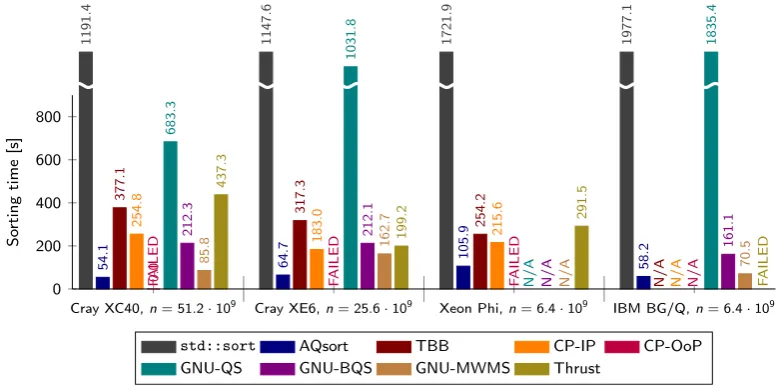
The obtained results are shown in Figures 5.5–5.7. The “N/A” labels denote an absence of a given imple-mentation on a given architecture. The “FAILED” labels denote measurements that were repeatedly terminated due to runtime errors, typically segmentation faults; we have not performed analyses of these errors. Based on these results, we can make the following observations:
N/A N/A N/A N/A N/A N/A FAILED
Cray XC40,n= 3.2·109
Cray XE6,n= 1.6·109
Xeon Phi,n= 0.4·109
IBM BG/Q,n= 0.4·109
0 50 100 4 3 0 .6 3 6 2 .4 2 8 1 .7 3 5 1 .0 5 2 .5 7 1 .5 1 4 .4 2 7 .9 3 0 .6 5 7 .9 2 0 .1 3 1 .3 4 4 .3 1 8 .9 3 3
.1 40
.3 6 .4 5 0 .9 7 6 .3 1 2 .1 3 4 .6 6 3 .8 1 1 .2 3 3 .5 4 8 .6 1 7 9 .9 1 8 7 .8 7 6 .9 5 8 .5 So rting time [s]
std::sort AQsort TBB CP-IP CP-OoP
GNU-QS GNU-BQS GNU-MWMS Thrust
Fig. 5.7: Comparison of sorting times for different implementations of sorting algorithms for SM data sets.
An exception was only GNU-QS in combination with the BN data sets.
2. Thrust performed poorly in comparison with other parallel solutions. Recall that though Thrust sup-ports OpenMP, it was primarily designed as a library for Nvidia GPU accelerators. It thus seems that the optimization level for OpenMP is in Thrust relatively low, at least for its sorting functionality. 3. The other out-of-place sorting implementations, i.e., CP-OoP and GNU-MWMS, mostly, but not always,
provided the lowest sorting times.
4. GNU-BQS always outperformed GNU-QS.
5. AQsort outperformed for BN data sets all other implementations—even the out-of-place ones—on all architectures.
6. For IN and SM data sets, AQsort run slowly on IBM BG/Q in comparison with GNU-QS, GNU-BQS, and GNU-MWMS. This might have been caused by not-so-well optimized OpenMP environment for task-based parallelism on this architecture; AQsort was the only implementation build upon OpenMP tasks.
7. AQsort provided lowest sorting times of all in-place sorting implementations on Intel Xeon Phi. 8. For IN data sets and Cray architectures, AQsort performed slightly worse than its in-place competitors
(TBB, CP-IP, GNU-QS, and GNU-BQS).
9. For SM data sets, AQsort provided higher sorting times than most of other implementations. How-ever, these sorting times do not include the overhead given by the SoA-to-AoS and back AoS-to-SoA transformations; see Section 5.3 for details.
5.3. SoA-to-AoS and AoS-to-SoA Transformations. The reason why we did not include the SoA-to-AoS and AoS-to-SoA transformations in measurements presented by Figure 5.7 was that the performance and efficiency of theses transformations are highly implementation-dependent. For illustration, consider the following C++ solution for the SoA-to-AoS transformation that we used within our codes:
// sparse matrix in COO
std::vector<uint32_t> rows, cols; std::vector<double> vals;
...
struct element_t { uint32_t row, col; double val; };
const std::size_t n = rows.size(); std::vector<element_t> elements(n); #pragma omp parallel for
Profiling of this code on a Cray XC40 node for n = 3.2·109 and 24 threads revealed that the parallel for loop took only 1.58 seconds, while the initialization of the elements vector took 23.15 seconds (subsequent sorting with GNU-MWMS took 32.75 seconds). A similar problem arose in the case of out-of-place sorting, where memory occupied by therows,cols, andvalsarrays had to be released prior to sorting and reallocated afterwards. This consisted of 3 calls of thestd::vector::resizefunction, which took in this experiment 24.61 seconds, while the final parallel AoS-to-SoA transformation took only 2.13 seconds. A detailed analysis of this problem is beyond the scope of this article. Let us just note that it is caused by so-calledzero-initialization of elements during resizing of C++std::vectors, which is inherently carried out sequentially.
6. Discussion. A straightforward conclusion of our work is that though speedups are far from being linear, parallel/multi-threaded sorting considerably reduces sorting times on modern multi-core and many-core hardware architectures. The question that remains to be answered is which implementation to choose for particular sorting problems.
If we need to sort multiple arrays at once and suppose that there might not be enough available memory for the SoA-to-AoS transformation, then AQsort is the only option of all the considered solutions. This might happen, e.g., when developing scientific or engineering applications where multi-array sorting is required for possibly very large data, such as large sparse matrices or discretization meshes. In such cases, we do not want to limit the sizes of users’ problems being solved just because of sorting. AQsort is the only implementation that does not need to run the SoA-to-AoS transformation. Therefore, it is the only implementation that can be straightforwardly applied to multiple arrays large enough to fill more than the half of the available memory. On the contrary, if we certainly know that there is enough memory available, there will be no simple answer. Generic sorting of a single array with a lot of distinct sorting keys would be likely most efficient with some parallel out-of-place implementation. However, one might need to implement the SoA-to-AoS and back AoS-to-SoA transformations carefully to prevent its large runtime overhead.
Another aspects that play a crucial role in the selection of sorting implementation are threading paradigms and portability. Generally, OpenMP prevails in the domains of HPC, mathematical, scientific, and engineering software. Of all the considered implementations, only AQsort and Nvidia Thrust provide portable OpenMP solutions. GNU Libstdc++ Parallel Mode implementations are tightly bound to the GNU C++ compiler; except of this compiler, we succeeded in compiling programs that called the GNU Libstdc++ Parallel Mode sorting functions only with the newest versions of the Intel C++ compiler, namely versions 14 and 15. PGI, Cray, IBM, and older versions of Intel C++ compilers failed in such a compilation. The portability of sorting implementations based on Intel TBB and Intel Cilk Plus is relatively low in comparison with OpenMP. Moreover, though it is technically possible to integrate TBB or Cilk Plus routines into OpenMP code, such a combination of threading paradigms might result in malformed parallelism; we encountered such a behavior in the Cray runtime environments. Generally, it is not recommended to combine multiple threading paradigms within a single code.
Moreover, the interface of AQsort allows its integration with C and Fortran codes through explicit instan-tiation of its sorting functions with fixed footprints of comparison and swapping functions. Such an option is not feasible with other iterator-based sorting solutions.
where OpenMP parallel paradigm is dominant.
AQsort fills some gaps in modern implementations of parallel sorting algorithms. Moreover, it provides also sequential sorting functionality that can be exploited either in sequential codes or in HPC codes based on pure MPI parallelism.
The main features of AQsort are:
1. Generality—it works with user-provided functions for comparing and swapping sorted data. Con-sequently, in contrast to pointer-based/iterator-based sorting functions, it can directly sort multiple arrays at once (see Section 3).
2. Space-efficiency—it operates in place and for multiple arrays it does not require the SoA-to-AoS and back AoS-to-SoA transformations. Therefore, it is the only implementation that can be straighforwardly applied to multiple arrays large enough to fill more than the half of the available memory (see Section 1). 3. Scalability—it considerably reduces sorting time with respect to optimized implementations of sequential sorting algorithms and it efficiently utilizes all the cores of modern multi-core and many-core hardware architectures (see Section 5.1).
4. Portability—it is implemented with standard OpenMP pragmas and functions. It is build upon the combination of nested parallelism and tasking, which are supported by majority of modern C++ com-pilers (see Section 4). Moreover, AQsort allows to create wrappers for C and Fortran programming languages. Of all the considered parallel implementations, only AQsort and Thrust were available on all the tested architectures. In comparison with AQsort, Thrust provided longer runtimes in all mea-surements and required more memory due to the implementation of an out-of-place sorting algorithm (see Section 5.2).
5. Efficiency—its performance is generally comparable with modern implementations of sorting algorithms when running on forefront HPC hardware architectures (see Section 5.2). It seems to be especially suitable for Xeon Phi coprocessors and for data that contain only few distinct sorting keys. In other cases, AQsort might be outperformed by its competitors, which is a price for its universality (see Section 6).
In addition to the presentation of AQsort, this article also:
1. serves as a brief updated survey of existing implementations of parallel sorting algorithms and their ex-perimental comparison on leading-edge shared-memory hardware architectures (see Sections 2 and 5.2), 2. presents a parallel partitioning algorithm briefly proposed by Pasetto and Akhriev [23] in terms of
detailed pseudocode (see Section 3),
3. generally evaluates the universal approach to parallel sorting that uses custom compare and swap functions with traditional solutions (see Section 6).
Acknowledgements. The authors would like to thank T. Dytrych of the Louisiana State University for providing an access to the Blue Waters system. The authors would like to thank M. V´aclav´ık of the Czech Technical University in Prague for providing an access to the Star university cluster. The authors acknowledges support from M. Pajr of CQK Holding and International HPC Initiative.
We acknowledge PRACE for awarding us access to resource JUQUEEN based in Germany at the Gauss Center for Supercomputing. We acknowledge PRACE for awarding us access to resource Hornet based in Germany at the High Performance Computing Center Stuttgart. This research is part of the Blue Waters sustained-petascale computing project, which is supported by the National Science Foundation (awards OCI-0725070 and ACI-1238993) and the state of Illinois. Blue Waters is a joint effort of the University of Illinois at Urbana-Champaign and its National Center for Supercomputing Applications.
REFERENCES
[1] R. Barrett, M. Berry, T. F. Chan, J. Demmel, J. Donato, J. Dongarra, V. Eijkhout, R. Pozo, C. Romine, and H. V. der Vorst,Templates for the Solution of Linear Systems: Building Blocks for Iterative Methods, SIAM, Philadelphia, PA, 2nd ed., 1994.
[2] F. Beekhof,OMPTL: OpenMP multi-threaded template library, 2012. Accessed July 17, 2015 at
http://tech.unige.ch/omptl/.
[3] N. Bell and J. Hoberock,Thrust: A productivity-oriented library for CUDA, in GPU Computing GEMs: Jade Edition,
W.-M. Hwu, ed., Morgan Kaufmann, 2011.
[5] B. Chapman, G. Jost, and R. v. d. Pas,Using OpenMP: Portable Shared Memory Parallel Programming (Scientific and Engineering Computation), The MIT Press, 2007.
[6] T. H. Cormen, C. E. Leiserson, R. L. Rivest, and C. Stein,Introduction to Algorithms, Third Edition, The MIT Press, Cambridge, Massachusetts, USA, 3rd ed., 2009.
[7] R. Dementiev, L. Kettner, and P. Sanders,STXXL: standard template library for XXL data sets, Software: Practice
and Experience, 38 (2008), pp. 589–637.
[8] C. Hoare,Algorithm 64: Quicksort, Communications of the ACM, 4 (1961), pp. 321–322. [9] ,Quicksort, The Computer Journal, 5 (1962), pp. 10–16.
[10] ISO/IEC,ISO/IEC 9899:1999: Information Technology — Programming languages — C, 1999. [11] ,ISO/IEC 14882:2011: Information Technology — Programming languages — C++, 2011.
[12] D. Langr, I. ˇSimeˇcek, and T. Dytrych,Block iterators for sparse matrices, in Proceedings of the Federated Conference on Computer Science and Information Systems (FedCSIS 2016), IEEE Xplore Digital Library, 2016. Accepted for publication. [13] D. Langr, I. ˇSimeˇcek, P. Tvrd´ık, T. Dytrych, and J. P. Draayer,Adaptive-blocking hierarchical storage format for sparse matrices, in Proceedings of the Federated Conference on Computer Science and Information Systems (FedCSIS 2012), IEEE Xplore Digital Library, 2012, pp. 545–551.
[14] D. Langr and P. Tvrd´ık, Evaluation criteria for sparse matrix storage formats, IEEE Transactions on Parallel and Distributed Systems, 27 (2016), pp. 428–440.
[15] B. A. Mahafzah,Performance assessment of multithreaded quicksort algorithm on simultaneous multithreaded architecture, The Journal of Supercomputing, 66 (2013), pp. 339–363.
[16] D. Man, Y. Ito, and K. Nakano,An efficient parallel sorting compatible with the standard qsort, International Journal of
Foundations of Computer Science, 22 (2011), pp. 1057–1071.
[17] M. Matsumoto and T. Nishimura,Mersenne Twister: a 623-dimensionally equidistributed uniform pseudo-random number generator, ACM Transactions on Modeling and Computer Simultaion, 8 (1998), pp. 3–30.
[18] M. McCool, R. A. D., and R. James,Structured Parallel Programming: Patterns for Efficient Computation, Morgan Kaufmann, 2012.
[19] Microsoft,Parallel STL, 2014. Accessed July 17, 2015 athttps://parallelstl.codeplex.com/.
[20] D. R. Musser,Introspective sorting and selection algorithms, Software: Practice and Experience, 27 (1997), pp. 983–993. [21] R. Nair,ParallelSort: Parallel sorting algorithm using OpenMP, 2014. Accessed July 17, 2015 at
https://github.com/rsnair2/ParallelSort.
[22] D. Pasetto and A. Akhriev,A comparative study of parallel sort algorithms, in Proceedings of the ACM International
Conference Companion on Object Oriented Programming Systems Languages and Applications Companion, OOPSLA ’11, New York, NY, USA, 2011, ACM, pp. 203–204.
[23] ,A comparative study of parallel sort algorithms. Accessed July 17, 2015 at http://researcher.watson.ibm.com/files/ie-albert akhriev/sort2011-full.pdf, 2011.
[24] J. Reinders,Intel Threading Building Blocks, O’Reilly & Associates, Inc., Sebastopol, CA, USA, 2007.
[25] A. D. Robinson,A parallel stable sort using C++11 for TBB, Cilk Plus, and OpenMP, 2014. Accessed July 17, 2015 at
https://software.intel.com/en-us/articles/a-parallel-stable-sort-using-c11-for-tbb-cilk-plus-and-openmp. [26] A. Robison,Composable parallel patterns with Intel Cilk Plus, Computing in Science Engineering, 15 (2013), pp. 66–71. [27] Y. Saad,Iterative Methods for Sparse Linear Systems, Society for Industrial and Applied Mathematics, Philadelphia, PA,
USA, 2nd ed., 2003.
[28] B. Sch¨aling,The Boost C++ Libraries, XML Press, 2nd ed., 2014.
[29] I. ˇSimeˇcek and D. Langr, Efficient parallel evaluation of block properties of sparse matrices, in Proceedings of the Federated Conference on Computer Science and Information Systems (FedCSIS 2016), IEEE Xplore Digital Library, 2016. Accepted for publication.
[30] J. Singler and B. Konsik,The gnu libstdc++ parallel mode: Software engineering considerations, in Proceedings of the 1st
International Workshop on Multicore Software Engineering, IWMSE ’08, New York, NY, USA, 2008, ACM, pp. 15–22. [31] J. Singler, P. Sanders, and F. Putze,MCSTL: The multi-core standard template library, in Proceedings of the Euro-Par
2007 Parallel Processing, vol. 4641 of Lecture Notes in Computer Science, Springer Berlin Heidelberg, 2007, pp. 682–694. [32] M. S¨us and C. Leopold,A user’s experience with parallel sorting and OpenMP, in Proceedings of the Sixth European
Workshop on OpenMP, EWOMP’04, 2004, pp. 23–28.
[33] N. Thomas, G. Tanase, O. Tkachyshyn, J. Perdue, N. M. Amato, and L. Rauchwerger,A framework for adaptive algorithm selection in STAPL, in Proceedings of the Tenth ACM SIGPLAN Symposium on Principles and Practice of Parallel Programming, PPoPP ’05, New York, NY, USA, 2005, ACM, pp. 277–288.
[34] P. Tsigas and Y. Zhang, A simple, fast parallel implementation of Quicksort and its performance evaluation on SUN Enterprise 10000, in Proceedings of the 11th Euromicro Conference on Parallel, Distributed and Network-Based Processing (PDP 2003), 2003, pp. 372–381.
[35] S. Williams, A. Waterman, and D. Patterson, Roofline: An insightful visual performance model for multicore architectures, Commun. ACM, 52 (2009), pp. 65–76.