Life Estimation of HMC Package under Dynamic Load
Condition and Correlation of Analysis and Test Results
Chandrashekar BK*, Santosh Joteppa, Kiran R. Bakale, Vinod S. Chippalkatti
Design and Engineering, Centum Electronics Ltd., Bangalore, India
Abstract
Electronic equipment’s are manufactured with many types of Electronic components which are largely available as leaded and leadless mounting, these components are mounted on the PCB with through-hole or surface mounted technologies. The electronic equipment’s which are used in aerospace, space, military, commercial applications etc., have to undergo vibration and shock testing. When these equipment’s are subjected for such vibration requirements they are prone to fatigue failure and the primary failures will be observed at component leads and solder joints. These components need to be designed and used for rated fatigue loads with required vibration level to avoid such fatigue failures. HMC (Hybrid Micro Circuit) Packages are one among such leaded electronic components being widely used in space, aerospace and defense industries for various application to reduce the mass and volume. During the usage these leaded component experiences severe dynamic loads which may lead to fatigue failure at leads and solder joints. Thus, it is necessary to verify such electronic component life before they are subjected to dynamic load testing to save the time and huge cost. This paper describes the method of designing and analyzing the HMC package subjected for higher vibration loads and analytical method of fatigue life estimation. Subsequently, the HMC package has been manufactured and validated by subjecting it to the higher vibration load to find out the fatigue life and correlated with the analytical results.Keywords
HMC, Leads, Fatigue life, FEA, SN Curve, Transmissibility, Dynamic bending stress1. Introduction
Hybrid Micro Electronics deals with packaging and interconnection technologies for combining two or more semiconductor devices on a common interconnect substrate, typically to create a specific electrical function. The semiconductor devices may be in the form of bare, unpackaged die or in miniature packages which mount on the interconnect substrate surface. The interconnection pattern may include deposited resistors, capacitors, and inductors or these passive components may be mounted in chip form on
the surface of the substrate [1, 2] refer Figure 1.
In Space, aerospace and defense application, the Hybrid microcircuits are extensively used over other forms of package for saving of space, volume and weight. As mass has direct effect on cost of payload launch, the use of microelectronics circuit’s helps in reducing the cost of these payload launch and electronics manufacturing.
These microcircuit packages are manufactured using thick film technology, where the conductors, dielectric and resistor layers are deposited. These packages need to be qualified for high vibration and shock loads based on MIL or space
* Corresponding author:
[email protected] (Chandrashekar BK) Published online at http://journal.sapub.org/jmea
Copyright © 2017 Scientific & Academic Publishing. All Rights Reserved
application requirements. When these packages are mounted on PCB they will experience further amplification and it is necessary to understand the fatigue life of such components before finalizing the design for manufacturing [3].
2. Background
Figure 1. Schematic diagram of cross section illustrating Hybrid microelectronics technology
3. Design Description
The HMC packages are available in standard sizes, based upon the output requirement, the substrate size shall be decided and based on the substrate and number of input/output requirement lead size will be decided. The basic construction of the HMC package consisting of multiple layers, able film [7] being placed at the bottom of package called package base upon that the substrate has been placed which is basically alumina [8], over the alumina, epoxy material is deposited for insulation, the microelectronic chips are then place over the epoxy layer and all these layers and microelectronic components are hermetically sealed inside mechanical housing and a lid which are manufactured using KOVAR material [9].
Figure 2. Typical hybrid microcircuit package
4. Realization
In this section, how the life of the HMC package has been estimated by calculation and testing is explained in detail. There are different methods available to estimate the fatigue life of any structure.
Following equation is used for calculating the fundamental frequency.
𝑓𝑓𝑛𝑛 =21𝜋𝜋�𝛿𝛿𝑔𝑔𝑠𝑠𝑠𝑠, Hz (1)
In the equation, ‘g’ is the acceleration due to gravity in
mm. sec-2 and δst is the displacement of the leads in mm [10].
In the current work, the fundamental frequency and peak acceleration level on the HMC package is identified using numerical code - Finite Element Method and the values are directly considered for HMC package life calculation.
The HMC package (46.48mm x 33.78mm x 4.57mm) is mounted on the PCB having thickness of 1.6mm by soldering the leads. The HMC package has 34 numbers of leads with 0.45 diameters. The package mass 24 grams and PCB mass 47.56 grams has been considered for simulation.
4.1. Finite Element Analysis
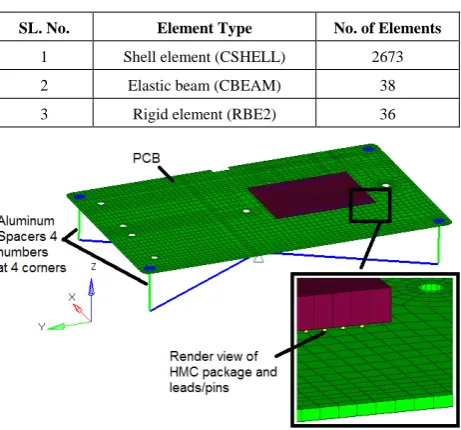
The finite element modeling of HMC package along with PCB is done using 2D shell elements and HMC leads by 1D
elastic beam elements refer Figure 3. The PCB is fixed at
four mounting location along with four number of aluminum spacers of 30mm length. The Eigen value analysis and Sine response analysis has been carried out. The first fundamental
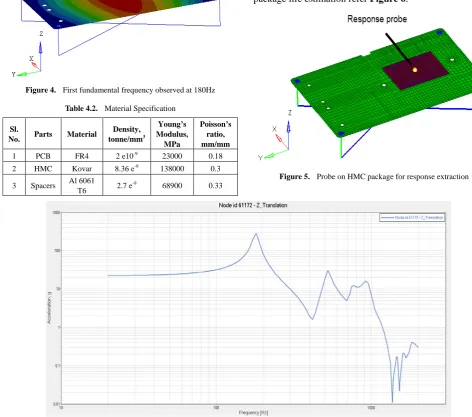
frequency is found to be 180Hz refer Figure 4.
Table 4.1. Finite Element model details
SL. No. Element Type No. of Elements
1 Shell element (CSHELL) 2673
2 Elastic beam (CBEAM) 38
3 Rigid element (RBE2) 36
Figure 4. First fundamental frequency observed at 180Hz
Table 4.2. Material Specification
Sl.
No. Parts Material
Density, tonne/mm3
Young’s Modulus, MPa
Poisson’s ratio, mm/mm
1 PCB FR4 2 e10-9 23000 0.18
2 HMC Kovar 8.36 e-9 138000 0.3
3 Spacers Al 6061
T6 2.7 e
-9 68900 0.33
The sine response analysis has been performed for a constant 20g loading which is applied continuously in the frequency range of 20Hz to 2000 Hz.
The response is extracted exactly at the center of the HMC
package refer Figure 5. The peak acceleration observed on
the HMC package is 244g and which is considered for
package life estimation refer Figure 6.
Figure 5. Probe on HMC package for response extraction
Figure 6. Peak acceleration of 244g is observed at 180Hz
4.2. Fatigue Life Estimation
Fatigue is a process of progressive permanent change occurring in any objects which are subjected to fluctuating stress and strains at some point and they may culminate in crack and leads to complete fracture after a sufficient number of fluctuation.
The basics factors for this fatigue failure are considered to be, the maximum tensile stress of sufficiently high value, the large amount of fluctuation in the applied stress or strain and the sufficient large number of cycles of applied stress or strains.
The Fatigue life of the HMC package is calculated using the following equation,
𝑁𝑁1= 𝑁𝑁2�𝑆𝑆2𝑆𝑆1�
𝑏𝑏
, Cycles and (2)
𝐿𝐿𝐿𝐿𝑓𝑓𝐿𝐿𝑜𝑜𝑓𝑓𝑠𝑠ℎ𝐿𝐿𝑝𝑝𝑝𝑝𝑝𝑝𝑝𝑝𝑝𝑝𝑔𝑔𝐿𝐿 (𝐿𝐿𝐿𝐿𝑝𝑝𝐿𝐿𝑜𝑜𝑜𝑜𝑝𝑝𝐿𝐿𝑛𝑛𝑠𝑠) = 𝑁𝑁1
𝑓𝑓𝑛𝑛𝑋𝑋 60, minutes (3)
Where N1 is the cycles to failure, N2 being the cycles to
failure for the respective material (taken from SN curve), S2
ultimate tensile stress in N.mm-2 of package material (from
SN Curve), S1 being the bending stress from calculation and
b is the fatigue exponent slope.
The main parameters required for the fatigue life calculation under dynamic load condition are as follows,
c. Fatigue exponent slope, b
d. Dynamic force, Pd
e. Dynamic bending stress, Sb
f. Length of the leads, L g. Radius of the leads, c
h. MOI of the total numbers of leads, M and
i. Fundamental frequency of the package, fn.
The details of the HMC is as shown in the below Table 4.3
Table 4.3. HMC package details
Sl.
No. Description Values Units
1 Weight of the component/Package , W 24.00 grams
2 Length of the leads. L 1.20 mm
3 Diameter of the leads, d 0.45 mm
4 Number of leads 34.00 NA
5 Gravity input , Gin 244.00 g
6 First fundamental frequency (assembly), fn
180.00** Hz
The dynamic force Pd acting on the HMC package is
obtained from the peak acceleration observed on the package for the applied acceleration load of 20g, mass of the package
refer Table 4.3 and the transmissibility ‘Q’ at the first
fundamental frequency.
𝑃𝑃𝐿𝐿=𝑊𝑊 𝐺𝐺𝐿𝐿𝑛𝑛𝑄𝑄, N (4)
And, for beam type of element, the good approximation of the transmissibility value will arrive at 0.1 times the square root of the natural frequency [4, 11], since the package will be mounted on the PCB with raised height of 1.2mm and can be derived as follows,
𝑄𝑄 = 0.1 �𝑓𝑓𝑛𝑛 (5)
The dynamic bending stress Sb is again an another
important parameter depends on dynamic bending moment M, radius of the HMC leads ‘c’ and the moment of inertia from 34 number of leads.
𝑆𝑆𝑏𝑏=𝑀𝑀𝐼𝐼𝑝𝑝 , N/mm2 (6)
Where,
𝑀𝑀=𝑃𝑃𝐿𝐿𝐿𝐿 , N.mm and (7)
I =𝜋𝜋𝐿𝐿644 , mm4 (8) The life is calculated against the yield stress and number of cycles to failure, which is extracted from SN curve of the
KOVAR material. The yield stress at 105 cycles and fatigue
exponent slope at stress concentration factor K =2 is considered for calculation.
By taking all these parameter into consideration, the life of HMC leads is found to be 19 minutes for a constant quasi static load 20g. The calculated values are tabulated in the
Table 4.4.
Figure 7. SN curve of KOVAR material
Table 4.4. Calculation details
Sl No. Description Results Units
1 Transmissibility, Q 1.34 * NA
2 Dynamic force, Pd 76.9794 * N
3 Lead radius, c 0.225 mm
4 Dynamic bending moment, M 92.3753 * N mm
5 Moment of inertia, I 0.068 * mm4
6 Bending Stress, S2 303.6962 * N/mm2
7 No. of cycles to failure, N2 100000 Cycles
8 Yield stress of kovar material 340 N/mm2
9 No. of Cycles, N1 205976.8 * Cycles
10 Life of the HMC package 19.07 * minutes
4.3. Testing
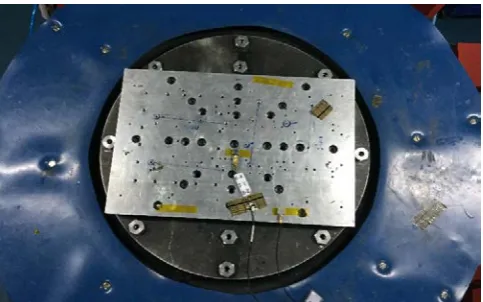
The HMC package along with PCB is fixed to shaker armature with the help of fixture/interface plate using four number of aluminum spacers (30mm x OD 10mm x ID
3.5mm) refer Figure 10.
Before performing the actual vibration test, the fixture has been qualified with low level sine vibration test for 0.5 g load and a flat response has been observed through the frequency
range, 20Hz to 2000Hz [12] refer Figure 9.
Figure 8. Fixture resonance check test setup
Figure 9. Fixture resonance check plot
The sine vibration test has been performed for the load
shown in the Table 4.5, the load is applied continuously in
positive and negative sweeps. The response is extracted on the HMC package to observe the dynamic behavior of the
package refer Figure 10.
Table 4.5. Sine response input
Frequency, Hz Acceleration Unit
20 20 g
100 20 g
2000 20 g
Figure 10. Vibration test setup
Figure 11. Sine response input plot
Figure 12. Screenshot of vibration test at the package corner leads damage
Figure 13. Response on the package at corner leads damage
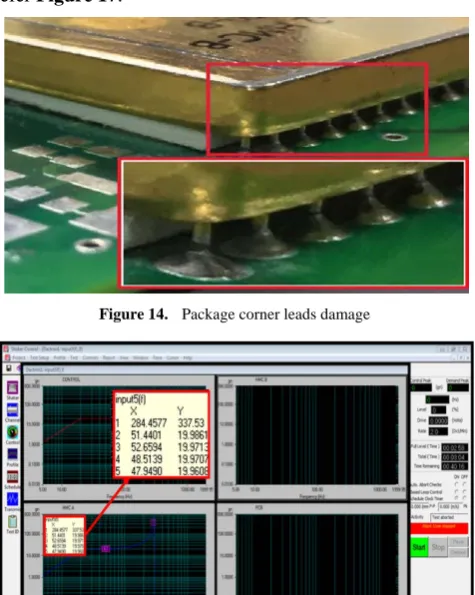
During the 4th sweep of testing at 17.34 minutes refer
Figure 13, the changed vibration noise and visual inspection confirms the damage in the package corners leads refer
Figure 14.
The response plot during 5th sweep of the testing at around 20.38 minutes (17.34 minutes + 3.04 minutes) shows complete drop in the dynamic response on the package refer
Figure-16 which confirms the complete detachment of package leads and the package gets separates from the PCB
CONTROL
input3(f)
1999.95
5.00 10.00 100.00 1000.00
1000.0000
0.0100 0.1000 1.0000 10.0000 100.0000
refer Figure 17.
Figure 14. Package corner leads damage
Figure 15. Screenshot of vibration test at complete package breakdown
Figure 16. Response on the package at complete package breakdown
Figure 17. Package breakdown
5. Conclusions
The life of the HMC package under dynamic load condition is obtained based on the results of FEA and testing
is tabulated in the Table 5.1
Table 5.1. HMC package fatigue life
HMC package life
in minutes % error
From calculation 19
6.77 %
From testing 20.38
The above table depicts the HMC package which is made up of KOVAR material with 34 number of pins which can withstand for a time of about 18 minutes when it is continuously subjected to 20g load.
Also from the above table it is observed that the life of HMC package obtained from the analytical calculation and physical testing are in good correlation and hence the assumption made and fatigue parameters considered for the calculation holds good.
The inference from the response plots obtained from the testing predicts the peak at first fundamental frequency and also as the sweep continues the pins experience a constant load and resulting in permanent failure which we call it as fatigue failure.
From this study one can understand the serviceability of leaded components (in this case HMC) in terms of time duration can be calculated under different gravitational load. Understanding the component serviceability is very important in Aerospace and Space domain for better reliability of the products.
REFERENCES
[1] Jerry E Sergent & Charles A Harper “Hybrid Microelectronics handbook” second edition, Mc graw hill publications.
[2] F. R. Muccino “Simplified method of Hybrid microcircuit Fabrication” Jonson Hopkins applied physics laboratory. [3] Da Yu, Abdullah Al Yafawi, Seungbae Park & Soonwan
Chung “Finite Element based Fatigue Life prediction for Electronic Components under Random Vibration Loading” Electronic components and Technology Conference proceedings 2010.
[4] Steinberg D. S “Vibration analysis for Electronic Equipment” A Wiley-Inter science Publications.
[5] Steinberg D. S “Preventing Thermal Cycling and Vibration Failures in Electronic Equipment” Wiley (New York, 2001). [6] Thomson W. T & Dahleh M. D “Theory of Vibration with
Applications” Pearson Publication, Fifth Edition. [7] Ablestik, ABLEFILM 5020K technical data sheet.
Part 1, Semitracks monthly newsletter. [9] Carpenter data sheet for kovar material.
[10] Young W. C & Budynas R. G “Roark’s formulas for Stress and strain” McGraw-Hill Publishers, eighth edition, New Delhi.
[11] Steinberg D. S “Vibration analysis for Electronic Equipment” A Wiley-Inter science Publications.