5465 STABILITY INDICATING METHOD DEVELOPMENT AND VALIDATION FOR THE
ESTIMATION OF OXAZEPAM BY RP-HPLC METHOD IN BULK AND PHARMACEUTICAL DOSAGE FORM
Debasis bora1, Dr S K Gupta2
1Research Scholar, Sunrise University, Alwar, Rajasthan, India
2
Vice chancellor, Sunrise University Alwar Rajasthan, India
*Corresponding author E-mail:[email protected]
ARTICLE INFO ABSTRACT
Key Words
Oxazepam, RP-HPLC, Method development,
Method validation
The Present work was to develop a simple, fast, accurate, precise, reproducible, reverse phase high performance liquid chromatographic method for estimation of Oxazepam in pharmaceutical tablet dosage form marketed as Oxapreinate. Chromatographic separation was done using Inertsil ODS RP C18 column having dimension of 4.6×250mm having particle size of 5µm, with mobile phase consisting of phosphate buffer pH 3 ±0.02 pH adjusted with ortho phosphoric acid and acetonitril (50:50 %v/v), flow rate was adjusted to 1.0 ml/min and detection wavelength at 263nm. The retention times of oxazepam was found to be 2.35. The Proposed method has been validated for accuracy, precision, linearity; range and robustness were within the acceptance limit according to ICH guidelines. Linearity for oxazepam was found in range of 25µg-150µg and correlation coefficient was found to be 0.999 %RSD for method precision was found to be 0.76 and for system precision was 0.80 respectively, % mean recovery for oxazepam was found to be 99.18%. The method was found to be robust even by change in the mobile phase ±5% and in less flow condition. The developed method can be successfully employed for the routine analysis of present drug in API and Pharmaceutical dosage forms.
INTRODUCTION:
Oxazepam is a short-to-intermediate-acting benzodiazepine. Oxazepam is used for the treatment of anxiety and insomnia and in the control of symptoms of alcohol withdrawal syndrome. It is a metabolite of diazepam, prazepam and temazepam.It is an intermediate-acting benzodiazepine with a slow onset of action, so it is usually
prescribed to individuals who have trouble staying asleep, rather than falling asleep. It is commonly prescribed for anxiety disorders with associated tension, irritability, and agitation. It is also prescribed for drug and alcohol withdrawal, and for anxiety associated with depression..Its IUPAC name is 7-Chlor-3-hydroxy-5-phenyl-1,3-dihydro-An Elsevier Indexed Journal ISSN-2230-7346
5466 2H-1,4-benzodiazepin-2-onOxazepam is an
intermediate-acting benzodiazepine of the 3-hydroxy family; it acts on benzodiazepine receptors, resulting in increased effect of GABA to the GABAA receptor which
results in inhibitory effects on the central nervous system. The half-life of oxazepam is four to 15 hours It has been shown to suppress cortisol levels. Oxazepam is the most slowly absorbed and has the slowest onset of action of all the common benzodiazepines according to one British study Oxazepam is an active metabolite formed during the breakdown of diazepam, nordazepam, and certain similar drugs. It may be safer than many other benzodiazepines in patients with impaired liver function because it does not require hepatic oxidation, but rather, it is simply metabolized by glucuronidation, so oxazepam is less likely to accumulate and cause adverse reactions in the elderly or people with liver disease.
Equipment and Apparatus used:
HPLC instrument used was of WATERS HPLC 2965 SYSTEM with Auto Injector and PDA Detector. Software used is Empower 2. UV-VIS spectrophotometer PG Instruments T60 with special bandwidth of 2mm and 10mm and matched quartz was be used for measuring absorbance for Oxazepamsolutions.
Methods:
Diluent: Based up on the solubility of the drugs, diluent was selected, Acetonitrile and Water taken in the ratio of 50:50
Preparation of Standard stock solutions:
Accurately weighed 50mg of Oxazepam transferred10ml and volumetric flasks, 3/4 th of diluents was added and sonicated for 10 minutes. Flasks were made up with diluents and labeled as Standard stock solution (5000µg/ml of Oxazepam)
Preparation of Standard working solutions (100% solution): 1ml of Oxazepam from each stock solution was
pipetted out and taken into a 10ml volumetric flask and made up with diluent. (500µg/ml of Oxazepam)
Preparation of Sample stock solutions: 5 tablets were weighed and the average weight of each tablet was calculated, then the weight equivalent to 1 tablet was transferred into a 10 ml volumetric flask, 5ml of diluents was added and sonicated for 25 min, further the volume was made up with diluent and filtered by HPLC filters.(5000 µg/ml of Oxazepam)
Preparation of Sample working solutions (100% solution): 1ml of filtered sample stock solution was transferred to 10ml volumetric flask and made up with diluent. (500µg/ml of Oxazepam)
Preparation of buffer:
0.1%OPA Buffer: 1ml of Perchloric acid was diluted to 1000ml with HPLC grade water.
Precision:
Preparation of Standard stock solutions:
Accurately weighed 50mg of Oxazepamtransferred to 10ml and volumetric flasks, 3/4 th of diluents was added and sonicated for 10 minutes. Flasks were made up with diluents and labeled as Standard stock solution (5000µg/ml of Oxazepam)
Preparation of Standard working solutions (100% solution): 1ml of Oxazepamfrom stock solution was pipetted out and taken into a 10ml volumetric flask and made up with diluent.500 µg/ml of Oxazepam)
System suitability parameters:
The system suitability parameters were determined by preparing standard solutions of Oxazepam(200ppm) and the solutions were injected six times and the parameters like peak tailing, resolution and USP plate count were determined.
5467 RESULTS
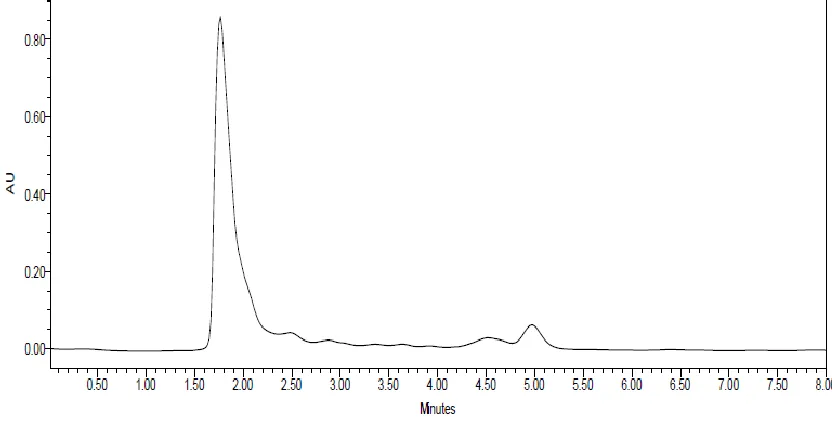
Fig. No. 1 Chromatogram showing Observation: Oxazepam eluted with good peak shape and retention time and tailing was passed
Table No: 1 System suitability data
S.No Oxazepam
Inj RT(min) USP Plate Count Tailing
1 2.662 12943 1.05
2 2.665 12940 1.04
3 2.667 13175 1.04
4 2.673 13507 1.12
5 2.673 13464 1.09
5468 Fig. No. 2 Calibration graphs showing Oxazepam.
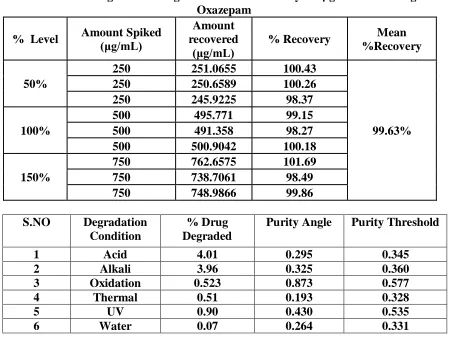
5469 Table no.2 Chromatogram showing Observation: Linearity125 µg/ml Chromatogram of
Oxazepam
% Level Amount Spiked (μg/mL)
Amount recovered
(μg/mL)
% Recovery Mean %Recovery
50%
250 251.0655 100.43
99.63% 250 250.6589 100.26
250 245.9225 98.37
100%
500 495.771 99.15
500 491.358 98.27
500 500.9042 100.18
150%
750 762.6575 101.69 750 738.7061 98.49 750 748.9866 99.86
S.NO Degradation Condition
% Drug Degraded
Purity Angle Purity Threshold
1 Acid 4.01 0.295 0.345
2 Alkali 3.96 0.325 0.360
3 Oxidation 0.523 0.873 0.577
4 Thermal 0.51 0.193 0.328
5 UV 0.90 0.430 0.535
6 Water 0.07 0.264 0.331
Table no.3 Chromatogram showing Observation: Degradation data of Oxazepam
Fig no.5 Chromatogram showing Observation: Peroxide degradation Chromatogramof
5470 Linearity:
Preparation of Standard stock solutions:
Accurately weighed 50mg of Oxazepam transferred to two separately 10ml and volumetric flasks, 3/4 th of diluents was added and sonicated for 10 minutes. Flasks were made up with diluents and labeled as Standard stock solution (5000µg/ml of Oxazepam)
Accuracy:
Preparation of Standard stock solutions:
Accurately weighed 50mg of Oxazepam transferred to two separately 10ml and volumetric flasks, 3/4 th of diluents was added and sonicated for 10 minutes. Flasks were made up with diluents and labeled as Standard stock solution (5000µg/ml of Oxazepam)
Robustness: Small deliberate changes in method like Flow rate, mobile phase ratio, and temperature are made but there were no recognized change in the result and are within range as per ICH Guide lines.
LOD sample Preparation:
0.25ml standard stock solutions was pipetted out and transferred to two separate 10ml volumetric flasks and made up with diluents. From the above solutions 0.1ml Oxazepam, solutions respectively were transferred to 10ml volumetric flasks and made up with the same diluents.
LOQ sample Preparation: 0.25ml standard stock solutions was pipetted out and transferred to two separate 10ml volumetric flask and made up with diluent. From the above solutions 0.3ml Oxazepam of, solutions respectively were transferred to 10ml volumetric flasks and made up with the same diluent.
Degradation studies: Oxidation: To 1 ml of stock solution of Oxazepam, 1 ml of 20% hydrogen peroxide (H2O2) was added separately. The solutions were kept for 30 min at 600c. For HPLC study, the resultant
solution was diluted to obtain 500µg/ml solutionand10µlwereinjectedintothe
system and the chromatograms were recorded to assess the stability of sample.
Acid Degradation Studies:
To 1 ml of stock ssolution Oxazepam, 1 ml of 2N Hydrochloric acid was added and refluxed for 30mins at 600c. The resultant solution was diluted to obtain 500 µg/ml solution and10µl solutions were injected into the system and the chromatograms were recorded to assess the stability of sample.
REFERENCES
1. Indian Pharmacopoeia (2010) 6thEdition, standard deviation less
than 2. (Table 4 and 5) Ministry of Health and Family Welfare, pp.1566 (India: Controller of Publications, Govt. of India).
2. Barbosa L, Berk m, Vorster M. A double- blind, randomized, placebo-controlled trial of augmentation with Lamotrigine or placebo in patients concomitantly treated with fluoxetine for resistant major depressive episodes J ClinPsychiatry 2003; 64 (4):403–7.
3. Rogawski MA, Löscher W. The neurobiology of antiepileptic drugs, Nat Rev Neurosci 2004; 5 (7): 553– 564.
4. R.S. Talekar, A.S. Dhake, D.B. Sonaji AND V.K. Maurya. Spectro-photometric determination of Lamotrigine, Indian J Pharm Sci 2000; 62(1):51-52.
5. ICH, Q2A validation of analytical procedure, Methodology International Conference on Harmonization, Geneva, October 1994.