Management and Research
Available online at: www.ijstmr.comIJSTMR © 2016 | All Rights Reserved 77
Driver Drowsiness Detection System
Shivam Nivrutti Ambekar
Computer Engineering Sanghavi College of Engineering
Nashik, India
Mohan Rajaram Korde
Computer Engineering Sanghavi College of Engineering Nashik, India
Sagar Rajendra Patil Shubham Dipak Puranik
Computer Engineering Computer Engineering Sanghavi College of Engineering Sanghavi College of Engineering
Nashik, India Nashik, India _________________________________________________________________________________________________
Abstract: Drowsiness especially in long distance journeys is a key factor in traffic accidents. In this paper a new module for automatic driver drowsiness detection based on visual information and Artificial Intelligence is presented. The aim of this system is to locate, track and analyze both the driver's face and eyes to compute a drowsiness index to prevent accidents. Both face and eye detection is performed by Haar-like features and AdaBoost classifiers. In order to achieve better accuracy in face tracking, we propose a new method which is combination of detection and object tracking. Proposed face tracking method, also has capability to self-correction. After eye region is found, Local Bi- nary Pattern (LBP) is employed to extract eye characteristics. Using these features, an SVM classifier was trained to perform eye state analysis. In this video we were able to track face by an accuracy of 100 percent. and detecting eye blink by accuracy of 98.4 percentage. Also we can calculate face orientation and tilt using eye position which is valuable knowledge about driver concentration. Finally, we can make a decision about drowsiness and distraction of the driver. Experimental results show high accuracy in each section which makes this system reliable for driver drowsiness detection.
Keywords: Drowsiness detection techniques, Driver fatigue, Image processing, Face detection, Eye Detection. _______________________________________________________________________________________________
I. INTRODUCTION
The increasing number of traffic accidents due to a drivers diminished vigilance level has become a serious problem for society. Some of these accidents are the result of the drivers medical condition. However, a majority of these accidents are related to driver fatigue, drowsiness of drivers. Car accidents associated with driver fatigue are more likely to be serious, leading to serious injuries and deaths. Fletcher et al. in has mentioned that 30 percentage of all traffic accidents have been caused by drowsiness. It was demonstrated that driving performance deteriorates with increased drowsiness with resulting crashes constituting more than 20 percentage of all vehicle accidents Traditionally transportation system is no longer sufficient. One can use a number of different techniques for analyzing drivers drowsiness. These techniques are Image Processing based techniques, Electroencephalograph based techniques, and artificial neural network based techniques. And image processing based techniques can be divided in three categories. These categories are template matching technique, eye blinking technique, yawning based technique. These techniques are based on computer vision using image processing. In the computer vision technique, facial expressions of the driver like eyes blinking and head movements are generally used by the researchers to detect driver drowsiness.
Motivation of the Project
IJSTMR © 2016 | All Rights Reserved 78 video sequence of the drivers and image processing techniques. The system consists of four well-defined phases, namely the face detection, eye tracking, yawning detection and detection of head lowering.
The sequences of images from the camera are fed to the system. Initially, the system does not know the initial position of the face. The system grabs the first image and tries to find the face region in the image using the skin color model. Due to unfavorable lighting conditions or initial head orientation of the driver, the localization might fail. So the system grabs another frame and repeats the same process until the face region is detected with certainty.
II. LITRATURESURVEY
In the literature, a driver drowsiness detection system is designed based on the measurement of driver's drowsiness, which can be monitored by three widely used measures: vehicle-based measures, behavior measures, and physiological measures. The vehicle-based method measures deviations from lane position, movement of the steering wheel, pressure on the acceleration pedal, etc. Any change in these that crosses a specified threshold indicates a significant increased probability that the driver is drowsy. However, studies found that vehicle based measures are poor predictors for drowsiness because the change in the metrics can be caused by other factors such as alcohol or drugs. In addition, if the driver starts to deviate from the lane, maybe it is too late to prevent an accident. The behavior measures capture driver's facial movements, including blinking, nodding or swinging their heads, and frequent yawning by cameras and detect drowsiness by image processing. The main limitation of this vision-based approach is lighting because normal cameras do not perform well at night. Another limitation is that the speed of image processing on videos is a bottleneck. The physiological measures use physiological signals such as electrocardiogram (ECG), electromyography (EMG), electroencephalogram (EEG), and electro-oculogram (EoG) to detect drowsiness. The physiological signals start to change in earlier stages of drowsiness. Comparing with other methods, the reliability and accuracy of this method are very high. However, this method has an intrusive nature: Electrodes need to be placed on the driver's body or scalp. Researchers overcome this drawback by placing electrodes on the steering wheel or driver's seat. Signals are sent wirelessly to a smart phone for processing and the drowsy driver is alerted. However, the accuracy of this non-intrusive system is relatively low due to movement and improper electrode contact.
The latest release of wireless wearable devices such as biosensors makes it possible to explore new ways to design a reliable and user-friendly driver drowsiness detection system. These wear- able are non-intrusive: People can wear them 24/7 without being distracted from their normal lives. They can measure people's heart rate, heart beat-to-beat interval (RR interval), breathing rate, posture, activity level, peak acceleration, respiration rate etc. The measured data are then sent to a smart phone wirelessly for processing and display. Studies show that heart rate varies significantly between the different stages of drowsiness. Therefore, heart rate can be used to detect drowsiness.
Every year the number of car thefts and road accidents are increasing in India. Therefore security of car as well as the driver safety is very important. Such a system for driver safety and car security is present only in the luxurious costly cars.
The main hindrances in the widespread use of such car security and driver safety system is the cost factor involved. Hence, the primary concern while implementing the project AVCSS using face detection is to make it economically feasible.
Additionally, within the costs of the project features like driver safety and car security using a normal camera were included, unlike CCTV camera’s, hereby adding to the above point, to keep the cost low. The learning curve embarked on is considerably steeper than previous work that we have undertaken. The knowledge of the software and hardware components to be used is both challenging and interesting.
IJSTMR © 2016 | All Rights Reserved 79
III. SYSTEMARCHITECTURE
In the era of automation different vehicle control functions and driver safety functions has been introduced in modern cars by many companies. But these functions are been brought up only in the luxurious car. Car security and also drivers safety has become very important as there has been a constant rise in accidents. Therefore every car should have a driver safety system which is effective also economically viable. Advanced Vehicle Control and Safety System using face detection strives to achieve that very fundamental aspect of car security and driver safety and also different vehicle control functions which has become a must in todays world. Advanced Vehicle Control and Safety System using face detection combines both these technologies into single low cost package which is more feasible for the common man.
Architectural Design
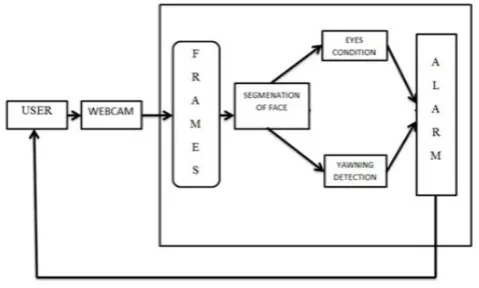
The general diagram of system has been shown in Fig. As it can be seen, the image received from camera is sent to central processor to be processed and then it will operate considering condition of drivers' face.
Fig 1: System Block Diagram
Description of Modules
Segmentation of face:
The face is segmented from the input image that is initially whatever the video that is recorded by the camera will be fragmented into the frames and this frames will be given as inputs for segmenting the face.
Eyes condition:
The position of the driver's eye is determined by using appropriate threshold. In this work, edge detection of the eyes region is considered.
Yawning Detection:
Among clustering methods used in segmentation of various parts of the image, the mean-based clustering was utilized for yawning detection. The objective function was to obtain then minimum distance between the classes, or basically between the image pixels.
System Implementation
Implementation is the stage of the project when the theoretical design is turned into a working system. Thus it can be considered as the critical stage in achieving a successful new system and in giving the user, confidence that the new system will work and be effective.
The implement stage involves careful planning, investigation of the existing system and its constraints on implementation, designing of methods to achieve change over and evaluation of change over methods.
IJSTMR © 2016 | All Rights Reserved 80
Segmentation of face:
This is the very first module in which the face is segmented from the input image that is initially whatever the video that is recorded by the camera will be fragmented into the frames and then into the image, this image will be given as input for segmenting the face.
The partial segmentation of the image by selecting the appropriate threshold is based on dividing the image into the background and foreground classes. Thresholding is primarily concerned with selecting an appropriate
threshold according to image histogram. That is, the value of thresholding or border as the brightness intensity is considered as the basis of the division and the brightness intensities greater and less than threshold is equal to 1 and zero respectively.
The purpose of face detection is to minimize the error rate in identifying facial expressions. The importance of this part is to measure the position of the eyes, the mouth and the head.
Fig 2: Face Detection for Keyless Authentication for Driver
Detection of eyes condition:
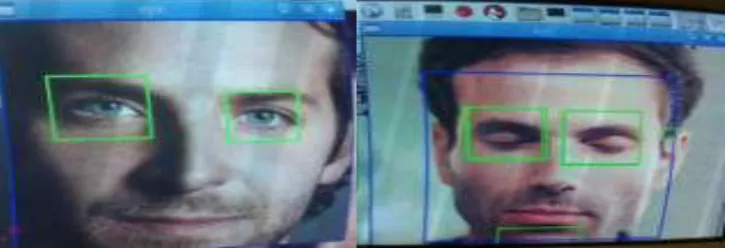
Important factor which helps detect driver fatigue is the state of eyes, i.e. whether they are open or closed. In the state of fatigue, eyelid muscles subconsciously attempt to accelerate the process of going to sleep. Using this property, determining whether eyes are open or closed is done by relying on the di_erence of brightness intensity of the pupil in the image and its symmetry. Locating the position of the eye in the frame taken from the drivers face is difficult. The position of the eye can be identified by drawing on geometry properties and symmetry. Edging is concerned with locating the position of areas or pixels where the brightness intensity has considerably increased. One of the effective operators for edge detection is the Sobel operator.
Fig 3: Eye Movement Detection for Open Eyes and Close Eyes for Drowsiness Detection
Yawning detection:
IJSTMR © 2016 | All Rights Reserved 81
CONCLUSION
The system proposed in this paper is acceptable level of performance and an average accuracy of 93.18 percentage. The high fatalities of road accidents, which is primarily due to human errors committed out of fatigue, justifies the use of this system to alarm drivers at the time of driving. High-speed data processing and great accuracy distinguish this system from the similar ones. The development and improvement of this system can save the lives of millions of people annually. The processing rate or framing of this camera is 15 fps and the _rst video sequence is related to the state where the head is in a lowered position which includes 85 sample frames. The second video sequence deals with the recording of the open or closed state of the eyes in which 48 image frames indicate that eyes are closed in a 6 seconds period while 65 frames show that the eyes are normally open. The third video sequence shows the yawning or the frequent opening of the driver's mouth. And _nally the fourth video sequence is a combination of all three modes and its recon ling takes a longer time. The average accuracy (AAC), the detection rate (DR) and false alarm rate (FAR) has been calculated. These three factors, which have been proposed for assessing the detection accuracy of the video sequence, indicate the acceptable performance of the proposed system in detecting the signs of fatigue in driver's face at the time of driving.
REFERENCE
1. C. C. Liu, S. G. Hosking, “Predicting driver drowsiness using vehicle measures, recent insights and future challenges”. J. Safety Res, 40(4),
pp 239-245.2009
2. PT. Azim, MA. Jaffar, AM Mirza, “Automatic Fatigue Detection of Drivers through Pupil Detection and Yawning Analysis.” In: Proc
Fourth International Conference on Innovative Computing, Information and Control 2009 pp.441-445.
3. R G Gonzales, and RE. Woods, “Digital Image Processing,”. Second Edition, Prentice Hall, 2002.
4. McKinsey, “Automatic Fatigue Detection of Drivers through Pupil Detection and Yawning Analysis.” tech.rep.
5. “Automatic eye detection using intensity and edge information"
6. “Government website to support entrepreneurs:http://msme.gov.in/mob/home.aspx."
7. A. Mercy Gnana Rani, Dr. A. Marimuthu, "Key Real-Time Warning System for Driver Drowsiness Detection Using Visual Information" ,in
Proc. Of IEEE Computing and Communication Technologies (WCCCT), 2014 World Congress, ISBN: 978-1-4799-2876-7.
8. R. Wei and Z. Zeng, "Real-Time system for monitoring driver vigilance," IEEE Transactions on Intelligent Transportation Systems", IACR
Cryptology ePrint Archive, 2010.
9. Abhinandan P Shirahatti, P S Khanagoudar, "Display driver drowsiness warning system”, in IMACST of NCACC-12 and NCETCT-2012,
VOLUME 3 NUMBER 3 JUNE 2012, pages: 161-171.
10. Li, H.;Yang, Y. ; Luan, T. ; Liang, X. ; Zhou, L. ; Shen, X., 'Predicting driver drowsiness using vehicle measures, recent insights and future
challenges",in Proc. Of IEEE Dependable and Secure Computing, IEEE Trans- actions on (Volume:PP , Issue: 99 ), ISSN : 1545-5971
,DOI: 10.1109/TDSC.2015.2406704 ,Date of Publication: 24 February 2015.
11. Ning Cao, Cong Wang, Ming Li, Kui Ren, and Wen-jing Lou."Privacy-Preserving Multi-keyword Ranked Search over Encrypted Cloud
Data"
12. Mohit Marwaha, Rajeev Bedi "Applying Encryption Algorithm for Data Security and Privacy in Cloud Computing" in IJCSI International
Journal of Computer Science Issues, Vol. 10, Issue 1, No 1, January 2013 ISSN (Print): 1694-0784, ISSN (Online): 1694-0814.
13. Rashmi Nigoti. Manoj Jhuria, Dr. Shailendra Singh," ADVANCE VEHICLE CONTROL AND SAFETY SYSTEM USING FACE
DETECTION" in IJETCAS ISSN(print):2279-0047 ,ISSN(online) :2279-0055.
14. Neha Tirthani, Ganesan R. "Data Security in Cloud Architecture Based on Di_eHellman and Elliptical Curve Cryptography."
15. Dr. L. Arockiam, S. Monikandan "Predicting driver drowsiness using vehicle measures, recent insights and future challenges" in IJARCCE