E x p l o i t i n g C o n t e x t u a l I n f o r m a t i o n in H y p o t h e s i s Selection for
G r a m m a r R e f i n e m e n t
T h a n a r u k T h e e r a m u n k o n g Y a s u n o b u K a w a g u c h i M a n a b u O k u m u r a J a p a n A d v a n c e d I n s t i t u t e o f J a p a n A d v a n c e d I n s t i t u t e o f J a p a n A d v a n c e d I n s t i t u t e o f
S c i e n c e a n d T e c h n o l o g y S c i e n c e a n d T e c h n o l o g y S c i e n c e a n d T e c h n o l o g y 1-1 A s a h i d a i T a t s u n o k u c h i 1-1 A s a h i d a i T a t s u n o k u c h i 1-1 A s a h i d a i T a t s u n o k u c h i
N o m i I s h i k a w a J a p a n N o m i I s h i k a w a J a p a n N o m i I s h i k a w a J a p a n
ping~j aist. ac. j
p
kawagut i©j aist. ac. j
p
oku~j aist. ac. j
p
A b s t r a c t
In this paper, we propose a new frame- work of grammar development and some techniques for exploiting contextual infor- mation in a process of grammar refine- ment. The proposed framework involves two processes, partial grammar acquisition
and grammar refinement. In the former
process, a rough grammar is constructed from a bracketed corpus. The grammar is later refined by the latter process where a combination of rule-based and corpus- based approaches is applied. Since there may be more than one rules introduced as alternative hypotheses to recover the anal- ysis of sentences which cannot be parsed by the current grammar, we propose a method to give priority to these hypotheses based on local contextual information. By experi- ments, our hypothesis selection is evaluated and its effectiveness is shown.
1 I n t r o d u c t i o n
One of the essential tasks to realize an efficient natural language processing system is to construct a broad-coverage and high-accurate grammar. In most of the currently working systems, such gram- mars have been derived manually by linguists or lexicographers. Unfortunately, this task re- quires time-consuming skilled effort and, in most cases, the obtained grammars may not be com- pletely satisfactory and frequently fail to cover many unseen sentences. Toward these problems, there were several attempts developed for automat- ically learning grammars based on rule-based ap- proach(Ootani and Nakagawa, 1995), corpus-based approach(Srill, 1992)(Mori and Nagao, 1995) or hy- brid approach(Kiyono and Tsujii, 1994b)(Kiyono and Tsujii, 1994a).
Unlike previous works, we have introduced a new framework for grammar development, which is a combination of rule-based and corpus-based ap- proaches where contextual information can be ex-
ploited. In this framework, a whole grammar is not acquired from scratch(Mori and Nagao, 1995) or an initial grammar does not need to be assumed(Kiyono and Tsujii, 1994a). Instead, a rough but effective grammar is learned, in the first place, from a large corpus based on a corpus-based method and then later refined by the way of the combination of rule- based and corpus-based methods. We call the former step of the framework partial grammar acquisition and the latter grammar refinement. For the partial grammar acquisition, in our previous works, we have proposed a mechanism to acquire a partial gram- mar automatically from a bracketed corpus based on local contextual information(Theeramunkong and Okumura, 1996) and have shown the effectiveness of the derived grammar(Theeramunkong and Oku- mura, 1997). Through some preliminary experi- ments, we found out that it seems difficult to learn grammar rules which are seldom used in the corpus. This causes by the fact that rarely used rules oc- cupy too few events for us to catch their properties. Therefore in the first step, only grammar rules with relatively high occurrence are first learned.
In this paper, we focus on the second step, gram- mar refinement, where some new rules can be added to the current grammar in order to accept un- parsable sentences. This task is achieved by two components: (1) the rule-based component, which detects incompleteness of the current grammar and generates a set of hypotheses of new rules and (2) the corpus-based component, which selects plausible hypotheses based on local contextual information. In addition, this paper also describes a stochastic parsing model which finds the most likely parse of a sentence and then evaluates the hypothesis selection based on the plausible parse.
2 T h e F r a m e w o r k o f G r a m m a r D e v e l o p m e n t
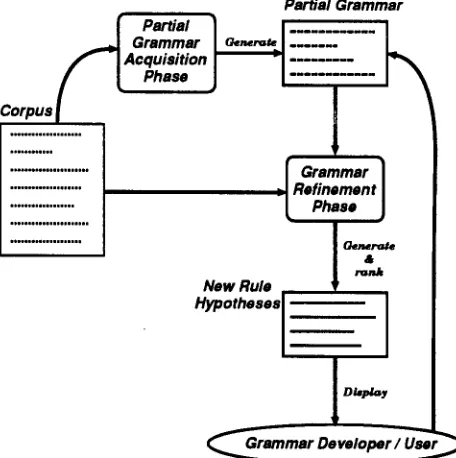
T h e proposed framework is composed of two phases: partial g r a m m a r acquisition and g r a m m a r refine- ment. The graphical representation of the frame- work is shown in Figure 1. In the process of g r a m m a r development, a partial g r a m m a r is automatically ac- quired in the first phase and then it is refined in the second phase. In the latter phase, the system generates new rules and ranks them in the order of priority before displaying a user a list of plausible rules as candidates for refining the g r a m m a r . Then the user can select the best one a m o n g these rules. Currently, the corpus used for g r a m m a r development in the framework is E D R corpus(EDR, 1994) where lexical tags and bracketings are assigned for words and phrase structures of sentences in the corpus re- spectively but no nonterminal labels are given.
Partial Grammar
[
P ,l 1
l
Grammar I ~ " ~ l ' - z ' - ' - ' - ' - ~ . . . ] Acquisition I
[
t'-" I
-I====:-
°":"':!
. . .1
. , o , . , ° ° o . o [image:2.612.90.318.287.516.2]. . .
[
Grammar... D I Refinement
... L Phase
:::::::7
I
|
New Rule Hypotheses
Do,,olomr
Figure 1: T h e overview of our g r a m m a r development framework
2.1 Partial G r a m m a r Acquisition
In this section, we give a brief explanation for par- tial g r a m m a r acquisition. M o r e detail can be found in (Theeramunkong and O k u m u r a , 1996). In par- tial g r a m m a r acquisition, a rough g r a m m a r is con- structed from the corpus based on clustering anal- ysis. A s mentioned above, the corpus used is a tagged corpus with phrase structures marked with brackets. At the first place, brackets covering a s a m e sequence of categories, are assumed to have a s a m e nonterminal label. W e say they have the s a m e bracket type. T h e basic idea is to group brack- ets (bracket types) in a corpus into a n u m b e r of
similar bracket groups. Then the corpus is auto- matically labeled with some nonterminal labels, and consequently a g r a m m a r is acquired. T h e similarity between any two bracket types is calculated based on divergencel(Harris, 1951) by utilizing local con- textual information which is defined as a pair of categories of words immediately before and after a bracket type. This approach was evaluated through some experiments and the obtained result was al- most consistent with t h a t given by h u m a n evalua- tots. However, in this approach, when the n u m b e r of occurrences of a bracket type is low, the simi- larity between this bracket type and other bracket types is not so reliable. Due to this, only bracket types with relatively frequent occurrence are taken into account. To deal with rarely occurred bracket types, we develop the second phase where the sys- t e m shows some candidates to g r a m m a r developers and then they can determine the best one a m o n g these candidates, as shown in the next section.
2.2 G r a m m a r R e f i n e m e n t w i t h A d d i t i o n a l H y p o t h e s i s R u l e
The g r a m m a r acquired in the previous phase is a partial one. It is insufficient for analyzing all sen- tences in the corpus and then the parser fails to produce any complete parse for some sentences. In order to deal with these unparsable sentences, we modify the conventional chart parser to keep record of all inactive edges as partial parsing results. T w o processes are provoked to find the possible plausible interpretations of an unparsable sentence by hypoth- esizing some new rules and later to add t h e m to the current g r a m m a r . These processes are (1) the rule- based process, which detects incompleteness of the current g r a m m a r and generates a set of hypothe- ses of new rules and (2) the corpus-based process, which selects plausible hypotheses based on local contextual information. In the rule-based process, the parser generates partial parses of a sentence as much as possible in b o t t o m - u p style under the g r a m - m a r constraints. Utilizing these parses, the process detects a complete parse of a sentence by starting at top category (i.e., sentence) covering the sentence and then searching down, in top-down manner, to the p a r t of the sentence t h a t cannot f o r m any parse. At this point, a rule is hypothesized. In m a n y cases, there m a y be several possibilities for hypothesized rules. T h e corpus-based process, as the second pro- cess, uses the probability information from parsable sentences to rank these hypotheses. In this research, local contextual information is taken into account for this task.
1 The effectiveness of divergence for detecting phrase
3 H y p o t h e s i s G e n e r a t i o n
When the parser fails to parse a sentence, there ex- ists no inactive edge of category S (sentence) span- ning the whole sentence in the parsing result. Then the hypothesis generation process is provoked to find all possible hypotheses in top-down manner by start- ing at a single hypothesis of the category S covering the whole sentence. This process uses the partial chart constructed during parsing the sentence. This hypothesis generation is similar to one applied in (Kiyono and Tsujii, 1994a).
[ H y p o t h e s i s g e n e r a t i o n ]
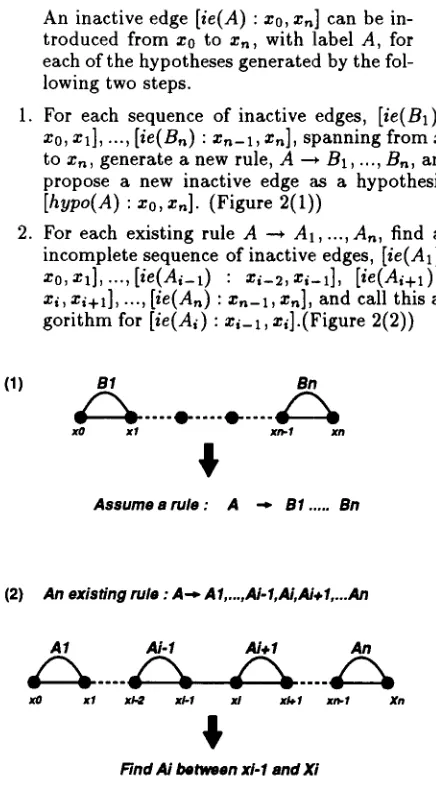
An inactive edge [ i s ( A ) : xo, xn] can be in- troduced from x0 to x , , with label A, for each of the hypotheses generated by the fol- lowing two steps.
1. For each sequence of inactive edges, [is(B1) :
xo, x l ] , ..., [ ie( B n ) : X n - l , agn ] , spanning from x0
to xn, generate a new rule, A ---, B z , ..., B n , and propose a new inactive edge as a hypothesis,
[ h y p o ( A ) : xo, xn]. (Figure 2(1))
2. For each existing rule A --+ A1, ..., An, find an incomplete sequence of inactive edges, [ie(A1) :
xo, x l ] , . . . , [ i e ( a i - 1 ) : xi-2, zi-1], [ i e ( A i + l ) :
xi, xi+l], ..., [ie(An) : x n - z , xn], and call this al- gorithm for [ i e ( A i ) : x l - z , xl].(Figure 2(2))
(1) B1 Bn
9 ~ D - . . . . e - . . . . e - . . . . ( ~ - ~
xO X l Xn. f x n
#
A s s u m e e r u l e : A ..~ B I ... Bn
(2) An existing rule : A.-~ A1,...,Ai-I, Ai, Ai+ I,...An
A1 Ai-1 Ai + l An
. . . . . . . .
. ~ x l x l , ~ xl-1 ~ x l . 1 x ~ 1 X n
#
Find Ai between xi-1 and Xi
Figure 2: Hypothesis Rule Generation
By this process, all of possible single hypotheses (rules) which enable the parsing process to succeed, are generated. In general, among these rules, most of them may be linguistically unnatural. To filter out such unnatural hypotheses, some syntactical crite- ria are introduced. For example, (1) the m a x i m u m
number of daughter constituents of a rule is limited to three, (2) a rule with one daughter is not pre- ferred, (3) non-lexical categories are distinguished from lexical categories and then a rule with lexical categories as its mother is not generated. By these simple syntactical constraints, a lot of useless rules can be discarded.
4 H y p o t h e s i s S e l e c t i o n w i t h L o c a l C o n t e x t u a l I n f o r m a t i o n
Hypothesis selection utilizes information from local context to rank the rule hypotheses generated in the previous phase. In the hypothesis generation, al- though we use some syntactical constraints to reduce the number of hypotheses of new rules that should be registered into the current grammar, there may still be several candidates remaining. At this point, a scoring mechanism is needed for ranking these can- didates and then one can select the best one as the most plausible hypothesis.
This section describes a scoring mechanism which local contextual information can be exploited for this purpose. As mentioned in the previous section, lo- cal contextual information referred here is defined as a pair of categories of words immediately before and after the brackets. This information can be used as an environment for characterizing a nonterminal category. T h e basic idea in hypothesis selection is that the rules with a same nonterminal category as their mother tend to have similar environments. Lo- cal contextual information is gathered beforehand from the sentences in the corpus which the current g r a m m a r is enough for parsing.
When the parser faces with a sentence which can- not be analyzed by the current grammar, some new rule hypotheses are proposed by the hypothesis gen- erator. Then the mother categories of these rules will be compared by checking the similarity with the local contextual information of categories gathered from the parsable sentences. Here, the most likely category is selected and that rule will be the most plausible candidate. The scoring function (probabil- ity p) for a rule hypothesis C a t ---* a is defined as follows.
p ( C a t --* ~) -" p ( C a t [ l , r) - g ( C a t , l, r)
N ( l , r) (1)
where N ( C a t , l, r) is the number of times that C a t
is occurred in the environment (l, r). I is the cat- egory immediately before C a t and r is the lexical category of the word immediately after C a t . N ( l , r) is the number of times that i and r are occurred immediately before and after any categories. Note that because it is not possible for us to calculate the probability of C a t ---+ ot in the environment of (l, r), we estimate this number by the probability that C a t
[image:3.612.55.273.229.623.2]5 T h e S t o c h a s t i c M o d e l
This section describes a statistical parsing model which finds the most plausible interpretation of a sentence when a hypothesis is introduced for recov- ering the parsing process of the sentence. In this problem, there are two components taken into ac- count: a statistical model and parsing process. The model assigns a probability to every candidate parse tree for a sentence. Formally, given a sentence S and a tree T, the model estimates the conditional probability
P(TIS).
The most likely parse under the model isargrnaxT P(TIS )
and the parsing process is a method to find this parse. In general, a model of a simple probabilistic context free g r a m m a r (CFG) applies the probability of a parse which is defined as the multiplication of the probability of all applied rules. However, for the purposes of our model where left and right contexts of a constituent are taken into account, the model can be defined as follows.P(T]S) =
H
p(rli, li, ri)
(2) (rl, ,I,,ri)ETwhere
rli
is an application rule in the tree and l~ andri
are respectively the left and right contexts at the place the rule is applied. In a parsing tree, there is a hypothesis rule for which we cannot calculate the probability because it does not exist in the current grammar. Thus we estimate its probability by using the formula (1) in section 4.Similar to most probabilistic models, there is a problem of low-frequency events in this model. Although some statistical NL applications apply backing-off estimation techniques to handle low- frequency events, our model uses a simple interpola- tion estimation by adding a uniform probability to every events. Moreover, we make use of the geomet- ric mean of the probability instead of the original probability in order to eliminate the effect of the number of rule applications as done in (Magerman and Marcus, 1991). The modified model is:
P(T]S)
=
(
H
(~*p(rl"l"r')+(1-c~)*N-'~))ff'I
(rll ,l, ,r~)ET
(3)
Here, o~ is a balancing weight between the observed distribution and the uniform distribution. It is as- signed with 0.8 in our experiments. Nrl is the num- ber of rules and Nc is the number of possible con- texts, i.e., the left and right categories. The applied parsing algorithm is a simple bottom-up chart parser whose scoring function is based on this model. A dynamic programming algorithm is used to find the Viterbi parse: if there are two proposed constituents which span the same set of words and have the same label, then the lower probability constituent can be safely discarded.6 E x p e r i m e n t a l E v a l u a t i o n
Some evaluation experiments and their results are described. For the experiments, we use texts from the EDR corpus, where bracketings are given. The subject is 48,100 sentences including around 510,000 words. Figure 3 shows some example sentences in the EDR corpus
(((ART," a" )((ADJ ," large" )(NOUN ,"festival" ))) ((VT,"held")(ADV,"biennially")))
( ( A O V , " a g a i n " ) ( ( P R O N , " h e " ) ( ( V T , " s a y s " ) ((P RON," he")((A DV," completely")
((VT,"forgot")((PaEe,"about")
( ( e a O i , " his" )(NOUN," homework" )))))))))
Figure 3: Some example sentences in the EDR cor- pus
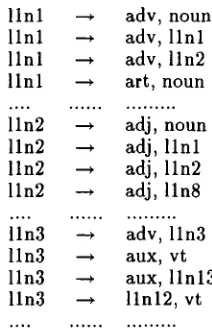
The initial g r a m m a r is acquired from the same corpus using divergence shown in section 2.1. The number of rules is 272, the m a x i m u m length of rules is 4, and the numbers of terminal and nonterminal categories are 18 and 55 respectively. A part of the initial grammar is enumerated in Figure 4. In the grammar,
llnl
is expected to be noun phrase with an article,lln2
is expected to be noun phrase without an article, andiln3
is expected to be verb phrase. Moreover, among 48,100 sentences, 5,083 sentences cannot be parsed by the grammar. We use these sentences for evaluating our hypothesis selection ap- proach.l l n l ---. adv, noun l l n l ---* adv, l l n l l l n l ~ adv, lln2 l l n l ---* art, noun
lln2 ---* adj, noun lln2 ---* adj, l l n l lln2 ---* adj, lln2 lln2 ~ adj, lln8
lln3 -* adv, lln3 lln3 ---* aux, vt lln3 ---* aux, l l n l 3 lln3 ---* l l n l 2 , vt
Figure 4: A part of initial g r a m m a r
6.1 T h e C r i t e r i o n
[image:4.612.384.490.440.604.2]Ranking A/all • At least one of the derivations inside the hy-
pothesis include the brackets which do not cross with those given in the corpus
• When the hypothesis is applied, it can be used to form a tree whose brackets do not cross with those given in the corpus.
6.2 H y p o t h e s i s L e v e l E v a l u a t i o n
From 5,083 unparsable sentences, the hypothesis generator can produce some hypotheses for 4,730 sentences (93.1%). After comparing them with the parses in the EDR corpus, the hypothesis sets of 3,127 sentences (61.5 %) include correct hypothe- ses. Then we consider the sentences for which some correct hypotheses can be generated (i.e., 3,127 sen- tences) and evaluate our scoring function in selecting the most plausible hypothesis. For each sentence, we rank the generated hypotheses by their prefer- ence score according to our scoring function. T h e result is shown in Table 1. From the table, even though only 12.3 % of the whole generated hypothe- ses are correct, our hypothesis selection can choose the correct hypothesis for 41.6 % of the whole sen- tences when the most plausible hypothesis is selected for each sentence. Moreover, 29.8 % of correct hy- potheses are ordered at the ranks of 2-5, 24.3 % at the ranks of 6-10 and just only 6.2 % at the ranks of more than 50. This indicates that the hypothesis se- lection is influential for placing the correct hypothe- ses at the higher ranks. However, when we consider the top 10 hypotheses, we found out that the accu- racy is ( 1 3 6 2 + 3 3 6 8 + 3 1 3 4 ) / ( 3 2 1 7 + 1 1 2 8 8 + 1 2 8 4 6 ) = 28.8 %. This indicates that there are a lot of hy- potheses generated for a sentence. This suggests us to consider the correct hypothesis for each sentence instead of all hypotheses.
Ranking
1
2-5 6-10
11-20
21-30 31-50 51- all
whole (A) hypotheses
3217 11288 12846 22105 17743 27001 102015 196214
correct (B) A / B hypotheses
1340 41.6% 3368 29.8% 3134 24.3% 4300 19.4% 2673 i5.0% 3033 11.2%
6315 6.2%
24203 12.3%
Table 1: Hypothesis Level Evaluation
6.3 S e n t e n c e L e v e l E v a l u a t i o n
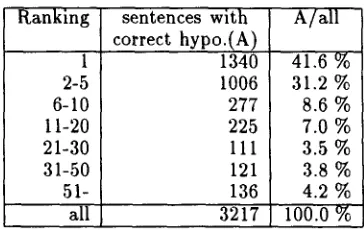
In this section, we consider the accuracy of our hy- pothesis selection for each sentence. Table 2 displays the accuracy of hypothesis selection by changing the number of selected hypotheses.
From the table, the number of sentences whose best hypothesis is correct, is 1,340 (41.6%) and we
1
2-5 6-10 11-20 21-30 31-50
51-
all
sentences with correct hypo.(A)
1340 1006 277 225 111 121 136
3217
41.6 % 31.2 % 8.6
%
7.0 % 3.5
%
3.8
%
4.2 % 100.0 %
Table 2: Sentence Level Evaluation
can get up to 2,623 (81.5%) accuracy when the top 10 of the ordered hypotheses are considered. T h e result shows that our hypothesis selection is effective enough to place the correct hypothesis at the higher ranks.
6 . 4 P a r s i n g E v a l u a t i o n
Another experiment is also done for evaluating the parsing accuracy. The parsing model we consider here is one described in section 5. T h e chart parser outputs the best parse of the sentence. This parse is formed by using g r a m m a r rules and a single rule hypothesis. T h e result is shown in Table 3. In this evaluation, the PARSEVAL measures as defined in (Black and et al., 1991) are used:
Precision :
number of correct brackets in proposed parses
Recall =
number of brackets in proposed parses
number of correct brackets in proposed parses number of brackets in corpus parses
From this result, we found out that the parser can succeed 57.3 % recall and 65.2 % precision for the short sentences (3-9 words). In this case, the aver- aged crossings are 1.87 per sentence and the number of sentences with less than 2 crossings is 69.2 % of the comparisons. For long sentences not so much ad- vantage is obtained. However, our parser can achieve 51.4 % recall and 56.3 % precision for all unparsable sentences.
7
D i s c u s s i o n a n d C o n c l u s i o n
[image:5.612.321.503.76.191.2] [image:5.612.65.276.484.602.2]Sent. Length Comparisons Avg. Sent. Len. Corpus Parses System's Parses Crossings/Sent. Sent. cross.= 0 Sent. cross.< 1 Sent. cross.< 2 Recall
Precision
3-9 1980
6.9 5.15 5.78
1.87
20.1% 43.9% 69.2% 57.3% 65.2%
3-15 3864 9.5 7.65 8.27 3.32 10.6% 25.0% 41.7% 53.2% 58.7%
10-19 2491
13.4 11.47 12.07 5.69 0.4% 3.9% 9.7% 47.3% 50.0%
all length 4730
10.8 8.95 9.57 4.18 8.9%
21.1% 35.1% 51.4%
56.3%
Table 3: Parsing Accuracy
(Pereira and Schabes, 1992)(Mort and Nagao, 1995). Through some experiments, our method can achieve effective hypothesis selection and parsing accuracy to some extent. As our further work, we are on the way to consider the correctness of the selected hy- pothesis of the most plausible parses proposed by the parser. Some improvements are needed to grade up the parsing accuracy. Another work is to use an existing grammar, instead of an automatically learned one, to investigate the effectiveness of con- textual information. By providing a user interface, this method will be useful for grammar developers.
A c k n o w l e d g e m e n t s
We would like to thank the EDR organization for permitting us to access the EDR corpus. Special thanks go to Dr. Ratana Rujiravanit, who helps me to keenly proofread a draft of this paper. We also wish to thank the members in Okumura laboratory at JAIST for their useful comments and their tech- nical supports.
R e f e r e n c e s
Black, E. and et al. 1991. A procedure for quantita- tively comparing the syntactic coverage of English grammars. In Proc. of the 1991 DARPA Speech
and Natural Language Workshop, pages 306-311.
Brill, Eric. 1992. Automatically acquiring phrase structure using distributional analysis. In Proc.
of Speech and Natural Language Workshop, pages
155-159.
Collins, Michael John. 1996. A new statistical parser based on bigram lexical dependencies. In Proc. of the 3~th Annual Meeting of the ACL, pages 184-191.
EDR: Japan Electronic Dictionary Research Insti- tute, 1994. EDR Electric Dictionary User's Man- ual (in Japanese), 2.1 edition.
Harris, Zellig. 1 9 5 1 . Structural Linguistics. Chicago: University of Chicago Press.
Kiyono, Masaki and Jun'iehi Tsujii. 1994a. Combi- nation of symbolic and statistical approaches for grammatical knowledge acquisition. In Proc. of 4th Conference on Applied Natural Language Pro-
cessing (ANLP'94), pages 72-77.
Kiyono, Masaki and Jun'ichi Tsujii. 1994b. Hy- pothesis selection in grammar acquisition. In
COLING-94, pages 837-841.
Magerman, D. M. and M. P. Marcus. 1991. Pearl: A probabilistic chart parser. In Proceedings of the European A CL Conference.
Magerman, David M. 1995. Statistical decision-tree models for parsing. In Proceeding of 33rd Annual
Meeting of the ACL, pages 276-283.
Mort, Shinsuke and Makoto Nagao. 1995. Parsing without grammar. In Proc. of the 4th Interna-
tional Workshop on Parsing Technologies, pages
174-185.
O o t a n i , K. and S Nakagawa. 1995. A semi- automatic learning method of grammar rules for spontaneous speech. In Proc. of Natural Language
Processing Pacific Rim Symposium'95, pages 514-
519.
Pereira, F. and Y. Schabes. 1992. Inside-outside reestimation from partially bracketed corpora. In Proceedings of 30th Annual Meeting of the ACL, pages 128-135.
Theeramunkong, Thanaruk and Manabu Okumura. 1996. Towards automatic grammar acquisition from a bracketed corpus. In Proc. of the 4th Inter-
national Workshop on Very Large Corpora, pages
168-177.
[image:6.612.141.498.77.206.2]